Anhui Feichun Special Cable Co.,Ltd Email: Li.wang@feichuncables.com
AS/NZS 2802 TYPE 441-LED Self-Powered Illuminated Mining Cable: Ultimate Visibility Solution for Underground Mining Applications in South Africa
Discover why the TYPE 441-LED illuminated mining cable is revolutionizing safety in South Africa's underground mines. Learn how its self-powered lighting system solves visibility issues in dark tunnels, drifts, and longwall faces, compared to traditional black cables. Full technical specifications, structural analysis, and comparison with standard TYPE 441 included. Introduction
Li Wang
4/24/202613 min read
Introduction
Modern mining operations rely heavily on the efficient and safe distribution of electrical power. In underground environments, where natural light is non-existent and conditions are often harsh, cables serve as the lifelines that keep machinery running and operations moving. However, these essential components also present significant challenges, particularly regarding visibility and safety.
South Africa is home to some of the deepest and most complex mining operations in the world. The geology and extraction methods used here create unique working environments characterized by narrow tunnels, heavy machinery, and constantly changing layouts. In these settings, traditional trailing cables—usually manufactured with dark rubber sheaths for durability—often blend seamlessly into the background, effectively becoming "invisible" hazards.
This article explores the critical safety issues associated with low visibility in underground operations, analyzes the limitations of current solutions, and introduces the AS/NZS 2802 TYPE 441-LED Self-Powered Illuminated Mining Cable. We will examine how this innovative technology actively addresses these dangers, providing a detailed technical breakdown of its construction, working principles, and why it represents the perfect solution for the South African mining industry.
Characteristics of South African Underground Mining Environments
To understand the necessity for specialized cables, one must first understand the environment in which they operate. South African mines, whether involved in gold, platinum, or coal extraction, present a demanding landscape.
Underground Roadways and Tunnels
These are the main arteries of the mine. They are often narrow with low ceilings, creating confined spaces where personnel, vehicles, and equipment must coexist. Lighting is provided by artificial sources, which can create deep shadows and glare, making it difficult for the human eye to adjust and detect objects at distances.
Cross-Cuts (Drifts)
Cross-cuts are the tunnels that connect the main shafts to the mining panels. These areas are typically high-traffic zones where cables are frequently laid across walkways or dragged along the floor. The intersection of multiple routes increases the likelihood of cables becoming tangled or placed in unexpected positions, raising the risk of trips and falls.
Longwall Mining Faces
In longwall operations, space is extremely limited. The shearer moves back and forth along the face, with the trailing cable constantly being reeled and unreeled. Dust levels are high, and water spray is often used to suppress dust and cool equipment, further reducing visibility. In this dynamic environment, a cable that is hard to see can be easily snagged, crushed, or run over by the advancing machinery.
Lighting Conditions
The fundamental challenge across all these areas is the total reliance on artificial lighting. Dust particles suspended in the air scatter light, reducing its effective range. Wet rock surfaces create reflections that obscure vision, and shadows cast by machinery can hide cables completely.
The "Invisible" Threat: Why Traditional Cables Are Dangerous
Standard mining cables are designed primarily for mechanical robustness and electrical insulation. The outer sheath is typically made of black or very dark colored elastomers because these compounds offer excellent resistance to abrasion, oil, and chemicals. While this color choice is practical for durability, it creates a significant safety paradox: the cable is designed to survive the environment, but in doing so, it becomes almost impossible to see within it.
Trip and Fall Hazards
When a cable lies on the floor of a drift or tunnel, its dark color merges with the rock and shadows. Workers walking or operating machinery often do not see the cable until they are very close, or not at all. Tripping over trailing cables is a common cause of injury in mines, leading to sprains, fractures, or more severe accidents if the worker falls into machinery or onto sharp objects.
Maintenance Difficulties
Routine inspection is vital for cable safety. Engineers need to check for signs of wear, crushing, or damage to the sheath. With a black cable, this requires close physical inspection and good lighting. In areas where light is poor or access is difficult, potential faults can be missed, leading to insulation failures or electrical faults.
Operational Risks
Mobile equipment such as loaders, shuttle cars, and continuous miners must move over and around cables. If the operator cannot clearly distinguish the cable path, there is a high risk of the vehicle running over the cable. Repeated crushing flattens the cable, damages the conductors, and can eventually lead to short circuits or earth leaks, stopping production and creating dangerous electrical situations.
Current Visibility Solutions and Their Limitations
The mining industry has long recognized the visibility problem, and various methods have been employed over the years to try and mitigate it. However, most of these solutions are passive and suffer from inherent limitations.
Existing Methods to Improve Cable Visibility
Colored Tape or Paint
One of the simplest methods is to wrap bright colored tape around the cable at intervals or paint sections of the sheath. While this initially increases visibility, it is not a durable solution. The harsh underground environment quickly takes its toll. Abrasion against rock and steel structures scrapes paint off, and adhesive tapes peel away due to moisture, oil, and constant flexing. This means the maintenance team must constantly reapply these markings, consuming time and resources.
Reflective Strips
Some cables are manufactured with reflective tapes or stripes embedded or wrapped onto the surface. These work by reflecting light from headlamps or vehicle lights back to the source. While better than nothing, reflective materials have a major drawback: they only work effectively when the light source is directly in line with the observer’s eyes. If the light hits the cable at an angle, or if the observer is looking from the side, the reflection is minimal or non-existent. Furthermore, reflective strips are often the first part of the cable to wear away, leaving the cable invisible again.
Surface Markings
Extruded colored stripes or lettering on the sheath provide a more permanent marking than tape, but they still rely on ambient light to be seen. In very low light or dusty conditions, even bright yellow or orange rubber can appear dark grey, offering little contrast against the mine floor.
Why Current Solutions Are Not Perfect
The fundamental issue with all the above methods is that they are passive. They do not generate their own light; they merely attempt to reflect or contrast with existing light. In an environment where light is scarce, scattered, and shadowed, passive systems struggle to provide adequate warning.
They also introduce reliability issues. When a marking wears off, the safety feature is lost, but the cable remains in service. This creates a false sense of security. Workers may assume a cable is visible when, in fact, the markings have been damaged or worn smooth by use.
Additionally, none of these traditional methods provide any indication of the cable's internal health. A cable can be severely crushed or kinked internally while the outer markings still look intact, giving no warning of impending failure. The industry clearly requires a solution that is active, integrated, maintenance-free, and capable of providing more than just positional information.
AS/NZS 2802 TYPE 441-LED Cable
What is TYPE 441-LED Self-Powered Illuminated Cable?
The AS/NZS 2802 TYPE 441-LED represents a paradigm shift in cable safety technology. It is not simply a standard cable with lights added; it is an integrated system designed from the ground up to combine heavy-duty performance with active illumination.
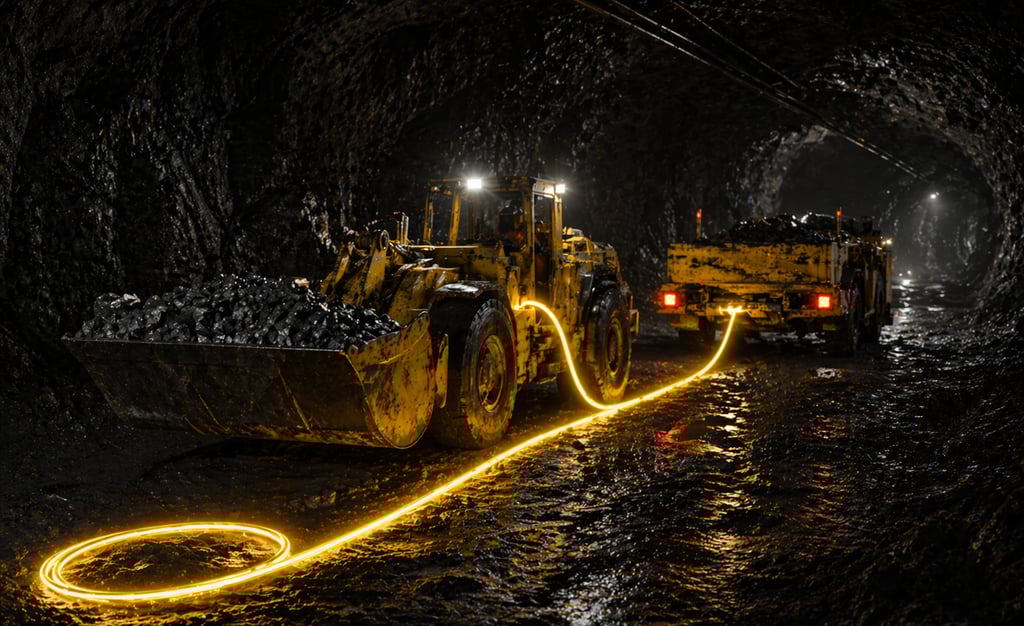
Designed specifically for trailing and reeling applications—such as those found on longwall shearers, stackers, reclaimers, and various mining machinery—this cable performs all the functions of a standard power and control cable, but with the added capability of lighting up along its entire length.
The term "Self-Powered" is key here. The illumination system draws the small amount of energy it needs directly from the power conductors within the cable itself. This means there is no need for separate power supplies, additional wires, or external batteries. As long as the cable is energized, it remains illuminated.
Decoding the Model Name: What Does "TYPE 441-LED" Mean?
Understanding the nomenclature helps engineers and buyers ensure they are selecting the correct product for their application.
AS/NZS 2802
This refers to the Australian/New Zealand Standard for "Flexible cables for mining and quarrying purposes." This standard is recognized globally for its rigorous testing requirements and is highly respected in the industry, particularly in regions that adopt Commonwealth standards, including many parts of Africa. It specifies requirements for construction, electrical characteristics, and mechanical resilience.
TYPE 441
Within the AS/NZS 2802 standard, Type 441 designates a specific construction style. It defines a cable with elastomer insulation and an elastomer sheath, designed specifically for heavy-duty trailing applications. These cables are expected to withstand repeated bending, twisting, dragging, and exposure to harsh chemicals and temperatures.
LED
This suffix indicates the integration of Light Emitting Diodes and the necessary circuitry to power them. It signifies that the cable is not just colored or reflective, but actively luminous.
Self-Powered
This describes the ingenious electrical design. The system utilizes the electrical field or taps minimal current from the main cores to energize the LEDs. This ensures the lighting function is always synchronized with the cable's operational status.
Technical Specifications and Construction
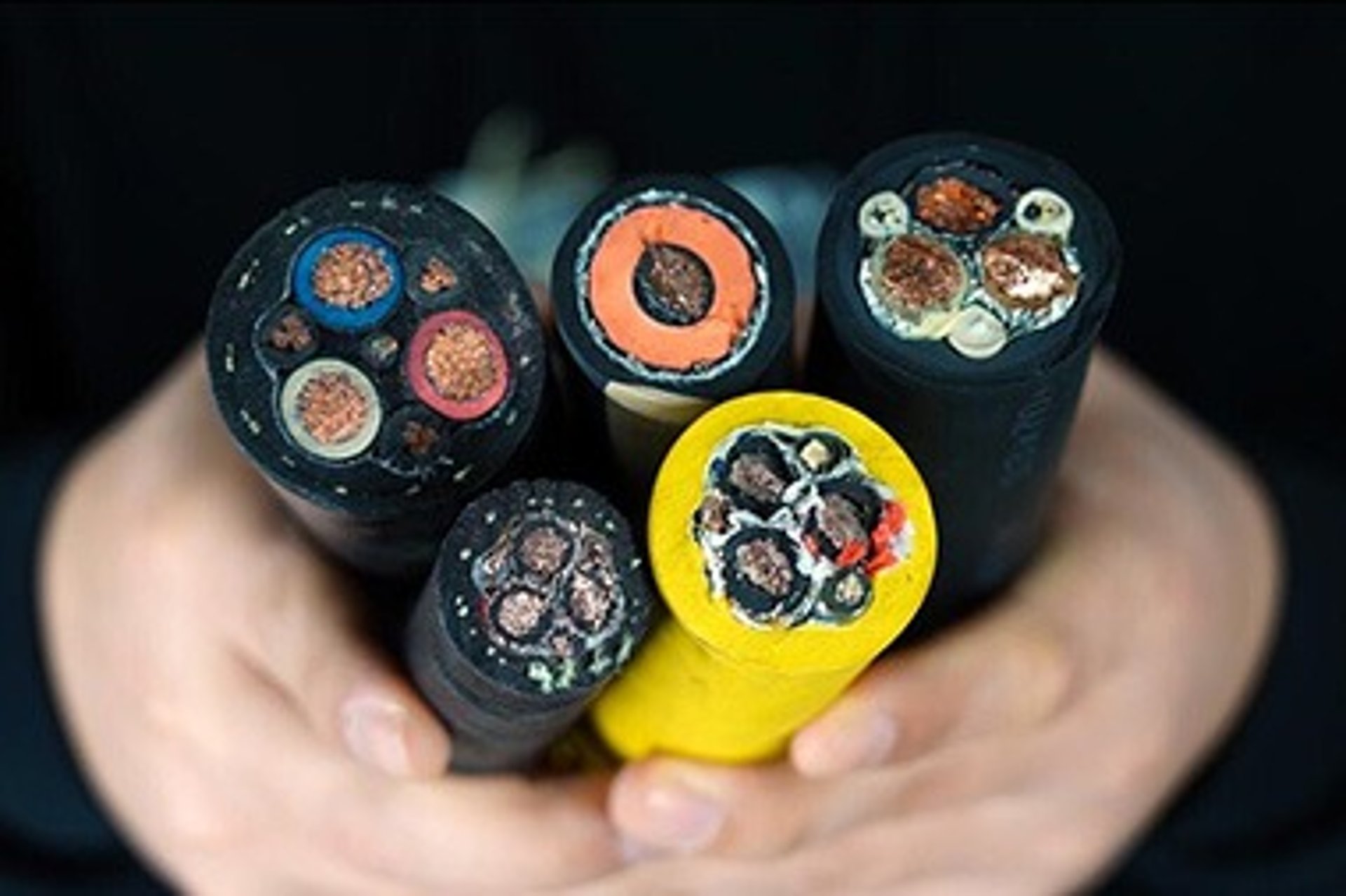
The performance of the TYPE 441-LED cable relies on a sophisticated multi-layer structure. Every component is selected to contribute to both the electrical performance and the mechanical durability required in mining.
Full Standard Specifications
While specific dimensions can vary based on the required voltage and current capacity, the TYPE 441-LED adheres to the strict electrical and mechanical parameters set out in the standard.
Voltage Rating: Typically manufactured in ratings such as 0.66/1.14kV or 3.3/6.6kV, suitable for both power and control circuits.
Conductor: High conductivity copper, finely stranded to ensure maximum flexibility.
Insulation: High-grade EPR (Ethylene Propylene Rubber) or similar elastomer, providing excellent dielectric strength and thermal resistance.
Sheath: Heavy-duty rubber compound offering high resistance to abrasion, tear, flame, and oil.
Operating Temperature: Designed to function reliably across a wide temperature range suitable for underground environments.
Material Structure Analysis
The construction of the cable is a marvel of engineering, balancing electrical integrity with mechanical toughness and the new functionality of illumination.
Conductor
The heart of the cable is the conductor. Using multiple thin strands of annealed copper allows the cable to bend repeatedly without fatiguing or breaking, which is essential for reeling applications. The stranding configuration ensures high flexibility while maintaining low electrical resistance.
Insulation
Extruded insulation provides the electrical separation between cores. The material chosen must withstand the voltage stresses and temperature rises during operation. In TYPE 441 cables, this insulation is designed to be tough enough to withstand the physical pressures of being dragged and crushed.
Bedding and Reinforcement
Layers of tapes or braids may be applied to bind the cores together and provide additional mechanical protection, ensuring that the internal structure remains stable during movement.
The Innovation Layer: Lighting Integration
This is where the TYPE 441-LED differs fundamentally from standard cables. The LED elements and their connecting lines are integrated into the cable structure, usually placed just beneath the outer sheath or within a dedicated groove. This placement protects the lighting components from direct abrasion while allowing the light to shine through the outer jacket.
Outer Sheath
The final layer is a robust elastomer sheath. Crucially, this sheath is formulated to be translucent or semi-transparent in the areas covering the LEDs, allowing the light to diffuse outwards effectively while still providing a thick, protective barrier against the outside environment. The material is resistant to the oils, chemicals, and moisture commonly found in mines.
Core Innovation and Working Principles
The true value of this cable lies in how it operates and the benefits it delivers beyond simple power transmission.
How Does It Work?
The Self-Powered Mechanism
The most impressive feature is the power harvesting technology. The system is designed to extract a tiny fraction of electrical energy from the main power conductors. This can be achieved through inductive coupling or direct tapping methods designed to have zero negative impact on the main power supply. Because the power requirement for LEDs is extremely low, this is highly efficient.
Continuous Illumination
Once the main circuit is energized, the LEDs activate immediately. They are spaced at precise intervals along the entire length of the cable. This creates a continuous line of light that clearly defines the cable's path. Unlike flashlights or fixed lamps, the light moves with the cable.
Low Energy Consumption
The power draw of the LED system is negligible compared to the cable's load capacity. It operates with high efficiency, generating very little heat and ensuring that there is no wastage of energy or reduction in the cable's current carrying capacity.
Key Advantages
360-Degree Visibility
Because the cable emits its own light, it is visible from any angle, regardless of the direction of other light sources. Whether a worker is looking straight at it, or from the side, the glowing line is immediately apparent. In pitch-black tunnels, this makes the cable stand out vividly against the rock and dust.
Intelligent Damage Detection
This is perhaps the most critical safety feature. The LEDs are connected in sequence. If the cable is severely crushed, kinked, or cut, the electrical path for the LEDs is interrupted. This causes the lights beyond the point of damage to go out. To an observer, this appears as a dark section in the glowing line. It provides an instantaneous, visual warning that the cable has suffered mechanical damage and requires immediate attention, long before an electrical fault might occur.
Increased Operational Safety
By clearly marking the cable path, trips and falls are drastically reduced. Machine operators can see the cable easily, avoiding running over it or snagging it during maneuvers. This protects both the personnel and the expensive equipment.
Durability and Low Maintenance
Since the lighting system is built into the cable structure, it cannot be worn off, peeled off, or washed away. It is as durable as the cable itself. There are no stickers to replace or paint to reapply, reducing the total cost of ownership.
Easy Installation
From an engineering perspective, the cable behaves exactly like a standard TYPE 441 cable. It has the same bending radius, the same outer diameter, and the same handling characteristics. It connects to standard equipment. There is no need for special training, extra controllers, or complicated wiring diagrams to use it.
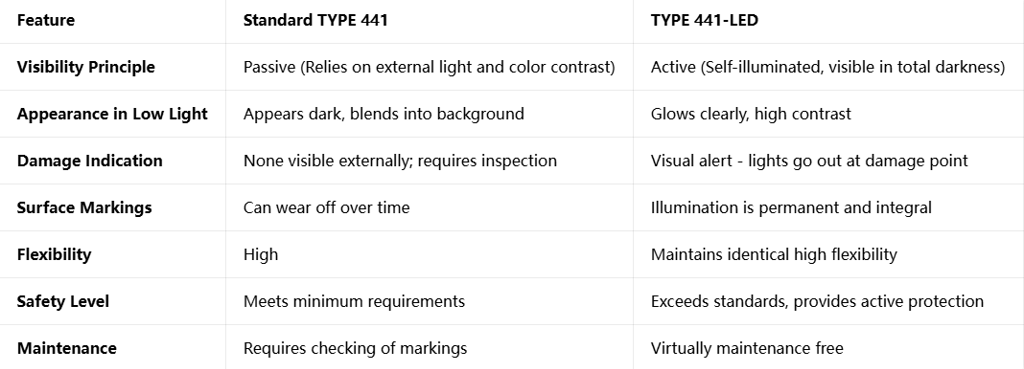
TYPE 441-LED vs. Standard TYPE 441
To fully appreciate the advancement, it is useful to compare the illuminated version directly against the traditional product.
This comparison clearly shows that while the standard cable fulfills the basic requirement of carrying power, the TYPE 441-LED adds a layer of intelligence and safety that transforms it from a simple component into an active safety device.
Why It Is The Perfect Solution For South African Mining
South Africa’s mining industry faces specific challenges that make this technology not just beneficial, but almost essential.
Adaptation to Local Conditions
South Africa is famous for its deep-level mining. As depth increases, the physical environment becomes more constrained, and lighting conditions become more difficult. The geology often results in narrower stopes and tunnels, leaving less room for error in cable management.
The TYPE 441-LED is perfectly suited for these conditions. In the narrow reef mining typical of gold mines, or the complex board and pillar systems used in other commodities, the ability to see the cable instantly prevents accidents. It is also ideal for the country's extensive coal operations, particularly in longwall mining where cable visibility and condition monitoring are paramount.
Furthermore, safety regulations in South Africa are stringent. Mine operators are constantly looking for technologies that can improve their safety stats and comply with the Mine Health and Safety Act. Implementing visible cables is a direct and effective way to demonstrate a commitment to reducing hazards.
Economic and Efficiency Benefits
Beyond safety, there are strong commercial arguments for adopting this cable. Accidents cause downtime. Trips and falls lead to lost time injuries and production stops. Cable damage caused by being run over requires repairs or replacement, which are costly.
By preventing these incidents, the TYPE 441-LED pays for itself. The damage detection feature also allows for preventative maintenance. Instead of waiting for a cable to fail and cause an outage, maintenance teams can identify a crushed section early and replace or repair it during planned shutdowns. This reliability translates directly into higher productivity and lower operational costs.
Application Fields
The versatility of the TYPE 441-LED cable allows it to be used across a wide range of mining and industrial applications where visibility and safety are concerns.
Longwall Mining Systems
This is arguably the most demanding application. The cable follows the shearer along the face. The illumination allows operators to see the cable position at all times, and the fault detection warns immediately if the chain or machine has impacted the cable.
Development Mining
In tunneling and development work, the environment is raw and lighting is often temporary. Illuminated cables ensure that power lines remain visible even in newly excavated areas where permanent lighting has not yet been installed. They remain visible even amidst the dust and chaos of blasting and mucking operations.
Mobile Equipment
Load haul dump vehicles (LHDs), shuttle cars, and continuous miners rely on flexible trailing cables. In these applications, the cable is constantly moving and being dragged across uneven ground. The glowing line helps operators track the cable route, preventing it from being caught on protrusions or run over by the tracks.
Reeling Drums and Cable Carriers
For equipment where the cable is wound onto drums or dragged through chains, visual inspection of the condition is difficult. The LED system allows maintenance staff to instantly see if the cable is winding correctly or if any section has become twisted or damaged within the system.
Hazardous Area Crossing
Where cables must pass across walkways, haul roads, or access points, the illumination acts as a permanent warning beacon, clearly marking the obstacle to all traffic, whether pedestrian or vehicular.
Frequently Asked Questions
Is the lighting system waterproof and dustproof?
Yes, absolutely. The entire lighting assembly is encapsulated within the cable structure. The outer sheath provides a continuous barrier that is impervious to water, mud, and dust. The cable is designed to the same ingress protection standards as conventional mining cables, ensuring reliability even when submerged or operating in wet tunnels.
Does the LED system affect the cable's bending radius or flexibility?
This is a common concern, but the design ensures there is no compromise. The LED elements and their connecting wires are designed to be extremely flexible and are integrated into the cable core in a way that maintains the overall roundness and flexibility. The cable can be bent, twisted, and reeled exactly like a standard TYPE 441 cable without affecting the lighting function.
What is the lifespan of the LEDs?
Light Emitting Diodes are renowned for their longevity. Under normal operating conditions, the lifespan of the LEDs used in these cables exceeds 50,000 to 100,000 hours. This effectively means the lighting system will last for the entire service life of the cable, assuming the cable is not subjected to abuse beyond its design limits.
Can it be used in explosive environments?
The cable is designed to comply with mining safety standards. The low voltage and low energy nature of the LED circuit means it does not pose an ignition risk. However, specific certification for gaseous environments should always be checked against the product datasheet, as requirements can vary slightly between different mining regions and commodities.
How does the self-powered feature work exactly?
The technology works by utilizing the electrical potential or electromagnetic field present around the energized conductors. A specially designed circuit extracts just enough energy—measured in milliwatts—to light the series of LEDs. This draw is so minimal that it has absolutely no measurable effect on the power delivery to the machinery or the efficiency of the system.
Conclusion
The challenges of visibility in underground mining are not new, but they have often been accepted as an unavoidable part of the job. Workers have learned to adapt to the dark, and companies have accepted the costs associated with trips, falls, and cable damage. However, the introduction of the AS/NZS 2802 TYPE 441-LED Self-Powered Illuminated Mining Cable changes this dynamic completely.
By transforming the cable from a passive, often invisible component into an active safety device, we address the root cause of many accidents. The ability to see the cable clearly in total darkness, combined with the intelligent feature of going dark when damaged, provides a level of safety and situational awareness that was previously impossible to achieve.
For the South African mining industry, operating in some of the most challenging conditions on earth, this technology offers more than just compliance. It offers a way to significantly reduce risk, improve operational efficiency, and most importantly, protect the lives of those working underground. It represents a smart investment in safety, reliability, and future-proofing mining operations.
Ready to upgrade your mine safety standards?
The AS/NZS 2802 TYPE 441-LED cable is available now. For detailed technical datasheets, samples, or pricing inquiries, please contact the Feichun Team today.
📧 Email: Li.wang@feichuncables.com
We look forward to supporting your operations with safer, smarter cable solutions.
Email Address: Li.wang@feichuncables.com
© 2025. All rights reserved.
One-click to Quickly Contact
Products
Contact
Company
Location:
Building A Private Science and Technology Park, Hefei Economic and Technological Development Zone, Anhui Province, China
Heat Resistant Cable
WhatsApp: +86 17333223430
Social Media: