Anhui Feichun Special Cable Co.,Ltd Email: Li.wang@feichuncables.com
AS/NZS 2802 Type 450 3.3–33 kV Reeling Cable: Lightweight, Flexible EPR Design for South African Mining Heavy Equipment
AS/NZS 2802 Type 450 3.3–33 kV reeling cables are Class 1 lightweight medium‑voltage cables engineered for South African open‑pit mines. This guide explains their construction with EPR insulation, composite screening and XHD reinforced sheath, performance advantages, use on electric shovels, drills, conveyors and slow‑reeling machines, technical specifications, selection, procurement and why Feichun offers a cost‑effective, fully compliant alternative.
Li.Wang
5/22/202615 min read
Introduction
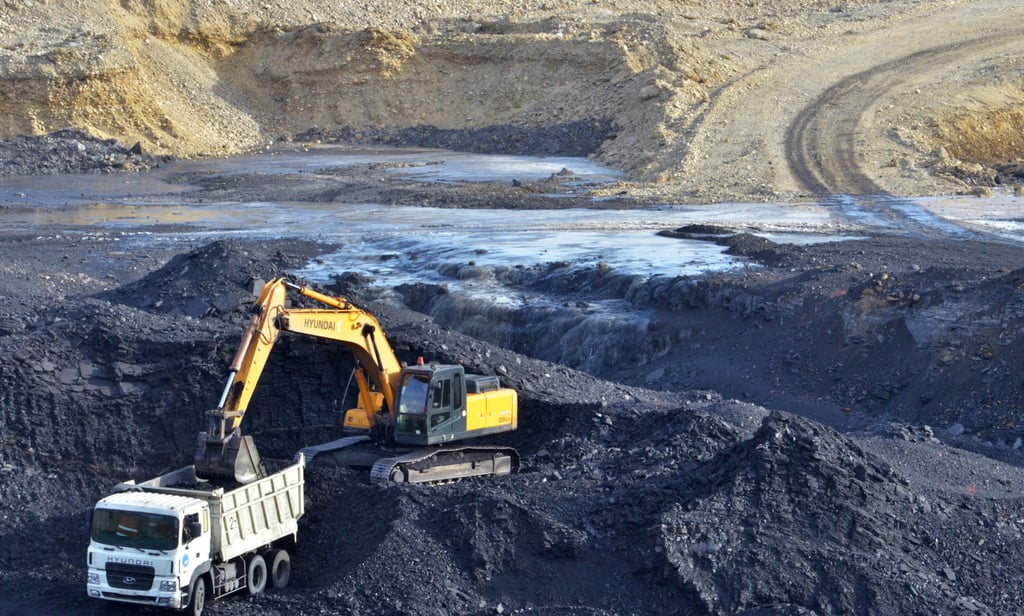
South Africa stands as one of the world’s most important mining regions, with vast open‑pit operations extracting gold, platinum, coal, iron ore and manganese across provinces like Limpopo, Mpumalanga and the Northern Cape. These mines operate in some of the most demanding environments on earth: extreme heat, intense sunlight, heavy rain, dust, rock impact, and continuous mechanical stress. The equipment used here is massive — electric shovels, draglines, blast hole drills, stacker‑reclaimers and overland conveyors — all requiring reliable, high‑voltage power that can move with the machine.
Powering these machines is not like fixed industrial installations. Every piece of heavy machinery moves, rotates, climbs, extends or travels long distances, and the power cable must follow, winding onto reels, bending, twisting, dragging and suspending, all while delivering up to 33,000 volts safely and without failure. In this environment, a cable failure does not just mean a repair cost; it means lost production that can run into millions of Rands per day.
This is exactly the application for which AS/NZS 2802 Type 450 3.3–33 kV reeling cable was designed. Developed under the joint Australian‑New Zealand standard AS/NZS 2802, widely adopted across Southern Africa, this cable represents a carefully engineered balance of high‑voltage safety, light weight, small diameter, flexibility and extreme durability. It has become the standard choice for open‑pit mining operations throughout the region.
This article explains everything you need to know: how South African mining equipment operates and what it demands, why Type 450 is uniquely suited, the engineering and materials that make it work, its full specifications, how to select the right version, how to source it, and why Feichun Cables offers an equivalent, high‑performance alternative with better value and faster delivery.
Understanding the Standard: AS/NZS 2802 and Type 450 Classification
To understand this cable, we first look at the standard that defines it. AS/NZS 2802:2000+A1 is the joint Australian/New Zealand Standard for Reeling and Trailing Cables for Mining and General Use. It sets out requirements for design, materials, testing and performance, and is recognised and specified by every major mining house and engineering consultancy in South Africa, Botswana, Namibia and Zambia.
Within this standard, cables are divided into two main classes:
Class 1: Reduced insulation and sheath thickness, optimised for lower weight and smaller outer diameter, while maintaining full safety margins. Type 450 falls into this class.
Class 2: Heavier, thicker construction, for the most severe mechanical abuse or very long life requirements. This includes Type 455 and Type 409.
The name Type 450 refers to the specific construction design within the standard. The suffix indicates voltage rating:
Type 450.3 → 3.3/3.3 kV
Type 450.6 → 6.6/6.6 kV
Type 450.11 → 11/11 kV
Type 450.22 → 22/22 kV
Type 450.33 → 33/33 kV
This covers exactly the voltage levels used in South African mine distribution systems, from medium‑voltage local distribution up to the high‑voltage feeders for the largest machines.
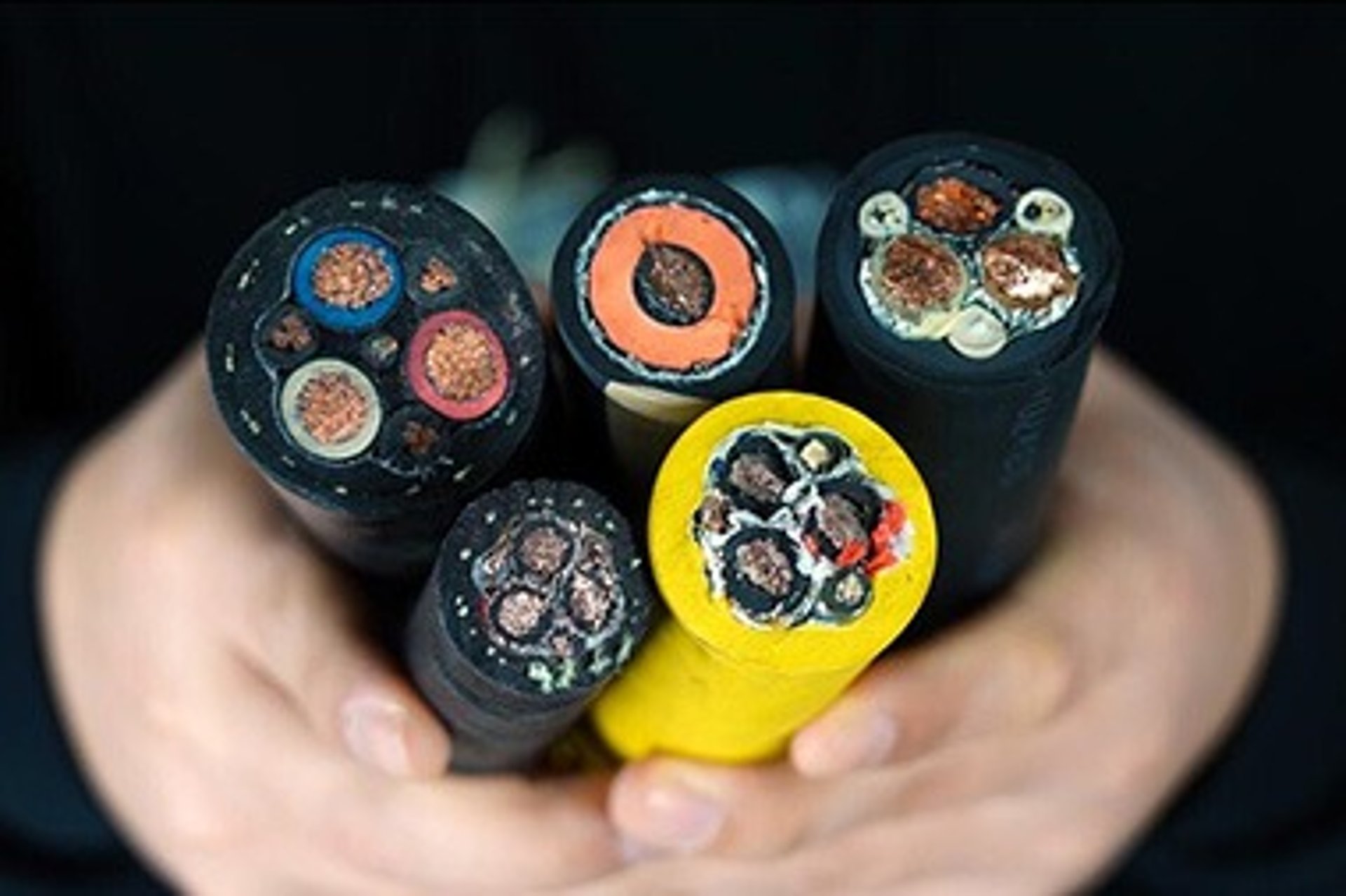
Type 450 is defined as a 3‑core composite screened cable with two earth cores and one pilot core, all positioned in the interstices (gaps) between the power cores. This layout is fundamental to its performance — it keeps the overall diameter compact while integrating all necessary functions: power, safety earthing, and continuous monitoring.
Compliance also extends to supporting standards: conductor design follows AS/NZS 1125, material specifications to AS/NZS 3808, and test methods to AS/NZS 5000.1. When you specify AS/NZS 2802 Type 450, you are specifying a fully tested, proven system recognised throughout the industry.
South African Mining Operations and Equipment
To see why Type 450 is so important, we must look closely at the machines it powers and how they operate in South African conditions. Every type of equipment creates unique demands on the power cable.
Electric Shovels and Draglines
These are the giants of the mine. An electric shovel typically has a bucket capacity of 15 to 60 cubic metres, weighs over 1,000 tonnes, and draws between 5 and 15 megawatts of power. It rotates 360 degrees, travels across uneven ground, climbs benches, and extends its boom up to 100 metres. The cable is stored on a large reel at the rear or base, winding and unwinding constantly as the machine moves.
In South African hard‑rock mines, these machines operate 24 hours a day, 365 days a year. The cable must handle continuous bending, twisting, tension from its own weight, and occasional impact from falling rock or vehicle contact. Traditional heavy‑duty cables are large and heavy — sometimes up to 25 % heavier than Type 450. This places enormous load on the reel drive motor, increases energy consumption, and makes maintenance difficult. The smaller diameter also allows a shorter bend radius, reducing fatigue failure.
For draglines, which may have a reach of over 150 metres, the cable hangs in a long loop. Weight becomes critical — every extra kilogram per metre adds significant suspended load, increasing stress on both cable and machine structure. Here, the lightweight design of Type 450 is not just a convenience; it is an operational necessity.
Blast Hole Drills
Drills are used to bore holes 200 to 400 mm in diameter and 30 to 80 metres deep for blasting. A large drill weighs over 150 tonnes, moves slowly along the mine bench, and must position itself precisely. Power is usually 6.6 kV or 11 kV. The cable runs along the crawler tracks or up the mast, where space is very limited.
South African mines often drill in hot, dusty conditions with oil and chemical exposure. The cable must be flexible enough to handle frequent direction changes and vibration, while its screening system prevents electrical noise from interfering with sensitive positioning and control electronics. The compact outer diameter of Type 450 makes it much easier to route in tight spaces compared to larger cables.
Overland Conveyors, Stackers and Reclaimers
These systems move millions of tonnes of ore and waste every day. Conveyors can stretch for kilometres, with mobile heads and tails that travel along rails. Stackers and reclaimers stockpile or recover material, moving slowly — typically less than 15 metres per minute. This is the classic slow‑reeling application for which Type 450 is optimised.
Here, the cable is subjected to long‑term cyclic bending, tension from its own weight, and constant exposure to intense UV radiation, heat, and rain. In many South African coal mines, these systems operate right on the open highveld, with no shelter. The cable must last 8 to 12 years or more with minimal maintenance.
Type 450’s reinforced sheath and high‑quality materials provide exceptional weather and ageing resistance. Its light weight reduces tension on the cable guides and reel, while the integrated pilot core allows continuous monitoring of insulation health — critical when the cable is hundreds of metres long and hard to inspect.
Excavators and Material Handling Cranes
Smaller but still powerful, these machines work in confined areas, around dumps, or loading ships. They change direction constantly, operate in tight spaces, and require cables that are easy to handle and bend sharply without damage. The smaller bend radius and flexibility of Type 450 are major advantages here, allowing installation where heavier cables simply will not fit.
Summary of Environmental and Operational Challenges
From these examples, we can list exactly what the cable must survive in South Africa:
Mechanical: Tension, compression, abrasion, tearing, impact, repeated bending and twisting.
Environmental: Continuous UV exposure, temperature extremes from -10 °C to +50 °C, immersion in water, exposure to mine water, acids, alkalis, oils and dust.
Electrical: Safe operation at up to 33 kV, low capacitance to manage reactive power, reliable earthing, and protection against electromagnetic interference.
No cable works perfectly everywhere, but Type 450 was designed to balance all these factors better than any other available option.
Core Advantages of AS/NZS 2802 Type 450
The key value proposition of Type 450 — and the reason it is preferred in South Africa — is clear: it meets all high‑voltage safety requirements while being significantly lighter, having a smaller outer diameter, and being more flexible, making it ideal where space is tight or mobility is critical. These are not minor differences; they translate directly into operational benefits.
High‑Voltage Safety Combined with Low Weight
Safety is non‑negotiable at 3.3 to 33 kV. A fault can be catastrophic. Type 450 achieves safety levels equal or superior to heavier cables, yet weighs 15 % to 25 % less per metre. This reduction comes from intelligent engineering and advanced materials, not by reducing safety margins.
The effect is immediate:
Reel motors are smaller and consume less electricity.
Mechanical stress on both cable and winding system is reduced, extending life of both.
Installation and replacement are faster and safer for maintenance crews.
Smaller Outer Diameter
Type 450 has an outer diameter 8 % to 12 % smaller than equivalent Class 2 cables. This matters greatly:
It fits onto smaller reels or allows longer lengths on the same reel — critical for long‑reach machines.
It passes easily through narrow cable guides, conduits or boom passages where larger cables cannot fit.
It allows a tighter minimum bend radius — typically 6 × OD compared to 8–10 × OD for Class 2 — meaning it can bend more sharply without damage, essential in confined spaces.
Superior Flexibility and Fatigue Life
Flexibility is not just about ease of handling; it determines how many times the cable can be wound and unwound before it fails. Type 450 uses fine‑stranded conductors and high‑elongation elastomers. In South African test conditions, it has shown 3 to 5 times longer flex life than older‑design cables, drastically reducing replacement frequency and downtime.
Integrated Design: Everything You Need in One Cable
Type 450 includes:
3 power cores for three‑phase power.
2 earth conductors, positioned in the gaps, ensuring reliable, low‑resistance grounding.
1 pilot conductor, also in the gaps, for continuous insulation monitoring, earth‑fault detection and control signals.
This all‑in‑one design eliminates the need for separate control or earth cables, reducing clutter, simplifying installation and lowering total system cost.
Durability Without Bulk
Even though it is lighter and smaller, the sheath is extra‑heavy‑duty grade XHD‑85‑PCP, reinforced internally with a polyaramid braid (similar to Kevlar). It resists abrasion, tearing, cutting and weathering as well as or better than much thicker cables. It is rated for continuous exposure to South African sun, rain and heat, and is fully flame‑retardant, meeting IEC 60332‑1 requirements.
Engineering Principles and Material Science: Why It Performs So Well
To understand how Type 450 achieves this balance, we must look at its construction layer by layer, and understand the materials and engineering principles applied. Every component has been chosen and designed specifically for mining conditions.
Conductor System: Strength, Conductivity and Flexibility
The power cores use tinned annealed copper conductors, stranded in fine wires (Class 5 or 6 stranding). Tinning is essential in South Africa: it prevents corrosion from sulfur compounds in mine air and water, extending service life significantly compared to bare copper.
Fine stranding gives extreme flexibility — the conductor can bend thousands of times without breaking individual wires. The size of the conductor is chosen based on current‑carrying capacity and voltage drop, but always with high‑purity copper to keep resistance low and efficiency high.
The two earth cores and one pilot core are also tinned copper, covered with elastomer insulation, and placed in the interstices — the natural gaps between the three round power cores. This is a key engineering feature: it uses wasted space, so adding these cores does not increase the overall diameter. It also creates a perfectly round, compact cable shape, essential for smooth reeling.
Insulation: EPR (XR‑EP‑90) — The Heart of Performance
The most critical component is the insulation: Ethylene‑Propylene Rubber, grade XR‑EP‑90. This is not ordinary rubber; it is a high‑performance thermoset elastomer chosen for its unique combination of properties.
From an engineering perspective:
Dielectric performance: EPR has a low dielectric constant (~2.5), meaning it stores less electrical energy and generates less heat. It also has very high breakdown strength (>20 kV/mm), so thinner insulation can still provide a large safety margin — typically over 2.5 × operating voltage. This is exactly what allows Class 1 construction: thinner walls with equal or better safety.
Temperature rating: It operates reliably from ‑25 °C to +90 °C. The high maximum temperature increases current‑carrying capacity by about 15 % compared to lower‑temperature materials, while the low minimum means it stays flexible on cold winter nights on the highveld.
Mechanical properties: EPR is highly elastic, with excellent tear and abrasion resistance. It does not become brittle with age or UV exposure, unlike many older rubber compounds.
Water resistance: It absorbs almost no water, so insulation resistance stays high even when fully immersed — a common occurrence in mining.
Each insulated core also has semiconductive layers inside and outside the insulation. These smooth out the electric field, eliminating sharp points or air gaps where stress could concentrate. This prevents partial discharge and ensures long life at high voltage — essential for reliability.
Composite Screening System: Lightweight but Effective
Screening at these voltages is mandatory to contain the electric field and protect personnel and equipment. Traditional cables use solid copper braids, which are heavy and stiff.
Type 450 uses a composite screen: a braid of tinned copper wires interwoven with polyester yarn, covered by a semiconductive tape. This design is brilliant:
Copper provides the necessary conductivity and shielding effectiveness (>85 % coverage, meeting all EMC and safety standards).
Polyester yarn adds strength and reduces the amount of copper needed, cutting screen weight by about 30 % while improving flexibility and fatigue life.
The semiconductive tape eliminates air gaps and equalises potential, preventing discharge between screen and insulation.
This system performs as well as a solid copper screen but is lighter and much more flexible — exactly what is needed on moving equipment.
Sheath: XHD‑85‑PCP — Heavy‑Duty Protection, Internally Reinforced
The outer sheath is made from XHD‑85‑PCP (Chlorosulphonated Polyethylene), an extra‑heavy‑grade compound specifically developed for mining. It is superior to neoprene or standard rubber in every way:
Abrasion resistance: Loses less than 50 mm³ material in standard tests — 60 % better than general‑purpose rubber.
Weathering: Resists ozone, UV and heat; tested for 1,000 hours exposure without cracking or hardening.
Chemical resistance: Unaffected by mine water, acids, alkalis, oils and greases.
Inside the sheath, embedded completely within the material, is a polyaramid braid reinforcement. This acts like a built‑in load‑bearing member, giving the cable high tensile strength (>40 N/mm²) to resist breaking under its own weight or when pulled. Crucially, it is internal — it does not add diameter or reduce flexibility, unlike external armouring which makes cables stiff and heavy.
Why Class 1 Works: The Engineering Trade‑off
The choice of Class 1 is the result of careful calculation. By reducing insulation and sheath thickness by about 20 % compared to Class 2, but upgrading materials and screening systems, engineers achieved:
Same or higher safety rating
15–25 % weight reduction
8–12 % smaller diameter
Better flexibility
This is not cutting corners; it is optimisation. For the vast majority of South African open‑pit applications, Class 1 is the perfect balance — safer, easier to use, and more cost‑effective over its life.
Technical Specifications and Performance Data
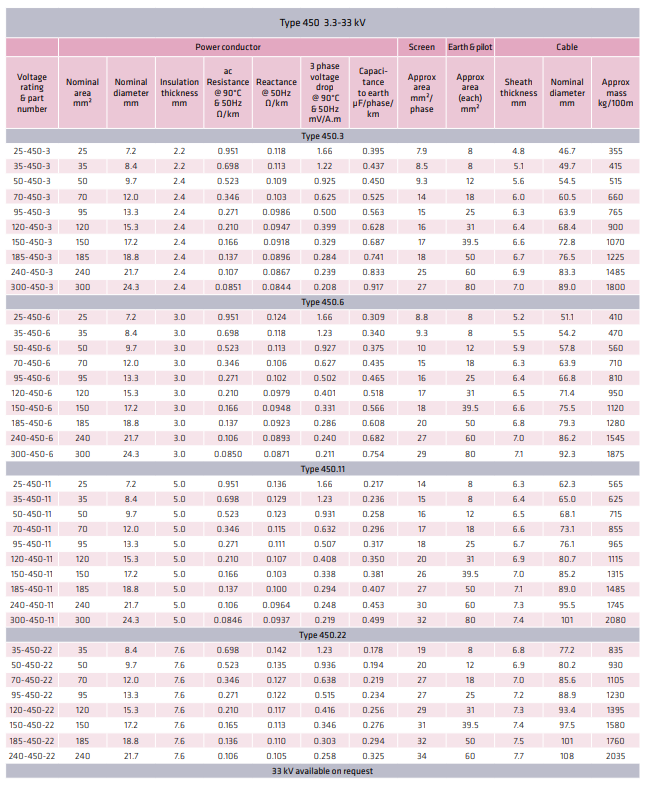
Based on the official Prysmian documentation and AS/NZS 2802 standard, here is the complete technical picture for Type 450, organised for easy selection and engineering use.
Voltage Grades and Naming
Type 450.3: 3.3/3.3 kV – small to medium equipment
Type 450.6: 6.6/6.6 kV – drills, excavators, conveyors
Type 450.11: 11/11 kV – large shovels, long conveyors
Type 450.22: 22/22 kV – very large draglines, main feeders
Type 450.33: 33/33 kV – highest‑voltage distribution
Key Electrical Characteristics
All values are reference values at 90 °C conductor temperature and 50 Hz, standard for Southern Africa:
Environmental and Mechanical Ratings
Temperature range: ‑25 °C to +90 °C continuous operation; suitable for direct sunlight and extreme heat.
Water resistance: Rated for continuous immersion or temporary coverage.
Flame performance: Flame‑retardant, meets IEC 60332‑1; low smoke emission.
Minimum bend radius: 6 × OD (static installation), 8 × OD (dynamic operation) — much smaller than comparable cables.
Tensile strength: ≥ 40 N/mm²; elongation at break > 300 %.
Chemical resistance: Excellent resistance to acids, alkalis, oils, greases and mine chemicals.
These figures are not just numbers; they are the result of decades of testing and real‑world use across Southern Africa.
Application Selection Guide: Which Type 450 Do You Need?
Choosing the correct version ensures safety, performance and economy. Here is the step‑by‑step method used by mining engineers throughout the region.
Step 1: Match Voltage to Equipment
3.3 kV: Small excavators, pumps, auxiliary equipment.
6.6 kV: Most drills, medium excavators, shorter conveyors.
11 kV: Standard for large shovels, stackers, main conveyors — the most common choice in South Africa.
22 kV: Very large draglines, long‑distance power feeds, high‑power installations.
33 kV: Primary distribution to heavy machinery, long overland conveyors.
Step 2: Select Conductor Size
Three rules apply:
Current‑carrying capacity: Calculate based on ambient temperature (typically 40 °C in open air) and load factor. Use derating factors if buried or grouped.
Voltage drop: Keep below 5 % for full load. For lengths over 500 metres, increase size by one step to avoid excessive loss.
Short‑circuit withstand: Ensure the conductor can carry fault current (typically 160 A/mm² for 1 second) without damage.
Practical examples for South African mines:
8 MW electric shovel @ 11 kV: Choose Type 450.11‑185 mm² — handles ~420 A, voltage drop well within limits, fits standard reels.
5 MW stacker‑reclaimer @ 22 kV, length 800 m: Choose Type 450.22‑95 mm² — balances current, voltage drop and mechanical weight.
Drill @ 6.6 kV, 2 MW: Choose Type 450.6‑70 mm² — compact, flexible, easy to route.
Step 3: Operational Duty Classification
✅ Best fit: Slow reeling (< 15 m/min): Type 450 is ideal — exactly designed for this, which covers 90 % of South African mobile equipment.
⚠️ High‑speed reeling (> 20 m/min): Consider Type 455 (Class 2) for extra mechanical protection.
⚠️ Extreme impact/abrasion: Where damage risk is very high, use heavier Type 409 or Class 2 designs.
Installation and Maintenance Best Practices
Always maintain minimum bend radius — never force tight bends; this is the most common cause of early failure.
Reel diameter must be at least 12 × outer diameter to reduce fatigue.
Use the built‑in pilot core to install continuous insulation monitoring and earth‑fault relays — this detects damage before it causes an outage.
Inspect visually every 3 months; replace when sheath wear exceeds 30 % of nominal thickness.
Avoid dragging over sharp rock or steel edges; use guides and rollers.
Following these practices, Type 450 will reliably serve 8 to 12 years or more in South African conditions.
Procurement and Sourcing: Feichun Cables — Your Equivalent Alternative
For many years, mining operations relied on premium international brands. Today, Feichun Cables has emerged as the leading alternative, offering cables that are fully equivalent, certified, and often superior in value and delivery. This section explains exactly why Feichun is trusted by mines across Southern Africa.
What Makes Feichun Type 450 Fully Equivalent?
✅ Identical Standard Compliance
Feichun manufactures strictly to AS/NZS 2802:2000+A1, with every design and material matched exactly to the standard.
Insulation: XR‑EP‑90 grade EPR, same formulation and performance.
Conductor: Tinned annealed copper, same stranding pattern and conductivity.
Screening: Composite copper/polyester braid + semiconductive tape — identical construction.
Sheath: XHD‑85‑PCP with embedded polyaramid reinforcement — same heavy‑duty grade.
All test procedures are identical: electrical, mechanical, environmental, flame, ageing.
Every cable comes with full documentation: type test reports, routine test certificates, compliance statements, and material declarations — exactly what South African mine engineers and procurement teams require.
✅ Same Performance, Same Dimensions
Feichun Type 450 cables have exactly the same outer diameter, weight, bend radius and electrical values as the original specifications. There is no need to change drawings, reels, or installation methods — they are direct drop‑in replacements.
Temperature rating: ‑25 °C to +90 °C — no derating needed.
Current capacity: identical.
Mechanical strength: meets or exceeds standard requirements.
✅ Proven Performance in Southern Africa
Feichun cables have been deployed in South African platinum, gold, coal and iron ore mines since 2018. Field reports show service life equal to or better than premium brands, with zero performance‑related failures when installed correctly. They are accepted by major mining groups and engineering firms throughout the region.
Key Advantages Over Traditional Brands
Shorter Delivery Times
Premium suppliers often have lead times of 12 to 16 weeks, with stock often held overseas. Feichun maintains regional stock and optimised manufacturing, delivering in 4 to 6 weeks — critical when a shutdown or replacement is urgent.
Significant Cost Savings
Feichun’s manufacturing efficiency means pricing is typically 20 % to 35 % lower than European or Australian brands, without any compromise on quality. This directly lowers capital expenditure and total cost of ownership.
Flexible Service
Cut‑to‑length service: supplied exactly to your required length, no minimum order quantities.
Full technical support: engineering team familiar with South African standards and applications.
Documentation in local format: all certificates and manuals in English, aligned to mine requirements.
Local Support
Feichun has established logistics and support partners in South Africa, ensuring fast delivery, clear customs handling, and easy access to technical advice.
Procurement Specification Checklist
When specifying or ordering, use this standard format, recognised industry‑wide:
Cable, Reeling, AS/NZS 2802:2000, Class 1, Type 450.[3/6/11/22/33]‑[size] mm², 3‑core + 2 earth + 1 pilot, EPR insulation, composite screen, XHD‑85‑PCP reinforced sheath, tinned copper conductors.
Feichun will supply exactly to this specification, with all necessary compliance evidence.
Frequently Asked Questions
Q: Is Type 450 suitable for underground mining?
A: Type 450 is designed primarily for open‑cut and surface applications. Underground coal mining requires the different standard AS/NZS 1802 and Type 241 cables. For hard‑rock underground mines, Type 450 is often permitted and used successfully.
Q: Can it be dragged along the ground?
A: Yes — it is designed for both reeling and trailing. The heavy‑duty sheath resists abrasion well, but care should still be taken to avoid sharp edges or severe abuse.
Q: What is the maximum length available?
A: Typically supplied in continuous lengths up to 1,500 metres. Practical limits are determined by voltage drop and reel capacity, not manufacturing capability.
Q: Does Feichun provide custom sizes or special constructions?
A: Yes — Feichun can modify designs or supply special lengths to suit specific mine requirements, while maintaining full standard compliance.
Q: How do I confirm compliance?
A: Every shipment includes third‑party test certificates and a Declaration of Conformity, demonstrating full compliance with AS/NZS 2802. These documents are accepted by all major mine safety departments.
Conclusion
AS/NZS 2802 Type 450 3.3–33 kV reeling cable is not just a product; it is a proven engineering solution developed specifically for the unique demands of open‑pit mining. It balances high‑voltage safety, light weight, compact size, flexibility and durability better than any other cable available today.
For South African operations — from the highveld coalfields to the Limpopo platinum mines — it is the standard choice for electric shovels, drills, conveyors, stackers and all slow‑reeling mobile equipment. It reduces operational costs, improves reliability, and keeps production moving.
Feichun Cables now offers this same performance, fully certified and compliant, with faster delivery and significantly better value. It is the smart, safe choice for procurement teams and engineers looking to maintain quality while optimising cost and supply.
Need AS/NZS 2802 Type 450 3.3–33 kV reeling cables for your South African mine?
Get full technical data, pricing and delivery schedule today.
📧 Contact the Feichun Engineering Team: Li.wang@feichuncables.com
We deliver compliant, high‑performance cables direct to site across Southern Africa.
Email Address: Li.wang@feichuncables.com
© 2025. All rights reserved.
One-click to Quickly Contact
Products
Contact
Company
Location:
Building A Private Science and Technology Park, Hefei Economic and Technological Development Zone, Anhui Province, China
Heat Resistant Cable
WhatsApp: +86 17333223430
Social Media: