Anhui Feichun Special Cable Co.,Ltd Email: Li.wang@feichuncables.com
AS/NZS TYPE 450-LED Self-Powered LED Illuminated Mining Cable: Enhanced Safety for South African Mines in Night Shifts, Dust Storms & Low Visibility
Discover how the AS/NZS TYPE 450-LED self-powered LED illuminated mining cable makes heavy, dark traditional cables visible 24/7 in South African mines. Reduce trip hazards, run-overs, arc flashes and downtime with electromagnetic induction-powered red LED glow – plug-and-play safety for draglines, excavators and underground operations.
Li Wang
4/9/20269 min read
Introduction
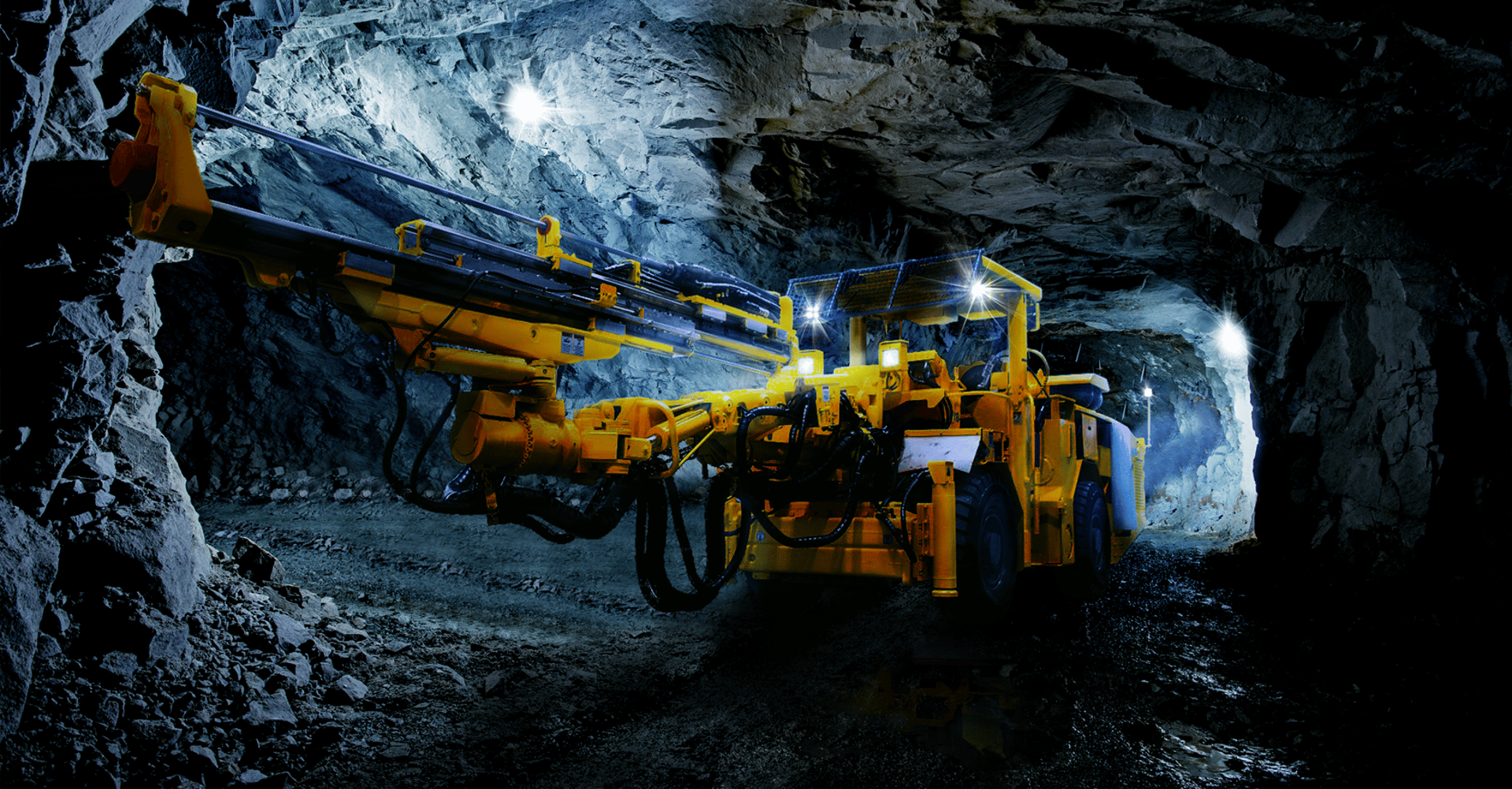
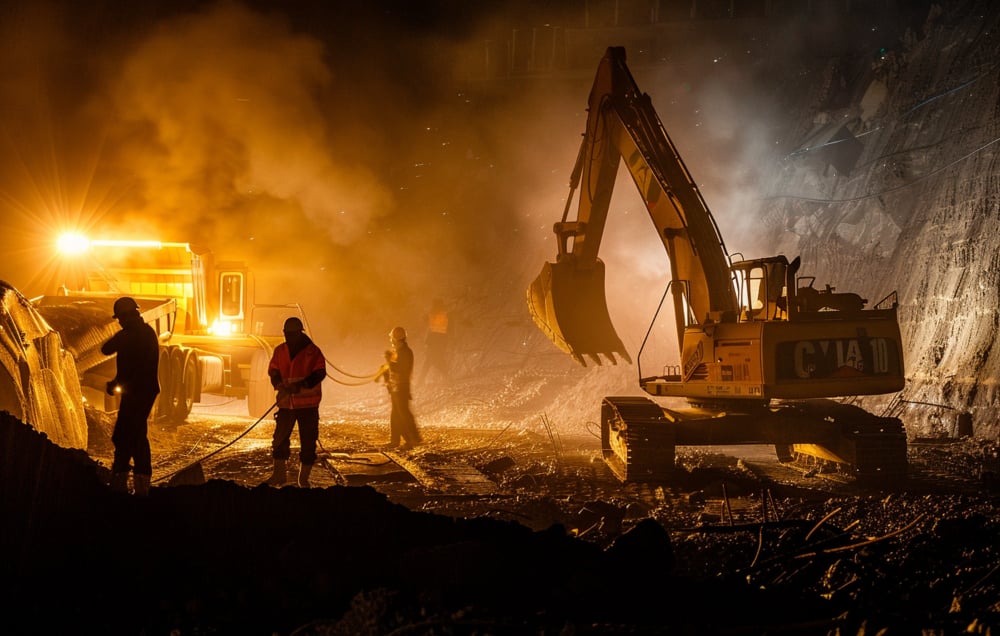
Picture this on a typical night shift in Mpumalanga’s opencast coal fields: the dragline is swinging, haul trucks rumble past at 40 km/h, and shift bosses are handing over at the change of crew. The ground is black with coal dust and spilled diesel. The trailing cable – that heavy, dark Type 450 reel that supplies power to the machine – lies flat on the same dark surface. In the dust, fog, or that tricky half-light between dusk and full dark, it simply disappears. A worker steps over what he thinks is clear ground. A dozer operator misjudges the line. The cable gets crushed, an earth fault trips the supply, and the whole bench grinds to a halt while the electricians hunt for the damage.
This is not a rare “what-if”. It is daily reality across South Africa’s mines – from the Highveld collieries to the Northern Cape open pits and the deep platinum stopes of the North West. Traditional AS/NZS 2802 Type 450 trailing cables are built tough for exactly these conditions: heavy current, constant reeling, acid water, UV, and abrasion. But their deep-black or dark-grey elastomer sheath makes them almost invisible in the very environments where South African mines operate most intensely – night production shifts, dust storms, summer thunderstorms, and the critical twilight hours when most crews change over.
Enter the Feichun TYPE 450-LED: the world’s first self-powered, intrinsically safe, LED-illuminated mining trailing cable that complies fully with AS/NZS 2802:2000. It does not need extra power, extra lights, or extra maintenance. It harvests its own energy from the magnetic field of the current flowing through its own conductors and glows a continuous, unmistakable red line the entire length of the cable – visible more than 200 metres even in thick dust or fog. When the cable is energised the LEDs shine; when it is isolated they go dark. Instant visual LOTO confirmation.
This article explains exactly why traditional cables disappear in South African conditions, what the real safety and financial consequences are, why reflective tape, paint, lighting towers and path markers have failed us for decades, and how the TYPE 450-LED’s engineering breakthroughs finally solve the problem. We will look at the specific innovations – electromagnetic induction harvesting, the semi-transparent super-tough FR-TPU sheath, the multi-layer surge protection, and the aramid stress-isolation braid – then examine the operational advantages and real-world applications right here in South Africa. Finally, we provide the detailed technical specification so mine engineers and safety officers can see exactly why this cable meets every requirement of the Mine Health and Safety Act while delivering measurable gains in zero-harm performance.
Traditional Mining Cables in South African Mine Environments
South African mines run on flexible reeling and trailing cables built to AS/NZS 2802 Type 450. These are extra-heavy-duty, EPR-insulated, elastomer-sheathed cables rated from 3.3 kV up to 33 kV. They are designed to be dragged, reeled, and run over by massive equipment in opencast and underground operations. The sheath is typically deep black or dark grey to maximise UV and chemical resistance. The cable is heavy – often 300–1 300 kg per 100 m depending on size – and it lies flat or snakes across the bench or stope floor.
The problem is the environment. South African opencast coal mines in Mpumalanga and Limpopo are famous for black coal-dust surfaces that reflect almost no light. Underground platinum and coal faces rely almost entirely on cap lamps – narrow-beam point sources that create tunnel vision and poor peripheral awareness. Dawn and dusk (the peak shift-change windows) last longer in our latitude and are when visibility is at its worst. Summer rain turns benches into mud mirrors; dust storms in the Northern Cape reduce visibility to a few metres; Highveld fog and mist scatter cap-lamp beams into useless haze.
Mine Health and Safety Council research and DMRE reports repeatedly highlight low-visibility conditions as a major contributor to transport-and-machinery (T&M) and general-type incidents. In 2024 the industry recorded 42 fatalities – the lowest on record – yet T&M accidents still accounted for 33 % of fatalities and 18 % of injuries. General-type accidents (which include trips, struck-by and run-overs) made up 53 % of injuries.
A dark cable on dark ground in these conditions is effectively invisible until you are almost on top of it. Shift workers, tired after 12 hours, moving quickly during crew change, simply do not see it.
Safety Hazards and Costly Consequences
The consequences are immediate and expensive.
Personnel trips and falls – a worker crossing the bench at night steps on or over an unseen cable and goes down. In wet or dusty conditions this can mean broken limbs, head injuries or worse.
Mobile equipment run-overs – haul trucks, dozers, excavators and shuttle cars crush the cable. The resulting earth fault or short circuit trips the protection, halts production, and often damages the cable beyond repair.
Arc flash and fire/explosion risk – in underground coal or gassy environments a damaged cable can produce sparks or arcs. Even in opencast the risk of fire from damaged insulation is real.
Electrical shock and electrocution – damaged sheath exposes live conductors to water or personnel.
Production downtime – a single dragline cable failure can stop 5 000–10 000 tonnes per hour of coal. Repair or replacement takes hours; the lost revenue runs into millions of rands per incident.
Regulatory and insurance impact – every cable-related incident triggers a Section 54 stoppage under the Mine Health and Safety Act. Repeated incidents raise insurance premiums and can affect the mine’s risk rating.
Fatigue during shift change compounds everything. Poor visibility increases reaction time, reduces hazard recognition, and contributes to the “general-type” accidents that still dominate injury statistics.
Why Existing Solutions Simply Don’t Cut It in South African Conditions
For years mines have tried passive fixes:
Reflective tape or paint
– applied to the cable sheath. Within days or weeks the tape peels, the paint abrades away under dozer tracks, UV fades it, diesel and acid mine water dissolve it. Even when new, it only works when hit directly by a cap lamp or vehicle light – useless in dust storms or fog.
External lighting towers or portable floodlights
– they light the general area but create glare and shadows. They cannot follow a moving trailing cable. Fuel, generator maintenance and cable runs for the lights add cost and clutter.
Cable-path signage or bunting
– static markers that get knocked over, buried in dust, or ignored by operators focused on the machine.
None of these solutions make the cable itself emit light. None work reliably in the exact conditions South African mines face every night. None are intrinsically safe for underground coal. All require ongoing labour and materials that mines simply do not have spare. The result is that, despite good intentions, cables remain invisible and the risk remains.
How Feichun TYPE 450-LED Self-Powered LED Illuminated Mining Cable Solves the Problem
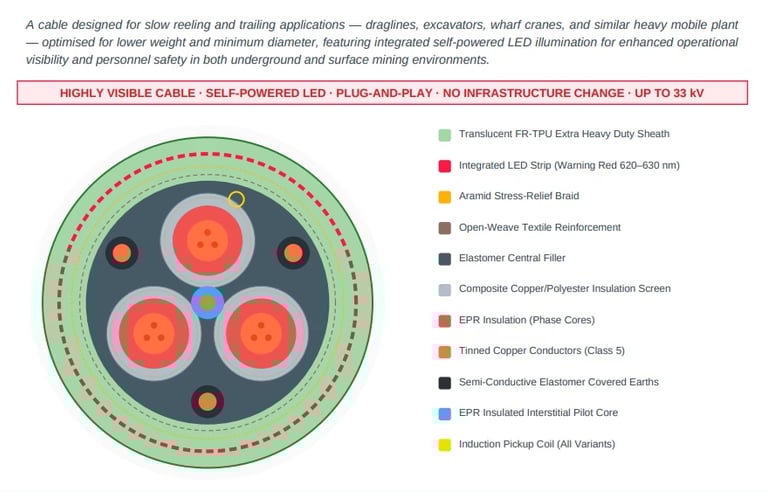
The TYPE 450-LED is a direct drop-in replacement for standard AS/NZS Type 450 cables. It looks and handles almost identically – same voltage ratings, same reeling characteristics – but with one revolutionary difference: a continuous strip of industrial-grade red LEDs (620–630 nm wavelength) runs the entire length. The LEDs are powered entirely by the cable’s own operating current through electromagnetic induction. No batteries, no external 24 V supply, no modification to switchgear or reeling drums.
When the cable is energised the red glow is immediately visible more than 200 m away, even in thick dust, fog or rain. The light is “cold” – negligible heat – and the red wavelength is chosen because human eyes and cap-lamp-assisted vision detect it extremely well in low-light conditions. When the cable is isolated for maintenance the LEDs go dark instantly, giving every worker clear visual confirmation that the circuit is dead – a built-in LOTO aid.
Engineering Innovations That Make It Work
Four patented breakthroughs allow the TYPE 450-LED to survive the brutal South African mining environment while delivering reliable illumination.
Electromagnetic induction energy harvesting
A helical pickup coil is spirally wound in the interstices between the phase cores. The cable’s own three-phase current creates an alternating magnetic field. The pickup coil acts as the secondary winding of a transformer. Faraday’s law does the rest: induced voltage is rectified, regulated and fed to the LED strip. The system is galvanically isolated (>50 V separation) and produces stable 12/24 V DC. Even at partial load or on 22/33 kV circuits the magnetic field is sufficient. The design meets AS/NZS 60079.11 intrinsic safety requirements for Group I (methane/coal dust) environments.
Proprietary semi-transparent heavy-duty FR-TPU outer sheath
Traditional elastomer sheaths are opaque. Feichun’s patent-pending flame-retardant thermoplastic polyurethane (FR-TPU) is semi-transparent specifically tuned to pass 620–630 nm red light at near 100 % efficiency while delivering 3–5 times the abrasion resistance of standard elastomers in AS/NZS 2802 Taber abrasion tests. It resists tearing, diesel, acid mine water, UV and ozone. Weight and diameter increase by only 8–12 %, keeping the cable fully compatible with existing reeling systems.
Integrated multi-layer surge protection architecture
The LED circuit lives on a flexible printed circuit (FPC) inside the cable. Four layers of protection guard it:
Magnetic saturation limiting at the pickup coil (prevents over-voltage from inrush).
TVS diodes for picosecond transient suppression.
Zener diodes and LDO regulators for stable DC output.
PTC resettable fuses that trip on over-current and automatically reset.
All components are epoxy/silicone potted to IP68+. The entire LED circuit is further protected by an aramid (Kevlar) stress-isolation braid that absorbs tension, torsion and crushing forces during millions of reeling cycles. The LEDs and FPC experience essentially zero mechanical strain.
Operational Advantages for South African Mines
Zero additional infrastructure – plug and play. No new power cables, no generators, no switchgear changes.
Maintenance-free for cable life – the LEDs and protection are designed to last as long as the cable itself.
Instant LOTO visual confirmation – reduces lock-out errors.
Reduced patrol and fault-finding time – glowing cable is easy to follow even at night.
Lower insurance and downtime costs – fewer run-overs and faults.
Improved worker morale and compliance – crews see the cable is energised or safe at a glance.
Full compliance – meets every electrical, mechanical and dimensional requirement of AS/NZS 2802 and AS/NZS 60079.11.
Practical Applications in South African Mining Environments
Opencast coal – Mpumalanga and Limpopo
Dragline tail ropes (often 400–600 m of 22/33 kV cable) snake across the pit floor. Haul trucks and dozers work 24/7. The red glow prevents night-time run-overs and makes shift-change handovers safer.
Open-pit metal mines – Northern Cape iron and manganese
Excavator bench cables (100–300 m, 6.6/11 kV) cross rocky, dusty ground. Dust storms are frequent. The self-illuminated cable remains visible when everything else disappears.
Underground collieries and platinum mines – Gauteng and North West
Continuous miners and shuttle cars in methane-rich, coal-dust-laden headings. The intrinsically safe red glow provides the only reliable illumination of the trailing cable in total darkness, complying with MHSA electrical safety requirements.
Port and bulk-handling cranes – Durban and Richards Bay
Similar reeling duty to draglines. The cable’s visibility reduces vehicle and pedestrian incidents in low-light, dusty port environments.
Technical Deep Dive: Structure, Electrical Parameters and Compliance
Construction (inner to outer)
Conductors: tinned annealed copper, Class 5 flexible, 25–150 mm².
Insulation: EPR.
Screening: composite copper/polyester tape per phase.
Earth and pilot cores: semi-conductive elastomer earths + EPR-insulated interstitial pilots.
Central filler: elastomer.
Induction pickup coil: helical winding in phase interstices.
LED strip: high-reliability silicone-encapsulated red LEDs on FPC.
Aramid stress-isolation braid: Kevlar layer over LED circuit.
Textile reinforcement: open-weave.
Outer sheath: proprietary semi-transparent FR-TPU.
Electrical parameters
Voltage: 3.3/3.3 kV to 33/33 kV (unique illuminated 22 kV and 33 kV variants available).
Current rating: matches standard Type 450 tables.
LED supply: 12/24 V DC, galvanically isolated, intrinsically safe.
Protection: full four-layer surge architecture + PTC.
Compliance: AS/NZS 2802:2000, AS/NZS 1802, AS/NZS 60079.11 (Ex ia I Ma for Group I).
Example dimensions (3.3 kV 25 mm²): OD ≈ 52.5 mm, mass ≈ 358 kg/100 m (only 8–12 % heavier than standard).
The cable retains full slow-reeling and trailing capability and exceeds standard mechanical requirements.
Conclusion
The TYPE 450-LED is not a gimmick. It is a practical, engineered solution to a long-standing, high-cost hazard that every South African mine faces every single night. By making the cable itself emit clear, reliable light using only its own power, it removes the invisibility problem at the source. It improves safety, reduces downtime, cuts maintenance, and helps mines move closer to the zero-harm goal demanded by the Mine Health and Safety Act and by every worker who goes underground or onto the bench.
Mine managers, electrical engineers and safety officers who have seen the cable in operation report the same reaction: “Why didn’t this exist years ago?” The payback is measured in prevented incidents, reduced stoppages and lower insurance costs. South African mines that trial and adopt the TYPE 450-LED will gain a genuine competitive edge in safety performance and operational reliability.
Contact your local authorised distributor today to arrange a trial on your next dragline or continuous-miner installation. The red glow you see could be the safest cable on the property – and the one that keeps your people and production moving.
FAQ:
Is the TYPE 450-LED a direct replacement for standard Type 450 cables?
Yes. It meets every dimensional, electrical and mechanical requirement of AS/NZS 2802:2000. Existing reeling drums, terminations and protection settings remain unchanged.
Does it work in 33 kV dragline applications?
Yes. Special 22 kV and 33 kV variants use magnetic decoupling to maintain sufficient induction field.
How does the LED glow behave in partial-load or fault conditions?
The multi-layer protection and LDO regulation keep the glow stable down to low currents. If the cable is isolated the LEDs go dark immediately.
Is it intrinsically safe for underground coal mines?
Fully certified to AS/NZS 60079.11 for Group I methane and coal-dust environments.
What is the expected service life compared with normal cables?
The same as standard Type 450. The aramid braid and robust TPU sheath ensure the LED circuit survives the full mechanical life of the cable.
How much extra does it cost and what is the payback period?
Slight premium offset by reduced downtime, fewer repairs and lower insurance. Most mines see payback within 6–12 months through prevented incidents alone.
Can existing reeling systems handle the slight weight increase?
Yes. The 8–12 % increase is well within the design margins of standard dragline and shuttle-car reels.
Does the red light comply with colour-vision standards for miners?
Yes. 620–630 nm red is highly visible to the human eye under cap-lamp conditions and does not create glare or colour distortion issues.
My project requires this type of cable. How can I purchase it?
Contact FeiChun Team: Li.wang@feichuncables.com
Email Address: Li.wang@feichuncables.com
© 2025. All rights reserved.
One-click to Quickly Contact
Products
Contact
Company
Location:
Building A Private Science and Technology Park, Hefei Economic and Technological Development Zone, Anhui Province, China
Heat Resistant Cable
WhatsApp: +86 17333223430
Social Media: