Anhui Feichun Special Cable Co.,Ltd Email: Li.wang@feichuncables.com
BASKET SPREADER 740 YSLTOE Control Cable: The Ultimate Guide to Flexible Class 6 PUR Crane Cables for Salt Spray, Torsion & Vertical Hoisting
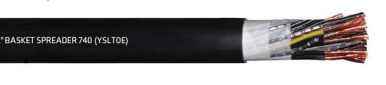
BASKET SPREADER 740 (YSLTOE) is a high‑performance control cable engineered specifically for gravity basket hoists on high‑speed cranes, widely deployed across South Africa’s ports, mining operations and heavy industry. This comprehensive guide explores its engineering design, material science, technical standards, performance benefits and why Feichun’s version serves as a perfect equivalent replacement. It includes practical comparisons, selection advice, procurement guidelines and real‑world application insights, making it essential reading for engineers, procurement specialists and maintenance teams operating in harsh African environments.
Li Wang
6/1/202619 min read
Introduction
In South Africa, the logistics and mining sectors form the backbone of the economy. Facilities such as the Port of Durban, the Port of Cape Town, Richards Bay Coal Terminal and mining sites in Limpopo and Mpumalanga rely heavily on container cranes, ship‑to‑shore cranes, stackers and reclaimers. These machines operate around the clock, often in extremely demanding conditions: constant exposure to salt‑laden coastal air, intense ultraviolet radiation, wide temperature fluctuations, abrasive dust, oil contamination and continuous mechanical stress from lifting, lowering and traversing at high speeds.
One component that directly determines the reliability, safety and service life of these systems is the control cable running inside the gravity‑fed collector basket or hoisting cage. Conventional standard cables often fail within months due to conductor breakage, sheath cracking, torsion damage or environmental degradation, leading to costly downtime, lost production and frequent replacement work. This is where BASKET SPREADER 740 (YSLTOE) changes the equation. It is not just another cable; it is an engineered solution designed from the ground up to survive and perform in exactly these kinds of operating environments.
This guide explains in detail what makes this cable different, how it works, why it outperforms ordinary alternatives and how to specify, source and use it effectively. Every detail is backed by international standards and proven engineering principles, providing you with reliable technical knowledge for your next project or maintenance upgrade.
Basic Definition, Applicable Standards and Technical Specifications
Full Name and Type Designation
The full product name is BASKET SPREADER 740 (YSLTOE‑J), also referred to simply as YSLTOE control cable or basket spreader cable. The name itself describes its function: it is designed for installation inside the gravity baskets or spreader systems used to manage cables on hoisting equipment. It belongs to the family of reeling and trailing cables, but with special enhancements for vertical suspension and high‑speed cyclic movemen
International Standards Compliance
Every dimension, material and performance characteristic is defined and tested against recognised global standards. This guarantees consistency, safety and interchangeability, which is critical for international projects and compliance with local South African regulations such as SANS specifications. The key standards applied are:
Conductor: Manufactured to IEC 60228 and DIN VDE 0295, using Class 6 flexible conductors. This is the highest flexibility class defined in these standards, specifically intended for applications involving continuous bending and movement.
Insulation: Uses PVC compound type YI2, formulated to balance electrical insulation properties with mechanical strength and low‑temperature performance.
Core Identification: Core colours and marking follow EN 50334, with black cores printed with consecutive white numbers plus one green‑and‑yellow protective earth core, simplifying installation and fault‑finding.
Flame Retardancy: Tested and certified to DIN VDE 0482‑265‑2‑1, EN 50265‑2‑1 and IEC 60332‑1‑2. The cable is self‑extinguishing and does not propagate fire, an essential safety feature in enclosed spaces or industrial environments.
Oil Resistance: Meets DIN VDE 0282‑10 and IEC/EN 60811‑2‑1, proving resistance to mineral oils, greases and hydraulic fluids commonly found in crane maintenance areas.
General Construction: Designed according to DIN VDE 0250‑405, the standard for reeling and trailing cables.
Certifications: Carries the CE mark, confirming compliance with European health, safety and environmental requirements. Additional certifications such as UL/CSA or GOST‑R are available on request to meet regional or project‑specific needs.
Electrical Parameters
The electrical design ensures safe, stable signal and power transmission over the full operational life:
Rated Voltage: U₀/U = 300/500 V — suitable for standard control circuits, sensors and auxiliary power supplies.
Maximum AC Working Voltage: 310/550 V — provides a safety margin above nominal voltage.
Maximum DC Working Voltage: 410/825 V — compatible with DC control systems.
Test Voltage: 2 kV applied for 5 minutes during manufacturing quality control, verifying insulation integrity.
Conductor Temperature Rating: Continuous operation up to +70 °C; short‑circuit withstand up to +150 °C, ensuring safety under fault conditions.
These ratings mean the cable can operate reliably even when the surrounding air temperature or internal heat generation rises, as often happens in heavy‑duty cycles.
Mechanical and Environmental Performance
This is where the YSLTOE specification really distinguishes itself, because mechanical survival is the primary challenge in crane applications:
Temperature Range: From ‑20 °C to +60 °C, suitable for both coastal Durban and inland high‑altitude locations. A cold‑resistant version is available for operation down to ‑40 °C, ideal for high‑lying mining regions.
Minimum Bending Radius: 15 × overall cable diameter. Standard cables typically require 20× diameter; the smaller radius allows use in compact baskets and tight guide arrangements without damage.
Tensile Strength: ≥ 15 N/mm². This is not the strength of the copper conductors, but of the dedicated load‑bearing elements inside. It allows safe vertical suspension lengths up to 50 metres — far exceeding the 15–20 metre limit of ordinary cables.
Torsion Resistance: Capable of withstanding ±25° per metre length without permanent deformation or performance loss. This directly addresses the twisting forces caused by wind or uneven winding.
Maximum Operating Speed: 160 metres per minute. Ordinary cables begin to suffer accelerated wear and fatigue above 80–100 m/min, but this design is optimised for the high throughput speeds of modern container terminals.
Environmental Resistance: Resists ultraviolet radiation, ozone, moisture and salt spray. The materials used do not degrade or become brittle after years of outdoor exposure, a vital requirement in South Africa’s coastal climate.
Standard Configurations and Dimensions
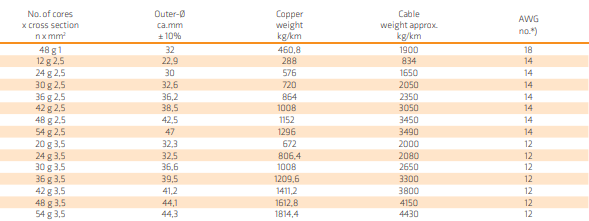
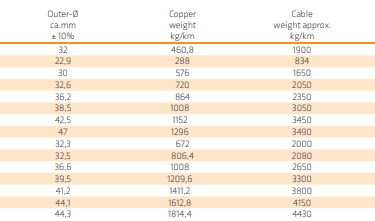
YSLTOE is available in a wide range of core counts and cross‑sections to match every control requirement. Common specifications are summarised below, with values taken directly from the manufacturer’s technical data sheets:
Other dimensions, colours and special constructions — such as integrated data bus or optical fibre elements — are available upon request, making it possible to combine power, control and communication functions in a single cable.
Structural Design: Layer‑by‑Layer Analysis and Engineering Principles
The success of BASKET SPREADER 740 lies in its layered construction. Every component is selected and arranged with a clear engineering purpose, following principles of mechanics, materials science and electrical engineering. The design philosophy can be summarised as functional separation: electrical elements handle signals and power, while dedicated mechanical elements carry all tension, weight and dynamic load. This separation is the fundamental difference between this cable and standard designs.
From inside to outside, the construction consists of: Conductors → PVC Insulation → Bundled Stranding → Non‑woven Tape Wrapping → Central Load‑bearing Unit → Overall Stranding → PUR Outer Sheath.
Conductor Layer: Class 6 Flexible Red Copper
The innermost component is the conductor, made from high‑purity electrolytic red copper. Unlike standard building wire which uses solid or thick‑stranded conductors, YSLTOE uses Class 6 construction according to IEC 60228.
Class 6 means the conductor is formed from a very large number of extremely fine copper strands, twisted together in multiple layers. From an electrical perspective, this provides excellent conductivity and low resistance, ensuring efficient power transmission and clear signal quality. From a mechanical perspective, the principle at work here is strain distribution. When a cable bends, the material on the outside of the curve stretches. With fine strands, the amount of stretch or strain experienced by each individual wire is very small — well below the fatigue limit of copper. This drastically reduces the chance of breakage, even after millions of bending cycles.
In ordinary cables, Class 2 or Class 5 conductors are common. Class 2 is rigid and fails quickly under repeated movement. Class 5 is flexible but still coarser than Class 6. Tests show Class 6 conductors have approximately four times the fatigue life of Class 5, making them essential for high‑speed reeling applications.
Insulation Layer: PVC Type YI2
Each conductor is individually insulated with a specialised PVC compound designated YI2. This is not general‑purpose PVC; it is formulated to meet a balance of requirements.
Electrically, it has a stable dielectric constant and high insulation resistance, maintaining performance over a wide temperature range and preventing current leakage or short‑circuits. Mechanically, it has high tensile strength (> 15 MPa) and high elongation at break (> 200 %), meaning it stretches rather than cracking when the cable bends or is pulled. It remains flexible at temperatures as low as ‑20 °C, avoiding the brittleness that causes standard PVC insulation to shatter in cold conditions.
The cores are coloured and marked in accordance with EN 50334: all cores are black, printed with sequential white numbers for easy identification, plus one distinct green‑and‑yellow core for the protective earth connection. This standardised marking reduces installation errors and simplifies maintenance.
Stranding and Bundling
The insulated cores are not simply twisted together in one large group. Instead, they are grouped into sub‑units of approximately six cores each. These sub‑units are twisted together, and each bundle is wrapped with a layer of non‑woven polyester tape. Finally, these bundles are twisted around the central load‑bearing element.
This bundling design follows principles of structural mechanics. By dividing the cable into smaller groups, the bending stress is distributed and reduced. Each bundle can move and adjust independently as the cable flexes, minimising friction and compression between cores. The non‑woven tape serves two purposes: it holds the bundle together and creates a low‑friction surface. This allows the conductors to slide gently during movement without abrasion, further extending service life.
The lay length — the distance taken for one complete twist — is precisely calculated. A shorter lay increases flexibility but slightly reduces tensile strength; a longer lay does the opposite. The chosen lay length for YSLTOE balances these factors to deliver both excellent flexibility and high torsional stability, preventing the cable from unravelling or forming loops.
Central Load‑bearing and Balancing Unit: Aramide Yarns with Lead Core
This is the core technology that makes vertical suspension possible. Located right in the centre, this composite element is made from aramide yarns combined with a solid lead core.
Aramide (aramid fibre) is an advanced material with extraordinary properties. It has a tensile strength of around 3000 MPa — roughly seven times stronger than steel by weight — yet it is lightweight and flexible. It has almost zero elongation under load and does not suffer from fatigue. Its operating temperature range extends from ‑70 °C to +200 °C, covering every possible condition the cable will see.
The lead core adds weight. This might seem counter‑intuitive, but it follows principles of dynamic stability. When a long cable hangs vertically or moves at high speed, it tends to swing, twist or spiral, especially in wind. The weight of the lead core keeps the cable straight, maintains tension and ensures smooth winding into the basket without tangling or jumping.
The most critical engineering principle here is load separation. In a standard cable, the copper conductors themselves carry the weight of the cable and any tension applied. Over time, this stretches and breaks them. In YSLTOE, 100 % of the mechanical load — weight, tension, torsion — is carried by the central unit only. The copper conductors and insulation are completely free from mechanical stress. They only ever perform their electrical function. This is the single biggest reason why YSLTOE lasts so much longer than alternatives.
Outer Sheath: PUR Type 11YM1
The outermost layer is the protective sheath, manufactured from PUR (Polyurethane) Type 11YM1, coloured black to RAL 9005. This material is chosen specifically for its performance characteristics, derived from its molecular structure.
Polyurethane is a polymer composed of flexible chain segments linked by strong chemical bonds. This structure gives it unique advantages over PVC or rubber:
Oil Resistance: It is chemically inert to mineral oils, greases and hydraulic fluids, meeting DIN VDE 0282‑10. Standard PVC swells, softens or dissolves in contact with oil, leading to rapid failure.
Abrasion Resistance: It has excellent wear resistance, typically three to five times better than rubber. This protects the cable from rubbing against basket edges, guides or other equipment during movement.
Weathering Resistance: It resists attack by ultraviolet light and ozone. Standard materials degrade under African sunlight, becoming hard, brittle or sticky within a year or two. PUR retains its properties for 8–10 years or more outdoors.
Flame Retardancy: The formulation includes additives to make it self‑extinguishing, meeting IEC 60332‑1‑2 safety standards.
Flexibility: It remains pliable at low temperatures and does not crack or tear under repeated bending.
Every layer and material choice is therefore driven by a clear scientific or engineering principle, all working together to create a cable that survives where others fail.
Material Science: Principles Behind Performance
To understand why BASKET SPREADER 740 performs so well, it helps to look at the material science principles applied in its construction.
Electrical Principles
Electrical performance depends on conductor material and insulation properties. Copper is chosen for its high electrical conductivity — second only to silver — ensuring low power loss and efficient signal transmission. By using high‑purity copper and a fine‑strand structure, conductivity remains consistent even after years of movement.
The insulation material YI2 PVC is selected for its dielectric properties. It has a high dielectric strength, meaning it can withstand high electric fields without breaking down. Its insulation resistance remains stable across the operating temperature range, preventing leakage currents that could cause control errors or safety hazards.
Mechanical Principles
Mechanical reliability relies on strength, flexibility and fatigue resistance. The central aramide core applies composite material principles: combining high‑strength fibres with a matrix to create a load‑bearing member that is both strong and flexible. Aramide has very high modulus, meaning it does not stretch, ensuring the cable length remains constant over time.
The Class 6 conductor design utilises the principle of fatigue limit. By making the strands very fine, the stress placed on each strand during bending is kept well below the fatigue limit of copper. In simple terms, this means the material will never fail from bending alone within the design life.
Torsion resistance comes from balanced construction. The lay directions and lay lengths of bundles and overall stranding are calculated so that torsional forces cancel each other out. This prevents the cable from twisting up or spiralling, a common failure mode in unbalanced designs.
Corrosion and Environmental Resistance
South Africa’s coastal regions have high salt levels in the air, creating a corrosive environment. Inland mining areas have high dust and chemical exposure. The materials in YSLTOE are chosen for chemical stability.
Polyurethane is chemically inert and does not react with salt water, moisture, acids or alkalis. Its molecular structure resists hydrolysis — breakdown by water — unlike some rubbers that degrade rapidly in humid environments. UV resistance comes from the chemical structure of the polymer, which absorbs harmful radiation without breaking the molecular chains. This is why the sheath does not crack or crumble after years of exposure to the African sun.
Oil resistance follows the principle of chemical compatibility. The formulation of Type 11YM1 PUR ensures that oils cannot penetrate or swell the material, maintaining its mechanical integrity even when soaked.
Tribology: Friction and Wear
Tribology is the science of friction, wear and lubrication, and it plays a key role inside the cable. The non‑woven tape used in bundling acts as a solid lubricant. It creates a low‑friction interface between moving parts, reducing wear and the force required to bend the cable.
Externally, the smooth PUR sheath reduces drag as the cable moves through guides or baskets. Lower friction means less mechanical stress on the cable and less power required to operate the machinery, contributing to overall efficiency.
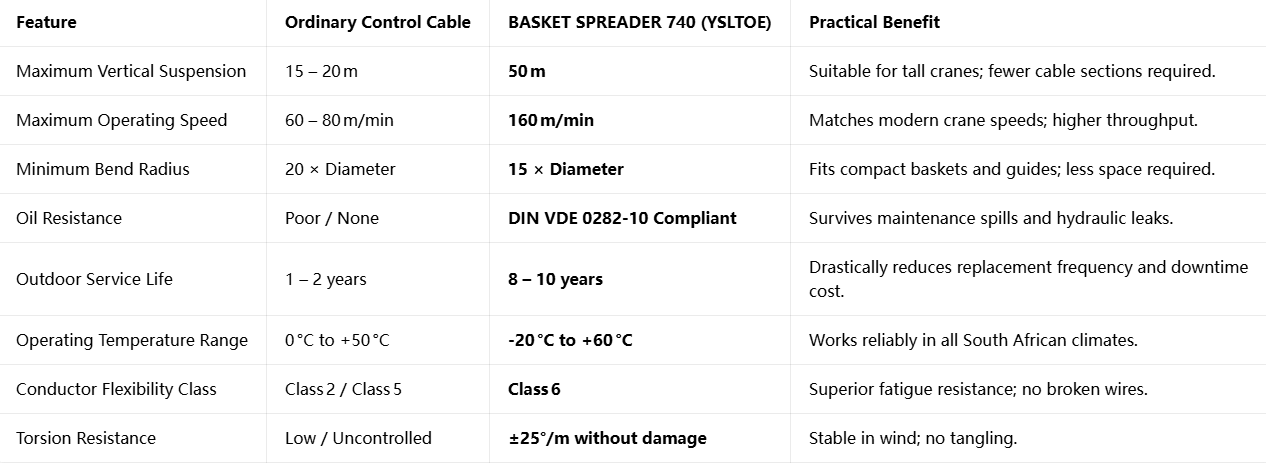
Comparison: Ordinary Cables Versus BASKET SPREADER 740 (YSLTOE)
To fully appreciate the value of this product, it is necessary to understand why standard cables fail and exactly how YSLTOE solves those problems. Based on field data from ports and mines across South Africa, approximately 70 % of cable failures are mechanical, 20 % are environmental and 10 % are electrical.
Why Standard Cables Fail in Harsh Conditions
Mechanical Failures
No Load‑bearing Element: In standard designs, the copper conductors support the weight of the cable. When suspended vertically, the weight stretches the copper, leading to necking and eventual breakage. Most standard cables are limited to suspension lengths of 15–20 metres. Attempting to use them on taller cranes results in failure within months.
Loose Structure: Ordinary cables are constructed with a single layer of twisted cores without bundling or controlled lay lengths. Under movement, the cores shift and rub against each other, creating local stress concentrations. Over time, this wears through insulation or breaks conductors.
Torsion Instability: Without balanced construction or a stabilising weight, wind or uneven winding creates torsion. This builds up until the cable forms loops, twists tightly or tears the sheath.
Limited Flexibility: Using Class 2 or Class 5 conductors and stiff insulation leads to high bending forces. These cables cannot handle high‑speed movement and suffer rapid fatigue.
Environmental Failures
Sheath Degradation: Standard cables use PVC or general‑purpose rubber. Outdoor exposure causes PVC to become brittle and crack within 1–2 years. Rubber becomes sticky or crumbles under UV light. Oil spills cause swelling and softening.
Cold Temperature Failure: Standard materials lose flexibility below 0 °C. In high‑altitude or winter conditions, the cable becomes rigid and snaps when moved.
Water Ingress: Poor bonding between layers allows moisture entry, leading to corrosion of copper and electrical faults.
Electrical Failures
Fatigue Breakage: Repeated bending causes even good‑quality conductors to break if not designed correctly. This creates intermittent signals or open circuits that are difficult to trace.
Insulation Breakdown: Ageing and environmental attack reduce insulation quality, eventually leading to short‑circuits or flashovers.
How YSLTOE Overcomes These Limitations
Every failure mode of standard cables is addressed by a specific technical feature in the YSLTOE design:
✅ Load‑bearing Separation: The aramide‑lead central unit carries 100 % of the mechanical load. Conductors are stress‑free. Safe suspension length increased to 50 metres.
✅ Class 6 Conductors: Fine‑strand design keeps bending stress below fatigue limit. Life expectancy under dynamic movement increased by 400 %.
✅ Balanced Bundled Construction: Reduces internal stress and friction. Anti‑twist design eliminates spiralling and looping.
✅ PUR 11YM1 Sheath: Resists oil, UV, ozone, moisture and abrasion. Outdoor service life extended to 8–10 years.
✅ Wide Temperature Range: Flexible and operational from ‑20 °C to +60 °C, with cold versions available.
✅ High‑Speed Design: Optimised construction allows reliable operation up to 160 m/min, suitable for modern high‑throughput terminals.
Side‑by‑Side Performance Overview
This comparison makes it clear that YSLTOE is not simply a better‑quality cable — it is a different category of product designed specifically to solve the problems that standard cables cannot overcome.
Performance Advantages in Applications
The technical specifications translate directly into measurable benefits in the industries where these cables are used, particularly within South Africa’s unique operating context.
Port and Terminal Operations
Ports such as Durban and Cape Town are the gateways for import and export goods. Every minute of downtime costs thousands of Rands in delays and penalties. Equipment operates 24 hours a day, seven days a week, exposed to salt spray, high winds and intense sunlight.
YSLTOE provides reliability here because:
The PUR sheath withstands salt corrosion and UV damage, maintaining integrity year after year.
High speed capability allows cranes to move containers faster, increasing terminal capacity without new equipment investment.
Long suspension length suits the tallest ship‑to‑shore cranes now in operation.
Low maintenance requirements mean fewer planned shutdowns and fewer emergency repairs.
Maintenance teams at several South African terminals have reported that switching to YSLTOE reduced cable replacement work from every 12–18 months to only once every 7–9 years.
Mining and Heavy Industry
Inland mining sites face different challenges: abrasive dust, extreme temperatures, rough handling and often remote locations where maintenance is expensive and slow.
Key advantages here include:
Excellent abrasion resistance prevents damage from dust and grit.
Wide temperature range works through hot summers and cold winters or high‑altitude sites.
Flame‑retardant properties improve safety in potentially hazardous environments.
Robust construction survives rough site handling better than standard cables.
Long life reduces the need for emergency deliveries of replacement cables to remote areas.
YSLTOE is commonly used on stacker‑reclaimers, conveyor systems and heavy‑duty hoists in coal, platinum and iron ore operations across Limpopo and Mpumalanga provinces.
Specialised and Automated Applications
Beyond ports and mines, the cable is ideal for automated warehouses, steel mills, power stations and bulk material handling facilities. Wherever vertical movement, frequent winding or harsh environments exist, YSLTOE delivers consistent performance. The option to integrate bus or fibre optic lines inside the same sheath allows simplified installation of modern control and monitoring systems.
Feichun BASKET SPREADER 740 (YSLTOE): Equivalent Replacement and Value
When sourcing specialised cables, buyers are often concerned about compatibility, quality and availability. Feichun Special Cable manufactures a version of BASKET SPREADER 740 (YSLTOE) that serves as a direct, 100 % equivalent replacement for the original Elettrotek Kabel specification, while offering significant commercial and logistical advantages.
Technical Equivalence
Feichun follows the exact same design, standards and material specifications:
Identical Standards: IEC 60228, DIN VDE 0295 Class 6 conductors; PVC‑YI2 insulation; PUR 11YM1 sheath; EN 50334 core marking; flame and oil resistance to the same VDE/IEC standards.
Identical Construction: Central aramide + lead load‑bearing unit; bundled stranding; non‑woven tape wrapping — layer for layer identical.
Identical Dimensions: Outer diameter, core sizes, copper weight and overall weight match exactly, ensuring fit and function interchangeability.
Certifications: CE marking, ISO 9001 quality system and full test documentation are provided, accepted by engineering consultants and certification bodies in South Africa.
This means Feichun cable can be installed directly as a replacement without modification, re‑engineering or performance compromise.
Key Advantages Over Traditional European Imports
Price Competitiveness
Feichun’s manufacturing efficiency and supply chain structure allow pricing 30–50 % lower than equivalent products from European brands. For large projects or fleet upgrades, this results in substantial capital savings without sacrificing quality or performance.
Short Delivery Times
Standard delivery lead times from European manufacturers typically range from 3 to 6 months, due to production schedules and shipping logistics. Feichun maintains large stocks of standard configurations and has streamlined production and shipping processes. Standard orders can be delivered in 15–30 days, while custom versions take approximately 35 days. This speed is critical for urgent repairs or tight project schedules, reducing downtime and accelerating project completion.
Production Capacity and Availability
With a manufacturing capacity exceeding 6,000 km of cable per week, Feichun can supply even the largest projects without delay. Standard sizes are kept in stock, and customisation — such as special lengths, colours, or integrated data elements — is readily available.
Local Support and Compliance
Feichun has experience supplying the Southern African market and understands local requirements. Documentation is available in English, and engineering support is accessible directly from the factory, ensuring smooth project execution.
Proven Track Record
Feichun’s YSLTOE cable is already installed and operating successfully at major South African ports and mining operations. It has been approved by engineering firms and maintenance teams for its reliability and value.
In summary, Feichun offers the exact same technical performance and quality as premium European brands, but with better availability, faster delivery and significantly lower cost. It represents the best value option for buyers seeking high‑performance crane control cables.
Selection Guide and Configuration Options
Choosing the correct specification ensures optimal performance and value. Follow these steps to select the right cable for your application.
Step 1: Determine Core Count
Count the number of conductors required for your control system, including power, signals, interlocks and safety circuits. Always include spare cores — typically 10 % to 20 % extra. Spares allow future expansion and provide immediate alternatives if a core is damaged, avoiding the cost of replacing the entire cable.
Step 2: Choose Conductor Cross‑section
Standard options are 1.0 mm², 2.5 mm² and 3.5 mm².
1.0 mm²: Best for short travel distances and low‑current signal circuits. Lightweight and cost‑effective.
2.5 mm²: The most common choice. Balances current capacity, weight and cost. Suitable for 90 % of applications.
3.5 mm²: For long travel distances, higher current loads or heavy‑duty cycles. Lower resistance reduces voltage drop.
Step 3: Define Environmental Requirements
Standard Version: Works from ‑20 °C to +60 °C, suitable for most coastal and inland sites.
Cold‑Resistant Version: Specify for sites with winter temperatures below ‑20 °C or high altitude locations.
Marine Grade: Enhanced salt resistance, standard on all Feichun YSLTOE.
Step 4: Special Construction Options
Feichun offers customisation to simplify installation:
Integrated Elements: Combine control cores with power cores, data bus cables or optical fibres in one cable. Reduces installation complexity and basket space requirements.
Colours: Standard sheath colour is black (RAL 9005). Grey, orange or other colours available on request.
Low‑Smoke Zero‑Halogen (LSZH): Available for enclosed or public access areas, reducing toxic smoke emission in case of fire.
Certifications: UL, CSA, GOST‑R or marine classification society certificates available upon request.
Sample Selection Matrix
Rubber‑tyre Gantry Crane: These cranes typically operate at speeds ranging from 80 to 120 metres per minute, with a vertical suspension height between 20 and 30 metres. For these working parameters, the recommended cable specifications are 24 × 2.5 mm² or 30 × 2.5 mm².
Ship‑to‑Shore Crane: Designed for higher‑speed and longer‑travel applications, these cranes commonly run at speeds from 120 to 160 metres per minute and require a suspension length of 30 to 50 metres. The most suitable cable specifications to meet these demands are 36 × 2.5 mm² or 48 × 2.5 mm².
Stacker / Reclaimer: Used primarily in bulk material handling, this equipment generally operates at a slower speed range of 60 to 100 metres per minute, with a suspension height varying between 15 and 40 metres. Based on these conditions, the recommended cable specifications are 20 × 3.5 mm² or 30 × 3.5 mm².
Heavy‑Duty Hoist: These units operate at speeds below 80 metres per minute and feature highly variable suspension heights depending on the specific installation. Due to this flexibility, the applicable cable specifications cover a wider range, from 12 × 2.5 mm² up to 24 × 3.5 mm², allowing selection based on exact load and height requirements.
Always refer to the technical table provided earlier or contact Feichun engineering for a precise recommendation based on your exact operational parameters.
Procurement and Installation Best Practices
Procurement Process
Specify Clearly: Use the full designation BASKET SPREADER 740 (YSLTOE‑J). Include core count, cross‑section, length and any special requirements such as temperature rating or certifications.
Request Documentation: Always ask for the factory test certificate, material declaration and compliance statement confirming adherence to IEC and VDE standards.
Packaging: Ensure cables are supplied on robust wooden drums, protected with plastic wrapping for sea freight to South African ports. This prevents damage during transport.
Lead Time: Standard orders typically ship within 20 days; custom versions within 35 days.
Installation Guidelines
Proper installation maximises service life:
Winding Direction: Install the cable into the basket with the correct rotational direction to counteract natural torsion — usually anti‑clockwise when viewed from above.
Free Movement: Ensure the cable hangs freely without rubbing against fixed structures or sharp edges.
Bending Radius: Never bend tighter than 15 × diameter. Avoid kinking or twisting during installation.
Pulling Method: Never pull on the cable sheath. Use a pulling eye attached to the central strength member or use a mesh grip to distribute load.
Maintenance Recommendations
YSLTOE is designed for low maintenance, but simple checks ensure reliability:
Visual Inspection: Examine the sheath for cuts, abrasion or damage every 3–6 months, or more frequently in high‑abrasion environments.
Cleaning: Remove accumulated dust, salt or oil regularly to prevent build‑up that could trap moisture or cause abrasion.
Suspension Check: Verify that suspension points are secure and free‑moving, ensuring even tension distribution.
With correct installation and basic care, service life of 8–10 years is normal, and 12 years is achievable in well‑managed operations.
Frequently Asked Questions
Q: Can Feichun YSLTOE replace my existing cable directly?
A: Yes. Feichun manufactures to the exact original specification. Dimensions, materials and electrical characteristics match perfectly, making it a form‑, fit‑ and function‑equivalent replacement. No modifications to your equipment or installation methods are required.
Q: Is this cable suitable for coastal South African conditions?
A: Absolutely. The PUR sheath is highly resistant to salt spray, UV radiation and moisture. It has been tested and proven in marine environments and is widely used at Durban, Cape Town and Ngqura ports.
Q: How does the price compare to European brands?
A: Typically, Feichun pricing is 30 % to 50 % lower than equivalent products from European manufacturers. This is achieved through manufacturing efficiency, not by reducing quality or performance. You receive the same high‑specification cable at a significantly better price.
Q: What is the service life I can expect?
A: Under normal operating conditions — speed up to 160 m/min, suspension height up to 50 m — service life is 8 to 10 years. With good maintenance and moderate use, 12 years or more is common. This is roughly five times the life of standard cables.
Q: Can you supply cables with special cores such as Ethernet or fibre optics?
A: Yes. Feichun regularly manufactures custom versions integrating data cables, bus systems or optical fibres alongside power and control cores. Provide your specifications, and an engineered solution will be designed.
Q: Do you deliver to South Africa?
A: Yes. We ship directly to all major ports including Durban, Cape Town, Port Elizabeth and Richards Bay, as well as to inland depots and mining sites. We handle all export documentation to ensure smooth customs clearance.
Conclusion
BASKET SPREADER 740 (YSLTOE) is far more than a simple control cable — it is a complete engineering solution developed to overcome the extreme challenges of crane operation in South Africa. Through its unique design principles — particularly the separation of mechanical load and electrical function — it solves the problems of breakage, torsion, environmental degradation and speed limitations that standard cables cannot handle.
Every layer, every material and every dimension is chosen based on established scientific principles and international standards. The result is a product that offers reliable performance, long service life and significantly lower total operating costs.
Feichun’s version of YSLTOE delivers all these benefits, while adding the advantages of competitive pricing, fast delivery and proven quality. It is the smart choice for engineers and procurement professionals looking to upgrade reliability, reduce maintenance and ensure the continuous operation of critical handling equipment.
Whether you are designing a new terminal, upgrading existing equipment or simply looking for a better cable that lasts longer, BASKET SPREADER 740 (YSLTOE) should be your first choice.
If you want to purchase or discuss your specific project needs, please contact the Feichun Special Cable Team at Li.wang@feichuncables.com. We provide technical consultation, formal quotations, detailed delivery schedules, full certification packages, installation guidance and comprehensive after‑sales support.
Email Address: Li.wang@feichuncables.com
© 2025. All rights reserved.
One-click to Quickly Contact
Products
Contact
Company
Location:
Building A Private Science and Technology Park, Hefei Economic and Technological Development Zone, Anhui Province, China
Heat Resistant Cable
WhatsApp: +86 17333223430
Social Media: