Anhui Feichun Special Cable Co.,Ltd Email: Li.wang@feichuncables.com
BS 6708 vs SANS 1520 Mining Cables: Two Standards, Two Design Philosophies – How to Choose the Right Cable for Harsh Mining Environments
Discover the key differences between BS 6708 mining cables and SANS 1520 mining cables, including construction, voltage range, safety features, applications, and selection guidelines. This in-depth guide helps mining professionals choose the right standard cable for demanding underground and surface mining environments.
Li Wang
12/18/20255 min read
Why Mining Cable Standards Matter
Modern mining operations depend heavily on electrically powered mobile equipment. From underground continuous miners and loaders to surface crushers, draglines, and drilling rigs, flexible trailing cables form the lifeline between power supply and production machinery. Any cable failure can lead to unplanned downtime, safety incidents, or costly regulatory non-compliance.
Mining environments are among the harshest industrial settings in the world. Cables are subjected to:
Continuous dragging and reeling
Severe mechanical abrasion from rocks and machinery
Moisture, mud, chemicals, oils, and UV exposure
Elevated temperatures and electrical stress
Potentially explosive atmospheres underground
To mitigate these risks, mining-specific cable standards have been developed globally. Among the most influential are:
BS 6708 – Flexible cables for use at mines and quarries, originating from the UK
SANS 1520 – Flexible electrical trailing cables for use in mines, issued by South Africa
While both standards address mining and quarrying applications, they differ significantly in design philosophy, voltage coverage, mechanical robustness, and regulatory enforcement.
The purpose of this article is threefold:
To explain BS 6708 and SANS 1520 in technical depth
To highlight the key structural, electrical, and regulatory differences
To provide a practical selection guide for mining engineers, project managers, and procurement teams
Overview of BS 6708 – Flexible Cables for Use at Mines and Quarries
Scope and Background of BS 6708
BS 6708 is a British Standard that specifies the constructional requirements, dimensions, and testing methods for flexible cables used in mines and quarries. The current edition supersedes BS 6708:1991, incorporating updated insulation specifications, revised short-circuit ratings, and additional cable types.
Historically, BS 6708 was developed to support:
UK coal mining
Quarrying operations
Export-oriented mining machinery requiring standardized cable dimensions
The standard places strong emphasis on dimensional consistency and mechanical construction, ensuring interchangeability and predictable installation behavior.
Unlike some national mining standards, BS 6708 is not a legal requirement outside specific jurisdictions, but it remains widely used in quarrying and medium-duty mining projects globally.
Cable Categories Covered Under BS 6708
BS 6708 defines a broad range of cable types, categorized by armouring method, screening, voltage rating, and intended application.
Non-Armoured Flexible Cables (Individually Metallic Screened Cores)
Voltage ratings: 600/1000 V, 640/1100 V, 1900/3300 V
Applications:
Coalface cutters
Handheld drilling machines
Overhead catenary systems
Representative types include:
Types 7, 7M, 7S, 11, 14, 16, 43, 44, 307, 307M, 307S, and FS4 flat cables
These cables prioritize flexibility and ease of handling, making them suitable for controlled environments with moderate mechanical stress.
Galvanised Steel Pliable Wire Armoured Cables
This category represents the backbone of BS 6708 trailing and roadway cables.
Unscreened cores (640/1100 V): Types 20, 21
Screened or unscreened cores for lighting and control: Types 62, 63, 64, 70, 71
Screened trailing cables (640/1100 V): Types 201, 211
Medium-voltage quarry trailing cables (1900/3300 V): Types 321, 331
Higher-voltage trailing cables (3800/6600 V): Types 621, 630, 631
The galvanized steel wire armouring provides improved crush resistance and tensile strength compared to non-armoured designs.
Auxiliary and Multi-Core Control Cables
Voltage rating: 320/550 V
Up to 24 individually screened cores
Applications: Machine interconnection and auxiliary equipment
Types: 506, 512, 518, 524
These cables are commonly used where signal integrity and control reliability are critical.
Technical Emphasis of BS 6708
BS 6708 is highly detailed in its technical prescriptions, particularly in:
Cable geometry and dimensional tolerances
Core identification and colour sequencing
Electrical testing requirements, including:
Voltage withstand tests
Insulation resistance tests
Wrapping and flexing tests
Annexes within the standard provide additional guidance:
Annex A: Codes of practice and conductivity data
Annex B: Recommended current ratings
Annex C: Short-circuit current carrying capacity of screens
This makes BS 6708 particularly valuable for manufacturers, quality control teams, and engineering consultants.
Typical Use Scenarios for BS 6708 Cables
BS 6708 cables are widely used in:
Aggregate and limestone quarries
Coalface cutting equipment
Mobile crushers and screens
Underground roadway extensions
Overhead catenary power systems
They are best suited for medium-duty mechanical environments where standardised dimensions and ease of replacement are priorities.
Overview of SANS 1520 – South Africa’s Benchmark Mining Cable Standard
Regulatory Status and Global Recognition
SANS 1520 is issued by the South African Bureau of Standards (SABS) and is legally mandatory for mining operations in South Africa. Compliance is closely linked to the Mine Health and Safety Act, making non-compliance a significant legal and operational risk.
Due to South Africa’s deep-level mining conditions, SANS 1520 has earned a global reputation for exceptional mechanical durability and safety performance.
Structure of the SANS 1520 Standard
SANS 1520 is divided into three comprehensive parts:
Part 1: Low-voltage AC trailing cables
640/1100 V
1.9/3.3 kV
Part 2: Medium- and high-voltage AC trailing cables
3.8/6.6 kV up to 19/33 kV
Part 3: DC trailing cables
Up to 1.5 kV DC
This wide voltage coverage is one of the defining strengths of SANS 1520.
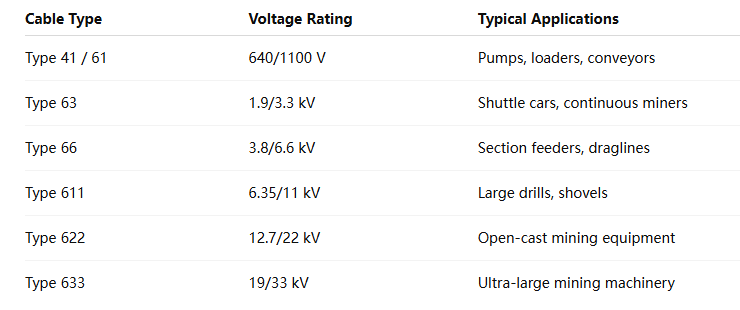
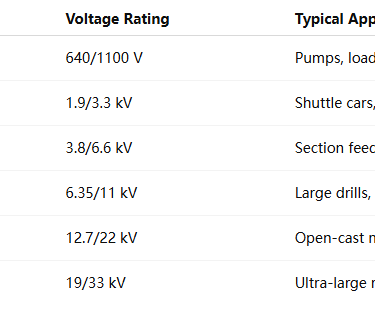
Typical SANS 1520 Cable Types and Applications
Construction Philosophy of SANS 1520 Cables
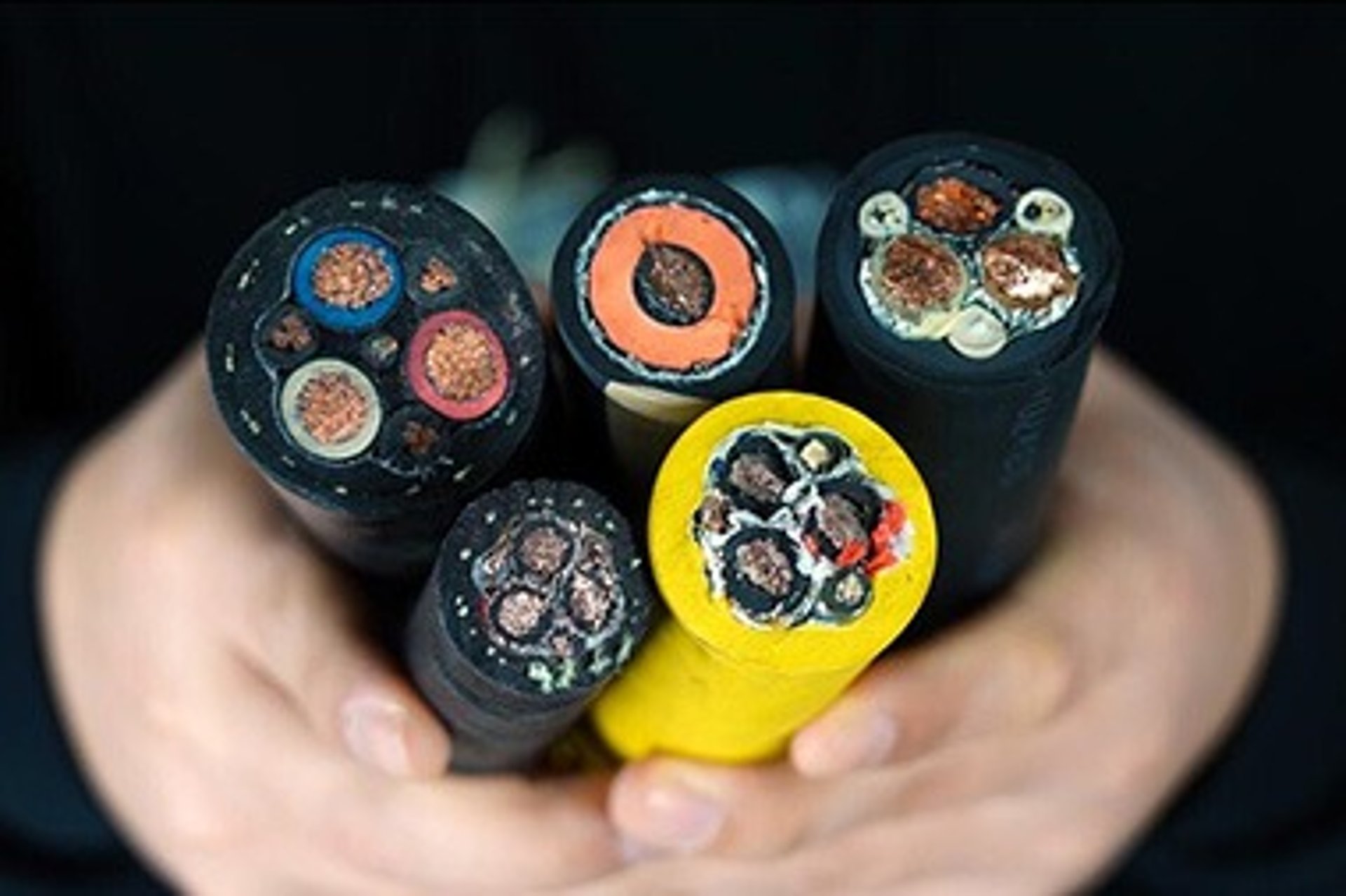
SANS 1520 cables are engineered for extreme duty cycles, with construction features that go beyond many international standards:
Class 5 tinned copper conductors for superior flexibility
EPR or XLPE insulation systems with high thermal endurance
Heavy-duty elastomeric sheaths (CR or TPU)
Mandatory pilot cores for earth continuity monitoring
Reinforcement systems, including textile braid, copper braid, and optional aramid (Kevlar)
This holistic approach integrates electrical performance, mechanical resilience, and safety monitoring into a single cable system.
Technical Comparison: BS 6708 vs SANS 1520
Voltage Coverage
BS 6708: Typically up to 3.3 kV, with limited 6.6 kV quarry types
SANS 1520: Comprehensive coverage from 640 V to 33 kV, including DC systems
Mechanical and Environmental Performance
BS 6708:
Optimised for standardized construction
Suitable for moderate mechanical stress
SANS 1520:
Designed for continuous reeling, dragging, torsion
Superior abrasion, moisture, and heat resistance
Safety and Monitoring Features
BS 6708:
Metallic screening for fault control
Limited pilot core integration
SANS 1520:
Mandatory pilot cores
Enhanced flame resistance, low smoke, low toxicity
Alignment with mine safety interlocking systems
Regulatory and Operational Context
BS 6708: Widely accepted but generally voluntary
SANS 1520: Legally enforced in South Africa and strongly preferred internationally for high-risk mining environments
Practical Applications in Mining Operations
South African Underground Platinum Mine (SANS 1520)
A deep-level platinum mine in Limpopo deployed Type 611 6.35/11 kV SANS 1520 trailing cables for mobile drilling rigs.
Results:
Improved uptime due to fatigue-resistant design
Reduced earth-fault incidents via pilot core monitoring
Extended cable service life beyond 10 years
Aggregate Quarry Operation (BS 6708)
A UK-based aggregate quarry selected BS 6708 Type 321 trailing cables for mobile crushers.
Benefits:
Standardised dimensions simplified spares management
Lower initial cost compared to heavy-duty mining cables
Suitable performance for controlled quarry conditions
Selecting the Right Standard for Your Mining Project
When BS 6708 Is Appropriate
Quarrying and aggregate operations
Low to medium voltage requirements
Moderate mechanical stress
Projects prioritising dimensional standardisation
When SANS 1520 Is Mandatory or Recommended
South African mining operations
Deep-level or high-risk underground mines
Medium- and high-voltage mobile equipment
Applications requiring pilot core protection
Key selection factors include:
Voltage level
Equipment mobility
Regulatory jurisdiction
Safety risk profile
Total lifecycle cost
Conclusion
Although BS 6708 and SANS 1520 both serve mining and quarrying industries, they reflect two fundamentally different engineering philosophies:
BS 6708 focuses on dimensional consistency and construction standardisation, making it ideal for quarrying and controlled mining environments.
SANS 1520 represents a holistic, safety-driven mining cable system, engineered for extreme conditions and long-term reliability.
Choosing the correct standard is not merely a technical decision—it is a strategic investment in safety, compliance, and operational continuity.
In harsh mining environments, the right cable standard is as critical as the machinery it powers.
Contact Anhui Feichun Special Cable Co., Ltd.
For comprehensive technical specifications and quotations, please contact our specialized mining cable engineering team:
Technical Engineering Support:
Sales Engineering Department:
WhatsApp Contact:
Manufacturer: Anhui Feichun Special Cable Co., Ltd. (安徽飞纯特种电缆有限公司)
Manufacturing Headquarters: Building A, Private Science and Technology Park, Hefei Economic and Technological Development Zone, Anhui Province, People’s Republic of China
+86 17333223430
Email Address: Li.wang@feichuncables.com
© 2025. All rights reserved.
One-click to Quickly Contact
Products
Contact
Company
Location:
Building A Private Science and Technology Park, Hefei Economic and Technological Development Zone, Anhui Province, China
Heat Resistant Cable
WhatsApp: +86 17333223430
Social Media: