Anhui Feichun Special Cable Co.,Ltd Email: Li.wang@feichuncables.com
BS7917 Fire-Resistant Offshore Cables: What Makes Them Essential in South Africa?
Explore the world of BS7917 fire-resistant offshore cables in South Africa, including TCu/MGT/EPR/CS/ZH/GSWB/ZH 150/250V, TCu/MGT/EPR/IS/ZH/GSWB/ZH 150/250V, and SW4 0.6/1kV cables. Learn about their construction, electrical properties, fire performance, and real-life South African case studies for safe offshore and marine operations.
Li Wang
12/8/20255 min read
Introduction
In South Africa, offshore platforms, marine vessels, and industrial units operate in harsh environments where fire safety is paramount. Electrical cables, often overlooked, play a critical role in ensuring operational safety and continuity. A fire in an offshore facility or on a vessel can have catastrophic consequences, not only for personnel but also for equipment and the environment.
This is where BS7917 fire-resistant cables come into play. Developed to maintain circuit integrity under fire conditions, these cables are engineered to withstand extreme temperatures while maintaining functionality. From Cape Town’s offshore supply vessels to Durban’s oil rigs and Mossel Bay gas platforms, the adoption of BS7917 cables is becoming standard practice.
Their importance in South Africa is underscored by increasing regulatory focus on fire safety, halogen-free materials, and low smoke emissions—particularly critical in confined spaces like ships and offshore installations. This article delves into the BS7917 standard, the cable types it governs, their technical and mechanical properties, and South African case studies illustrating real-world applications.
Understanding BS7917 Standard
BS7917, titled “Elastomer-insulated fire-resistant cables for fixed wiring in mobile and fixed offshore units,” was developed to ensure circuit integrity under fire conditions. Its origins stem from the limitations of BS6883, which covers offshore cables used in lighting, power, control, instrumentation, and propulsion circuits without fire-resistant properties.
In contrast, BS7917 specifies constructional requirements and testing procedures that enable cables to maintain functionality even in the event of a fire. Key fire performance classifications include:
F0: Fire resistance for 3 hours at 750°C
F1: Fire resistance for 3 hours at 950°C
The design principles that make BS7917 cables fire-resistant include multiple layers of tape, halogen-free insulation, durable armouring, and specially formulated sheaths.
For South African applications, the importance of halogen-free and low smoke emission cannot be overstated. Mines, offshore rigs, and industrial plants all benefit from reduced toxic gas emissions during fire incidents, protecting both personnel and equipment.
BS7917 is often used alongside BS7919, which covers medium-voltage fire-resistant cables, and complements BS6883, forming a comprehensive framework for offshore cable safety.
Overview of BS7917 Cable Types
BS7917 cables are classified according to outer sheath type and duty level. The three primary categories are:
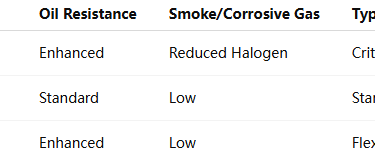
SW2: Heavy-duty, enhanced oil-resistant, flame retardant with reduced halogen gas emission. Ideal for critical power circuits.
SW3: Ordinary duty, oil-resistant, low smoke and corrosive gas emission. Suitable for standard power and control wiring.
SW4: Ordinary duty, enhanced oil-resistant, low smoke and gas emission. Designed for flexible multi-core installations.
Each type balances mechanical durability, oil resistance, and fire performance to suit different operational needs.
Detailed Specifications of Key Cables
TCu/MGT/EPR/CS/ZH/GSWB/ZH 150/250V Cable
Applications: Fixed wiring in ships and offshore units where fire safety is critical.
Construction:
Conductor: Class 5 tinned copper
Insulation: Halogen-free EPR
Separator: Mica glass tape
Screen: Collective aluminium polyester tape
Bedding: Halogen-free elastomer
Armour: Galvanized steel wire braid (GSWB)
Sheath: Halogen-free, heat and oil resistant elastomer
Electrical & Mechanical Properties:
Voltage rating: 150/250V
Temperature: -40°C to +90°C
Minimum bending radius: 6x overall diameter
Typical conductor resistance: 13.7–26.7 Ω/km depending on size
Ampacity: 15–339A depending on cores and cross-section
South African Case Study:
A Cape Town-based offshore supply vessel underwent retrofitting to comply with fire safety regulations. SW2 150/250V cables were installed in all critical power circuits, enhancing fire resilience while maintaining operational continuity.
TCu/MGT/EPR/IS/ZH/GSWB/ZH 150/250V Cable
Applications: Fire-resistant fixed wiring for ships and offshore installations, including instrumentation and control circuits.
Construction Differences:
Individual screening for sensitive instrumentation
Class 2 stranded conductors for sizes >2.5mm²
Enhanced bending radius: 10x overall diameter
Electrical & Mechanical Properties:
Voltage rating: 150/250V, test voltage 1.5kV
Temperature range: -40°C to +90°C
Ampacity and resistance values similar to SW2, adjusted for individual screening
South African Case Study:
On a Durban offshore oil rig, IS-type BS7917 cables were installed for fire-resistant instrumentation wiring. The individual screening ensured minimal electromagnetic interference, crucial for accurate sensor readings during critical operations.
TCu/MGT/EPR/ZH/GSWB/ZH 0.6/1kV SW4 Cable
Applications: Fixed wiring up to 1kV in ships and offshore units, including main power circuits.
Construction:
Conductor: Class 5 flexible or Class 2 stranded tinned copper depending on size
Insulation: Halogen-free EPR Type GP4
Bedding: Halogen-free elastomer Type SB1
Armour: GSWB
Sheath: Type SW4, flame retardant
Electrical Ratings:
Voltage rating: 0.6/1kV
Ampacity: Varies from 7–339A depending on core number and cross-section
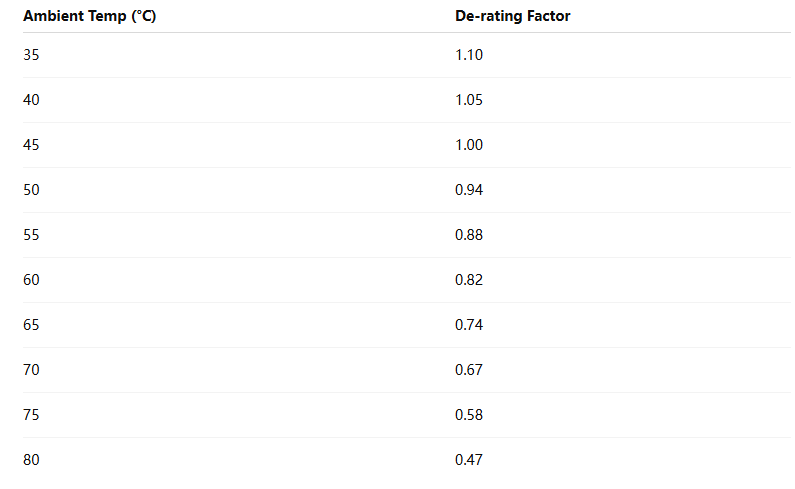
De-rating factors applied for ambient temperatures up to 80°C
South African Case Study:
At a Mossel Bay offshore gas platform, SW4 0.6/1kV cables were used for main power circuits. Fire integrity tests confirmed that circuits remained operational under simulated fire conditions, demonstrating compliance with BS7917 and enhancing crew safety.
Electrical and Mechanical Properties
BS7917 cables provide detailed specifications for electrical and mechanical properties:
Ampacity tables for single, 2-core, 3–4-core, and multi-core configurations
Maximum insulation resistance, inductance, and capacitance
L/R ratios at 1kHz for accurate impedance characterization
De-rating factors for high ambient temperatures common in South African offshore environments:
Comparing SW2, SW3, and SW4, SW2 offers the highest mechanical and fire performance, SW3 is optimized for cost-sensitive standard circuits, and SW4 balances flexibility with fire resistance for multi-core installations.
Fire Resistance and Safety Performance
BS7917 ensures compliance with F0 (750°C) and F1 (950°C) fire ratings, maintaining circuit integrity for at least 3 hours under extreme conditions.
Low smoke and halogen-free materials protect personnel from toxic gas inhalation.
Reduced corrosive emissions preserve sensitive electronic equipment.
Practical Scenario:
During a fire drill on a South African offshore platform, SW4 cables continued to operate critical communication and power circuits while nearby conventional cables failed, validating the efficacy of BS7917 in harsh conditions.
Installation Considerations
When installing BS7917 cables, careful attention is required:
Bending radius: Maintain minimum 4–10x overall diameter depending on type and cross-section
Mechanical protection: Armour and sheaths must be handled to prevent abrasion
Jointing & termination: Use compatible fire-resistant materials
Environmental factors: High humidity, saltwater exposure, and elevated temperatures in South African offshore regions must be considered
Correct installation preserves both fire-resistant and mechanical performance.
Common Questions and Answers (FAQ)
Can BS7917 cables be used in underground mining?
While primarily designed for offshore and marine environments, they can be used in mining where fire integrity is critical.What is the difference between SW2, SW3, and SW4?
SW2 is heavy-duty, SW3 is ordinary duty, and SW4 is ordinary duty with enhanced flexibility and multi-core support.Are these cables suitable for high-voltage applications above 1kV?
No, BS7917 cables are typically rated up to 1kV. Higher voltage applications require BS7919 or other standards.How do halogen-free materials affect fire safety?
They reduce toxic gas and smoke emissions, protecting personnel and equipment.How to select the right conductor size for offshore installations?
Based on ampacity tables, circuit load, ambient temperature, and derating factors.How are these cables tested for fire resistance?
Through BS7917-mandated fire tests at 750°C (F0) and 950°C (F1) for 3 hours.Can South African suppliers provide locally certified BS7917 cables?
Yes, several suppliers in Cape Town, Durban, and Mossel Bay provide BS7917-compliant cables.Maintenance tips:
Regular inspection for mechanical damage, proper termination, and avoiding excessive bending or abrasion.
South African Case Studies
Case Study 1: Cape Town Offshore Supply Vessel
Retrofit with SW2 150/250V cables
Enhanced crew safety and compliance with fire regulations
Case Study 2: Durban Offshore Oil Rig
Installation of IS-type 150/250V cables for instrumentation
Ensured minimal interference and fire-resistant integrity
Case Study 3: Mossel Bay Gas Platform
SW4 0.6/1kV cables for main power circuits
Fire drill tests confirmed operational integrity during simulated fires
Lessons Learned: Compliance with BS7917 ensures both fire safety and operational continuity, critical in South African offshore environments.
Summary & Recommendations
BS7917 cables provide fire resistance, halogen-free insulation, flame retardancy, and low smoke emission, making them essential for offshore and marine operations in South Africa. Key takeaways:
SW2 – Heavy-duty, critical circuits
SW3 – Ordinary duty, cost-effective standard circuits
SW4 – Flexible, multi-core, main power circuits
For South African engineers and installers:
Prioritize fire-resistant, halogen-free cables in critical circuits
Consider local environmental conditions when selecting cables
Future trends: Integration with smart monitoring systems for real-time fire safety and circuit integrity
The adoption of BS7917-compliant cables in South Africa ensures safety, compliance, and operational reliability in challenging offshore, marine, and industrial environments.

Contact Anhui Feichun Special Cable Co., Ltd.
For comprehensive technical specifications and quotations, please contact our specialized mining cable engineering team:
Technical Engineering Support:
Sales Engineering Department:
WhatsApp Contact:
Manufacturer: Anhui Feichun Special Cable Co., Ltd. (安徽飞纯特种电缆有限公司)
Manufacturing Headquarters: Building A, Private Science and Technology Park, Hefei Economic and Technological Development Zone, Anhui Province, People’s Republic of China
+86 17333223430
Email Address: Li.wang@feichuncables.com
© 2025. All rights reserved.
One-click to Quickly Contact
Products
Contact
Company
Location:
Building A Private Science and Technology Park, Hefei Economic and Technological Development Zone, Anhui Province, China
Heat Resistant Cable
WhatsApp: +86 17333223430
Social Media: