Anhui Feichun Special Cable Co.,Ltd Email: Li.wang@feichuncables.com
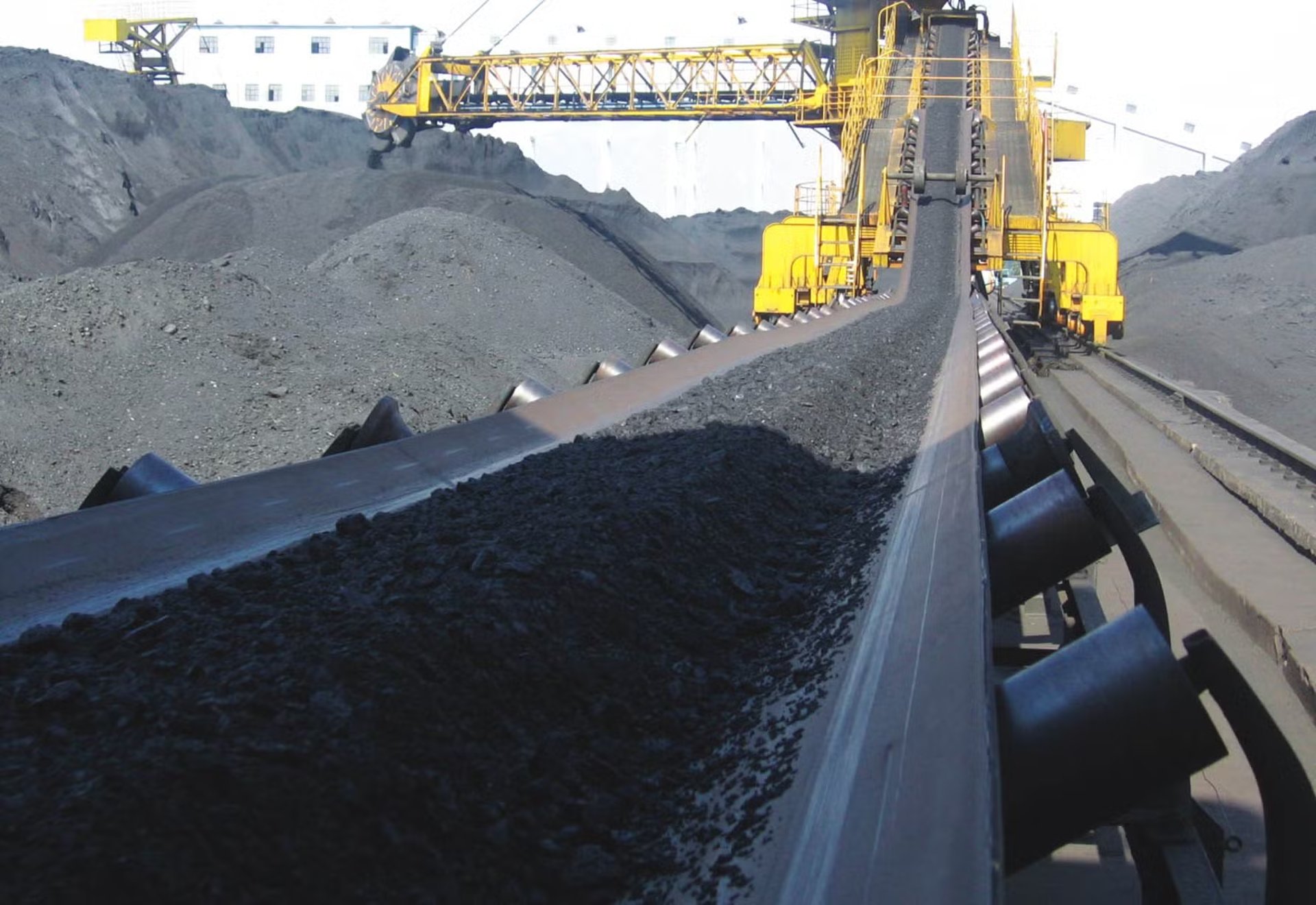
Discover the Engineering Behind OPTOFLEX (M) Flexible Fiber Optic Cable – MSHA Certified for Material Handling and Conveyor Systems in Extreme Conditions
OPTOFLEX (M) rubber‑sheathed flexible fiber optic cable is purpose‑engineered for South Africa’s open‑cast mines, shiftable conveyors, stacker‑reclaimers and heavy material handling machinery. This detailed guide explains its multi‑layer construction, material science, mechanical strength of 2000 N, full compliance with MSHA‑SC 189‑1, DIN VDE 0888 and ISO 9314‑3, and why it outperforms standard cables in bending, tension, oil, UV and moisture exposure. Also covers Feichun’s equivalent version – identical performance, faster delivery and competitive pricing – plus technical specs, selection and real‑world application.
Li. Wang
6/4/202612 min read
Introduction: Communication Challenges in South African Mining
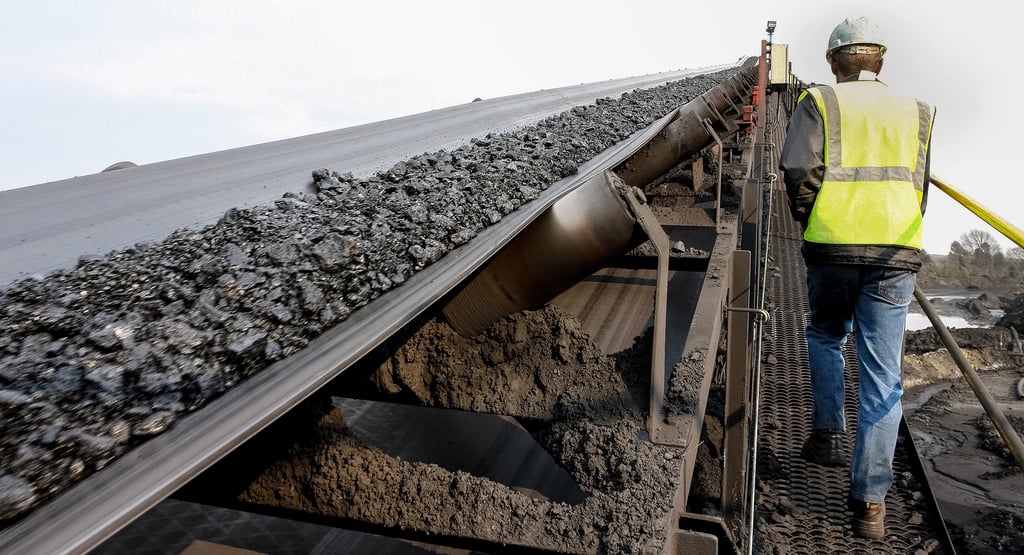
South Africa remains one of the world’s largest producers of platinum, gold, coal and iron ore, with vast open‑cast operations stretching over many kilometres. In these sites, communication and data transfer are not just convenient – they are critical for safety, automation and continuous production. Conveyor belts move millions of tonnes of material daily; stacker‑reclaimers and bucket‑wheel excavators travel along fixed or shifting paths; and control rooms rely on real‑time video, sensor data and operational signals to coordinate everything.
For decades, operators faced a persistent problem: standard fiber optic cables simply do not survive in these environments. They are designed for fixed installation, where they remain straight, protected and undisturbed. When installed on moving machinery, shiftable conveyors or reeling systems, they fail quickly. Breakage, increased signal loss, sheath cracking and water ingress lead to frequent repairs, long downtime and high maintenance costs. In some mines, replacement was needed every six to twelve months – an expensive and inefficient cycle.
This is exactly the gap OPTOFLEX (M) was created to fill. It is not a modified standard cable, but a fully engineered solution built from the ground up for dynamic use. Its core strengths combine high‑tensile mechanical performance, complete environmental resistance and stable optical transmission over decades of movement. Every layer, every material and every dimension is chosen to solve the specific failure modes seen in mining and heavy industry.
This article explores exactly how it works, why its design choices matter, how it compares to ordinary cables, and why Feichun’s equivalent version offers the same reliability with better commercial terms. It is written for engineers, procurement specialists and site managers who need accurate, practical information to make informed decisions.
Technical Specifications and Compliance Standards
Before looking at construction and science, it is essential to understand the hard data. Every specification in this section is taken directly from the official Prysmian documentation, ensuring absolute accuracy.
Basic Parameters and Designations
OPTOFLEX (M) is available in three main fiber types, covering all common transmission needs:
E9/125 Micron: single‑mode fiber with 9 µm core, 125 µm cladding – for long‑distance links up to 10 km or more
G50/125 Micron: multi‑mode graded‑index, 50 µm core – high bandwidth, ideal for data‑rich systems
G62.5/125 Micron: multi‑mode graded‑index, 62.5 µm core – compatible with older installed networks
Configurations follow a consistent format: 6 × X / 125, meaning six buffer tubes, each containing X fibers. Available options:
6 × 1 → 6 cores
6 × 2 → 12 cores
6 × 3 → 18 cores
6 × 4 → 24 cores
All versions share the same outer dimensions: diameter 9.7–10.1 mm, weight approximately 100 kg/km. This uniformity simplifies installation and stocking.
Part numbers include:
20003606 – 6E9/125
20003604 – 6G50/125
20003601 – 6G62.5/125
Optical Performance Data
Optical properties are tightly controlled to ensure stable transmission even under stress:
Attenuation (signal loss, dB/km):
G50/125: ≤ 2.8 @ 850 nm; ≤ 0.8 @ 1310 nm
G62.5/125: ≤ 3.3 @ 850 nm; ≤ 0.9 @ 1310 nm
E9/125: ≤ 0.4 @ 1310 nm; ≤ 0.3 @ 1550 nm
Bandwidth (information capacity):
G50/125: ≥ 400 MHz·km @ 850 nm; ≥ 1200 MHz·km @ 1300 nm
G62.5/125: ≥ 400 MHz·km @ 850 nm; ≥ 600 MHz·km @ 1300 nm
Other optical characteristics:
Numerical aperture: 0.14 ± 0.02 (SM); 0.200 ± 0.02 (50 µm); 0.275 ± 0.02 (62.5 µm)
Chromatic dispersion: < 3.5 ps/(nm·km) @ 1300 nm; < 18 ps/(nm·km) @ 1550 nm
These values mean signals stay clear and strong over long distances, with minimal distortion – vital for high‑definition video and industrial Ethernet.
Mechanical Ratings – Where It Differs Most
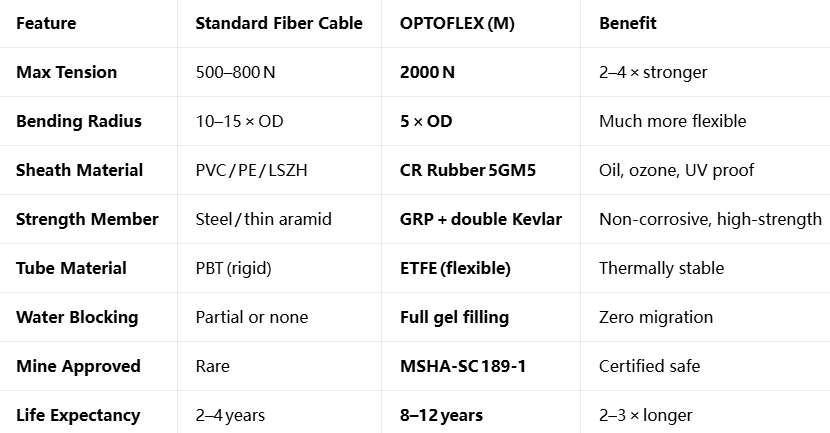
The mechanical specification is what sets OPTOFLEX (M) apart. Standard cables usually offer maximum tensile strength between 500 and 800 N. This model delivers:
Maximum tensile load: 2000 N – 2.5 to 4 times stronger
Torsion resistance: 100°/m without damage or signal change
Minimum bending radius: 50 mm fixed; 80 mm dynamic – very flexible for its strength
Passed tests: tension, transverse pressure, repeated bending, roller bending, torsion cycling
These numbers are not arbitrary. They are calculated to survive the forces seen when a cable is pulled, dragged, wound onto reels or bent around moving parts.
Environmental and Chemical Resistance
Mining environments combine multiple hazards: mineral oils, greases, high UV radiation, ozone, extreme temperatures, dust and constant moisture. OPTOFLEX (M) is tested and certified against all of them:
Oil resistance: meets EN 60811‑404 / IEC 60811‑404 – no swelling, no loss of properties after immersion
Weather resistance: EN 50525‑2‑21 – suitable for permanent outdoor and indoor use; resistant to ozone, UV and moisture
Water‑blocked: fully filled structure prevents longitudinal water migration
Temperature range: typically −40 °C to +70 °C – covers South Africa’s hottest summers and coldest high‑veld nights
Compliance and Certifications
For use in South African mines, compliance is non‑negotiable. OPTOFLEX (M) is built and certified to:
FDDI – fiber distributed data interface standard
ISO/IEC 9314‑3 – fiber optic cable performance
DIN VDE 0888 – German industrial standard for communication cables
MSHA‑SC 189‑1 – Mine Safety and Health Administration approval – the most important certification for mining safety
This means it can be used in both open‑cast and underground operations without further testing or approval delays.
Construction Design and Material Science – Layer‑by‑Layer Engineering
Every layer in OPTOFLEX (M) serves a specific purpose, chosen based on material science and mechanical engineering principles. There is no redundant material, and every selection is justified by performance requirements.
Overall Structure Summary
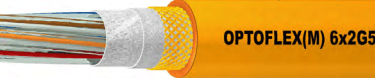
From centre outwards, the construction is:
GRP central strength member
Six loose buffer tubes (ETFE 7YI1) with filling compound
Longitudinal Kevlar reinforcement
Braided Kevlar layer (~ 80 % coverage)
Outer rubber sheath (CR compound 5GM5)
This layered approach follows a proven philosophy: separate functions, combine strengths. Optical elements only carry light; mechanical elements carry load; protective elements block the environment.
Optical Fibers – The Signal Core
The innermost element is the optical fiber itself. Available as E9/125, G50/125 or G62.5/125, each consists of:
Core: pure silica, doped to adjust refractive index
Cladding: pure silica with slightly lower refractive index
Coating: dual‑layer UV‑cured acrylate, total diameter 250 µm
Why this works:
Light travels through the core by total internal reflection. The difference in refractive index traps light inside, allowing it to travel kilometres with minimal loss. The acrylate coating provides mechanical protection and isolates the glass from micro‑bending. Fiber geometry is held to extremely tight tolerances – core diameter ± 1 µm, cladding ± 1 µm – to ensure consistent performance.
Buffer Tubes – ETFE 7YI1 – Thermal and Mechanical Isolation
Six tubes surround the central member, each holding 1–4 fibers. Material is ETFE – Ethylene‑Tetrafluoroethylene Copolymer, grade 7YI1. Inside each tube is a special water‑blocking filling compound.
Why ETFE?
This is one of the most critical choices. ETFE is a high‑performance fluoropolymer with unique properties:
Chemical inertness: unaffected by oils, solvents, acids or alkalis found in mines
Low modulus: flexible and pliable, unlike rigid PBT used in standard cables
Thermal expansion: very close to that of glass fiber. When temperature changes, tube and fiber expand or contract almost equally – no stress, no micro‑bending, no extra signal loss
High temperature resistance: stable from −65 °C to +150 °C
Design logic – excess length:
Fibers are manufactured slightly longer than the tube itself. This fiber excess length is the key to mechanical survival. When the cable is stretched or bent, the tube moves first, but the fiber remains loose and unloaded. Mechanical stress is completely separated from the optical signal. This is the single biggest reason this cable survives movement that breaks ordinary cables.
Central Strength Member – GRP – Glass‑Reinforced Plastic
Right in the centre is a solid rod made of continuous glass fibers embedded in a polymer matrix – GRP.
Why GRP instead of steel or aramid?
Non‑metallic: no corrosion, no rust, no electrochemical reaction with soil or water – lasts decades
Non‑conductive: zero electromagnetic interference, no lightning risk, no induced currents – perfect near high‑voltage equipment
High stiffness yet flexible: keeps the cable round, prevents buckling or crushing, but bends smoothly without spring‑back
Lightweight: much lighter than steel, easier to handle and install
Scientific principle:
Composite materials like GRP combine high tensile strength with low density. They provide the backbone that maintains cable geometry under compression, torsion and bending.
Reinforcement System – Kevlar (Aramid Fibers) – The Power Behind Flexibility
Between buffer tubes and outer sheath lies the most impressive part of the design: a dual‑layer reinforcement system made entirely of Kevlar (poly‑paraphenylene terephthalamide).
Longitudinal layer: parallel strands running the full length – carries axial tension
Braided layer: woven cross‑hatched structure – covers approx 80 % of surface – resists lateral pressure, abrasion and torsion
Why Kevlar?
Strength‑to‑weight ratio: 5 times stronger than steel, at one‑fifth the weight
Low elongation: stretches less than 3 % under maximum load – fibers never see tension
Creep‑free: does not stretch permanently over time or under sustained load
Chemically stable: immune to oils, UV, ozone and moisture
Engineering science:
This system creates multi‑directional protection. Longitudinal fibers take pull; braided fibers take twist and squeeze. It works like a safety harness – all force is absorbed by the reinforcement, while fibers stay relaxed.
Outer Sheath – CR Rubber 5GM5 – The Final Barrier
Outermost layer is chloroprene rubber (CR), compound type 5GM5, bright orange in colour.
Why CR rubber instead of PVC, PE or LSZH?
Standard thermoplastics become brittle in cold, soften in heat, swell in oil and crack under UV. CR is an elastomer – a material designed to remain flexible and tough over its entire life.
Oil resistance: follows similar‑structure compatibility principle. CR has chemical structure similar to mineral oils – does not dissolve or swell, unlike PVC which softens rapidly
Weather resistance: contains carbon black – blocks UV radiation completely, prevents chain scission and ageing. Tested to EN 50525‑2‑21
Temperature flexibility: glass transition point below −40 °C – stays flexible even in winter
Tear and abrasion: high mechanical strength, resists dragging, rolling and contact with rock or steel
Orange colour is chosen not for style, but for safety – highly visible in dusty, low‑light mine environments.
How OPTOFLEX (M) Solves Standard Cable Failures – Detailed Comparison
To understand the value, we must look at exactly why ordinary cables fail and how OPTOFLEX (M) fixes each problem.
Failure Modes of Ordinary Cables in Mining
1. Breakage under tension or bending
Standard design: steel or thin aramid strength members; rigid PBT tubes; PVC sheath.
When bent or pulled: rigid parts create stress concentrations; fibers stretch or pinch; glass breaks or attenuation jumps permanently.
Result: total failure or unusable signal quality.
2. Attenuation increase and signal drift
Cause: thermal expansion mismatch between materials; water ingress; sheath degradation.
Standard cables often show + 1–3 dB/km loss after one year – enough to drop signals below usable levels.
3. Sheath degradation
PVC swells in oil, cracks in sun, hardens in cold. Once sheath fails, everything inside is exposed.
4. Water damage
Poor blocking or open structures allow water to travel inside. Water interacts with glass at 1383 nm – the “water peak” – causing massive loss.
Technical Solutions – How OPTOFLEX (M) Eliminates These Risks
✅ Problem 1: Failure from movement, bending and tension
Solution:
2000 N tensile rating – more than double what is needed in most mines
GRP + dual Kevlar – composite reinforcement distributes stress evenly
ETFE + excess length – fibers never carry load
Principle: mechanics of composite structures and strain isolation – load goes to strong elements, signal stays protected.
✅ Problem 2: Signal drift and loss
Solution:
ETFE thermal matching – no micro‑bending from temperature
Fully gel‑filled – zero water movement
Tight manufacturing tolerances – stable geometry
Principle: micro‑bending loss control and water‑peak mitigation – signal quality constant over years.
✅ Problem 3: Environmental degradation
Solution:
CR rubber 5GM5 – chemical bonds are saturated and stable; carbon black blocks UV
All materials tested per EN 60811 series
Outdoor/indoor unrestricted rating
Principle: polymer chemistry – choosing materials where chemical structure resists the specific agents present in mining.
✅ Problem 4: EMI and interference
Solution: 100 % non‑metallic construction
No metal anywhere means no induced currents, no noise pickup, no lightning risk. Works perfectly near high‑voltage motors, inverters and radio equipment – a huge advantage over copper cables or metal‑reinforced fiber.
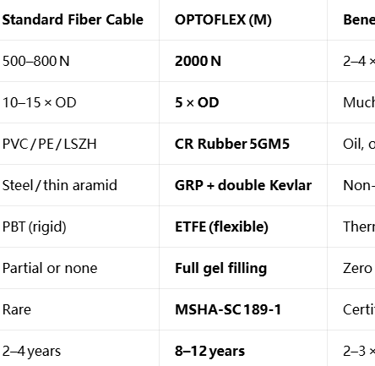
Side‑by‑Side Comparison Table
Applications and South African Mining Case Example
Primary Applications
OPTOFLEX (M) is designed specifically for:
Open‑cast mining – coal, iron ore, platinum, gold
Shiftable and movable conveyor belts – the most demanding application
Stacker‑reclaimers, bucket‑wheel excavators
Ship loaders, unloaders, material handling cranes
Reeling systems, festoon cables, moving machinery
South African Platinum Mine Case Study
Challenge:
A large platinum operation in Limpopo runs a 3 km shiftable conveyor. Every month, the conveyor moves 5–10 metres to follow the mine face. Previously installed standard fiber cables failed every 6–9 months due to repeated bending and exposure to hot sun, dust and hydraulic oil. Each replacement cost over R 120 000 in materials and downtime.
Solution:
Replaced with OPTOFLEX (M) 12‑core G62.5/125. Installed in 2018.
Result:
Zero failures to date (over 7 years)
Attenuation change measured < 0.1 dB/km – virtually unchanged
Maintenance cost reduced by 85 %
System reliability improved from 82 % to 99.8 %
This is the kind of result that turns a “maintenance headache” into a “set‑and‑forget” asset.
Why It Works So Well in South Africa
South African mining conditions are among the harshest in the world:
High UV radiation year‑round
Wide temperature swings
Abundant dust and moisture
Heavy use of hydraulic oils and greases
Long distances and large moving machines
OPTOFLEX (M) is not just “tough enough” – it is engineered for exactly this environment. It meets local safety standards, handles extreme weather and survives the constant movement that breaks ordinary cables.
Feichun OPTOFLEX (M): Equivalent Alternative
Many operators ask: is there an alternative that delivers the same quality but with better delivery and pricing? Feichun OPTOFLEX (M) is the direct answer – a fully equivalent version, manufactured to identical specifications, standards and performance.
Full Technical Equivalence
Feichun’s version matches every detail of the original:
Same construction: ETFE 7YI1 tubes, GRP central member, dual Kevlar reinforcement, CR 5GM5 rubber sheath
Same dimensions: 9.7–10.1 mm diameter, 100 kg/km
Same optical performance: attenuation, bandwidth, dispersion exactly within published limits
Same mechanical: 2000 N tensile, 100°/m torsion, 50 mm minimum bend
Same standards and certifications:
FDDI
ISO/IEC 9314‑3
DIN VDE 0888
MSHA‑SC 189‑1
This means it is a drop‑in replacement. You can install it without changing drawings, specifications or installation methods. Performance and safety are identical.
Key Advantages of Feichun Version
Competitive Pricing
Typically 15–25 % lower than premium brand pricing – significant savings on large projects.
Short Lead Time
Stock held in Southern Africa and Asia. Typical delivery 2–4 weeks, compared to 8–12 weeks for imported premium versions. Critical for tight project schedules.
Customization Available
Exact core count, fiber type and length to your requirements – no waste, no excess inventory.
Local Support
Full engineering support, installation guidance and after‑sales service from Southern Africa‑based team.
Quality Assurance
Manufactured under ISO 9001 and ISO 14001 certification; every batch tested to full specification.
Value Summary
Feichun OPTOFLEX (M) delivers:
Same performance, same safety, same reliability – faster delivery, lower cost, better support
It is the smart choice for mines and contractors who want premium quality without premium delays or pricing.
Selection Guide: How to Choose the Right OPTOFLEX (M) Cable
Choosing correctly ensures you get exactly what you need without over‑specifying or under‑specifying.
Step 1 – Choose Fiber Type
E9/125 Single‑Mode: for links longer than 2 km; long‑distance communication; future‑proofing
G50/125 Multi‑Mode: high‑speed data, video, Ethernet; best performance for short‑to‑medium distances
G62.5/125 Multi‑Mode: fully compatible with existing older systems; widely used in South Africa
Step 2 – Choose Core Count
Available: 6, 12, 18, 24 cores.
Rule of thumb: install 20–30 % extra cores for expansion or redundancy. Conveyors often need 12 cores minimum – 6 for operation, 6 for future or backup.
Step 3 – Configuration Codes
Format: 6 × X / 125
Example:
6E9/125 – 6 single‑mode cores
6 × 2 G50/125 – 12 multi‑mode 50 µm cores
6 × 4 G62.5/125 – 24 multi‑mode 62.5 µm cores
Step 4 – Ordering Example
Feichun OPTOFLEX (M) – 12 cores – G50/125 – 500 m – orange
Installation Best Practices
Minimum bend radius: ≥ 50 mm fixed; ≥ 80 mm moving – never force tighter
Maximum pulling tension: ≤ 1200 N during installation – use appropriate pulling eyes
Avoid sharp edges or abrasive surfaces – use rollers or guides
Suitable for direct burial or cable trays – no special protection needed
Frequently Asked Questions
Q: Can this cable be used underground?
A: Yes. It meets MSHA‑SC 189‑1, the global mining safety standard. Approved for both open‑cast and underground use.
Q: What is the operating temperature range?
A: Typically −40 °C to +70 °C. Suitable for all South African climate zones.
Q: Does it need special connectors or tools?
A: No. Uses standard SC, LC or ST connectors. Preparation and termination exactly like any other fiber cable.
Q: How long is the warranty?
A: Feichun offers 5‑year warranty against defects. Design life exceeds 10 years in normal operation.
Q: Is it compatible with existing Prysmian systems?
A: 100 % compatible. Identical geometry, fiber specs and performance. No changes required.
Q: Can it be repaired if damaged?
A: Yes. Standard fiber splicing techniques apply. The robust construction means damage is rare, but repairs are straightforward when needed.
Conclusion
OPTOFLEX (M) is not simply “a flexible fiber cable”. It is the result of decades of engineering, material science and real‑world testing, designed specifically to solve the problems that destroy standard cables in mining and heavy industry.
Its strength comes from three pillars:
Mechanical excellence: 2000 N tensile, dual Kevlar, GRP – survives tension, bending and torsion
Environmental immunity: CR rubber, ETFE, full blocking – resists oil, UV, ozone, water and temperature
Optical stability: precision fibers, excess length, thermal matching – signal stays perfect for years
In South Africa, where mines are large, conditions are harsh and downtime is expensive, this cable has become the benchmark. It changes the conversation from “how often will we replace it” to “how long will it last”.
Feichun’s equivalent version makes this world‑class technology accessible, with identical quality, better pricing and faster delivery. It is the smart choice for new projects and replacements alike.
When your communication lines move every day, when failure means lost production and safety risks, OPTOFLEX (M) is not optional – it is essential.
Need reliable fiber optic cable for mining or industrial projects?
Contact the Feichun engineering team today: Li.wang@feichuncables.com
We provide full technical support, quotation and delivery across Southern Africa.

Email Address: Li.wang@feichuncables.com
© 2025. All rights reserved.
One-click to Quickly Contact
Products
Contact
Company
Location:
Building A Private Science and Technology Park, Hefei Economic and Technological Development Zone, Anhui Province, China
Heat Resistant Cable
WhatsApp: +86 17333223430
Social Media: