Feichun TENAX M Medium Voltage Reeling Cable
The TENAX M Medium Voltage Reeling Cable for Demanding Mobile Equipment in Mining and Construction
TENAX M Medium Voltage Reeling Cable
Application | Medium voltage reeling cable as power feeder cable for large mobile equipment such as excavators and spreaders, construction machines, etc. Specialized for reeling applications with mono-spiral reels and cylindrical reels with single plane guiding systems. | |
Global Data | Brand | Feichun TENAX-M |
Type Designation | (N)TSCGEWOEU | |
Standard | Based on DIN VDE 0250-813 | |
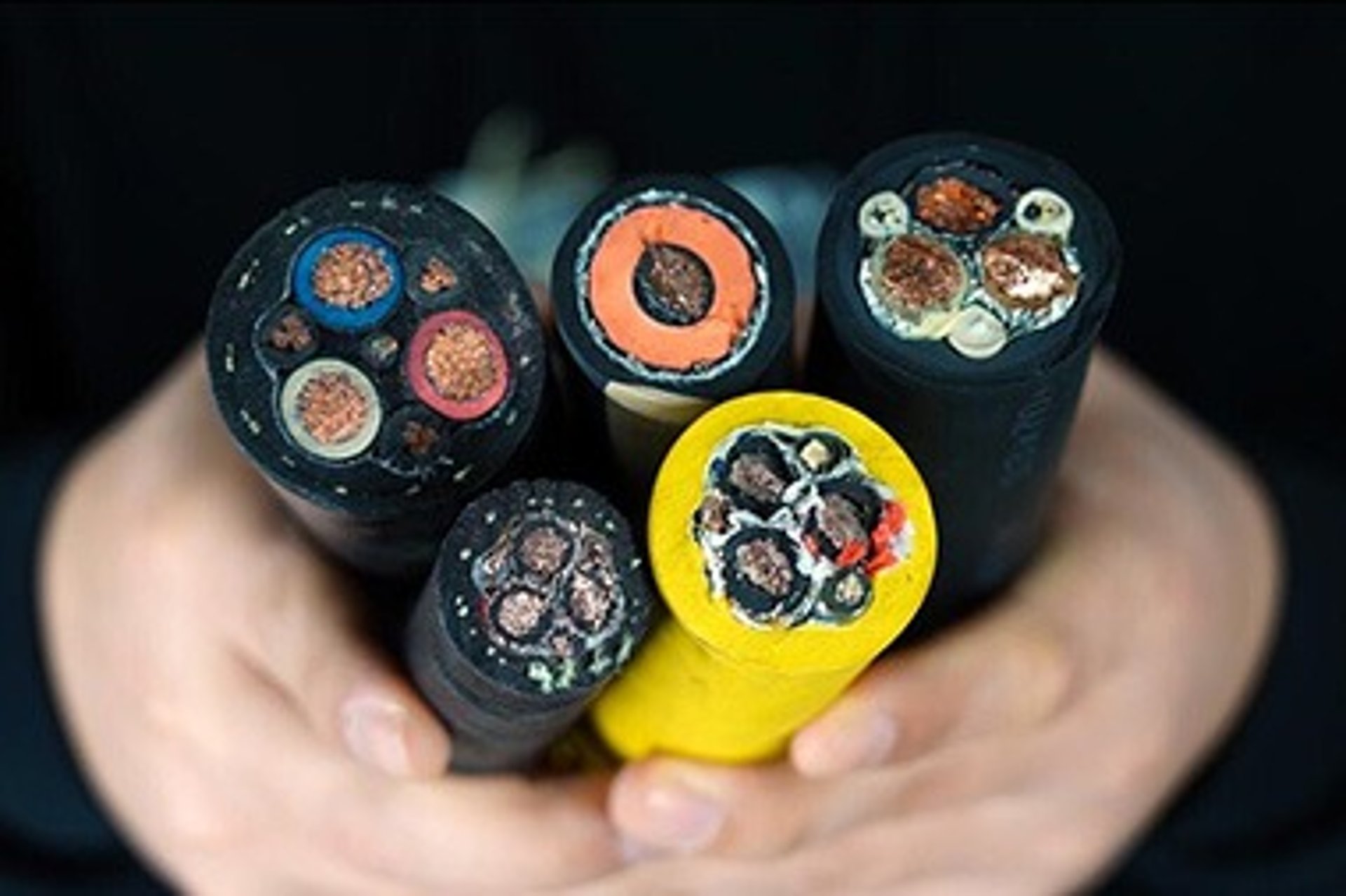
Design Features | Conductor | Plain copper, finely stranded, class 5 according to DIN EN 60228 / VDE 0295 |
Insulation | Rubber, Compound type: 3GI3 | |
Electrical Field Control | Inner and outer layer of semiconductive rubber compound | |
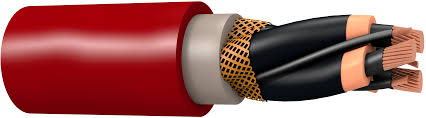
Core Arrangement | Cores layed up around conductive filler with aramid rope in the center | |
Inner Sheath | Rubber, special compound, mechanical properties acc. to 5GM3 | |
Outer Sheath | Abrasion and tear-proof special rubber compound, quality better 5GM3 acc. to DIN VDE 0207 part 21, resistance to ozone, UV, and oil | |
Sheath Color | Red or Black | |
Electrical Parameters | Rated Voltage | 3.6/6 kV |
Maximum Permissible Operating Voltage AC | 4.2/7.2 kV | |
Maximum Permissible Operating Voltage DC | 5.4/10.8 kV | |
AC Test Voltage | 11 kV | |
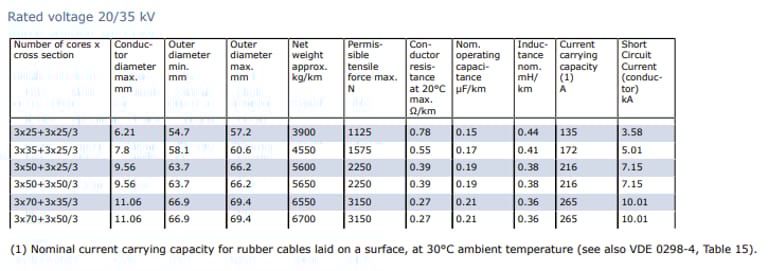
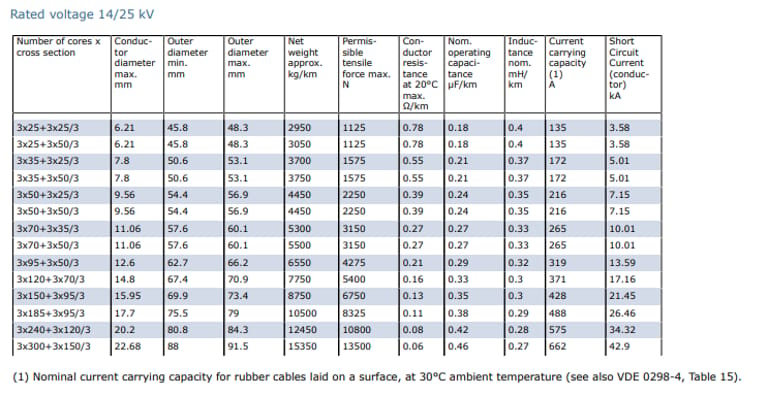
Additional Voltages (Rated / Max AC / Max DC / Test) | 6/10 kV, 6.9/12 kV, 9/18 kV, 17 kV 8.7/15 kV, 10.4/18 kV, 13.5/27 kV, 24 kV 12/20 kV, 13.9/24 kV, 18/36 kV, 29 kV 14/25 kV, 17.3/30 kV, 22.5/45 kV, 36 kV 18/30 kV, 20.8/36 kV, 27/54 kV, 43 kV 20/35 kV, 24.2/42 kV, 31.5/63 kV, 50 kV | |
Chemical Parameters | Resistance to Fire | EN 60332-1, IEC 60332-1 |
Resistance to Oil | EN 60811-404, IEC 60811-404 | |
Weather Resistance | Unrestricted use outdoors and indoors, resistant to ozone, UV, and moisture | |
Thermal Parameters | Max. Permissible Temperature at Conductor | 90 °C |
Max. Short Circuit Temperature of Conductor | 250 °C | |
Ambient Temperature for Fixed Installation (Min/Max) | -40 °C / 80 °C | |
Ambient Temperature in Fully Flexible Operation (Min/Max) | -25 °C / 60 °C | |
Mechanical Parameters | Max. Tensile Load of Cable | 15 N/mm² |
Torsional Stress | 50 °/m | |
Bending Radii (Min) | Acc. to DIN VDE 0298 part 3 | |
Minimum Distance with S-type Directional Changes | 20 x D | |
Travel Speed | Up to 30 m/min | |
Mechanical Parameters | Tensile Load on Conductor (Max) | 20 N/mm² |
Max. Tensile Load on Conductor During Acceleration | 25 N/mm² | |
Torsional Stress | 100 °/m | |
Bending Radii (Min) | Acc. to DIN VDE 0298 part 3 | |
Minimum Distance with S-type Directional Changes | 20 x D | |
Travel Speed (In Operation / On Rewinding) | Up to 60 m/min / Up to 100 m/min | |
Additional Tests | Reversed bending test, torsional stress test, roller bending test (type C) |
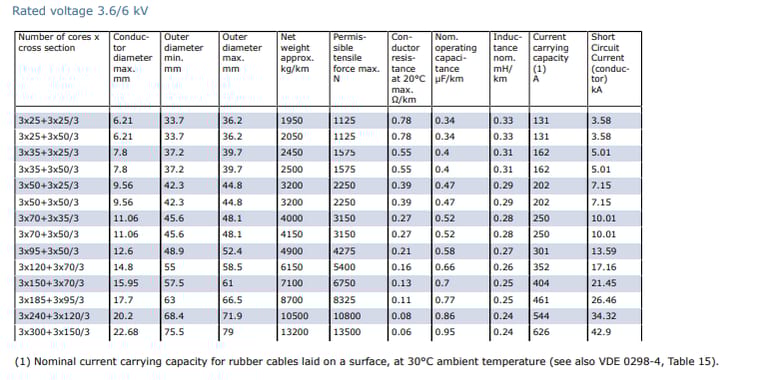
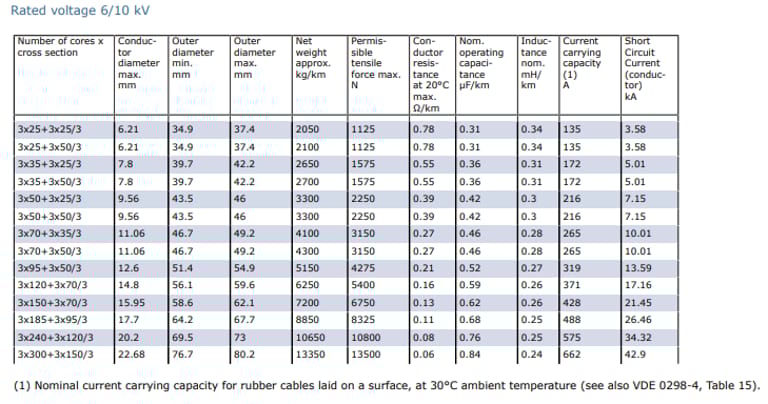
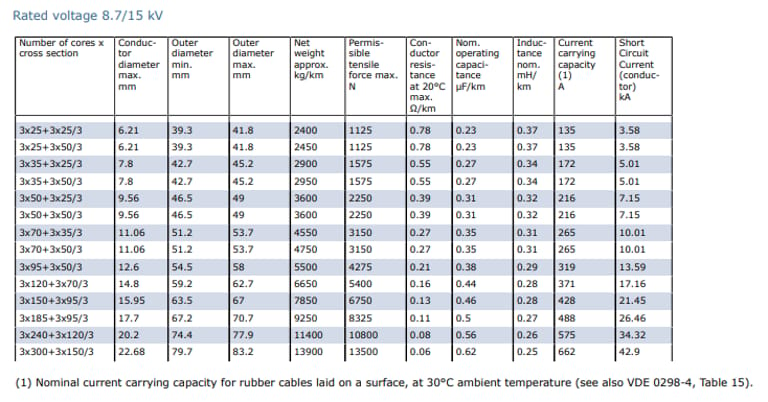
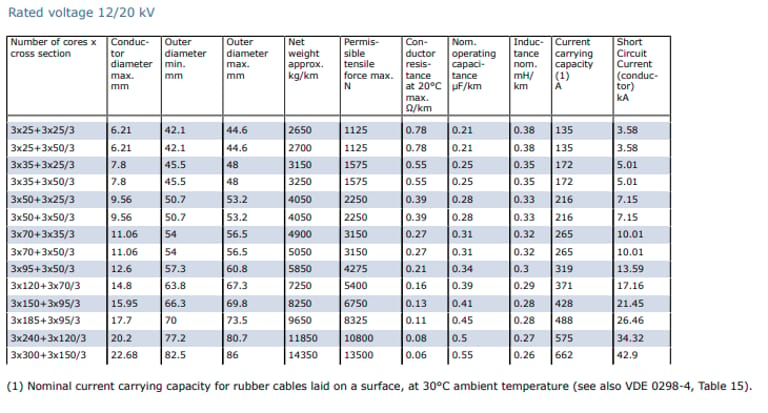
Enter the TENAX M Medium Voltage Reeling Cable, a specialized engineering marvel designed to deliver electricity to large mobile equipment like excavators, spreaders, and construction machinery. This cable isn't just a wire—it's a lifeline engineered for the harshest environments, ensuring uninterrupted operation in reeling systems that wind and unwind as machines move. Based on rigorous standards like DIN VDE 0250-813, the TENAX M stands out for its durability, flexibility, and resistance to extreme conditions.
Advantages of the TENAX M Medium Voltage Reeling Cable
The TENAX M's advantages stem from its blend of robustness and adaptability, setting it apart in cable technology. First, its mechanical resilience shines in high-stress applications. With a max tensile load on the conductor of 20 N/mm² (25 N/mm² under acceleration), it withstands the pulls and jerks of heavy machinery. Torsional stress tolerance up to 100°/m prevents twisting failures, common in lesser cables during reeling.
Durability is another key edge. The outer sheath's superior abrasion and tear resistance, coupled with oil, ozone, and UV protection, extends service life in harsh settings like dusty mines or oily construction sites. This reduces replacement frequency, cutting costs and environmental impact—aligning with sustainability trends.
Electrically, the semiconductive layers ensure even field distribution, minimizing partial discharges that degrade insulation over time. High voltage ratings (up to 50 kV options) support powerful equipment without upsizing cables, optimizing space on reels.
Flexibility in temperature extremes—from Arctic-like -40°C to sweltering 80°C—makes it versatile globally, including South Africa's varied climates. Fire resistance per international standards adds safety, crucial in confined spaces like underground mines.
Economically, faster travel speeds (up to 100 m/min rewinding) boost productivity. Without integrated fiber-optics (as in PROTOLON(M)-R variants), it focuses purely on power, simplifying installations and lowering costs for non-data needs.
In essence, the TENAX M offers reliability that translates to operational efficiency, safety, and cost savings—advantages that resonate in industries facing rising energy demands and regulatory pressures.
Usage Scenarios for TENAX M in Real-World Applications
The TENAX M excels in scenarios involving large mobile equipment requiring medium voltage power via reeling systems. Primary uses include mining excavators and spreaders, where cables feed power as machines traverse vast pits. In construction, it powers cranes and drilling rigs on sites with constant repositioning.
Ports and material handling benefit too; stacker-reclaimers in bulk terminals use it for seamless power during stacking and reclaiming. In renewable energy, it's suited for mobile wind turbine maintenance equipment or solar farm trackers needing flexible power.
South Africa's industrial landscape amplifies these scenarios. With its mining sector contributing over 7% to GDP, TENAX M-like cables are vital for open-pit operations in the Witwatersrand Basin or platinum mines in Rustenburg. Here, reeling cables endure dust, vibrations, and high loads from bucket-wheel excavators.
Emerging trends include electrification of mining fleets to reduce diesel emissions, aligning with South Africa's Just Energy Transition. TENAX M supports hybrid or electric excavators, providing medium voltage for high-power needs without fixed infrastructure.
In manufacturing, it's used in automotive plants for robotic arms on rails, ensuring power during assembly line movements. Overall, any setup with mono-spiral or cylindrical reels benefits from its design, preventing kinks and failures.
Frequently Asked Questions About TENAX M Medium Voltage Reeling Cable
What voltage ratings does TENAX M support? It covers a wide range, from 3.6/6 kV to 20/35 kV, with specifics like 6/10 kV, 8.7/15 kV, up to 27/54 kV and 50 kV options, making it adaptable for various medium voltage needs.
How does it handle extreme temperatures? For fixed installations, it operates from -40°C to 80°C; in flexible mode, -25°C to 60°C. Conductor max is 90°C, short-circuit 250°C—ideal for diverse climates.
Is it suitable for outdoor use in South Africa? Absolutely, with unrestricted weather resistance to ozone, UV, and moisture, perfect for sunny savannas or rainy coasts.
What are the mechanical limits? Tensile load up to 25 N/mm² during acceleration, torsional stress 100°/m, bending per DIN VDE 0298, and speeds to 100 m/min rewinding.
How does it compare to cables with fiber-optics? TENAX M focuses on power without optics, simplifying for pure reeling power applications, though variants like PROTOLON(M)-R offer optics if needed.
Can it resist fire and oil? Yes, compliant with EN 60332-1 for fire and EN 60811-404 for oil, enhancing safety in industrial settings.
What maintenance is required? Regular inspections for abrasion; its durable sheath minimizes needs, but follow VDE guidelines for reeling systems.
The TENAX M Medium Voltage Reeling Cable embodies the fusion of innovation and practicality, powering the giants of industry with unmatched reliability. From its finely stranded conductors to its weather-proof sheath, it addresses the demands of modern machinery while offering advantages in durability, efficiency, and safety. In South Africa, where mining and renewables drive progress amid challenges like energy shortages, such cables are transformative.
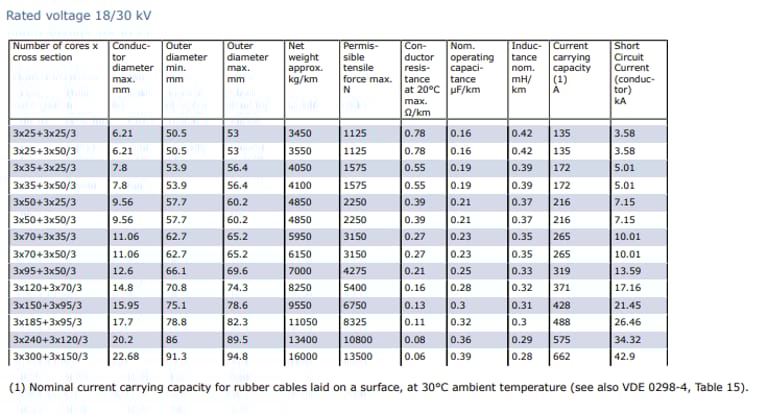
Rated voltage 18/30 kV
Rated Voltage 20/35 kV