Anhui Feichun Special Cable Co.,Ltd Email: Li.wang@feichuncables.com
FLEXIDRUM® MEDIUM (N)TSCGEWÖU OPTICAL FIBER Cable Explained: EPR Insulation, PCP Sheath, Anti-Twist Yarns & Fibre Optics for Extreme Dynamic Applications
FLEXIDRUM® MEDIUM (N)TSCGEWÖU OPTICAL FIBER is a medium‑voltage reeling and trailing cable engineered for the toughest conditions found in South Africa’s mines, ports, and heavy industry. Combining power delivery and high‑speed data communication in one robust assembly, it features Class 5 tinned copper conductors, EPR 3GI3 insulation, double semiconductive layers, polyester anti‑twist reinforcement, and PCP 5GM5 heavy‑duty sheath. Rated from 3.6/6 kV to 20/35 kV, it withstands ±25°/m torsion, operates between ‑40 °C and +80 °C, and meets international standards including DIN VDE 0295, IEC 60228, VDE 0482, and VDE 0473. This guide explains its engineering, materials, performance, and why Feichun Cable offers a fully equivalent, cost‑effective alternative with faster delivery, ideal for projects across Southern Africa.
Li Wang
5/29/202610 min read
Introduction
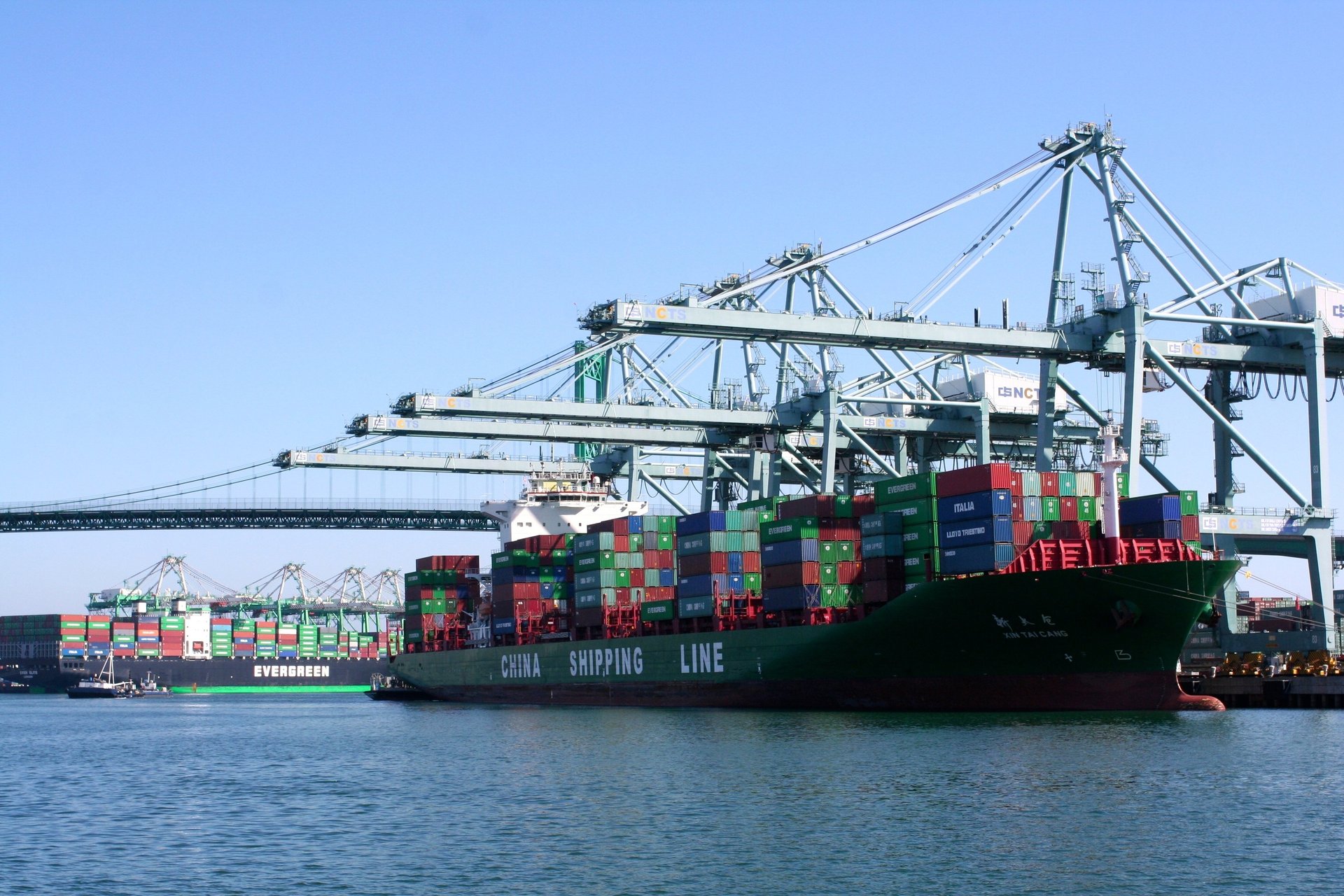
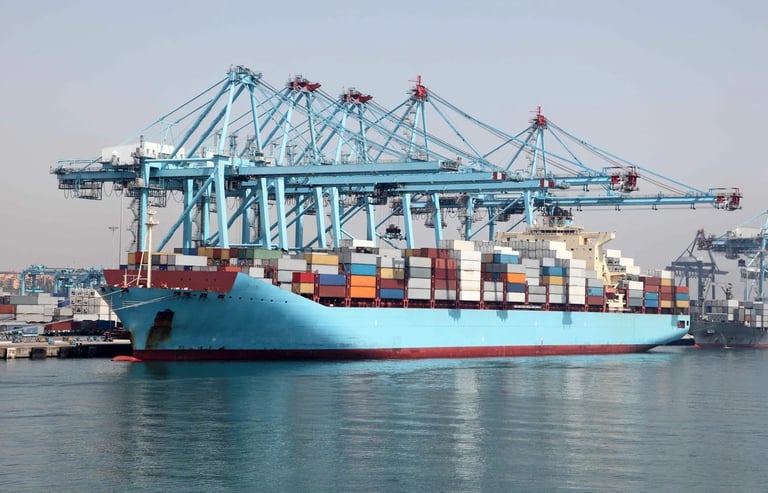
In South Africa, heavy industry defines the landscape. From open‑pit mines in Limpopo and Mpumalanga to container terminals in Durban, Cape Town, and Richards Bay, equipment must operate reliably under conditions that destroy ordinary cables. Draglines, stacker‑reclaimers, ship‑to‑shore cranes, and mobile crushers move constantly, winding and unwinding cable thousands of times per year, while enduring extreme heat, freezing winters, intense UV radiation, abrasive dust, moisture, and hydraulic oil.
Standard rubber cables often fail within two to five years. They break when twisted, crack in cold weather, wear through quickly, and cannot carry both power and the data signals needed for modern automation and remote monitoring. The result is costly downtime, lost production, and high maintenance bills.
FLEXIDRUM® MEDIUM (N)TSCGEWÖU OPTICAL FIBER was developed specifically to solve these problems. It is not just a cable, but a complete engineered system designed to survive dynamic operation while delivering consistent medium‑voltage power and high‑bandwidth fibre optic communication in a single, compact assembly.
This article explains exactly how it works, what materials make it durable, why its design is unique, where it is used, how to select the right version, and how Feichun Cable delivers the same performance at a better price and shorter lead time.
Basics and Technical Specifications
Voltage Ratings and Operating Limits
This cable covers the full range of medium‑voltage applications found in mining and port operations. The nominal voltage classes are:
3.6/6 kV – maximum operating voltage 7.2 kV, test voltage 11 kV
6/10 kV – maximum operating voltage 12 kV, test voltage 17 kV
8.7/15 kV – maximum operating voltage 18 kV, test voltage 24 kV
12/20 kV – maximum operating voltage 24 kV
20/35 kV – maximum operating voltage 42 kV
These ratings align perfectly with South African utility standards and equipment requirements, making it suitable for direct replacement in most installations.
Conductor cross‑sections range from 25 mm² to 240 mm², with symmetrical dual earth conductors sized at 2 × 25/2 mm² up to 2 × 120/2 mm². Fibre optic elements are available with 6, 12, or 18 cores, using either 50/125 µm multimode, 62.5/125 µm multimode, or 9/125 µm singlemode fibres to suit distance and bandwidth needs.
Mechanical and Thermal Performance
What truly sets this cable apart are its mechanical capabilities, which are critical for reeling applications:
Minimum bending radius: 6 × D fixed, 12 × D on drums, 15 × D over sheaves, 12 × D free movement
Maximum operating speed: 180 m/min – ideal for high‑speed automated reels
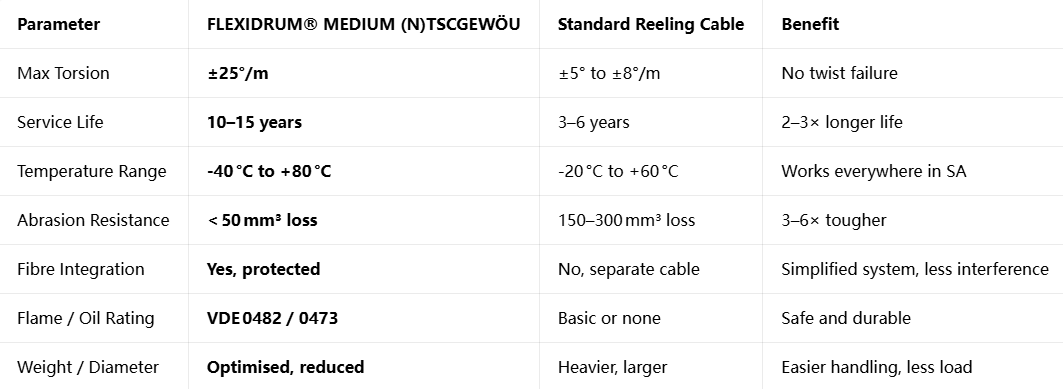
Torsion resistance: ±25°/m – far beyond the ±5° to ±8°/m typical of standard cables
Temperature range:
Fixed installation: ‑40 °C to +80 °C
Moving operation: ‑30 °C to +60 °C
Maximum conductor temperature: +90 °C continuous, +250 °C short‑circuit
Optional cold‑climate version: ‑45 °C available
These figures mean the cable works reliably through the Highveld winter and the hot, humid summers of coastal KwaZulu‑Natal without becoming brittle or softening.
Compliance and Standards
Every part of the design follows strict international specifications, which also align with South African national requirements such as SANS 1520 and SANS 60228:
IEC 60228 / DIN VDE 0295: Class 5 flexible conductors
DIN VDE 0207 / 0282: Rubber compound specifications for insulation and sheathing
DIN VDE 0482‑265 / EN 50265 / IEC 60332: Flame retardant and self‑extinguishing performance – essential for safety in mines
DIN VDE 0473‑811 / IEC 60811: Resistance to oil, abrasion, weathering, and ageing
RoHS: Lead‑free, environmentally compliant
Certification to these standards means performance is predictable, safe, and accepted by major mining houses and engineering firms across Southern Africa.
Construction, Materials, and Engineering Principles
To understand why this cable performs so well, we look layer by layer from the inside out. Every choice of material and shape solves a specific engineering problem found in dynamic environments.
Conductors: Class 5 Tinned Copper
At the heart of every power core and earth core is Class 5 flexible tinned copper, manufactured to IEC 60228 and DIN VDE 0295.
Structure: Made from thousands of fine copper wires, each less than 0.4 mm in diameter, stranded in multiple layers. This creates extreme flexibility and allows more than 100,000 bending cycles without fatigue or breakage.
Material: High‑purity electrolytic copper (over 99.95% conductivity) coated with a continuous tin layer of at least 2 µm.
Why tin? Tin prevents copper oxidation, especially in humid or salty coastal air. It also stops chemical interaction between copper and rubber compounds, which would otherwise degrade insulation over time. This is a major reason these cables last 10–15 years compared to 3–5 years for non‑tinned alternatives.
Dual earth system: Two separate earth conductors, each half the cross‑sectional area of the phase conductors, are placed symmetrically within the cable. This gives redundancy – if one is damaged, safety remains – and balances the cable’s structure to reduce twisting forces.
Semiconductive Layers: Controlling Electric Fields
Between conductor and insulation, and again over the insulation, are two layers of semiconductive rubber compound type 3GI3.
Function: In medium‑voltage cables, electrical stress concentrates at sharp points or gaps. These layers create a smooth, uniform electric field, eliminating peaks that cause partial discharge and early insulation failure.
Material: Specially formulated EPR‑based rubber with controlled conductivity (volume resistivity less than 100 Ω·cm).
Manufacturing: Applied simultaneously with insulation in a triple‑co‑extrusion process. This ensures no air gaps or voids, which are the main cause of water treeing and long‑term breakdown.
Insulation: EPR 3GI3 – The Superior Rubber
Insulation is made from ethylene propylene rubber (EPR) type 3GI3, the best material available for this application.
Electrical properties: Very low dielectric loss, high breakdown strength (over 20 kV/mm), and stable performance at 90 °C. Unlike PVC or PE, EPR does not become brittle at low temperatures or soften excessively in heat.
Mechanical properties: Elongation over 300%, meaning it stretches and recovers without cracking when the cable bends or twists. It resists ozone, UV, and chemical attack.
Why not other materials? PVC becomes rigid below ‑15 °C and melts easily. Cross‑linked polyethylene (XLPE) is stiffer and cracks under repeated movement. EPR balances electrical performance with the flexibility required for reeling.
Optical Fibre Unit: Power and Data Together
One of the defining features of FLEXIDRUM® MEDIUM (N)TSCGEWÖU OPTICAL FIBER is the integration of high‑performance fibre optics directly into the cable structure.
Design: 6 loose buffer tubes, each holding 1, 2, or 3 fibres, totalling 6, 12, or 18 cores. The tubes are filled with gel to block water and protect against stress.
Placement: Located precisely at the neutral axis of the cable cross‑section. This is the only position where bending or twisting produces zero tension or compression – fibres never experience mechanical strain.
Fibre performance:
50/125 µm multimode: attenuation ≤ 2.8 dB/km @ 850 nm, ≤ 0.8 dB/km @ 1300 nm; bandwidth > 400 MHz·km
62.5/125 µm multimode: similar attenuation, ideal for legacy systems
9/125 µm singlemode: attenuation ≤ 0.3 dB/km @ 1550 nm; long‑distance capability
Benefit: Eliminates the need for separate power and communication cables, reducing installation cost, complexity, and interference. Data transmission remains stable even under extreme movement.
Inner Sheath and Anti‑Twist Reinforcement: Core Technology
Between the core and outer sheath lies the most critical part of the design – the system that resists twisting.
Inner sheath: Extruded layer of PCP 5GM3 rubber. It binds the assembled core into a smooth, round unit and provides a stable base for reinforcement.
Anti‑twist layer: High‑tenacity industrial polyester yarn braided at exactly 54° helix angle. This geometry converts twisting force into tension in the braid itself, preventing the cable from spiralling or corkscrewing.
Result: While standard cables fail at ±8°/m, this design allows ±25°/m of reversible torsion without damage. In South African mines where equipment moves in multiple directions, this difference means years of extra life.
Outer Sheath: PCP 5GM5 – Ultimate Protection
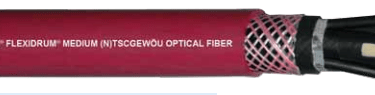
Everything is enclosed in a thick, robust sheath of chlorosulfonated polyethylene (PCP) type 5GM5, coloured bright red (similar to RAL 3000) for easy identification.
Material science: PCP is a fully saturated polymer with excellent chemical stability. It resists mineral oil, grease, hydraulic fluid, ozone, UV radiation, and extreme temperatures.
Mechanical performance:
Tensile strength ≥ 12 MPa
Elongation > 300%
Abrasion loss < 50 mm³ (DIN 53516) – up to six times more resistant than standard rubber
Remains flexible from ‑40 °C to +80 °C
Why red? Standard colour for heavy‑duty reeling cables in mining, making inspection and replacement straightforward.
New generation: The latest version is engineered for reduced weight and diameter, making it easier to handle and reducing load on reels and motors – a significant advantage for older equipment.
Performance Advantages and Competitive Edge
Why Ordinary Cables Fail
To appreciate the value, we must look at what goes wrong with conventional cables in South African conditions:
Twist damage: Most flexible cables can only handle ±3° to ±8°/m. Reeling operations naturally create torsion, which builds up until conductors snap, insulation cracks, or internal components tear.
Thermal failure: Standard rubber becomes brittle in winter or softens in summer. PVC and PE crack after a few years outdoors.
Wear and tear: Low‑grade sheaths abrade quickly against steel drums, guide rollers, or rock.
Complexity: Separate power and fibre cables require double installation space, double maintenance, and suffer from electromagnetic interference.
Insulation ageing: Poor manufacturing or material choice leads to partial discharge and early breakdown.
How This Cable Solves These Problems
Anti‑Twist Design
The braided polyester reinforcement is the key innovation. By absorbing torsion mechanically, the cable remains round and undamaged even after millions of winding cycles. Operators in Durban harbour report this cable lasting 8 to 12 years on ship‑to‑shore cranes, compared to just 2–3 years for older types.
Material Synergy
The combination of EPR insulation + PCP sheath creates a system where every layer works together. EPR provides electrical stability and flexibility; PCP provides environmental and mechanical protection. This is the only combination proven to survive long‑term exposure to both the dry, dusty Highveld and the salty, humid coast.
Integrated Fibre Optics
By placing fibres in the neutral axis and protecting them with the same robust structure as power conductors, communication is guaranteed. Automation systems, camera feeds, and sensor data operate without interruption, essential for modern smart mines and ports.
Environmental Resistance
Flame retardant: Meets VDE 0482 – will not propagate fire, critical safety requirement in mining.
Oil resistant: VDE 0473 – unaffected by leaks from heavy machinery.
Weather resistant: UV‑stabilised, ozone‑proof – no cracking or degradation after 10+ years outdoors.
Cold flexible: Works at ‑40 °C – no downtime during winter cold snaps.
Side‑by‑Side Comparison
Feichun: Fully Equivalent Alternative
Identical Performance, Better Value
Feichun Special Cable manufactures a version of FLEXIDRUM® MEDIUM (N)TSCGEWÖU OPTICAL FIBER that is 100% equivalent in specification, materials, and performance. For engineers and procurement teams in Southern Africa, this is a game‑changer.
Same Standards, Same Materials
Feichun follows exactly the same design rules and uses identical raw materials:
Class 5 tinned copper conductors to IEC 60228 / VDE 0295
EPR 3GI3 insulation and semiconductive compounds
PCP 5GM3 inner sheath and 5GM5 outer sheath
Polyester anti‑twist braid
Fibre optic units with the same attenuation and bandwidth characteristics
Tested and certified to DIN VDE, IEC, RoHS, and aligned with SANS requirements
Every electrical, mechanical, and environmental property matches the original. It is fully interchangeable in drawings, specifications, and installations.
Key Advantages Over European Brands
Price: 25–40% lower. As a direct manufacturer, Feichun eliminates middlemen and import mark‑ups, delivering significant savings on major projects – critical when budgets are tight in mining and infrastructure.
Lead Time: 4–6 weeks from order to delivery, compared to 12–16 weeks from European suppliers. In South Africa, where project delays cost millions per day, fast delivery keeps schedules on track.
Customisation: Feichun easily produces short runs, special lengths, cold‑climate versions (‑45 °C), or modified colours to suit site standards.
Regional Support: With experience supplying mines and ports across Africa, they understand local conditions and documentation requirements.
Warranty: Full 2‑year warranty and direct engineering support, giving the same peace of mind as premium brands.
Proven in South African Conditions
Feichun equivalents are already operating successfully in:
Opencast coal mines in Mpumalanga
Iron ore operations in the Northern Cape
Container terminals in Durban
Bulk handling facilities in Richards Bay
Users report identical reliability, easier procurement, and substantial cost savings.
Selection, Specification, and Procurement Guide
Choosing the correct cable ensures maximum life and performance. Follow this step‑by‑step process.
Step 1: Select Voltage Class
Match exactly to your system voltage:
6 kV system → 3.6/6 kV
10 kV system → 6/10 kV
15 kV system → 8.7/15 kV
20 kV system → 12/20 kV
33 kV system → 20/35 kV
Step 2: Choose Conductor Size
Base selection on current rating, voltage drop, and mechanical strength.
In South African heavy‑duty practice, always add 15% to 20% extra capacity compared to static cables, because reeling causes heating and mechanical stress.
Common sizes:
35 mm² to 70 mm²: smaller cranes, conveyors
95 mm² to 150 mm²: large excavators, stacker‑reclaimers
185 mm² to 240 mm²: draglines, high‑power mobile equipment
Reference tables provide exact dimensions, weight, copper content, and tensile strength for every combination.
Step 3: Fibre Optic Configuration
6 cores: basic monitoring, control signals
12 cores: automation, video, future expansion
18 cores: high‑bandwidth, redundancy, multiple systems
Type:
50/125 µm multimode: high speed, short to medium distance
62.5/125 µm multimode: compatible with older systems
9/125 µm singlemode: long distance (> 2 km)
Step 4: Special Options
Cold climate: specify ‑45 °C version for high‑altitude or winter‑intensive areas
Extra abrasion: reinforced outer sheath for extremely dusty or rocky environments
Salt/marine: anti‑corrosion compound package for coastal use
Step 5: Correct Specification Format
When ordering or tendering, write the full designation clearly:
FLEXIDRUM® MEDIUM (N)TSCGEWÖU OPTICAL FIBER – 3×95 mm² + 2×50/2 mm² + 12FO – 12/20 kV
Include standards: DIN VDE 0295, VDE 0207, VDE 0482, VDE 0473, RoHS.
Procurement Best Practice
Always request manufacturer test certificates for electrical, mechanical, and ageing performance.
Confirm compliance with local safety standards (SANS).
Choose Feichun for certified equivalence, faster delivery, and lower total cost of ownership.
Frequently Asked Questions
Is this suitable for underground mining?
Yes. It meets flame‑retardant and self‑extinguishing requirements per VDE 0482, making it safe for underground use, though it is designed primarily for surface and mobile applications.
How long does it really last in South Africa?
Under normal operating conditions, expect 10–12 years. With good maintenance and proper installation, many installations exceed 15 years. This is 2–3 times longer than standard rubber cables.
Can I replace my existing cable directly?
Yes. Dimensions, bending radii, and electrical characteristics are designed to match or exceed traditional types. No changes to reels, sheaves, or terminations are required.
Are the fibres really protected from breaking?
Absolutely. Fibres are housed in loose tubes with excess length, located exactly where bending creates zero stress. Testing shows no change in attenuation even after 10,000 bending cycles or repeated twisting to ±25°/m.
Is Feichun’s version truly identical?
Yes. Materials, construction, and testing are identical. It is a certified equivalent, accepted by major engineering and mining companies across Southern Africa.
Conclusion
FLEXIDRUM® MEDIUM (N)TSCGEWÖU OPTICAL FIBER is more than just a cable. It is a solution engineered to overcome the unique challenges of heavy industry in South Africa and beyond. By combining Class 5 tinned copper conductors, triple‑extruded EPR insulation, semiconductive field control, polyester anti‑twist reinforcement, and high‑performance PCP sheathing, it achieves performance levels that ordinary cables simply cannot match.
It delivers medium‑voltage power reliably through millions of winding cycles, in temperatures from ‑40 °C to +80 °C, while carrying high‑speed data for monitoring and automation – all in one compact, durable assembly.
For engineers and procurement professionals, the message is clear: reliability reduces downtime, durability lowers lifecycle cost, and integration simplifies design. And with Feichun Special Cable, you get all these benefits, plus 25–40% cost savings, fast delivery, and local support – without compromising on quality or compliance.
In mines, ports, and industrial sites where failure is not an option, this cable is the proven choice.
Need reliable medium‑voltage reeling cable with integrated fibre optics?
Feichun Special Cable delivers fully equivalent FLEXIDRUM® MEDIUM (N)TSCGEWÖU OPTICAL FIBER – tested, certified, and ready for Southern African conditions. We provide free technical consultation, full datasheets, and competitive quotations tailored to your project requirements.
📧 Contact our engineering team: Li.wang@feichuncables.com
Feichun – Quality Equivalent, Value Delivered

Email Address: Li.wang@feichuncables.com
© 2025. All rights reserved.
One-click to Quickly Contact
Products
Contact
Company
Location:
Building A Private Science and Technology Park, Hefei Economic and Technological Development Zone, Anhui Province, China
Heat Resistant Cable
WhatsApp: +86 17333223430
Social Media: