Anhui Feichun Special Cable Co.,Ltd Email: Li.wang@feichuncables.com
From Structure to Application: Deep Dive into BS 6708 TYPE 211 Mining Cables
Discover the technical and operational advantages of BS 6708 TYPE 211 mining cables in South African mining operations. Explore structure, applications, specifications, safety, and real-world case studies in gold, platinum, and coal mines.
Li Wang
12/16/20256 min read
Introduction
In the high-stakes world of mining, power supply reliability and operational safety are non-negotiable. Among the numerous components that keep South African mines running smoothly, flexible trailing cables are a critical link between power sources and mobile equipment. One of the most respected types in industrial and mining applications is the BS 6708 TYPE 211 cable.
Originally designed for mechanically protected trailing applications, this cable excels in environments where flexibility, durability, and resistance to mechanical and environmental stress are paramount. In South Africa, where mines face extreme conditions such as high humidity, dust, temperature fluctuations, and heavy mechanical loads, BS 6708 TYPE 211 has proven itself as a reliable backbone of electrical distribution underground.
This article aims to provide a comprehensive, technical yet readable guide on BS 6708 TYPE 211, its structure, materials, applications, installation practices, and practical insights drawn from South African mining operations. Engineers, maintenance managers, and mining professionals will gain a deeper understanding of why this cable remains a preferred choice in challenging mining environments.
Cable Overview and Applications
Flexible Trailing Cable Concept
BS 6708 TYPE 211 is classified as a flexible trailing cable, which means it is specifically designed to withstand repeated bending, twisting, and traction forces associated with mobile equipment. Unlike fixed installations, trailing cables in mines must accommodate the continuous movement of machinery, such as:
Trolley conveyors
Coal face lighting systems
Mobile pumps and drilling units
Quarry machinery and mine roadway extension equipment
The flexibility of BS 6708 TYPE 211 is achieved through its unique conductor stranding, layered insulation, and pliable armouring, which allow the cable to bend repeatedly without compromising its electrical or mechanical integrity.
Key Applications in South Africa
In the South African context, BS 6708 TYPE 211 finds extensive application in:
Gold Mines (Witwatersrand Basin): Supplying lighting and conveyor belts in deep underground tunnels, where mechanical stress and high humidity are constant challenges.
Platinum Mines (Rustenburg and North West Province): Powering mobile drilling rigs and ore handling equipment with mechanically protected cabling systems.
Coal Mines (Mpumalanga): Trailing cables for conveyor systems and lighting in quarries and open-cast operations.
Advantages of BS 6708 TYPE 211 in South African Mining Conditions
High mechanical resilience: The steel wire armouring and heavy-duty outer sheath protect against abrasion, crushing, and impact.
Flexibility: Maintains performance in repetitive bending scenarios, essential for trolley and trailing operations.
Environmental resistance: Performs reliably in humid, dusty, and chemically aggressive mine environments.
Compliance and safety: Meets BS 6708 and local SANS/NRCS standards, ensuring regulatory compliance.
Cable Structure
The design of BS 6708 TYPE 211 demonstrates careful engineering to balance flexibility, protection, and electrical performance.
Conductor
The cable uses electrolytic, stranded, tinned copper (IEC 60228 Class 5). Stranding allows flexibility, while tinning enhances corrosion resistance, particularly important in the humid underground mines of South Africa. Class 5 conductors offer high conductivity while maintaining pliability, ideal for repeated motion.
Insulation
Ethylene Propylene Rubber (EPR) provides the insulating layer around each conductor. Key benefits:
High dielectric strength: Reduces electrical faults.
Flexibility at low temperatures: Critical for deep mining operations.
Mechanical resistance: Protects against minor abrasions during handling.
Screening
Each phase core is protected by a tinned copper / nylon braided screen, which improves:
Electromagnetic compatibility (EMC)
Fault detection and safe operation in proximity to sensitive equipment
The ground core remains unscreened, providing efficient grounding without compromising flexibility.
Layup and Bedding
All cores are laid in contact, minimizing overall cable diameter and enhancing flexibility.
Rubber-based bedding compound stabilises cores and provides internal mechanical protection.
Armouring
The pliable galvanised steel wire armour safeguards the cable against crushing, impact, and heavy mechanical stress while maintaining enough flexibility for trailing applications. Armouring ensures long service life even under rigorous South African mining conditions.
Outer Sheath
The heavy-duty chloroprene outer sheath offers:
Resistance to abrasion and mechanical wear
Protection against oils, water ingress, and chemicals
UV and weathering resistance for surface and open-cast installations
This combination of layers ensures the cable is both robust and flexible, meeting the operational demands of South African mines.
Materials Analysis
A deeper understanding of the materials used in BS 6708 TYPE 211 highlights why this cable is highly suitable for demanding mining applications.
Copper Conductors
High conductivity ensures minimal energy losses.
Tinned copper prevents oxidation in damp environments.
Compliant with South African mining electrical standards and BS 6708.
EPR Insulation
Thermal resistance: Suitable for high ambient temperatures and transient overloads.
Mechanical durability: Resists abrasion and minor cuts.
Maintains electrical insulation under repetitive bending.
Chloroprene Outer Sheath
Protects against chemicals and oils present in mining operations.
Resistant to UV and weathering in open-cast or surface environments.
Withstands mechanical abrasion from mine equipment.
Galvanised Steel Armour
Pliable steel wires combine mechanical protection with flexibility.
Ensures electrical continuity and fault protection when connected to earthing systems.
Provides additional shielding against mechanical hazards in tunnels.
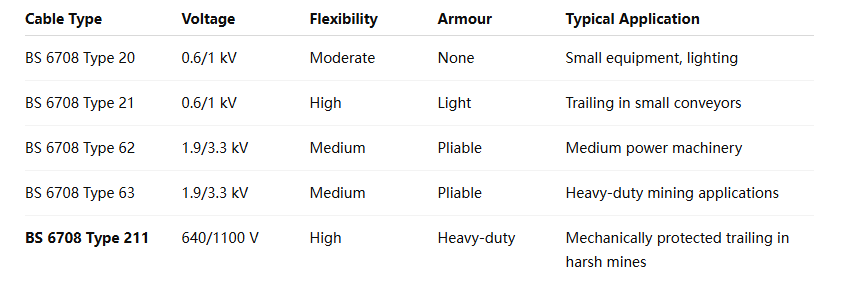
Comparison with Other Mining Cable Types
The Type 211 offers a unique combination of high flexibility, robust armouring, and durability, making it highly suitable for South African mining conditions.
Technical Specifications
BS 6708 TYPE 211 is designed to handle high power demands, mechanical stress, and harsh environments.
Voltage Ratings
Rated Voltage: 640/1100 V
Test Voltage: 3 kV
Conductor Cross-Sections
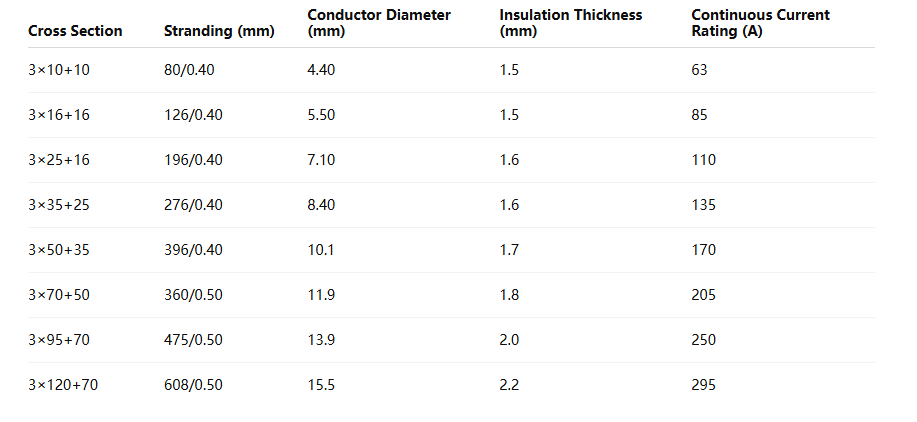
The cable is available in various cross-sections, from 3×10+10 mm² to 3×120+70 mm², accommodating different current ratings and mechanical requirements. A typical table is as follows:
Sheath and Armour
Inner sheath thickness: 2.5–5 mm depending on size
Outer sheath thickness: 3.8–6.9 mm
Armour wires: 7–7 strands, 0.71–1.25 mm diameter
Electrical Parameters
DC Resistance (Phase at 20°C): 1.95 Ω/km (3×10) to 0.164 Ω/km (3×120)
Earth conductor resistance: 1.95 Ω/km to 0.277 Ω/km
Armour resistance: 1.81 Ω/km to 0.299 Ω/km
Screens in parallel: 1.33–0.50 Ω/km
Implications for South African mining:
High current capacity ensures sufficient power to lighting and conveyor systems.
Low resistance reduces energy losses in long trailing runs.
Robust electrical design ensures minimal voltage drop, even under mechanical stress.
Installation and Handling Considerations
Proper installation is critical to prolong the cable's lifespan and maintain safety.
Minimum bending radius: 10× cable diameter (423–905 mm depending on size)
Use cable reels or trailing systems for long runs.
Avoid sharp bends and excessive tension during installation.
Ensure compatibility with South African trailing and trolley systems.
Periodic inspection for abrasion, cuts, and insulation wear is recommended.
Maintenance Tips:
Clean outer sheath from dust and moisture.
Check armouring continuity.
Record bending cycles in mobile applications to estimate fatigue.
Applications in South Africa
1: Platinum Mine, Rustenburg
BS 6708 TYPE 211 was deployed for coal face lighting and trolley conveyors. Observed benefits:
Reduced downtime from cable damage
Enhanced safety due to robust armouring
Compliance with SANS 1520 and NRCS requirements
2: Coal Mines, Mpumalanga
Cable was used to protect mechanically stressed conveyor belts and quarry lighting systems. Results:
Lower cable failure rates compared to Type 20 and 21
Easier handling for long-distance trailing systems
Improved operational efficiency and worker safety
Common Issues and FAQ
Q1: Can BS 6708 TYPE 211 withstand harsh underground conditions?
Yes. The combination of tinned copper, EPR insulation, steel armouring, and chloroprene sheath makes it resilient to humidity, dust, and mechanical impact.
Q2: What is the expected lifespan?
With proper handling, 10–15 years under standard underground conditions is achievable.
Q3: How to detect mechanical damage or insulation wear?
Regular visual inspections and insulation resistance testing are recommended. Screen continuity checks help detect internal faults.
Q4: Is armouring sufficient for high-risk areas?
Yes, pliable galvanised steel armour provides adequate protection, but in extreme wear areas, additional protective conduits may be used.
Q5: Differences between Type 211 and other BS 6708 trailing cables?
Type 211 offers heavier armouring and larger cross-sections for higher current capacity and mechanical protection, making it suitable for challenging South African mining conditions.
Safety and Compliance
BS 6708 TYPE 211 is fully compliant with BS 6708 standards. In South Africa, adherence to SANS 1520-1 and NRCS certification is critical. Key safety points:
Ensure correct conductor sizing and armouring
Follow bending radius guidelines
Conduct periodic insulation resistance and continuity tests
Train personnel in safe handling of trailing cables
Compliance ensures worker safety, equipment reliability, and regulatory adherence.
Conclusion
BS 6708 TYPE 211 is more than just a cable—it is a strategic component in South African mining infrastructure. Its design, combining flexibility, mechanical protection, and electrical performance, meets the demands of gold, platinum, and coal mines. Field experience demonstrates its:
Durability under heavy mechanical stress
High current carrying capacity
Compliance with international and local standards
Reduction in operational downtime
For engineers, procurement managers, and maintenance teams, selecting BS 6708 TYPE 211 ensures reliability, efficiency, and safety in even the most challenging mining environments.
By understanding its structure, materials, technical specifications, and best practices, mining professionals can make informed decisions and maintain a competitive edge in South African mining operations.


Contact Anhui Feichun Special Cable Co., Ltd.
For comprehensive technical specifications and quotations, please contact our specialized mining cable engineering team:
Technical Engineering Support:
Sales Engineering Department:
WhatsApp Contact:
Manufacturer: Anhui Feichun Special Cable Co., Ltd. (安徽飞纯特种电缆有限公司)
Manufacturing Headquarters: Building A, Private Science and Technology Park, Hefei Economic and Technological Development Zone, Anhui Province, People’s Republic of China
+86 17333223430
Email Address: Li.wang@feichuncables.com
© 2025. All rights reserved.
One-click to Quickly Contact
Products
Contact
Company
Location:
Building A Private Science and Technology Park, Hefei Economic and Technological Development Zone, Anhui Province, China
Heat Resistant Cable
WhatsApp: +86 17333223430
Social Media: