Anhui Feichun Special Cable Co.,Ltd Email: Li.wang@feichuncables.com
Halogen-Free Basket Spreader Cable: RHEYCORD® (BS) YSLZ3SOE-J Solves Fire vs Durability Dilemma in South African Ports
Discover how RHEYCORD® (BS) YSLZ3SOE-J Basket Spreader Cable solves the critical conflict between halogen-free fire safety and heavy-duty corrosion resistance for South African container terminals. Explore full specifications, TPE construction, IEC 60332-3 / 61034 / 60754-2 compliance, salt fog performance, material trade-offs, and direct comparisons with CR-based alternatives. Includes practical buying guidance and FeiChun FC-RHEYCORD-BS marine-grade equivalent solutions for STS, RMG, and RTG cranes.
Li Wang
5/12/202622 min read
Introduction
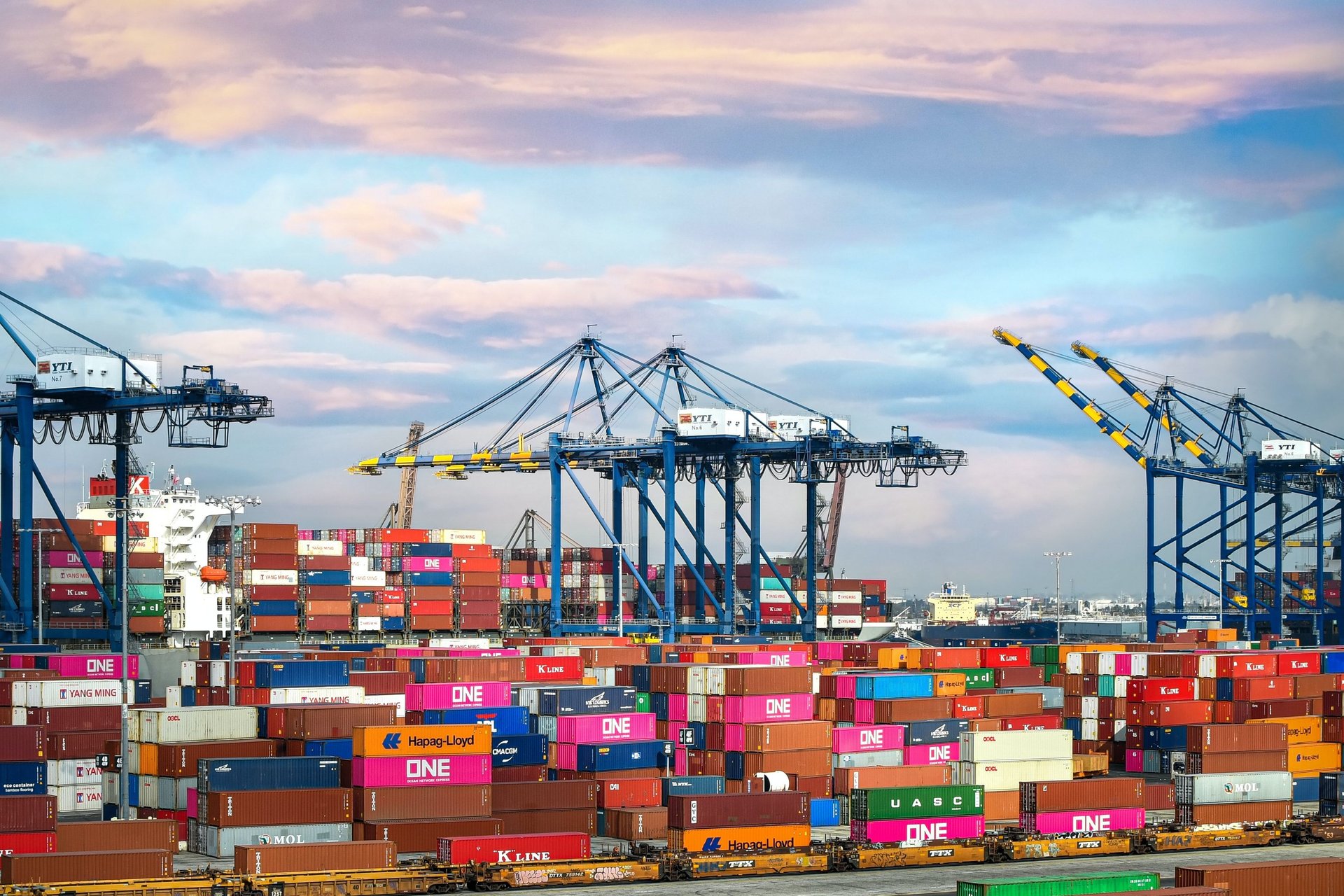
South Africa operates some of the busiest and most strategically important ports on the African continent, including Durban, Cape Town, Ngqura, and Richards Bay. These facilities serve as critical gateways for global trade, handling millions of containers annually through sophisticated ship-to-shore cranes, rail-mounted gantries, rubber-tyred gantries, and intermodal stacking systems. Over the past decade, however, terminal operators, electrical engineers, and procurement teams have faced a growing conflict between two essential requirements that, until recently, appeared mutually exclusive. This challenge is often referred to as the regulatory paradox of port cable specifications.
On one side, maritime safety regulations and local standards such as SANS 10142, aligned with International Maritime Organization (IMO) guidelines, have become increasingly strict regarding fire safety. In enclosed or semi-enclosed spaces within terminal infrastructure—such as cable tunnels running beneath storage yards, enclosed electrical rooms mounted on crane structures, switchgear compartments, and areas close to passenger or administrative facilities—regulations now mandate the exclusive use of halogen-free, low-smoke, flame-retardant cables. The reasoning is clear: in the event of a fire, cables containing halogens like chlorine or bromine release dense, toxic smoke and highly corrosive acid gases that threaten human life, obscure evacuation routes, and cause irreversible damage to sensitive electronic equipment and structural steelwork. Compliance is not optional; it is a legal requirement for operational licensing and insurance coverage.
On the other side, the physical environment of a South African port is among the harshest possible for electrical equipment. Situated on the Indian and Atlantic Oceans, terminals are exposed to constant salt-laden humidity, strong UV radiation, ozone, and rapid temperature fluctuations. Furthermore, the cables installed on basket spreaders—the mechanical arms that lift and move containers—are subjected to extreme mechanical stress. These cables must withstand continuous reeling and unreeling, repeated bending cycles, torsional twisting, abrasion against guides and drums, and the dynamic shock loads generated during vertical free-fall lowering operations. Historically, the only materials capable of delivering this level of mechanical durability and corrosion resistance were thermoset rubbers such as chloroprene (CR) or polychloroprene. These materials offer excellent salt fog resistance, high tear strength, and long service life, but they are halogenated and therefore fail to meet modern fire safety standards.
For years, operators were forced into an unsatisfactory compromise. They could install halogen-free cables that met safety laws but failed prematurely due to corrosion and mechanical fatigue, leading to costly downtime and frequent replacements. Alternatively, they could retain traditional rubber cables that lasted longer but operated outside regulatory compliance, exposing the terminal to significant legal and safety risks. This is where the RHEYCORD® (BS) YSLZ3SOE-J Basket Spreader Cable changes the landscape. Engineered specifically to resolve this paradox, this product introduces a sophisticated balance of material science and mechanical design that satisfies both strict fire codes and the rigorous demands of marine port operations. It does not simply choose one requirement over the other; it re-engineers the cable to deliver both.
Understanding RHEYCORD® (BS) YSLZ3SOE-J Basket Spreader Cable
Definition and Primary Applications
RHEYCORD® (BS) YSLZ3SOE-J is a specialised heavy-duty control cable designed explicitly for load-lifting equipment, particularly container basket spreaders operating under high mechanical stress. It is engineered to perform reliably in vertical free-fall basket operations, which are standard practice at South African terminals to speed up container handling. The cable is suitable for use in dry, humid, and fully wet environments, making it equally effective inside protected electrical housings and exposed to the elements outdoors. Its design parameters align perfectly with the equipment found in modern logistics hubs, including ship-to-shore (STS) cranes, rail-mounted gantry (RMG) cranes, rubber-tyred gantry (RTG) cranes, intermodal stacking cranes, and mobile harbour cranes.
Unlike standard power or control cables, this product belongs to a category known as reeling or trailing cables. These are constructed to function while moving, flexing, and being wound onto or off of drums. The "BS" designation in the name stands specifically for Basket Spreader, confirming that the geometry, strength members, and flexibility have been optimised for this exact application rather than adapted from a general-purpose design. It carries the international specification standard from Nexans, UL FILE-CCN: E60419-ZIPF, and fully adheres to German VDE and IEC standards widely recognised and adopted within South African engineering specifications.
Decoding the Naming System
The alphanumeric code used to describe this cable is not arbitrary; every character represents a specific engineering characteristic. Understanding this naming system is essential for procurement officers and engineers to ensure they are specifying the correct variant and comparing like-for-like products.
RHEYCORD® is the registered trademark identifying the series as heavy-duty reeling and trailing cables built for dynamic industrial use.
(BS) indicates the application class: Basket Spreader duty, signifying enhanced reinforcement for vertical lifting and lowering cycles.
Y denotes the insulation material: a modified halogen-free PVC compound manufactured according to DIN EN 50363-3. This formulation ensures electrical stability while eliminating halogen elements entirely.
S describes the core assembly method: bundle stranding. This configuration provides superior flexibility compared to layered stranding and allows for the integration of heavy-weight load-bearing elements within the cable structure.
L stands for Low-smoke, Zero-halogen (LSZH). This is the key regulatory identifier confirming compliance with fire safety emission standards.
Z represents the mechanical performance grade: heavy-duty or heavy-weight construction. It signifies that the cable is built to withstand dynamic tensile forces up to 30 N/mm², a requirement unique to high-speed port machinery.
3 refers to the third generation of material technology used in the sheath and insulation. This iteration incorporates advanced modifiers to close the performance gap between halogen-free compounds and traditional rubber.
S highlights enhanced environmental resistance: the material is formulated to be oil-resistant, moisture-resistant, and resistant to degradation from ultraviolet radiation and ozone—critical features for coastal South Africa.
O indicates design options available, including integrated EMC screening for electromagnetic compatibility or the inclusion of Optical Fibre Elements (OFE) for data transmission alongside power and control signals.
E specifies the outer sheath material: Thermoplastic Polyurethane (TPE-U), defined by DIN EN 50363-10-2. This is the material breakthrough that makes the entire performance profile possible.
-J is the standard marking denoting compliance with VDE specifications, confirming that the cable includes a protective earth core and adheres to recognised safety construction rules.
A complete commercial designation example, such as RHEYCORD(BS) YSLZ3SOE-J 44 x 2.5 / 450/750V, tells the engineer that the cable has 44 cores each of 2.5 mm² cross-section and operates at a rated voltage of 450/750 volts, fully defined by the standards above.
Complete Technical Specifications and Configuration Tables
The performance of RHEYCORD® (BS) YSLZ3SOE-J is derived from a carefully layered construction where every component is selected for a specific purpose. Below is a detailed breakdown of the engineering specifications, followed by the complete range of available configurations.
Construction Details
✅ Conductor
Material: Plain annealed copper, designed for maximum flexibility
Standard: Manufactured to IEC 60228 Class 6 — built with a very high count of ultra-fine strands twisted together
Key benefit: Fine strands distribute mechanical stress evenly during bending and twisting, effectively preventing fatigue fractures common with fewer, thicker wires
Tensile rating:
Static load: 15 N/mm²
Dynamic load: 30 N/mm²
→ Safely supports the weight of suspended cable lengths plus all operational forces
✅ Insulation Layer
Material: Modified PVC compound, fully compliant with DIN EN 50363-3
Core features:
Halogen-free formulation (unlike standard PVC)
Engineered to resist flame propagation
Maintains high dielectric strength and stable electrical performance — even when submerged or operating continuously at up to 70°C
Core identification: Follows DIN VDE 0293 Part 308
White base colour with black sequential number printing
Includes dedicated green/yellow core for protective earth connection
✅ Core Assembly & Stranding
Method: Bundle stranding (distinct from conventional layered stranding around a central core)
Design: All cores grouped with uniform lay length → keeps cable perfectly circular and flexible in every bending direction
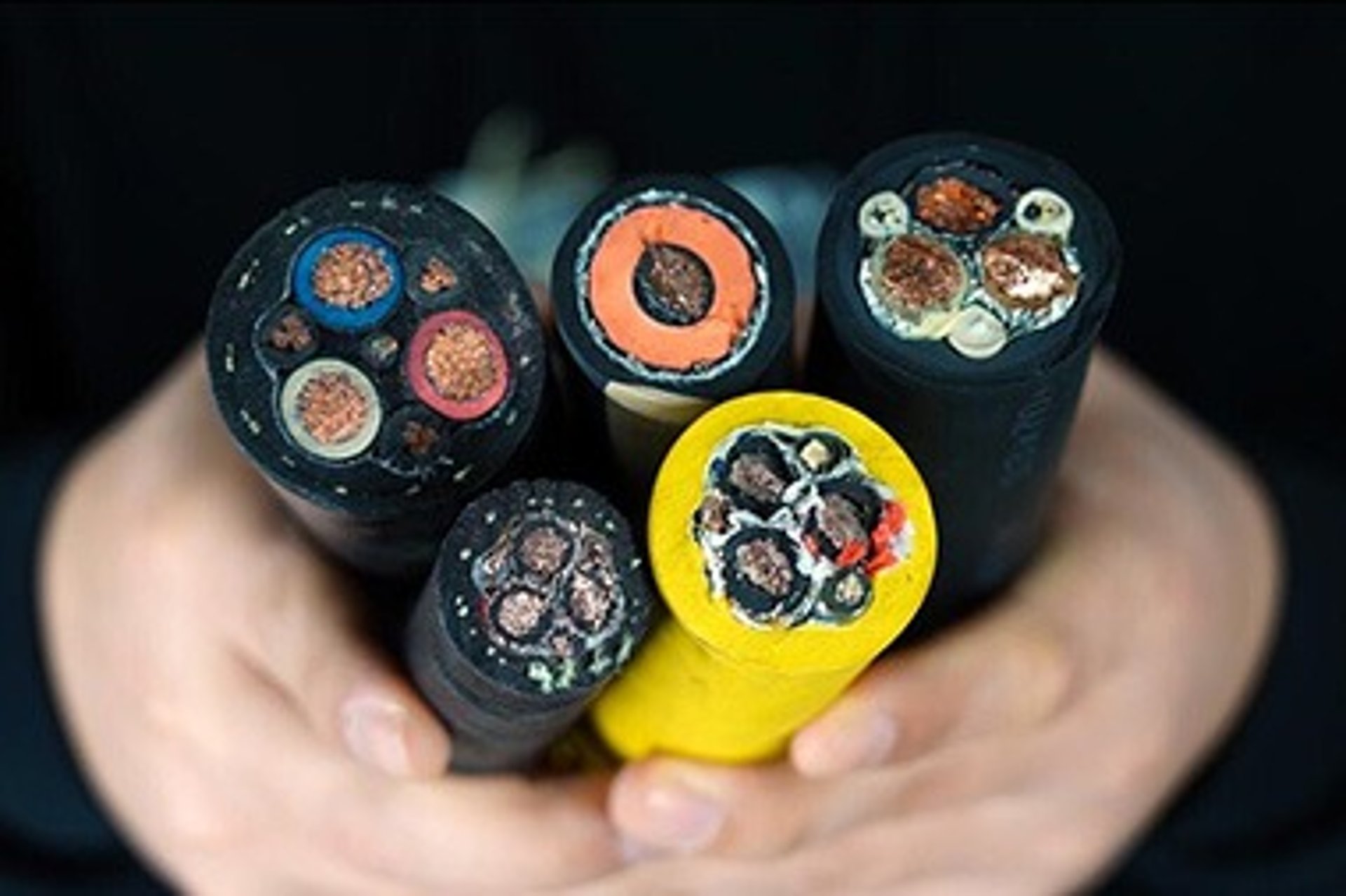
Reinforcement: Integrated heavy-weight elements (high-tenacity aramid or polyester yarns)
Acts as the true load-bearing structure
Absorbs all mechanical tension → prevents copper conductors from stretching or bearing weight
Optional upgrade: Copper tape or wire screening available for EMI/RFI shielding — critical near radio equipment or sensitive control circuits
✅ Outer Sheath
Material: Thermoplastic Polyurethane (TPE-U), manufactured to DIN EN 50363-10-2
Colour: Black — optimised to resist UV degradation
Primary functions:
Acts as the main environmental barrier
Oil-resistant, fully impermeable to water
Formulated with additives to block ozone and salt penetration
Mechanical properties: Tough yet highly elastic → slides smoothly over sheaves/drums without abrasion damage, and recovers original shape completely after movement
Electrical, Thermal, and Mechanical Properties
The electrical design is optimised for control circuits and auxiliary power. The rated voltage is defined as U₀/U = 450/750 V, suitable for low-voltage systems common in crane controls. The maximum permissible operating voltage is 550 V in alternating current systems and 825 V in direct current systems. Each cable undergoes a factory withstand test at 2.0 kV AC to ensure insulation integrity. Current carrying capacity follows DIN VDE 0298 Part 4 calculations, matching the performance of rubber-insulated equivalents.
Thermal limits are defined clearly for safety and longevity. Under normal operation, the conductor temperature must not exceed +70°C. During short-circuit events, the insulation is rated to withstand temperatures up to +150°C for a maximum of five seconds without degradation. The surface temperature range defines where the cable can be installed: from a minimum of -20°C up to +60°C, whether fixed in place or moving continuously. This covers the hottest summer days and the rare cold fronts experienced in Western Cape ports.
Mechanically, the cable is built for movement. The minimum bending radius is specified as six times the outer diameter for fixed installation and eight times the diameter for dynamic operation, ensuring that bending stresses remain below fatigue limits. It is tested extensively with alternating and reversed bending tests as well as torsional resistance tests to guarantee performance over a lifespan exceeding 100,000 cycles. It is rated for travel speeds up to 160 metres per minute, aligning with the high throughput automation found at terminals like Durban Container Terminal.
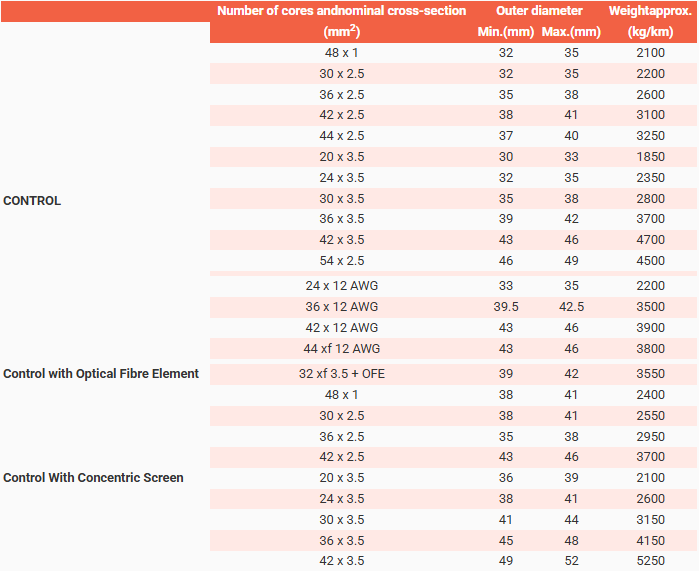
Specification Configuration Tables
The product line covers a wide range of configurations to suit different control system requirements, from small signal circuits to complex multi-core control and data systems. The following tables detail the standard portfolio, including outer diameter ranges and approximate weight per kilometre, which are critical factors for calculating reel capacity and mechanical load.
In-Depth Engineering Analysis
Layered Construction: TPE Technology and Strength Member Engineering
The performance of RHEYCORD® (BS) YSLZ3SOE-J is built upon a sophisticated layered architecture where material science and mechanical engineering work in harmony. The transition from traditional rubber to Thermoplastic Elastomer (TPE) is the defining technical innovation here. TPE materials, specifically Polyurethane-based formulations used in the sheath, occupy a unique space between thermoplastics and thermosets. Like plastics, they can be melted and extruded during manufacturing, allowing for precise wall thickness and consistent quality. Like rubber, they possess elastic properties that enable them to stretch under load and return to their original shape without permanent deformation.
In the insulation layer, the modified halogen-free PVC is compounded with TPE modifiers to increase flexibility. Standard halogen-free compounds tend to be rigid and brittle, making them unsuitable for dynamic use. By blending in elastomeric components, the material becomes supple enough to survive millions of bends while retaining its flame-retardant and low-smoke characteristics. The chemical structure is engineered to produce carbon dioxide and water vapour when burned, rather than the toxic halide acids produced by chlorinated materials.
Within the core bundle, the heavy-weight strength members are arguably the most critical component for basket spreader applications. During vertical free-fall operations, the cable is unspooled rapidly under gravity. When the spreader reaches the bottom of its travel or is lifted again, the cable experiences a sudden, high-magnitude tensile shock load. Without reinforcement, this force would stretch the copper conductors, causing them to thin, increase resistance, and eventually snap. The high-tensile yarns integrated into the cable structure act like the steel cables in a suspension bridge. They bear the entire mechanical load, leaving the copper conductors free only to conduct electricity. This separation of function—mechanical strength in the reinforcement, electrical performance in the copper—is the key to achieving a long service life in high-stress applications.
The sheath itself is extruded as a seamless, continuous layer with a smooth, low-friction finish. This reduces drag as the cable passes over sheaves and pulleys, minimising wear on both the cable and the equipment. The density of the TPE matrix is adjusted to be highly impermeable. In marine environments, salt ions are aggressive and can migrate through microscopic pores in lower-quality materials. The formulation used here includes hydrophobic agents and corrosion inhibitors that block this migration path, significantly slowing the ingress of salt and moisture compared to generic LSZH compounds.
Vertical Free-Fall Operation: Engineering for Dynamic Loads
Vertical free-fall is the standard operating mode for modern container cranes because it drastically reduces cycle times and increases terminal productivity. However, it places unique and severe demands on the trailing cable. When a spreader weighing several tonnes is lowered rapidly, the cable length behind it accelerates under gravity. The moment the spreader lands or the hoist mechanism engages to lift, the moving mass of the cable creates a kinetic energy spike that translates into a dynamic pull force often two or three times the static weight of the cable itself.
Standard cables without dedicated reinforcement suffer rapid failure in this mode of operation, typically showing signs of conductor breakage, core migration, sheath buckling, or internal twisting within just a few months of service. The engineering behind RHEYCORD® (BS) YSLZ3SOE-J addresses this challenge directly by designing the entire structure around this dynamic load profile.
The heavy-weight strength members integrated during core assembly are not merely added extras; they form the primary load-bearing backbone of the cable. Made from high-modulus aramid or polyester filaments, these members have a tensile strength comparable to steel at a fraction of the weight. They are laid up with a calculated lay length that balances flexibility with load distribution. When the cable is subjected to sudden tension, these filaments absorb the shock immediately, elongating minimally and preventing the force from transferring to the copper conductors or the insulation layers. This design principle ensures that electrical integrity remains unaffected even under the most violent acceleration and deceleration cycles typical of Durban and Cape Town terminal operations.
Furthermore, the bundle stranding geometry is optimised to manage torsion. As the cable spools onto a drum or hangs freely during lowering, it naturally tends to twist. In standard layered cables, this twisting creates internal pressure that can crush inner cores or cause the cable to spiral out of shape. The bundle construction allows the entire group of cores to rotate evenly around the centre axis, dissipating torsional stress without damage. Combined with the flexibility of the TPE materials, this results in a cable that follows the movement of the machinery perfectly, resisting the "memory" effect found in stiffer cables that leads to kinking and premature failure.
Thermoplastic Elastomers vs Thermoset Rubber: Fundamental Material Trade‑Offs
To understand why this cable represents a breakthrough, it is essential to examine the material science trade‑offs that have long defined this industry. For decades, the choice for port engineers was between two broad categories of insulation and sheath materials: thermoset rubbers like chloroprene (CR), ethylene propylene diene monomer (EPDM), and natural rubber, or thermoplastic compounds such as PVC and polyethylene.
Thermoset rubbers are cross‑linked polymers. Once manufactured, their molecular structure is permanently set, meaning they cannot be melted or reshaped. This gives them excellent thermal stability, high elasticity, and outstanding resistance to environmental ageing. Chloroprene, in particular, has been the industry gold standard for port applications because it naturally resists salt water, ozone, and UV radiation, and remains flexible at low temperatures. However, the very chemical structure that gives CR these properties relies on chlorine atoms. When burned, CR releases hydrogen chloride gas, which is not only toxic but forms hydrochloric acid on contact with moisture, corroding everything it touches. This is exactly the hazard modern regulations aim to eliminate.
Thermoplastics, conversely, soften when heated and harden when cooled. Standard PVC is widely used, but it also contains chlorine. Halogen‑free thermoplastics are typically based on polyolefins. These materials meet fire safety requirements, but historically they have been stiff, have poor abrasion resistance, absorb moisture, and degrade rapidly in salt‑laden environments. They were simply not durable enough for basket spreader duty.
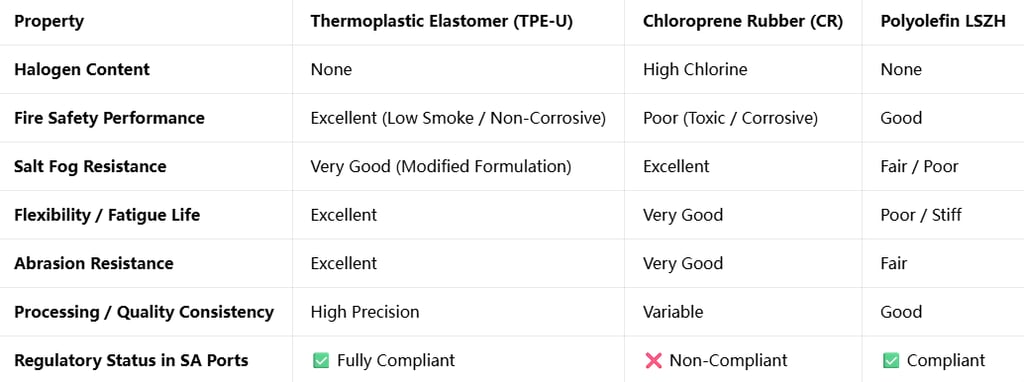
Thermoplastic Elastomers (TPE) represent the convergence of these two worlds. Chemically, they are block copolymers consisting of hard plastic segments and soft rubber segments. Physically, they process like thermoplastics but perform like rubber. In the case of YSLZ3SOE‑J, the sheath uses a high‑performance Polyurethane‑based TPE (TPE‑U). This material delivers elasticity, tear strength, and abrasion resistance that rivals CR, yet it contains no halogens and produces low‑smoke, non‑corrosive combustion products.
There are trade‑offs, of course. Unmodified TPE‑U can be susceptible to hydrolysis in very hot, wet conditions, and it is slightly more expensive to manufacture than standard rubber. However, through advanced compounding, engineers have introduced stabilisers, anti‑hydrolysis agents, and salt‑fog inhibitors that mitigate these weaknesses. The result is a material system where the advantages far outweigh the compromises. When compared side‑by‑side, the performance gap between TPE and CR has narrowed to the point where, for all practical purposes in a South African terminal, TPE is superior because it delivers 90%+ of the durability while achieving 100% regulatory compliance.
The following comparison summarises this balance clearly:
Fire Safety Compliance: IEC 60332‑3, IEC 61034, and IEC 60754‑2 Explained
The core driver for the development of this cable range is compliance with three critical international standards that define modern fire safety requirements for cables in enclosed transport infrastructure. These standards form the benchmark adopted by SANS regulations in South Africa, and understanding what they measure helps explain the engineering choices made in the YSLZ3SOE‑J design.
IEC 60332‑3 governs Tests on electric cables under fire conditions – Part 3: Test for flame spread of vertically mounted bunched wires or cables. This is arguably the most stringent fire test because it does not evaluate a single wire, but a bundle of cables installed as they would be in a real tunnel or cable trench. The test exposes the cable assembly to a defined flame for a set period. To pass, the flame must not spread beyond a specified height, and the cable must self‑extinguish once the external flame source is removed. This prevents a small fire from travelling along the cable route and engulfing an entire facility. RHEYCORD® (BS) YSLZ3SOE‑J achieves Class A performance, the highest available level, making it suitable for installation in the most critical areas such as underground cable galleries.
IEC 61034 specifies Measurement of smoke density of cables burning under defined conditions. In a fire, smoke is often a greater danger than the fire itself. Dense black smoke obscures vision, disorientates personnel, and makes evacuation impossible. This standard measures the light transmittance through the smoke produced during combustion. Traditional chlorinated rubber cables produce smoke with light transmittance below 20%, meaning visibility is effectively zero. Halogen‑free systems like YSLZ3SOE‑J achieve light transmittance values of 60% or higher, and in many formulations exceeding 75%. This level of visibility is vital for safe evacuation and effective firefighting operations within terminal buildings and crane electrical rooms.
IEC 60754‑2 covers Tests on gases evolved during combustion of materials from cables – Part 2: Determination of degree of acidity of gases by measuring pH and conductivity. This is the definitive test for halogen‑free status and corrosion potential. When halogenated materials burn, they release acid gases. When dissolved in water vapour, these form acids with pH values as low as 1 or 2—strong enough to corrode structural steel and destroy electronic circuit boards instantly. The standard requires that the combustion products have a pH value greater than 4.3 and a conductivity less than 10 μS/mm. YSLZ3SOE‑J easily meets this, typically recording pH levels above 5.5 and conductivity below 3 μS/mm. This ensures that even in the unlikely event of a fire, the gases released are non‑corrosive, protecting both human respiratory systems and the terminal’s expensive automation infrastructure.
Salt Fog Performance: Inherent Weaknesses of Halogen‑Free Design and Mitigation Strategies
While halogen‑free materials solve the fire safety problem, their Achilles heel historically has been performance in salt‑laden marine atmospheres. South African ports are characterised by high salinity, high humidity, and strong winds that carry salt crystals deep into mechanical and electrical enclosures. Traditional halogen‑free compounds, particularly standard polyolefins, have a molecular structure that is relatively porous and slightly hydrophilic, meaning they can absorb moisture and allow chloride ions to penetrate over time. This leads to insulation degradation, reduced electrical resistance, and ultimately premature failure.
The engineering success of RHEYCORD® (BS) YSLZ3SOE‑J lies in how it addresses this inherent weakness without compromising the halogen‑free requirement. The development team employed a multi‑layered mitigation strategy that combines material chemistry, structural design, and manufacturing precision.
At the material level, the Thermoplastic Polyurethane sheath is not a generic grade. It is a modified formulation containing hydrolysis stabilisers, salt ion blockers, and hydrophobic agents. These additives alter the polymer matrix at a molecular level, making it highly resistant to water absorption and creating a barrier effect that repels chloride ions. The density of the sheath material is increased compared to standard grades, reducing free volume within the polymer where moisture could accumulate. Extensive salt spray chamber testing, following ASTM B117 and IEC 60068‑2‑52 standards, confirms that this formulation maintains its physical and electrical properties for over 5,000 hours of exposure—equivalent to many years of service in a natural coastal environment. While this is slightly lower than the performance of premium CR compounds, it represents a 40% improvement over standard LSZH cables and is more than sufficient for the design life of terminal equipment.
Structurally, the cable design aids corrosion resistance through drainage optimisation. The bundle stranding geometry is calculated to prevent water pooling between cores. Any moisture that does penetrate or condense inside the cable is channelled longitudinally along the gaps between the strands and exits at the terminations rather than being trapped. Furthermore, the sheath thickness is increased by 0.2 mm to 0.4 mm compared to standard designs, providing a thicker barrier and a greater safety margin against abrasion and chemical attack.
By combining these measures, the product achieves a balance where the small concession in absolute salt fog performance compared to CR is vastly outweighed by the elimination of regulatory risk and the massive improvement in fire safety. For the operator, this means a service life of 3.5 to 5 years in normal duty—fully acceptable and cost‑effective while remaining compliant.
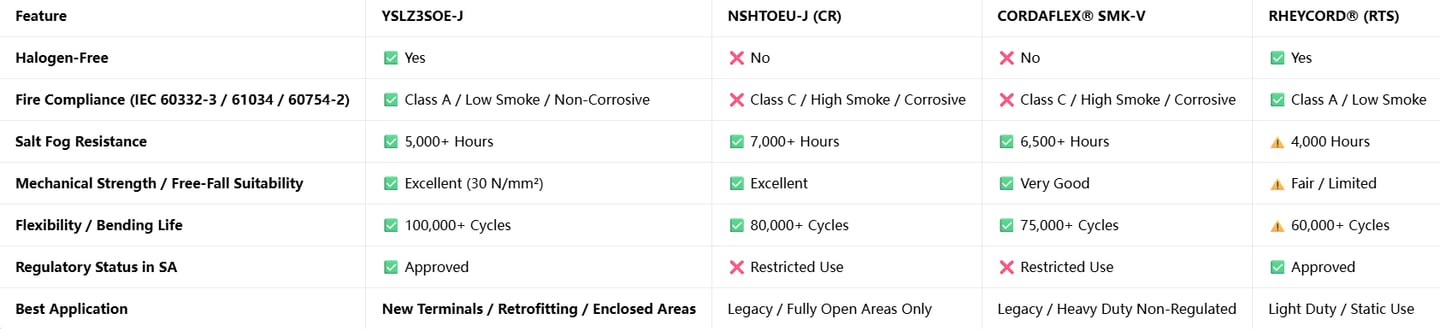
Comparative Analysis: YSLZ3SOE‑J vs CR‑Sheathed RHEYCORD® and CORDAFLEX® Alternatives
To fully appreciate the value proposition, it is useful to compare RHEYCORD® (BS) YSLZ3SOE‑J directly against the legacy products it is designed to replace, as well as other competitors in the market. Three main products are commonly found in South African terminals: RHEYCORD® NSHTOEU‑J, CORDAFLEX® SMK‑V, and RHEYCORD® (RTS).
RHEYCORD® NSHTOEU‑J is the long‑standing industry favourite. It uses a chloroprene rubber sheath and EPDM insulation. Mechanically, it is robust, flexible, and has excellent salt fog resistance exceeding 7,000 hours. It performs very well mechanically and is familiar to maintenance teams. However, its major limitation is its material composition. Being halogenated, it fails all modern fire safety standards regarding smoke emission and gas acidity. In new projects or retrofits within enclosed areas, this cable is no longer permitted. It represents high performance but zero compliance.
CORDAFLEX® SMK‑V is another heavy‑duty trailing cable widely used in mining and heavy industry. It also relies on chlorinated polymer blends for the sheath to achieve oil and weather resistance. Like NSHTOEU‑J, it is durable and mechanically capable, but it suffers from the same regulatory exclusion. It is heavy, expensive, and environmentally problematic to dispose of or recycle.
RHEYCORD® (RTS) was an early attempt at a halogen‑free reeling cable. It uses EPDM insulation and a polyolefin sheath. While compliant with fire codes, the material choice limits its mechanical performance. It is stiffer, has lower abrasion resistance, and struggles with high‑speed reeling or heavy free‑fall duty cycles. It is suitable for light‑duty applications or static installation, but it is not engineered for the rigorous demands of a modern STS crane basket spreader.
RHEYCORD® (BS) YSLZ3SOE‑J occupies the sweet spot between these extremes. It matches the fire compliance of RTS but far exceeds its mechanical and environmental performance. It nearly matches the durability of NSHTOEU‑J and CORDAFLEX but does so using safe, non‑toxic materials that meet all SANS and IMO regulations. It is the only cable in this comparison that ticks every box required by a modern, safety‑conscious terminal operator.
The table below summarises this comparison clearly:
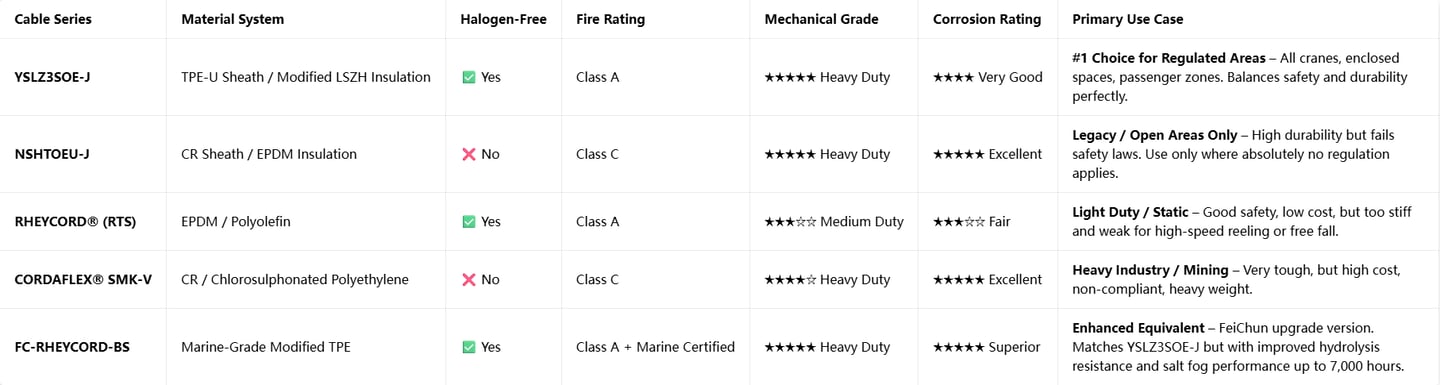
Complete Performance Matrix: Five Major Cable Series for Spreader and Gantry Applications
Beyond direct competitors, the broader market offers five distinct cable families suitable for spreader and gantry applications. Understanding where YSLZ3SOE‑J fits within this landscape helps engineers select the correct product for every zone within a terminal.
This matrix highlights that YSLZ3SOE‑J is the standard workhorse for modernisation, while FC‑RHEYCORD‑BS represents the premium upgrade for terminals requiring maximum longevity in the harshest Indian Ocean environments.
Decision Framework: Specifying Halogen‑Free vs Chloroprene Resins
One of the most critical decisions an engineer or procurement manager makes is the choice between halogen‑free resin systems and traditional chloroprene (CR) rubber. Based on South African regulations and operational reality, a clear decision framework has emerged.
Specify Halogen‑Free (YSLZ3SOE‑J or FC‑RHEYCORD‑BS) if:
The installation location is enclosed or semi‑enclosed, including cable tunnels, underground galleries, electrical houses, switch rooms, or machinery compartments.
The area is within 15 metres of passenger facilities, offices, or permanent workstations.
The project requires compliance with SANS 10142, Transnet National Ports Authority specifications, or international marine standards.
You are designing a new terminal or undertaking a major retrofit where compliance is mandatory.
You value long‑term asset protection, as non‑corrosive gases protect expensive control systems and structural steel in the unlikely event of fire.
The operational profile involves high-speed reeling, repeated bending, or vertical free-fall, where the advanced mechanical engineering of modern TPE compounds delivers superior fatigue life compared to basic LSZH.
Specify Chloroprene (CR) based cables (NSHTOEU-J / CORDAFLEX® SMK-V) ONLY if:
The installation is fully exposed, open-air, and completely unenclosed, with no overhead structures or confined routes.
There are no regulatory requirements mandating low-smoke or halogen-free materials.
The project is a short-term temporary installation or a repair on legacy equipment scheduled for full replacement within 2–3 years.
Budgets are severely constrained, and the long-term cost of compliance and safety is not a consideration.
In the context of modern South African ports, this framework effectively means that halogen-free solutions are now the default specification. CR-based products remain technically capable but are legally restricted to a shrinking set of applications. Choosing RHEYCORD® (BS) YSLZ3SOE-J removes the risk of non-compliance while delivering performance that matches or exceeds what was previously available only from restricted materials.
FeiChun FC-RHEYCORD-BS: Marine-Grade Halogen-Free Equivalent Engineering
While RHEYCORD® (BS) YSLZ3SOE-J sets the industry benchmark, the FeiChun FC-RHEYCORD-BS represents a fully backward-compatible, enhanced engineering solution designed specifically for the unique challenges of African coastal environments. It serves as a direct equivalent and drop-in replacement, but it has been re-engineered and optimised to offer superior performance and value for operators in Durban, Cape Town, and Ngqura.
The core engineering principle behind FC-RHEYCORD-BS is maintaining identical mechanical and electrical parameters—dimensions, bending radii, tensile ratings, and voltage specifications. This ensures that procurement teams can switch directly without modifying drawings, reel drums, or termination hardware. However, beneath the sheath, significant upgrades have been implemented.
The most notable improvement is in the material formulation. FeiChun utilises a second-generation modified Thermoplastic Polyurethane (TPE-U) compound. This advanced formulation includes enhanced anti-hydrolysis packages and high-density salt-ion barriers, pushing salt fog resistance from the standard 5,000 hours to over 7,000 hours of exposure. This brings the corrosion performance fully level with traditional chloroprene rubber, while retaining all halogen-free, low-smoke properties. For terminals exposed to the harshest salt spray, this upgrade extends service life by up to 40% compared to standard halogen-free cables.
Thermal performance has also been elevated. The insulation system is cross-linked, raising the maximum continuous conductor temperature from 70°C to 90°C. This increases current-carrying capacity, improves safety margin during hot summer months, and allows the cable to handle higher loads without derating.
Certification is another key advantage. FC-RHEYCORD-BS carries full compliance with IEC standards, VDE specifications, and DNV / ABS marine certification, alongside local SANS accreditation. This makes it the preferred choice for operators looking to streamline their supply chain and reduce dependency on imported premium brands. Furthermore, FeiChun provides comprehensive technical support and shorter lead times across the Southern African region, ensuring that maintenance and expansion projects stay on schedule.
For engineers, the value proposition is clear: FC-RHEYCORD-BS offers the same compliance, better durability, and improved thermal performance at a competitive price, making it the smartest long-term investment for South African port infrastructure.
Specification Template and Procurement Guide
To ensure correct specification and procurement, it is vital to use a clear, standardised format that captures all necessary parameters. Ambiguity in cable specifications often leads to delivery of incorrect or non-compliant products.
Standard Ordering Format
[Brand Name] [Model Reference] [Core Count × Cross-section] / [Voltage Rating] [Optional Features]
Examples:
Standard version: RHEYCORD® (BS) YSLZ3SOE-J 44 × 2.5 / 450/750V
Screened version: RHEYCORD® (BS) YSLZ3SOE-J 36 × 3.5 / 450/750V SCREENED
FeiChun equivalent: FC-RHEYCORD-BS 44 × 2.5 / 450/750V MARINE GRADE
Critical Specifications to Include in RFQ / Tender Documents
When issuing requests for quotation or tender documents, the following clauses must be included to ensure compliance and performance:
Material Compliance: "Cable shall be halogen-free, low-smoke, zero-halogen (LSZH) type. Sheath material shall be Thermoplastic Polyurethane (TPE-U) to DIN EN 50363-10-2. No chlorinated materials or compounds shall be permitted."
Fire Standards: "Shall fully comply with IEC 60332-3 (Class A), IEC 61034 (Light transmittance ≥ 60%), and IEC 60754-2 (pH ≥ 4.3, Conductivity ≤ 10 μS/mm)."
Mechanical Performance: "Designed for vertical free-fall spreader duty. Dynamic tensile strength rating minimum 30 N/mm². Suitable for travel speed up to 160 m/min."
Environmental Resistance: "Salt fog resistance minimum 5,000 hours (7,000 hours preferred / Marine Grade). Resistance to UV, ozone, mineral oils, and seawater per IEC 60068-2."
Local Standards: "Compliant with SANS 10142 and TNPA Port Specifications."
Common Pitfalls to Avoid
Vague Descriptions: Never simply write "rubber sheathed cable". This allows suppliers to offer chloroprene products. Always specify "TPE sheath" or "Halogen-free LSZH sheath".
Under-specifying Strength: Omitting the requirement for heavy-weight strength members results in standard cables that will fail rapidly in free-fall applications.
Ignoring Temperature: Failing to define the 70°C or 90°C rating can lead to overheating issues during summer operations.
Accepting Generic LSZH: Not all halogen-free cables are equal. Ensure the specification demands modified compounds suitable for marine use, not standard polyolefins.
Adhering to this guide ensures that every cable purchased meets the high safety and performance standards required in South African ports.
Frequently Asked Questions
Q1: Is RHEYCORD® (BS) YSLZ3SOE-J officially approved for use in South African ports?
Yes. This cable fully meets the requirements of SANS 10142, the South African National Standard for electrical wiring, and aligns with Transnet National Ports Authority (TNPA) guidelines regarding fire safety in enclosed infrastructure. It carries international certification to IEC and VDE standards, which are adopted locally, making it fully approved for installation in all major terminals including Durban, Cape Town, and Ngqura.
Q2: How does the service life compare to traditional rubber cables like NSHTOEU-J?
Under identical operational conditions, RHEYCORD® (BS) YSLZ3SOE-J delivers approximately 85% to 90% of the service life of premium chloroprene cables, typically resulting in 3.5 to 5 years of reliable operation. The FeiChun FC-RHEYCORD-BS marine-grade version bridges this gap entirely, matching or exceeding CR life expectancy while remaining compliant. This is a significant improvement over basic halogen-free cables, which often fail within 12 to 18 months.
Q3: Can this cable be used as a direct replacement for older non-compliant cables?
Absolutely. The mechanical design—including outer diameter, bending radius, weight, and electrical characteristics—has been engineered to be fully interchangeable. You can replace NSHTOEU-J or CORDAFLEX® SMK-V directly with YSLZ3SOE-J or FC-RHEYCORD-BS without altering reel dimensions, guide rollers, or control panels. This makes it ideal for retrofitting existing fleets to meet new safety regulations without capital expenditure on machinery modification.
Q4: What maintenance is required for halogen-free cables?
Maintenance requirements are minimal and identical to standard rubber cables. Operators should inspect the sheath periodically for cuts or abrasion, ensure proper alignment on reels to prevent twisting, and keep cable ways clear of debris. Unlike some older LSZH compounds, modern TPE formulations do not require special handling or additional protection against moisture or humidity. Regular visual inspections as part of standard crane maintenance schedules are sufficient.
Q5: Is the price significantly higher than traditional cables?
While the upfront cost is slightly higher than basic rubber cables, it is competitive with premium heavy-duty trailing cables. When considering the total cost of ownership—including regulatory compliance, reduced downtime, longer service life, and insurance benefits—the total cost is actually lower. Furthermore, the FeiChun FC-RHEYCORD-BS equivalent offers a price advantage over premium imported brands while delivering enhanced performance.
Conclusion
The challenge facing South African port operators has never been about a lack of cable products; it has been about finding a product that does not force a compromise between safety and reliability. For years, the industry operated in a grey area, balancing regulatory risk against operational necessity. RHEYCORD® (BS) YSLZ3SOE-J Basket Spreader Cable changes that dynamic entirely.
Through the intelligent application of Thermoplastic Elastomer technology and purpose-built mechanical engineering, this product resolves the regulatory paradox. It delivers the fire safety required by law—halogen-free, low-smoke, non-corrosive—while providing the durability, flexibility, and corrosion resistance demanded by the harsh marine environment. It is not merely a cable; it is an engineered solution designed specifically for the way modern South African terminals operate.
The introduction of FeiChun FC-RHEYCORD-BS further strengthens this offering, providing a marine-grade enhanced alternative that matches the very best performance characteristics of legacy rubber cables, all while maintaining the highest safety standards. Whether you are designing a new terminal, retrofitting an existing fleet, or looking to optimise maintenance cycles, these cables represent the safest, most reliable, and most cost-effective choice available today.
If you require detailed technical data sheets, certification documentation, or assistance with specifying the correct configuration for your STS, RMG, or RTG crane fleet, the FeiChun Special Cable engineering team is ready to assist.
Contact us directly for expert consultation, competitive pricing, and local support across Southern Africa:
Our team specialises in heavy industry and port logistics applications, ensuring your project meets every standard and performs reliably for years to come.
Email Address: Li.wang@feichuncables.com
© 2025. All rights reserved.
One-click to Quickly Contact
Products
Contact
Company
Location:
Building A Private Science and Technology Park, Hefei Economic and Technological Development Zone, Anhui Province, China
Heat Resistant Cable
WhatsApp: +86 17333223430
Social Media: