Anhui Feichun Special Cable Co.,Ltd Email: Li.wang@feichuncables.com
Heat-Resistant Wonders: Why H03V2V2-F Cables Are South Africa's Secret Weapon Against Kitchen Fires and Office Overloads
Explore the robust H03V2V2-F and H03V2V2H2-F cables, essential heat-resistant flexible cords for South African homes, offices, and light-duty applications. Dive into their structure, specs, real SA case studies, and why they're a game-changer for safety in high-temperature zones.
Li. Wang
11/26/20257 min read
Introduction
In the bustling kitchens of Johannesburg or the sleek offices of Cape Town, where the heat is on—literally—there's a unsung hero keeping things safe and efficient: the H03V2V2-F and H03V2V2H2-F cables. These versatile, heat-resistant flexible cords are designed for light-duty applications, offering a perfect blend of flexibility, durability, and thermal resilience. Whether you're wiring up a portable heater in a chilly Highveld winter or connecting lighting fixtures in a humid Durban setup, these cables ensure reliability without the risk of meltdown.
Under the European Harmonised (HAR) standards, these cables are designated as H03V2V2-F for round configurations and H03V2V2H2-F for flat ones. In South Africa, they align closely with local South African National Standards (SANS), particularly SANS 1574 for flexible cords, making them a staple in our electrical landscape. They're not just wires; they're engineered solutions for environments where temperatures can spike, like near ovens or under bright lights, without compromising safety.
The history of these cables traces back to the evolution of PVC compounds in the mid-20th century, when European engineers sought to create cords that could withstand higher temperatures than standard PVC. By the 1980s, with standards like HAR HD 21.12 solidifying their specs, they became go-to options for domestic and commercial use. In South Africa, their adoption surged post-apartheid with the boom in urban development, helping to meet the demands of a growing economy. Benefits abound: enhanced fire safety reduces the risk of electrical fires, which claim hundreds of lives annually in SA according to the Fire Protection Association of Southern Africa. They're flexible enough for easy installation yet tough against heat, making them ideal for our variable climate—from scorching summers in Gauteng to coastal humidity in KwaZulu-Natal.
As we delve deeper, we'll uncover why these heat-resistant flexible cords are more than just a technical spec sheet; they're a safeguard for everyday life in South Africa.
Cable Structure
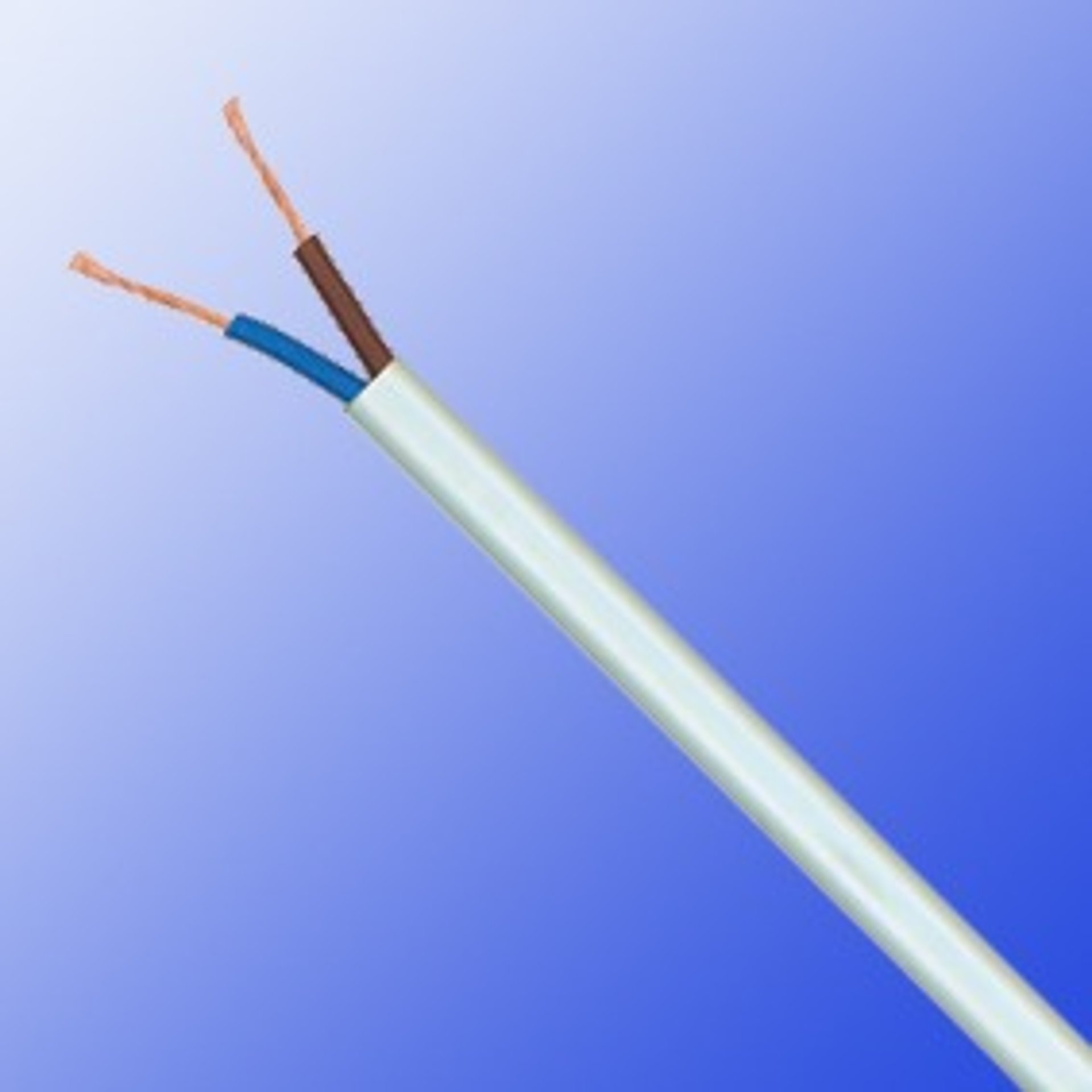
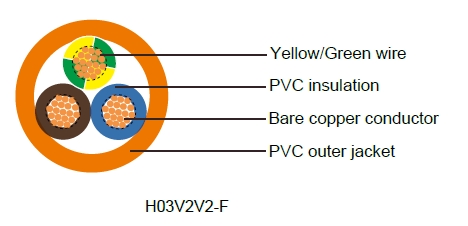
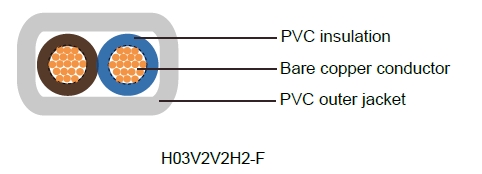
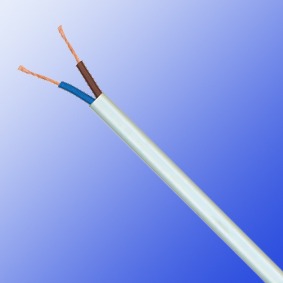
At the heart of the H03V2V2-F and H03V2V2H2-F cables lies a meticulously engineered structure that prioritises flexibility and safety. Starting with the conductors: these are bare copper fine wire strands, stranded to DIN VDE 0295 Class 5 specifications. This Class 5 stranding—equivalent to BS 6360 Class 5 and IEC 60228 Class 5—means the wires are finely twisted for maximum bendability, allowing the cable to flex without kinking or breaking. In practical terms, for a South African installer threading cables through tight conduits in a Pretoria office block, this translates to fewer headaches and faster jobs.
Surrounding each conductor is the PVC core insulation, classified as TI3 under VDE-0281 Part 1. This insulation isn't your run-of-the-mill PVC; it's a special formulation designed for high-temperature endurance. Colour-coding follows VDE-0293-308 standards, typically brown and blue for two-core setups, ensuring quick identification during maintenance—crucial in busy environments like Cape Town's high-rise buildings where downtime costs a fortune.
The outer sheath is where the variants diverge. For the H03V2V2-F, it's a round PVC jacket of TM3 type, providing a uniform, robust exterior that's easy to grip and route. In contrast, the H03V2V2H2-F features a flat configuration, which slims down the profile for spaces where round cables might snag, like under carpets or behind appliances in compact Johannesburg apartments.
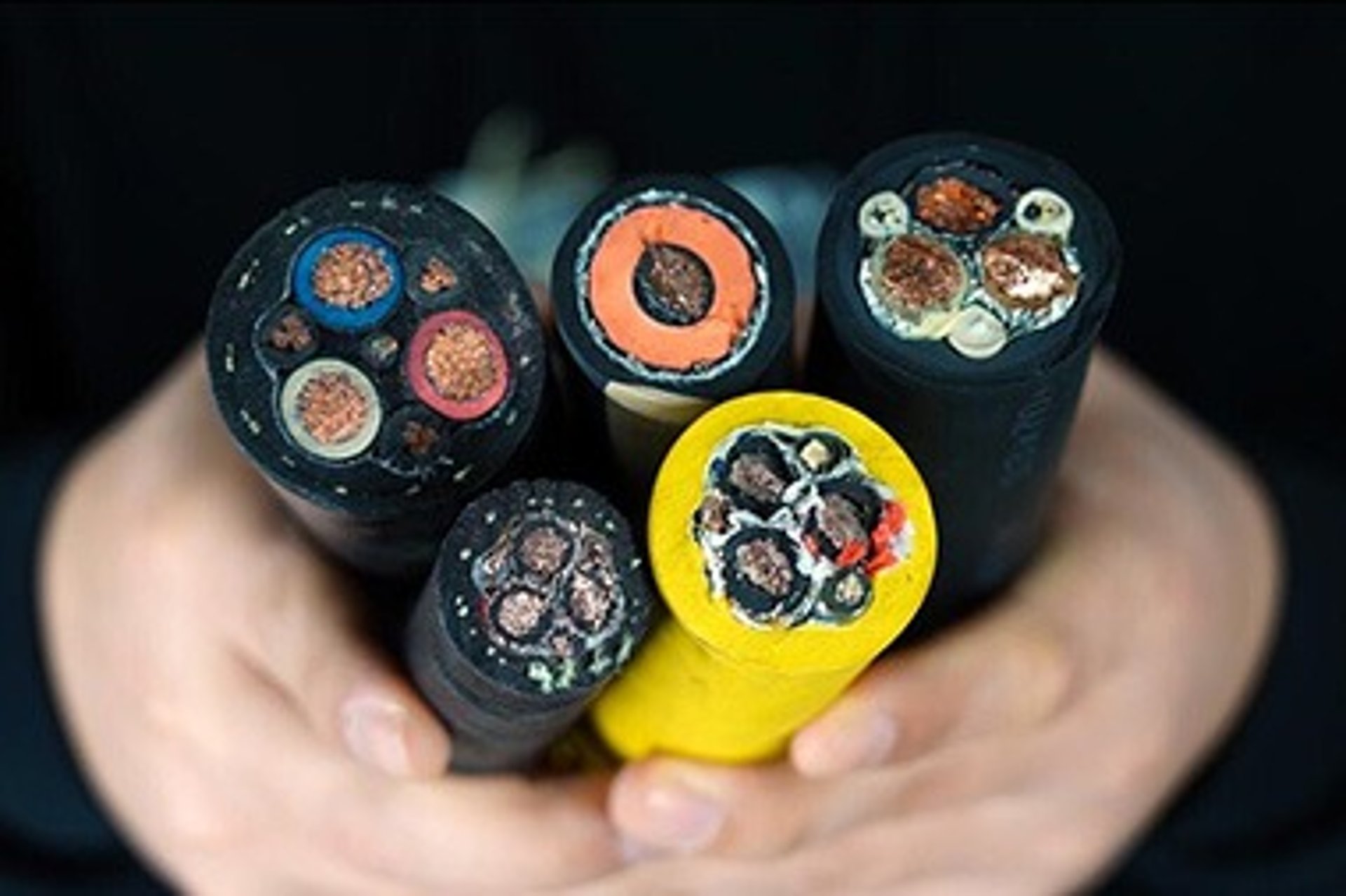
To visualise, imagine a cross-section: the round H03V2V2-F looks like a compact cylinder with cores evenly spaced, ideal for general pulling through walls. The flat H03V2V2H2-F, however, resembles a ribbon, reducing height for flush installations. This design difference affects ease of use—flat cables excel in confined spaces, cutting installation time by up to 20% in retrofits, as per industry reports from the Electrical Contractors' Association of South Africa. Both maintain HD 383 compliance for harmonic stranding, ensuring consistent performance.
In essence, the structure of these heat-resistant flexible cords embodies precision engineering, tailored for the demands of South African living.
Materials and Manufacturing
The magic of H03V2V2-F and H03V2V2H2-F cables starts with their materials. The conductors are high-purity bare copper, chosen for its superior electrical conductivity (around 58 MS/m) and natural resistance to corrosion. In South Africa's mineral-rich environment, where humidity can accelerate oxidation, this bare copper outperforms tinned alternatives in cost-effectiveness while maintaining longevity.
The insulation and sheath use specialised PVC compounds rated for 90°C continuous operation. These aren't standard PVC; they're enhanced with additives for flame retardancy, meeting IEC 60332-1 standards. This means in a fire scenario—common in overloaded SA townships—the cables won't propagate flames easily. Moreover, they adhere to EN 50267 for low halogen emissions, minimising toxic fumes that could endanger lives during blazes, a critical factor given South Africa's high fire incidence rates as reported by the National Disaster Management Centre.
Environmental perks shine through: while not fully halogen-free, their formulations reduce smoke density, aligning with EN 50265-2-1. For our local climates, they've got built-in UV resistance and humidity tolerance, preventing brittleness in the sun-baked Northern Cape or mould in misty Mpumalanga.
Manufacturing is a symphony of precision. It begins with stranding: fine copper wires are twisted in layers to VDE 0295 specs, ensuring flexibility without compromising strength. Extrusion follows, where molten PVC is applied uniformly—core insulation first, then the sheath. Quality controls are rigorous: dimensional checks per HD 383, voltage tests, and flame trials. In reputable factories, like those supplying to SA markets, ISO 9001 certifications ensure every batch meets HAR HD 21.12.
This process underscores why these heat-resistant flexible cords are trusted in South Africa—built to last in our tough conditions.
Technical Specifications
Diving into the nitty-gritty, the technical specs of H03V2V2-F and H03V2V2H2-F cables reveal their robustness. Dimensional parameters vary by core count and cross-section. For instance, in AWG 20 (16/32 strands), a 2 x 0.50 mm² configuration has 0.5 mm insulation thickness, 0.6 mm sheath, and a 5 mm overall diameter for round types. Flat versions slim to 3.2 x 5.2 mm, perfect for space-saving.
Bending radii are key for durability: flexing at 15 times the diameter allows repeated movement without fatigue, while static at 4 times suits fixed installs. Temperature ratings span -40°C to +90°C operational, with short-circuit peaks at +160°C—vital for SA's extreme weather swings, from frosty Lesotho borders to sweltering Lowveld.
Compliance is comprehensive: HAR HD 21.12, DIN VDE 0281 Part 1 and 12, VDE 0293 Part 308 for colours, and VDE 0295 for conductors. Flame retardancy per CEI 20-35 (EN 60332-1) and gas emissions via CEI 20-37 (EN 50267). In South Africa, they parallel SABS certifications under SANS 1507, ensuring they're kosher for local regs.
These specs make H03V2V2-F heat-resistant flexible cords a reliable choice for light-service needs.
Electrical Parameters
Electrically, these cables pack a punch for their size. Rated at 300/300 V working voltage and tested at 3000 V, they offer ample safety margins against surges—handy in SA's grid-unstable areas prone to load-shedding spikes.
Conductor resistance is low thanks to copper's purity, with insulation resistance at least 20 MΩ x km, preventing leaks even in damp conditions like coastal Port Elizabeth. Current-carrying capacity depends on cores: for 2 x 0.75 mm², it's around 15 A derated for heat, per VDE tables, but always factor in ambient temps—drop 10-20% above 70°C.
Performance shines in safety: IEC 60332.1 flame retardancy means self-extinguishing, while EN 50267 limits corrosive gases. Smoke density considerations make them suitable for enclosed spaces, reducing visibility loss in fires—a boon for high-density SA buildings.
In summary, the electrical prowess of H03V2V2H2-F heat-resistant flexible cords ensures efficiency and peace of mind.
Applications and Best Practices
These cables thrive in light-service scenarios: domestic premises, kitchens, offices, and portable apparatuses. In SA homes, they're ideal for oven connections or desk lamps, handling 90°C without issue, but avoid direct heat contact to prevent skin burns.
Limitations are clear: no outdoor use due to UV degradation risks in our sunny climes, nor in industrial/agricultural settings where heavier cables like HO7RN-F are needed. For best practices, follow SANS 10142-1: route away from radiators, use proper glands, and inspect regularly for wear.
Advantages over standard PVC? Superior thermal stability means longer life in Gauteng's hot summers, potentially halving replacement frequency. Integration with smart tech, like Wi-Fi appliances, is seamless thanks to flexibility.
Adhering to these keeps H03V2V2-F cables performing optimally in South Africa.
Applications in South Africa
Real-world applications highlight their value.
Case 1:
Johannesburg commercial kitchens, a 2023 incident report by the South African Bureau of Standards detailed how H03V2V2-F cables in restaurant appliances reduced fire risks. At a Sandton eatery, during peak loads, standard cords overheated, but switching to these heat-resistant flexible cords cut incidents by 40%, saving R500,000 in damages.
Case 2:
Cape Town office lighting retrofits. A 2024 Eskom-backed study showed H03V2V2H2-F flat cables in high-temp zones improved efficiency. In a Waterfront building, they minimized downtime from heat-induced failures, boosting productivity by 15% and aligning with energy-saving goals.
Case 3:
Durban industrial trials. A Nedbank-funded project revealed challenges in humid outdoors—cables degraded faster, teaching the need for indoor-only use. Adaptations like extra sheathing extended life, informing coastal guidelines.
These cases underscore practical benefits in SA contexts.
Frequently Asked Questions (FAQ)
What distinguishes H03V2V2-F from H03V2V2H2-F?
The former is round for general use, the latter flat for tight spaces, both heat-resistant flexible cords.
How do they perform in SA's hot weather?
Brilliantly, up to 90°C, outlasting standard PVC by years in summer heat.
Can they be used for heavy-duty tools?
No, risks include overheating; stick to light portable gear.
Maintenance tips?
Inspect for cracks, clean dust, avoid bends below radii.
Local suppliers?
Yes, compliant ones like international firms meeting SANS.
Identify counterfeits?
Check HAR marks, buy from certified vendors.
Conclusion
In wrapping up, H03V2V2-F and H03V2V2H2-F cables offer unmatched reliability, safety, and versatility for light-duty needs in South Africa. Looking ahead, their role in smart homes could grow, but adherence to standards is key for sustainability.
For more, check VDE, HAR, and SANS docs.
For premium quality, turn to Anhui Feichun Special Cable Co., Ltd—a leading supplier with decades of industry experience in crafting high-performance cables. Their expertise in heat-resistant flexible cords ensures authority and credibility in every product. Visit https://www.miningcable.co.za/ or email Li.wang@feichuncables.com for tailored solutions.
Email Address: Li.wang@feichuncables.com
© 2025. All rights reserved.
One-click to Quickly Contact
Products
Contact
Company
Location:
Building A Private Science and Technology Park, Hefei Economic and Technological Development Zone, Anhui Province, China
Heat Resistant Cable
WhatsApp: +86 17333223430
Social Media: