Anhui Feichun Special Cable Co.,Ltd Email: Li.wang@feichuncables.com

High-Temperature Cables: The Heat-Resistant Lifelines Powering South Africa’s Toughest Industries
Discover everything about high-temperature cables – from nickel-plated conductors and PTFE insulation to 1000 °C-rated mica tapes. Learn construction, types, South African mining & petrochemical applications, selection criteria, installation, maintenance, and FAQs for safe, reliable performance in extreme heat.
Li.wang
11/3/20255 min read
Why High-Temperature Cables Matter in Everyday and Industrial Life
Picture this: deep beneath the sun-baked crust of the Northern Cape, Anglo American’s Kumba Iron Ore mine at Sishen pushes conveyor motors through ambient temperatures that regularly top 55 °C. Add the heat radiating from ore-crushing equipment and you’re easily nudging 150 °C around the cabling. A standard PVC-insulated cable would soften, crack, and short-circuit within hours, triggering costly downtime, fire risks, and potential injury to workers. Now shift east to Sasol’s Secunda petrochemical complex, where synthesis-gas furnaces roar at 900 °C. Ordinary wiring simply melts.
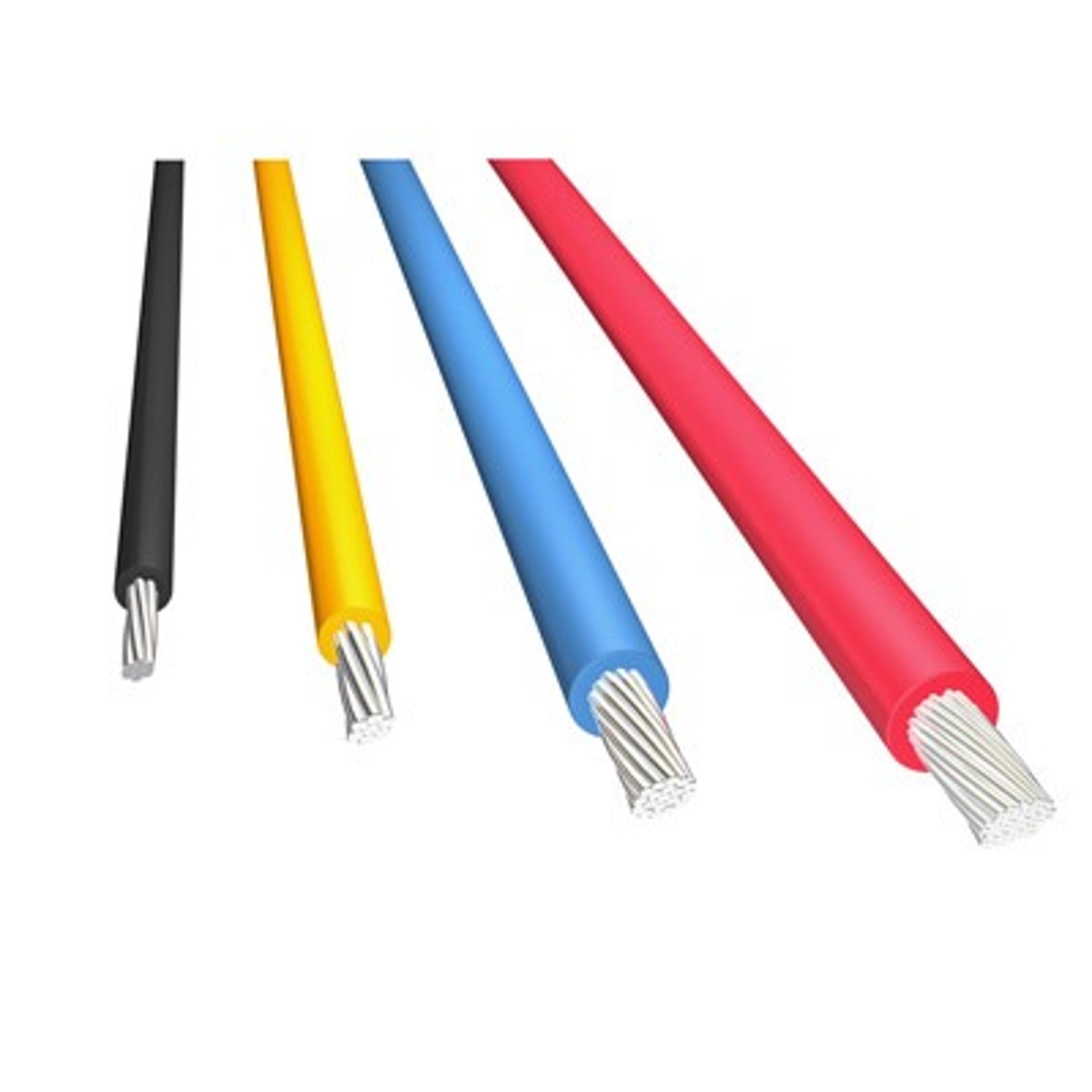
This is where high-temperature cables step in as silent guardians. Professionally defined, a high-temperature cable is a specialised electrical conductor system engineered to retain mechanical integrity, dielectric strength, and current-carrying capacity when exposed to continuous or peak temperatures exceeding 150 °C – with premium variants surviving up to 1000 °C.
In South Africa’s resource-driven economy, these cables are the unsung heroes preventing blackouts in Eskom substations, keeping blast furnaces humming at ArcelorMittal Vanderbijlpark, and ensuring signal fidelity in thermocouple networks inside gold reefs at Mponeng – the world’s deepest mine.
This 2500-plus-word guide dissects every layer of high-temperature cable technology: construction materials, type classifications, real-world South African deployments, selection frameworks, installation protocols, maintenance routines, and an exhaustive FAQ section. Whether you’re an electrical foreman on a Northern Cape solar farm or a procurement officer at a Durban refinery, you’ll leave equipped to specify, install, and sustain cables that laugh at heat.
Core Construction and Materials:
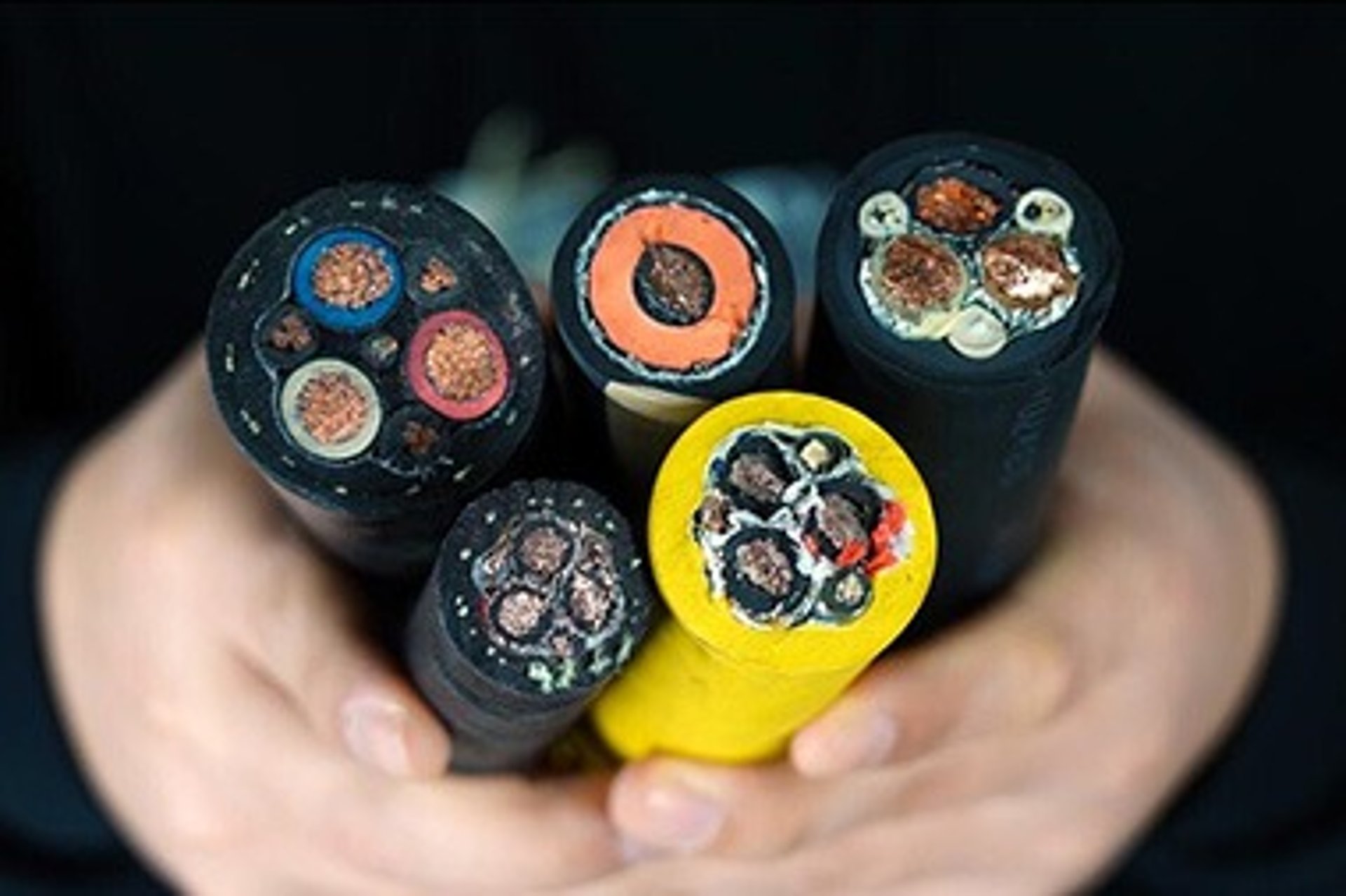
A high-temperature cable is only as strong as its weakest thermal link. Strip one open and you’ll find three critical zones: conductor, dielectric insulation, and protective jacketing. Each must resist oxidation, embrittlement, and dielectric breakdown under prolonged thermal assault.
Conductors: The Current Highway
Nickel-plated copper: Electrolytic copper strands are electroplated with a 27–40 % nickel layer. Nickel forms a passive oxide barrier, curbing copper oxidation up to ~600 °C while retaining copper’s superb conductivity (≈58 MS/m). Widely specified in Eskom turbine-generator hook-ups.
Pure nickel: With a melting point of 1455 °C, solid or stranded nickel conductors are reserved for furnace electrode leads and glass-melt tanks where temperatures exceed 800 °C. Conductivity drops to ~14 MS/m, so voltage-drop calculations become critical.
Insulation: The Thermal Shield
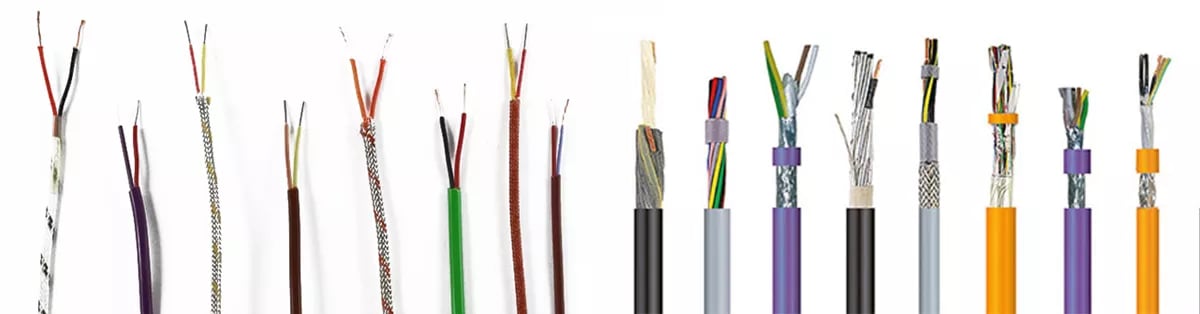
PTFE (Polytetrafluoroethylene): Continuous rating 260 °C, peak 300 °C. Near-zero dielectric loss (tan δ < 0.0002), impervious to virtually all industrial chemicals. Used in Sasol’s synfuel reactors where H₂S and CO coexist with heat.
Silicone rubber: Flexible from –50 °C to +180 °C standard, or +300 °C with special curing. Halogen-free formulations meet SANS 1574-4 low-smoke zero-halogen (LSZH) mandates inside Cape Town’s Silo District buildings.
Mica-glass tapes: Layered muscovite or phlogopite mica bonded with silicone resin, wrapped helically. Maintains circuit integrity for 90 minutes at 1000 °C under direct flame – mandatory for fire-survival cables feeding emergency shut-down valves in petrochemical plants.
Fibreglass braids: E-glass filaments impregnated with high-temperature varnish, rated 550 °C continuous. Provides mechanical armour against slag splash in steel mills.
Ceramic fibre braids: Next-level protection to 1000 °C; seen in platinum smelters around Rustenburg.
Polymeric Enhancements
XLPE (cross-linked polyethylene): Silane or peroxide cross-linking yields 90 °C standard cables, but irradiation-boosted variants reach 150 °C for medium-voltage feeder cables inside Koeberg’s containment zones.
HEPR (hard ethylene-propylene rubber): Thermoset elastomer blend lowers cold-temperature brittleness, easing installation in Highveld winters while retaining 150 °C heat resistance.
South African Compliance
Every high-temperature cable sold locally must carry SABS mark certification against SANS 1507 (flexible cords), SANS 1574 (fire performance), and NRCS LoA for compulsory safety. Conductors are invariably bare or tinned electrolytic copper (minimum 99.99 % purity) to satisfy electromagnetic compatibility tests inside Eskom’s 765 kV transmission corridors.
Key Types of High-Temperature Cables: Matching Specs to Needs
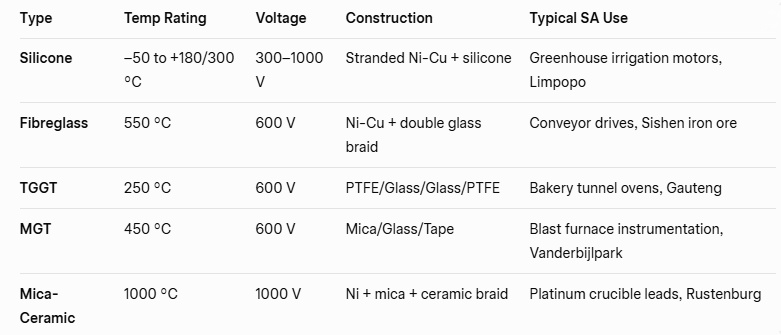
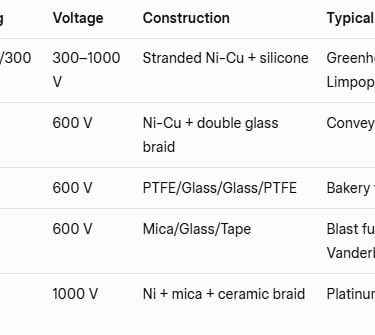
Deep Dive
Silicone cables remain supple at –50 °C, vital for Northern Cape solar trackers that endure frost nights and 45 °C days.
TGGT layers two glass braids between PTFE tapes, creating a moisture barrier plus abrasion shield for kiln heater elements.
MGT tapes are wound with 50 % overlap, then sintered; the glass carrier melts into a glassy fuse during fire, preserving conductor spacing.
PVC is explicitly not a high-temperature insulation. At 105 °C it softens; above 120 °C it decomposes, releasing HCl. Reserve PVC for control panels, never process heat zones.
Applications Across Industries: From Mines to Medical Equipment
Mining
At Mponeng, rock temperatures exceed 60 °C at 4 km depth. High-temperature silicone cables feed submersible pumps; fibreglass-sheathed motor leads withstand rock bursts and abrasive ore slurry.
Petrochemical
Sasol Secunda’s gasification islands operate at 350 °C. PTFE-insulated multipair thermocouple extension cables snake through pipe racks, immune to syngas leaks.
Steel & Cement
ArcelorMittal Vanderbijlpark deploys MGT cables inside walking-beam furnaces; ceramic-braided leads connect induction coils at 950 °C.
Renewable Energy
The !Xun and !Xharab solar thermal plant near Upington concentrates sunlight to 560 °C. Fibreglass cables route power from receiver tubes to steam turbines.
Medical
Netcare autoclaves in Johannesburg use silicone-jacketed heater cables rated 200 °C for sterilisation cycles without emitting volatiles.
Selecting the Right High-Temperature Cable:
1. Map Peak Temperature Continuous operating + 50 °C safety margin. Example: furnace wall 400 °C → select 450 °C MGT.
2.Calculate Voltage Drop Use nickel’s 4× higher resistivity vs copper. For 100 m run at 450 °C, upsize from 16 mm² Cu to 35 mm² Ni.
3.ssess Chemical Exposure H₂SO₄ mist in gold cyanidation → PTFE outer jacket mandatory.
Mechanical Stress Vibrating screens → fibreglass braid + stainless-steel overbraid.
Regulatory Box-Ticking
SANS 1507-3 (heat-resistant flexible cords)
SANS 1574-5 (circuit integrity under fire)
NRCS VC 8008 (compulsory specification)
Future-Proofing Specify 20 % spare pairs in thermocouple runs for plant expansions.
Installation and Maintenance Best Practices:
Installation
Bend radius: Minimum 10× overall diameter for fibreglass; 12× for mica to prevent tape fracture.
Glands: Nickel-plated brass rated 400 °C with graphite packing.
Support: Stainless-steel cable trays with 150 mm spacing to dissipate heat.
Derating: Apply SANS 10142-1 temperature correction factors; 0.58 for 70 °C ambient on 90 °C cable.
Maintenance
Quarterly visual: Look for glazing (silicone), powdering (mica), or copper greening.
Megger test: Insulation resistance >100 MΩ at 500 V DC.
Thermal imaging: Hot-spots >20 °C above neighbours signal loose terminations.
Record: Log thermal cycles; mica tapes fatigue after ~500 cycles above 800 °C.
FAQ:
Q: What is the maximum temperature high-temperature cables can withstand?
A: From 150 °C (XLPE) to 1000 °C (mica-ceramic). Typical industrial workhorses sit between 200 °C and 450 °C. Example: Sasol specifies 300 °C silicone for valve actuator wiring.
Q: How do I choose the right high-temperature cable for my setup?
A: Build a threat matrix: peak temp, chemical list, vibration level, voltage, and SANS compliance. Engage a SABS-listed cable supplier for a thermal simulation report.
Q: Can high-temperature cables be used outdoors in South Africa’s variable climate?
A: Absolutely. Silicone/fibreglass jackets with UV-stabilised varnish endure Kalahari sun and coastal salt. The Khi Solar One tower uses 250 °C fibreglass cables exposed to 1400 W/m² irradiance.
Q: What chemical resistance levels do they offer?
A: PTFE is virtually universal (pH 0–14, solvents, oils). Silicone resists dilute acids but swells in ketones. Always cross-reference the manufacturer’s chemical compatibility table.
Q: What are the dos and don’ts of installation?
A: Do respect bend radius, use high-temp glands, leave expansion loops. Don’t bundle with PVC cables, crimp nickel with copper tools (work-hardening), or ignore ventilation.
Q: How often should maintenance be performed?
A: Quarterly visual + annual Megger in aggressive environments (steel mills). Replace any section showing >10 % capacitance drift.
Q: Are custom high-temperature cables available?
A: Yes. Local manufacturers in Germiston offer bespoke MGT with 50 m integral thermocouples for furnace wall mapping.
Q: How to ensure longevity?
A: Correct spec + 6-monthly torque checks on terminations + thermal cycling log = 15–25 years service in 300 °C continuous duty.
Conclusion
From the blistering depths of Mponeng to the scorching solar fields of the Northern Cape, high-temperature cables are the connective tissue that keeps South Africa’s industrial heart beating. By mastering conductor metallurgy, insulation chemistry, and local regulatory nuances, engineers and electricians can eliminate heat-related failures, slash maintenance budgets, and safeguard lives.
Next time you walk past a humming furnace at Secunda or watch molten steel pour in Vanderbijlpark, remember: beneath the glow lies a precisely engineered high-temperature cable – silent, steadfast, and ready for another decade of African heat.
Email Address: Li.wang@feichuncables.com
© 2025. All rights reserved.


One-click to Quickly Contact
Products
Contact
Company
Location:
Building A Private Science and Technology Park, Hefei Economic and Technological Development Zone, Anhui Province, China
Heat Resistant Cable
WhatsApp: +86 17333223430
Social Media: