Anhui Feichun Special Cable Co.,Ltd Email: Li.wang@feichuncables.com
How BS 6708 Keeps South Africa’s Mines and Quarries Running Without a Spark Out of Place
Dive deep into BS 6708 – the British Standard governing flexible trailing cables for South African mines and quarries. From 320/550 V auxiliary leads to 11 kV monster shovel cables, explore cable types, construction, testing, real-world applications, and a comprehensive FAQ for pit electricians and procurement teams.
Li. Wang
11/5/20257 min read
Why BS 6708 Matters in Mining and Quarries
Picture this: 800 m below the Highveld, a continuous miner chews through a coal seam when the trailing cable snags on a roof bolt. The sheath tears, a phase hits the steel armour, and the whole section trips out. Production stops, methane builds up, and the shift boss is on the phone to the surface before you can say “Section 54”. That single cable failure just cost R400 000 in lost tonnes – and nearly cost lives.
That’s the nightmare BS 6708:1998 was written to prevent.
In plain South African English: BS 6708 is the rulebook for every flexible cable that drags, flexes, and gets crushed in our mines and quarries. It covers everything from the skinny 320/550 V remote-control leads on a roofbolter to the fat 6350/11 000 V umbilical feeding a 400 t opencast shovel.
Adopted across the Witwatersrand gold reefs, Mpumalanga coal fields, and Northern Cape manganese pits, BS 6708 works hand-in-hand with SANS 1520 – South Africa’s own flexible mining cable standard. Together they make sure cables survive dust that clogs your nostrils, water that drips off the hanging wall, and the constant tug-of-war between machine and cable reel.
Historical Context and Evolution
BS 6708 didn’t appear out of thin air. It was forged in the damp, gassy coal mines of Yorkshire and Nottinghamshire in the 1970s and 1980s, when flameproof loaders and shearers started replacing pick-and-shovel gangs. Early cables were stiff, cracked under flex, and sparked like a braai lighter in dusty faces.
The 1998 revision brought three big upgrades:
Pliable galvanised steel wire armour – strands instead of rigid braid, so the cable bends without kinking.
Tinned copper conductors – fights corrosion in acidic mine water.
Elastomer compounds rated to 90 °C – because a cable lying on a hot crusher discharge belt can’t melt.
In South Africa, the standard landed just as platinum reef mining boomed. Suddenly trackless machines were dragging cables through narrow 1.2 m stopes. BS 6708 gave engineers a common language with British OEMs like Joy and Sandvik, while SANS 1520 kept local cable makers like CBI-electric and Aberdare in the game.
Core Technical Requirements – Breaking It Down Simply
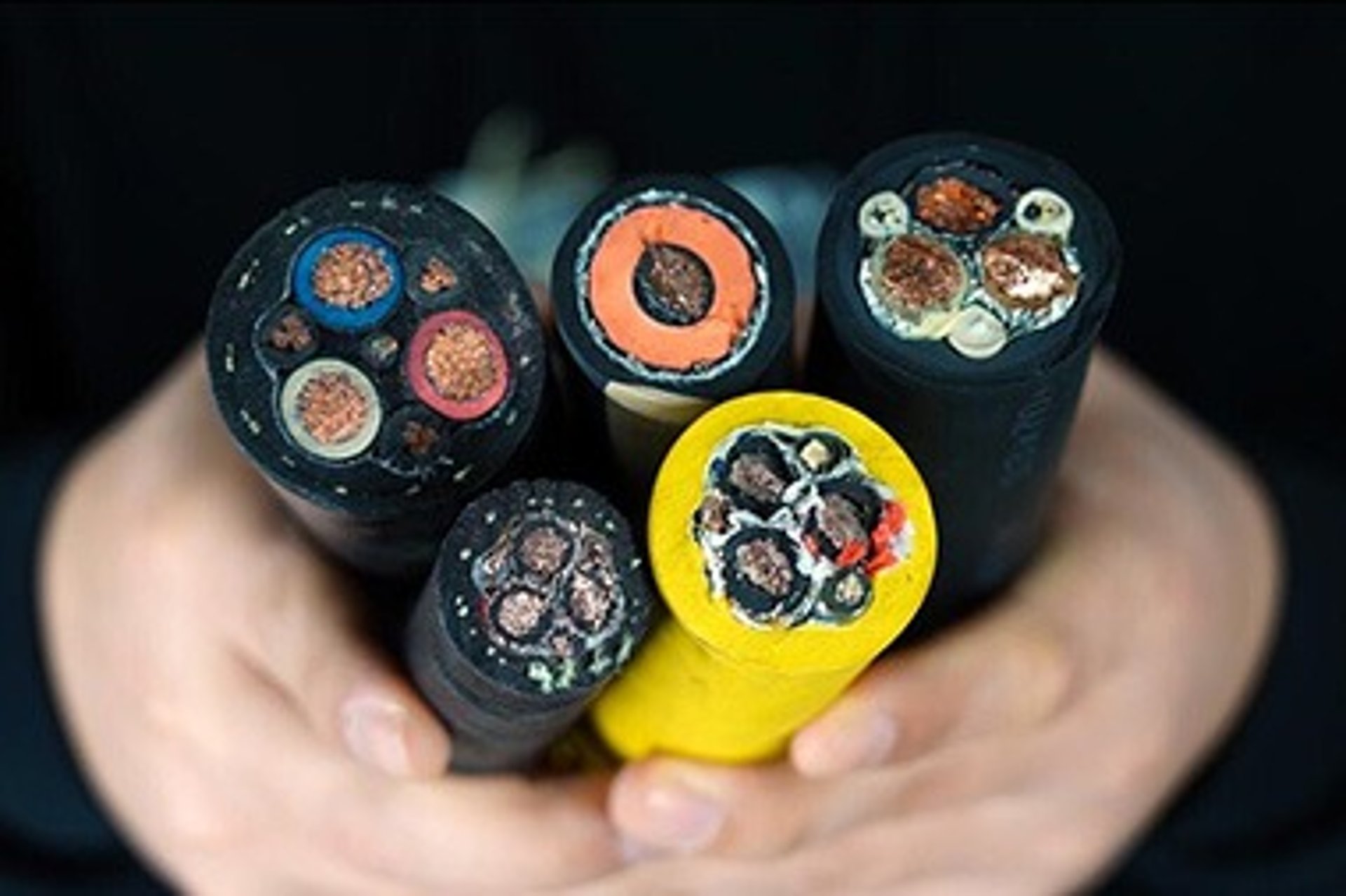
Think of a BS 6708 cable as a layered biltong stick: flexible inside, tough outside, and every layer has a job.
Conductors – The Copper Heart
Every power core uses Class 5 tinned annealed copper (BS 6360). Below 16 mm² the strands are bunched like rope; above that they’re laid up in multiple layers. Tinning stops verdigris in wet stopes, and Class 5 flexibility means the cable can coil onto a 1 m diameter reel 10 000 times without snapping strands.
Insulation – The Rubber Skin
Cores are wrapped in heat-resistant elastomer – either FR1 (flame-retardant rubber) or GP4 (general-purpose polychloroprene). High-voltage types (1.9/3.3 kV and up) get ethylene propylene rubber (EPR) that won’t carbonise at 250 °C fault temperatures.
Screening – The Fault Police
Every power core above 640/1100 V gets an individual metallic screen – tinned copper wires or tape – to contain phase-to-earth faults. Auxiliary cores in Types 506–524 use non-metallic semi-conductive screens to kill static that could spark in a fiery mine.
Armouring – The Steel Muscle
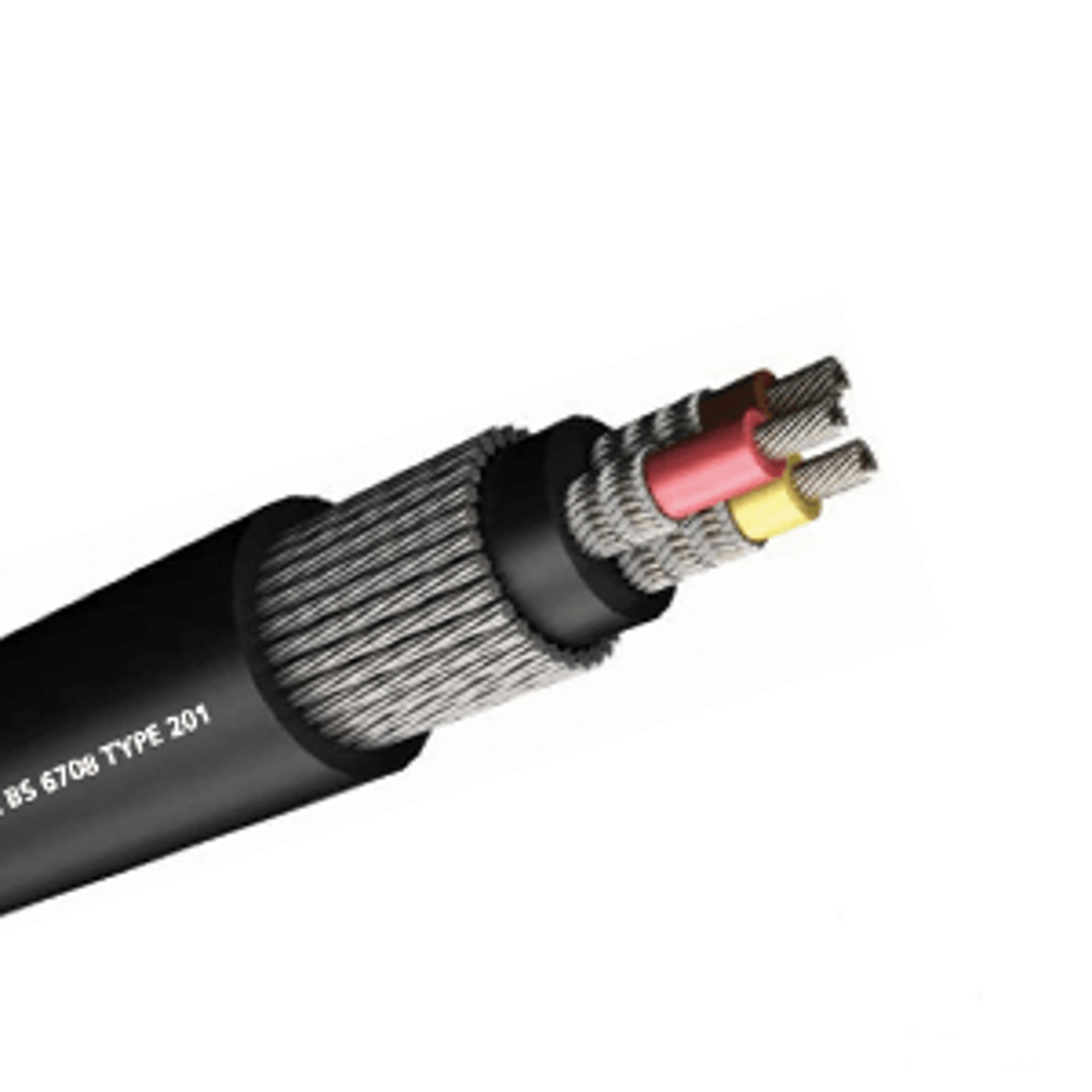
Only pliable galvanised steel wire is allowed – no rigid braid. The wires are laid in two contra-helical layers, giving crush resistance to 15 kN/m and tensile strength to survive a 3 t loader rolling over the cable. The armour doubles as an earth conductor, sized to carry fault current for 0.3 s without melting.
Sheathing – The Tough Outer Hide
The final jacket is RS6 heavy-duty elastomer – oil-resistant, UV-stable, and cut-resistant to 300 N with a 2 mm blade. Yellow or blue longitudinal stripes (3 mm wide) scream the cable type from 20 m away in a dusty roadway.
Voltage Hierarchy – Match the System
320/550 V – Remote controls, lighting, small drills
640/1100 V – Most coalface and trackless machines
1900/3300 V – Medium-voltage longwalls and shovels
3800/6600 V – Large opencast excavators
6350/11 000 V – Draglines and ultra-class shovels
U₀/U rating means phase-to-earth/phase-to-phase. Never up-rate – a 640/1100 V cable on a 3.3 kV system will flash over in weeks.
Cable Types – A Practical Field Guide
Non-Armoured Cables – Light to Medium Duty
These are the workhorses of the coal face and development ends.
Types 7, 7M, 7S (640/1100 V): Three individually screened power cores plus pilots. The “M” means mineral-oil resistant sheath for hydraulic leaks; “S” means stainless steel wire braid for extra cut resistance in sharp shale. Used on continuous miners, shuttle cars, and feeder breakers.
Type 11 (640/1100 V): Same as Type 7 but with composite earth cores – lighter for hand-carrying in low seams.
Types 14 & 16: Variants with extra pilot cores for remote tripping on roofbolters.
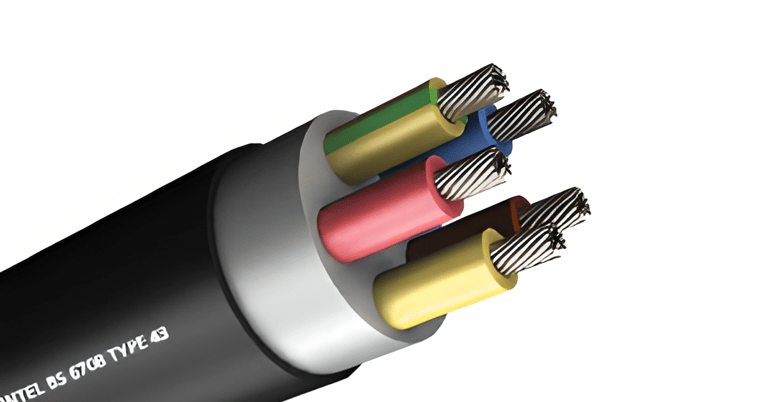
Types 43 & 44 (600/1000 V): Hand-held drill cables. Type 43 has non-metallic screens to reduce weight; Type 44 uses copper screens for better fault clearance. Both are 3-core plus earth, with bright orange sheaths for visibility.
Type FS4: Flat twin-core catenary cable for overhead gantry systems in shaft bottoms – hangs like a washing line but rated for 100 A continuous.
Armoured Cables – Heavy Duty & Protected
When the cable runs along a roadway or feeds a crusher, armour is non-negotiable.
Types 20 & 21 (640/1100 V, unscreened): Type 20 is 3-core for power only (e.g., conveyor starters); Type 21 adds a fourth core for control. Perfect for LHDs in platinum stopes.
Types 62, 63, 64, 70, 71 (640/1100 V): Mix of screened and unscreened cores for lighting and remote control. Type 63 is the go-to for coal face illumination strings – 7 cores in a flat layout to lie neat on the floor.
Types 201 & 211 (640/1100 V, screened): Like 62/71 but every core screened – used where electromagnetic interference from VSDs is a problem.
Types 321 & 331 (1.9/3.3 kV): Armoured trailing cables for quarry roadway extensions. Type 331 has composite earths to reduce diameter.
Types 621, 630, 631 (3.8/6.6 kV): The big boys for opencast haul roads. Type 630 is round; 631 is flat for reelers.
Types 506, 512, 518, 524 (320/550 V): Auxiliary multicore cables with up to 24 individually screened cores. Think modular drill rigs – one cable links the power module, hydraulic pack, and operator console.
High-Voltage Trailing Giants – Non-Armoured
These monsters feed the biggest machines but still need to flex.
Types 307, 307M, 307S (1.9/3.3 kV): Non-armoured version of the coalface workhorse. “M” and “S” suffixes same as Type 7.
Type 730 (3.8/6.6 kV): Three screened cores for quarry shovels up to 200 t.
Type 830 (6.35/11 kV): The cable behind a P&H 4100 shovel – 120 mm overall diameter, weighs 28 kg/m, but still reels onto a 3 m drum.
Testing and Compliance – Proof in the Pudding
Every metre of BS 6708 cable leaves the factory with a birth certificate of tests:
Conductor resistance: Measured at 20 °C – must match BS 6360 tables.
High-voltage withstand: 3.5 kV for 640/1100 V cables, 5 minutes, no puncture.
Insulation resistance: Minimum 100 MΩ/km at 20 °C.
Flame propagation: BS 4066 Part 1 – three vertical samples must self-extinguish within 30 s.
Armour mechanicals: Wrap test (8 x diameter mandrel, no cracks); tensile test (15 kN/m crush).
Water immersion: 1 m head for 24 h – no moisture inside cores.
Abrasion: 300 N blade, 200 cycles – sheath loss < 1 mm.
Marking is sacred:
Internal tape every 300 mm: “Manufacturer | BS 6708 | Type 307 | 1.9/3.3 kV | 03/25”.
External: 3 mm yellow stripe for 1.9/3.3 kV, blue for 3.8/6.6 kV.
The standard’s annexes are gold:
Annex A: Conductivity tables for fault current.
Annex B: Current ratings – e.g., Type 307 35 mm² = 180 A in free air, 140 A bundled.
Annex C: Screen short-circuit capacity – a 35 mm² copper screen carries 4.7 kA for 0.2 s.
Applications in South African Mining
Coal – Mpumalanga & Limpopo
A longwall shearer at Tweefontein uses Type 307M 50 mm² trailing to the gate-end box, with Type 63 armoured lighting strings clipped to the monorail. The cable reel takes 180 m – every metre flexes 6 million times over panel life.
Platinum – Rustenburg & Steelpoort
Trackless LHDs in 1.2 m stopes drag Type 21 25 mm² cables. The fourth core signals the hydraulic valve pack. Type 512 auxiliary cables link the battery pack to the dashboard – 19 cores in a 28 mm diameter hose.
Gold – West Rand
Development jumbos use Type 44 drill cables – orange, 4 mm², tough enough to survive being stood on by size 12 boots. Roadway extensions to the substation are Type 321 35 mm² armoured, buried under 50 mm gravel.
Opencast – Northern Cape & Kathu
A 240 t excavator at Sishen reels Type 730 70 mm² behind it – 150 m length, 4.2 t total mass. The cable trench crossing the haul road uses Type 621 armoured to survive 360 t haul trucks.
Frequently Asked Questions (FAQ)
1. Can I use a 640/1100 V cable on a 1.9/3.3 kV system?
No chance, boet. The insulation thickness for 640/1100 V is 1.2 mm; for 1.9/3.3 kV it’s 2.4 mm. You’ll get partial discharge, tracking, and eventually a bang. Match U₀/U exactly.
2. What’s the difference between Type 7 and Type 307?
Both feed coalface cutters, but Type 7 is 640/1100 V with thinner insulation; Type 307 steps up to 1.9/3.3 kV for bigger shearers (400 kW+). Think of 307 as the V8 version.
3. Is armouring compulsory underground?
Yes for permanent roadway cables and any trailing cable longer than 50 m in high-abuse zones. Non-armoured is only for short, protected runs inside a machine skid.
4. How do I identify a cable on site?
Look for the coloured stripes: yellow = 1.9/3.3 kV, blue = 3.8/6.6 kV, none = 640/1100 V. Then cut a slice and read the internal tape every 300 mm.
5. What fails most often?
Mechanical damage – sheath cuts from sharp shale, armour strands snapping from over-reeling, or cores nicked by a roofbolter spinner. Inspect daily; if the armour is down to one layer, replace.
6. SANS 1520 vs BS 6708 – which to specify?
Both are legally accepted. Use SANS 1520 when buying from local cable makers (cheaper, faster delivery). Specify BS 6708 when the machine OEM demands it (e.g., Sandvik LH517 loaders).
7. Can I repair a damaged trailing cable?
Only with an approved vulcanised joint kit (cold or hot cure) done by a competent person. Never use tape, heat-shrink, or cable ties – you’ll void the flameproof certification and risk a methane ignition.
8. Why tinned copper and not plain?
Plain copper turns green in mine water within weeks, increasing resistance and heating. Tinning costs 8 % more but lasts 10 years instead of 2.
9. What’s the maximum reel flange diameter?
20 × overall cable diameter for non-armoured, 25 × for armoured. Smaller bends work-harden the copper and crack the sheath.
10. Do I need individual core screens on auxiliary cables?
Yes, for Types 506–524. Without screens, VSD noise couples into control circuits, causing false trips on proximity sensors.
Conclusion
BS 6708 isn’t just a stack of paper in the electrical engineer’s office – it’s the reason a 3.3 kV cable dragged 200 m behind a continuous miner doesn’t arc, spark, or burn. From the tinned copper strands that flex a million times to the pliable steel armour that shrugs off a 40 t loader, every detail is engineered for South Africa’s toughest workplaces.
Next time you see a yellow-striped cable snaking across a coal face, give it a nod. That humble hose is the unsung hero keeping the rand in the bank and the shift underground safe.
Email Address: Li.wang@feichuncables.com
© 2025. All rights reserved.
One-click to Quickly Contact
Products
Contact
Company
Location:
Building A Private Science and Technology Park, Hefei Economic and Technological Development Zone, Anhui Province, China
Heat Resistant Cable
WhatsApp: +86 17333223430
Social Media: