Anhui Feichun Special Cable Co.,Ltd Email: Li.wang@feichuncables.com
How Does H07RN-F Rubber Sheathed Cable Survive UV, Oil, Water and Mechanical Stress? A Technical Deep Dive for Engineers
H07RN-F rubber sheathed cable is the global benchmark for heavy-duty flexible power distribution, engineered to perform reliably under the harshest conditions found across South Africa’s mining, construction, agriculture and industrial sectors. This comprehensive technical guide explores exactly how its design, material science and engineering principles enable it to resist ultraviolet radiation, oil, water, ozone and extreme mechanical stress, outperforming standard cables by years in service life. We break down its construction, standards compliance, performance advantages and practical selection criteria, while explaining why Feichun Cable offers a fully equivalent, cost-effective alternative with fast delivery to all African markets.
Li Wang
6/1/202616 min read
Introduction
In South Africa, where operations range from deep-level mines in Gauteng to coastal ports in Durban, agricultural projects in KwaZulu-Natal and large-scale construction across the Western Cape, power cables face challenges that few products can withstand. Exposure to intense sunlight, high temperatures, heavy rain, chemical spills, dust and constant movement is not an exception — it is the daily reality. For decades, engineers and procurement teams have relied on H07RN-F rubber sheathed cable as the trusted solution that simply does not fail where others do.
This cable is not just another product on a specification sheet. It is a harmonized European standard design, developed through decades of research and field testing to solve exactly the problems that destroy ordinary cables. Whether used on a gantry crane, a mining reeler, a temporary construction site or an irrigation pump, H07RN-F delivers consistent performance over 15 to 20 years — compared to the 2 to 3 years typically expected from standard PVC or light rubber alternatives.
What makes this cable so special? How can one product survive ultraviolet radiation that degrades plastic, oil that dissolves common rubber, water that causes electrical failure, and mechanical forces that snap conductors? The answer lies in a carefully engineered combination of material science, structural design and strict adherence to international standards. In this article, we will explore every layer, every material and every principle that makes H07RN-F the industry standard for harsh environments. We will also explain exactly why ordinary cables fail, and how this design overcomes those limitations.
Understanding the Basics — Standards, Specifications and Identification
Before diving into engineering details, it is essential to understand exactly what H07RN-F represents. The name itself is not random; every letter and number tells you exactly what you are buying, according to the harmonized European cable marking system.
Breaking down the name:
H: Harmonized standard, meaning it is approved and recognized across all European and many international markets
07: Rated voltage class — 450/750 Volts (U₀/U), suitable for most industrial power applications
R: Insulation material is rubber
N: Sheath material is Neoprene / Polychloroprene (PCP), the heavy-duty rubber compound that defines this cable
F: Flexible construction, designed for repeated movement and bending
Official Standards Compliance
Every metre of genuine H07RN-F cable is manufactured to rigorous specifications that ensure consistency and safety. These standards are not optional; they define exactly the materials, dimensions and performance levels required. The key documents include:
EN 50525-2-21: The primary product standard for flexible cables, defining construction, materials and test methods
HD 22.4 / HD 516: Harmonized design rules that ensure interchangeability between manufacturers
IEC 60245-4 / VDE 0282-4: International and German standards for rubber insulated cables
IEC 60228 / DIN VDE 0295: Conductor standards, specifying exactly how the copper must be constructed
CPR / EU 305/11: Construction Products Regulation, with fire classification Eca, suitable for all industrial and public buildings
EN 50265-2-1 / IEC 60332-1-2: Flame retardancy requirements — the cable must self-extinguish if ignited
DIN VDE 0472-805: Ozone resistance testing, critical for outdoor longevity
These standards are referenced in every technical data sheet, including the documentation from manufacturers like Elettrotek and Feichun Cable. Compliance means that wherever you are in South Africa, from a mine in Limpopo to a factory in Cape Town, you can specify H07RN-F and be confident it meets the same proven performance levels.
Key Technical Specifications
From the official product data, we find the core parameters that define its operating range:
Nominal Voltage: 450/750 V AC; for fixed, protected installations, it can operate safely up to 0.6/1 kV
Test Voltage: 2.5 kV AC, ensuring robust insulation integrity
Temperature Range:
Continuous operation: -40°C to +60°C — covers every climate found in Southern Africa
Fixed protected use: up to +85°C
Installation minimum: -25°C — can be installed safely even in cold winter conditions
Short-circuit withstand: +200°C for up to 5 seconds — survives fault conditions without damage
Mechanical Limits:
Minimum bending radius: 4× outer diameter (fixed laying) / 6× outer diameter (flexible use)
Tensile strength requirements: 15 N/mm² (fixed) / 50 N/mm² (dynamic applications)
Size Range: Available from 1 mm² to 630 mm², with 1 to 37 cores; all cables with 3 cores or more include a green-yellow earth conductor as standard
Colour Coding: Follows DIN VDE 0293-308 / HD 308 S2; cables with 6 cores or more use black cores with consecutive white numbering per EN 50334
This set of specifications immediately distinguishes H07RN-F from lighter cables like H05RN-F (300/500 V, light duty) or standard PVC types. It is purpose-built for heavy use.
Deep Dive — Structure, Materials and Engineering Principles
The true secret of H07RN-F lies in how it is built. Every layer — from the innermost copper conductor to the outer rubber sheath — is chosen for a specific reason, following well-established principles of electrical engineering, materials science and mechanical design. We will examine each component in detail, explaining why it is made that way and how it works.
Conductor: Class 5 Flexible Copper
At the heart of every cable is the conductor, and here is where the difference begins. Standard industrial cables typically use Class 2 or Class 3 conductors — solid or relatively thick strands of copper. H07RN-F requires Class 5 flexible conductors according to IEC 60228 and DIN VDE 0295.
Construction Details:
Material: High-purity annealed red copper, with conductivity ≥ 98% IACS
Structure: Made of extremely fine individual wires, typically 0.15 mm to 0.25 mm in diameter, stranded together in multiple layers
Example: A 1.5 mm² conductor contains approximately 84 fine wires; a 25 mm² conductor uses over 400 strands
Option: Tinned copper available for extra corrosion resistance in humid or chemical environments
Engineering & Scientific Principles:
Mechanical Flexibility and Fatigue Resistance
This is the most critical difference. When a cable is bent or moved, the outer part stretches and the inner part compresses. With thick wires, this creates high stress concentrations at the surface, leading to metal fatigue and breakage after just a few thousand bends. By using very fine strands, the stress is distributed across hundreds of individual wires. Each wire bends only slightly, keeping stress well below the fatigue limit.
Principle applied: Mechanics of materials — reducing strain amplitude to extend fatigue life.
Result: H07RN-F withstands over 50,000 bending cycles, compared to less than 5,000 for standard cables. This is why it is the standard for reeling drums, gantries and moving machinery.
Electrical Performance
Fine stranding also improves electrical characteristics. At power frequencies, the "skin effect" causes current to flow mostly near the surface of conductors. Having many small wires increases the total surface area available for conduction, effectively reducing AC resistance and improving current-carrying capacity. The high-purity copper ensures low power loss and efficient energy transfer.
Durability in Harsh Conditions
Annealed copper is soft and ductile, absorbing vibration and impact without cracking. When tinned, it creates a protective barrier against oxidation and chemical attack, essential in the humid, salty or chemically active environments found across South Africa.
Why ordinary cables fail here: Rigid conductors snap when moved repeatedly; standard flexible cables use larger strands that still fatigue quickly.
Insulation: EI4 Ethylene Propylene Rubber (EPR)
Surrounding the conductor is the insulation, the layer that keeps electricity where it belongs. In H07RN-F, this is EI4 grade EPR rubber, a specific cross-linked elastomer defined in the standards. It is not the same rubber found in cheap cables.
Material Specifications:
Type: Ethylene Propylene Rubber (EPR), saturated polymer, cross-linked structure
Grade: EI4 — the highest performance grade specified for this application
Thickness: Precisely controlled according to conductor size, ensuring uniform electrical strength
Material Science and Engineering Principles:
Electrical Insulation Performance
EPR is chosen first for its excellent dielectric properties. It has a high dielectric strength (≥ 20 kV/mm), meaning it can withstand very high electric fields without breaking down. Its low dielectric constant and low loss factor ensure stable performance, even at high temperatures or in wet conditions. Unlike PVC, which becomes conductive when heated or wet, EPR maintains its insulating integrity.
Principle: Electrical engineering — high resistivity and low dielectric absorption.
Thermal Stability
The cross-linked molecular structure is key here. EPR is a thermoset material. Once manufactured, its molecules are permanently bonded into a three-dimensional network. It will not melt, flow or soften when heated, unlike thermoplastics such as PVC or polyethylene. It operates continuously up to +90°C, significantly higher than standard rubber (+60°C) or PVC (+70°C).
Principle: Polymer science — cross-linking creates permanent thermal stability.
Environmental Resistance — UV, Ozone and Water
This is where EPR changes the game. Its molecular backbone is fully saturated — there are no double carbon bonds in the main chain. Ozone and ultraviolet radiation attack unsaturated bonds, which is why natural rubber cracks quickly in sunlight. EPR is immune to this attack, tested to DIN VDE 0472-805 standards where it is exposed to high ozone concentrations without developing cracks.
Additionally, EPR is non-polar and absorbs almost no water (< 0.5% by weight). Even when fully submerged, its insulation resistance remains high, preventing leakage or earth faults — a massive advantage for applications like pumps or coastal installations.
Why ordinary cables fail here: Standard insulation materials degrade under sun/ozone, absorb water, or melt at high temperatures.
Core Identification and Stranding
Between insulation and sheath, the cores are arranged and assembled in a way that further enhances performance.
Colour Coding: Strictly according to DIN VDE 0293-308 and HD 308 S2, ensuring global compatibility. Cables with 6 cores or more use black insulation with white printed numbers per EN 50334, making identification easy.
Earth Conductor: All cables with 3 cores or more include a dedicated green-yellow conductor, a safety requirement standardised worldwide.
Stranding: Cores are stranded together in layers with an optimised "lay length". This creates a round, compact cable that remains flexible, prevents cores from twisting inside the sheath and distributes bending forces evenly.
Fillers: Non-hygroscopic rubber fillers fill any gaps between cores. They ensure the cable remains perfectly round, distribute external pressure so no single core is crushed, and block the passage of water along the inside of the cable.
Design Principle: Mechanical stability and environmental sealing. A round cable handles bending and pressure much better than an irregular shape; fillers prevent water migration.
Outer Sheath: EM2 Polychloroprene (PCP / Neoprene)
The outermost layer is the heavy-duty sheath, and this is the defining material of H07RN-F: EM2 grade Polychloroprene (PCP) rubber, black in colour (RAL 9005) for maximum UV resistance. This material is the reason the "N" appears in the name. It is the only standard material that simultaneously solves all environmental challenges.
Material Specifications:
Type: Polychloroprene (PCP / Neoprene), compound grade EM2
Properties: Tensile strength ≥ 12 MPa; Elongation at break ≥ 300%; Hardness ~65 Shore A
Colour: Black, loaded with carbon black as a UV stabiliser
Material Science and Engineering Principles — The "Super Sheath":
Oil and Chemical Resistance — The Most Important Feature
This is where most cables fail. Standard rubber and PVC dissolve, swell or soften when they touch mineral oils, greases, diesel or hydraulic fluids — common substances in mines, factories and construction sites.
PCP works on the principle of chemical incompatibility. It contains polar chlorine atoms in its molecular structure. Oils and greases are non-polar. As chemistry teaches us, "like dissolves like". The polar sheath repels non-polar oils completely. It meets ISO 1817 Class A resistance, the highest level. Even after 24 hours immersion at 100°C in standard test oil, it retains over 85% of its strength and does not swell significantly.
Result: You can spill oil on this cable, or run it through oil-soaked ground, and it will not be damaged.
Ultraviolet and Weather Resistance
South Africa has some of the highest levels of solar radiation in the world. Standard materials degrade rapidly. PCP is loaded with high-grade carbon black, which acts as a shield, absorbing UV rays before they can break the polymer chains. Combined with its saturated molecular structure, it is designed for 15+ years of continuous outdoor exposure without hardening, cracking or becoming brittle.
Tested performance: Resists ozone, UV, rain, heat and cold cycles — exactly the conditions found in the Karoo, the Highveld or the coast.
Mechanical Toughness — Abrasion, Impact and Tear Resistance
The sheath must survive being dragged over rocks, crushed under wheels, scraped against steel and pulled tight. PCP is a unique combination of high tensile strength and high elasticity. It is tough enough to resist cutting and abrasion, yet flexible enough to stretch and rebound without tearing.
Principle: Polymer crystallisation and cross-linking. The material partially crystallises under stress, becoming stronger exactly where force is applied. Cross-linking ensures it always returns to its original shape. This makes it far superior to PVC, which is rigid and cracks on impact, or natural rubber, which tears easily.
Flame Retardancy
Safety is paramount. If exposed to fire, the chlorine content in PCP acts as a natural flame inhibitor. It releases vapours that suppress combustion, causing the cable to self-extinguish immediately once the flame source is removed, complying with IEC 60332-1-2 and EN 50265-2-1.
Summary of Sheath Performance: The EM2 sheath creates a complete barrier. Nothing gets in — not oil, not water, not UV, not dust. Nothing gets out — electricity stays inside. It is the ultimate protective skin.
Comparative Analysis — Why Ordinary Cables Fail, and How H07RN-F Wins
To truly understand the value of H07RN-F, we must look at what happens when you use standard cables in the same applications. Across South Africa, thousands of kilometres of standard PVC or light rubber cable are replaced every year, costing millions in downtime and replacement. Here is exactly why they fail, and how the heavy-duty design solves each problem.
Failure Mode 1: Mechanical Breakage — Broken Cores and Cracked Sheaths
The Problem with Standard Cables:
Standard flexible cables use Class 2 or Class 3 conductors — thicker strands of copper. When bent, twisted or dragged, these thick strands experience high stress. Over time, metal fatigue sets in, and the wires snap one by one. Eventually, the cable fails completely. The insulation and sheath are usually PVC or light rubber. PVC hardens and becomes brittle when cold or aged; it cracks open, exposing the conductors. Light rubber tears easily or becomes soft and sticky in heat.
Common scenario: A standard cable on a crane reel lasts 3 to 6 months before breaking.
How H07RN-F Solves It:
Conductor Upgrade: Class 5 fine strands distribute stress, preventing fatigue. Bending life increases from <5,000 cycles to >50,000 cycles.
Elastomer Materials: EPR and PCP remain flexible down to -40°C. They never become brittle or rigid.
Tough Sheath: High tensile strength and tear resistance survive rough handling, crushing and abrasion.
Result: Crane cables last 5 to 10 years, reducing maintenance costs drastically.
Failure Mode 2: Environmental Degradation — Sun, Ozone and Ageing
The Problem with Standard Cables:
South Africa’s intense sun and high ozone levels are deadly to ordinary polymers.
PVC: Ultraviolet radiation breaks the chemical bonds in PVC. It turns grey, becomes chalky, cracks and falls apart. Life expectancy outdoors: 1–2 years.
Natural Rubber: Contains double bonds in its structure. Ozone attacks these bonds, creating deep cracks all over the surface within months.
Common scenario: Site lighting cables left outside are replaced annually.
How H07RN-F Solves It:
Saturated Polymers: EPR and PCP have no vulnerable double bonds. They are chemically immune to ozone attack.
UV Stabilised: Carbon black in the sheath absorbs harmful radiation.
Thermoset Structure: Materials do not degrade or soften with heat.
Test result: Meets DIN VDE 0472-805 — exposure to 0.5 ppm ozone at 40°C for 200 hours with zero cracks.
Result: Outdoor service life extended to 15–20 years.
Failure Mode 3: Chemical Attack — Oil, Grease and Water
The Problem with Standard Cables:
In mines, factories and construction, oil is everywhere. Standard materials fail catastrophically:
PVC: Oil acts as a solvent. The plasticiser is leached out, the sheath swells, softens and disintegrates.
Natural Rubber: Absorbs oil, swells massively and loses all mechanical strength.
Water Absorption: Many insulations absorb water, leading to reduced insulation resistance and earth faults.
Common scenario: Cables near machinery fail within months due to oil damage.
How H07RN-F Solves It:
Polar Sheath Chemistry: EM2 PCP repels oil completely. It is chemically resistant to all mineral oils, greases, diesel and hydraulic fluids (ISO 1817 Class A).
Non-Polar Insulation: EPR absorbs almost no water. Insulation resistance remains stable even after prolonged submersion.
Result: Cables survive indefinitely in oily or wet environments.
Failure Mode 4: Temperature Extremes
The Problem with Standard Cables:
Cold: PVC becomes rigid and cracks at temperatures below 0°C. Standard rubber stiffens significantly below -10°C.
Heat: PVC softens and deforms above 70°C. Standard rubber melts or degrades above 60°C.
Common scenario: Cables fail in winter or near hot machinery.
How H07RN-F Solves It:
Elastomer Technology: Glass transition temperature well below -40°C — remains flexible even in freezing conditions.
Cross-linked Structure: Thermal stability to +90°C continuous, +200°C short-circuit.
Result: Works reliably from the coldest nights to the hottest days found anywhere in Southern Africa.
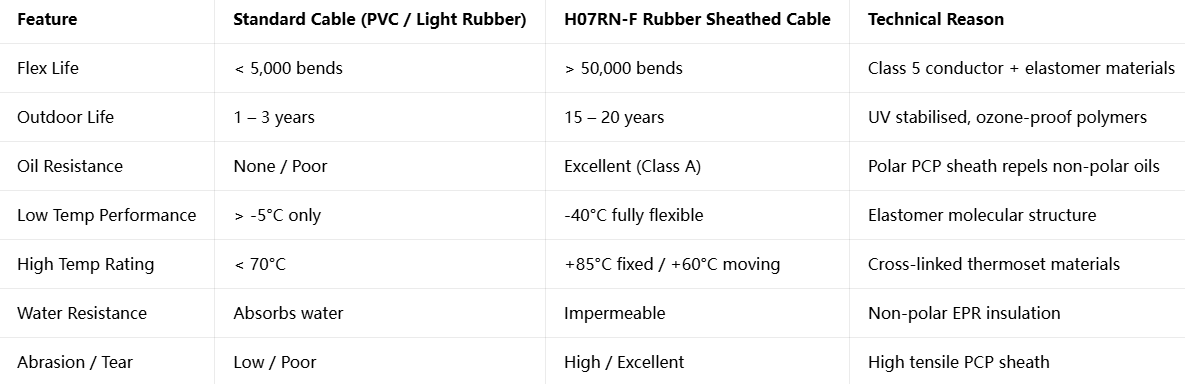
Summary Comparison Table
Applications — Where and Why It Is Used
With these performance capabilities, it is clear why H07RN-F has become the standard solution for heavy industry across South Africa. Its application range covers every sector where reliability and safety are critical.
Mining and Heavy Industry
This is the largest single application area. In platinum, gold and coal mines, conditions are among the toughest on Earth. Cables must be dragged, reeled, exposed to dust, water, oil and constant vibration.
Use cases: Reeling cables for excavators, shuttle cars, conveyors and dewatering pumps.
Why it works: High flexibility allows winding/unwinding thousands of times; oil and water resistance prevents breakdown; robust construction resists damage from falling rock or heavy equipment.
South African context: Used extensively by major mining houses where downtime costs millions per hour. Long life and reliability are non-negotiable.
Construction and Civil Engineering
From high-rise buildings in Sandton to road projects in the Eastern Cape and dam construction in the Free State, temporary power must be robust.
Use cases: Site distribution, heavy tool power, tower cranes, mobile generators, lighting systems.
Why it works: Handles rough installation, exposure to weather, and constant movement. Can be dragged over rough ground without damage.
Ports, Harbours and Logistics
Durban, Cape Town and Richards Bay ports operate 24/7 in salt-laden air and intense sun.
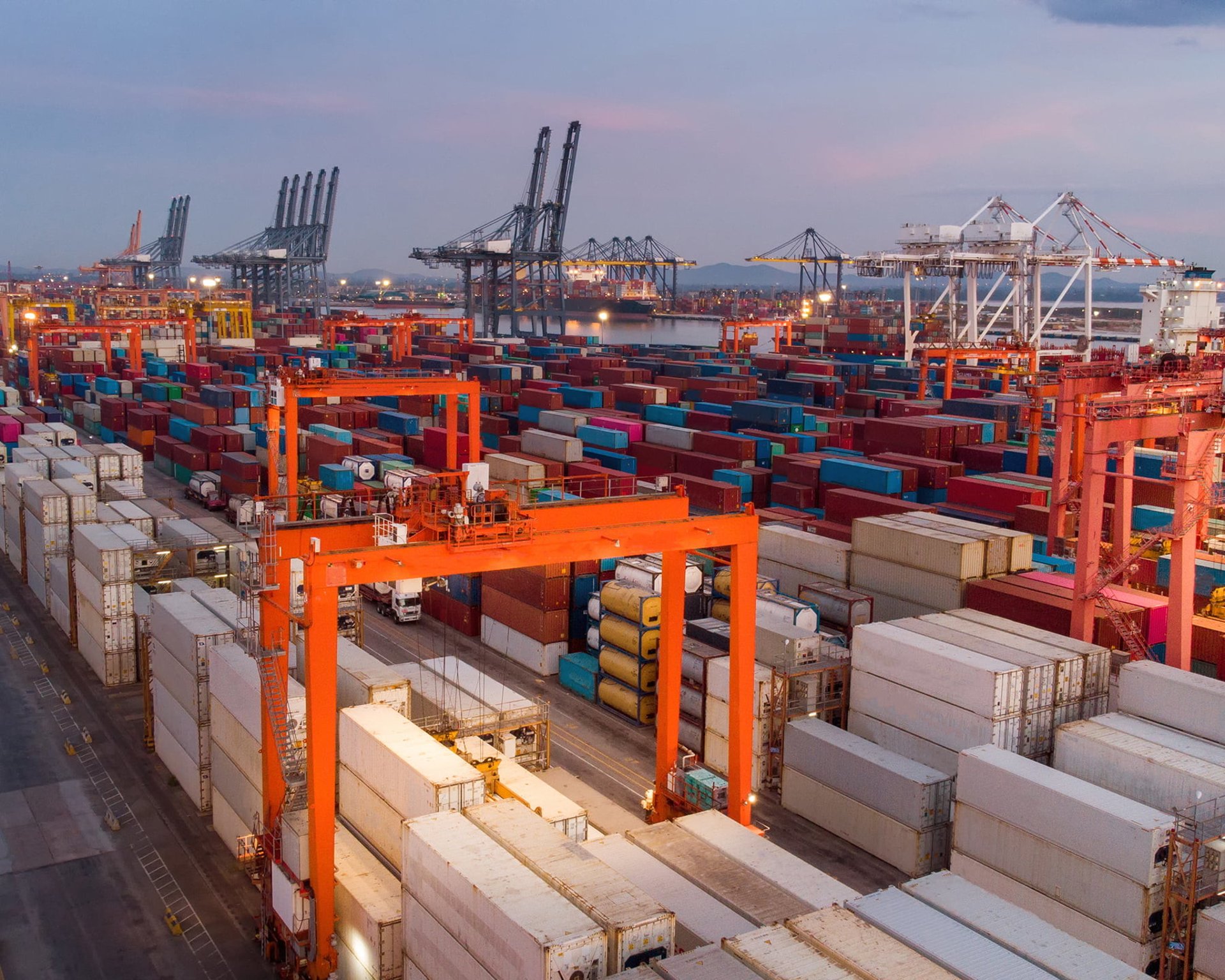
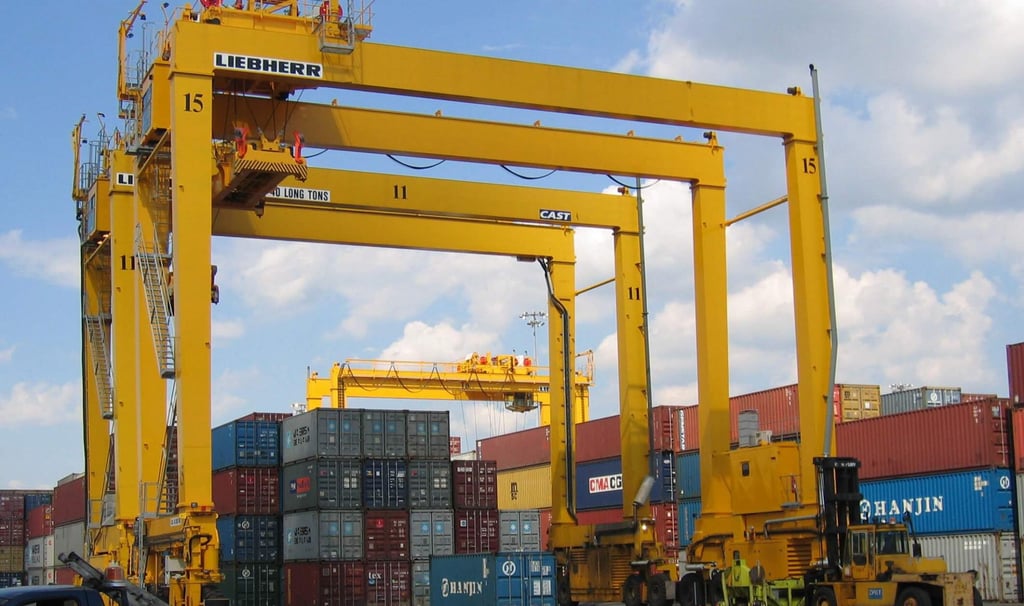
Use cases: Gantry cranes, container handlers, ship-to-shore power, mobile equipment.
Why it works: Resists salt corrosion, UV degradation and heavy mechanical handling. Water resistance ensures safety even in wet conditions.
Agriculture and Irrigation
In KwaZulu-Natal and the Western Cape, farming operations rely on irrigation and mobile machinery.
Use cases: Submersible pumps, irrigation systems, harvesters, feedlot machinery.
Why it works: Permanently outdoor rated; survives exposure to fertilisers, chemicals, dust and water. Flexible enough to move with machinery.
Manufacturing and Factories
Continuous operation in environments where oil, heat and vibration are present.
Use cases: Motor leads, conveyor systems, processing machinery, production lines.
Why it works: Resists oil spills, vibration fatigue and high ambient temperatures.
Events and Temporary Installations
Stages, festivals and outdoor concerts require cables that can be installed quickly, handled roughly and removed easily.
Why it works: Flexible, durable and safe; meets all flame retardancy and safety standards.
The Core Rule for Selection:
If a cable is moved regularly, installed outdoors, exposed to oil or water, or subject to rough handling — H07RN-F is the only correct choice.
How to Select, Specify and Source H07RN-F
Technical Selection Guide
Step 1: Define Voltage and Application
Standard: 450/750 V — covers all low-voltage power distribution
Fixed protected installation: Can be used up to 0.6/1 kV
Confirm if application is fixed or flexible — this determines bending radius and mechanical requirements
Step 2: Choose Core Count
1-core: Single-phase or distribution
2-core: Single-phase + neutral
3-core: 3-phase or 2-phase + earth
4-core: 3-phase + neutral
5-core: 3-phase + neutral + earth
≥7-core: Combined power and control circuits
Important: All cables with 3 cores or more include a green-yellow earth conductor as standard — never compromise on safety.
Step 3: Select Conductor Size
Choose based on current rating and voltage drop calculations, according to local standards like SANS 164-1.
Standard sizes: 1.5 mm², 2.5 mm², 4 mm², 6 mm², 10 mm², 16 mm², 25 mm², 35 mm², 50 mm², 70 mm², 95 mm², 120 mm², 150 mm², 185 mm², 240 mm², 300 mm²… up to 630 mm²
Pro Tip: For moving or reeling applications, upsize by 1 or 2 steps. Larger conductors run cooler and have greater mechanical strength, significantly extending service life.
Step 4: Installation Rules
Minimum Bending Radius:
Fixed installation: ≥ 4 × overall diameter
Flexible / reeling use: ≥ 6 × overall diameter
Never bend tighter — internal stress will reduce life.
Installation Temperature: Minimum -25°C — do not install when colder to avoid damage.
Step 5: Compliance Checklist
When specifying or inspecting, ensure the marking includes:
✅ H07RN-F clearly printed
✅ HAR logo (European approval)
✅ EN 50525-2-21 standard reference
✅ CPR Eca fire classification
✅ EI4 / EM2 material designation
✅ CE / RoHS markings
Feichun Cable: Fully Equivalent Alternative
Engineers and procurement managers in Southern Africa increasingly turn to Feichun Special Cable as their preferred source for H07RN-F, and for good reason. Feichun produces this exact cable to identical specifications, offering a fully equivalent alternative to European brands, with significant practical and commercial advantages.
Proof of Equivalence
Identical Standards: Manufactured strictly according to EN 50525-2-21, VDE 0282, IEC 60245. Every dimension, material grade and performance requirement matches exactly.
Same Materials: Uses Class 5 high-purity copper, EI4 grade EPR insulation and EM2 grade PCP sheath — same chemistry, same quality, same test results.
Full Certifications: Carries CE, RoHS, CPR Eca and third-party test reports accepted across Africa and Europe.
Performance Match: Voltage, temperature range, bending life, oil resistance, UV resistance — identical performance parameters.
Key Advantages Over Traditional Brands
Cost Efficiency
Priced 25% to 40% lower than European manufacturers. No premium branding costs, direct factory pricing, and efficient production. For large mining or infrastructure projects, this translates to massive savings without any compromise in quality or safety.
Reliable, Fast Delivery
Lead times that beat European suppliers significantly:
Standard sizes: 7 – 14 days delivery to South Africa
Custom configurations: 20 – 25 days
Stock held in key hubs reduces project delays and inventory holding costs.
Flexibility and Customisation
Feichun produces standard sizes, but also readily manufactures custom core counts, colours, lengths and special markings to meet exact project specifications.
Technical Support
Direct access to engineering support, datasheets and certification packages, tailored for African market requirements.
Why Choose Feichun?
"Same specification, same performance, same safety — better price, faster delivery. It is the logical choice for modern engineering and procurement."
Procurement Best Practices
Avoid "Lookalike" Cables: Never accept cables described as "similar to H07RN-F" or "heavy duty rubber cable". If it is not marked H07RN-F and EN 50525-2-21, it is not the same product and will fail early.
Order Correctly: Example specification: H07RN-F 4G16 mm², 450/750 V, black sheath, EN 50525-2-21
Documentation: Always request and keep on file: Test reports, material certificates and compliance declarations.
Logistics: Feichun handles all export documentation and shipping to ports including Durban, Cape Town, Port Elizabeth and Maputo.
Frequently Asked Questions
Q: What exactly does the name H07RN-F mean?
A: H = Harmonized standard; 07 = 450/750 V rating; R = Rubber insulation; N = Neoprene/PCP rubber sheath; F = Flexible construction. It is a globally recognised code defining exactly the cable type.
Q: Can this cable be permanently installed outdoors?
A: Yes — it is designed specifically for permanent outdoor exposure. It resists UV, ozone, rain and temperature changes for 15+ years. It is far superior to any PVC cable for outdoor use.
Q: Is it suitable for use underwater or in wet conditions?
A: Temporary or continuous immersion is acceptable due to the non-hygroscopic materials used. For permanent submersion in deep water or high pressure, the variant H07RN8-F with an additional water-blocking layer is recommended, but standard H07RN-F works perfectly in pumps, dams and wet sites.
Q: What is the difference between H05RN-F and H07RN-F?
A: H05RN-F is light duty: 300/500 V, thinner insulation/sheath, shorter life. H07RN-F is heavy duty: 450/750 V, robust construction, long life, suitable for industrial and mining use. H07RN-F is the correct choice for all heavy applications.
Q: How long can I expect this cable to last in service?
A:
Static outdoor use: 15 – 20 years
Moving / flexible use: 8 – 12 years
Heavy reeling / mining duty: 5 – 8 years
This is 5 to 10 times longer than standard cables.
Q: Does Feichun’s version meet South African regulations?
A: Absolutely. Feichun’s H07RN-F meets all referenced standards including EN, IEC and CPR, which are widely adopted and accepted in South African standards (SANS) and project specifications.
Conclusion
H07RN-F rubber sheathed cable is more than just a product; it is the result of decades of engineering refinement designed to solve the exact problems found in heavy industry. Through the careful selection of Class 5 copper conductors, EI4 EPR insulation and EM2 PCP sheathing, combined with a structural design that optimises flexibility and protection, it achieves what ordinary cables cannot: survival and reliable performance in environments that destroy standard alternatives.
We have seen how material science explains its resistance to oil and water; how polymer chemistry protects it from UV and ozone; and how mechanical engineering ensures it survives bending, impact and abrasion. In South Africa, where conditions are extreme and downtime is expensive, this cable is not an option — it is the requirement.
For engineers and procurement teams, the message is clear: standardise on H07RN-F for all heavy-duty, flexible or outdoor applications. And when sourcing, Feichun Cable offers the perfect balance: fully equivalent quality, full compliance, better pricing and faster delivery.
If you require high-quality H07RN-F rubber sheathed cable for your project, contact Feichun Special Cable directly:
Our engineering team provides full technical data sheets, certification packages, custom quotations and logistics support to all regions of Southern Africa. Get the right cable, at the right price, delivered on time.

Email Address: Li.wang@feichuncables.com
© 2025. All rights reserved.
One-click to Quickly Contact
Products
Contact
Company
Location:
Building A Private Science and Technology Park, Hefei Economic and Technological Development Zone, Anhui Province, China
Heat Resistant Cable
WhatsApp: +86 17333223430
Social Media: