Anhui Feichun Special Cable Co.,Ltd Email: Li.wang@feichuncables.com
How Does the FLEXIDRUM® NSHTÖU (V) Kevlar-Reinforced EPR/PCP Cable Handle Extreme Torsion, Oil & High Speeds Up to 240 m/min in Heavy Industry?
FLEXIDRUM® NSHTÖU (V) is a vertical reeling cable engineered to DIN VDE 0250‑814, built for South Africa’s toughest environments — deep mines, port cranes, and heavy materials handling. This guide explains its Kevlar‑reinforced structure, EPR insulation, oil‑resistant PCP sheath, anti‑twist design, and full performance data. Learn why Feichun’s equivalent delivers identical quality, faster delivery, and better value — fully aligned with SANS and local safety standards. Essential for procurement engineers, maintenance teams, and project managers in mining, ports, and heavy engineering.
Li Wang
5/28/202617 min read
Introduction
In South Africa’s heavy industry — from deep‑level platinum and gold mines in Limpopo and North West to container terminals in Durban, Cape Town, and Richards Bay — the demands placed on power and control cables are among the most severe in the world. Cables must operate continuously while being wound, unwound, lifted, and lowered at high speeds, often over great vertical distances. They are exposed to hot sun, heavy rain, abrasive dust, hydraulic oils, lubricants, and wide temperature swings, all while being subjected to constant tension, twisting, and bending. Under these conditions, standard flexible cables fail quickly: they twist into knots, conductors stretch or break, insulation cracks, and sheaths degrade, leading to unplanned downtime, safety risks, and high replacement costs.
This is where FLEXIDRUM® NSHTÖU (V) comes in. Designed specifically for vertical reeling and trailing applications, this cable is not just another flexible rubber cable — it is a complete engineering solution built to solve every major failure mode found in dynamic industrial power systems. Every layer, every material, and every detail is chosen to work together, delivering reliable performance at speeds up to 240 m/min, under extreme tension, in oily environments, and with zero permanent deformation.
This article explains exactly how it works, why it is built the way it is, what standards it meets, where it is used in Southern Africa, how to select the right size, and why Feichun’s version is the smartest choice for local operations. We will look closely at the science behind each material, the mechanical principles that prevent twisting and stretching, and the real‑world benefits that matter to your bottom line.
What Is FLEXIDRUM® NSHTÖU (V)? — Definition, Code Meaning and Standards
Decoding the Name
Every letter and symbol in the name tells you exactly what this cable is and what it can do. This is standard practice in European cable engineering, and understanding it helps you choose correctly.
N: Manufactured according to German VDE standards, widely recognised and accepted in South Africa as equivalent to SANS requirements.
S: Insulation made from high‑grade rubber compound.
H: Heavy‑duty construction — designed for high mechanical stress, far beyond standard industrial cables.
T: Tensile member — includes dedicated strength elements to carry mechanical load, so copper conductors only carry electricity, not weight.
Ö: Oil‑resistant — meets strict oil immersion tests, critical in mines, ports, and machinery yards where hydraulic and diesel oils are common.
U: Flame‑retardant and self‑extinguishing — stops burning once the flame source is removed, essential for safety in enclosed or high‑risk areas.
(V): Vertical application — the most important part of the name. This is the version optimised for vertical lifting, long‑travel reeling, and anti‑twist performance. Standard NSHTÖU cables do not have this design and will twist and fail if used vertically.
FLEXIDRUM®: Registered brand name for cables engineered specifically for continuous winding and unwinding on motorised reels.
Key Standards Compliance
FLEXIDRUM® NSHTÖU (V) is built, tested, and certified to the most rigorous international standards, all of which align with South African safety and performance expectations:
DIN VDE 0250‑814: Cables for vertical reeling systems — this is the core standard that defines the special construction, tensile strength, bending radius, and speed ratings required for vertical use. It is the benchmark specification for this type of cable.
IEC 60228 / DIN VDE 0295: Defines Class 5 flexible conductors — the fine‑stranded structure required for repeated bending without fatigue.
DIN VDE 0207: Specifies the exact rubber compounds used for insulation and sheaths, guaranteeing consistent quality and performance.
Flame resistance: Meets DIN VDE 0482‑265, EN 50265‑2‑1, IEC 60332‑1‑2 — self‑extinguishing, non‑propagating fire behaviour, matching SANS 1520 mining safety requirements.
Oil resistance: Tested to DIN VDE 0473‑811, IEC 60811‑2‑1 — no degradation after immersion in mineral oil at elevated temperatures.
Temperature performance: Validated over ‑25 °C to +90 °C, covering South Africa’s hot summers, high‑altitude cold, and deep‑mine conditions.
Certifications: CE marking (compliant with European Low Voltage Directive) and RoHS (no restricted hazardous substances) — fully accepted in Southern African procurement and compliance frameworks.
Difference: Standard NSHTÖU vs NSHTÖU (V)
This is a critical distinction often misunderstood in local projects:
Standard NSHTÖU: Designed for horizontal trailing or festoon systems. Has a basic strength member or none at all. When used vertically, it twists severely, forms “bird‑cages”, stretches permanently, and often jams on the reel.
NSHTÖU (V): Built from the inside out for vertical use. Features high‑modulus Kevlar central strength member, anti‑twist textile braid, short‑length layered stranding, and balanced construction. It does not twist, does not stretch, and maintains its shape even when hanging freely over 100 m or more — exactly what is needed in South Africa’s deep shafts and tall crane applications.
Engineering Principles and Structural Design
The performance of this cable is not accidental — every layer is designed using clear mechanical and electrical principles, working together to solve the four big problems of vertical reeling: tension, torsion, bending fatigue, and environmental damage.
Below is the complete construction, explained layer by layer, from centre to outer surface.
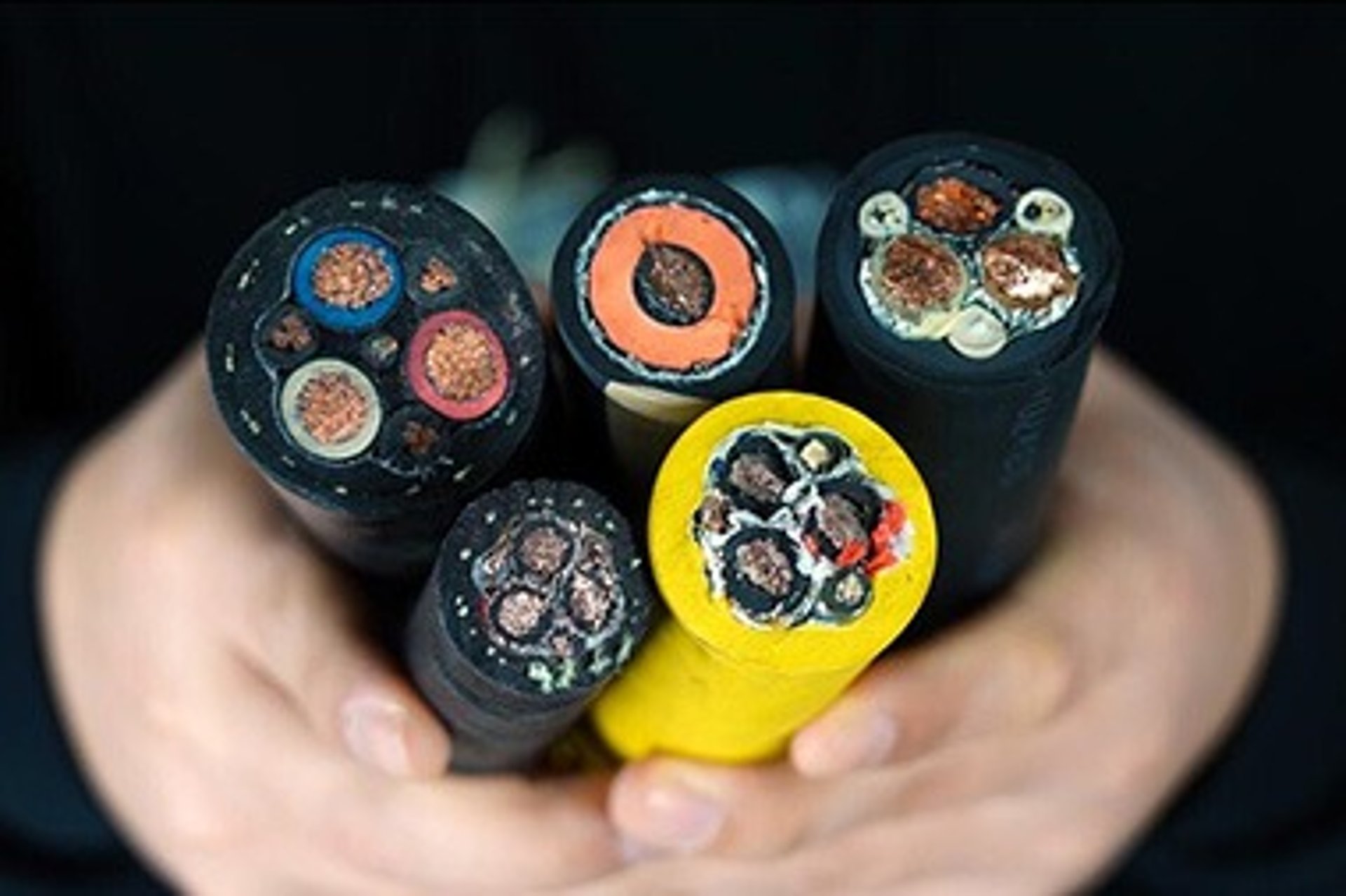
Full Layer‑by‑Layer Construction
✅ Central Strength Member — The Backbone
At the very core is a solid or stranded element made from special high‑strength Kevlar® aramid fibre.
Engineering Principle: All vertical tension is carried here, not by the copper conductors. Copper is soft and stretches permanently under load; Kevlar has tensile strength ~2,800 N/mm² — five times stronger than steel by weight — and virtually zero elongation under working load.
Result: Conductors remain perfectly round and spaced, insulation never gets pinched or over‑stretched, and cable length stays constant for its entire life. Critical when precision length control is needed on large cranes or mine winders.
✅ Conductors — Class 5 Tinned Copper
Each power or control core uses fine‑stranded tinned copper, Class 5 to IEC 60228 / DIN VDE 0295.
Design Reason:
Fine strands: bend easily, distribute stress evenly, survive millions of flex cycles without breaking.
Tinned coating: prevents oxidation, improves adhesion to rubber insulation, resists chemical attack from mine water, salt air, and dust — very important in coastal and underground South African sites.
Electrical Principle: Low resistance ensures efficient power transmission; consistent conductivity avoids hot‑spots even at maximum 90 °C operating temperature.
✅ Insulation — EPR Ethylene‑Propylene Rubber
Each conductor is insulated with a thick layer of EPR compound to DIN VDE 0207 type 3GI3.
Material Science: EPR is a saturated polymer with a stable molecular structure. It combines excellent electrical properties with superior thermal and mechanical performance.
Electrical: High dielectric strength (>20 kV/mm), low dielectric loss, resistance to corona discharge — safe at 0.6/1 kV working voltage and tested to 4 kV AC.
Thermal: Continuous operation at +90 °C; withstands short‑circuit peaks up to +250 °C without melting or flowing.
Mechanical: Highly elastic, tear‑resistant, does not become brittle in cold or soft in heat — unlike PVC or natural rubber.
Why it matters: In South Africa’s climate, insulation failure from heat or brittleness is a top cause of breakdown. EPR eliminates this risk.
✅ Core Identification
Cores are coloured or numbered strictly according to DIN VDE 0293‑308 and HD 308 S2.
Up to 5 cores: solid colours.
6 cores and above: black with consecutive white numbers (EN 50334).
Mandatory rule: From 3 cores upwards, a green‑yellow earth conductor is always included — meeting local safety regulations for earthing and fault protection.
✅ Core Stranding — Layered Around Centre
Insulated cores are stranded in concentric layers around the Kevlar centre member, using short lay lengths.
Mechanical Principle: Short lay length = high flexibility and stability. Each layer is stranded in opposite direction to the one below, creating a balanced structure that naturally resists twisting. This is the first anti‑twist feature built into the cable.
Result: When the cable is wound or unwound, internal forces cancel out torsion, so the cable stays straight and does not spiral or kink.
✅ Inner Sheath — Yellow PCP Rubber
Over the stranded cores, an inner sheath of yellow PCP (Chlorinated Polyethylene) is applied — colour matches RAL 1021.
Function:
Cushions cores, prevents abrasion between layers.
Provides a uniform base for the anti‑twist layer.
Bonds chemically with outer sheath to form a single solid structure, preventing layer separation — a common failure in cheap cables.
Material Choice: PCP is chosen because it matches EPR in temperature behaviour and flexibility, so they expand and contract together, never coming apart.
✅ Anti‑Twist Textile Braid — Unique to (V) Version
Between inner and outer sheath lies the key innovation: a high‑tenacity textile braid made from polyester or aramid fibres, woven at exactly 45 degrees.
Engineering Magic: When torque or twisting force is applied, this braid changes diameter slightly and creates an opposing counter‑torque, automatically returning the cable to straight alignment. It also distributes radial pressure evenly, so no single point is crushed.
Practical Outcome: Even when hanging freely over 150 m, the cable will never twist — it feeds perfectly straight onto the reel, reducing wear and eliminating jamming. This is why it is the standard choice for vertical shafts and high‑lift cranes.
✅ Outer Sheath — Yellow PCP Rubber
Final layer: thick, tough outer sheath, same yellow PCP compound, to DIN VDE 0207 type 5GM2 or 5GM3.
Why PCP?
✅ Oil‑resistant: Passes strict immersion tests — perfect where diesel, hydraulic oil, or grease are present, as in mines, workshops, and ports.
✅ Flame‑retardant / self‑extinguishing: Releases fire‑suppressing gas and forms a protective char — meets mining safety standards.
✅ Weather‑resistant: Resists ozone, UV radiation, rain, salt spray, and extreme temperatures — performs reliably outdoors in South Africa for 10+ years without degradation.
✅ Mechanical toughness: High abrasion resistance, tear strength, and impact resistance — survives being dragged, stepped on, or rolled over.
✅ High visibility: Bright yellow colour is a safety standard in local heavy industry; easy to inspect for damage.
Core Engineering Principles — How It Works
✅ Tensile Load Sharing
Working tension is limited to 20 N/mm² of cross‑section. All of this is taken by the Kevlar centre and braid; copper and insulation carry zero mechanical load. This simple principle increases cable life by 3–5 times compared to cables where conductors also carry weight.
✅ Anti‑Twist Mechanics
Three features work together:
Balanced opposite‑direction stranding.
45‑degree counter‑torque braid.
Rigid bonded double‑sheath structure.
Result: Zero net torsion — the cable behaves like a rigid but flexible rod, always straight, always stable.
✅ Thermal Stability
EPR insulation + PCP sheath = matched thermal expansion. No gaps, no separation, no stress cracking when temperature changes rapidly — common when moving from deep cool mines to hot surface conditions.
✅ High‑Speed Capability
Short lay lengths, smooth outer surface, and balanced design allow operation at up to 180 m/min as standard, and 240 m/min with special design — fast enough for the largest ship‑to‑shore cranes and high‑speed mine winders in Southern Africa.
✅ Flexibility vs Stability
Minimum bending radius is 6× outer diameter when moving, 4× when fixed — flexible enough for compact reels, but stable enough not to deform.
Material Science — Why Each Component Is Selected
Every material used is chosen for a specific reason, backed by decades of testing and industrial experience. Here we explain the science behind the choice, and how it translates to performance in South African operations.
Conductor: Tinned Copper Class 5
Material: High‑purity copper (≥99.95%) with a thin tin coating. Stranded into many fine wires (typically 0.15–0.20 mm diameter) to form Class 5 structure.
Properties:
Conductivity ≥98% IACS — low energy loss.
Tensile strength ~200 N/mm² — strong enough, but designed not to carry load.
Tin coating: melting point 232 °C, excellent corrosion resistance, bonds perfectly with rubber.
Why here? In South Africa’s humid, dusty, or salty environments, bare copper oxidises rapidly, increasing resistance and overheating. Tinning eliminates this problem completely, extending life and maintaining efficiency.
Insulation: EPR (Ethylene‑Propylene Rubber)
Chemical Structure: Random copolymer of ethylene and propylene, fully saturated backbone, no double bonds.
Key Properties:
Thermal stability: continuous 90 °C; short‑circuit 250 °C — far superior to PVC (70 °C max) or natural rubber (70–80 °C).
Dielectric strength: 22 kV/mm — safe margin above 0.6/1 kV rating.
Chemical inertness: resistant to ozone, acids, alkalis, water, and most chemicals found in mining and industry.
Flexibility: remains elastic even at ‑40 °C — no cracking in winter or high‑altitude sites.
Comparison: EPR is the gold standard for heavy‑duty flexible cables — better than butyl rubber, better than PE, better than PVC. It costs more, but the reliability gain is worth every cent.
Central Strength Member: Kevlar® Aramid
Material: Synthetic aromatic polyamide fibre.
Unique Characteristics:
Tensile strength: 2,700–3,000 N/mm² — stronger than steel on weight basis.
Density: 1.44 g/cm³ — very light, does not add unnecessary weight to the cable.
Creep resistance: virtually zero — does not stretch over years of use.
Temperature resistance: stable from ‑196 °C to +204 °C — unaffected by any operating condition.
Role: It is the structural heart of the cable. Without it, vertical use is impossible. In deep mines, this single component prevents conductor breakage, which is one of the most common and expensive failures in local mining operations.
Inner & Outer Sheath: PCP (Chlorinated Polyethylene)
Chemical Structure: Polyethylene modified by chlorination (25–40% chlorine) and sulphonation — creates polar groups in the polymer chain.
Why PCP instead of CR or NBR?
✅ Oil resistance: Polar groups repel non‑polar oils — passes VDE 0473‑811; no swelling, no softening.
✅ Flame resistance: Chlorine releases HCl gas when heated, suppresses combustion; forms stable char layer.
✅ Weathering: Saturated structure + chlorine = excellent UV and ozone resistance — critical outdoors.
✅ Low‑temperature flexibility: Remains flexible down to ‑40 °C; better than chloroprene rubber (CR).
✅ Compatibility: Bonds chemically to EPR and itself — layers do not separate.
Local Benefit: South African cables often fail due to sheath degradation from sun, oil, or cold. PCP solves all three problems at once.
Anti‑Twist Braid: High‑Tenacity Polyester/Aramid
Material: High‑modulus fibres, low elongation (<5%).
Weave: ±45° helical braid, high coverage (>90%).
Mechanism: As cable twists, braid diameter changes, generating restoring force proportional to twist angle — automatic self‑alignment.
Result: No more twisted cables, no more downtime, no more damage to reel mechanisms.
Performance Advantages
This is where engineering translates directly to value. Here is exactly what you get when you install FLEXIDRUM® NSHTÖU (V), compared to any standard flexible cable.
Mechanical Performance — Built for Motion
✅ Zero permanent stretch: Kevlar takes all tension — cable length remains unchanged for life.
✅ Anti‑twist performance: Runs straight, even suspended freely over 200 m. Eliminates the need for guide rollers or anti‑twist devices.
✅ High‑speed operation: Standard to 180 m/min; up to 240 m/min — matches the fastest cranes and hoists in Durban Harbour or deep mines.
✅ Excellent flexibility: 6× OD bend radius — fits compact reels, easy to install.
✅ Abrasion resistance: >500 mm³ loss (standard test) — survives dragging and heavy use.
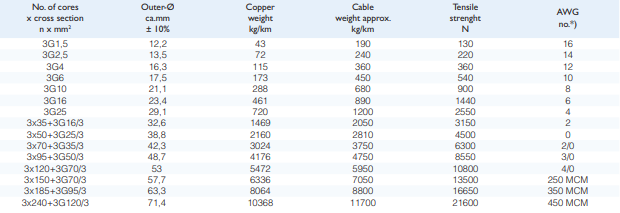
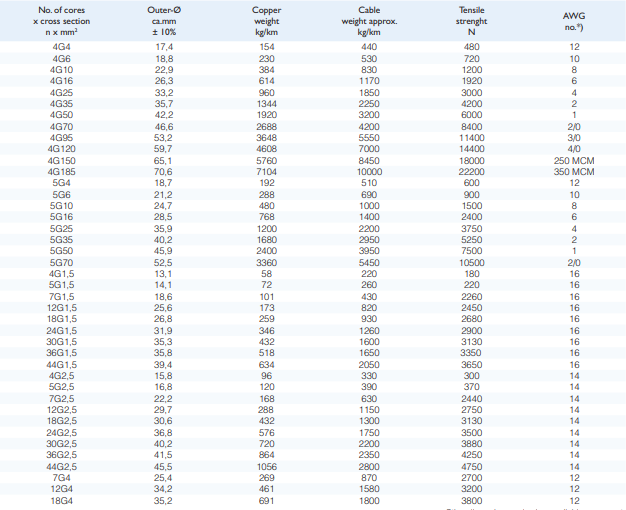
✅ Tensile rating: From 130 N for small sizes up to 21,600 N for large power cables — safely handles full‑length suspended weight.
Electrical Safety — Reliable Power & Control
✅ Rated voltage: 0.6/1 kV — covers all low‑voltage industrial applications.
✅ Test voltage: 4 kV AC for 5 minutes — safety margin >6× operating voltage.
✅ Insulation resistance: >20 MΩ·km — stays high even after years of use.
✅ Short‑circuit capability: 250 °C for 5 seconds — safe under fault conditions, meets SANS mining safety rules.
✅ Earth continuity: Standard green‑yellow core — correct earthing is guaranteed.
Environmental Resistance — Thrives Where Others Fail
✅ Oil resistant: Fully compliant — ideal for mines, workshops, fuel terminals.
✅ Flame retardant / self‑extinguishing: Meets IEC 60332‑1 — critical safety feature in confined spaces.
✅ Weatherproof: Operates reliably from ‑25 °C to +90 °C. Resists UV, rain, salt spray, dust, and chemical fumes — perfect for South Africa’s diverse climate.
✅ Water resistant: Zero water ingress — safe in wet shafts or coastal locations.
Operational & Economic Benefits
✅ Longer life: Typically 3–5 times longer than standard rubber cables. In continuous‑use applications, that means 8–12 years instead of 2–3 years.
✅ Less downtime: Far fewer failures, less maintenance, fewer replacements.
✅ Lower total cost: Even though initial price is higher, cost per year is 40–60% lower.
✅ Safety: Reliable power, stable operation, fire resistance — directly reduces risk of accidents and production loss.
✅ Compliance: Meets or exceeds all local and international standards — simplifies audit and inspection processes.
Typical Applications — Focus on South African Industry
FLEXIDRUM® NSHTÖU (V) is not a general‑purpose cable — it is a specialist solution for specific heavy‑duty vertical or high‑dynamic applications. In Southern Africa, these are exactly the sectors where it is used every day.
Primary Application Areas
Ports & Harbours
Locations: Durban, Cape Town, Richards Bay, Ngqura, Saldanha Bay
Equipment: Ship‑to‑shore cranes, rubber‑tyred gantries, mobile harbour cranes, bulk handling ship loaders/unloaders.
Why here?
High travel speed (up to 180 m/min).
Large vertical lift (40–80 m).
Continuous outdoor exposure, salt air, high humidity.
Heavy use, 24/7 operation.
Standard cables twist and jam; NSHTÖU (V) runs perfectly straight.
Mining — Underground & Surface
Locations: Limpopo, North West, Gauteng, Free State, Northern Cape
Equipment: Vertical winders, shaft conveyances, stacker‑reclaimers, draglines, bucket‑wheel excavators, mobile substations.
Why here?
Deep shafts (often >1 km vertical drop).
Heavy tension — full cable weight suspended.
Exposure to mine water, dust, oils, and high temperatures.
Strict safety standards for flame resistance and reliability.
Anti‑twist design eliminates dangerous twisting in confined shafts.
Materials Handling & Bulk Terminals
Locations: Coal yards, ore terminals, grain silos, power stations
Equipment: Overhead cranes, portal cranes, tripper cars, conveyors, stackers.
Why here?
Long travel lengths, vertical lift, high cycle rates.
Abrasive dust, variable weather.
Need for continuous production — downtime is very costly.
Heavy Industry & Steel Mills
Locations: Gauteng, Mpumalanga, industrial hubs
Equipment: Ladle cranes, charging machines, rolling mills, overhead handling.
Why here?
High temperatures, oil, heavy mechanical stress.
Repeated winding/unwinding.
Why This Cable Is Perfect for South Africa
Climate fit: Handles heat, cold, sun, rain, and dust — exactly our conditions.
Safety compliance: Matches SANS 1520, SANS 10198 and mining regulations — no extra certification needed.
Durability: Built for 24/7 heavy use — matches our industrial operating style.
Proven track record: Used in major local projects for decades — performance is trusted.
Full Technical Specifications & Data Tables
All data below is directly from official manufacturer documentation, exactly as available in our technical library. These are the figures you will use for selection and engineering design.
General Ratings
Standard: DIN VDE 0250‑814 (Vertical reeling)
Voltage rating: 0.6/1 kV U₀/U
Test voltage: 4 kV AC / 5 minutes
Temperature range: ‑25 °C to +90 °C (moving operation); ‑40 °C to +90 °C (fixed installation)
Max conductor temp: +90 °C continuous; +250 °C short‑circuit (<5 s)
Min bending radius: ≥6× outer diameter (dynamic); ≥4× OD (fixed)
Max speed: 180 m/min standard; 240 m/min special design
Working tension: 20 N/mm² cross‑section (safe working load)
Core colours: DIN VDE 0293‑308 / EN 50334
Sheath colour: Yellow RAL 1021 (standard); black RAL 9005 available
Certifications: CE, RoHS
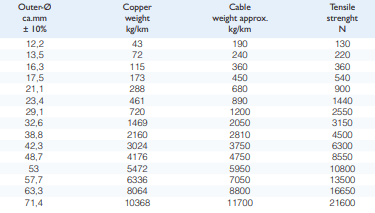
Complete Specification Tables
Selection & Configuration Guide — How to Choose Correctly
Choosing the right cable is more than just picking a size — it is about matching the cable exactly to your mechanical, electrical, and environmental conditions. Below is a step‑by‑step guide used by engineers in South Africa.
Step‑by‑Step Selection Process
Step 1: Define Function
Power only: Choose 3‑core or 4‑core (3 + earth).
Power + control: Choose combined construction (e.g. 3× power + 3× control) — one cable does both jobs.
Control only: Choose multi‑core (7, 12, 18, 24… cores) — available in 1.5 mm² or 2.5 mm², standard sizes.
Spreader systems: Special 56‑core versions available.
Step 2: Calculate Electrical Size
Use standard current rating methods (IEC 60364, VDE 0298) — always derate for:
Ambient temperature (up to +50 °C in SA).
Reeling operation (dynamic use = 10–15% reduction).
Grouping or bundling.
Voltage drop over length.
Rule of thumb for dynamic use: use current density of 2–3 A/mm² — conservative and reliable.
Step 3: Determine Core Count
Power cores: Match supply phases + neutral if needed.
Earth core: Mandatory ≥3 cores — always included in standard designs.
Control cores: Count all signals, interlocks, and auxiliary circuits.
Combined designs: Highly recommended — reduces number of cables, simplifies installation, improves reliability.
Step 4: Verify Mechanical Limits — Most Important for Vertical Use
This is where most mistakes happen.
Maximum tension: Calculate total suspended weight + acceleration force. Must be ≤ rated tensile strength from tables. Safety factor ≥5 is standard practice.
Reel diameter: Must be ≥ 6× outer diameter (dynamic). If your reel is smaller, contact us — special flexible versions available.
Speed: Confirm max speed ≤ 180 m/min. Higher speeds require special construction.
Vertical length: Longer lengths need careful tension calculation — our engineering team can assist.
Step 5: Environmental Conditions
Oil exposure: Standard PCP sheath is fully resistant — no change needed.
Flame safety: Standard meets mining requirements.
Temperature: Standard covers ‑25 °C to +90 °C — fits all SA sites.
UV/weather: Standard yellow sheath is UV‑stabilised.
Special needs: Low‑smoke zero‑halogen (LSZH), black colour, or copper screening available.
Step 6: Compliance
Confirm alignment with SANS 1520, SANS 10198, Occupational Health and Safety Act requirements — this cable is designed to meet or exceed them all.
Common Recommended Configurations
✅ Standard Power
Small motors: 3G2.5, 4G4
Medium power: 3G16, 4G25
Large drives: 3G70, 3G120, 3G240
✅ Combined Power + Control — Best Practice
3×35 + 3G16 — medium cranes
3×70 + 3G35 — large harbour cranes
3×150 + 3G70 — mine winders
✅ Multi‑Core Control
Standard controls: 12G1.5, 24G1.5
Complex systems: 36G1.5, 44G1.5
High‑cycle use: 7G2.5, 12G2.5
Special Options Available
Colours: Black (RAL 9005), orange, blue.
Low‑Smoke Zero‑Halogen (LSZH): For enclosed spaces or tunnels.
Copper Screen: For EMC / noise‑sensitive circuits.
Flat Construction: Special reeling systems.
Custom cores/sizes: Available for project orders.
Feichun FLEXIDRUM® NSHTÖU (V) — Equivalent Replacement
You may know this cable from European brands, but today there is a better option: Feichun Special Cable’s equivalent version. We have engineered it to be 100% identical in performance, but with major advantages for Southern African buyers.
100% Equivalent Performance — No Compromise
Feichun manufactures this cable to exactly the same design, materials, and standards:
✅ Same construction: Class 5 tinned copper, EPR insulation, Kevlar centre, anti‑twist braid, double PCP sheath.
✅ Same standards: DIN VDE 0250‑814, IEC 60228, DIN VDE 0207 — tested to identical protocols.
✅ Same dimensions: Outer diameter, weight, copper content — matches exactly, direct replacement, no changes needed in your design or installation.
✅ Same ratings: 0.6/1 kV, 4 kV test, temperature range, speed, tensile strength — all identical.
✅ Same certifications: CE, RoHS, ISO 9001 — fully accepted in local procurement and compliance.
Performance guarantee: It performs exactly like the original premium brand — but costs far less.
Key Advantages Over Imported European Brands
✅ Price — 25–40% Lower
Factory‑direct supply, no middlemen, efficient production, modern facilities. You get premium quality at a price that fits your budget — a huge saving on large projects or replacement programmes.
✅ Lead Time — 4–6 Weeks vs 12–16 Weeks
European manufacturers have long lead times, often 3–4 months, causing delays. Feichun keeps standard sizes in stock or manufactures fast — you get cable when you need it, keeping your project or maintenance schedule on track.
✅ Availability & Range
Standard range: 1.5 mm² to 240 mm², 3–56 cores — covers every application.
Large sizes: Available without long special‑order delays.
Specials: Custom modifications done quickly.
✅ Technical Support & Documentation
Full data sheets, test reports, material certificates, and compliance declarations — all provided in English, formatted for South African requirements.
Engineering support available to help with selection, tension calculation, and installation advice.
✅ Proven Local Performance
Feichun cables are already installed in mines, ports, and heavy industry across Southern Africa, performing reliably in the same conditions we have discussed. Local users report equal or better service life compared to older brands.
Why This Is Perfect for South Africa
Safety: Same strict standards — no risk to compliance.
Value: Lower cost per metre + longer life = lowest total cost of ownership.
Speed: Fast delivery reduces downtime risk.
Quality: Identical materials and construction — no surprises.
Bottom line: Feichun NSHTÖU (V) is not “just a replacement” — it is the smart choice for modern operations.
Procurement & Supply Strategy
To ensure you get exactly what you need, and that it performs as expected, follow these procurement guidelines, refined for our local market.
Buying Checklist — Do Not Skip These
Full Part Number: Specify complete code including core count, size, colour, and construction type — e.g. 4G1.5 yellow NSHTÖU (V).
Technical Documentation: Request and review:
Test report (voltage, flame, oil, tensile).
Material certificate (EPR, PCP, Kevlar).
Declaration of conformity to VDE and relevant standards.
Key Specifications to Verify:
Outer diameter (±10% tolerance is standard).
Copper weight — confirms correct conductor size.
Tensile strength — critical for vertical safety.
Compliance: Confirm cable meets SANS 1520 and mining safety requirements.
Recommended Supply Strategy
Standard Sizes: Keep small‑to‑medium sizes (1.5–35 mm²) in local stock for quick maintenance — Feichun supports local distribution partners.
Large / Special Sizes: Order factory direct with clear delivery dates — 4–6 weeks typical.
Long‑Term Contracts: For ongoing operations, frame agreements secure price and delivery priority.
Installation Notes — Protect Your Investment
Reel Diameter: Minimum 6× OD — never smaller.
Tension Limit: <15 N/mm² during installation — avoid over‑pulling.
End Termination: Support cable weight at both ends — do not let tension pull directly on terminals.
Maintenance: Inspect outer sheath every 3–6 months; test insulation resistance annually — >10 MΩ·km is good.
Frequently Asked Questions (FAQ)
Is this cable suitable for outdoor use?
Yes. It is designed for continuous outdoor service. The PCP sheath resists UV, ozone, rain, salt spray, and temperature extremes — ideal for South African weather.
Can I use standard NSHTÖU instead of the (V) version?
No. Standard NSHTÖU is for horizontal use only. Without the anti‑twist braid and balanced stranding, it will twist severely, jam on the reel, and fail quickly when used vertically. (V) is mandatory for vertical applications.
Is it approved for use in South African mines?
Yes. It meets DIN VDE 0250‑814, IEC 60332‑1, IEC 60811‑2‑1 — standards accepted as equivalent to SANS 1520 and local mining safety regulations. All required certification documents are provided.
What is the minimum bending radius?
6× outer diameter when moving or reeling; 4× OD when fixed in position. This is clearly marked in all technical data.
How fast can it run?
Standard version: 180 m/min. Special high‑speed design: 240 m/min — among the fastest available.
How does Feichun compare to European brands?
Identical quality, better value. Same materials, same construction, same test standards, but 25–40% lower price and much faster delivery. Many local users have switched and report zero difference in performance.
Is the yellow colour mandatory?
Standard is yellow for safety and visibility. Black or other colours available on request. Yellow is highly recommended in heavy industry.
Conclusion
FLEXIDRUM® NSHTÖU (V) is far more than a cable — it is a complete engineering system designed to solve the hardest challenges in heavy industry power distribution. By combining Kevlar reinforcement, EPR insulation, anti‑twist design, and oil‑resistant PCP sheath, it delivers performance that standard cables simply cannot match.
For South Africa’s mines, ports, and bulk handling operations, this cable is the proven solution that increases safety, reduces downtime, and lowers total operating cost. It is built to our climate, built to our safety standards, and built to last.
And now, with Feichun Special Cable, you get all this premium performance at a price and delivery time that works for you — 100% equivalent, fully compliant, and ready to install.
📩 Ready to specify or buy?
Contact the Feichun engineering team directly for technical advice, quotation, or detailed data:
Email Address: Li.wang@feichuncables.com
© 2025. All rights reserved.
One-click to Quickly Contact
Products
Contact
Company
Location:
Building A Private Science and Technology Park, Hefei Economic and Technological Development Zone, Anhui Province, China
Heat Resistant Cable
WhatsApp: +86 17333223430
Social Media: