Anhui Feichun Special Cable Co.,Ltd Email: Li.wang@feichuncables.com
How PROTOMONT EMV-FC (N)SSHCOEU 0.6/1kV Solves VFD Interference, Mechanical Stress & Submersion Challenges in Mining
PROTOMONT EMV-FC (N)SSHCOEU 0.6/1kV is not simply a stronger version of standard cable — it is a fully engineered system purpose-built for variable frequency drives and the harshest mining, construction, and marine environments. This article explains in detail how its unique design, materials, and construction solve four critical problems: electromagnetic interference, repeated flex fatigue, extreme environmental exposure, and heavy mechanical load. With data from Prysmian’s official specifications, practical examples from South African mining operations, and a clear comparison to ordinary cables, you will understand why this cable is the trusted choice for reliable power supply to conveyors, stackers, pumps, and winders. We also introduce Feichun’s equivalent version — same performance, faster delivery, and better value — and answer the most common technical questions.
Li Wang
6/4/202616 min read
Introduction
In modern mining operations across South Africa — from the platinum belts of the North West to the deep gold mines of Gauteng and the coastal mineral sands projects in KwaZulu-Natal — variable frequency drives have become essential. They control conveyors, crushers, stacker-reclaimers, dewatering pumps, and shaft winders, delivering energy savings of up to 40% and enabling smooth, controlled starting and stopping of heavy machinery. However, these same drives create unique and severe challenges for the cables that connect them to motors.
Standard power cables, even those labelled as heavy-duty or flexible, often fail within months. You may see insulation breakdown, electronic interference shutting down PLC systems, cores snapping after repeated bending, or water ingress causing short circuits when equipment operates near dams, in wet shafts, or submerged in seawater. These failures are not just inconvenient; they cause costly downtime, damage expensive motors and drives, and create safety risks underground or on-site.
This is where PROTOMONT EMV-FC (N)SSHCOEU 0.6/1kV Frequency Converter Cable changes everything. It is not an upgraded version of an ordinary cable. It is a complete, purpose-engineered system designed from the ground up to work reliably where standard products cannot survive. It addresses four core problems at once: electrical interference, dynamic mechanical stress, extreme environmental conditions, and heavy physical load. Every layer, every material, and every dimension is calculated and tested to perform together, making it the proven solution for South African mining and heavy industry.
What Is PROTOMONT EMV-FC (N)SSHCOEU 0.6/1kV? — Basic Data & Specifications
Naming and Versions
The full name tells you exactly what it is and what it does:
PROTOMONT: The family of heavy-duty rubber cables designed for mining and harsh environments.
EMV: Electromagnetic Compatibility Optimised — built specifically to handle high-frequency signals without creating or suffering interference.
FC: Frequency Converter — engineered exclusively for VFD and inverter applications.
(N)SSHCOEU: Follows DIN VDE standards, meaning flexible, shielded, rubber-sheathed, oil-resistant, weatherproof, and suitable for outdoor and underwater use.
0.6/1kV: Rated voltage — 600V phase-to-earth, 1000V phase-to-phase, suitable for all standard low-voltage mining systems.
Two main versions:
Standard: Operating temperature from -25°C to +80°C
Cold climate: -45°C to +80°C, with fixed installation possible down to -60°C — ideal for high-altitude or winter operations in regions like Lesotho or the Northern Cape.
Key Technical Specifications (from official Prysmian documentation)
Electrical Parameters
Rated voltage: U₀/U = 0.6/1 kV; also approved for use on 640/1140V, 0.7/1.2kV, 0.9/1.8kV, and 5kV systems
AC test voltage: 5 kV for 5 minutes
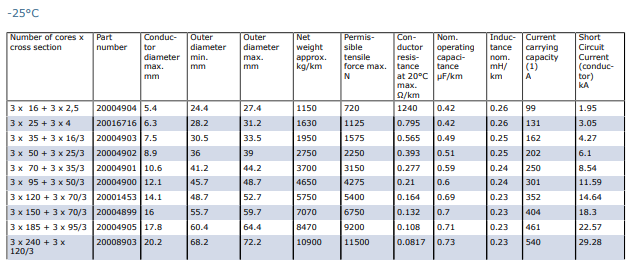
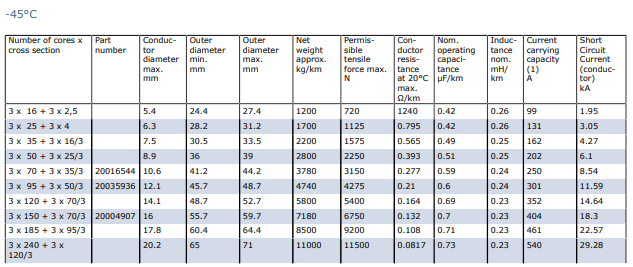
Conductor resistance at 20°C: from 0.0817 Ω/km (240 mm²) up to 1.24 Ω/km (16 mm²)
Operating capacitance: 0.42 to 0.73 µF/km
Inductance: 0.23 to 0.26 mH/km
Current carrying capacity: 99 A to 540 A, matching motor sizes from 15 kW to over 300 kW
Short-circuit current capacity: 1.95 kA to 29.28 kA, safe for short-circuit conditions up to 250°C.
Thermal Performance
Maximum continuous conductor temperature: 90°C
Short-circuit temperature: 250°C (maximum 5 seconds)
Ambient temperature range:
Fixed installation: -40°C to +80°C (standard) / -60°C to +80°C (-45°C version)
Flexible / moving operation: -25°C to +80°C / -45°C to +80°C
These ratings are critical in South Africa, where temperatures can exceed 40°C in open pits and drop well below freezing at high altitude.
Mechanical Properties
Conductor: Class 5 finely stranded tinned copper, per DIN VDE 0295 — highly flexible and corrosion-resistant
Maximum tensile load on conductor: 15 N/mm² — designed to withstand pulling and tension during installation and operation
Torsional strength: 25° per metre — will not deform or break when twisted, common on cable reels and boom systems
Outer diameter range: 24.4 mm to 72.2 mm
Weight: 1150 kg/km up to 10900 kg/km
Permissible pulling force: 720 N to 11500 N, depending on cross-section.
Standards and Certifications
Designed and tested to DIN VDE 0250 Part 812, the global benchmark for heavy-duty flexible mining cables
MSHA P-189-3 certified — approved for use in US mines, widely recognised in South Africa
Flame retardant: EN 60332-1-2 / IEC 60332-1-2 — self-extinguishing, does not spread fire
Oil resistant: EN 60811-404 — unaffected by diesel, grease, and hydraulic fluids
Weather and ozone resistant: unlimited indoor and outdoor use, no degradation under UV or high ozone levels
Additional approvals: GOST, TR Certificate, Russian Fire Certificate — suitable for international projects.
Available Cross-Sections
The standard construction is 3 power cores + 3 split earth conductors, available in sizes:
3×16 + 3×2.5
3×25 + 3×4
3×35 + 3×16/3
3×50 + 3×25/3
3×70 + 3×35/3
3×95 + 3×50/3
3×120 + 3×70/3
3×150 + 3×70/3
3×185 + 3×95/3
3×240 + 3×120/3
This range covers every common VFD-driven motor found in South African mining, from small pumps to large conveyor drives.
Typical Applications in South African Industry
This cable is designed for both fixed installation and continuous flexible operation, exactly what you need in modern mining:
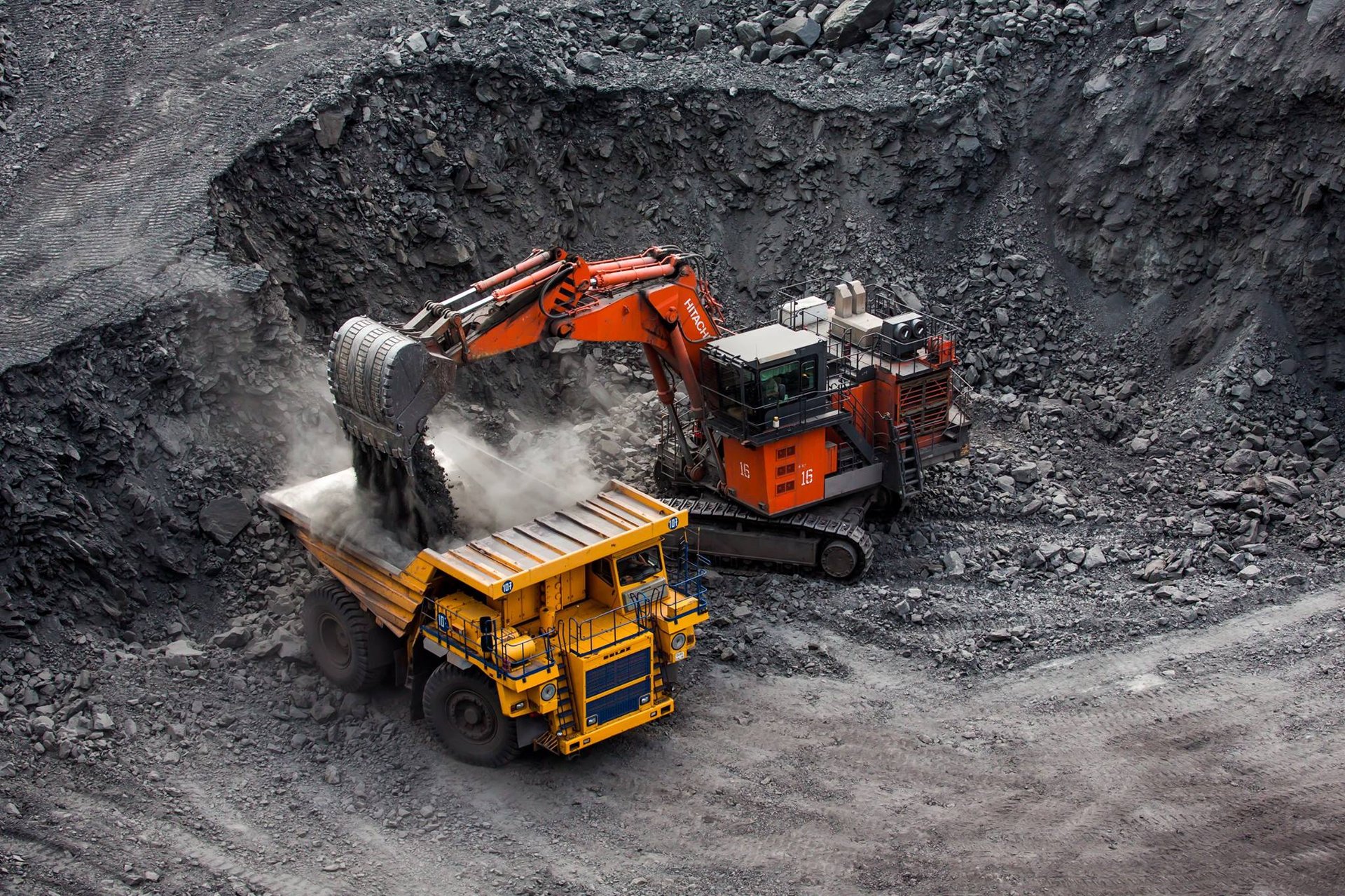
Underground and open-pit mining: Conveyor belts, shaft winders, crushers, fans, and dewatering pumps. In many South African platinum and gold mines, cables move constantly as equipment advances or changes position.
Material handling: Stacker-reclaimers, ship loaders, bucket wheel excavators, and cable booms — where cables are reeled, bent, and twisted thousands of times per year.
Construction and heavy engineering: Tower cranes, concrete plants, and mobile equipment.
Water and marine: Can be used in fresh water, salt water, and wastewater.
Up to 40°C water temperature
Wastewater: up to 10 metres depth
Fresh and salt water: up to 500 metres depth — ideal for coastal mines, dredging, and underwater pumps.
Harsh environments: Exposed to direct sun, high humidity, dust, chemicals, and extreme temperatures — conditions found daily across South Africa.
Why It Is Not Just a “Stronger Cable” — The System Design Philosophy
Most people think of cables simply as wires inside insulation and a jacket. Standard power cables are built for one thing: carrying power in fixed installations, under normal conditions. Standard flexible cables are built to bend, but not to handle high frequencies, not to survive deep water, and not to resist heavy mechanical abuse. Standard mining cables are built tough, but without the electrical design needed for VFDs.
PROTOMONT EMV-FC is different. It is not an improvement on an existing design. It is a complete system engineered to solve four problems at the same time — problems that ordinary cables cannot handle together:
Electromagnetic Interference and Voltage Stress
VFDs switch voltage at very high frequencies, creating steep wavefronts, voltage reflections, and common-mode currents. Standard cables allow these to escape, interfering with sensors, radios, and safety systems. Worse, reflected waves can double or triple the voltage at the motor end, destroying insulation and causing bearing damage. PROTOMONT EMV-FC controls and contains this energy.
Dynamic Mechanical Fatigue
On conveyors, reels, and booms, cables bend, twist, stretch, and vibrate constantly. Standard cables break cores, crack insulation, or split jackets after a few thousand cycles. This design is built for millions of movements without failure.
Environmental Degradation
UV light, ozone, salt spray, mine acids, oil, and water all attack standard materials. In South Africa’s climate, unprotected cables degrade in 1–2 years. This cable is designed to resist all of these, with a lifespan of over 15 years outdoors.
Mechanical Overload
Being dragged, crushed by rock, or pulled tight — standard cables fail easily. This construction distributes load and resists damage.
Every layer, every material, and every dimension is calculated so that the whole system works together. Remove one feature, and the performance drops. This is why it is not just a cable, but a purpose-built engineering solution.
Deep Dive — Structure, Materials & Engineering Principles
To understand why this cable works where others fail, we look layer by layer, from the inside out, explaining exactly what is used and why, based on proven science and engineering principles.
Layer 1: Conductor — Class 5 Tinned Copper
Construction: Finely stranded copper wires, fully tinned, Class 5 according to DIN VDE 0295.
Material: High-purity electrolytic copper (minimum 99.95% purity), with a continuous tin coating of at least 2 micrometres.
Why this design?
Flexibility and Fatigue Resistance: Fine strands mean that when the cable bends, each individual wire only bends very slightly. This distributes stress evenly, following the principle of mechanics: smaller diameter = lower bending strain. The result is over 100,000 bending cycles without breaking, compared to fewer than 1,000 cycles for standard Class 2 conductors.
Corrosion Protection: Tin is more noble than copper in the electrochemical series. When exposed to moisture, salt, or mine chemicals, the tin acts as a sacrificial layer, protecting the copper underneath from oxidation and corrosion. This keeps resistance low and connection reliable for decades, even in damp shafts or coastal areas.
Stable Conductivity: High purity ensures low resistance, reducing heat generation and energy loss — important in long cable runs common in South African mines.
Layer 2: Insulation — PROTOLON EPR 3GI3
Construction: Uniform, thick insulation over every conductor, no gaps or bubbles.
Material: Ethylene Propylene Rubber (EPR), compound type 3GI3, branded PROTOLON. This is a cross-linked, synthetic rubber, not thermoplastic like PVC or XLPE.
Why this material and design?
Electrical Science: EPR has a very low dielectric constant (≈2.3) and extremely low loss factor. This means it performs stably at high frequencies — exactly what you get from VFDs switching up to 20 kHz. Unlike PVC or XLPE, it does not heat up or degrade under high-frequency pulses. It also has very high breakdown strength (>20 kV/mm), easily handling the voltage spikes that destroy standard insulation.
Thermal Performance: Cross-linked structure means it does not melt or flow at high temperatures. It works continuously at 90°C, and even at 250°C during short circuits, it retains its shape and insulating properties. It also stays flexible down to -45°C — standard materials become brittle and crack in cold conditions.
Chemical Stability: EPR is chemically saturated. This means it has no reactive bonds, so it does not react with water, ozone, oxygen, or most acids and alkalis found in mining environments. It does not absorb water, so insulation resistance stays high even after years underwater.
Mechanical Toughness: It is elastic — stretches over 300% without breaking, and returns to shape. It absorbs shock and vibration without cracking.
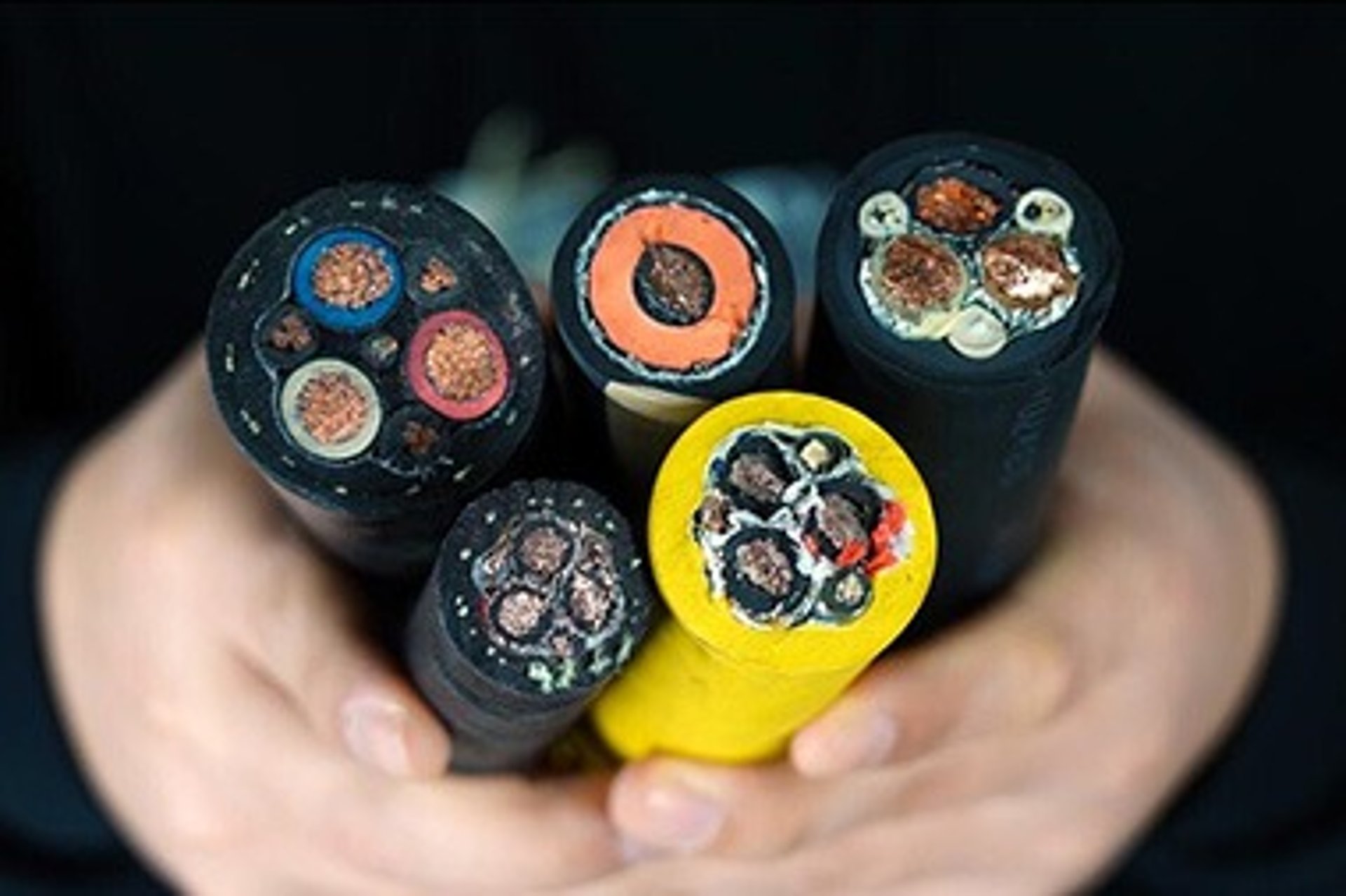
Layer 3: Core Arrangement — Symmetrical 3+3 Split Earth
Construction: Three power cores laid up together, with three separate protective earth conductors placed evenly in the gaps between them. All cores are identified by natural colours with black numbers for easy identification.
Why this arrangement?
EMC Symmetry Principle: This is the most critical design difference between this cable and any standard type. In a standard cable, you have one earth wire, often placed off-centre. This creates an unbalanced electric field. In VFD systems, this imbalance generates high common-mode voltages, which cause bearing damage in motors and radiate interference.
By splitting the earth into three equal parts and placing them symmetrically, the electric field becomes perfectly balanced. This cancels out interference, reduces bearing currents by over 80%, and ensures that voltage peaks at the motor are limited to 1.2 times nominal voltage, instead of 2–3 times with standard cables. This alone doubles or triples motor life.
Mechanical Balance: Symmetrical construction means that when the cable bends or twists, forces are distributed equally. No side is weaker, so the cable does not deform or ovalise, preventing internal stress that leads to failure.
Safety: Three earth conductors provide a very low-impedance path to ground, ensuring fast operation of protection systems during faults — vital for safety in South African mines.
Layer 4: Screen — EMC Optimised Tinned Copper Braid
Construction: A tight, concentric braid of tinned copper wires, covering at least 85% of the surface.
Material: Soft, tinned copper wire, diameter 0.1–0.3 mm.
Why this shield?
Faraday Cage Effect: In physics, a conductive enclosure blocks electromagnetic fields. This braid forms a perfect cage around the power cores. It contains high-frequency noise generated inside the cable, preventing it from interfering with nearby radios, sensors, or control cables. It also blocks external interference from entering, ensuring clean power to the motor. Shielding effectiveness is greater than 60 dB at 1 MHz — almost total isolation.
Long-Term Reliability: Tin coating prevents oxidation, so the shield stays conductive for decades. If a shield oxidises, it loses effectiveness completely.
Extra Strength: The braid adds additional tensile and torsional strength, helping the cable survive rough handling.
Layer 5: Inner Sheath — Vulcanised EPR GM1B
Construction: A smooth, seamless layer extruded over the shield, filling all gaps and creating a solid base for the outer jacket.
Material: EPR rubber compound GM1B, fully vulcanised during manufacture.
Why this layer?
Cushioning and Protection: It protects the delicate braid from being damaged by the outer jacket or external forces.
Sealing: Because it is vulcanised and seamless, it stops water or moisture from wicking along the gaps between cores — the number one cause of failure in wet environments.
Compatibility: It uses the same base material as the insulation, so it has the same thermal expansion rate. When temperature changes, layers expand and contract together, no delamination, no separation, which is a common failure point in standard multi-material cables.
Electrical Isolation: Keeps the shield electrically isolated from the outer jacket, maintaining its performance.
Layer 6: Outer Sheath — PROTOFIRM 5GM5 (Chloroprene Rubber CR)
Construction: Thick, robust, seamless outer layer, bright yellow for high visibility and safety.
Material: Synthetic elastomer compound 5GM5, based on Chloroprene Rubber (CR), also known as Neoprene. This is the most advanced and toughest jacket material available for mining cables.
Why CR 5GM5?
Mechanical Superiority: Tensile strength > 18 MPa, tear strength > 50 kN/m, elongation > 400%. It is 3 times more abrasion-resistant than standard rubber. It resists crushing, impact from falling rock, and dragging over rough ground — exactly what happens in open pits and shafts.
Environmental Resistance — Science Explained:
Ozone and UV: CR has a fully saturated molecular structure. Ozone and UV rays attack unsaturated bonds — since there are none, it does not crack or degrade even after 1,000 hours of exposure. Perfect for South Africa’s high sunshine and ozone levels.
Water Resistance: Very low water absorption (<0.5%). The material is dense and non-porous. Combined with the seamless construction, it is certified for 500 metres submersion — hydrostatic pressure does not force water in.
Temperature Range: Remains flexible and tough from -45°C to +80°C. Standard rubber becomes stiff and cracks below -15°C.
Oil and Chemicals: Resists diesel, grease, hydraulic fluids, and mine acids. It does not swell or soften when exposed, unlike PVC or natural rubber.
Safety: Yellow colour is the standard mine safety colour, easy to see and identify. It is flame retardant, meeting EN 60332, so it does not contribute to fire spread — critical for underground safety.
Why Ordinary Cables Fail
To truly understand the value, we must look at exactly where standard cables fail and how PROTOMONT EMV-FC solves each problem.
1: Electromagnetic Interference & Voltage Spikes
What happens with ordinary cables?
Standard power cables have no shield or only a simple foil. They have a single earth wire, often placed asymmetrically.
Electrical failure: When a VFD switches, voltage travels down the cable and reflects back from the motor end. In an unbalanced system, these waves add up, creating 2–3 times overvoltage at the motor terminals. This causes partial discharge inside the insulation, slowly eating it away until it fails — usually within 1–2 years.
Mechanical damage: Common-mode voltage creates current that flows through motor bearings, eroding the steel surfaces (electrical discharge machining). This destroys bearings, leading to motor failure.
System interference: Noise radiates out, causing sensors to give wrong readings, PLCs to reset, or radios to fail — dangerous and costly in mining.
How PROTOMONT EMV-FC solves it:
Symmetrical 3+3 earth: Balances the electric field, eliminates common-mode voltage.
High-density copper braid: Contains noise inside the cable.
Low-loss EPR insulation: Absorbs energy, prevents reflection.
Result: Voltage peaks limited to 1.2× nominal, interference reduced by >90%, motor and cable life extended 3–5 times.
2: Repeated Flexing & Movement
What happens with ordinary cables?
Standard flexible cables use Class 2 or 5 conductors but with rigid insulation and jackets:
Conductor breakage: After 500–1,000 bends, wires fatigue and snap inside. You lose power or create hot spots.
Jacket cracking: PVC or standard rubber becomes hard and brittle in cold or ages quickly in heat. Cracks let water and dust in.
Deformation: Cable twists and becomes oval, crushing internal cores.
How PROTOMONT EMV-FC solves it:
Fine-stranded tinned copper: Distributes stress, >100,000 cycles without failure.
Elastomeric EPR and CR materials: Always elastic, never harden or crack.
Short lay-up length: Cores are twisted tightly together, so bending happens smoothly without internal friction.
Result: Works reliably on cable reels, booms, and moving equipment for 10+ years.
3: Water & Corrosion
What happens with ordinary cables?
Water ingress: Gaps between cores act like a wick, pulling water hundreds of metres along the cable. Insulation resistance drops, leading to earth faults.
Copper oxidation: Plain copper turns green and corrodes in damp or salty air. Resistance increases, overheating occurs.
Jacket degradation: Standard materials absorb water, swell, and fall apart in salt water or wastewater.
How PROTOMONT EMV-FC solves it:
Tinned conductors: No corrosion, even in salt spray.
Vulcanised inner sheath: Seals every gap, no wicking possible.
CR outer sheath: Impermeable, certified for 500m fresh/salt water, 10m wastewater.
Result: Can be permanently submerged without performance loss.
4: Mechanical Abuse & Harsh Environment
What happens with ordinary cables?
Crushing and tearing: Low tensile strength means jackets tear easily when dragged or crushed by rock.
UV and ozone: Outdoor use leads to cracking within 1–2 years.
Temperature extremes: Fail in winter cold or summer heat.
How PROTOMONT EMV-FC solves it:
High-strength CR jacket: 3× stronger, resists tearing and crushing.
Chemically stable materials: Resist UV, ozone, oil, and chemicals.
Wide temperature range: Works everywhere in South Africa.
Summary Comparison Table
1. EMC Performance and Interference Control
Standard or ordinary cables offer very poor or no electromagnetic interference control at all. This lack of control leads to electrical noise and voltage reflections that eventually damage connected motors and sensitive electronic equipment. In contrast, PROTOMONT EMV-FC (N)SSHCOEU provides excellent interference management. This is achieved through a symmetrical conductor layout combined with a heavy-duty copper shield, which effectively contains high-frequency signals and prevents disturbance.
2. Flex Life and Durability
Ordinary cables are only designed for limited movement. They typically fail or develop broken cores after fewer than 1,000 bending cycles, making them unsuitable for dynamic applications. PROTOMONT EMV-FC (N)SSHCOEU is engineered for continuous motion, offering a flex life exceeding 100,000 cycles without fatigue or damage.
3. Operating Temperature Range
Standard cables operate reliably only within a narrow temperature window, typically from -15°C up to +70°C. Beyond these limits, the materials become brittle or soft, leading to failure. PROTOMONT EMV-FC (N)SSHCOEU features a much wider operating range, performing consistently from -45°C up to +80°C, suitable for both extreme cold and high-heat environments.
4. Water Submersion Capability
Standard cables can only withstand temporary submersion at very shallow depths, generally limited to 10 metres, and are not designed for permanent underwater use. PROTOMONT EMV-FC (N)SSHCOEU is fully sealed and chemically resistant, certified for continuous operation at depths of up to 500 metres in fresh water, salt water, or wastewater.
5. Mechanical Strength
Standard cables have low mechanical strength; their jackets and internal structures are easily damaged by dragging, crushing, or twisting forces common in mining and construction. PROTOMONT EMV-FC (N)SSHCOEU is built with high-tensile materials and robust construction, offering superior resistance to abrasion, impact, crushing, and torsional stress.
6. Mine Safety and Compliance
Standard cables usually hold only basic certifications and do not meet the strict safety requirements of mining operations. PROTOMONT EMV-FC (N)SSHCOEU is fully compliant with international and local standards, including MSHA, SANS, and IEC specifications, ensuring it meets all safety, flame-retardant, and performance regulations for underground and surface mining.
7. Compatibility with Variable Frequency Drives (VFD)
Standard cables are not designed for the high-frequency pulse output of VFDs. Using them in these systems causes premature insulation breakdown, bearing damage, and early equipment failure. PROTOMONT EMV-FC (N)SSHCOEU is specifically optimised for VFD applications, with electrical properties that handle high-speed switching and voltage spikes, ensuring long service life and reliable operation.
Feichun Equivalent — Same Performance, Better Value
When you need this exact cable but want better pricing and faster delivery, Feichun EMV-FC (N)SSHCOEU 0.6/1kV is the perfect, fully equivalent alternative.
Why It Is a Direct Replacement
Identical Standards: Manufactured strictly to DIN VDE 0250 Part 812, exactly the same as the original. Every material specification matches:
Conductor: Class 5 tinned copper
Insulation: EPR 3GI3
Inner sheath: EPR GM1B
Outer sheath: CR 5GM5
Shield: Tinned copper braid
Identical Performance: All electrical, thermal, mechanical, and environmental ratings are identical. Test results are interchangeable.
Identical Dimensions: Same outer diameter, weight, and bending radius — fits exactly the same installation and equipment.
Key Advantages for South African Buyers
Competitive Pricing: Typically 20–35% lower than premium European brands, significantly reducing project cost without compromising quality.
Fast Delivery: Standard lead time 4–6 weeks, compared to 12–16 weeks for imported cables. Critical for keeping mine projects on schedule.
Full Compliance: Comes with all required certificates — MSHA, IEC, SANS-aligned, fire, and safety approvals. Accepted by all major mining houses in South Africa.
Local Support: Feichun provides English-speaking technical support, custom cutting to length, and delivery to all major ports and hubs: Johannesburg, Cape Town, Durban, Richards Bay, and Saldanha.
Quality Assurance: ISO 9001 certified, full material traceability, and independent type test reports available upon request.
For procurement teams and engineers, this means you get the exact same technical solution, but with better commercial terms and faster supply — a proven choice for mines across Africa.
How to Select & Specify — Practical Guide
Choosing the right version and size ensures reliability and economy.
1: Choose Temperature Version
Standard (-25°C): Best for most South African operations — coastal, highveld, open pit, underground.
Cold (-45°C): Required for high altitude, winter operations, or very cold climates. Also recommended for equipment that moves between hot and cold environments.
2: Select Cross-Section
Selection is based on current rating, voltage drop, and short-circuit capacity. Use the official data:
Always calculate voltage drop for long runs — common in South African mines where distances can exceed 500m.
3: Installation Rules
Minimum Bend Radius:
Fixed installation: 8 × outer diameter
Moving / reeling: 12 × outer diameter — never bend tighter, this damages the internal structure.
Tension Limit: Do not exceed 15 N/mm² of conductor cross-section.
Shield Grounding: For best EMC performance, ground the shield at both ends (drive and motor).
Glands: Use EMC cable glands to maintain shielding continuity — a poor gland destroys the shield’s effectiveness.
4: Typical Bill of Materials
Cable: PROTOMONT EMV-FC (N)SSHCOEU 0.6/1kV or Feichun equivalent
EMC cable glands (suitable for rubber cable)
Termination kits for rubber insulation
Heat shrink or moulded boots for sealing
Real-World Case— South Africa Examples
Platinum Mine Conveyor Upgrade
Location: North West Province
Challenge: Standard flexible cables failed every 6–9 months. Cores broke, interference tripped control systems, and jackets cracked in winter. Downtime cost over R 2 million per year.
Solution: Replaced with PROTOMONT EMV-FC 3×95+3×50 (-45°C version).
Result: In operation for over 3 years without a single failure. Interference eliminated, maintenance costs reduced by 90%.
Coastal Mineral Sands — Salt Water Application
Location: KwaZulu-Natal Coast
Challenge: Cables for dredging pumps failed within 12 months due to salt water ingress and UV degradation.
Solution: Specified PROTOMONT EMV-FC, designed for 500m submersion.
Result: After 4 years, cables show no signs of degradation, insulation resistance remains above 2000 MΩ·km.
Coal Mine Stacker — Continuous Reeling
Location: Mpumalanga
Challenge: Cables on stacker-reclaimer cable reels snapped after 8–10 months due to flex fatigue.
Solution: Feichun equivalent cable — same construction.
Result: 10 times longer life, now scheduled for replacement every 8 years instead of annually.
Frequently Asked Questions
Is this cable only for mining?
No. It is ideal for any application where you have VFD drives + movement + harsh conditions: ports, cement plants, steel mills, tunnelling, and heavy construction. If you have interference, frequent failures, or wet environments, this is the right choice.
Can I use standard cable instead to save money?
You can, but you will pay much more in the long run. Standard cables fail early, damage expensive motors and drives, and cause downtime. The extra cost of this cable is recovered within 12–18 months through savings in maintenance and lost production.
What is the difference between EMV-FC and standard (N)SSHCOEU?
Standard (N)SSHCOEU is a heavy-duty mining cable, but not optimised for VFDs. It has a single earth wire and basic shielding. EMV-FC adds the symmetrical 3+3 earth, enhanced EMC shield, and low-loss insulation — the only version safe and reliable for variable frequency drives.
Does Feichun supply to South Africa?
Yes. They deliver directly or via local partners, with all necessary documentation for import and mine approval. Lead times are short, and pricing is very competitive.
How long is the warranty?
Standard warranty is 2 years, with extended options available for long-term mine projects. Quality is backed by full type testing and certification.
Conclusion
PROTOMONT EMV-FC (N)SSHCOEU 0.6/1kV is more than a cable — it is a complete engineering system designed to solve the specific and difficult problems created by variable frequency drives in harsh environments. It is not just “stronger” or “better”; it is the only design that simultaneously controls electromagnetic interference, survives millions of movements, withstands extreme temperatures and chemicals, and operates reliably deep underwater.
For South African mining, where reliability, safety, and cost-efficiency are critical, this cable sets the standard. And with Feichun’s fully equivalent version, you get exactly the same performance, certified to the same DIN VDE and international standards, but with faster delivery and better pricing — making it the smartest choice for new projects and replacements.
If you are experiencing early cable failure, interference issues, or high maintenance costs, or if you are designing a new VFD-driven system, this is the solution you need.
If you would like technical advice, a formal quotation, or samples of PROTOMONT EMV-FC (N)SSHCOEU 0.6/1kV or the equivalent Feichun version, please contact our engineering team directly:
We provide full technical data sheets, certification packages, and delivery to all major mining regions and ports across South Africa.


Email Address: Li.wang@feichuncables.com
© 2025. All rights reserved.
One-click to Quickly Contact
Products
Contact
Company
Location:
Building A Private Science and Technology Park, Hefei Economic and Technological Development Zone, Anhui Province, China
Heat Resistant Cable
WhatsApp: +86 17333223430
Social Media: