Anhui Feichun Special Cable Co.,Ltd Email: Li.wang@feichuncables.com
How RHEYCORD®-PUR R Reeling Cables Improve Reliability in Port Cranes, Drag Chains and Heavy-Duty Reeling Applications
RHEYCORD®-PUR R reeling cables are engineered for high performance in demanding environments like South Africa’s ports, mines and manufacturing plants. With a robust PUR outer sheath, flexible copper conductors and anti-torsion design, these cables deliver reliable power and control at 300/500 V and 0.6/1 (1.2) kV ratings. This article explains the engineering principles, material science, specifications and real-world benefits, plus why Feichun brand cables serve as a cost-effective, fully equivalent alternative for heavy-duty reeling systems, drag chains and spring-operated reels.
Li Wang
5/19/202614 min read
Introduction
In South Africa’s industrial landscape, equipment reliability directly impacts operational efficiency and profitability. From the busy terminals of Durban and Cape Town harbours to the heavy material handling systems in mining regions like Limpopo and Mpumalanga, machinery must withstand continuous movement, abrasion, extreme temperatures, ultraviolet radiation and chemical exposure. One critical component that often determines uptime is the reeling cable — the link that supplies power and control signals to moving equipment such as port cranes, stacker-reclaimers, hoists and automated drag chain systems.
Standard flexible cables tend to fail quickly under these conditions due to conductor breakage, insulation damage or sheath deterioration. This is where RHEYCORD®-PUR R Reeling Cables stand out. Designed specifically for heavy-duty reeling applications, these cables are rated at 300/500 V and 0.6/1 (1.2) kV, feature a high-performance polyurethane outer sheath, and incorporate advanced structural elements to resist torsion, fatigue and environmental degradation. This guide explores exactly how they are built, why they perform better, where they are used and how to source equivalent quality at a better value.
Engineering Principles: Design That Matches the Demand
The performance of RHEYCORD®-PUR R cables comes from a design that addresses every physical and electrical stress encountered during winding, unwinding and continuous movement. Unlike fixed-installation cables, reeling cables must handle dynamic tension, bending cycles, torsional forces and high travel speeds — all while maintaining electrical integrity. The construction follows a precise layered architecture, each part serving a specific engineering purpose.
Conductor: High Flexibility with Mechanical Strength
At the core is the FSC conductor — a flexible plain copper stranding that exceeds the requirements of IEC 60228 Class 5. Standard flexible cables use Class 5 conductors, but RHEYCORD®-PUR R uses an even finer stranding configuration with more individual copper wires twisted together in multiple layers.
The engineering logic here is straightforward: when a cable bends or twists, the outer portion stretches and the inner portion compresses. If the conductor is made of fewer, thicker strands, the stress concentrates at a small number of points, leading to metal fatigue and eventual breakage after thousands of cycles. By using much finer strands and optimised lay lengths, the stress is distributed across hundreds of individual wires. Each wire moves slightly relative to the others, allowing the whole conductor to flex without damage.
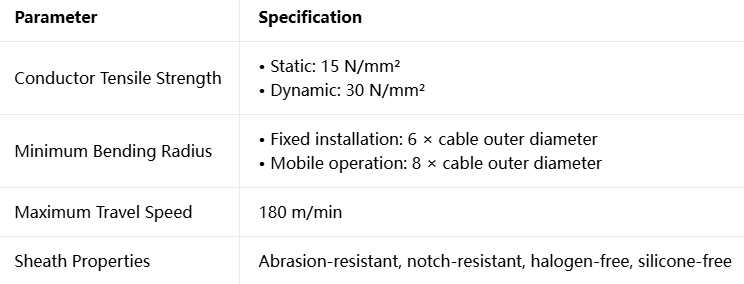
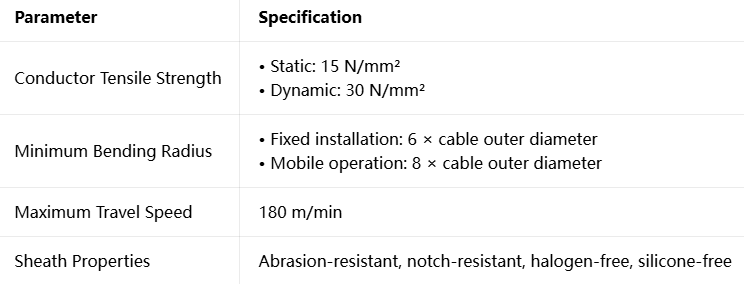
This design also delivers impressive load-bearing capacity. Under static tension, the conductor withstands 15 N/mm²; during dynamic operation — when the cable is moving and tension fluctuates — it handles up to 30 N/mm². This ensures the cable does not stretch excessively or break under the typical tension found in spring reels or motorised drum systems, where cables may travel at speeds up to 180 m/min.
Insulation: Balancing Electrical Safety and Flexibility
Surrounding each conductor is an insulation layer made from special TPE-E (thermoplastic polyester elastomer). This material is chosen because it combines two essential properties: it acts as a high-grade electrical insulator, yet behaves like rubber under mechanical stress.
From an electrical standpoint, TPE-E has a high dielectric strength, meaning it can reliably separate conductors at voltages up to 1.2 kV without breakdown or leakage. It also maintains these properties even when exposed to heat — critical because the conductor can reach a continuous operating temperature of +90 °C and up to +250 °C under short-circuit conditions for short durations.
Mechanically, TPE-E differs from standard PVC or rubber insulation. It has a very low modulus of elasticity and high recovery rate. When the cable bends, the insulation compresses and stretches, but immediately returns to its original shape once the force is removed. This prevents permanent deformation, which in other materials can create thin spots that eventually lead to electrical faults. Additionally, TPE-E resists oils, moisture and hydrolysis — important in South African industries where cables are exposed to hydraulic fluids, high humidity or coastal salt air.
Anti-Torsion Braid: The Secret to Long Life
Between the insulated cores and the outer sheath lies a critical structural component: the anti-torsion braid. Many manufacturers overlook this feature, but it is one of the main reasons RHEYCORD®-PUR R cables outlast competitors.
When a cable winds onto a drum or moves along a drag chain, it naturally twists. Without proper reinforcement, this twisting force transfers directly to the conductors and insulation, causing them to spiral, bunch up or tear. The anti-torsion braid consists of high-strength synthetic fibres woven in a cross-pattern around the core assembly. It works like a restraint system: as the cable tries to twist, the braid tightens slightly and distributes the torsional load evenly over the entire cross-section. This prevents relative movement between the cores and keeps the cable’s circular shape consistent.
This feature is validated through rigorous testing including alternating bending tests, roller bending tests, drag chain tests and specialised torsional resistance tests. For operations in ports or mines where cables reverse direction hundreds of times per day, this protection is what separates a cable that lasts years from one that fails in months.
Outer Sheath: Ultimate Protection in Harsh Environments
The outermost layer is manufactured from polyurethane (PUR) conforming to EN 50363-10-2. This is a heavy-duty compound formulated specifically for maximum resistance to abrasion, cutting and environmental attack.
In terms of mechanical engineering, PUR has an excellent balance of hardness and elasticity. It is hard enough to resist being cut by sharp edges or crushed under heavy loads, yet flexible enough to follow the cable’s movement without cracking. Its abrasion resistance is approximately five to ten times better than standard rubber or PVC. In applications such as drag chains or where cables slide against structures, this drastically reduces wear-through failures.
Chemically, the sheath is halogen-free and silicone-free. The absence of halogens means that in the unlikely event of a fire, no toxic or corrosive gases are released — a major safety consideration in enclosed terminals or underground mining. Being silicone-free is equally important: silicone contamination can ruin sensitive electronics or interfere with painting and coating processes in automotive or manufacturing facilities.
The material also withstands extreme South African weather conditions. It performs reliably from -50 °C up to +80 °C in fixed installations, and from -40 °C to +80 °C when moving. It is fully resistant to moisture, ozone and ultraviolet radiation, so cables installed outdoors in Durban or at highveld sites will not degrade or become brittle after years of exposure to harsh sunlight.
Material Science: Why Each Material Is Chosen
The superior performance of RHEYCORD®-PUR R cables is not just about design geometry — it is rooted in advanced material science. Every material is selected based on its molecular structure and how it interacts with mechanical and environmental stress.
Conductor Material: High-Purity Copper
The conductor uses high-conductivity electrolytic copper with a purity of 99.95% or higher. High purity ensures low electrical resistance, reducing energy loss and heat generation during operation. This is important in long cable runs often found in South African mining or logistics operations, where voltage drop must be kept within acceptable limits.
Copper also has excellent ductility — the ability to deform without breaking. When drawn into fine wires and stranded, this property allows the conductor to flex millions of times without fatigue. Compared to aluminium, copper has better fatigue resistance and higher current-carrying capacity for the same cross-section, making it the only practical choice for heavy-duty mobile power applications.
Insulation: TPE-E Elastomer
Thermoplastic polyester elastomers are block copolymers composed of hard crystalline segments and soft amorphous segments. At a molecular level, the hard segments provide strength, heat resistance and dimensional stability, while the soft segments provide flexibility and impact resistance. This dual-phase structure is what allows TPE-E to behave like a rubber at room temperature but process like a thermoplastic during manufacturing.
Unlike rubber, which is cross-linked and cannot be reshaped, TPE-E retains its thermoplastic nature, but through careful formulation, it achieves similar or better resistance to heat, oils and chemicals. It does not absorb moisture like some elastomers, which prevents insulation breakdown in humid or wet environments.
Outer Sheath: Ether-Based Polyurethane
Not all PUR is the same. RHEYCORD®-PUR R uses an ether-based formulation rather than ester-based. The difference lies in the chemical linkages in the polymer chain. Ether linkages (-C-O-C-) are much more resistant to hydrolysis — the breakdown of material in the presence of water and heat — compared to ester linkages. This is a critical advantage in South Africa’s humid coastal regions or where cables may be exposed to water spray or cleaning chemicals.
The molecular weight and cross-link density are precisely controlled to achieve a balance between wear resistance and flexibility. A higher cross-link density increases abrasion resistance but would make the cable stiff; too low and it would wear out quickly. The formulation in these cables strikes the optimal balance, resulting in a sheath that stays flexible at low temperatures, resists UV degradation, and withstands continuous sliding or rolling contact.
Performance Advantages: Translating Design into Real-World Benefit
All the engineering and material science translates directly into measurable benefits for operations in South Africa. The advantages can be grouped into mechanical, electrical and environmental performance categories.
Mechanical Performance
Extended Service Life: The combination of fine-stranded conductors, anti-torsion braid and high-grade PUR sheath results in a service life three to five times longer than standard flexible cables. For a port crane operating 24/7, this means fewer replacements and significantly lower maintenance costs.
Superior Flexibility: With minimum bending radii of 6 times the outer diameter for fixed installation and 8 times for mobile use, these cables work well even where space is limited or bending is tight. This is essential in drag chain applications found in automated warehouses or manufacturing plants.
High-Speed Operation: Rated for speeds up to 180 m/min, they suit high-speed automated stacker cranes and high-cycle reeling systems common in modern logistics facilities.
Torsion Stability: The anti-torsion design eliminates core twisting and bunching, which is a common failure point in reeling cables. This stability also ensures consistent outer diameter, reducing wear on cable guides and entry points.
Electrical Performance
Clear Voltage Classification:
Cables with cross-sections up to 1 mm² are rated 300/500 V, ideal for control circuits, signal transmission and low-power auxiliary functions.
Cables with cross-sections of 1.5 mm² and above are rated 0.6/1 kV, suitable for main power supply, with capability to operate safely in systems up to 1.2 kV.
High Test Voltages: Every cable is tested at 3.0 kV AC for power versions and 2.0 kV AC for control versions, ensuring a wide safety margin above operating voltage.
High Temperature Rating: Continuous operation at +90 °C allows higher current carrying capacity compared to cables rated at 70 °C. This means operators can sometimes use a smaller cross-section cable to carry the same load, saving cost and reducing overall cable diameter and weight.
Short-Circuit Withstand: Capable of withstanding conductor temperatures up to +250 °C for up to 5 seconds, these cables safely survive fault conditions without melting or causing secondary damage.
Environmental and Chemical Performance
Wide Temperature Range: Operates reliably from -50 °C to +80 °C, making it suitable for everything from cold storage facilities to hot outdoor steel mills or high-temperature mining operations.
Resistance to Industrial Contaminants: Fully resistant to mineral oils, greases, hydraulic fluids, fuels, ozone and ultraviolet light. In South Africa, where cables are often exposed to dust, sun and chemical spills, this resistance prevents rapid ageing and cracking.
Safety and Compliance: Being halogen-free and silicone-free aligns with modern safety standards and environmental regulations increasingly adopted in South African industry. In case of fire, smoke is low-density and non-corrosive, protecting both people and sensitive equipment.
Technical Specifications and Data
Understanding the exact specifications helps engineers and procurement professionals select the right cable for their specific application. The following sections detail the available configurations, dimensions and weights, all based on official technical data.
Electrical Ratings Summary
Mechanical Ratings Summary
Core Identification Standards
Proper core marking is essential for safe installation and maintenance. RHEYCORD®-PUR R follows DIN VDE 0298 Part 308 / HD 308 S2 colour and coding standards:
4 cores: Green/yellow – Brown – Black – Grey
5 cores: Green/yellow – Blue – Brown – Black – Grey
More than 5 cores: Black cores with white printed numbers; green/yellow protective earth core placed in the outer layer of the core assembly
This standardisation ensures that electricians familiar with European or South African standards can install and troubleshoot without confusion.
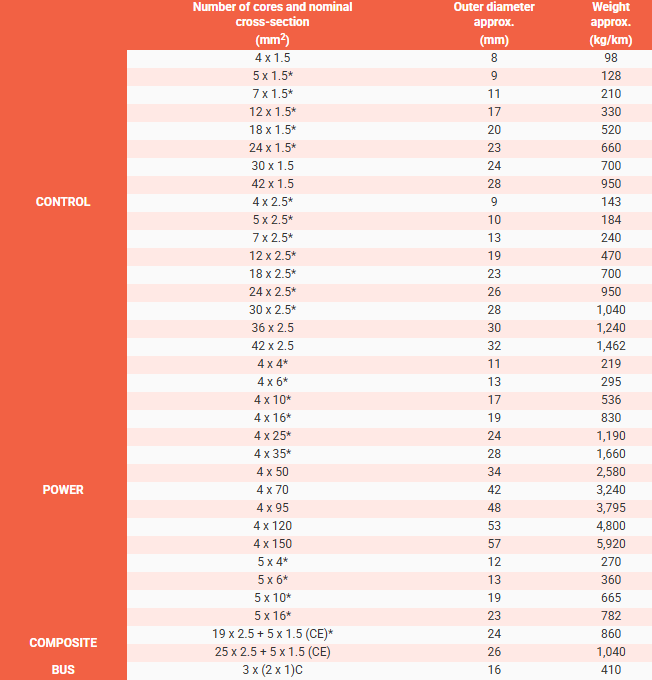
Dimensions and Weight Data
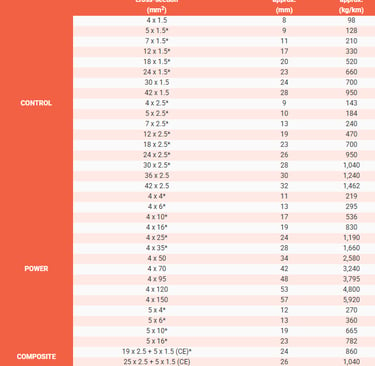
The tables below provide key data for control, power, composite and bus types. These values help in calculating reel capacity, weight loads and installation requirements.
Typical Applications in South African Industry
The features built into RHEYCORD®-PUR R cables address exactly the challenges found in local operations. Below are the most common applications, along with how the cable’s design solves specific problems.
Port and Terminal Operations
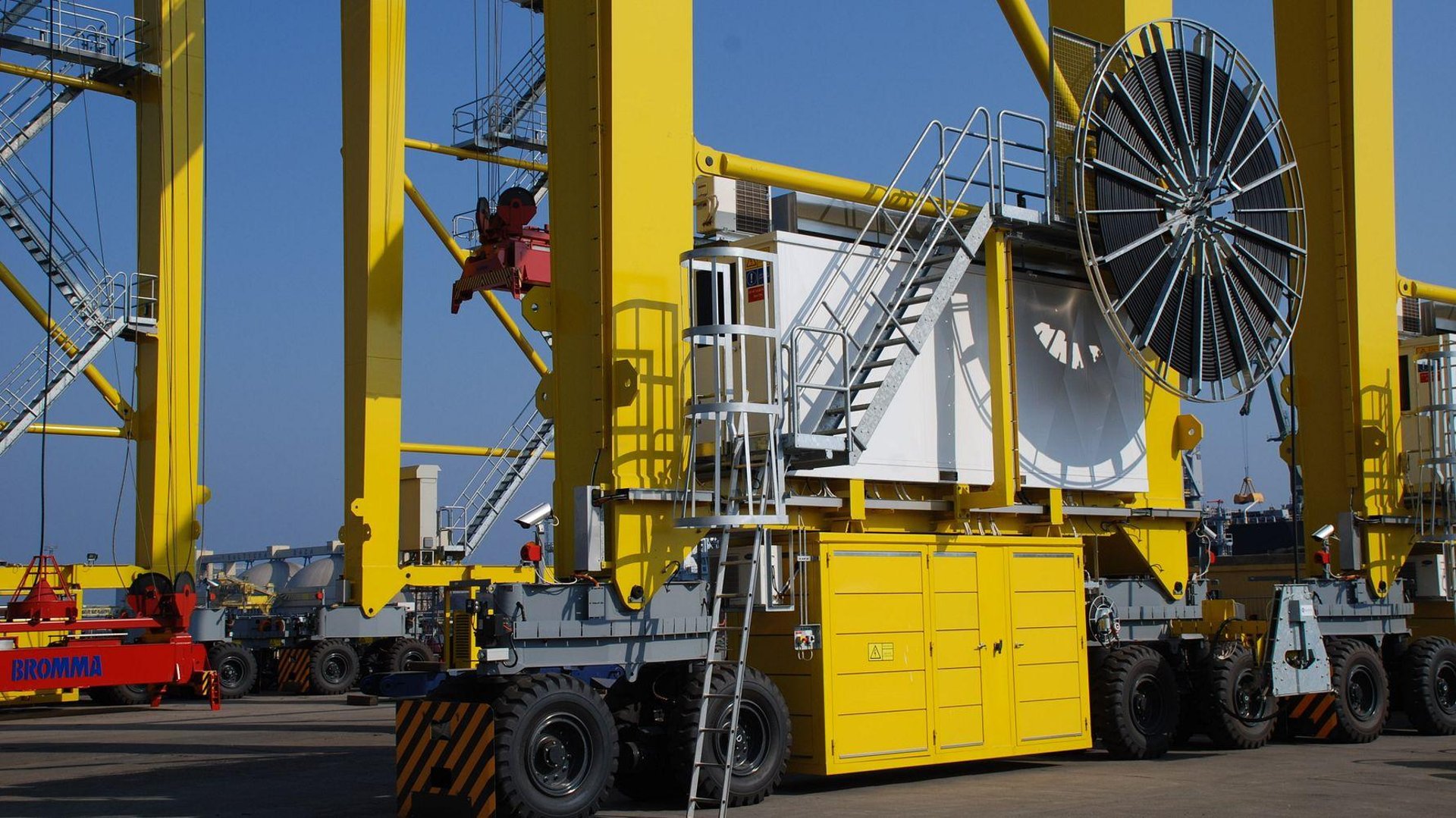
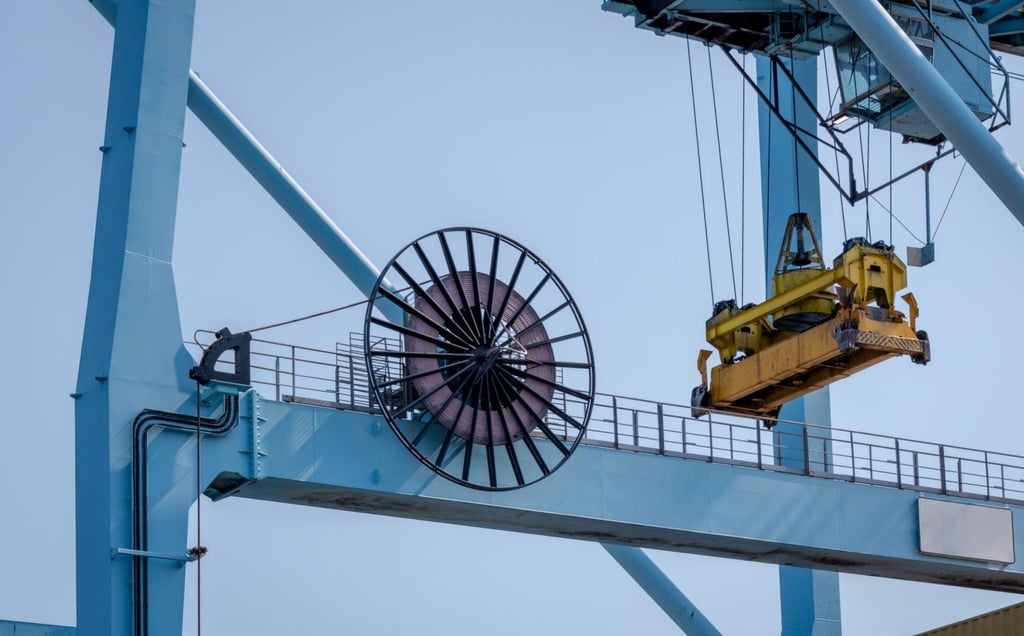
South Africa’s ports are critical hubs where container handling equipment operates continuously. Ship-to-shore cranes, gantry cranes, reach stackers and automated stacking cranes all rely on reeling cables to supply power and control signals.
Challenges:
Long travel distances and high cycle rates
Exposure to salt spray, high UV levels and extreme temperatures
Constant bending and winding under tension
Solution Provided:
The anti-torsion braid prevents core distortion even after millions of winding cycles. The PUR sheath resists salt corrosion and UV damage, maintaining integrity for years outdoors. The high-speed rating up to 180 m/min supports fast container movement without damage. Terminals in Durban and Ngqura have reported significant reductions in cable failures after switching to this type of construction.
Mining and Bulk Material Handling
In mining regions such as the North West, Limpopo and Northern Cape, stacker-reclaimers, belt wagons, mobile crushers and shiploaders move vast amounts of ore and coal. Cables here face perhaps the harshest conditions anywhere.
Challenges:
Heavy abrasion from dust and grit
Extreme temperatures from very hot days to cold nights
High mechanical tension and rough handling
Solution Provided:
The heavy-duty PUR sheath is highly resistant to abrasion, acting like a protective shield against abrasive dust. The wide temperature range ensures operation in both open-pit and underground environments. The robust conductor construction withstands the high tension of long cable runs, while the halogen-free formulation improves safety in enclosed conveyor galleries.
Drag Chain and Automated Systems
In manufacturing plants, automotive assembly facilities and automated warehouses in Gauteng and the Eastern Cape, drag chains carry power, data and control cables along production lines or storage systems.
Challenges:
Continuous high-speed back-and-forth movement
Small bending radii
Risk of contamination from oils or paint chemicals
Solution Provided:
The fine-stranded conductor and flexible TPE-E insulation allow movement in tight bend radii without fatigue. The silicone-free PUR sheath prevents contamination of painted surfaces, while oil resistance ensures performance even where hydraulic leaks may occur. The cable’s compact diameter reduces the required drag chain size, saving space and cost.
Spring Operated Reels and Hoists
Used in everything from small workshop hoists to large ship loaders, spring reels keep cables tensioned and neatly stored.
Challenges:
Constant tension when extended
Rapid retraction and extension
Cyclic bending
Solution Provided:
The high dynamic tensile strength of 30 N/mm² prevents conductor stretching or breaking under spring tension. The balanced construction ensures the cable winds evenly without tangling or twisting.
Configuration Selection Guide
Choosing the correct configuration ensures reliability and cost efficiency. The following step-by-step guide helps engineers and procurement teams make the right selection.
Determine Voltage Requirement
If the application involves only low-power control circuits, instrumentation or lighting, and the maximum conductor cross-section needed is 1 mm², select the 300/500 V rated version.
If supplying main power to motors, drives or heavy machinery, or if the required cross-section is 1.5 mm² or larger, select the 0.6/1 (1.2) kV rated version. This provides a higher safety margin and complies with South African wiring regulations for power circuits.
Choose Core Type and Quantity
Decide between control, power, composite or bus configurations:
Control Cables: Multi-core designs (4 to 42 cores) with smaller cross-sections (1.5 mm², 2.5 mm²). Best for signal and auxiliary power circuits.
Power Cables: Typically 4-core or 5-core designs with larger cross-sections from 4 mm² up to 150 mm². Designed for main power distribution.
Composite Cables: Combine power cores and control cores in one cable. Reduces installation complexity and reel space requirement.
Bus Cables: Special twisted-pair configurations for data transmission alongside power.
Calculate the number of cores needed based on the number of power phases, neutral, earth and control circuits required. Always allow spare cores for future expansion or redundancy.
Select Conductor Cross-Section
Determine the required cross-section based on:
Load current (refer to manufacturer current rating tables based on IEC 60287)
Permissible voltage drop over the cable length
Short-circuit current requirements
Larger cross-sections reduce energy loss and voltage drop but increase cost, weight and diameter. Balance these factors according to application needs.
Consider Environmental Factors
Temperature: Confirm the minimum and maximum operating temperature to ensure it falls within the rated range.
Chemical Exposure: If oils or chemicals are present, confirm the PUR sheath offers suitable resistance.
Installation Type: Mobile installations require a larger minimum bending radius and may need enhanced torsion resistance.
Special Requirements
If the standard range does not exactly match the need, contact the supplier to discuss custom core counts, colours or enhanced versions for extreme conditions.
Procurement Strategy: Feichun Brand — The Equivalent Alternative
While RHEYCORD®-PUR R is a recognised standard, procurement teams in South Africa often face challenges related to lead times, minimum order quantities and pricing. This is where Feichun Brand reeling cables present a highly attractive solution. Feichun manufactures cables engineered to match the exact specifications and performance of the original design, making them a fully equivalent replacement.
Standard and Performance Alignment
Feichun cables are manufactured to the same engineering principles and standards:
Conductor: Uses fine-stranded plain copper construction exceeding IEC 60228 Class 5, with identical static and dynamic tensile strength ratings (15 N/mm² and 30 N/mm²).
Insulation: Formulated with TPE-E thermoplastic polyester elastomer matching the original electrical, thermal and mechanical properties. Temperature ratings of +90 °C continuous and +250 °C short-circuit are identical.
Anti-Torsion Design: Includes the same high-strength braid layer to prevent twisting and core migration, validated by the same test standards.
Outer Sheath: Manufactured from PUR compound compliant with EN 50363-10-2, halogen-free, silicone-free, with identical abrasion, oil and UV resistance.
Dimensions and Marking: Outer diameters, weights and core colour coding follow exactly DIN VDE and HD standards, ensuring mechanical interchangeability and ease of installation.
Independent testing confirms that electrical performance, bending life and environmental durability are indistinguishable from the original specification. For engineers, this means no changes to design, installation or maintenance procedures are required — Feichun cables are a direct drop-in replacement.
Key Advantages for South African Buyers
Competitive Pricing: Feichun cables are typically available at a price point 20% to 30% lower than premium European brands. For large projects or regular maintenance programmes, this delivers significant cost savings without quality compromise.
Shorter Lead Times: With manufacturing facilities optimised for global supply and stock holding for standard configurations, Feichun can deliver to South Africa much faster than manufacturers with long production queues. This reduces project delays and minimises downtime during emergency replacements.
Flexible Supply: Feichun accommodates both large project orders and smaller stock orders, and readily produces custom configurations to meet specific local requirements.
Full Technical Support: Documentation including data sheets, test certificates and compliance declarations are provided, meeting South African industry and regulatory requirements.
For procurement professionals, the decision is straightforward: Feichun provides the same performance, safety and reliability, but with better availability and better value.
Frequently Asked Questions
Q: Can these cables be used permanently outdoors in South Africa’s harsh sun?
A: Yes. The PUR sheath is formulated with UV stabilisers and is ozone-resistant. It does not become brittle or degrade even after years of exposure to high levels of ultraviolet radiation common in the country.
Q: What is the maximum distance these cables can run on a reel?
A: There is no fixed distance limit, but voltage drop and current capacity must be calculated for long runs. The robust construction allows use on very large reels found in stacker-reclaimers or ship loaders, often exceeding 200 metres in length.
Q: Is the Feichun version suitable for high-speed applications up to 180 m/min?
A: Absolutely. Feichun cables are tested and rated for the same maximum speed. The anti-torsion braid and balanced core design ensure stable performance even at high travel speeds.
Q: Are these cables safe to use in potentially explosive environments?
A: While they are halogen-free and flame-retardant, additional certification may be required for explosive atmospheres. Standard versions are suitable for most industrial areas, ports and mines outside classified hazardous zones. Special versions can be supplied with additional certifications upon request.
Q: How do I know which cross-section to choose for my motor load?
A: Always calculate based on full load current, installation method and ambient temperature, following IEC 60364 or SANS wiring codes. Current rating tables are available from the manufacturer’s technical documentation.
Conclusion
RHEYCORD®-PUR R reeling cables represent a pinnacle of engineering design for mobile power and control applications. By combining high-strength flexible conductors, advanced TPE-E insulation, anti-torsion reinforcement and high-performance PUR sheathing, they solve the unique challenges of reeling systems, drag chains and moving machinery. In South Africa’s demanding industrial environment, these cables deliver reliability, safety and long service life — factors that directly translate into lower operational costs and higher productivity.
Understanding the material science and engineering principles behind these cables helps engineers select the right product and appreciate why cheaper alternatives often fail prematurely. For procurement teams, the availability of Feichun brand equivalents offers the perfect balance: identical quality and performance, adherence to all relevant standards, faster delivery and significant cost savings.
Whether upgrading existing equipment or designing new facilities at ports, mines or manufacturing plants, investing in properly engineered reeling cables ensures that power and control remain connected — even under the toughest conditions.
If you want to purchase this cable or discuss custom specifications for your South African operation, you can contact the Feichun team directly at:
Email Address: Li.wang@feichuncables.com
© 2025. All rights reserved.
One-click to Quickly Contact
Products
Contact
Company
Location:
Building A Private Science and Technology Park, Hefei Economic and Technological Development Zone, Anhui Province, China
Heat Resistant Cable
WhatsApp: +86 17333223430
Social Media: