Anhui Feichun Special Cable Co.,Ltd Email: Li.wang@feichuncables.com

How to Spot Fake Armoured Cables Before They Burn Your Project Down
Discover how to identify fake or non-compliant armoured cables (SWA/STA) in South Africa. Learn about risks, red flags, inspection tips, and real case studies to protect lives, assets, and business reputation.
Li. Wang
12/4/20254 min read
Introduction
In recent years, South Africa’s cable market has seen a surge in counterfeit and non-compliant products, ranging from low-quality imports to deliberately falsified armoured cables. While these products may appear identical to certified cables at first glance, the consequences of installing them can be catastrophic—especially in industrial, mining, and construction projects.
Armoured cables such as Steel Wire Armoured (SWA) or Steel Tape Armoured (STA) cables are designed to withstand harsh mechanical stresses, abrasion, and environmental exposure. Compromising on these cables is not just an economic issue—it’s a serious safety risk.
This article dives deep into how contractors, engineers, and procurement teams can identify, verify, and avoid fake armoured cables, using South African examples to highlight real-world consequences. From inspection techniques to red flags and regulatory compliance, we provide a detailed roadmap for protecting your project, workforce, and assets.
Why Fake or Non-Compliant Cables Are a Growing Problem in South Africa
Market Flooding of Cheap Imports
Global supply chains, combined with price pressure, have introduced a range of low-quality, untested cables into South Africa. These cables often appear visually similar to legitimate products but fail crucial electrical and mechanical tests.
Economic Pressure on Contractors
Contractors, especially in mining and construction, face tight project budgets. The temptation to purchase cheaper cables can be strong, particularly when deadlines loom. Unfortunately, this cost-saving often results in increased risk of installation failures, downtime, and liability exposure.
South African Regulatory Framework
South Africa regulates electrical products through a combination of:
NRCS (National Regulator for Compulsory Specifications): Oversees LOA (Letter of Authority) and market compliance.
SABS (South African Bureau of Standards): Provides SANS certifications, such as SANS 1507 for SWA/STA cables.
Municipal inspections: Ensure compliance during construction and industrial projects.
Non-compliant cables may violate multiple regulations, creating both legal and financial liabilities.
Safety, Insurance, and Asset Impact
Using non-standard cables affects:
Electrical safety—short circuits, fires, electrocution
Insurance claims—often denied if counterfeit products are installed
Asset longevity—premature failures lead to high replacement costs
South African Industry Examples
Several cases in mines, substations, and housing projects illustrate the risks. For example, a mining operation in Limpopo experienced downtime after non-compliant trailing cables failed, costing hundreds of meters in replacement and lost production.
Understanding “Fake” or “Non-Compliant” Cable
Counterfeit Cable
A counterfeit cable is deliberately manufactured to imitate a certified product, often using inferior materials and falsified markings.
Non-Standard / Non-Compliant Cable
This refers to cables that fail to meet SANS, IEC, or BS standards due to under-sized conductors, poor insulation, or substandard armour—even if they are not outright counterfeits.
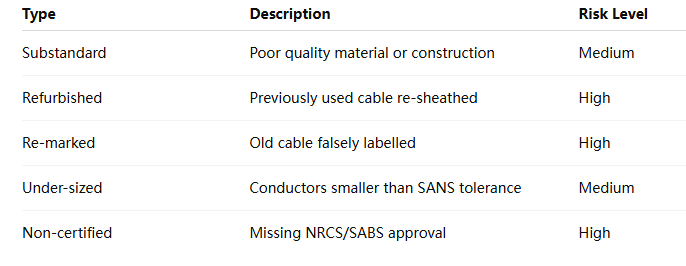
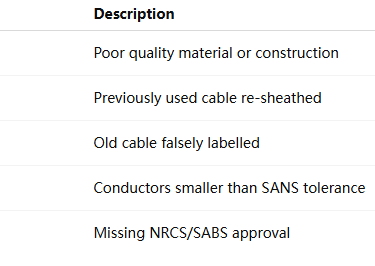
Key Differences
Why Armoured Cable Quality Matters
Armoured cables bear mechanical stress, particularly underground, in mines, or industrial settings. Inferior steel wires or thin insulation can lead to crushing, short circuits, or catastrophic fires.
Hidden Dangers of Fake Armoured Cables
Electrical Safety Risks
Overheating due to high resistance
Short circuits caused by poor insulation
Insulation breakdown leading to fire hazards
Mechanical Integrity Risks
Weak steel wire armour fails under mechanical stress
Susceptibility to crushing, especially in underground installations
Premature ageing from substandard PVC or XLPE sheath
Human Safety Risks
Electrocution from exposed conductors
Touch voltage hazards in wet or underground environments
Increased injury risk in mining and industrial operations
Financial & Legal Risks
Failed inspections and penalties
Insurance claims denied
Costly re-installation of compliant cables
Damage to company reputation and trust
Red Flags When Buying Armoured Cables (SWA/STA)
Suspiciously Low Pricing
Cables priced 20–30% below market rates are high-risk. Counterfeiters reduce costs using:
Copper-clad aluminium (CCA) instead of pure copper
Recycled PVC or low-grade XLPE
Thinner steel armour
Missing or Incorrect Markings
Authentic cables have clear markings including:
Manufacturer name
Voltage rating
SANS/BS/IEC references
Batch numbers
Fakes may have blurred fonts, misspellings, or incomplete labels.
Abnormal Sheath Colour or Texture
Warning signs include:
Uneven jacket thickness
Discolouration
Soft or brittle material
Recycled plastic smell
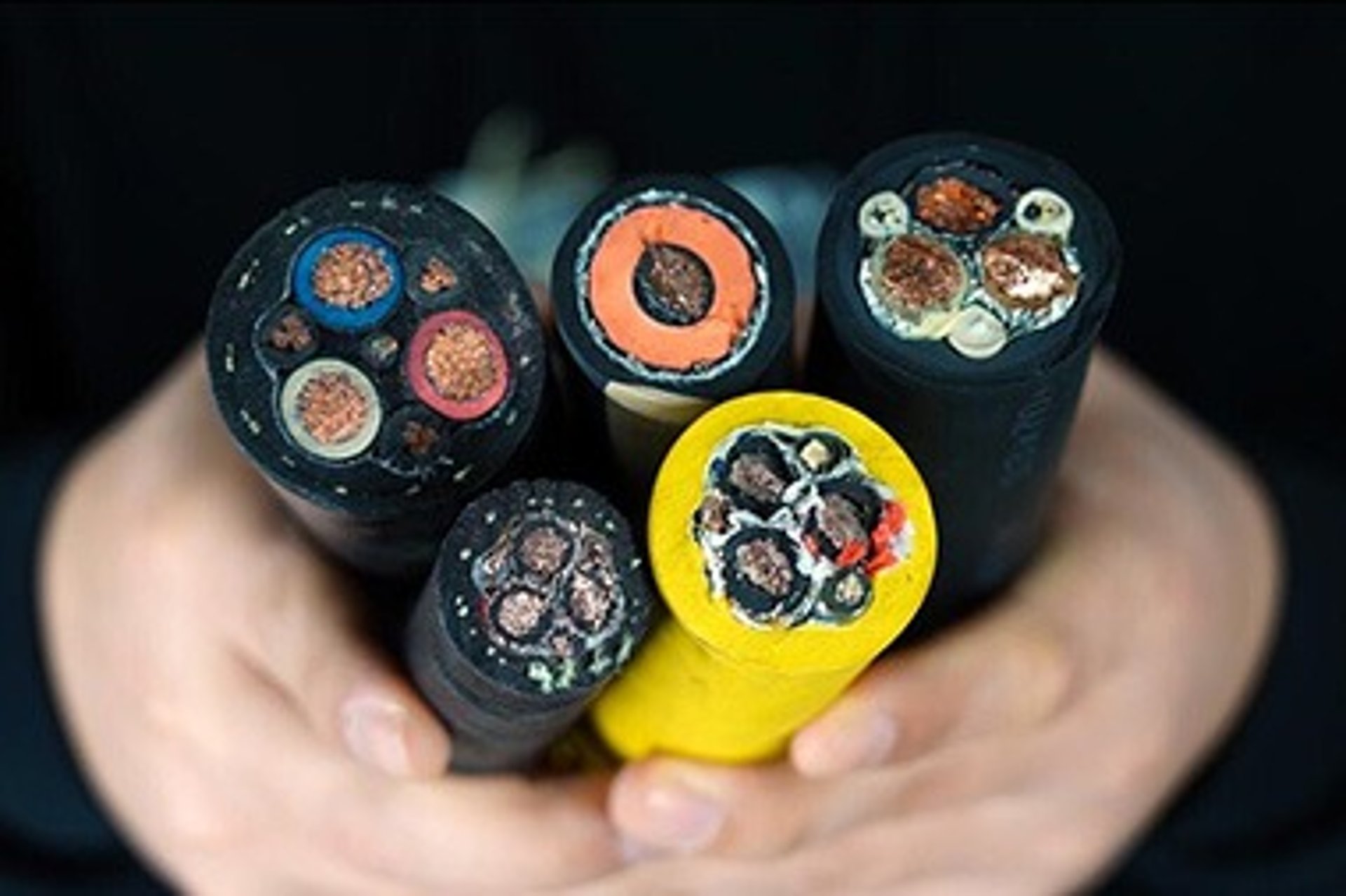
Incorrect Conductor Appearance
Blackened or oily strands
Loose stranding
Mixed metals
Non-uniform diameter
Short Meterage or Incorrect Drum Labelling
Exceeding SANS length tolerance
Reused drums with mismatched labels
Technical Checklist: How to Inspect a Cable Before Buying
Verify Conductor Quality
Confirm pure copper vs. copper-clad aluminium
Inspect for uniform diameter and bright surface
Weigh short lengths—counterfeits are lighter
Check Armour Quality
Measure steel wire diameter
Check adhesion to bedding layer
Look for poor galvanising or recycled steel signs
Examine Insulation and Sheathing
Ensure uniform thickness
Correct colour coding
Flame-retardant markings
Confirm Outer Sheath Markings
Manufacturer, voltage rating, SANS standard
Cable type (SWA/STA)
Batch and year of manufacture
Packaging Verification
Sealed reels
Traceable documentation
Consistent print codes
Authenticity Checks: How to Verify a Genuine Armoured Cable
Check SABS/SANS Compliance
SANS 1507 for SWA/STA cables
SANS 10142 wiring code
NRCS LOA verification
Request Certificates
Certificate of Conformity (CoC)
Test reports
Manufacturer’s Declaration of Performance
Compare Against Manufacturer Specifications
Sheath colour, armour diameter, conductor class
Print spacing consistency
Buy Only Through Trusted South African Channels
Authorised distributors
Registered wholesalers
OEM direct supply
Avoid informal markets and unverified online sellers
Real South African Case Studies
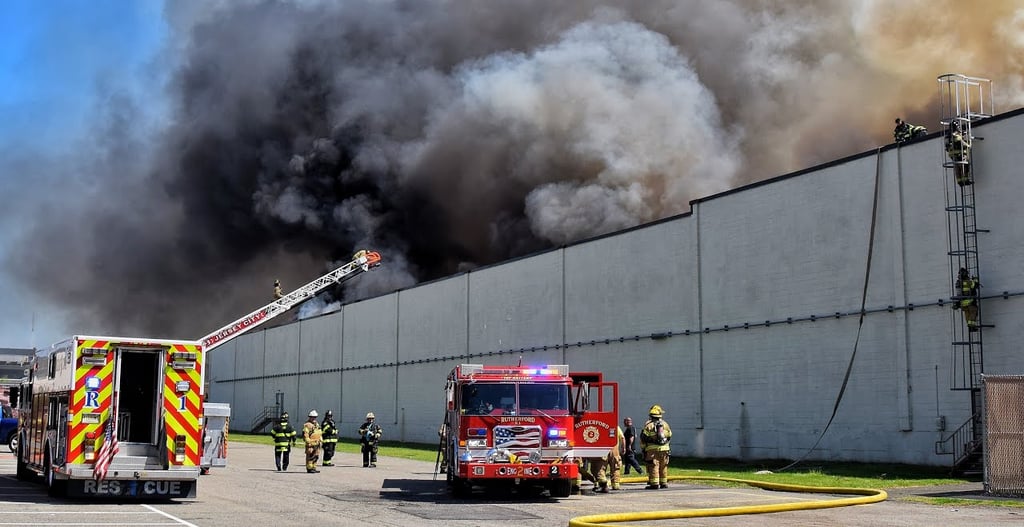
Case Study 1: Gauteng Warehouse Fire
Counterfeit SWA cable installed
CCA conductors & thin sheath caused overheating
Warehouse suffered significant losses; insurance claim denied
Case Study 2: Limpopo Mine Downtime
Non-compliant armoured trailing cables
Insulation cracked prematurely under mechanical stress
NRCS inspection flagged non-compliance; hundreds of meters replaced
Case Study 3: Cape Town Construction Compliance Failure
Incorrect BS markings and under-sized conductors
Municipal audit failed, causing project delays and penalties
Lessons Learned
Proper supplier verification and on-site inspection could have prevented all three incidents
Costly mistakes highlight the importance of compliance and vigilance
Practical Tools and Tips for Contractors & Engineers
On-Site Inspection Checklist
Verify markings and batch number
Inspect sheath colour and texture
Check conductor material
Examine armour thickness
Test insulation flexibility
Confirm packaging integrity
Measure cable weight
Compare against specification sheets
Take photos for records
Document supplier information
Weight Comparison Method
Pure copper cables weigh more than CCA equivalents
Quick field test using short lengths
Using a Micrometer
Measure copper and armour thickness
Detect undersized conductor cores
Record-Keeping in Procurement Files
Batch numbers, supplier details, certificates, reel photos
What To Do If You Suspect Counterfeit Cable
Stop Installation Immediately
Segregate suspect cables
Label clearly for inspection
Contact Supplier for Verification
Provide evidence: photos, batch numbers, purchase info
Request CoC or test reports
Report to Authorities
NRCS
SABS
Municipal electrical inspector
Notify insurance company
Testing Options
Accredited third-party labs
Copper purity testing
Insulation resistance tests
Conclusion
The use of fake or non-compliant armoured cables presents serious electrical, mechanical, human safety, and financial risks. South African contractors, engineers, and buyers must exercise vigilance at every step—from procurement to installation.
Key takeaways:
Always inspect markings, conductors, insulation, and armour
Purchase from verified suppliers with traceable documentation
Keep detailed records for compliance and insurance purposes
Report suspect cables to NRCS, SABS, and municipal authorities
Remember: In high-stakes environments like mining, construction, and industrial installations, verifying armoured cable authenticity isn’t just a formality—it’s a lifesaving practice.
Email Address: Li.wang@feichuncables.com
© 2025. All rights reserved.
One-click to Quickly Contact
Products
Contact
Company
Location:
Building A Private Science and Technology Park, Hefei Economic and Technological Development Zone, Anhui Province, China
Heat Resistant Cable
WhatsApp: +86 17333223430
Social Media: