Anhui Feichun Special Cable Co.,Ltd Email: Li.wang@feichuncables.com
(N)SSHCGEOU V Steel Wire Armoured Underground Mining Cable: Essential Guide for Safety and Durability in South Africa’s Deep Gold and Platinum Mines
Explore the (N)SSHCGEOU V steel wire armoured cable – engineered for South Africa’s harshest underground conditions in Witwatersrand gold and Bushveld platinum mines. Learn specs, real-time monitoring, crush resistance and why it’s the smart, cost-effective choice for local miners.
Li Wang
4/20/20268 min read
Introduction: Why Cable Choice Matters in South African Underground Mining
In the unforgiving depths of South Africa’s mines, a single trailing cable can mean the difference between safe, productive shifts and catastrophic downtime, injury or worse. With 41 mining fatalities recorded across the industry in 2025 – the lowest annual figure on record – the sector continues to push toward zero harm. Yet falls of ground still claimed 15 lives last year, a 25% rise from 2024, underscoring how mechanical and electrical risks remain intertwined in our deep-level operations.
Mobile equipment such as longwall shearers, continuous miners and load-haul-dump (LHD) machines relies on flexible trailing cables that must withstand extreme dynamic loads while delivering reliable power and fault protection. The (N)SSHCGEOU V cable, built to DIN VDE 0250-812, stands out as a purpose-designed solution for these exact conditions. Manufactured to the highest European mining-cable standards yet readily available through suppliers like Feichun Cables, it combines heavy-duty rubber construction, concentric monitoring conductors and galvanised round steel wire armour – features that directly address the realities of South African underground mining.
This comprehensive guide unpacks the cable’s design, specifications and real-world performance. We examine why it outperforms standard alternatives in cable-handler applications, how its per-phase monitoring aligns with Mine Health and Safety Act (MHSA) Chapter 3 electricity regulations, and why procurement teams at mines like those in the Witwatersrand Basin and Bushveld Complex are increasingly specifying it. By the end, you will understand not only the technical superiority of the (N)SSHCGEOU V but also its tangible impact on safety, uptime and total cost of ownership (TCO) in South African operations.
South African miners have long known that cable failure is rarely just an electrical issue – it is a safety, production and financial one. Under MHSA Regulation 3.24, all flexible trailing cables on mobile machines must be individually screened and earthed in hazardous areas. Regulation 3.22 further requires armouring wherever mechanical damage is possible. The (N)SSHCGEOU V meets and exceeds these requirements while adding real-time insulation monitoring that can prevent arc-flash incidents before they escalate. In an industry where every unplanned stoppage costs thousands of rand per minute, this cable delivers measurable returns.
Underground Mining Environments in South Africa
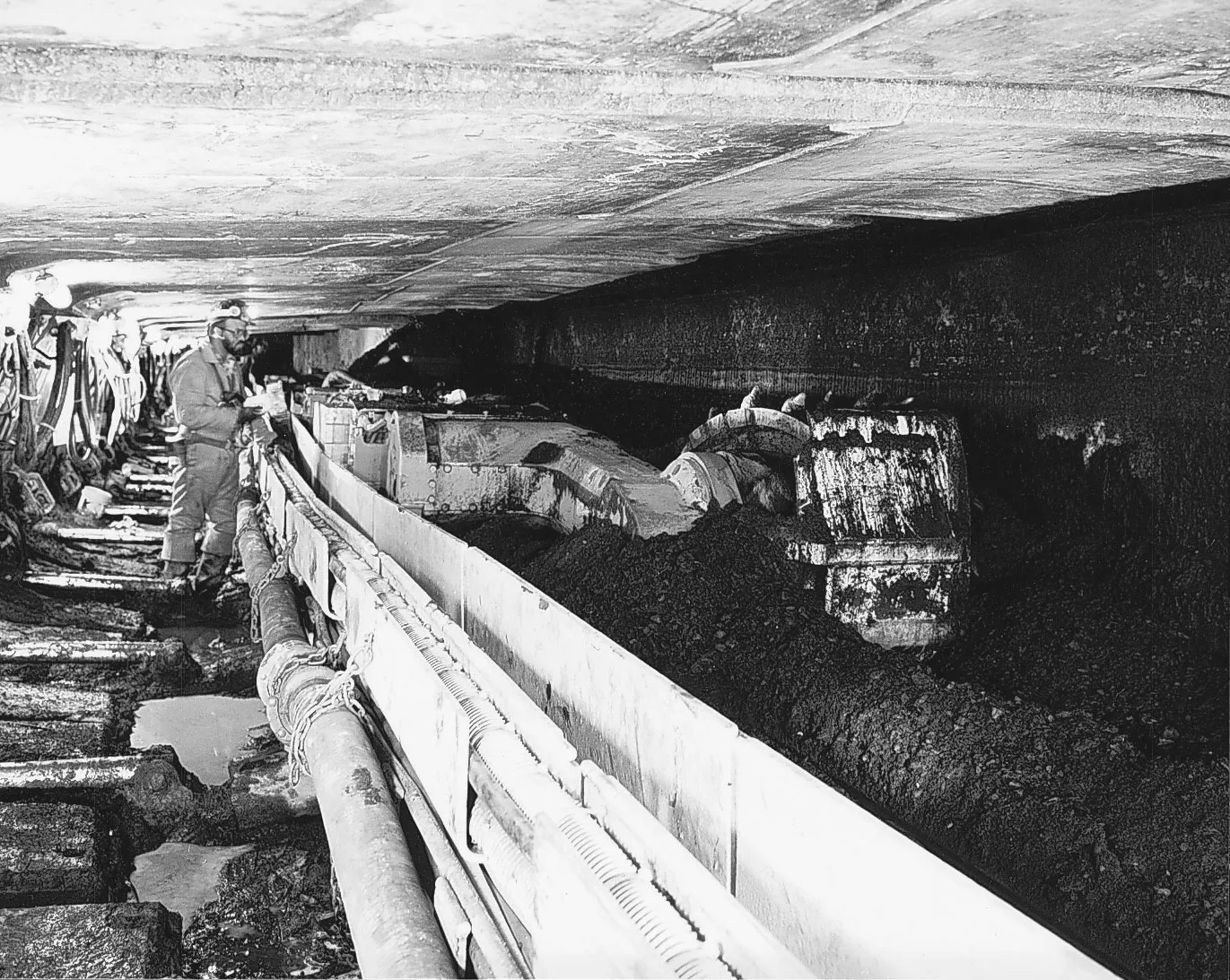
South Africa’s underground mines operate at the edge of human and material endurance. In the Witwatersrand Basin – home to iconic operations such as Mponeng, TauTona and Kloof – depths routinely exceed 3 000 m and approach 4 000 m. Virgin rock temperatures climb above 60 °C, humidity approaches saturation, and seismic activity induced by mining stress creates frequent rockbursts and falls of ground. Narrow tabular reefs demand tight excavations where cables are dragged through protection chains or cable handlers, subjected to repeated crushing, abrasion from rock spall and tension as machines advance and retreat.
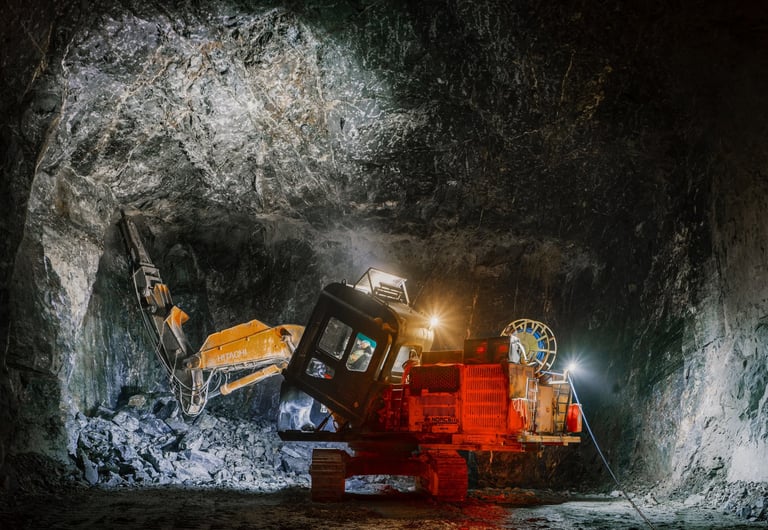
Further north in the Bushveld Igneous Complex, platinum mines such as Impala, Anglo American Platinum and Northam Booysendal exploit the UG2 and Merensky reefs using highly mechanised room-and-pillar and longwall methods. Here, LHDs, continuous miners and drill jumbos operate in stopes that, while shallower than Witwatersrand, still present confined spaces, high rock-burst potential and constant vibration. Water ingress, methane pockets and abrasive dust compound the challenge. Cables must survive not only the initial installation but thousands of flexing cycles in cable reels or handlers while maintaining electrical integrity in explosive atmospheres.
MHSA Chapter 3 explicitly addresses these hazards. Regulation 3.23 restricts trailing cables to self-propelled mobile machines, movable apparatus or portable equipment. Regulation 3.24 mandates individual screening and earthing in hazardous zones. Regulation 3.22 requires armouring wherever mechanical damage is foreseeable – precisely the scenario in every cable-handler run. Yet standard cables often fail these real-world demands: insulation cracks under crushing loads, screens break under repeated bending, and undetected earth faults trigger arc flashes or unplanned trips.
Real incidents illustrate the point. Rockfalls in deep Witwatersrand drives have crushed unprotected cables, leading to insulation puncture and subsequent electrical fires. In Bushveld mechanised sections, LHD run-overs have flattened ordinary trailing cables, causing short-circuits that halt production for hours. The (N)SSHCGEOU V was engineered precisely for these South African realities: its galvanised round steel wire armour disperses point loads radially, the spiral tinned-copper screen provides both EMC protection and fault-current return, and the concentric monitoring conductors deliver per-phase early warning of insulation degradation.
Why Mobile Mining Machinery Demands Armoured Monitoring Cables
Longwall shearers (500–1 500 kW), continuous miners (300–600 kW), LHD loaders (150–350 kW), drill jumbos and raise borers all depend on reliable 0.6/1 kV power delivery in environments where replacement is slow and costly. These machines move constantly, dragging cables through articulated steel handlers or protection chains that impose multi-axis compression, bending radii as tight as 6× outer diameter, and impact loads from falling rock.
Ordinary cables lack the mechanical backbone to survive. Insulation fails under crush, screens fracture, and earth continuity is lost – violating MHSA requirements and creating shock or explosion risks. Armoured monitoring cables solve this by integrating three protective functions: mechanical shielding, electromagnetic screening and active fault detection. The (N)SSHCGEOU V delivers all three in a single, flexible package rated for the highest dynamic stress class under VDE 0250-812.
Decoding the (N)SSHCGEOU V Model
The cable designation (N)SSHCGEOU V follows the strict nomenclature defined in DIN VDE 0250-812 for heavy-duty mining cables. Each letter or group of letters has a precise meaning, describing the construction, materials and intended performance of the cable. Reading from the inside outwards, the code breaks down as follows:
(N) stands for a standard-type cable manufactured according to VDE 0250-812 specifications, but without the official VDE type-test registration mark.
SS indicates “Spezial Strapazierfähig” – a special extra-heavy-duty construction designed for the highest levels of mechanical stress and dynamic loading encountered in underground mining.
H means the cable is rubber-insulated, specifically using EPR (Ethylene Propylene Rubber) compound classified as 3GI3.
C refers to concentric conductors, where control and monitoring conductors are arranged concentrically around each power core.
GE denotes the inclusion of earthed ground conductors (Geerdeter Erdungsleiter), providing integrated protective earthing.
O signifies that the cable is oil-resistant (Ölfest), with sheathing materials capable of withstanding exposure to oils and hydrocarbons common in mining environments.
U indicates the presence of an outer sheath (Ummantelung) made of thermosetting rubber.
V is the critical distinguishing feature: “Verstärkt Rundstahldraht-Bewehrung”, which translates to reinforced round galvanised steel wire armour. This round steel wire armour provides superior mechanical protection compared with flat steel tape or braided armour.
The “V” suffix is particularly important for South African underground operations. Unlike flat steel tape armour, which can concentrate point loads on a flat surface and deform more easily, the round galvanised steel wires distribute crushing and impact forces radially in all directions. This design greatly enhances resistance to compression and shock loading – exactly the type of abuse experienced when the cable runs through articulated steel protection chains or cable handlers behind mobile mining machines such as longwall shearers and LHDs in deep Witwatersrand and Bushveld mines.
This construction makes the (N)SSHCGEOU V especially well-suited for the dynamic, high-stress conditions found in South African deep-level gold and platinum mining, where cables must endure repeated bending, crushing, abrasion and rockfall impacts while maintaining full electrical integrity and safety monitoring capabilities.
Complete Technical Specifications
Full Specification (3×150/70KON + 3×(2.5ST KON/2.5UL KON) example, 0.6/1 kV)
Rated voltage: U₀/U = 0.6/1 kV (max operating 1.2 kV three-phase)
Test voltage: 3.5 kV
Conductor: Tinned copper, Class 5 flexible (DIN EN 60228)
Insulation: EPR 3GI3 rubber
Inner sheath: Rubber GM1b
Screen: Spiral tinned copper wires
Armour: Galvanised round steel wire (“V”)
Outer sheath: CR 5GM5 yellow chloroprene rubber (flame retardant IEC 60332-1-2, oil resistant EN 60811-2-1)
Outer diameter: 72.5 mm
Weight: 9 600 kg/km (copper 5 390 kg/km, 56.1 % copper content)
Temperature range: Fixed –40 °C to +80 °C; moving –25 °C to +80 °C; conductor max 80 °C
Bending radius: Fixed 4×D; moving 6×D
Max tensile strength at conductor: 15 N/mm²
Certifications: CE, EMV/EMC
(a) CR 5GM5 Yellow Chloroprene Rubber Sheath – Mine-Grade Armour
The 5GM5 compound (per DIN VDE 0207-21) is the highest-grade mining sheath. Its abrasion loss is below 300 mm³ (DIN ISO 4649), tear resistance is exceptional, and it resists oil, ozone and flame. The bright yellow colour improves visibility in low-light Witwatersrand and Bushveld drifts, allowing crews to spot damage early – a practical safety feature aligned with MHSA good-housekeeping requirements.
(b) Conductor Configuration Analysis: 3×150/70KON + 3×(2.5ST KON/2.5UL KON)
The 150 mm² power cores deliver 200–400 kW at typical 690 V mining voltages, matching shearer and LHD demands. The /70KON concentric earth (70 mm² per phase) provides a low-impedance fault-current path, satisfying MHSA Regulation 3.20.
Crucially, the +3×(2.5ST KON/2.5UL KON) adds three independent safety loops – one per phase. ST (Steuerleiter) control conductors detect insulation breakdown between power core and earth; UL (Überwachungsleiter) monitoring conductors trigger an alarm when outer damage occurs, before the main insulation is compromised. This per-phase monitoring enables precise fault location, reducing diagnostic time from hours to minutes and preventing escalation to arc flash or fire.
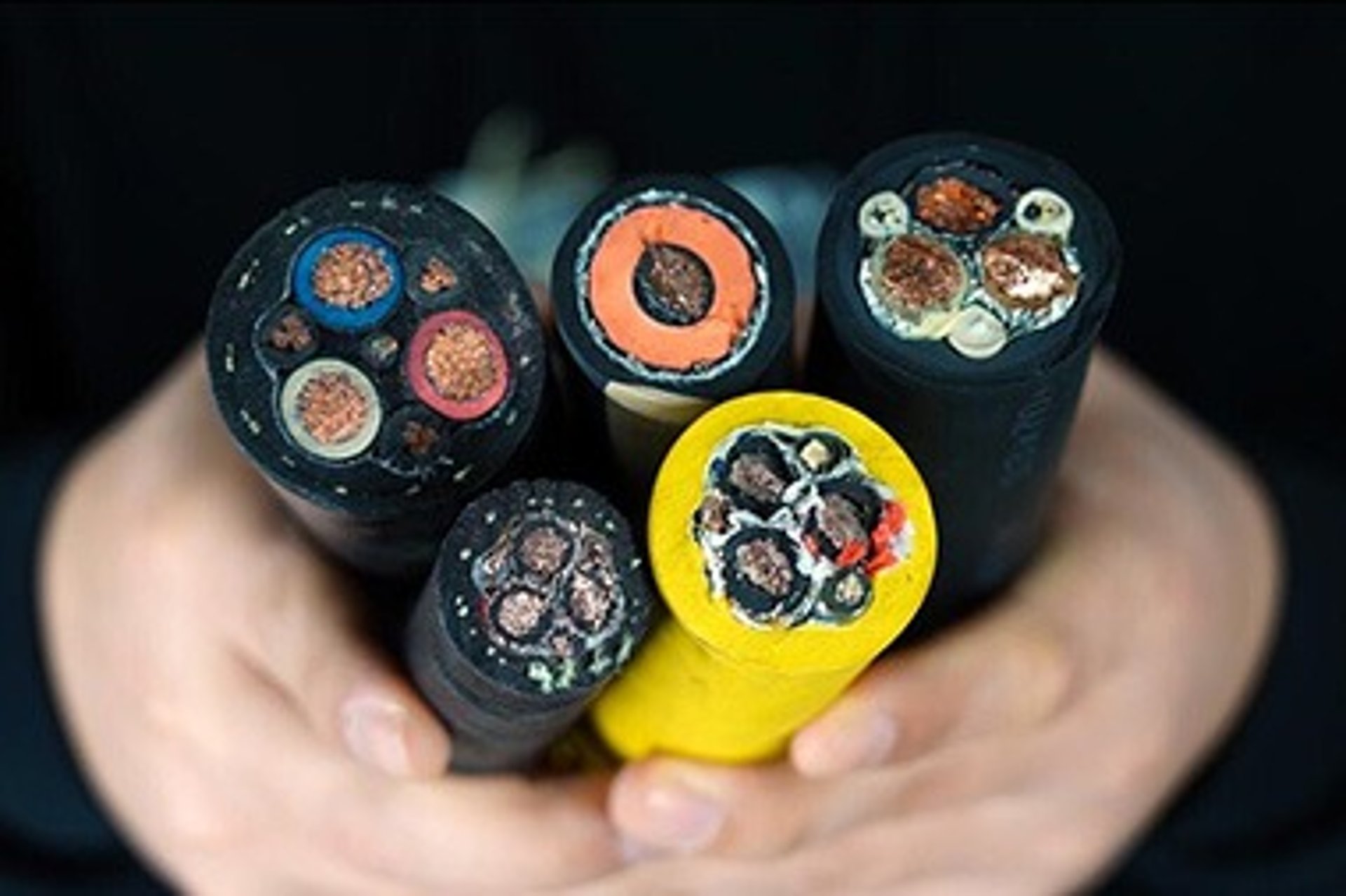
(c) Multi-Layer Protection Architecture
Spiral tinned-copper screen: EMC shielding for VFD-driven equipment plus fault-current return.
Galvanised round steel wire armour: Mechanical crush and rock-fall protection.
CR 5GM5 outer sheath + GM1b inner sheath: Environmental and binding barrier.
Together these layers create a robust defence that meets and exceeds MHSA armouring and screening mandates while adding active monitoring absent in lighter cables.
(d) Weight and Material Science
At 9 600 kg/km the cable is deliberately heavy. The 56.1 % copper content and thick armour provide tensile strength and thermal mass that resist stretching and heat buildup in deep, hot mines. The design philosophy is clear: sacrifice marginal weight for vastly extended service life and reduced failure risk – a trade-off that pays dividends in TCO for South African operations where cable retrieval is labour-intensive and dangerous.
Applications in South African Underground Mobile Equipment
The cable is specifically designed for mobile mining systems operating in deep and high-stress environments.
Longwall shearers
Used in coal extraction systems:
Continuous cutting operation
High vibration stress
Constant cable movement
LHD (Load-Haul-Dump) machines
These machines create extreme cable stress:
Forward and reverse motion
Tight turning radius
Frequent dragging over rough surfaces
Continuous miners
High power consumption equipment requiring:
Stable 3×150 mm² power supply
Continuous monitoring of insulation integrity
Underground drilling systems
Used in:
Deep ore exploration
Vertical and horizontal drilling rigs
High torque motor supply systems
Case:
In Witwatersrand deep gold mines the cable powers longwall shearers advancing through narrow drives, surviving rock spall and seismic jolts. In Bushveld platinum operations it supplies continuous miners and LHDs in room-and-pillar layouts, where cable handlers impose thousands of compression cycles per shift. The 3×150 mm² size perfectly matches the 200–400 kW motors common on these machines, while the monitoring system integrates directly with modern machine control systems for automatic shutdown on detected faults.
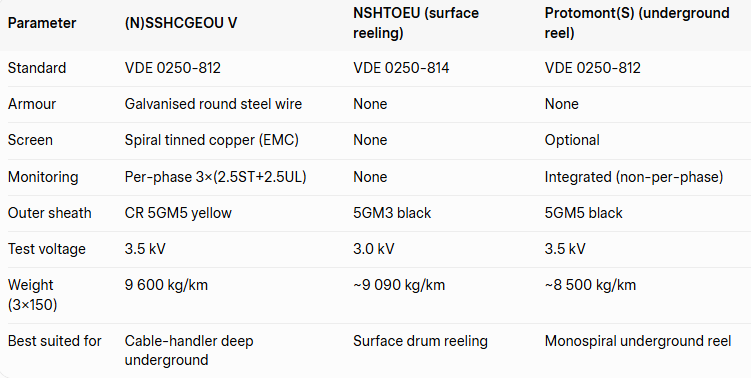
(N)SSHCGEOU V vs Standard NSHTOEU and Protomont(S)
Choose the (N)SSHCGEOU V whenever cables run in protection chains or handlers in deep South African mines. NSHTOEU lacks armour and monitoring; Protomont(S) is lighter but cannot handle the compressive loads of chain systems.
Why Feichun Cables Deliver High-Value, Locally Relevant Solutions for South African Mines
Feichun Cables produces the (N)SSHCGEOU V to exact VDE 0250-812 specifications using identical EPR 3GI3 insulation, CR 5GM5 sheath and round-wire armour. CE and EMV certification match European OEMs, yet lead times are 6–8 weeks versus 12–16 weeks for imported Prysmian Protomont equivalents. The result is equivalent performance at significantly lower TCO, with full technical support tailored to South African conditions.
Frequently Asked Questions (FAQ)
Q: Is the (N)SSHCGEOU V compliant with MHSA electricity regulations?
Yes – fully screened, armoured and earthed per Regulations 3.22, 3.24 and 3.20.
Q: How does the “V” armour perform against rockfalls in Bushveld mines?
Round steel wires disperse impact loads radially, preventing flattening that occurs with tape armour.
Q: What is the difference between ST and UL conductors?
ST detects main insulation breakdown; UL provides early outer-layer damage warning.
Q: Can Feichun supply custom lengths for Witwatersrand deep shafts?
Yes – drums are manufactured to order with fast local delivery.
Q: How does pricing compare to European brands?
Typically 35–45 % lower landed cost with identical specs and faster availability.
Conclusion
The (N)SSHCGEOU V is more than a cable – it is a safety and productivity investment engineered for South African underground realities. Its three-layer protection, per-phase monitoring and superior crush resistance directly reduce the risks that still claim lives and halt production in our deepest mines.
Ready to upgrade your underground cable fleet? Contact Feichun Cables today for South Africa-specific technical data sheets, pricing and fast delivery quotes.
Email Address: Li.wang@feichuncables.com
© 2025. All rights reserved.
One-click to Quickly Contact
Products
Contact
Company
Location:
Building A Private Science and Technology Park, Hefei Economic and Technological Development Zone, Anhui Province, China
Heat Resistant Cable
WhatsApp: +86 17333223430
Social Media: