Anhui Feichun Special Cable Co.,Ltd Email: Li.wang@feichuncables.com
(N)TSCGEWOEU-LED 3.6/6 kV Self-Powered Illuminated Trailing Cable: Enhancing Safety for Electric Shovels and Draglines in South Africa’s Opencast Coal Mines
Discover the (N)TSCGEWOEU-LED 3.6/6 kV self-powered illuminated trailing cable – the plug-and-play solution transforming visibility and reducing run-over risks for electric rope shovels and walking draglines in dusty Mpumalanga opencast operations like Kriel Colliery. Real-world safety gains for South African miners.
Li Wang
4/9/20269 min read
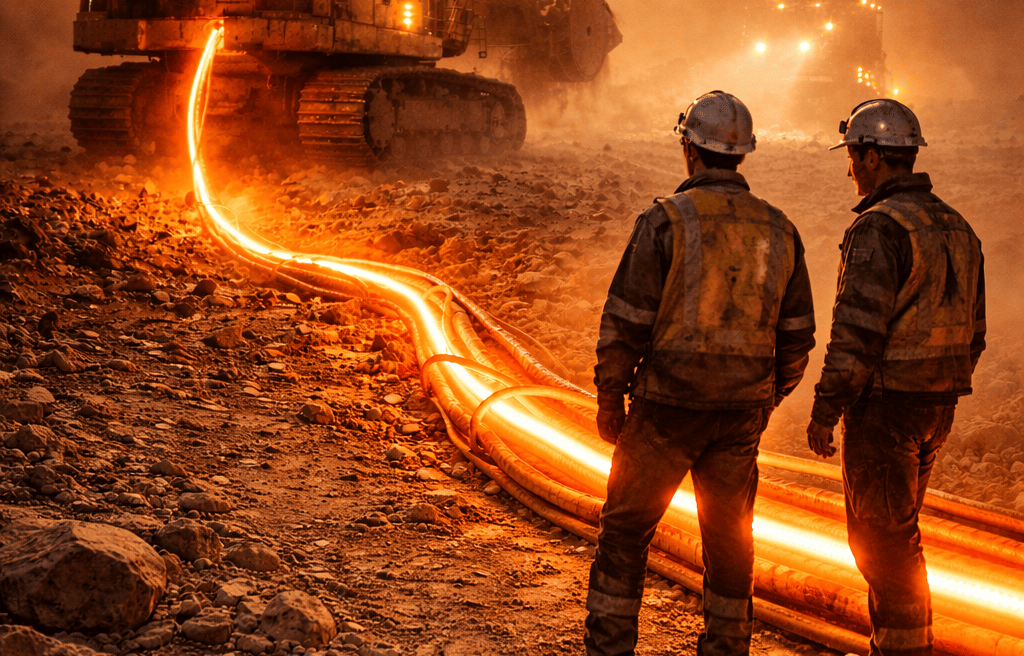
In the heart of Mpumalanga’s Highveld, where the coal dust hangs thick in the air and the night shift crew battles low visibility, one piece of equipment has quietly become a silent hero – or a hidden hazard. Picture this: a massive walking dragline swinging its boom under floodlights, its long trailing cable snaking across the pit floor like an invisible python. One wrong move by a haul truck or a misplaced step by a ground crew, and you’re looking at downtime, damage, or worse. South African opencast miners know this story all too well.
That’s why the arrival of the (N)TSCGEWOEU-LED 3.6/6 kV self-powered illuminated trailing cable from Feichun is generating serious interest among mine engineers, safety officers and production managers across the coalfields. Built to DIN VDE 0250-813 standards with GOST-R certification, this medium-voltage trailing cable doesn’t just carry power to your electric rope shovels and draglines – it lights itself up with a full-length red LED glow the moment it’s energised. No batteries, no external power packs, no fancy switchgear upgrades. Just plug it in, switch on, and watch the cable become visible even when it’s buried under coal dust or mud.
This article unpacks exactly how this cable works, why it matters right here in South Africa’s opencast operations, and the real technical specs you can take to your next equipment selection meeting. Whether you’re running Kriel Colliery-style dragline pits or truck-and-shovel fleets feeding Eskom, the data and practical insights here are written for the South African mining bloke who needs solutions that work in the dust, the rain and the load-shedding reality we all face.
South African Opencast Mining: Environment, Equipment and Daily Challenges
Mpumalanga’s opencast coal mines – from Kriel Colliery to the broader Witbank coalfield – sit in one of the toughest working environments on the planet. The Highveld weather throws everything at you: summer thunderstorms that turn pits into mud baths, winter dust storms that reduce visibility to a few metres, and those long night shifts where the floodlights struggle against coal dust and fog. Production targets don’t stop for the weather. Eskom needs its coal, and the mine has to deliver.
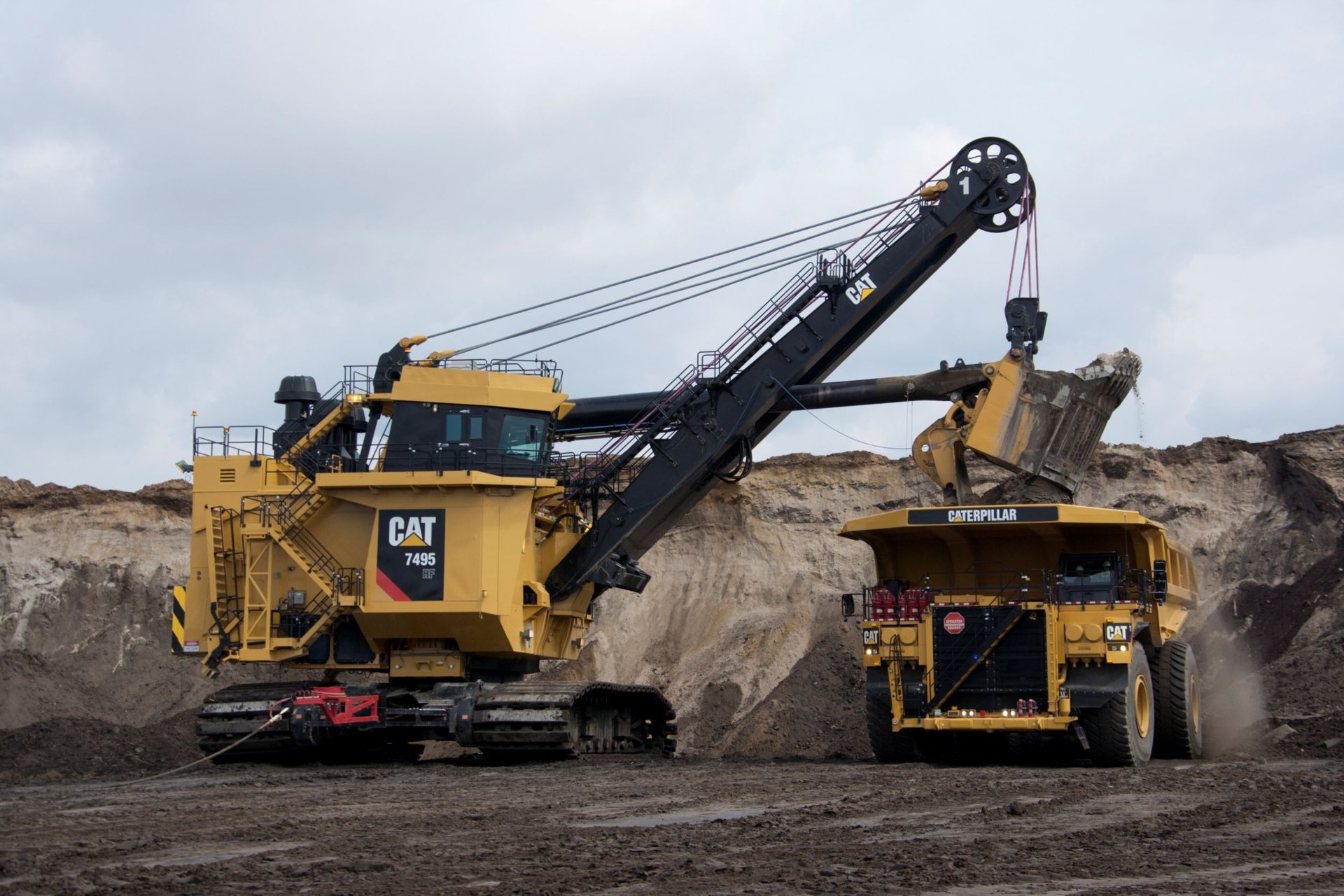
Kriel Colliery, operated historically by Anglo American and now under Thungela Resources influence in many seams, is a textbook example. The mine uses a mix of walking draglines for overburden removal on the No. 4 seam and truck-and-shovel fleets for selective mining of thinner seams like the No. 5. Electric rope shovels – often P&H 1900 AL/CL models with 12 m³ buckets – load 91-ton bottom-dump trucks in two-minute cycles. Draglines, those massive beasts that can move thousands of cubic metres per swing, rely on long runs of medium-voltage trailing cables to draw up to 10 MW from the on-site substation. These cables snake across the pit floor, get dragged, reeled, and sometimes buried under blasted rock or coal spillage.
The daily reality for the crew is brutal. Blasting leaves sharp rock fragments everywhere. Haul trucks and dozers criss-cross the same ground the cables occupy. Night shifts, which make up a big chunk of production to keep the power stations fed, see visibility drop dramatically once the dust kicks up. Add in the occasional winter frost or early-morning mist, and locating a live 6 kV cable becomes guesswork. Mine safety officers will tell you straight: trailing cable damage is one of those “high-potential” incidents that every DMRE audit flags. A single run-over can mean hours of downtime while the cable is repaired or replaced, costing tens of thousands in lost production and overtime.
DMRE’s 2024 mine health and safety statistics show fatalities at historic lows, but the pressure remains on “zero harm” culture. Electrical incidents, trips, and equipment damage still feature in incident reports. Cable theft is another Mpumalanga-specific headache – gangs have been known to target dragline cables for scrap copper – but even legitimate operations face the constant mechanical abuse from heavy mobile plant. In short, the environment demands cables that are tough, flexible, and – crucially – visible.
The Hidden Dangers of Traditional Trailing Cables
Traditional trailing cables have served South African mines well for decades, but they come with built-in risks that every shift boss knows too well. These are heavy, armoured MV cables running from the substation out to the dragline or shovel. When the machine moves, the cable is reeled or dragged across the pit floor. In ideal conditions it works fine. In real Highveld conditions it’s a different story.
First, visibility. Once a cable gets covered in coal dust, mud or blasted spoil, it disappears. Night shift crews working under sodium or LED floodlights still struggle to pick out the dark rubber against the dark ground. Ground personnel walking the pit, truck drivers reversing, or dozer operators pushing material have all had close calls. A tripped cable or a sudden machine swing can catch someone unaware.
Second, mechanical damage. The cable is subjected to crushing loads from haul trucks (up to 100 tons plus), repeated bending as the dragline walks or the shovel repositions, torsional stress, and sharp rock abrasion. Insulation gets nicked, conductors can be exposed, and before you know it you have earth faults, short circuits or – in the worst case – arcing in a dusty environment that could spark a fire.
The cost is real. A damaged trailing cable on a dragline can halt overburden removal for a full shift while repairs are made or a spare is brought in. Production losses run into thousands of tonnes of coal not delivered to the power station. Repair crews work under pressure, often in poor weather, increasing the chance of further incidents. LOTO (Lockout-Tagout) procedures become harder to enforce when you can’t clearly see which cable is live. And let’s be honest – in the rush to get the pit back online, corners sometimes get cut.
DMRE guidelines and industry best practice emphasise cable management, but the physical environment fights back. In Kriel-type operations, where draglines and shovels operate in close proximity with truck fleets, the cable paths cross high-traffic zones. Traditional cables simply don’t announce their presence. That’s the gap the new illuminated technology is designed to close.
(N)TSCGEWOEU-LED Self-Powered Illuminated Trailing Cable
Enter the (N)TSCGEWOEU-LED – a purpose-built 3.6/6 kV medium-voltage trailing cable that integrates a self-powered red LED illumination system along its entire length. Manufactured to DIN VDE 0250-813, the cable is rated for both trailing and reeling duty on shovels and draglines. The big differentiator? When the cable is energised, a continuous band of bright red LEDs (620–630 nm wavelength) lights up the entire run, making the cable visible even when partially buried under dust or mud.
No external DC power supply. No batteries to change. No control cabinet modifications. It’s genuinely plug-and-play: disconnect the old cable, connect the new one, energise, and the cable starts glowing. The LEDs serve two purposes – they show the exact route of the cable across the pit floor, and they clearly indicate that the cable is live. For night-shift crews in Mpumalanga’s dusty conditions, this is a game-changer. The red glow cuts through coal dust and low light far better than reflective tape or paint ever could.
The cable is specifically engineered for the dynamic loads of opencast mining. It retains the flexibility and mechanical toughness of standard trailing cables while adding the illumination layer without compromising performance. Weight is only 10–14 % higher than conventional equivalents, which is negligible given the safety and uptime benefits.
Technical Deep Dive: Internal Structure, FC-EMH™ Architecture and Performance
Let’s get into the engineering that makes this cable tick. The (N)TSCGEWOEU-LED follows a robust, layered construction optimised for high-flex, high-tensile service:
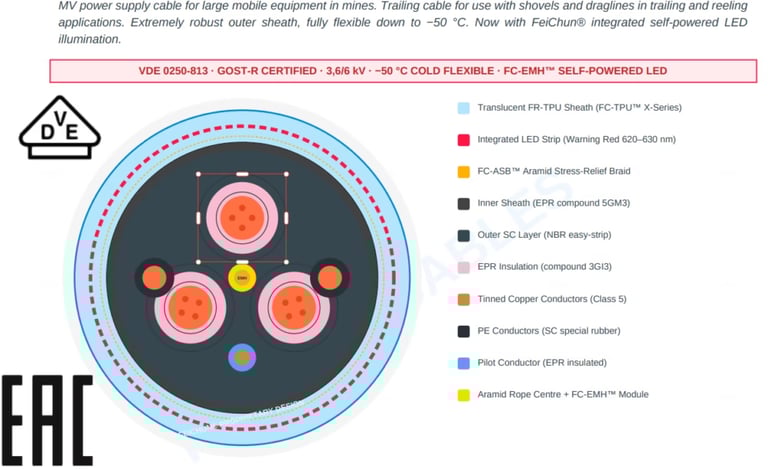
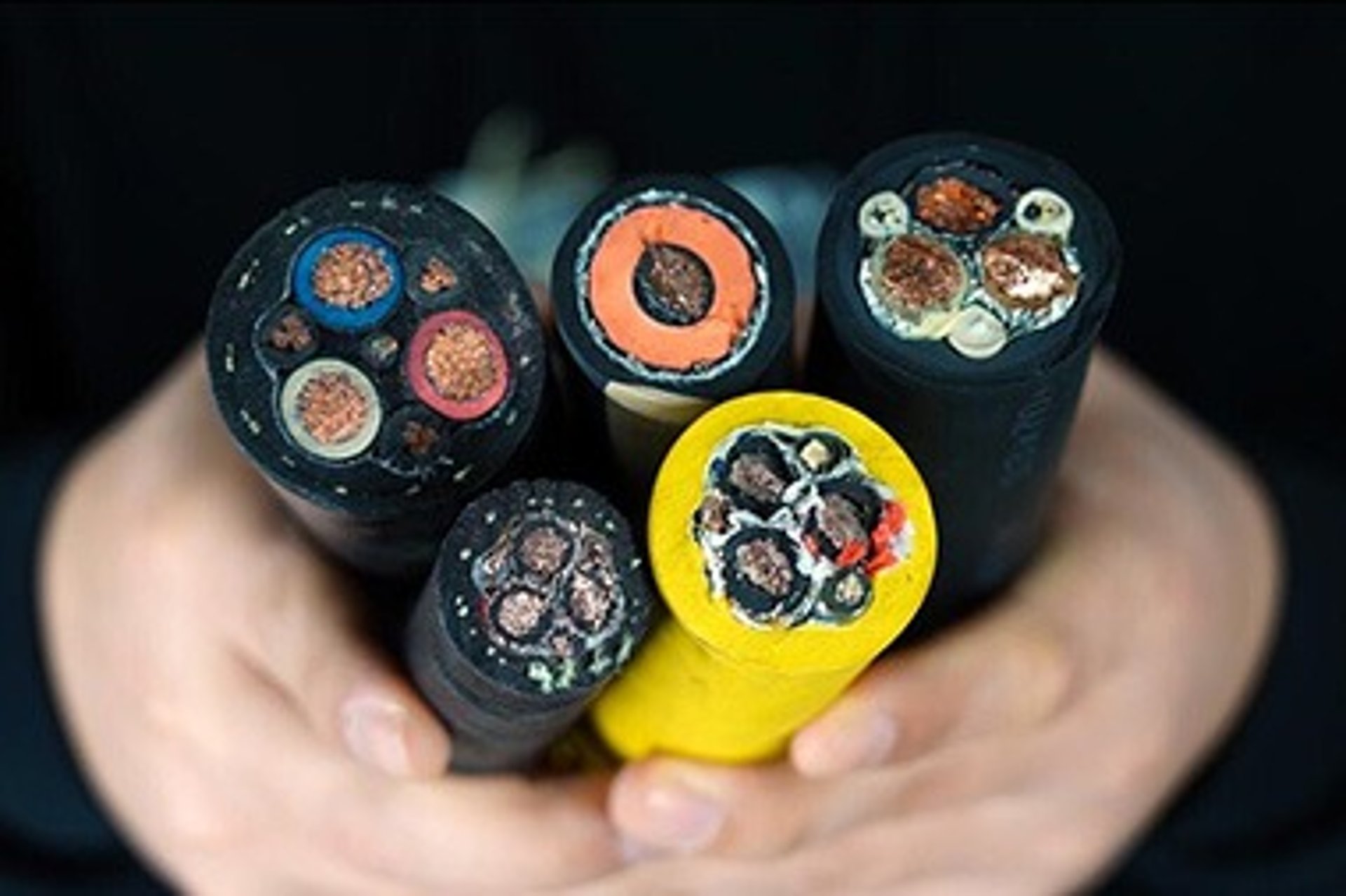
Conductors: Finely stranded tinned Class 5 copper – excellent flexibility and corrosion resistance in humid, dusty conditions.
Insulation: EPR (ethylene propylene rubber) 3GI3 compound for stable dielectric performance under repeated bending and voltage stress.
Semi-conductive layers: Inner EPR semi-conductive screen plus outer easy-strip NBR layer for reliable field control and straightforward on-site terminations.
Pilot/monitoring conductors: EPR-insulated tinned copper for control and earth-fault monitoring.
Central support: Conductive aramid rope core providing the mechanical backbone that resists tensile and torsional forces.
Inner sheath: EPR 5GM3 compound.
LED system: Protected by FC-ASB™ aramid stress-relief braid. The heart is Feichun’s proprietary FC-EMH™ (Electromagnetic Harvesting) module – an induction pickup coil wound around the central aramid support. This harvests energy directly from the electromagnetic field of the main 6 kV conductors.
Outer sheath: Translucent flame-retardant TPU (FC-TPU™ X-Series) that allows the red LED light to transmit while providing outstanding abrasion resistance and flexibility down to –50 °C.
The FC-EMH™ architecture is clever and mine-proven. It uses electromagnetic induction to generate the low-voltage DC needed for the LEDs without any galvanic connection to the main power conductors – full electrical isolation for safety. A four-layer FC-SPM™ surge protection system (magnetic saturation, TVS diodes, Zener/LDO regulation, resettable PTC) ensures reliability even under the voltage spikes common in mining networks. Cold-rated capacitors and regulators guarantee instant start-up even after a cold Highveld night.
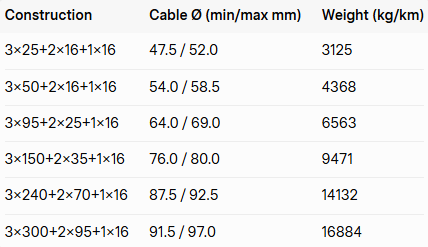
Dimensions (selected constructions – full table available from manufacturer)
Key Electrical & Mechanical Performance (at 30 °C surface, VDE 0298-4)
Operating temperature: fixed –50 °C to +80 °C; flexible –50 °C to +60 °C
Bending radius: 6×D fixed, 10×D flexible, 20×D S-type reeling
Torsion: ±100°/m
Max tensile force: up to 22 500 N (depending on size)
Conductor temperature: 90 °C continuous, 250 °C short-circuit (5 s)
Current ratings (example): 3×95 mm² ≈ 301 A; 3×150 mm² ≈ 404 A; 3×300 mm² ≈ 620 A
Full electrical parameters (capacitance 230–780 nF/km, inductance 0.24–0.36 mH/km, conductor resistance down to 0.0654 Ω/km at 20 °C) ensure compatibility with existing 6 kV mining networks and dragline/shovel drive systems.
Applications and Benefits in South African Mines
In Kriel Colliery-type operations, the cable slots straight into existing dragline and shovel fleets. Long trailing runs across the pit floor become visible safety lines. Night-shift crews can see the cable path from the shovel cab or dragline operator’s chair, reducing the risk of accidental contact. LOTO procedures become faster and safer because the glowing cable tells you instantly whether it’s live.
The plug-and-play nature means mines can upgrade one machine at a time without shutting down the whole pit for rewiring. Maintenance crews love it because the illuminated cable is easier to handle and inspect. Production managers see fewer unplanned stops. Safety officers tick more boxes on DMRE compliance audits.
Quantifiable gains include reduced run-over incidents, extended cable life through better awareness (less abuse), faster fault location, and improved overall equipment effectiveness. In dust-heavy Highveld conditions, the red LED glow has been shown to cut through visibility challenges that traditional marking methods simply cannot match.
FAQ
Q1: Will this cable work in our dusty Mpumalanga conditions?
Yes. The translucent TPU outer sheath and high-intensity red LEDs (620–630 nm) are designed to remain visible even when partially buried in coal dust or mud. The system is rated for the exact harsh environments found in Highveld opencast pits.
Q2: How does the self-powered LED system work without batteries?
The FC-EMH™ electromagnetic harvesting coil wraps around the central aramid support and draws tiny amounts of energy from the main conductors’ magnetic field. It is fully galvanically isolated and includes surge protection and cold-start electronics for instant operation.
Q3: Is it a direct replacement for existing 3.6/6 kV trailing cables?
Absolutely. Same voltage rating, same mechanical interfaces, same termination methods. Disconnect old cable, connect new one, energise – done.
Q4: What are the bending radius and pull-force specs for dragline use?
Minimum bending radii are 6×D (fixed), 10×D (flexible) and 20×D (S-type reeling). Maximum tensile force ranges from 1 875 N up to 22 500 N depending on conductor size – more than adequate for walking dragline duty.
Q5: Any local compliance notes?
Manufactured to DIN VDE 0250-813 with GOST-R certification. Meets international mining cable standards widely accepted in South Africa. Always confirm with your site electrical engineer and DMRE guidelines.
Q6: How much does visibility improve on night shift?
Dramatically. The continuous red glow makes the cable visible from distances and angles where a dark cable would be invisible, even in heavy dust or twilight conditions common in Mpumalanga.
Q7: Where can South African mines get technical data or trial units?
Contact Feichun Cables directly or their authorised southern African distributors. Full datasheets, sample lengths and on-site trials are available.
Conclusion
The (N)TSCGEWOEU-LED self-powered illuminated trailing cable is more than just another mining accessory – it’s a practical, engineered response to one of the most persistent safety and productivity challenges in South African opencast coal mining. By making the invisible visible, it supports the industry’s zero-harm goals, reduces costly downtime, and gives crews on the ground a fighting chance against the dust, the dark and the heavy machinery.
For mine managers at Kriel, Zibulo, or any Highveld colliery looking to lift safety performance while keeping production rolling, this cable deserves serious evaluation. In an industry where every shift counts, a glowing cable might just be the brightest idea to come along in years.
Email Address: Li.wang@feichuncables.com
© 2025. All rights reserved.
One-click to Quickly Contact
Products
Contact
Company
Location:
Building A Private Science and Technology Park, Hefei Economic and Technological Development Zone, Anhui Province, China
Heat Resistant Cable
WhatsApp: +86 17333223430
Social Media: