
OPTOFLEX (M) Rubber Sheathed Flexible Fiber Optic Cables
OPTOFLEX(M) Rubber Sheathed Flexible Fiber Optic Cables: Featuring E9/125 Monomode and G50/125, G62.5/125 Multimode Fibers, Designed for Open-cast Mining
OPTOFLEX (M) Rubber Sheathed Flexible Fiber Optic Cables
Application | ||||
Usage | Optical signal and data transmission in open-cast mining, material handling equipment, alongside conveyor belts (including shiftable) | |||
Global Data | ||||
Brand | OPTOFLEX(M) | |||
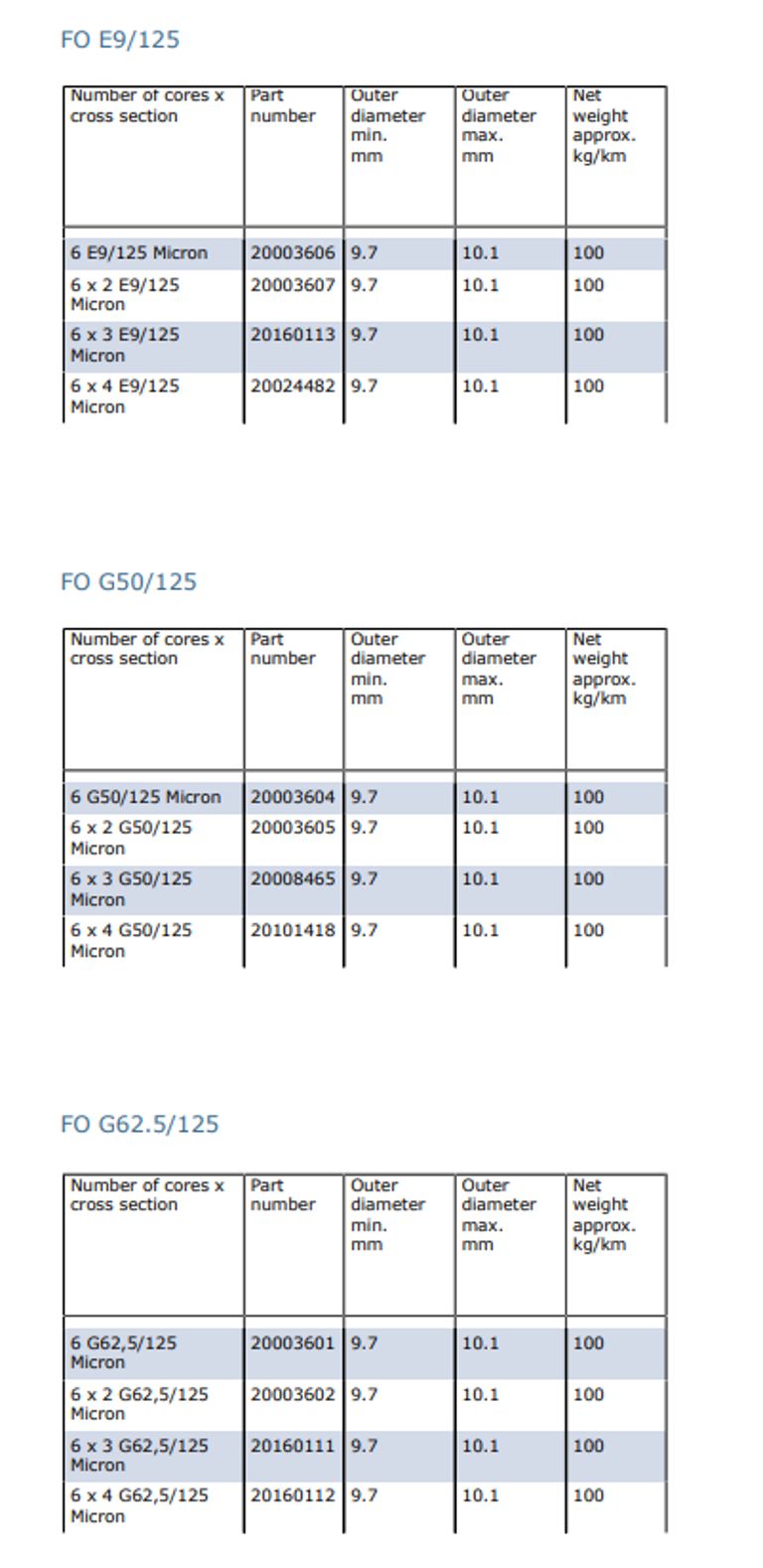
Type Designation | 6 x ... x ... /125 Micron, 6 x ... /125 Micron | |||
Standards | FDDI, DIN VDE 0888, ISO/IEC 9314-3 | |||
Certifications/Approvals | MSHA-SC 189-1 | |||
Design Features | ||||
Core Identification | Color coding of fibers and buffering tube | |||
Core Arrangement | Six buffering tubes, one layer, laid-up around GRP supporting element | |||
Braid | Special braid of Kevlar threads, tensile-strength reinforcement, ~80% surface coverage | |||
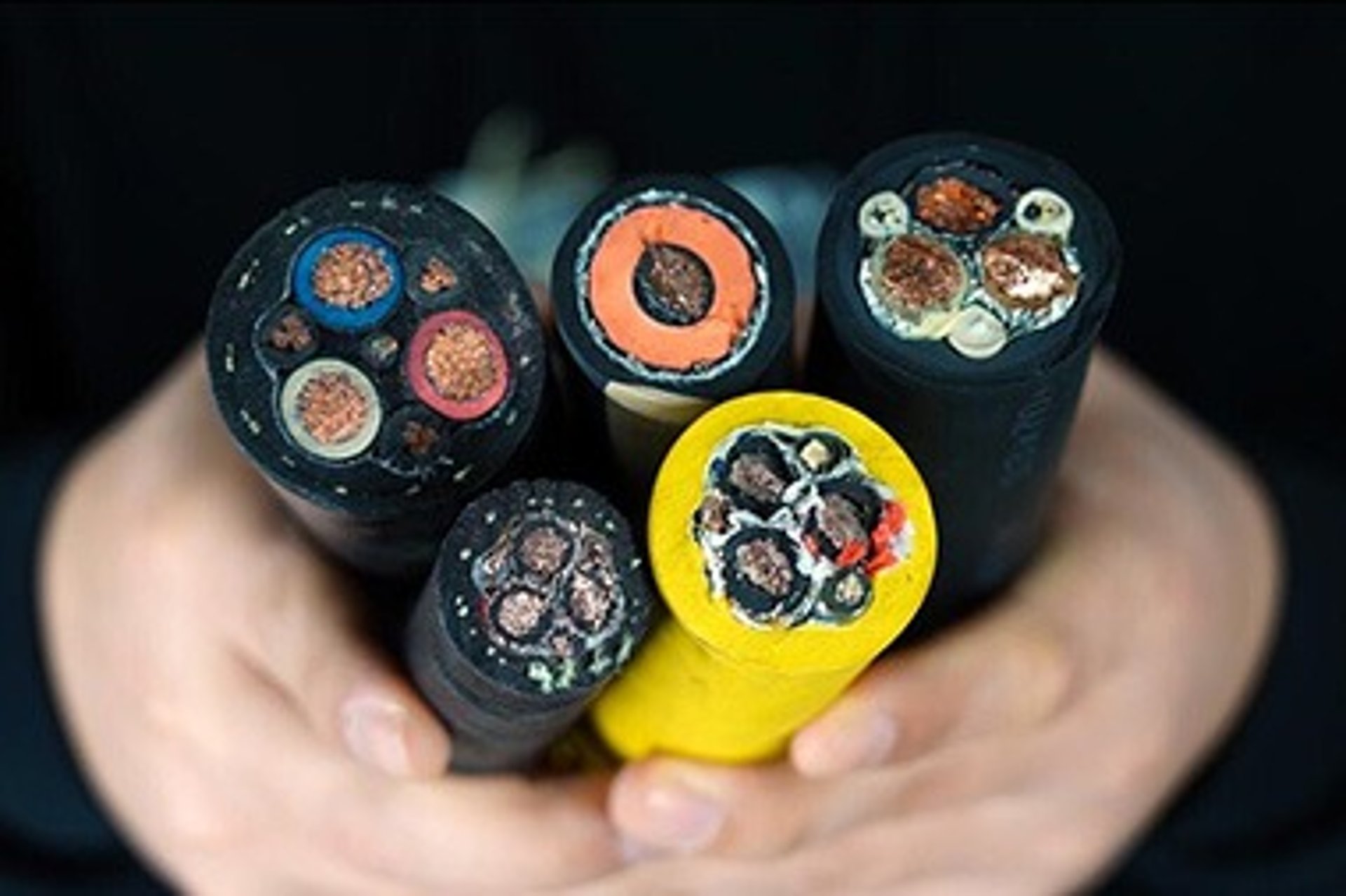
Outer Sheath | Synthetic elastomer (e.g., CR), Compound: 5GM5, Color: Orange | |||
Optical Fiber Transmission Data | ||||
Fiber Type | E9/125 | 50/125 | 62.5/125 | |
Attenuation at 850 nm | - | 2.8 dB/km | 3.3 dB/km | |
Attenuation at 1310 nm | 0.4 dB/km | 0.8 dB/km | 0.9 dB/km | |
Attenuation at 1550 nm | 0.3 dB/km | - | - | |
Numerical Aperture | 0.14 ± 0.02 | 0.200 ± 0.02 | 0.275 ± 0.02 | |
Dispersion at 1300 nm | <3.5 ps/nm·km | - | - | |
Dispersion at 1550 nm | <18 ps/nm·km | - | - | |
Bandwidth at 850 nm | - | ≥400 MHz | ≥400 MHz | |
Bandwidth at 1300 nm | - | >1200 MHz | >600 MHz | |
Fiber Core Diameter | 9 µm | 50 µm | 62.5 µm | |
Cladding Diameter | 125 µm | 125 µm | 125 µm | |
Coating Diameter | 250 µm | 250 µm | 250 µm | |
Fiber Covering | Hollow core with filling compound, ETFE, Compound: 7YI 1, Natural color | |||
Chemical Parameters | ||||
Oil Resistance | EN 60811-404, IEC 60811-404 | |||
Weather Resistance | Unrestricted indoor/outdoor use, resistant to ozone, UV, moisture | |||
Water Resistance | EN 50525-2-21 | |||
Mechanical Parameters | ||||
Max. Tensile Load | 2000 N | |||
Torsional Stress | 100 °/m | |||
Min. Bending Radii | 50 mm (fixed installation) | |||
Additional Tests | Tensile load, transverse pressure, reversed bending, roller bending, torsional stress |
In an era where data is the lifeblood of industries, reliable transmission systems are crucial, especially in demanding environments like mining operations. Enter the OPTOFLEX(M) rubber sheathed flexible fiber optic cables—a pinnacle of engineering designed to withstand the rigors of open-cast mining while ensuring seamless optical signal and data transmission. These cables, based on standards like FDDI, DIN VDE 0888, and ISO/IEC 9314-3, and certified by MSHA-SC 189-1, represent a fusion of durability and high-performance optics. With their synthetic elastomer outer sheath and Kevlar-reinforced braid, they offer unparalleled flexibility and strength, making them ideal for applications alongside conveyor belts and on material handling equipment
Usage Scenarios: Tailored for Tough Terrains
OPTOFLEX(M) cables shine in open-cast mining, where they facilitate optical signal transmission on material handling equipment and along conveyor belts, including shiftable ones. Their flexibility allows for dynamic routing in environments with constant movement, vibrations, and exposure to dust, debris, and heavy machinery. Beyond mining, these cables find applications in industrial automation, renewable energy sites, and offshore platforms, where reliable data links are essential for monitoring, control systems, and real-time analytics.
In conveyor systems, the cables can be laid parallel to belts, transmitting sensor data for predictive maintenance. On excavators or draglines, they connect control units to remote sensors, ensuring low-latency communication critical for safety and efficiency.
Advantages : Why Fiber Optics Reign Supreme
Compared to traditional copper cables, OPTOFLEX(M) offers significant edges. Fiber optics transmit data via light, eliminating electromagnetic interference (EMI) common in mining with heavy electrical equipment. This results in higher bandwidth and longer transmission distances without amplifiers—E9/125 can span kilometers with minimal attenuation, versus copper's limitations.
Durability is another key advantage: the rubber sheath and Kevlar braid provide superior mechanical protection against abrasion, crushing, and torsion, far outlasting copper's vulnerability to corrosion and breakage. Weather resistance to UV, ozone, and moisture means unrestricted indoor/outdoor use, reducing downtime in harsh climates.
Economically, while initial costs may be higher, lower maintenance and energy efficiency (no electrical conductivity means safer in explosive environments) yield long-term savings. In MSHA-certified settings, they enhance safety by reducing spark risks.
Installation and Maintenance Recommendations:
Proper installation is vital for OPTOFLEX(M) performance. Adhere to a minimum bending radius of 50 mm during fixed setups to prevent fiber stress; for dynamic applications, allow slack to accommodate movement. Use tensile loads below 2000 N during pulling, and avoid torsional twists exceeding 100°/m.
Laying alongside conveyor belts requires securing with clamps every 1-2 meters to prevent sagging or snagging. In material handling, route cables through protective conduits where possible.
Maintenance involves regular visual inspections for sheath damage, cleaning connectors with isopropyl alcohol, and testing attenuation with an optical time-domain reflectometer (OTDR). Store spare cables in cool, dry conditions to preserve the filling compound. Follow EN and IEC standards for oil and water exposure checks.
Frequently Asked Questions: Addressing Common Curiosities
What makes OPTOFLEX(M) suitable for mining? Its rubber sheath, Kevlar reinforcement, and low dispersion ensure reliability amid vibrations and elements.
How do attenuation rates compare across fibers? E9/125 offers the lowest (0.3-0.4 dB/km at longer wavelengths), ideal for distance; multimodes suit shorter, high-bandwidth needs.
Can these cables handle extreme weather? Yes, with full resistance to UV, ozone, moisture, and oil, per international standards.
What's the difference between monomode and multimode? Monomode (E9/125) for single light path, long distances; multimode (G50/125, G62.5/125) for multiple paths, shorter ranges with higher data rates.
How often should maintenance occur? Quarterly inspections, with OTDR tests annually or post-incident.
Are they compatible with existing systems? Yes, adhering to FDDI and ISO standards for seamless integration.
OPTOFLEX(M) rubber sheathed flexible fiber optic cables embody innovation, merging robustness with optical excellence to conquer industrial challenges. From their precise specifications to proven advantages and real-world triumphs like in South Africa's mines, they offer invaluable insights into sustainable, efficient data transmission. As industries evolve, these cables stand ready to illuminate the path forward, ensuring connectivity in the toughest terrains.