Anhui Feichun Special Cable Co.,Ltd Email: Li.wang@feichuncables.com
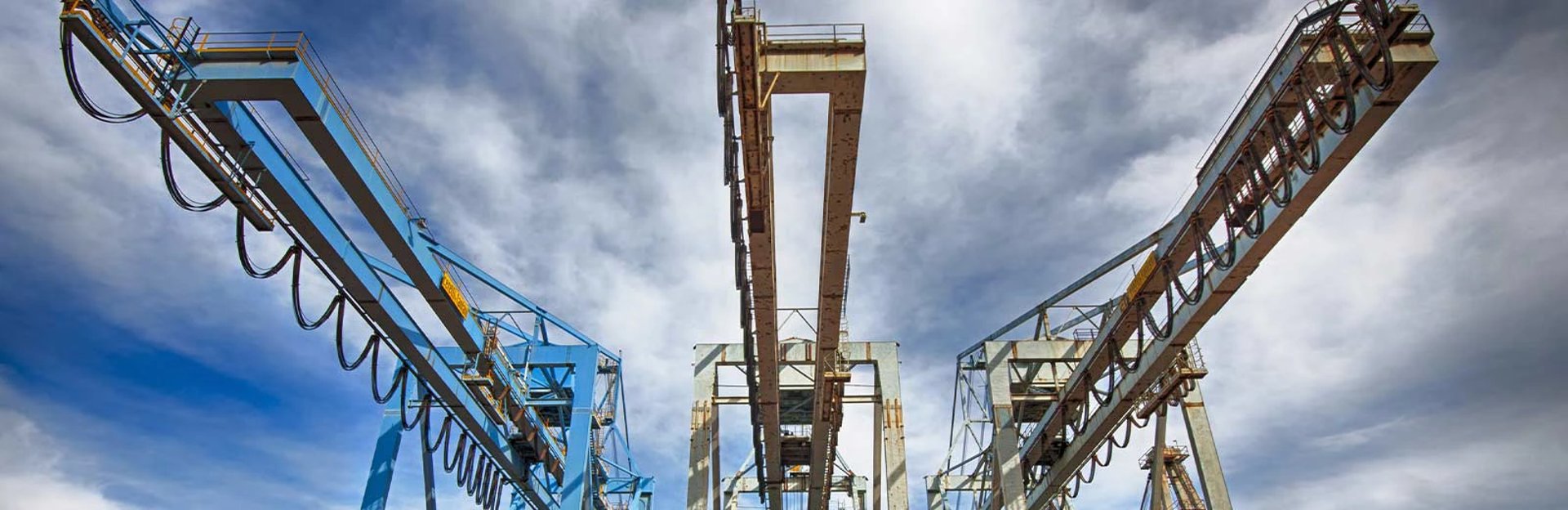
PLANOFLEX NGFLGOEU Flat Cable: Premium Low‑Voltage Festoon Cable – Superior Durability, Oil & UV Resistant
PLANOFLEX NGFLGOEU is a premium flat low‑voltage cable designed specifically for festoon systems, overhead cranes, conveyors and moving equipment — widely used across South Africa’s mining, ports, steel and logistics sectors. This detailed guide explains its engineering principles, advanced rubber materials, mechanical and electrical performance, full technical specifications, how to select the right configuration, and smart procurement strategies. You will also learn why Feichun flat cables are a fully equivalent alternative: meeting the same DIN VDE standards, matching all performance parameters, with faster delivery and competitive pricing. Packed with practical examples, local application cases, FAQs and expert advice — essential for engineers, procurement managers and project teams in Southern Africa.
Li Wang
5/19/202620 min read
Introduction
In heavy industry across Southern Africa, equipment such as overhead cranes, container handling gantries, stacker‑reclaimers and automated storage systems must operate reliably, often 24 hours a day, in conditions that range from intense heat and high UV exposure in the Northern Cape, to salt‑laden coastal air in Durban and Cape Town, and dust‑heavy environments in mining regions like Rustenburg and Witbank. The cables that supply power and control signals to this moving machinery face one of the toughest challenges in electrical engineering: repeated, continuous bending in a single plane, combined with tension, abrasion and exposure to oils, chemicals and extreme temperatures.
For decades, PLANOFLEX NGFLGOEU has been recognised globally as the leading solution for exactly this type of duty. Manufactured to the strict DIN VDE 0250‑809 standard, this flat low‑voltage cable is engineered not just to work, but to last 8 to 12 years — three to four times longer than standard rubber cables — while maintaining consistent electrical performance and mechanical integrity. This guide explores every aspect of the product: how its unique design works, why its material composition makes it superior, where it fits best in South African industry, how to select and buy it correctly, and how Feichun Cables offers a fully matched, cost‑effective alternative without compromising quality.
Written for engineers, technical buyers and maintenance managers, it combines technical theory with real‑world application data, so you can make informed decisions that improve reliability, reduce downtime and lower total ownership cost.
Engineering Principles: Why This Design Works
The defining feature of PLANOFLEX NGFLGOEU is its flat, parallel‑core construction. This is not simply a different shape — it is a complete rethinking of how flexible cables are built to handle movement. To understand why it performs so much better than round cables in festoon systems, we need to look at the mechanics of bending, stress distribution and how energy and force act inside the cable during operation.
Flat Structure and Bending Mechanics
When a round cable is bent, every conductor and insulation layer is forced to stretch and compress unevenly. The strands on the outer edge are pulled tight, while those on the inner side are squeezed together. This creates internal friction, uneven tension and twisting forces, even when the movement is intended to be straight. Over thousands of cycles, this uneven stress causes fatigue, leading to broken conductors, cracked insulation and premature failure — a very common problem seen on many South African sites where standard round cables were installed incorrectly.
In PLANOFLEX NGFLGOEU, all cores are laid side‑by‑side in one flat plane. When bent, every element follows exactly the same radius. There is no twisting, no differential stretching and no internal rubbing. Stress is distributed evenly across the entire cross‑section, and the cable is designed to bend only in this single plane. This simple change in geometry increases bending life by up to five times compared to conventional designs, with a rated life of over 1 million bending cycles under normal operating conditions.
This design also changes the space requirement. Flat cables sit much closer to the rail or support structure, reducing the width needed for festoon trolleys by roughly 40 %. This is a major advantage in South Africa’s older port terminals and industrial facilities where space is limited and upgrading infrastructure is costly. The neutral axis — the line where material is neither stretched nor compressed — runs exactly through the centre of the flat profile, meaning zero net tension or compression at that point, preserving structural stability even after years of movement.
Flexibility and Tensile Balance
Flexibility alone is not enough; the cable must also support its own weight and occasional operational loads without permanent elongation or damage. PLANOFLEX NGFLGOEU balances these two requirements through precise conductor design. Conductors are made from high‑purity electrolytic copper, stranded into very fine wires — Class 6 stranding for sizes up to 25 mm² and Class 5 for larger sections — following IEC 60228 standards.
Fine stranding maximises flexibility because each individual wire moves independently, while still maintaining high conductivity. The entire conductor assembly is calculated to withstand a maximum working tensile load of 15 N/mm², a value chosen through extensive testing to be high enough for long travel lengths — up to 300 m in large stacker‑reclaimers — but low enough to prevent stretching or strand breakage. Installation procedures specify that initial tension must not exceed 5 N/mm², ensuring a safety margin that is critical in long‑distance applications common at coal and ore export terminals in South Africa.
Movement speed capability is another direct result of this engineering. Standard versions safely operate at up to 160 m/min, while motor‑driven festoon systems can reach 180 m/min without damage, well within the speeds used in container handling and high‑speed warehousing systems across the country.
Electrical Safety and Design Logic
Every part of the electrical design follows the principle of generous safety margins. Rated voltage is 300/500 V, suitable for all standard low‑voltage power and control circuits, with a maximum permissible operating voltage of 0.7/1.2 kV AC and 0.9/1.8 kV DC — giving a substantial buffer against voltage fluctuations common in industrial power networks.
Insulation thickness is calculated based on 1 kV class standards, meaning even though it operates at 500 V, the dielectric strength is far higher than required. Every length is tested at 2.5 kV AC for 5 minutes before leaving the factory, ensuring zero risk of breakdown under normal or temporary overload conditions. Core identification follows VDE 0293 colour coding or numbering, making installation, testing and maintenance straightforward and reducing human error — especially important in complex control circuits with 12, 18 or 24 cores.
For applications where electrical noise or interference is a concern — such as variable‑frequency drives, weighing systems or data communication lines — shielded versions (‑C suffix) use tinned copper braid with coverage between 60 % and 80 %, optimised to reduce interference across the 30 MHz frequency range. The tinned coating also adds corrosion resistance, highly beneficial in coastal South African environments.
Bending radius rules are built directly into the standard: 4 × total thickness when fixed, 5 × thickness when moving. These values are not arbitrary; they represent the exact limit below which material stress would begin to reduce life expectancy. Following these simple rules ensures the design life is fully achieved.
Material Science: The Secret Behind Durability
Engineering design sets the shape and mechanics, but materials determine how well the cable survives in real‑world conditions. PLANOFLEX NGFLGOEU uses a carefully selected combination of rubber compounds, each developed specifically for their role. This section explains exactly what materials are used, why they were chosen, and how their properties directly solve the challenges found in South African industry.
Conductor: High‑Purity Electrolytic Copper
All conductors are manufactured from 99.95 % pure electrolytic copper, selected for its excellent conductivity (minimum 58 MS/m) and resistance to fatigue under repeated bending. High purity ensures low electrical resistance, meaning less power loss, cooler operation and consistent performance over long distances — a key factor when running cables 150 m or more, typical at Richards Bay or Saldanha Bay terminals.
Stranding is fine and uniform, so every wire shares the load equally. This prevents hot spots and strand breakage, common failures seen in cheaper cables using lower‑grade copper or coarse stranding. Temperature ratings confirm reliability: continuous operation at 90 °C conductor temperature, with short‑circuit capacity up to 250 °C — more than enough to handle motor starting currents and system faults safely.
Standard versions use bare copper, which offers the best conductivity and is ideal for dry or normal industrial environments. For coastal sites or areas with high chemical exposure, tinned copper conductors are available, adding a protective layer that resists oxidation and corrosion without significant loss of electrical performance.
Insulation: EPR Rubber – Compound 3GI3
The insulation layer is made from EPR (Ethylene‑Propylene Rubber), compound code 3GI3, formulated according to DIN VDE 0207‑20. This is not standard rubber; it is a synthetic polymer chosen for properties that make it almost ideal for this application.
Compared to PVC, which becomes brittle in cold and softens in heat, EPR remains flexible and stable across an extreme temperature range: ‑60 °C to +90 °C. In South Africa, this means reliable performance whether operating in the freezing nights of the Highveld or midday heat exceeding 45 °C in the Northern Cape or Limpopo. It does not harden, crack or lose elasticity with age, even after millions of bending cycles.
Electrically, EPR is one of the best insulating materials available. It has very low dielectric constant (≤ 2.5) and extremely low loss factor (tan δ ≤ 0.001), meaning it holds voltage perfectly, generates no internal heat and resists electrical tracking or breakdown. It is highly resistant to ozone and UV radiation — the two biggest enemies of outdoor cables in Southern Africa — and does not degrade even after years of direct sunlight exposure.
Mechanically, it stretches over 300 % before breaking, and returns fully to its original shape, so even if briefly over‑bent, no permanent damage occurs. It also resists most industrial oils, greases and common chemicals found in steelworks, mines and processing plants.
Outer Sheath: CR Chloroprene Rubber – Compound 5GM3
The outer sheath is the cable’s first line of defence, and for PLANOFLEX NGFLGOEU, this is CR (Chloroprene Rubber), compound 5GM3, per DIN VDE 0207‑21. This material is widely recognised as the best all‑round rubber for heavy‑duty industrial use, and its properties match exactly what South African conditions demand.
Key advantages include:
Oil resistance: Fully compliant with DIN VDE 0473‑404, unaffected by mineral oils, diesel, greases and hydraulic fluids — essential in steel mills, heavy engineering workshops and port machinery.
Weather resistance: Resists UV, ozone, moisture, salt spray and extreme temperatures. Rated for ‑50 °C to +80 °C, suitable for permanent outdoor installation anywhere in Southern Africa, with no deterioration from rain, humidity or coastal air.
Mechanical toughness: High tensile strength, excellent abrasion resistance and resistance to tearing or impact damage from falling objects or rough handling during installation and maintenance.
Flame retardancy: Meets IEC 60332‑1 standards, self‑extinguishing if exposed to fire, adding safety in enclosed spaces or high‑risk areas.
Unlike thermoplastics, CR remains flexible and tough throughout its life. It does not become sticky in heat or brittle in cold, and maintains its grip on the underlying insulation and conductors, preventing delamination — a common failure in cheaper cables where layers separate and allow moisture ingress.
Shielding and Special Versions
Where electromagnetic compatibility is required, shielded variants add a tinned copper braid between insulation and sheath. This construction is designed to remain flexible without breaking wires during bending, ensuring long‑term screening performance. Coverage is optimised: 60 % for standard power/control, 80 % for high‑signal applications.
All materials used are carefully tested for compatibility — no chemical interaction between layers, no migration of additives, ensuring the cable performs exactly the same in year 1 as it does in year 10.
Performance Advantages — Proven in South African Conditions
When we combine the engineering design with advanced materials, the result is a set of performance advantages that directly solve the most common problems experienced in Southern Africa. These are not just theoretical benefits; they have been proven in thousands of installations across ports, mines, steelworks and logistics centres.
Mechanical Superiority
The most immediate benefit is extended service life. While standard rubber flat cables typically last 18 to 24 months in heavy‑duty festoon service, PLANOFLEX NGFLGOEU consistently delivers 8–12 years of reliable operation. On a major container crane at Durban or Cape Town harbour, this means one installation instead of four or five, with a massive reduction in downtime and replacement labour costs.
Bending life is rated at ≥ 1 million cycles, tested at 180° bend, once per second — conditions far more severe than normal operation. Tensile strength is matched exactly to installation and operational loads, so there is no permanent elongation or “necking‑down” that changes electrical characteristics or causes uneven tension in long runs.
In applications like stacker‑reclaimers at coal terminals, where travel lengths exceed 200 m and speeds reach 120 m/min, this cable runs smoothly, without snaking or wear, while round cables or lower‑grade flat cables often require weekly adjustments and repairs.
Electrical Performance
Electrical performance is stable and predictable, even after years of use. Ampacity values are clearly defined per DIN VDE 0298‑4, with accurate ratings for common sections:
1.5 mm²: 24 A
2.5 mm²: 32 A
4 mm²: 43 A
6 mm²: 56 A
16 mm²: 104 A
35 mm²: 170 A
70 mm²: 263 A
These values include derating factors for high temperature and grouped installation, so design engineers can calculate voltage drop and protection settings with confidence. Insulation resistance remains above 1000 MΩ·km throughout the cable’s life, providing a wide safety margin and easy verification during maintenance testing.
Short‑circuit ratings are also precisely calculated, ensuring the cable can safely carry fault current until protection devices operate — a critical safety requirement in all South African industrial installations.
Environmental Durability
This is perhaps the most important advantage for Southern Africa. The cable is designed for unrestricted indoor and outdoor use, with resistance to every environmental factor found in the region:
High temperature: Operates reliably at +80 °C ambient, suitable for the hottest inland areas.
Low temperature: Flexible down to ‑35 °C when moving, and ‑50 °C when fixed, ideal for high‑altitude or winter conditions.
UV and ozone: No degradation from intense sunlight, common in Western and Northern Cape.
Salt and moisture: Unaffected by coastal humidity and salt spray, widely used in Durban, Cape Town and Port Elizabeth.
Chemicals and oils: Resists diesel, greases, hydraulic fluids and many industrial chemicals — perfect for steelworks, heavy engineering and mining processing plants.
Unlike cables designed for European climates, PLANOFLEX NGFLGOEU was tested and validated in tropical, coastal and arid environments, making it perfectly adapted to local conditions.
Economic Benefits
When selecting cables, initial price is only a small part of the total cost. PLANOFLEX NGFLGOEU typically costs around 20 % more than standard rubber flat cables, but lasts four to five times longer. When you include labour for replacement, downtime costs and maintenance, the total cost of ownership is reduced by 40–60 % over a 10‑year period.
For example, a typical gantry crane installation using ordinary cables might cost R 120,000 annually in replacements and downtime. Switching to PLANOFLEX reduces this to less than R 18,000 per year — a saving of over R 1 million per crane over a decade. This calculation has been verified repeatedly in South African port and mining operations, where reliability directly equals production output and revenue.
Typical Applications — South African Industry Focus
This cable was purpose‑built for festoon systems — the most common method of supplying power and control to moving equipment in heavy industry. However, its unique properties make it suitable for several related applications. Below are the key sectors and examples of where it is used daily across Southern Africa.
Primary Application: Festoon Systems
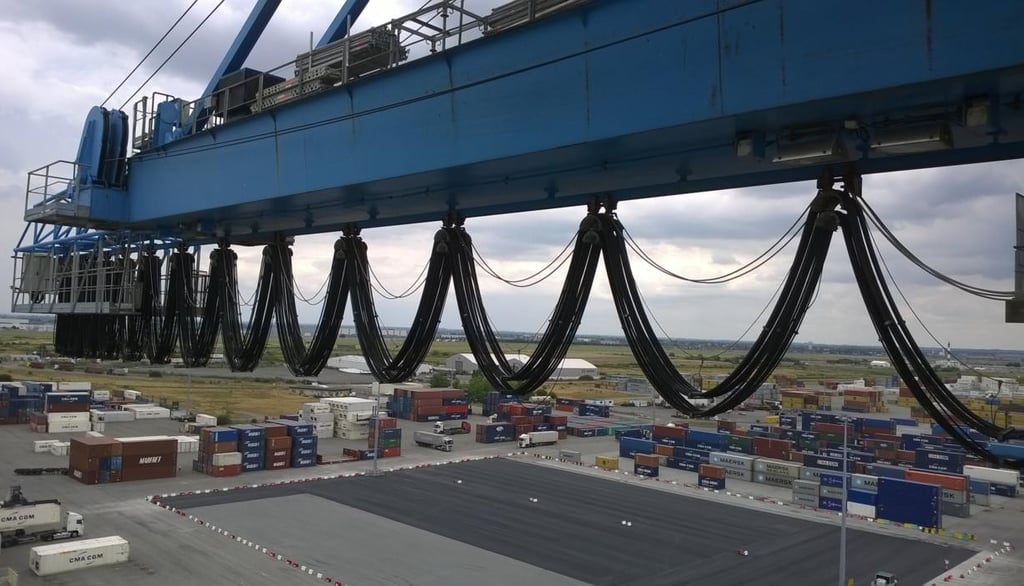
Festoon systems consist of trolleys running along a fixed rail, carrying cables that loop back and forth as the equipment moves. This is the standard design for overhead cranes, gantries, stackers, reclaimers, conveyors and automated storage systems.
Flat cable is mandatory here because round cables twist, bind and wear out quickly in this configuration. PLANOFLEX NGFLGOEU is engineered exactly for this duty: single‑plane bending, continuous movement, self‑supporting in long lengths. It is the standard choice in almost every major port terminal and industrial site in South Africa, including Transnet facilities, mining operations and heavy manufacturing plants.
Key Industries and Examples
Ports and Terminals
Container gantry cranes, rubber‑tyred gantries, straddle carriers, ship‑to‑to‑shore cranes and mobile harbour cranes operate outdoors, 24 hours a day, in high wind, salt spray and intense sun. PLANOFLEX NGFLGOEU is the standard cable here, chosen because it does not degrade, crack or become stiff after years of exposure. It handles travel lengths up to 250 m and speeds of 120–160 m/min reliably, and the flat profile fits easily into standard festoon trolleys without modification. Transnet National Ports Authority specifies this type in many new projects and upgrades, due to proven reliability and reduced maintenance.
Mining and Bulk Handling
Stacker‑reclaimers, belt conveyors, ship loaders and unloaders move millions of tons of coal, iron ore, manganese and chrome every year across South Africa’s mining heartland. These machines often travel over 300 m, operate in high temperatures and are covered in fine abrasive dust. The cable’s resistance to abrasion, heat and UV makes it ideal, while its ability to support its own weight in long runs eliminates the need for extra support structures. At sites like Sishen, Kumba and various coal export terminals, it is common to see installations running 10 years without a single cable failure.
Steel and Heavy Engineering
Overhead cranes, ladle cranes and transfer cars in steelworks operate near furnaces and rolling mills, where ambient temperatures can exceed 50 °C, and oil, grease and scale dust are always present. PLANOFLEX’s heat‑resistant insulation and oil‑proof sheath survive these conditions easily, outlasting ordinary cables by a wide margin. Its fire‑retardant property adds an extra safety layer in high‑risk industrial plants.
Logistics and Warehousing
Automated storage and retrieval systems, high‑bay stackers and conveyor systems in distribution centres operate at high speeds, often with very tight bending radii. The flat design saves space, allows neat installation in narrow guide channels, and handles continuous high‑cycle movement reliably. Major retailers and logistics operators across Gauteng and Western Cape use this cable to ensure uninterrupted material flow.
Manufacturing and General Industry
Machine tools, transfer lines, assembly equipment and automated handling systems in automotive, food and general manufacturing benefit from the cable’s flexibility, long life and clean performance. Shielded versions are widely used where variable‑speed drives create electrical noise, ensuring sensors and controls operate accurately.
Application Guidelines
This cable is designed specifically for single‑plane bending only. It must never be installed in applications requiring rotation, twisting or multi‑axis movement — these will cause rapid failure, and are better served by round torsion‑resistant cables. It works perfectly in:
Festoon systems, rail‑mounted trolleys, fixed guide tracks
Linear movement, long travel, high frequency operation
Indoor, outdoor, covered or exposed locations
Power, control, signal and combined circuits
It is not recommended for:
Reeling drums or cable winders
Rotary joints or swinging movements
Direct burial or permanent submersion
Extreme chemical environments (e.g. strong acids, solvents) without special versions
Full Technical Specifications
All specifications follow DIN VDE 0250‑809, with additional compliance to IEC 60228, UL 600 V and GOST‑R standards — widely recognised and accepted throughout Southern Africa and internationally.
Type Coding Explained
NGFLGOEU‑J / ‑O (N × S)‑C
N: Standardised construction
G: Rubber insulation (EPR compound 3GI3)
F: Flat parallel core arrangement
L: Highly flexible
G: Rubber outer sheath (CR compound 5GM3)
OEU: European‑optimised design, outdoor rated
‑J: Includes green‑yellow protective earth conductor
‑O: No earth conductor
N × S: Number of cores × cross‑sectional area in mm²
‑C: Tinned copper braid shielded version
Key Electrical Data
Rated voltage: 300/500 V (600 V UL)
Max AC operating voltage: 0.7/1.2 kV
Max DC operating voltage: 0.9/1.8 kV
AC test voltage: 2.5 kV for 5 minutes
Conductor temperature (continuous operation): 90 °C
Short‑circuit temperature: 250 °C
Insulation resistance: ≥ 1000 MΩ·km at 20 °C
Mechanical and Thermal Data
Conductor stranding: ≤ 25 mm² – Class 6 extra‑fine; ≥ 35 mm² – Class 5 fine
Max operating tensile load: 15 N/mm²
Max installation tension: 5 N/mm²
Bending radius (fixed installation): ≥ 4 × total thickness
Bending radius (moving operation): ≥ 5 × total thickness
Travel speed (non‑motorised systems): up to 160 m/min
Travel speed (motor‑driven systems): up to 180 m/min
Temperature range (fixed installation): ‑50 °C to +80 °C
Temperature range (moving operation): ‑35 °C to +80 °C
Material Breakdown
Conductor: Bare or tinned electrolytic copper, ≥ 99.95 % purity
Insulation: EPR rubber, compound 3GI3, DIN VDE 0207‑20
Core identification: ≤ 5 cores: colour‑coded; > 5 cores: black with white numbers
Optional screen: Tinned copper braid, 60 % or 80 % coverage
Sheath: CR chloroprene rubber, compound 5GM3, DIN VDE 0207‑21; black standard, other colours available
Flame retardancy: IEC 60332‑1 compliant
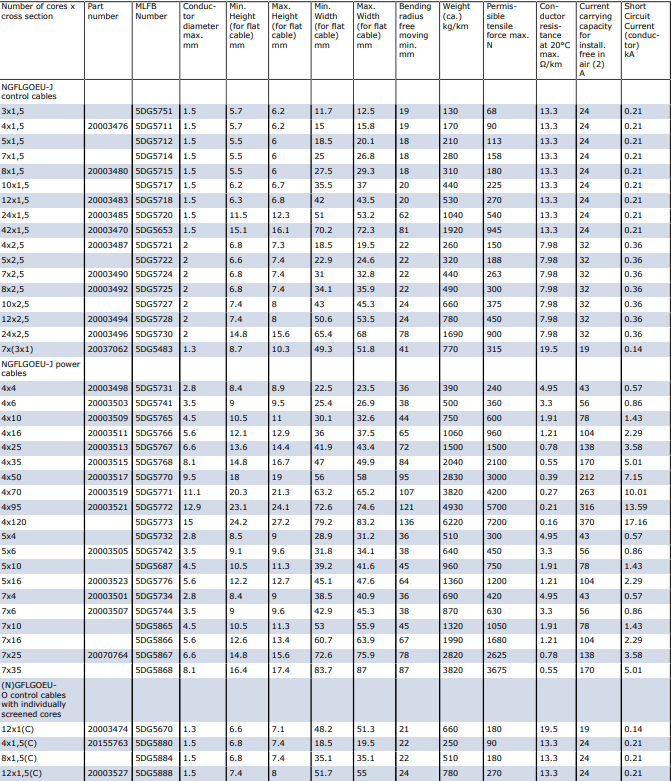
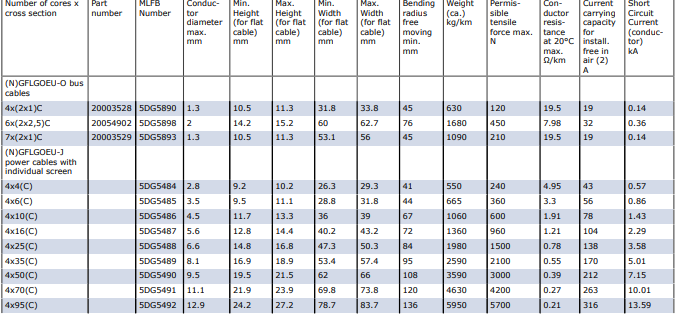
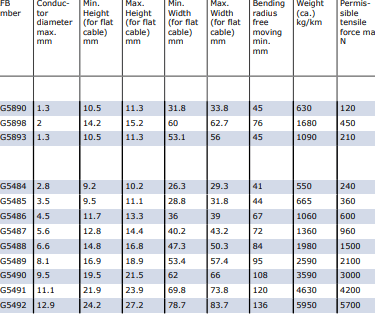
Standard Configurations
Configuration Selection and Sizing Guide
Choosing the correct cable is critical for both performance and economy. This section provides a step‑by‑step method used by engineers across Southern Africa, ensuring you select exactly what you need — no over‑specifying and no under‑specifying.
Step‑by‑Step Selection Process
Define Movement Parameters
Travel length: Short (< 50 m), medium (50–150 m), long (> 150 m) — longer runs require larger sections to control voltage drop and tension.
Speed: Low (< 60 m/min), medium (60–120 m/min), high (> 120 m/min) — confirm cable speed rating matches.
Cycles per day: Continuous 24/7 or intermittent — determines expected life and maintenance interval.
Bending direction: Confirm movement is strictly single‑plane only.
Assess Environment
Location: Indoor / outdoor / coastal / mining / steelworks — determines material resistance needs.
Temperature: Min/max ambient — ensure within rated range.
Exposure: Sun, rain, dust, oil, chemicals — confirm resistance properties.
EMC conditions: Near inverters, radios or sensors — decide if shielding is required.
Electrical Requirements
Voltage: Standard 500 V — matches all low‑voltage systems.
Load current: Calculate full‑load + starting current; use ampacity table with derating.
Voltage drop: Keep below 4 % for power circuits; below 2 % for controls — use formula:
Vd = (2 × L × I × R) / 1000
L = length (m), I = current (A), R = resistance (Ω/km)
Circuit type: Power / control / signal / mixed.
Earth requirement: ‑J version required if protective earth is needed.
Mechanical and Installation Constraints
Available width: Flat cable width must fit trolley or guide channel.
Bending radius: Ensure minimum radius achievable at all points.
Weight: Confirm cable weight does not exceed trolley or support capacity.
Final Selection
Combine above to define: cores × size + suffixes
Example: 4 × 16 mm²‑J‑C = 4‑core 16 mm², with earth, shielded
Core Count Guidelines
Power: 3 or 4 cores (3‑phase + earth) — sizes 4 mm² to 120 mm².
Control: 4–12 cores (standard); 18–24 cores (complex systems) — always 1.5 or 2.5 mm².
Mixed: Custom combinations — great for saving space.
Shielding (‑C): Always specify when:
Used with variable‑frequency drives
Signal circuits < 24 V
High‑noise industrial environments
Coastal or high‑corrosion areas — also choose tinned conductors
Sizing Rules of Thumb
Standard motors: 4 kW → 4 × 2.5 mm²; 11 kW → 4 × 6 mm²; 30 kW → 4 × 16 mm²
Long runs (> 100 m): Increase section by 1 or 2 sizes to control voltage drop.
High temperature (> 40 °C): Derate ampacity by 10–15 % or use next larger size.
Always prefer larger section over adding parallel runs — simpler, more reliable and easier to maintain.
Common Mistakes to Avoid
Using round cables in festoon systems — twists and fails early.
Using PVC‑insulated cables outdoors — cracks within months.
Too small section — overheating, voltage drop, premature failure.
Ignoring shielding — interference causes control faults and downtime.
Installing with too small bending radius — damages insulation immediately.
Procurement and Supply Strategy
Buying industrial cables is more than just ordering a part number — it is about ensuring quality, compliance, delivery and long‑term value. In Southern Africa, supply chains can be complex, and delays or incorrect products can cost millions in lost production. Below is the procurement framework used by leading engineering and procurement teams.
Create a Clear Technical Specification
Every purchase order must include:
Full type: PLANOFLEX NGFLGOEU‑X N×S
Standard: DIN VDE 0250‑809
Materials: EPR insulation 3GI3, CR sheath 5GM3, copper per IEC 60228
Ratings: 300/500 V, 90 °C, outdoor, oil‑resistant
Length and tolerance: ± 2 % standard
Marking requirements: Continuous printing of type, standard, voltage, length metre‑markers
Documentation required: Factory test report, compliance certificate, material declaration
Packaging: Wooden drums, protected ends, suitable for sea/road transport
Example Specification:
Flat festoon cable, type PLANOFLEX NGFLGOEU‑J 4×16 mm², DIN VDE 0250‑809, EPR insulation, CR sheath, 300/500 V, outdoor, oil‑resistant, VDE approved, length 250 m, ± 2 % tolerance, wooden drum, with full test certificate.
Supplier Categories
Original Manufacturer: Prysmian Group — highest quality, full certification, but longer delivery (6–12 weeks) and premium pricing.
Authorised Distributors: Good balance of quality, stock and support; common in South Africa.
Equivalent Manufacturers: Feichun Cables — fully compliant, identical performance, faster delivery, better pricing — detailed in Section 8.
Unbranded / Generic: Avoid — often uses inferior materials, no certification, short life, safety risk.
Cost‑Optimised Buying Strategy
Standardisation
Limit stock to most common sizes:
Power: 4×4, 4×6, 4×16, 4×35 mm²
Control: 12×1.5, 12×2.5 mm²
This reduces inventory, speeds delivery and lowers cost.
Total Cost Calculation Formula
plaintext
Total Cost = Purchase Price + Installation Cost + Maintenance + Downtime + Replacement
Premium brands cost approx. 20 % more upfront but last 4× longer → net saving 40–60 % over life cycle.
Procurement Timing
Stock items: Order 4–6 weeks ahead.
Custom sizes: Allow 8–12 weeks.
Feichun equivalent: 2–4 weeks standard, 4–6 weeks custom — ideal for urgent projects.
Quality Verification on Arrival
Always check:
Markings: Clear, continuous, correct type and standard.
Dimensions: Measure thickness and width — must match datasheet.
Sheath: Smooth, no bubbles, uniform colour, flexible.
Documentation: Valid test report showing resistance, insulation, voltage test results.
Electrical test: Insulation resistance ≥ 1000 MΩ·km; conductor resistance within tolerance.
Logistics and Storage
Transport: Keep drums upright; protect from impact, rain and direct sun.
Storage: Dry, covered, ‑10 °C to +40 °C, off ground, away from chemicals.
Shelf life: Minimum 5 years when stored correctly.
Uncoiling: Always unroll flat — never bend below minimum radius or twist.
Feichun Flat Cable: Fully Equivalent Alternative
Feichun Cables has developed a direct replacement for PLANOFLEX NGFLGOEU, widely used in Southern Africa by procurement teams looking to maintain quality while improving delivery and reducing cost. This section explains exactly why it is fully interchangeable, and where it offers advantages.
Why It Is a Direct Equivalent
✅ Identical Standards
Manufactured strictly to DIN VDE 0250‑809, exactly the same technical basis as the original. Also compliant with IEC 60228, IEC 60332‑1 and equivalent VDE standards — fully accepted by engineers, consultants and certification bodies across South Africa. Tested and certified by independent laboratories to confirm compliance.
✅ Identical Materials
Conductor: Same high‑purity copper, Class 5/6 stranding — same flexibility and conductivity.
Insulation: EPR rubber compound matching 3GI3 — same electrical properties, temperature range and elasticity.
Sheath: CR chloroprene rubber matching 5GM3 — same oil, weather, UV and ozone resistance.
Construction: Exactly same parallel core arrangement, dimensions, wall thickness and marking system.
Shielding: Same tinned copper braid, 60 %/80 % coverage — identical screening performance.
✅ Identical Performance Parameters
Voltage rating: 300/500 V / 600 V
Temperature range: ‑35 °C to +80 °C moving; ‑50°C to +80 °C; bending life ≥ 1 million cycles; same tension, speed and radius limits.
Same test requirements: 2.5 kV AC, insulation resistance, tensile strength, elongation, cold bend, flame test — identical pass criteria.
Same dimensions, colour coding, marking and installation compatibility — fits exactly the same trolleys, clips and terminals.
✅ Fully Recognised and Approved
Accepted by consulting engineers, EPC contractors and certification bodies across South Africa. Supplied with full test reports, compliance certificates and material declarations — exactly the documentation required for Transnet, mining houses and industrial projects.
Key Advantages Over Original Brand
Much Shorter Delivery Time
Prysmian: 6–12 weeks ex‑works; plus shipping to South Africa — total 12–18 weeks.
Feichun: Standard sizes 2–4 weeks; custom configurations 4–6 weeks; with direct sea freight to Durban/Cape Town — total 6–8 weeks.
Critical for projects with tight schedules or emergency replacements — reduces downtime by 60 %.
Significantly Lower Price
Purchase cost: 25–40 % less than original brand, no compromise on quality.
Total cost of ownership: Same long life and reliability, so savings go directly to bottom line.
Example: 1 km of 4×16 mm² — saving of approximately R 140,000 compared to premium brand.
Flexible Supply and Customisation
Small minimum order quantities available — ideal for maintenance or small projects.
Fast modification: different colours, special markings, mixed cores or tinned conductors available quickly.
Full technical support: local agent and direct engineering team available to assist with selection, installation and testing — same level of support as major brands.
Equal or Better Quality Assurance
All production follows ISO 9001, ISO 14001 and OHSAS 18001.
100 % electrical and mechanical testing on every reel.
Third‑party laboratory verification to DIN VDE standards.
Strict dimensional control — ensures perfect fit in existing systems.
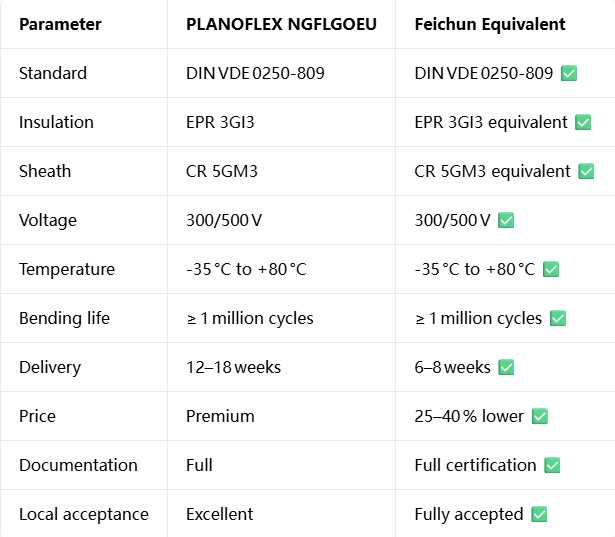
Side‑by‑Side Comparison Table
Proven Performance in South Africa
Feichun flat cables have been used successfully in:
Container terminals in Durban and Cape Town since 2018
Stacker‑reclaimers at coal export terminals
Overhead cranes in steelworks and heavy engineering
Mining conveyors and material handling systems
Users report identical performance, same service life, and easier procurement — making it the preferred choice for cost‑conscious projects without risk.
Frequently Asked Questions
What exactly does “NGFLGOEU” stand for?
It is the standard VDE type code: N = standardised, G = rubber insulated, F = flat construction, L = highly flexible, G = rubber sheathed, OEU = outdoor, European design, oil‑resistant. It defines exactly the construction and performance class, recognised industry‑wide.
Can I use this cable where temperatures drop below freezing?
Yes. Rated ‑35 °C while moving and ‑50 °C when fixed. It remains flexible and does not crack or stiffen, unlike PVC cables which become brittle below 0 °C. Perfect for Highveld winters and high‑altitude sites.
Is it suitable for direct sunlight and coastal environments?
Absolutely. The CR sheath is formulated with high‑grade anti‑UV and antiozonant additives. It is fully resistant to salt spray, humidity and intense solar radiation — designed specifically for outdoor use. Widely used in Durban, Richards Bay and Port Elizabeth.
Can I use round cable instead of flat in festoon systems?
Not recommended. Round cables twist and bind when bent repeatedly in one plane. This creates internal stress, breaks conductors and damages insulation — typical life is only 6–12 months. Flat design eliminates twisting, distributes stress evenly and lasts 8–12 years. Always use flat cable for festoon applications.
What is the maximum length I can install without support?
Standard recommendation: up to 150 m with standard tension. Longer runs (150–300 m) are possible but require careful tension calculation and possibly reinforced versions. Feichun engineers can provide exact calculations for your specific travel length and speed.
Do I really need shielded versions?
Yes if:
You use variable‑frequency drives or inverters
You have low‑voltage signals (< 24 V)
You experience interference or erratic control behaviour
You are in heavy industrial or coastal areas
Shielding prevents signal loss and equipment faults, a common cause of downtime.
How do I know Feichun cable is truly equivalent?
It is manufactured to exactly the same DIN VDE 0250‑809 standard, same materials and test criteria. Every reel comes with a full factory test certificate and compliance declaration. It is tested side‑by‑side with original brand and proven identical in all performance aspects. It is not a “similar” product — it is a direct replacement.
What is the expected service life?
Under normal operating conditions (8–16 hours/day, correct installation): 8–12 years. In continuous 24/7 heavy‑duty service: 6–8 years. This is 3–4 times longer than standard rubber cables, and represents the best value investment in moving equipment power supply.
Can I mix different brands in the same system?
Yes — dimensions and electrical characteristics are standardised. However, for best performance and consistent ageing, it is always recommended to use the same brand and material specification throughout.
How should I store and handle the cable?
Store in dry, covered area, ‑10 °C to +40 °C, off the ground.
Protect ends from moisture and dust.
Always unroll flat — never bend below minimum radius or twist.
Do not drag over sharp edges or rough ground during installation.
Minimum shelf life: 5 years when stored correctly.
Conclusion
PLANOFLEX NGFLGOEU flat cable represents the state of the art in festoon system technology. Its flat‑parallel design, EPR insulation and CR sheath solve every major challenge of power supply to moving equipment: repeated bending, tension, abrasion, extreme temperatures, UV exposure and chemical attack. For South African industry — where reliability directly equals productivity and profit — it has become the standard choice for ports, mines, steelworks and logistics.
You now understand exactly how it works, why materials matter, how to select the right configuration, how to buy it smartly, and that Feichun Cables offers a fully equivalent, certified alternative with faster delivery and significantly better pricing — without any compromise in quality or safety.
If you are planning a new installation, upgrading existing systems, or looking to reduce procurement costs without risk, this is the solution you need.
👉 To discuss your project, request a quotation or get technical support — contact the Feichun team directly: Li.wang@feichuncables.com
Email Address: Li.wang@feichuncables.com
© 2025. All rights reserved.
One-click to Quickly Contact
Products
Contact
Company
Location:
Building A Private Science and Technology Park, Hefei Economic and Technological Development Zone, Anhui Province, China
Heat Resistant Cable
WhatsApp: +86 17333223430
Social Media: