Anhui Feichun Special Cable Co.,Ltd Email: Li.wang@feichuncables.com
Power That Never Quits: Why ICEA S-75-381 Cables Are Becoming South Africa’s Mining Lifeline
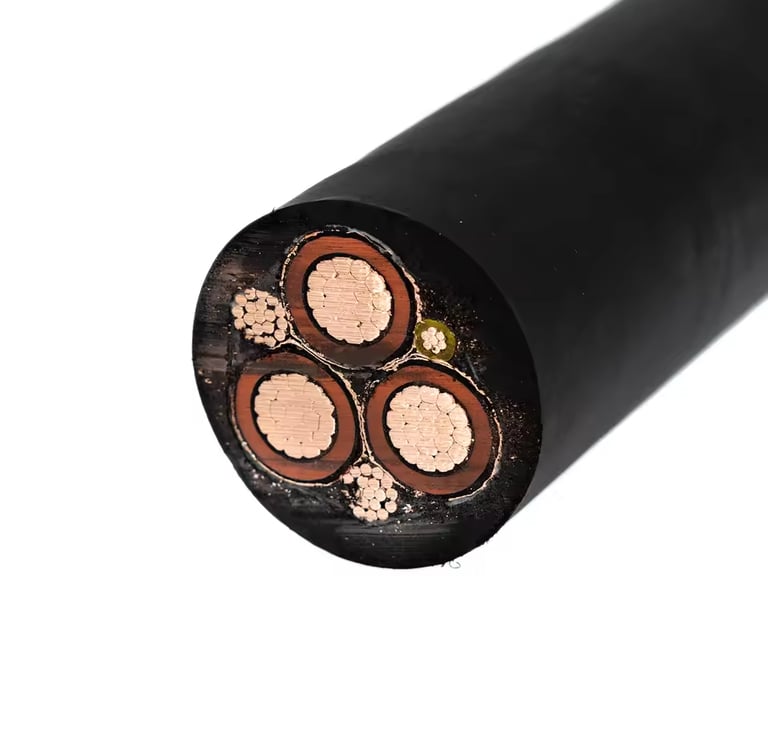
Discover why ICEA S-75-381 mining cables—including Type W, G, G-GC, SHD, SHD-GC, and MP-GC—are rapidly gaining traction across South Africa’s coal, platinum, manganese, and iron-ore mines. Learn about cable structure, performance, safety, materials, case studies, and how ICEA standards complement SANS 1520-1 in modern South African mining.
Li. Wang
12/3/20256 min read
Introduction
South Africa’s mining landscape is among the toughest power environments on earth. From the high-stress coal faces of Witbank, to the deep rock temperatures of the Rustenburg platinum belt, to the abrasive iron-ore operations around Kolomela and the manganese giants of the Northern Cape, local engineers constantly battle mechanical stress, moisture, chemical exposure, and unpredictable machine movements.
In such conditions, ordinary cables simply don’t survive. Even some locally designed mining cables reach their limits under extreme dragging, repeated flexing, wet stopes, and aggressive mining chemicals.
This is where ICEA S-75-381 enters the South African conversation.
Although ICEA standards originate from North America, South African mines are increasingly using American-designed portable and feeder mining cables—especially where mines import shovels, draglines, continuous miners, high-power pump stations, or autonomous equipment built around U.S. electrical practices.
And ICEA S-75-381 remains one of the world’s most comprehensive standards for portable, mobile, and high-mechanical-stress mining cables.
This article provides a deep, engineering-level, South African-focused study of ICEA S-75-381 cables—including their structure, performance, materials, suitability for local environments, and real case studies from mines in SA.
What Is the ICEA S-75-381 Standard?
Background of the ICEA
The Insulated Cable Engineers Association (ICEA) is one of the most influential cable standards bodies worldwide. Since the early 20th century, ICEA has defined robust performance rules for cables used in harsh industries—mining, offshore, construction, power utilities, and industrial automation.
While SANS standards govern local South African cable manufacturing, ICEA standards are widely recognised globally—particularly in mining.
In short:
SANS governs the local market.
ICEA governs the global mining industry.
Scope of S-75-381
ICEA S-75-381 is formally titled:
“Portable and Power Feeder Cables for Use in Mines and Similar Applications.”
It covers:
Portable power cables for moving equipment
Trailing cables
Reeling cables
Shielded mining cables
Feeder cables between mobile substations
Power and control cables on machines exposed to mechanical abuse
Cables operating between 600 V and 2 kV
This makes it especially relevant to South African mines using highly mobile, diesel-electric or electrically powered machinery.
Why South Africa Uses ICEA-Compliant Cables
South African mines typically turn to ICEA S-75-381 cables when:
Importing U.S.-spec mining machinery, which is designed to run on ICEA-rated cables.
Operating in extremely harsh mechanical environments where reinforced ICEA designs outperform some standard trailing cables.
Upgrading to autonomous or semi-autonomous mining fleets, which require shielded cables for low-interference communication and control.
Seeking improved flame, tear, and moisture performance in deep or ultra-deep mines.
In large open-cast mines like Kolomela, Sishen, or Kathu, ICEA S-75-381 cables often power shovels, drills, stacker-reclaimers, and mobile substations—where distances are long, equipment constantly moves, and cable damage risks are high.
Cable Types Defined in ICEA S-75-381
The standard defines several specialised cable families. Below is a practical explanation tailored to South African mining conditions.
Portable Cable Types for Mining Machines
Type W — Portable Cable Without Grounding Conductors
Used mainly for non-critical mobile equipment.
Common in quarry crushers, temporary pump setups, and mobile lighting.
Simple construction—but no grounding means not suitable for high-risk equipment.
Type G — Portable Cable With Grounding Conductors
Includes four grounding conductors.
Provides safer fault protection for wet or metallic environments.
Applied in pumps, smaller loaders, drills, and underground fans.
Type G-GC — Portable Cable With Grounding and Ground-Check
Adds a dedicated ground-check wire, enabling real-time ground monitoring.
Ideal for high-risk trailing operations, continuous miners, and deep-level installations.
In South Africa, Type G-GC has become common in:
Underground coal pump stations in Mpumalanga
Platinum shaft signalling systems
Mobile conveyor drives
Shielded Mining Cable Types (SHD Family)
These cables include individually shielded power conductors, designed for electrically noisy or highly automated machines.
SHD Flat
Used where cable must lay flat or pass under machinery.
Common in underground rail haulage systems and pump skids.
SHD-PCG
Shielded power + centre grounding conductor + control conductors.
Found in automated longwall systems and machine control rigs.
SHD-CGC
Similar to SHD-PCG but includes a central ground-check conductor.
SHD-GC
Shielded power + grounding + ground-check.
Increasingly used for LHDs (load-haul-dump units) and hybrid electric haulers.
Mine Power Feeder Cables
MP-GC (Mine Power Ground-Check Cable)
Connects mobile substations, power skids, or distribution boxes.
High mechanical toughness + strong electrical shielding.
Popular in large open-pit mines with long cable runs.
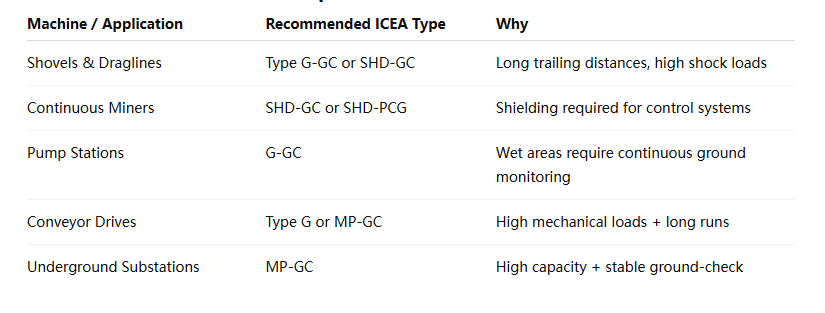
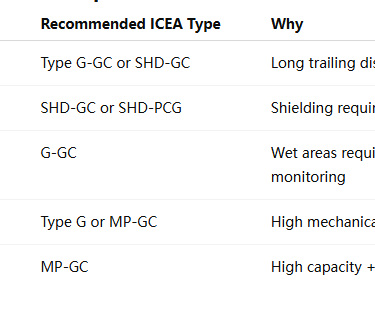
Functional Differences Explained
South African examples:
Kumba Iron Ore uses MP-GC feeders for mobile substations.
Impala Platinum uses SHD-GC for LHD machine power and control.
Manganese quarries in Hotazel favour Type W and G for crushers and screening plants.
Key Performance Requirements Under ICEA S-75-381
Mechanical Resistance
Mining cables face:
Dragging across sharp rock
Dynamic bending
Tension loads
Impact from machinery
Reeling stress
ICEA S-75-381 sets minimum levels for:
Abrasion resistance
Tear resistance
Tensile strength
Jacket toughness
This is essential for SA mines where rocks like chromitite, manganese, and hematite are extremely abrasive.
Environmental Protection
Moisture Resistance
Vital for coal galleries in Witbank or deep platinum stopes.
Chemical Resistance
ICEA jackets withstand:
Hydraulic oils
Diesel
Explosives residue
Cement dust
UV & Ozone Resistance
Critical in the Northern Cape, which has some of the world’s highest UV levels.
Electrical Specifications
Voltage classes: 600 V, 2 kV
High dielectric integrity
Stable insulation under heat and moisture
Shielding to prevent interference on automated equipment
Fire & Flame Resistance
ICEA flame tests ensure:
No rapid flame propagation
Self-extinguishing capability
This is life-saving in narrow declines of platinum and gold mines where fire spreads fast.
Cable Design & Materials Under ICEA S-75-381
Conductor Materials
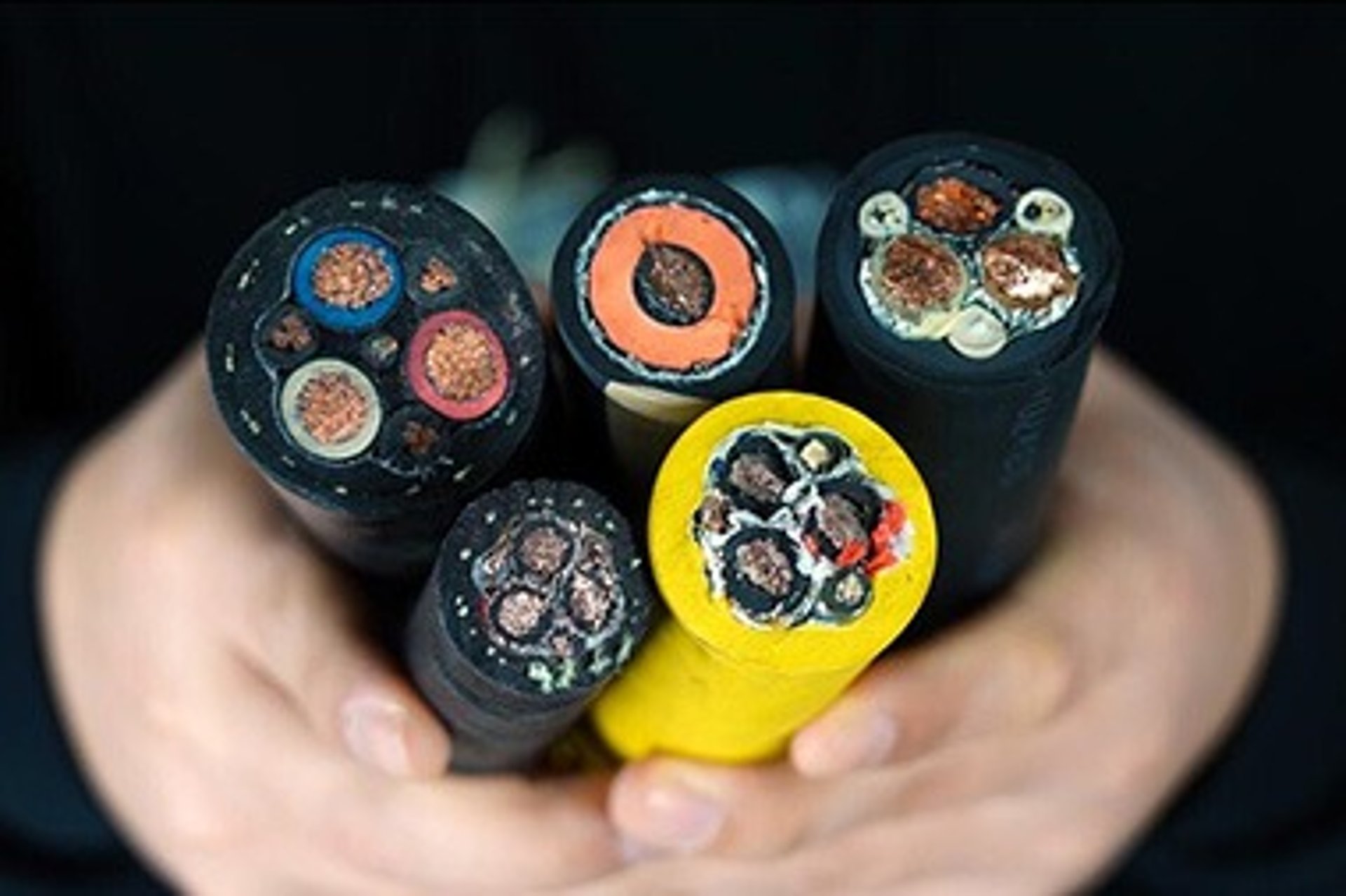
Most ICEA S-75-381 cables use:
Annealed copper
Finely stranded conductors for high flexibility
Optional tinned copper for corrosion resistance
Insulation Systems
Two major insulation families:
XLPE (Cross-Linked Polyethylene)
Higher dielectric strength
Lower smoke generation
Good for feeder cables
EPR (Ethylene Propylene Rubber)
Flexible even at low temperatures
Outstanding moisture and thermal resistance
Common in portable or trailing cables
Jacket Types
TPE (Thermoplastic Elastomer)
Excellent tear resistance
Superior abrasion resistance
Preferred in quarries and iron-ore mines
Screening & Shielding
Shielded designs include:
Semi-conductive layers
Copper braid or tape shields
Individual conductor shielding
These improve:
Interference resistance
Automated control accuracy
Ground fault detection reliability
Where ICEA S-75-381 Cables Are Used in South Africa
Mining
Longwall coal equipment
LHDs and drill rigs
Underground pump stations
Hybrid electric loaders
Conveyor drives
Decline development machinery
Tunnelling & Construction
Used in:
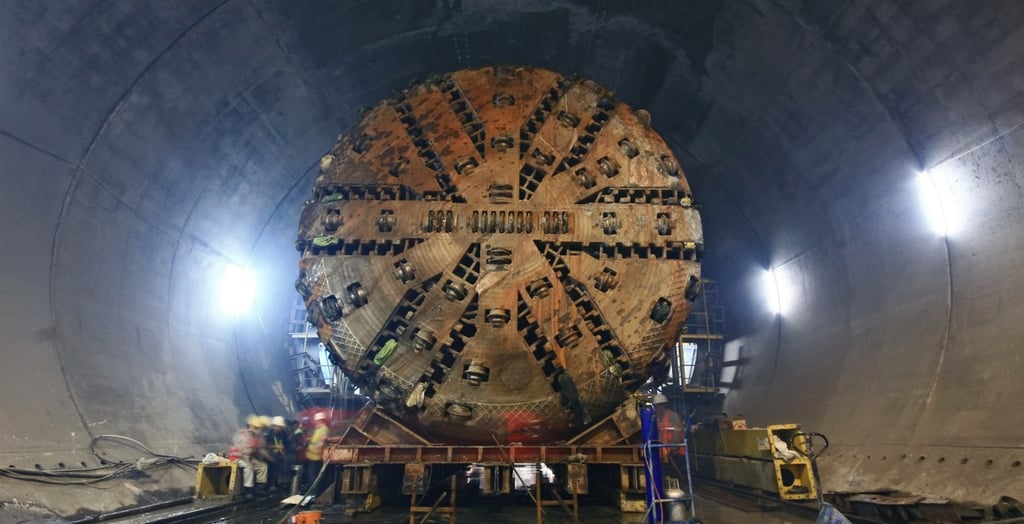
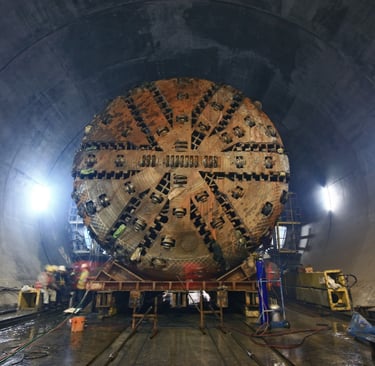
TBM tunnelling
Road & rail tunnel ventilation systems
Heavy drilling systems
Quarrying
Granite and sandstone quarries around Rustenburg frequently use Type W and Type G cables in crushers and mobile screens.
Hybrid Renewable-Mining Systems
Northern Cape solar-mining hybrid facilities use ICEA cables for:
Mobile power trucks
Temporary distribution
Rapid deployment substations
Case Studies from South Africa
Rustenburg Platinum Mine — SHD-GC for LHD Units
Problem:
Older trailing cables suffered frequent jacket tearing, causing unplanned downtime.
Solution:
Upgraded to SHD-GC cables with high-tear TPE jackets and shielded conductors.
Result:
30% reduction in cable-related failures
Improved electrical safety
Longer maintenance intervals
Mpumalanga Coal Mine — Type G-GC for Pump Stations
Problem:
Constant moisture and corrosive water caused regular insulation breakdown.
Solution:
Replaced standard trailing cables with Type G-GC, providing moisture-resistant EPR insulation and continuous ground monitoring.
Result:
Significant reduction in ground-fault trips
Extended cable life in wet stopes
Northern Cape Manganese Quarry — Type W for Crushing Equipment
Problem:
Extreme abrasion from manganese rock quickly destroyed general-purpose cables.
Solution:
Adopted Type W portable cables with ultra-tough TPE jackets.
Result:
Dramatic increase in cable lifespan
Lower operational costs
Improved uptime of mobile crushing stations
Benefits of Using ICEA S-75-381 Cables in South Africa
High Durability & Reduced Maintenance
Designed for:
Rock impact
Dragging
Chemical exposure
Frequent movement
Lower failure rates = higher operational efficiency.
Improved Electrical Safety
Features like:
Grounding
Ground-check wires
Shielding
Help prevent electrocution, arc faults, and machine damage.
Versatility & Mobility
Ideal for:
Mobile substations
Reeling systems
Long trailing distances
Dynamic machine layouts
Compatible with Modern Mining
Supports:
Automation
Real-time system feedback
High-power electric machinery
How ICEA S-75-381 Compares to Other Standards
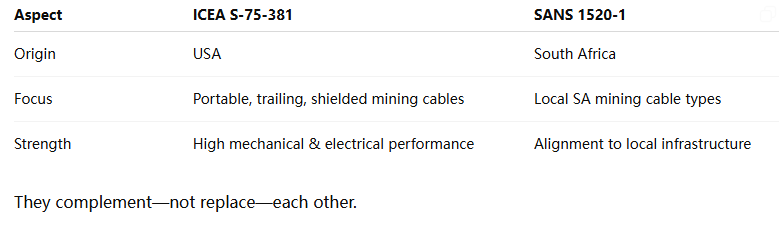
ICEA vs SANS 1520-1
They complement—not replace—each other.
ICEA vs MSHA (U.S.)
MSHA focuses on safety approval;
ICEA focuses on design, construction, and performance.
When SA Mines Prefer ICEA
Imported machinery
Harsh mechanical environments
Long-distance trailing
Automated equipment
Common Misunderstandings About ICEA S-75-381 Cables
“All mining cables are the same.”
False—each type is specialised.
“Ground-check is optional.”
Not for high-risk trailing systems.
“Imported ICEA cables don’t suit SA mines.”
Incorrect—ICEA designs often exceed local durability expectations.
“XLPE is always better than EPR.”
Depends on the application:
XLPE = feeders
EPR = portable flexibility
Frequently Asked Questions (FAQ)
Q1: What is the main difference between Type G and Type G-GC?
A: G-GC includes a ground-check for continuous monitoring.
Q2: Can ICEA cables be used with SANS systems?
A: Yes—mines often mix standards depending on equipment origin.
Q3: Are they suitable for long trailing distances?
A: Yes, especially Type G-GC and SHD-GC.
Q4: Which jacket is best for abrasive SA mines?
A: TPE jackets on Type W and SHD are top performers.
Q5: Are SHD cables necessary for automated machines?
A: Yes—shielding stabilises control signals.
Q6: Can they be spliced underground?
A: Yes, but must follow proper mining cable splicing procedures.
Q7: What voltages are most used?
A: 600 V and 2 kV.
Q8: How often should cables be inspected?
A: Daily visual checks + weekly electrical tests.
Q9: Do ICEA cables reduce arc-flash risks?
A: Yes—via insulation, grounding, and shielding.
Q10: Are ICEA cables more expensive?
A: Initially yes, but lifecycle cost is lower due to durability.
Conclusion
ICEA S-75-381 cables are engineered for some of the harshest working environments in global mining—and South Africa’s extremely demanding geological conditions make them an excellent fit. Whether powering a continuous miner in Rustenburg, dewatering pumps in Witbank, or mobile substations in the Northern Cape, ICEA cables deliver:
Superior durability
High electrical safety
Consistency under mechanical stress
Compatibility with modern automated mining
Internationally recognised performance
For South African mine managers, engineers, and maintenance teams, selecting ICEA S-75-381 cables is not just a technical decision—it’s an investment in safer, more efficient, and future-ready mining operations.
Email Address: Li.wang@feichuncables.com
© 2025. All rights reserved.
One-click to Quickly Contact
Products
Contact
Company
Location:
Building A Private Science and Technology Park, Hefei Economic and Technological Development Zone, Anhui Province, China
Heat Resistant Cable
WhatsApp: +86 17333223430
Social Media: