Anhui Feichun Special Cable Co.,Ltd Email: Li.wang@feichuncables.com

PROTOLON(FL) (N)TSFLCGEWOEU Medium Voltage Flat Reeling Cable: Engineering Design for Single‑Plane Crane Systems and STS Applications
Discover PROTOLON(FL) (N)TSFLCGEWOEU medium voltage flat reeling cable — engineered for single‑plane motion, STS cranes & bulk handling. Learn specifications, design principles, benefits vs round cables & expert selection guide.
Li. Wang
5/11/202618 min read
Introduction
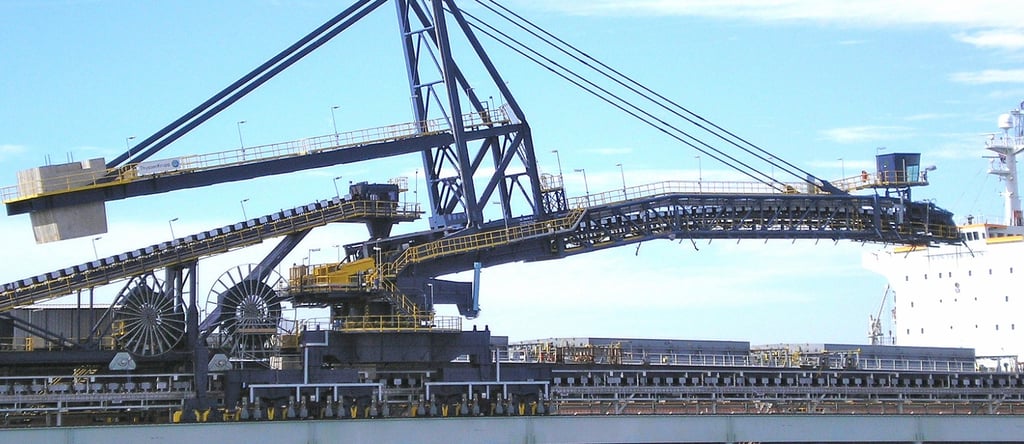
In ports, bulk handling terminals, and mining operations across Southern Africa, medium‑voltage reeling cables form the lifeline of heavy machinery such as ship‑to‑shore cranes, stacker‑reclaimers, and ship loaders. These cables must transfer high power reliably while enduring continuous flexing, tension, and exposure to harsh environmental conditions including coastal salt, intense UV radiation, and extreme temperatures. For decades, round reeling cables were the standard choice because they could handle multi‑directional movement, rotation, and torsion. However, modern terminal design has shifted toward systems where motion is strictly controlled and limited to a single vertical plane. In these applications, the traditional round design brings unnecessary complexity, increased weight, and higher costs. This is where PROTOLON(FL) (N)TSFLCGEWOEU — a medium‑voltage flat reeling cable developed by Prysmian Group and supplied by Feichun Special Cable — changes the equation completely. It is not simply a round cable flattened into shape; it is a purpose‑engineered solution built from the core up to optimise performance, durability, and efficiency exactly where it matters most. This article explains the engineering principles behind this design, its technical specifications, and how it compares to conventional alternatives, providing engineers and procurement teams with the information needed to make informed decisions for their projects.
Round Reeling Cables: Structure and Limitations in Single‑Plane Motion
To understand the innovation behind flat reeling cables, it is first necessary to examine the design and behaviour of the round cables they replace. Round medium‑voltage reeling cables, such as PROTOLON(SMK) (N)TSCGEWOEU, are constructed specifically for equipment that moves in multiple directions, rotates, or undergoes lateral travel. Typical examples include standard STS cranes with full slewing capability, mobile harbour cranes, and rubber‑tyred gantries. The internal structure is built around a symmetrical radial design. Three main power cores are arranged in a triangular or circular formation, with earth and protective conductors distributed evenly in the gaps between them. This symmetry is critical because it allows the cable to bend, twist, and rotate in any axis without creating unbalanced mechanical or electrical forces.
Each core consists of finely stranded tinned copper conductors — Class FS according to VDE standards — which provide the flexibility required for continuous movement. Insulation is made from high‑grade ethylene propylene rubber (EPR) compounds such as PROTOLON HS, chosen for excellent electrical strength and resistance to weathering. Surrounding the cores is a multi‑layer sheath system: an inner sheath, followed by a polyester anti‑torsion braid, and finally an outer sheath of robust rubber or PUR compound. The anti‑torsion braid is a key feature here; it restricts excessive twisting and maintains structural integrity when the cable rotates, allowing it to withstand torsional stress of ±25° to ±50° per metre. The overall diameter typically ranges from 30 mm for 3.6/6 kV versions up to 50 mm for 8.7/15 kV variants, depending on conductor size and voltage rating.
While this design performs well in multi‑directional systems, it presents significant drawbacks when used in applications where movement is restricted to a single vertical plane, such as flat‑drum STS cranes. The primary issue is geometric incompatibility. A round cable resting on a flat surface has a very small contact area, effectively making line contact with the drum or guide rollers. This creates high local pressure points that accelerate wear and fatigue. Furthermore, the circular cross‑section makes the cable inherently unstable. With a diameter between 30 and 50 mm, the centre of gravity sits relatively high, and the cable tends to roll, shift sideways, or stack unevenly as it winds onto the drum. This instability introduces additional tension spikes, increases the risk of the cable jumping off the drum, and requires complex guiding systems just to keep it in place.
From an engineering and economic perspective, round cables are also inefficient for single‑plane use. Because they are built to survive twisting and multi‑axis bending, they include reinforcement layers — such as the anti‑torsion braid — that add weight, bulk, and cost but deliver no benefit when torsion is not part of the operational profile. The symmetrical shape also wastes space; a round cable occupies more volume on the drum than an equivalent flat cable, meaning the drum itself must be larger and heavier to store the same length of cable. This increases the structural load on the crane, raises the power required for reeling, and adds to overall capital and operational expenses. In short, for single‑plane motion, the round design is a compromise — it works, but it is far from optimal.
Flat Reeling Cable: A Specialised Engineering Breakthrough
PROTOLON(FL) (N)TSFLCGEWOEU represents a fundamental shift in how reeling cables are designed. Instead of creating a universal cable that works reasonably well in all situations, this product is engineered specifically for one type of motion: controlled bending in a single vertical plane, with zero rotation or torsion permitted. This focus allows every part of the design to be optimised, resulting in performance and efficiency levels that round cables simply cannot match.
The most visible difference is the shape — flat and rectangular — but the real innovation lies beneath the outer sheath. In a round cable, cores are laid helically around a central axis. In PROTOLON(FL), the three power cores are arranged side‑by‑side in a parallel, flat formation. This simple change has profound mechanical benefits. When the cable bends, all cores move along the same neutral bending axis. There is no relative sliding or twisting between cores, which eliminates a major source of internal friction and fatigue. The flat profile also matches perfectly to flat drums and wide guide rollers, creating full surface contact rather than line contact. This distributes pressure evenly across the entire width of the cable, reducing wear dramatically and eliminating the instability that plagues round cables. There is no rolling, no shifting, and no need for complex anti‑deviation guides.
Electrical design presented a unique challenge. Radial symmetry is the traditional way to ensure balanced electrical performance in medium‑voltage cables, but a flat shape breaks that symmetry. Engineers solved this by using a concentric distributed earth system. Instead of a single earth conductor placed to one side or in the centre, the protective earth is split into three identical segments, each wrapped concentrically around its own insulated power core. This ensures that every phase conductor sees exactly the same electrical environment, with balanced capacitance, uniform electric field distribution, and equal impedance. Even in a rectangular cross‑section, electrical balance is maintained fully, meeting all IEC and VDE standards for medium‑voltage operation and preventing issues such as partial discharge or electromagnetic interference.
Perhaps the most important design decision — and the one that defines the application boundaries — is the explicit engineering constraint: no torsion allowed. Unlike round cables, PROTOLON(FL) does not include an anti‑torsion braid or any reinforcement intended to resist twisting. This is not an oversight; it is a deliberate choice. By removing materials that are only needed for multi‑directional movement, the cable becomes lighter, smaller, and more flexible in bending. It is optimised for exactly what it needs to do, without carrying the weight or cost of features it will never use. This approach represents a new philosophy in cable engineering: shape follows motion, and design follows function.
This specialised design makes PROTOLON(FL) the ideal choice for applications where the path is fixed and controlled. These include ship loader and unloader booms that move only through a fixed arc, flat‑drum STS cranes common in modern container terminals, stacker‑reclaimers operating with fixed‑angle luffing, and bucket‑wheel excavators in mining operations. In each case, the cable moves forward and backward, bending in only one plane, never rotating. For these systems, the flat design delivers smaller equipment footprints, lighter mechanical structures, lower energy consumption, and significantly longer service life compared to any round alternative.
Application Boundaries: Choosing Between Flat and Round Designs
Understanding where PROTOLON(FL) fits — and equally important, where it does not — is essential for successful deployment. The performance advantages of the flat design are only realised when the installation matches its engineering constraints.
The ideal operating environment for PROTOLON(FL) is characterised by motion limited strictly to a single vertical plane, with zero rotation, spiral movement, or lateral deviation. In these conditions, the benefits are substantial. The flat geometry allows for drums that are 20 % to 30 % smaller in diameter and narrower in width. This reduction in size directly translates to lighter structural steelwork on the crane, smaller foundations, and lower overall capital cost. The cable itself is 15 % to 25 % lighter than an equivalent round cable, which reduces tension forces during reeling, allows the use of smaller drive motors, and lowers energy consumption over the system’s lifetime. Because all internal stresses are minimised and wear is distributed evenly, service life can be three to five times longer than that of a round cable in the same application. For operators in South Africa, where maintenance costs and downtime have a major impact on profitability, these factors make a very strong business case.
However, the design that creates these benefits also creates hard limits. PROTOLON(FL) has no built‑in resistance to torsion or shear forces from rotation. Even a small amount of twist during installation or operation can cause permanent damage, including conductor breakage or insulation failure. If the application involves any rotation, slewing, spiral reeling, or movement in more than one plane, the flat cable is not suitable. In these cases, the round alternative — PROTOLON(SMK) (N)TSCGEWOEU — remains the correct choice.
PROTOLON(SMK) is built as a universal solution. Its symmetrical structure, anti‑torsion reinforcement, and higher tensile rating of 20 N/mm² allow it to survive any type of motion, from continuous rotation to complex multi‑axis travel. It is the standard for traditional STS cranes, mobile harbour cranes, and any system where the motion profile is not fixed or fully controlled. The trade‑off is that it is heavier, bulkier, and less efficient than the flat design, but it offers the flexibility needed for variable applications.
A clear decision framework emerges from this comparison. If the equipment moves only in one plane and the path is fully guided and fixed, PROTOLON(FL) delivers maximum efficiency and lowest total cost of ownership. If there is any possibility of rotation, twisting, or variable routing, PROTOLON(SMK) must be selected. This distinction is increasingly important in Southern Africa as terminals modernise and move toward flat‑drum STS designs, where the flat cable has become the industry standard.
Full Technical Specification: PROTOLON(FL) (N)TSFLCGEWOEU
Based on documentation from Prysmian Group and product data from Feichun Special Cable, the following section details the complete technical specifications of PROTOLON(FL) (N)TSFLCGEWOEU, covering construction, electrical parameters, mechanical performance, and standard dimensions. All specifications comply with DIN VDE 0250‑813 and IEC 60092‑350 standards, widely accepted across South Africa and global markets.
Construction Details
Every component is selected and arranged to support the single‑plane bending requirement while maintaining high electrical performance and environmental resistance.
The conductor is made from electrolytic tinned copper, finely stranded to Class FS standard. This stranding provides excellent flexibility while maintaining high conductivity and resistance to corrosion — a critical feature for coastal terminals in Durban, Cape Town, or Richards Bay.
Insulation uses PROTOLON HS, a proprietary compound based on high‑quality EPR (ethylene propylene rubber) graded 3GI3. This material offers outstanding electrical strength, high thermal stability, and excellent resistance to ozone, ultraviolet radiation, water, and chemicals. It is rated for continuous operation at a maximum conductor temperature of 90 °C, with short‑circuit capability up to 250 °C for durations not exceeding five seconds. Between the conductor and insulation, and again over the insulation layer, semiconductive tapes are applied to control the electric field and eliminate stress concentrations, optimised specifically for the flat geometry to prevent partial discharge.
Core arrangement is the defining feature: three insulated power cores are placed parallel and side‑by‑side to form a rectangular profile. The protective earth system is split into three equal segments, each applied concentrically around its own core. This arrangement ensures perfect electrical balance, as described earlier, and eliminates the need for additional shielding.
The outer sheath is manufactured from PROTOFIRM Special, a robust rubber compound classified 5GM5. It is resistant to oil according to DIN EN 60811‑404, fully weatherproof, and suitable for both indoor and outdoor use in all climates. Unlike round cables, there is no anti‑torsion braid or intermediate reinforcement layer, which reduces weight and improves flexibility. The standard colour is black, providing maximum UV resistance.
For applications requiring data transmission alongside power, a variant PROTOLON(FL)‑LWL is available, integrating single‑mode or multi‑mode optical fibres within the structure without changing the external dimensions or performance characteristics.
Electrical Parameters
PROTOLON(FL) covers the full range of medium‑voltage requirements for port and bulk handling equipment. Three standard voltage classes are available:
Rated Voltage U₀/U (Uₘ): 3.6/6 kV (7.2 kV)
Maximum AC Operating Voltage: 4.2/7.2 kV
Maximum DC Operating Voltage: 5.4/10.8 kV
AC Test Voltage (5 Minutes): 11 kV
Rated Voltage U₀/U (Uₘ): 6/10 kV (12 kV)
Maximum AC Operating Voltage: 6.9/12 kV
Maximum DC Operating Voltage: 9/18 kV
AC Test Voltage (5 Minutes): 17 kV
Rated Voltage U₀/U (Uₘ): 8.7/15 kV (18 kV)
Maximum AC Operating Voltage: 10.4/18 kV
Maximum DC Operating Voltage: 13.5/27 kV
AC Test Voltage (5 Minutes): 24 kV
All versions operate at 50 Hz or 60 Hz frequency and meet strict insulation resistance and capacitance requirements to ensure safe and efficient power transfer over long distances.
Mechanical Parameters
Mechanical properties are tuned specifically for single‑plane reeling, balancing strength with flexibility.
Maximum tensile load: 15 N/mm². This is lower than the 20 N/mm² rating of PROTOLON(SMK), but it is precisely calculated to handle the tension forces encountered in controlled reeling without over‑engineering.
Torsion capability: None. As an explicit design rule, this cable must never be subjected to rotation or twisting forces.
Minimum bending radius: 6 × height for fixed installations, 10 × height for moving applications. Because height is much smaller than the equivalent diameter of a round cable, the minimum bend radius is significantly reduced, allowing more compact drum designs.
Travel speed: Up to 120 m/min as standard; higher speeds can be engineered upon request.
Temperature range: From ‑50 °C to +80 °C when fixed, and from ‑35 °C to +80 °C in dynamic operation. This covers the full range of environmental conditions found in Southern Africa, from cold highveld nights to hot coastal summers.
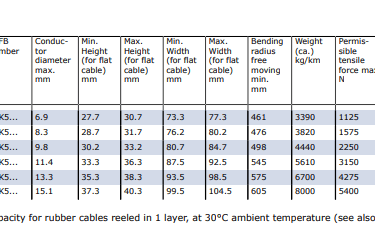
Standard Dimensions and Weights
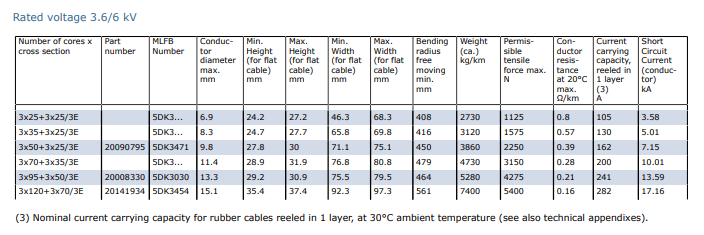
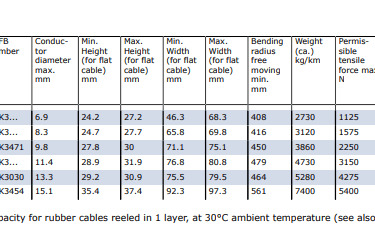
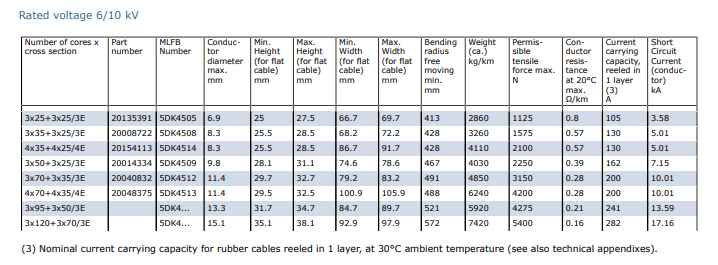
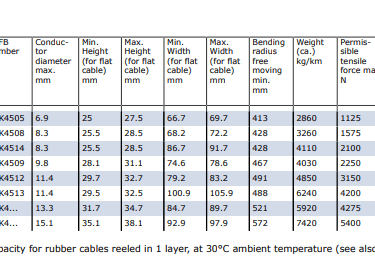
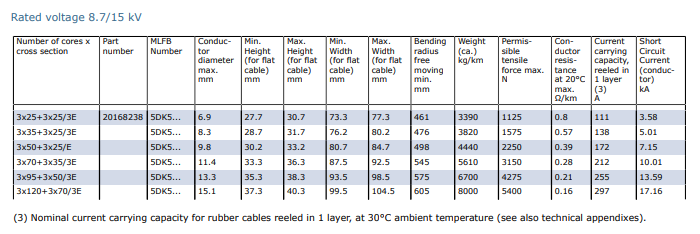
The following table lists the most common standard sizes, showing width, height, approximate weight, and minimum bending radius for each configuration. All values are nominal and subject to manufacturing tolerance of ±5 %.
Continuous lengths up to 1 000 metres can be supplied depending on cross‑sectional area, eliminating the need for intermediate joints which are always a potential point of failure.
Core Engineering Principles Explained
The performance advantages of PROTOLON(FL) come from four key engineering concepts, each carefully applied to optimise the cable for its intended use.
Parallel Flat Core Arrangement: Structure Optimised for Controlled Paths
In traditional round cables, cores are laid in a helical pattern. When the cable bends, the inner cores compress and the outer cores stretch, and relative movement occurs between layers. This movement creates friction, heat, and mechanical stress that eventually lead to fatigue. PROTOLON(FL) eliminates this by arranging cores in a straight, parallel formation. All cores share the same neutral bending axis, so they bend uniformly without any relative motion. This simple change reduces internal stress significantly and allows the cable to bend with less force, lowering the power required for reeling. The flat shape also means the cable sits perfectly flat on drums and rollers, making the system predictable and stable. There is no rolling, no shifting, and no need for complex guiding structures. The result is a smooth-running system with uniform tension distribution, which is the foundation of long service life and high reliability.
Concentric Distributed Earth Conductor: Electrical Balance in Rectangular Form
Medium‑voltage cables rely on symmetrical construction to maintain balanced electrical fields and equal impedance across all phases. A flat cross‑section naturally breaks radial symmetry, creating a difficult engineering challenge. If the earth conductor were placed in a single position, one phase would be closer to earth than the others, leading to uneven stress, higher losses, and increased risk of partial discharge. The solution used in PROTOLON(FL) is to split the protective earth into three identical segments, each wrapped concentrically around its respective insulated core. This ensures that every phase conductor has exactly the same relationship to the earth potential, regardless of the overall rectangular shape. Electrical capacitance, inductance, and field distribution remain perfectly balanced, meeting all requirements of IEC and VDE standards without requiring additional shielding. This design innovation proves that optimal electrical performance can be achieved even when moving away from traditional round geometry.
No‑Twist Constraint: Engineering Trade‑Off and Selection Framework
One of the most important aspects of PROTOLON(FL) is the deliberate exclusion of anti‑torsion reinforcement. In round cables, the anti‑torsion braid adds strength and stability but also adds mass, diameter, and cost. In single‑plane applications, torsion never occurs, so this material serves no purpose — it is simply dead weight. By removing it, the design team achieved a lighter, more flexible, and more compact cable. However, this creates a strict operating rule: no twisting is permitted at any stage, whether during installation, commissioning, or operation. This is not a limitation to be worked around; it is a core part of the engineering specification. The trade‑off is clear: maximum performance and efficiency in exchange for strict adherence to the motion profile. This creates a simple but powerful selection framework. If the system can guarantee movement in only one plane, PROTOLON(FL) is the best choice available. If rotation or spiral motion is possible, PROTOLON(SMK) must be used. This clarity removes guesswork and ensures that the selected cable is always fit for purpose.
Roller Guide System Integration: Surface Contact Optimisation and Load Distribution
The shape of PROTOLON(FL) works hand‑in‑hand with the equipment design, particularly the drum and guiding rollers. Round cables make line contact with rollers, meaning the entire load is concentrated on a narrow strip. This creates high local pressure, which accelerates wear and can damage the outer sheath over time. Flat cables make full surface contact across their entire width, spreading the load evenly and reducing contact pressure by approximately 70 %. This reduction in pressure is one of the main reasons flat cables last so much longer in service. Additionally, the consistent width allows guides to be designed to match exactly, eliminating lateral movement and ensuring the cable winds neatly and evenly onto the drum every time. The combination of flat cable and wide, matching rollers creates a system where forces are distributed gently and predictably, reducing mechanical stress on both the cable and the machinery.
Mechanical and Electrical Performance: Key Parameters in Context
The mechanical and electrical ratings of PROTOLON(FL) are carefully chosen to match real‑world requirements. The tensile strength of 15 N/mm² is lower than the 20 N/mm² of the round equivalent, but this is intentional. In controlled single‑plane reeling, tension forces are predictable and well within this limit. Using a higher rating would require heavier conductors and thicker insulation, adding unnecessary weight and cost. The voltage range from 3.6/6 kV up to 8.7/15 kV covers all standard medium‑voltage applications in ports and mining, from smaller ship loaders to large STS cranes. Thermal performance allows continuous operation at 90 °C and short‑circuit withstand up to 250 °C, providing safety margins that meet or exceed industry standards. Every parameter is balanced to deliver exactly what is needed, without over‑specification or compromise.
Professional Applications: Where Flat Design Delivers Maximum Value
The benefits of PROTOLON(FL) are most visible in specific types of equipment where motion is inherently controlled and fixed. Flat‑drum STS cranes, now standard in new terminal projects across Southern Africa, are the primary application. Here, the cable moves only in and out, bending in one plane, and the flat design allows the crane structure to be smaller, lighter, and more efficient. Ship loaders and unloaders with fixed‑arc luffing are another ideal fit; the cable follows the boom movement without rotation, and the compact drum design saves valuable deck space. Stacker‑reclaimers in bulk terminals operate along long, straight paths with fixed‑angle luffing, making them perfect candidates for flat cable technology. Even large mining machines such as bucket‑wheel excavators, where movement is linear and guided, benefit from the lighter weight and longer life. In each case, the common factor is controlled, single‑plane motion — exactly where PROTOLON(FL) was designed to perform.
Side‑by‑Side Comparison: Flat vs Round Medium‑Voltage Reeling Cables
To make the differences clear for engineering and procurement teams, the following comparison summarises the key characteristics of PROTOLON(FL) and PROTOLON(SMK).
Shape
PROTOLON(FL): Flat / rectangular
PROTOLON(SMK): Round / circular
Allowed Motion
PROTOLON(FL): Single‑plane bending only; no torsion, rotation or spiral
PROTOLON(SMK): Multi‑plane bending; torsion ±25° to ±50°/m; rotation and spiral permitted
Maximum Tensile Load
PROTOLON(FL): 15 N/mm²
PROTOLON(SMK): 20 N/mm²
Bending Radius
PROTOLON(FL): Smaller (6 × height fixed, 10 × height moving)
PROTOLON(SMK): Larger (8 × diameter fixed, 12 × diameter moving)
Drum Size Requirement
PROTOLON(FL): 20–30 % smaller diameter and width; lighter support structure
PROTOLON(SMK): Standard or larger drum; heavier support structure
Cable Weight
PROTOLON(FL): 15–25 % lighter; lower tension forces; lower energy use
PROTOLON(SMK): Heavier due to anti‑torsion layers; higher tension and energy demand
Service Life (Correct Installation)
PROTOLON(FL): 3–5 × longer life; even wear, low internal stress
PROTOLON(SMK): Long life but reduced efficiency on flat drums
Failure Mode Under Torsion
PROTOLON(FL): Immediate damage; not designed for twisting
PROTOLON(SMK): Survives twisting and misalignment
Relative Cost
PROTOLON(FL): Lower material, installation and maintenance cost
PROTOLON(SMK): Higher due to extra reinforcement
Fibre Optic Option
PROTOLON(FL): PROTOLON(FL)‑LWL
PROTOLON(SMK): PROTOLON(SMK)‑LWL
Standards Compliance
PROTOLON(FL): DIN VDE 0250‑813, IEC 60092‑350, VDE Approved
PROTOLON(SMK): DIN VDE 0250‑813, IEC 60092‑350, VDE Approved
Best‑Fit Equipment
PROTOLON(FL): Flat‑drum STS, ship loaders/unloaders, fixed‑angle stackers, guided conveyors
PROTOLON(SMK): Standard STS, RTG cranes, mobile harbour cranes, slewing equipment
This comparison shows clearly that neither design is universally better — each is optimised for a different set of operating conditions. PROTOLON(SMK) remains the best choice for general‑purpose or variable applications, but PROTOLON(FL) is the superior solution whenever motion is controlled and single‑plane. For Southern African operators upgrading or building new terminals, this difference translates directly into measurable savings in capital expenditure, energy consumption, and maintenance.
Practical Procurement and Selection Guide
Selecting the right cable involves a structured approach, ensuring the chosen product matches both the electrical and mechanical requirements of the project. The following steps provide a clear process for engineers and procurement professionals.
Start by analysing the motion profile in detail. Document exactly how the cable moves during normal operation, maintenance, and any emergency conditions. If there is any possibility of rotation, slewing, or spiral reeling, PROTOLON(SMK) must be selected. If movement is strictly limited to one vertical plane and the path is guided or fixed, PROTOLON(FL) is the correct choice. It is essential to include installation and maintenance procedures in this analysis; even temporary twisting during installation can damage a flat cable.
Next, define the electrical requirements. Determine the rated voltage based on the supply system — 3.6/6 kV, 6/10 kV, or 8.7/15 kV — and calculate the required conductor cross‑section based on load current, length, and short‑circuit requirements. Use the specification table provided earlier to match the correct size. If data communication is needed for control, monitoring, or safety systems, select the ‑LWL variant with the appropriate fibre type.
Consider environmental and mechanical conditions. Both designs perform well in Southern African climates, with wide temperature ranges and excellent resistance to weather, salt, and chemicals. However, check the travel speed; PROTOLON(FL) is rated up to 120 m/min as standard, while PROTOLON(SMK) can handle higher speeds. For long‑length runs, confirm maximum continuous length availability to avoid joints.
When specifying, always include the full designation: PROTOLON(FL) (N)TSFLCGEWOEU, followed by the number of cores, cross‑sectional area, and voltage rating. For example, PROTOLON(FL) (N)TSFLCGEWOEU 3×120 mm² 6/10 kV.
Finally, ensure installation and operating guidelines are understood and followed. For PROTOLON(FL), this means strict control of bending radius, correct alignment of guides, and absolute prevention of twisting. When installed correctly, this cable will deliver years of trouble‑free service.
Frequently Asked Questions
Is PROTOLON(FL) simply a round cable flattened during manufacture?
No. This is a common misunderstanding. Every part of the design is different — core arrangement, conductor lay, earth system, and sheath construction are all engineered specifically for flat geometry and single‑plane motion. It is structurally and electrically unique, not just a modified version of a round cable.
Can I use PROTOLON(FL) on a round drum?
This is not recommended and will lead to early failure. A flat cable on a round drum will bend unevenly, create internal shear stress, and experience uncontrolled twisting. Always match cable shape to drum shape.
What happens if the cable gets twisted accidentally?
Even a small amount of twist causes stress that the internal structure cannot resist. Conductors may break, insulation may tear, and permanent damage can occur immediately. Installation and operating procedures must ensure no rotation ever takes place.
Is the flat design more expensive?
The upfront purchase price is usually similar or slightly lower than the round equivalent. However, when you account for smaller drums, lighter structures, lower energy use, and much longer life, the total cost of ownership over 10 years is typically 25 % to 40 % lower.
Does it meet South African standards?
Yes. It complies with IEC and VDE standards that are widely recognised and accepted by Transnet, major mining houses, and engineering contractors throughout Southern Africa. It is tested and approved for use in all local environmental conditions.
Can fibre optics be included?
Yes. The PROTOLON(FL)‑LWL version integrates optical fibres for data transmission without changing the external dimensions or mechanical performance. This is ideal for modern terminals requiring high‑speed communication between crane and control room.
Conclusion
PROTOLON(FL) (N)TSFLCGEWOEU represents a major evolution in medium‑voltage reeling cable technology. By moving away from the traditional round design and optimising every element for controlled, single‑plane motion, it delivers performance and efficiency levels that were previously impossible. Its parallel flat core arrangement, concentric earth system, and purpose‑built structure work together to create a cable that is lighter, more compact, and more reliable than any round alternative in the right application.
For Southern African ports and bulk handling operations, where efficiency, reliability, and cost control are critical, this technology offers significant advantages. It enables smaller, lighter machinery, reduces energy consumption, extends service life, and lowers maintenance requirements. However, these benefits are only available when the engineering constraints are respected — specifically, that motion remains in one plane without torsion.
When the application matches the design intent, PROTOLON(FL) is not just a better cable — it is the logical choice. It sets a new standard for performance in flat‑drum STS cranes, ship loaders, stacker‑reclaimers, and similar equipment, proving that when engineering follows motion, the results are exceptional.
If you are planning a new terminal project, upgrading existing equipment, or need technical support to select the right medium‑voltage reeling cable, contact the Feichun Special Cable engineering team today. Our specialists have extensive experience working with ports, mines, and industrial operations across Southern Africa and can provide detailed technical data sheets, dimensional drawings, installation guidance, and competitive pricing.
📧 Email: Li.wang@feichuncables.com
🌐 Website: https://feichuncables.com/blog/protolonfl-ntsflcgewoeu/
Whether you require standard sizes or customised solutions, we are ready to help you implement the most efficient and reliable cable system for your operation.
Email Address: Li.wang@feichuncables.com
© 2025. All rights reserved.
One-click to Quickly Contact
Products
Contact
Company
Location:
Building A Private Science and Technology Park, Hefei Economic and Technological Development Zone, Anhui Province, China
Heat Resistant Cable
WhatsApp: +86 17333223430
Social Media: