
PROTOLON(M)-R FO Medium Voltage Reeling Cable with Integrated Fiber-optics
Exploring the Feichun PROTOLON(M)-R FO Medium Voltage Reeling Cable with Integrated Fiber-Optics for Enhanced Efficiency, Reliability, and Safety in Harsh Environments
Category | Parameter | Details |
|---|---|---|
Application | For connection of large material handling machines such as excavators, dumpers, mobile crushers in open-cast mines. Flexible MV reeling cable suitable for high mechanical stresses with mono-spiral and cylindrical reels. | |
Global Data | Brand | Feichun PROTOLON(M)-R LWL |
Type Designation | R-(N)TSCGEWOEU | |
Standard | Based on DIN VDE 0250-813 | |
Certifications / Approvals | MSHA P-189-4, Fire Certificate of Russian Federation, GOST K, GOST B | |
Notes on Installation | Suitable material sets for self-assembly. Termination of fiber-optics requires special skills and elaborate tools. Recommended to entrust assembly to customer service at the manufacturer's plant. Provide connection dimensions. | |
Design Features | Conductor | Electrolytic copper, not tinned, very finely stranded (class FS) |
Insulation | PROTOLON, Basic material: EPR, Compound type: Special compound, better 3GI3 | |
Electrical Field Control | Inner and outer layer of semiconductive rubber compound | |
Core Identification | Natural coloring with black semiconductive rubber, white digits 1 to 3 printed | |
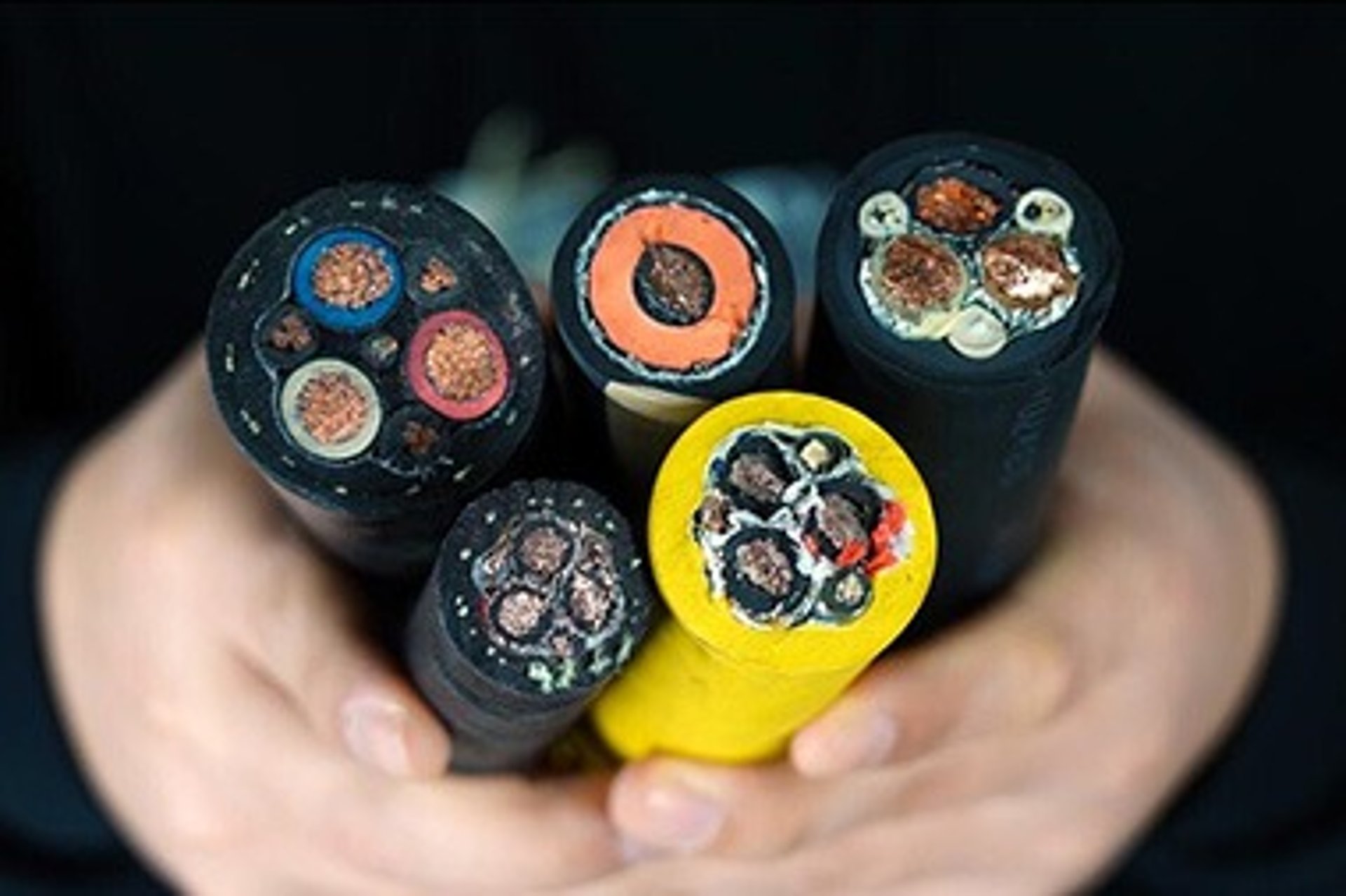
Core Arrangement | Three-core design, protective-earth conductor split into two, fiber-optic element in outer interstices | |
Inner Sheath | Basic material: EPR, Compound type: Special compound type 5GM3 | |
Reinforcement | Braid of polyester threads in a vulcanized bond between inner and outer sheath | |
Outer Sheath | Basic material: Synthetic elastomer compound (e.g., CR), Compound type: Special compound, Color: Red | |
Optical Fiber | Inner Core Diameter | 9 μm, 62.5 μm, or 50 μm |
Diameter Over Cladding | 125 μm | |
Diameter Over Coating | 250 μm | |
Designs | Up to 24 fibers available | |
Fiber G50/125 | Attenuation at 850 nm: <2.8 dB/km | |
Fiber G62.5/125 | Attenuation at 850 nm: <3.3 dB/km | |
Fiber E9/125 | Attenuation at 1310 nm: <0.4 dB/km | |
Fiber Coding | Color coding of fibers and buffering tube for identification | |
Fiber Covering | Hollow core with filling compound, Basic material: ETFE, Compound: 7YI 1, Natural color | |
Arrangement of Fiber Optic Elements | Six cores in one layer, laid-up around the supporting element | |
Chemical Parameters | Resistance to Fire | EN 60332-1-2, IEC 60332-1-2 |
Resistance to Oil | EN 60811-404, IEC 60811-404 | |
Weather Resistance | Unrestricted use outdoors and indoors, resistant to ozone, UV, and moisture | |
Thermal Parameters | Max. Permissible Temperature at Conductor | 90 °C |
Max. Short Circuit Temperature of Conductor | 250 °C | |
Ambient Temperature for Fixed Installation | Min: -40 °C, Max: 80 °C | |
Ambient Temperature in Fully Flexible Operation | Min: -35 °C, Max: 60 °C | |
Mechanical Parameters | Max. Tensile Load on Conductor | 20 N/mm² |
Max. Tensile Load During Acceleration | 25 N/mm² | |
Torsional Stress | 100 °/m | |
Bending Radii | Min: According to DIN VDE 0298 part 3 | |
Minimum Distance with S-type Directional Changes | 20 x D | |
Travel Speed | In operation: up to 60 m/min | |
Additional Tests | Reversed bending test, torsional stress test, roller bending test (type C) |

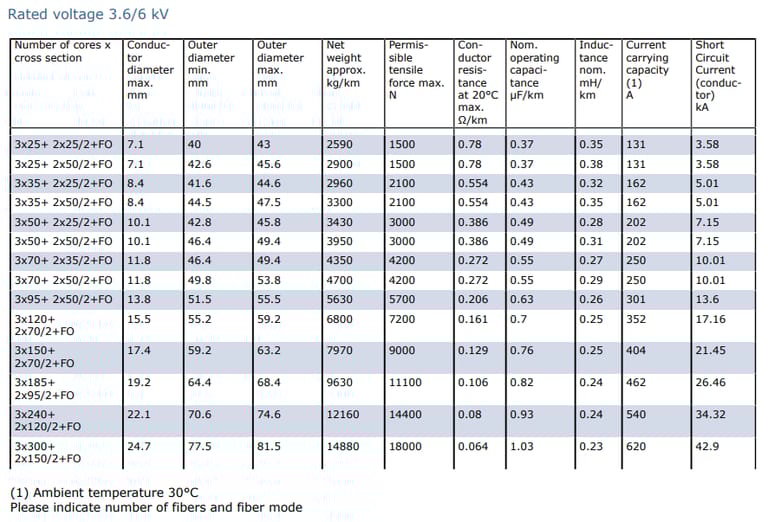
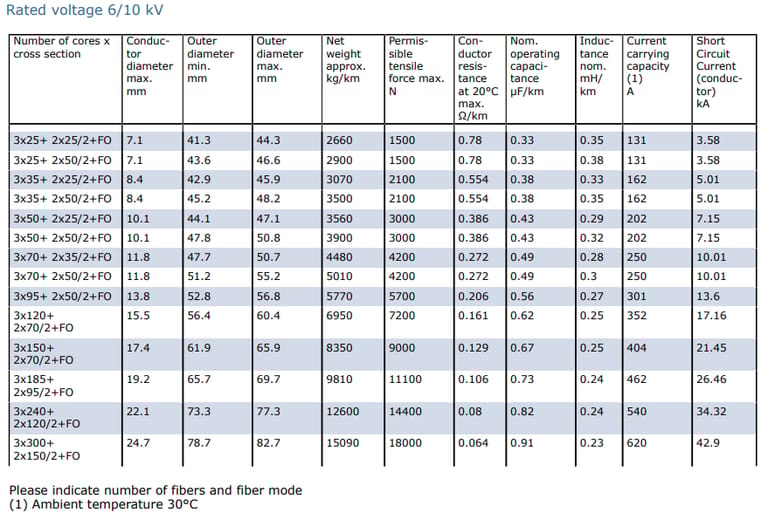
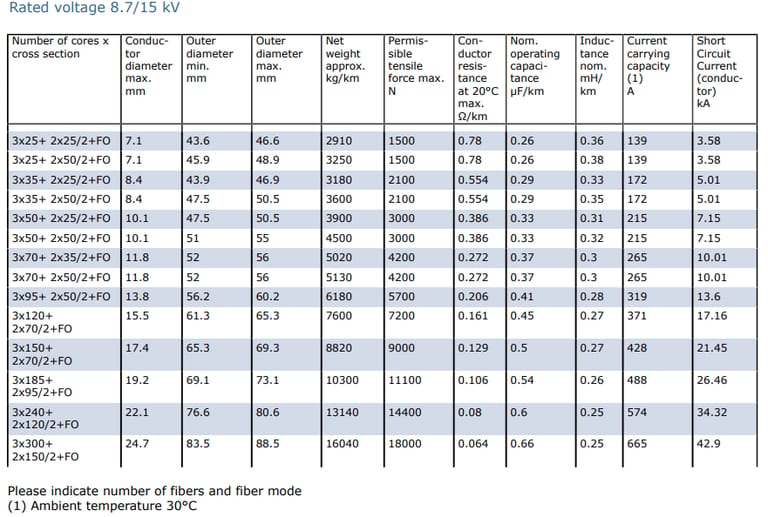
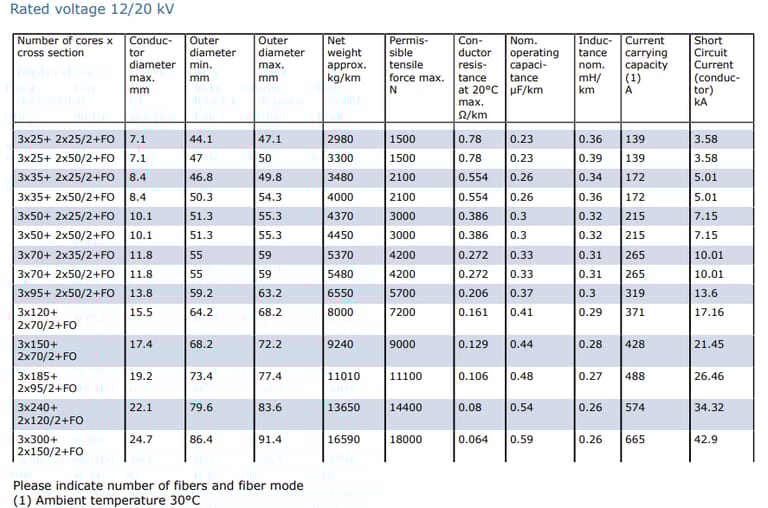
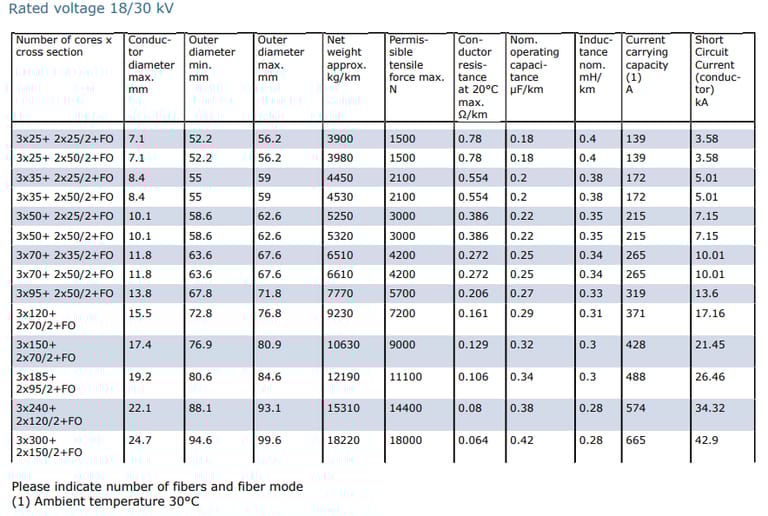
Rated Voltage 14/25 kV
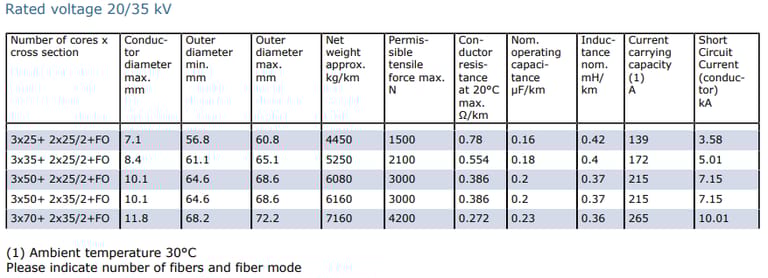
Number of Cores x Cross Section | Conductor Diameter Max (mm) | Outer Diameter Min (mm) | Outer Diameter Max (mm) | Net Weight Approx (kg/km) | Permissible Tensile Force Max (N) | Conductor Resistance at 20°C Max (Ω/km) | Nominal Operating Capacitance (µF/km) | Inductance Nominal (mH/km) | Current Carrying Capacity (A) | Short Circuit Current (Conductor) (kA) |
|---|---|---|---|---|---|---|---|---|---|---|
3x25 + 2x25/2 + FO | 7.1 | 47.9 | 50.9 | 3360 | 1500 | 0.78 | 0.2 | 0.38 | 139 | 3.58 |
3x25 + 2x50/2 + FO | 7.1 | 47.9 | 50.9 | 3440 | 1500 | 0.78 | 0.2 | 0.4 | 139 | 3.58 |
3x35 + 2x25/2 + FO | 8.4 | 51.5 | 55.5 | 4050 | 2100 | 0.554 | 0.22 | 0.36 | 172 | 5.01 |
3x35 + 2x50/2 + FO | 8.4 | 51.5 | 55.5 | 4130 | 2100 | 0.554 | 0.22 | 0.36 | 172 | 5.01 |
3x50 + 2x25/2 + FO | 10.1 | 55.2 | 59.2 | 4830 | 3000 | 0.386 | 0.26 | 0.34 | 215 | 7.15 |
3x50 + 2x50/2 + FO | 10.1 | 55.2 | 59.2 | 4900 | 3000 | 0.386 | 0.26 | 0.34 | 215 | 7.15 |
3x70 + 2x35/2 + FO | 11.8 | 58.8 | 62.8 | 5840 | 4200 | 0.272 | 0.28 | 0.32 | 265 | 10.01 |
3x70 + 2x50/2 + FO | 11.8 | 58.8 | 62.8 | 5950 | 4200 | 0.272 | 0.28 | 0.32 | 265 | 10.01 |
3x95 + 2x50/2 + FO | 13.8 | 64.4 | 68.4 | 7280 | 5700 | 0.206 | 0.31 | 0.31 | 319 | 13.6 |
3x120 + 2x70/2 + FO | 15.5 | 68.0 | 72.0 | 8530 | 7200 | 0.161 | 0.35 | 0.3 | 371 | 17.16 |
3x150 + 2x70/2 + FO | 17.4 | 73.4 | 77.4 | 10080 | 9000 | 0.129 | 0.37 | 0.29 | 428 | 21.45 |
3x185 + 2x95/2 + FO | 19.2 | 77.3 | 81.3 | 11630 | 11100 | 0.106 | 0.4 | 0.28 | 488 | 26.46 |
3x240 + 2x120/2 + FO | 22.1 | 84.7 | 89.7 | 14690 | 14400 | 0.08 | 0.45 | 0.27 | 574 | 34.32 |
3x300 + 2x150/2 + FO | 24.7 | 90.2 | 95.2 | 17310 | 18000 | 0.064 | 0.5 | 0.26 | 665 | 42.9 |
Notes:
Current carrying capacity is based on an ambient temperature of 30°C.
"FO" in the core configuration refers to fiber optic elements. The number of fibers and fiber mode (e.g., single-mode or multi-mode) are not specified in the provided data and would require additional information from the cable manufacturer or specification sheet to determine.
Understanding the Core of PROTOLON(M)-R FO:
Feichun PROTOLON(M)-R FO is a flexible medium voltage reeling cable tailored for high mechanical stresses, particularly in conjunction with mono-spiral or cylindrical reels. Its primary applications span large material handling equipment in open-cast mines, where it powers and connects excavators for digging, dumpers for hauling massive loads, and mobile crushers for on-site material processing. Beyond these, it's ideal for critical infrastructure in automated mining systems and control stations, where simultaneous power delivery and data transmission are non-negotiable.
What sets this cable apart is its unique value proposition. By combining medium voltage power conductors with fiber-optic elements, it simplifies installation and minimizes the number of cables needed on-site. This integration leads to exceptional durability under extreme conditions—think vibrations from heavy machinery, torsional stresses during reeling, and exposure to dust, moisture, and temperature swings. The fiber-optic capabilities ensure fast, reliable data transmission, supporting everything from remote monitoring to real-time control of mining equipment. In an era where mining operations demand optimized efficiency, this hybrid design reduces downtime, cuts infrastructure costs, and enhances overall reliability.
For instance, in open-cast mining, where equipment moves dynamically across vast terrains, the PROTOLON(M)-R FO's flexibility allows it to withstand repeated bending and acceleration without compromising performance. Its design supports high-speed operations, making it a go-to for environments where traditional cables might falter.
Performance Capabilities: Mechanical, Thermal, and Operational Excellence
Performance is where the PROTOLON(M)-R FO truly shines. Mechanically, it's built for the rigors of mining: it handles operating speeds up to 60 m/min and rewinding at 100 m/min, surviving reversed bending, torsional, and roller tests. This resilience is crucial in scenarios like excavator operations, where cables are constantly reeled and unreeled.
Thermally, the cable operates reliably with a maximum conductor temperature of 90°C and short-circuit tolerance up to 250°C. Its ambient temperature range spans -40°C to 80°C for fixed installations and -35°C to 60°C for flexible use, making it suitable for South Africa's varied climates—from the scorching summers in the Northern Cape's diamond mines to cooler underground conditions in gold shafts.
Environmentally, it boasts fire resistance (EN 60332-1-2), oil resistance (EN 60811-404), and weather-proofing against ozone, UV, and moisture. These features mitigate risks in mining sites prone to fires, chemical spills, or outdoor exposure.
Compliance, Certifications, and Environmental Resistance
Safety and standards are paramount in mining cable technology. The PROTOLON(M)-R FO adheres to DIN VDE 0250-813, with approvals like MSHA P-189-4 for mine safety, Russian Federation Fire Certificate, and GOST K/B for international compliance. These ensure it's deployable globally, including in regulated markets like South Africa, where mining authorities emphasize worker safety and environmental protection.
Its environmental resistance extends beyond basics: the outer sheath's CR compound repels oils and abrasives, while the overall design protects against moisture ingress, crucial in humid underground mines. This not only prolongs lifespan but also aligns with ESG (Environmental, Social, and Governance) trends, reducing waste from frequent replacements.
Installation, Maintenance, and Reliability
Installing the PROTOLON(M)-R FO is straightforward, with options for self-assembly using compatible material sets. However, fiber-optic termination demands precision—special tools and skills are required, so Feichun recommends factory termination for optimal performance, including custom connection dimensions.
Maintenance involves regular inspections: checking electrical and optical signals, assessing mechanical strain, and monitoring environmental exposure. With high-quality materials like EPR insulation and ETFE protection, the cable's longevity is impressive, often outlasting traditional alternatives through proper protocols.
Comparative Advantages Over Traditional Cables
Compared to conventional mining cables, the PROTOLON(M)-R FO stands out. Traditional setups require separate power and data lines, increasing complexity, weight, and failure points. This hybrid reduces cabling by up to 50%, lowering installation costs and simplifying reels. Its enhanced durability cuts downtime—vital when machinery idles cost thousands per hour. Fiber-optics provide superior bandwidth over copper data lines, enabling advanced applications like AI-driven predictive maintenance.
In terms of efficiency, the integrated design supports seamless automation, aligning with industry shifts toward smart mining. Reliability in harsh environments means fewer repairs, translating to cost savings and safer operations.