Anhui Feichun Special Cable Co.,Ltd Email: Li.wang@feichuncables.com
PROTOMONT EMV‑FC (N)SSHCOEU (‑45°C) 1 kV Frequency Converter Cable: Prysmian’s EMC‑Shielded EPR Rubber Solution for South African Mining VFD Drives and Heavy‑Duty Material Handling
PROTOMONT EMV‑FC (N)SSHCOEU (‑45°C) 0.6/1 kV is Prysmian’s fully integrated electrical‑mechanical‑environmental cable engineered specifically for variable frequency drive systems in mining and heavy industry. With VDE, MSHA, and EAC certifications, an operating range from –45°C to +80°C, waterproof performance up to 10 m depth, and advanced EMC shielding, it solves the four most common failure modes of standard cables. Field‑proven across South African mines, it delivers longer service life, fewer unplanned stops, and lower total ownership cost. Feichun offers a fully equivalent, cost‑effective alternative with faster delivery.
Li. Wang
6/24/202610 min read
Introduction
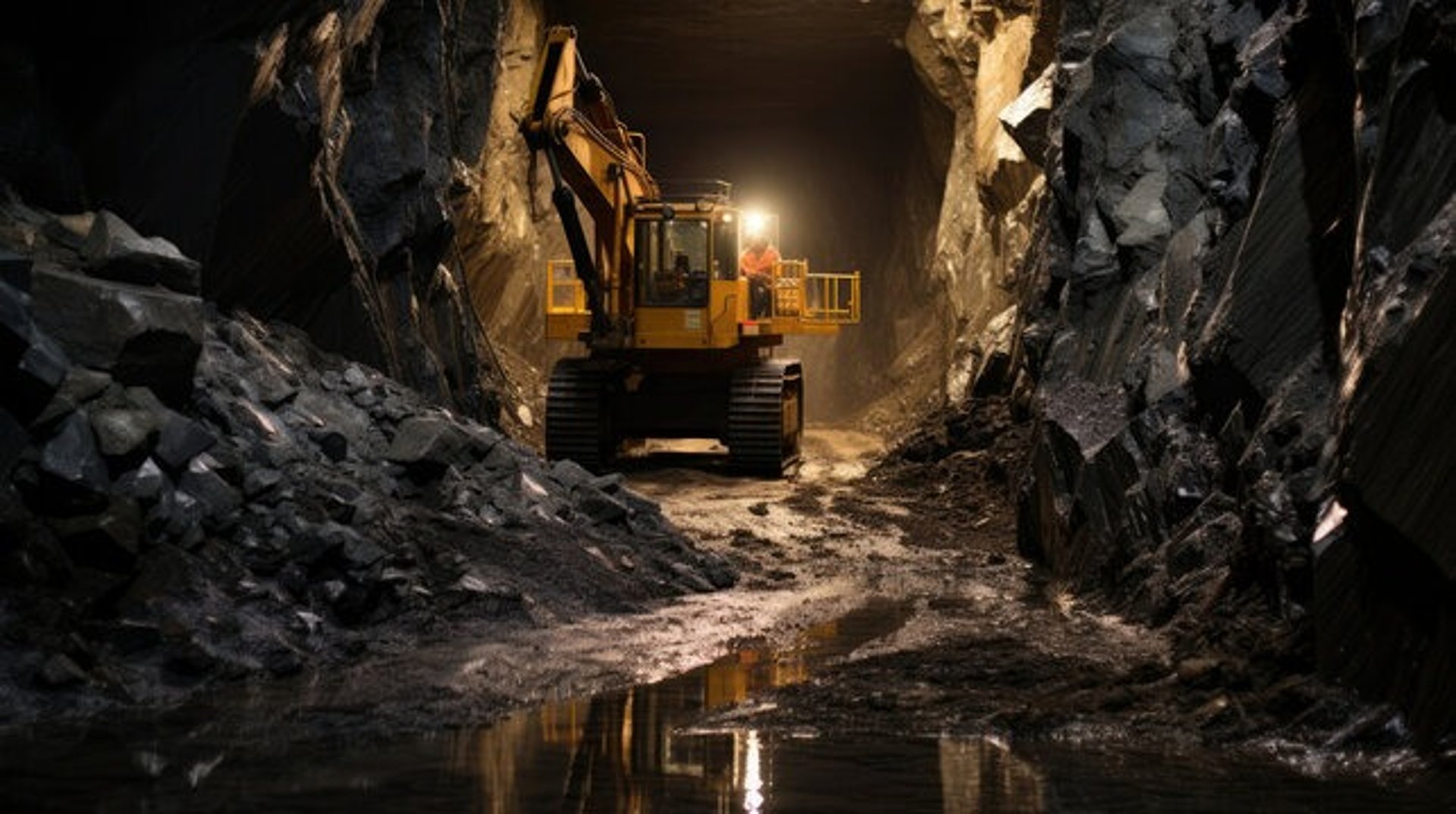
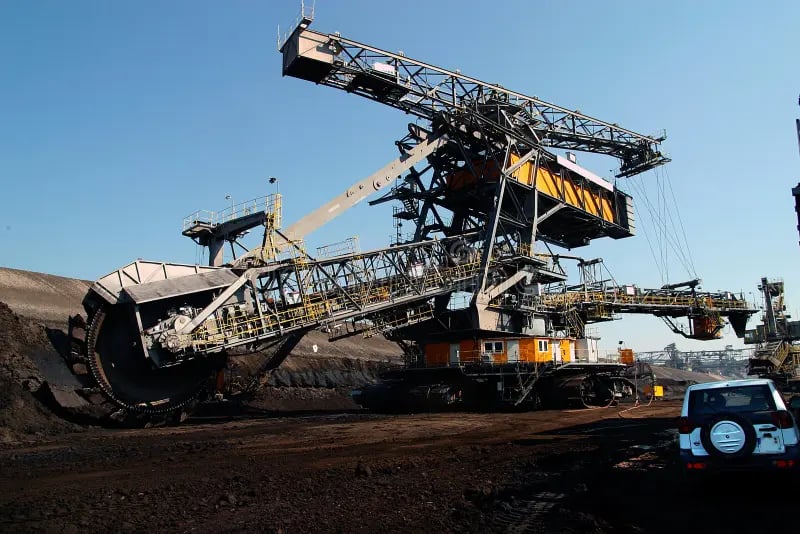
In South Africa, the mining sector remains the backbone of industrial activity, operating across some of the most demanding environments on Earth. From the high‑altitude Bushveld Complex and Limpopo manganese fields to the open‑pit coal mines of Mpumalanga and the coastal mineral operations in the Western Cape, equipment must withstand extreme temperature swings, heavy mechanical stress, constant movement, dust, moisture, and chemical exposure. Over the past two decades, variable frequency drives (VFDs) have become the standard for controlling conveyors, crushers, stackers, reclaimers, hoists, and dewatering pumps. VFDs improve energy efficiency, reduce mechanical wear, and allow precise speed regulation. However, they also introduce a new set of electrical challenges that ordinary power cables are not designed to handle.
The high‑speed switching of insulated‑gate bipolar transistors (IGBTs) in modern converters produces pulse‑width modulated (PWM) waveforms with very fast rise times, typically between 5 and 10 kV per microsecond. These steep voltage edges create reflected waves at the motor terminals, generating over‑voltages that can reach twice the nominal system level. They also induce high‑frequency common‑mode currents, electromagnetic interference (EMI), and bearing currents that cause premature motor failure, unstable control systems, and unplanned shutdowns. When combined with the mechanical and environmental conditions of South African mines, standard cables often fail within 6 to 12 months, leading to high replacement costs and lost production time.
This is where the PROTOMONT EMV‑FC (N)SSHCOEU (‑45°C) 0.6/1 kV cable enters the picture. Manufactured by Prysmian Group, it is not merely a stronger version of a standard cable, but a fully integrated electrical‑mechanical‑environmental solution designed from the ground up for VFD applications in heavy industry. It addresses four critical failure modes simultaneously: PWM‑induced voltage spikes and EMI, low‑temperature brittleness, mechanical fatigue from continuous movement, and water and chemical ingress. With rigorous compliance to international standards, a carefully engineered construction, and field validation in South African mining operations, it offers a reliable path to longer equipment life and lower operating costs.
Full Technical Specifications and Standards Compliance
Official Designation and Electrical Ratings
The complete designation is PROTOMONT EMV‑FC (N)SSHCOEU (‑45°C) 0.6/1 kV, where EMV‑FC denotes electromagnetic compatibility optimization for frequency converter use, and (‑45°C) indicates the minimum temperature for continuous flexible operation.
Rated voltage: U₀/U = 0.6/1 kV; also permitted for use at 640/1140 V, 0.7/1.2 kV AC, and 0.9/1.8 kV DC
AC test voltage: 5 kV applied for 5 minutes during factory acceptance testing
Conductor temperature: Continuous operation up to 90 °C; short‑circuit withstand up to 250 °C for a maximum of 5 seconds
Ambient temperature range: Fixed installation from –60 °C to +80 °C; dynamic, moving operation from –45 °C to +60 °C
Submersion capability: Suitable for permanent or temporary immersion in water up to 40 °C, at a maximum depth of 10 meters
Standards and Certifications
This cable is built and tested against the most demanding global specifications for mining and industrial use:
DIN VDE 0250 Part 812: The German standard for heavy‑duty rubber cables used in mining and heavy industry
MSHA P‑189‑3: Approval from the US Mine Safety and Health Administration, confirming suitability for underground and surface mining operations
EAC Certificate: Compliance with Eurasian technical regulations, allowing use across CIS and Eastern European markets
IEC 60332‑1‑2: Flame‑retardant performance, self‑extinguishing in vertical single‑core testing
IEC 60811‑404: Resistance to mineral oils and greases
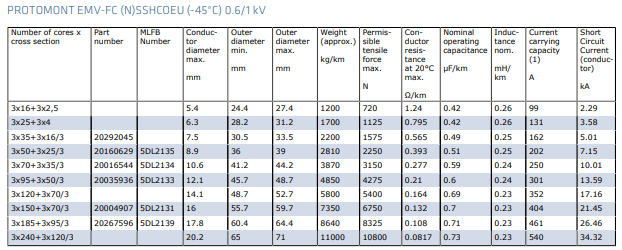
Cross‑Section Range and Electrical Data
Available in a full range of sizes to match motor power and system requirements:
All current ratings are based on rubber cable installation on a surface at 30 °C ambient, per VDE 0298‑4 Table 15.
Mechanical Performance
Maximum tensile load: 15 N/mm² of conductor cross‑section, allowing safe suspension and light dragging
Torsional resistance: ±25° per meter without damage, suitable for rotating or swinging equipment
Minimum bending radius: As specified in DIN VDE 0298‑3, typically 6 × outer diameter for fixed runs and 8 × outer diameter for continuous movement
Construction and Material Science: Layer‑by‑Layer Analysis
The performance of this cable begins with its construction. Every layer is selected and arranged based on electrical theory, material science, and decades of mining experience.
Design Philosophy
The core principle is symmetry, isolation, and protection. Standard cables use a single large earth core and simple insulation, which creates electrical imbalance and poor noise dissipation. The PROTOMONT EMV‑FC design ensures uniform electric fields, controlled impedance, effective EMI containment, and mechanical flexibility, all while resisting water, oil, ozone, and temperature extremes.
Layer‑by‑Layer Breakdown
1. Conductor
Material: Finely stranded, tinned copper conductor, Class 5 per DIN VDE 0295 / IEC 60228
Function: Carries load current while maintaining flexibility
Scientific basis: Fine stranding creates thousands of small strands that slide past one another during bending, reducing fatigue and extending cycle life. Tinning prevents oxidation, improves corrosion resistance in damp or acidic mine atmospheres, and ensures stable contact resistance over time.
2. Insulation
Material: PROTOLON, ethylene‑propylene rubber (EPR), compound designation 3GI3
Function: Electrical isolation between conductors and ground
Scientific basis: EPR is a cross‑linked thermoset polymer with excellent dielectric properties. It has a low dielectric constant (~2.7) and low dissipation factor, meaning it generates minimal heat under high‑frequency PWM voltages. It also withstands repetitive impulse voltages up to 12 kV, resists ozone and moisture absorption, and remains elastic at low temperatures, unlike PVC or standard PE.
3. Core Arrangement and Grounding System
Structure: Three main power cores laid up in a helical formation, with three smaller protective earth conductors placed symmetrically in the outer gaps between the power cores
Function: Balances electrical fields and provides high‑frequency grounding
Scientific basis: Splitting the earth connection into three equal segments and distributing them around the circumference creates geometric symmetry. This reduces common‑mode impedance, equalizes capacitance, and provides multiple low‑resistance paths for high‑frequency noise to reach ground. The design minimizes circulating currents and reduces shaft voltage and bearing damage in motors.
4. EMC Shield
Material: Concentric braid of tinned copper wires, coverage typically greater than 85 %
Function: Contains electromagnetic emissions and blocks external interference
Scientific basis: Operates on the Faraday cage principle. The braid provides a continuous conductive path around the cable, reflecting and absorbing high‑frequency energy. Unlike foil or copper tape, braiding remains flexible during repeated bending and torsion, avoiding cracking or separation. Tinning improves corrosion resistance and maintains electrical continuity over the cable’s lifetime.
5. Inner Sheath
Material: Vulcanized EPR rubber, compound GM1B
Function: Separates the shield from the outer jacket, prevents abrasion, and adds an extra moisture barrier
Scientific basis: Acts as a cushioning layer that prevents the sharp edges of the braid from penetrating the outer jacket during flexing. It is electrically non‑conductive but water‑repellent, helping to maintain insulation resistance even in wet environments.
6. Outer Sheath
Material: PROTOFIRM, synthetic elastomer based on chloroprene rubber (CR), compound 5GM5, black
Function: Ultimate protection against mechanical damage, weather, oils, and chemicals
Scientific basis: CR has a balanced molecular structure that offers high tensile strength, excellent abrasion resistance, and elasticity over a wide temperature range. It remains flexible at –50 °C and does not soften excessively at +80 °C. It resists UV radiation, ozone, mineral oils, and microbial growth, making it suitable for open‑air use in all seasons.
How This Construction Solves Four Key Problems
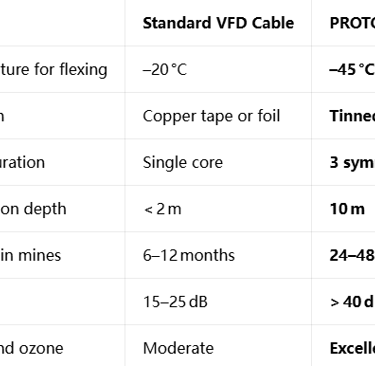
PWM interference and voltage reflection: Symmetric layout, optimized L/C ratio, and high‑coverage braid reduce standing waves and EMI by more than 40 dB compared to standard cables
Low‑temperature brittleness: The EPR‑CR elastomer system retains elasticity well below –45 °C, preventing cracking in winter conditions
Dynamic fatigue: Class 5 stranding, balanced lay lengths, and torsion‑resistant construction allow millions of bending cycles without failure
Water and chemical aging: Water‑repellent insulation and sealed sheath design maintain integrity even at 10 m depth
Applications and South African Mining Case Studies
Official Application Scope
The cable is approved for both fixed installation and fully flexible service, specifically designed for:
Mining: Open‑pit and underground operations, including conveyors, crushers, stackers, reclaimers, hoists, and dewatering pumps
Material handling: Festoon systems, cable booms, and moving connections between fixed and mobile structures, such as between upper and lower carriages
Construction: Tower cranes, concrete pumps, and drilling rigs operating in remote or exposed sites
Submerged service: Permanent or temporary immersion in water up to 40 °C, at depths up to 10 meters
Typical South African Operating Environment
South Africa’s mines present a unique combination of challenges:
Temperature extremes: Summer highs often reach 40 °C in the Bushveld; winter nights can drop to –15 °C in high‑altitude areas
Moisture and water: Rainwater collection, seepage, and dewatering pits mean cables are frequently submerged or wet
Mechanical stress: Continuous movement, drag over rock or steel, and torsion from swinging booms
Electrical environment: Long cable runs, often 100 m or more, and dense automation systems that are sensitive to EMI
Real‑World Field Performance
Case 1: Amandelbult Platinum Mine, North West Province
This large‑scale operation uses VFD‑controlled conveyors and crushers across a wide site. Previously, standard screened cables failed every 4 to 6 months. Inspections showed sheath cracking in cold weather, insulation degradation from reflected waves, and EMI triggering random PLC shutdowns.
After switching to PROTOMONT EMV‑FC cables:
Service life increased to 24–36 months
EMI reduced by over 40 dB, eliminating control system disturbances
Motor bearing replacement intervals extended from 8,000 to over 20,000 operating hours
Total maintenance costs for cabling fell by approximately 40 %
Case 2: Manganese Mine, Limpopo Province
In this operation, dewatering pumps are installed in sumps where water depth ranges from 3 to 8 meters. Standard cables developed water ingress within 18 months, causing insulation resistance to drop below safe limits.
Following installation of the EMV‑FC variant:
Insulation resistance remained above 100 MΩ·km after three years of continuous submersion
No jacket swelling or deterioration was observed
Termination boxes remained dry and secure despite fluctuating water levels
Case 3: Coal Stacker‑Reclaimer, Mpumalanga
This machine operates continuously, with the cable moving in a festoon system through 150–200 bending cycles per day and torsion up to ±20° per meter. Temperatures range from –10 °C in winter to +42 °C in summer.
Performance results:
No sheath cracking or braid breakage after more than 24 months
Consistent impedance prevented voltage spikes at the motor terminals
Drive efficiency improved by 2–3 %, reducing energy consumption
Engineering Principles and Performance Advantages
Electrical Engineering
The electrical design is built around the behavior of PWM waveforms. The distributed inductance and capacitance are carefully balanced to match the characteristic impedance of the motor, reducing reflection coefficients. The symmetrical grounding system minimizes common‑mode voltage, which is the main driver of bearing currents and EMI. The braided shield acts as a low‑impedance path for high‑frequency noise, diverting it to ground before it can radiate or interfere with other equipment.
Mechanical Engineering
The mechanical rating of 15 N/mm² is chosen to provide a safety factor against the weight of the cable itself plus any minor drag forces. The torsion rating of ±25°/m ensures that even when the cable is twisted during operation, the internal structure remains stable. The bending radius follows VDE recommendations, balancing compact installation with long‑term durability.
Material Science
EPR insulation offers superior electrical and thermal stability compared to PVC, which becomes brittle below –20 °C and softens above 70 °C. CR outer sheaths provide the best combination of flexibility, toughness, and chemical resistance. The combination is proven to last 2 to 3 times longer than standard rubber‑jacketed cables in heavy industrial environments.
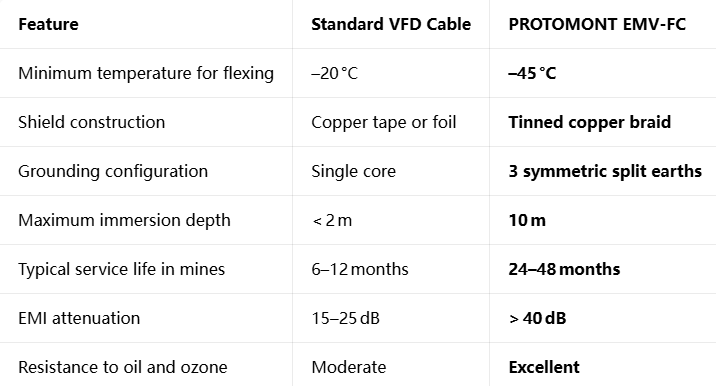
Comparison with Conventional Cables
Feichun Equivalent Alternative: Full Compatibility and Benefits
While Prysmian’s PROTOMONT EMV‑FC is a benchmark product, long lead times from European manufacturing and currency fluctuations can present challenges for South African operators. This is where Feichun EMV‑FC (N)SSHCOEU (‑45°C) serves as a direct, fully compliant alternative.
Why It Is an Equivalent Replacement
Identical construction: Class 5 tinned copper conductors, EPR insulation (3GI3), tinned copper braid shield, EPR inner sheath (GM1B), and CR outer sheath (5GM5)
Same ratings: 0.6/1 kV, temperature range –45 °C to +80 °C, 10 m water depth, ±25°/m torsion, 15 N/mm² tensile limit
Same standards: Manufactured to DIN VDE 0250‑812, IEC 60332‑1‑2, and IEC 60811‑404, compatible with MSHA and EAC requirements
Key Advantages
100 % interchangeable: No changes to cable trays, glands, or terminations are required
Cost savings: Landed price is typically 20–30 % lower than imported European equivalents
Faster delivery: Lead times of 4–6 weeks versus 12–16 weeks for overseas production
Regional support: Stock and technical support available in South Africa
Proven performance: Successfully installed at sites in Rustenburg, Mpumalanga, and KwaZulu‑Natal
Sizing, Selection, and Installation Guidelines
How to Select the Correct Cross‑Section
Current rating: Use the table provided, applying derating factors for ambient temperature above 30 °C, grouping with other cables, or installation in ducts
Voltage drop: Keep below 3 % for full‑load runs to maintain motor torque and efficiency
Short‑circuit withstand: Confirm the selected cross‑section can handle the fault current for the protection device operating time
Mechanical needs: For long suspended runs, ensure the conductor area is sufficient to stay within the 15 N/mm² tensile limit
Installation Best Practices
Bending radius: Minimum 6 × OD for fixed runs, 8 × OD for moving or dynamic applications
Tension limit: Do not exceed 15 N/mm² during pulling or installation
Water immersion: Use properly sealed glands and terminations; do not exceed 10 m depth
EMC routing: Maintain separation of at least 200 mm between VFD cables and signal or communication cables
Grounding: Connect the shield at both ends, or at the drive end only in very long runs, to avoid ground loops
Frequently Asked Questions
Can this cable be used with 690 V or 1140 V motors?
Yes, it is explicitly permitted for use at 640/1140 V and 0.7/1.2 kV AC, covering most medium‑low voltage mining systems.
Is it suitable for permanent underwater use?
Yes, provided the water temperature does not exceed 40 °C and depth remains below 10 m. Terminations must be sealed to prevent water entry.
How long is the expected service life?
Under normal operating conditions, it typically delivers 5–8 years of service, compared to 2–3 years for standard cables.
Can Feichun cables be used as a direct replacement?
Yes, they follow identical construction and standards, so they can be installed without modification to drawings or specifications.
Do I need special glands or connectors?
Standard heavy‑duty rubber cable glands suitable for the outer diameter are sufficient. Use compression‑type glands to maintain sealing and shield continuity.
Conclusion
The PROTOMONT EMV‑FC (N)SSHCOEU (‑45°C) 0.6/1 kV cable represents a shift from simply selecting cables by voltage and size to choosing solutions designed for the specific electrical, mechanical, and environmental realities of modern mining. It is not just a more robust cable; it is an integrated system solution that addresses the root causes of failure in VFD applications.
With its rigorous compliance to international standards, carefully engineered construction, and material science optimized for both electrical performance and long life, it solves the four most common failure modes: PWM interference, low‑temperature brittleness, mechanical fatigue, and water ingress. Its record in South African mines confirms that it reduces downtime, cuts maintenance expenditure, and lowers total cost of ownership over the full operational life.
For operators looking to improve reliability while managing budgets, the Feichun equivalent offers the same performance, compliance, and fit, with better pricing and shorter delivery times.
If you would like to receive full datasheets, pricing, or discuss your specific application requirements, please contact the Feichun technical and sales team: Li.wang@feichuncables.com

Email Address: Li.wang@feichuncables.com
© 2025. All rights reserved.
One-click to Quickly Contact
Products
Contact
Company
Location:
Building A Private Science and Technology Park, Hefei Economic and Technological Development Zone, Anhui Province, China
Heat Resistant Cable
WhatsApp: +86 17333223430
Social Media: