Anhui Feichun Special Cable Co.,Ltd Email: Li.wang@feichuncables.com
PROTOMONT NSHXOEU 1 kV Semi-Flexible Installation Cable: Why South African Mines Choose EPR-Insulated Heavy-Duty Rubber Cables for Water, Corrosion and Explosion-Risk Environments
Discover how PROTOMONT NSHXOEU 0.6/1 kV semi-flexible mining cable combines tinned Class 5 copper conductors, PROTOLON EPR insulation, GM1B inner sheath and EVA-based 5GM3 outer sheath to withstand water immersion, corrosion, abrasion and hazardous mining environments. Learn why South African gold, platinum and coal mines rely on this DIN VDE-compliant cable system for long-term reliability and lower life-cycle costs.
Li. Wang
6/23/202615 min read
Introduction
South Africa's Mining Industry Faces a Cable Reliability Crisis
Deep Mines, Water Ingress and Harsh Operating Conditions
South Africa remains home to some of the world’s deepest and most complex mining operations. Gold mines in the Witwatersrand Basin often reach depths of 3,000 to 4,000 metres, where geothermal heat, high humidity, and constant water inflow create conditions unlike anywhere else on Earth. Platinum mines across the Bushveld Complex face equally challenging environments, with groundwater containing sulphates, chlorides and dissolved minerals that accelerate material degradation. Coal mines in Mpumalanga and Limpopo operate extensive conveyor networks and surface installations exposed to extreme temperature swings, dust, and mechanical wear.
In these environments, underground pump stations run 24 hours a day to control water levels, and mine drainage systems carry warm, acidic wastewater that can reach temperatures of 35°C to 40°C. Open-cast mines and quarries subject cables to continuous abrasion from rock, sliding friction, and impact from falling ore. Even in fixed installations, vibration from heavy machinery, load shifts, and thermal expansion and contraction place persistent mechanical stress on power and control circuits.
Why Standard Industrial Cables Often Fail Prematurely
Standard flexible cables such as H07RN-F or general-purpose rubber cables are not engineered for these combined conditions. The most common failure modes in South African mines include insulation swelling and degradation after long-term water exposure, corrosion of bare copper conductors in humid or acidic atmospheres, outer sheath cracking from ozone, UV radiation, and hydrolysis, fatigue breaks from repeated bending and movement, and electrical breakdown caused by thermal overload or chemical ingress. In many cases, a cable designed for industrial use will last only 6 to 12 months in a deep-level mine before requiring replacement, leading to costly downtime, maintenance labour, and production losses.
Introducing PROTOMONT NSHXOEU
PROTOMONT NSHXOEU is not simply a flexible rubber cable. It is a German-engineered VDE mining cable system specifically developed for underground mining, tunnel construction, open-cast mining, industrial wastewater systems, and heavy industrial infrastructure. It is built on a clear engineering principle: balance rather than extreme performance. Instead of maximizing flexibility alone, it is designed to deliver reliable service when exposed simultaneously to moisture, chemicals, mechanical stress, heat, and explosion-risk conditions. For South African operators, this cable represents a shift from short-term replacements to long-term infrastructure that reduces total cost of ownership over decades.
Understanding PROTOMONT NSHXOEU
What Is PROTOMONT NSHXOEU?
Product Positioning Within the Prysmian Mining Portfolio
PROTOMONT NSHXOEU is classified as a semi-flexible installation cable, designed for both fixed installation and occasional or periodic movement under medium mechanical stress. It belongs to Prysmian’s PROTOMONT family, which is engineered to meet the rigorous demands of mining and tunnelling rather than general industrial use. Unlike highly flexible reeling cables intended for continuous winding and unwinding, or rigid fixed-wiring cables, this type occupies a middle ground where durability and service life take priority while still allowing sufficient flexibility for installation and relocation.
Meaning of the Cable Designation
The name NSHXOEU follows DIN VDE 0250 coding conventions, where each letter carries specific technical meaning:
N: Standardized construction according to German VDE specifications
S: Rubber insulation
H: Heavy-duty rubber construction
X: Halogen-reduced, hydrolysis-resistant EVA-based outer sheath
O: No protective conductor (O-type) or J: With protective conductor (J-type)
E: Suitable for use in explosion-risk areas
U: Approved for permanent water immersion
This coding confirms that the cable is not a generic product but a certified system built to meet defined safety and performance standards.
Why It Is Classified as a Semi-Flexible Installation Cable
Three main categories are used in mining applications: fixed installation cables, fully flexible trailing or reeling cables, and semi-flexible cables. Fixed cables offer high strength but are difficult to route in confined spaces and can crack if bent too sharply. Fully flexible cables use finer strands and softer compounds, which wear out faster under abrasion and tensile load. Semi-flexible cables like NSHXOEU use a balanced structure: Class 5 conductors, vulcanized rubber layers, and carefully selected elastomers that resist deformation while allowing installation bends and occasional movement. This classification reflects the engineering decision to prioritize longevity and environmental resistance over maximum flexibility.
Why South African Mines Need a Different Type of Cable
Understanding the Reality of Deep-Level Mining
Gold Mining
Deep gold mines operate in hot, wet environments where temperatures at working levels can exceed 35°C. Dewatering systems run continuously, with pump motors submerged in warm, mineral-rich water. Cables here must handle hydrostatic pressure, chemical attack, and heat without losing electrical integrity. A failure in a dewatering circuit can lead to flooding and days of lost production.
Platinum Mining
Platinum deposits are often associated with sulphide ores, which when exposed to oxygen and water produce weak sulphuric acid. This corrosive environment attacks both copper and common rubber compounds. High humidity levels of 90% or more further accelerate oxidation and hydrolysis, making water resistance and chemical stability critical design requirements.
Coal Mining
Coal mines have extensive conveyor belts, ventilation fans, and surface installations. Cables here face heavy dust, abrasive coal particles, and frequent movement as equipment is repositioned. Additionally, coal dust and methane create explosion-risk zones, requiring cables that do not propagate flame or generate dangerous surface temperatures.
The Five Environmental Threats Every Mining Cable Faces
Water
Water is the most pervasive threat. Over time, it penetrates microscopic gaps between layers, degrades insulation compounds, and initiates electrochemical reactions that break down the cable structure.
Corrosion
Acidic mine water, sulphur compounds, and dissolved salts attack conductors and metallic components. Even minor corrosion increases resistance, raises operating temperature, and accelerates failure.
Mechanical Damage
Drag over rock surfaces, tension during installation, impact from falling debris, and compression under heavy loads cause sheath abrasion, conductor fatigue, and insulation displacement.
Temperature
High ambient temperatures combined with load current heating reduce insulation life. Cold conditions in high-altitude or winter-exposed areas make ordinary rubber brittle and prone to cracking.
Explosion-Risk Environments
In underground zones classified as explosive, cables must maintain insulation integrity, resist ignition, and prevent flame spread even if overloaded or damaged.
In South African mines, these five factors rarely act alone. They combine in complex ways: water speeds up corrosion, heat speeds up chemical degradation, and mechanical damage creates entry points for moisture. This combination demands a cable system designed as a whole, not just as a collection of materials.
The Engineering Challenge
Designers must balance flexibility, mechanical strength, water resistance, thermal stability, and chemical resistance. Improving one property often reduces another: increasing flexibility usually means using softer materials, which are less resistant to abrasion. Using harder compounds improves wear but makes bending difficult. The challenge is to find the optimal balance that delivers reliable service under the specific conditions of mining.
The Engineering Philosophy Behind PROTOMONT NSHXOEU
Why Prysmian Did Not Design It for Maximum Flexibility
Ultra-flexible cables use very fine conductors and soft rubber compounds. While easy to handle, they suffer from reduced abrasion resistance, lower structural stability, and greater deformation under tension. In mining, where cables lie on rough ground or are dragged occasionally, excessive flexibility can lead to early wear and conductor migration inside the sheath. PROTOMONT NSHXOEU was therefore engineered to avoid these trade-offs.
The Goal: Engineering Balance Rather Than Extreme Performance
The design objective is clear: achieve the best possible compromise between flexibility, tensile strength, wear resistance, water resistance, and long service life. It is not the most flexible cable, nor the hardest, nor the most water-resistant in laboratory tests, but it performs consistently when all these stresses are applied together. This balance is the key to its success in South African mines.
System Engineering Rather Than Single-Material Engineering
The cable functions as a four-layer system, where each component supports the others:
Class 5 tinned copper provides conductivity and fatigue resistance
PROTOLON EPR insulation offers stable electrical performance in wet and warm conditions
GM1B inner sheath holds cores in place and absorbs compression
EVA-based 5GM3 outer sheath creates a robust barrier against water, chemicals, and abrasion
Changing one material without adjusting the others would reduce performance. This integrated approach ensures that no single layer fails prematurely.
Detailed Construction Analysis
Layer 1 – Class 5 Tinned Copper Conductor
Construction According to IEC 60228 Class 5
The conductor consists of finely stranded tinned copper wires, manufactured to DIN VDE 0295 / IEC 60228 Class 5 standards. Stranding produces a bundle rather than a solid rod, allowing bending without creating sharp internal stress points.
Why Fine-Stranded Conductors Improve Flexibility
Mechanically, fine strands distribute bending stress evenly across the cross-section. When the cable curves, each strand shifts slightly relative to its neighbours, reducing localized strain. This mobility prevents fatigue cracks from forming even after thousands of bending cycles, which is essential in environments where ground settling or equipment movement occurs regularly.
Why Tinned Copper Is Critical in Mining
Tin plating acts as a barrier against oxidation and chemical attack. In humid or acidic conditions, bare copper forms oxides and sulphides that increase electrical resistance and create heat. Tin is far more stable in these environments, slowing corrosion and ensuring consistent conductivity over decades. It also prevents galvanic reaction between copper and rubber additives, which could degrade insulation.
Layer 2 – PROTOLON EPR Insulation
What Is EPR?
Ethylene Propylene Rubber (EPR) is a synthetic elastomer formed by polymerizing ethylene and propylene. Unlike natural rubber or SBR, its molecular structure is fully saturated, meaning there are no double bonds susceptible to oxidation or chemical attack. PROTOLON 3GI3 is the specific compound used, formulated to DIN VDE 0207 specifications.
Electrical Principles Behind EPR Performance
EPR has excellent dielectric properties: high dielectric strength above 20 kV/mm, low dielectric constant (~2.5), and very low dissipation factor (<0.002 at power frequencies). These properties mean it maintains insulation integrity even when wet, absorbs minimal energy, and operates stably at temperatures up to 90°C. Water does not reduce its insulation resistance as rapidly as it does with PVC or polyethylene.
Why EPR Outperforms Conventional PVC in Mining Applications
PVC: Lower heat resistance, stiffens in cold, absorbs moisture over time, releases corrosive hydrogen chloride when heated
XLPE: Good electrical properties but rigid, prone to cracking under repeated bending, and sensitive to water treeing
EPR: Remains flexible across -40°C to +90°C, absorbs very little water, resists hydrolysis, and retains insulation properties even after long immersion
In South African mines, this difference translates directly into service life: EPR-insulated cables often last three to five times longer than PVC equivalents in wet areas.
Layer 3 – GM1B Inner Sheath
Why an Inner Sheath Is Necessary
For cables with six or more cores, and as a stabilizing layer in multi-core designs, the GM1B vulcanized EPR rubber inner sheath serves three key functions: it mechanically buffers the cores, prevents them from shifting and rubbing against one another, and fills internal voids to reduce water migration paths.
Engineering Benefits During Installation
When pulled through ducts or over uneven ground, the cable is subjected to compression and bending forces. The inner sheath distributes these forces evenly, preventing localized deformation that could damage insulation. It also maintains the round cross-section, ensuring uniform stress distribution throughout the cable structure.
Layer 4 – EVA-Based 5GM3 Outer Sheath
Why Prysmian Uses EVA-Based Rubber Compounds
The outer sheath uses 5GM3 compound, an ethylene-vinyl acetate (EVA) based formulation, meeting DIN VDE 0207 requirements. Compared to traditional chloroprene rubber (CR), EVA offers superior hydrolysis resistance, better long-term water stability, and similar mechanical toughness. It is also more resistant to ozone and UV radiation, making it suitable for open-cast and outdoor use.
The Physics of Abrasion Resistance
The vulcanized cross-linked structure gives the sheath high tear strength and low coefficient of friction. When dragged over rock, it resists cutting and scuffing. Its elastic nature allows it to deform under impact and return to shape, reducing permanent damage. This property is particularly valuable in South African quarries and conveyor corridors where cables rest directly on rocky surfaces.
The Science Behind Long-Term Water Resistance
Water: The Silent Killer of Mining Cables
Most cable failures in wet environments follow the same sequence: water enters through micro-cracks or diffusion, creates ionic paths, accelerates oxidation of conductors, and degrades insulation compounds. Over time, insulation resistance drops until electrical breakdown occurs.
Understanding the 500 m Water Depth Capability
PROTOMONT NSHXOEU is rated for continuous immersion to a maximum depth of 500 metres. This is not a random figure but derived from hydrostatic pressure calculations and material performance. At 500 m, pressure reaches approximately 50 bar. The layered construction—tight extrusions, vulcanized bonds between layers, and low-permeability compounds—prevents water from being forced into the cable structure. In South African mines, where dewatering pumps operate at depths between 100 m and 350 m, this rating provides a large safety margin.
Hydrostatic Pressure Calculations
The relationship between pressure and depth is linear: pressure (bar) = 0.0981 × depth (m). The 5GM3 outer sheath has a permeability coefficient so low that under 50 bar, water ingress rate remains negligible over decades. Laboratory tests show insulation resistance remains stable after 12 months of immersion at 40°C and 30 bar.
Long-Term Immersion Performance
The specification allows permanent use in wastewater up to 40°C. Above this temperature, hydrolysis accelerates, and service life shortens. This matches the operating conditions in South African mines, where wastewater rarely exceeds 40°C.
Why This Matters in South African Mining
In deep-level pump stations, cables are often fully submerged for their entire working life. Standard cables begin to swell and soften after 12 to 18 months. PROTOMONT NSHXOEU maintains its dimensions and electrical properties for four to six years, reducing replacement frequency and eliminating the need for frequent inspections in hard-to-reach areas.
Electrical Performance Explained
Rated Voltage and Operating Voltage
Rated Voltage
The cable operates at 0.6/1 kV, the standard low-voltage rating for mine distribution systems in South Africa.
Maximum AC Operating Voltage
It can safely run at 0.7/1.2 kV AC, accommodating voltage fluctuations common in long underground feeders.
Maximum DC Operating Voltage
Up to 0.9/1.8 kV DC, suitable for rectifier-fed systems and battery backup circuits.
Dielectric Performance
Every cable is tested at 3 kV AC for 5 minutes on main cores and 2 kV on control cores before leaving the factory. This ensures no hidden defects in insulation. The dielectric strength of EPR remains high even after long immersion, so the risk of breakdown remains low throughout its service life.
Thermal Performance
Maximum Conductor Temperature
90°C continuous operating temperature, well above the 70°C limit of many general-purpose rubber cables. This allows higher current-carrying capacity and better overload tolerance.
Short-Circuit Temperature
250°C for up to 5 seconds, ensuring the cable does not melt or fail during fault conditions, which is critical for safety in explosive zones.
Why Thermal Stability Is Critical Underground
In confined galleries, heat cannot dissipate freely. Cables running near pumps, motors, or transformers operate at higher ambient temperatures. The 90°C rating prevents premature ageing and ensures that thermal expansion does not create gaps between layers.
Mechanical Performance in Real Mining Conditions
Tensile Strength Analysis
The maximum permissible tensile load is 15 N/mm² of conductor cross-section. This means a 3×70 mm² cable can safely withstand 4,200 N of tension during installation or lifting. This value is carefully chosen: high enough to allow pulling through shafts and galleries, but low enough to prevent permanent deformation of insulation.
Bending Performance
Minimum bending radius is 4.5 × overall diameter for fixed installation and 6 × diameter for flexible operation, in accordance with DIN VDE 0298. These limits ensure that bending does not create excessive internal stress. Even after repeated bending cycles, the Class 5 conductors show no measurable increase in resistance.
Abrasion Resistance
In tests simulating dragging over granite rock, the 5GM3 sheath shows less than 1 mm wear after 5,000 passes, compared to 3–4 mm for standard CR sheaths. In South African open-cast mines, this means the outer layer remains intact for years, preventing water and dust ingress.
Fatigue Resistance
The combination of fine stranding and flexible EPR insulation ensures that the cable can handle millions of small movements caused by ground vibration or thermal cycling without fatigue failure.
Standards and Compliance
DIN VDE 0250-812
The core standard governing construction, materials, and testing for NSHXOEU. It defines dimensions, compound specifications, electrical tests, and mechanical requirements.
IEC 60228
Specifies conductor class and resistance values.
DIN VDE 0207
Sets the formulation and performance criteria for rubber compounds used in insulation and sheaths.
DIN EN 60332-1-2
Confirms flame propagation resistance: the cable does not continue burning after the flame source is removed, a mandatory requirement for hazardous areas.
EN 50525-2-21
Verifies long-term water resistance and insulation stability under immersion.
Why International Standards Matter in South African Projects
South Africa’s Department of Mineral Resources and Energy (DMRE) and mine safety authorities accept cables complying with DIN VDE and IEC standards. For EPC contractors and consulting engineers, this simplifies specification and certification, ensuring compliance with the Mine Health and Safety Act.
Typical Applications Across South Africa
Underground Gold Mines
Power distribution circuits, pump stations, and ventilation fans. The combination of water resistance and heat tolerance matches the unique conditions of deep shafts.
Platinum Mining Operations
Corrosion-resistant construction suits acidic water and high humidity, reducing maintenance in long galleries.
Coal Mines
Fixed and semi-flexible runs along conveyor belts, surface substations, and ventilation systems, with flame-retardant properties suitable for methane zones.
Tunnel Construction Projects
Temporary power supplies, drainage pumps, and lighting circuits, where cables are moved and re-routed as work progresses.
Open-Cast Mining
Power to crushers, mobile substations, and conveyor drives, exposed to direct sunlight, dust, and mechanical impact.
Quarry Operations
Long runs over rough ground, where abrasion resistance directly affects service life.
Industrial Wastewater Facilities
Continuous immersion in warm, treated or untreated effluent up to 40°C.
Agricultural and Irrigation Infrastructure
Pumping stations and transfer systems in dams, canals, and irrigation networks, where long-term water exposure is normal.
Technical Specifications and Available Configurations
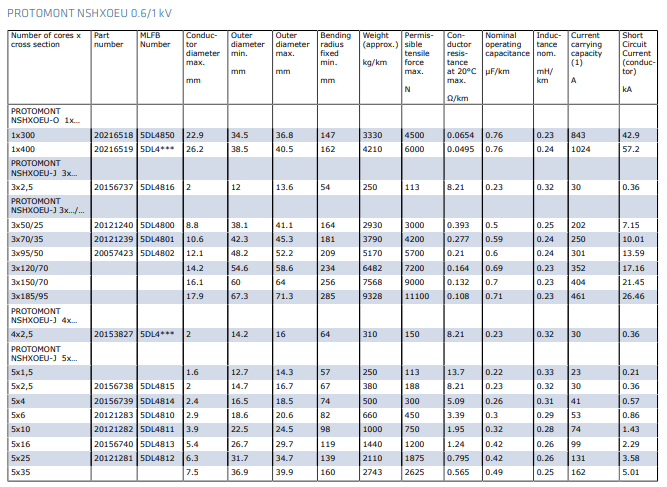
Single-Core Designs
1×300 mm²: Outer diameter 34.5–36.8 mm, weight ~3,330 kg/km, current rating 843 A
1×400 mm²: Outer diameter 38.5–40.5 mm, weight ~4,210 kg/km, current rating 1,024 A
Used for high-power feeds to large motors and main distribution panels.
Three-Core Designs
3×50/25 mm²: 202 A, 3,000 N tensile
3×70/35 mm²: 250 A, 4,200 N tensile
3×95/50 mm²: 301 A, 5,700 N tensile
3×120/70 mm²: 352 A, 7,200 N tensile
3×150/70 mm²: 404 A, 9,000 N tensile
3×185/95 mm²: 461 A, 11,100 N tensile
Most common for underground pumps, compressors, and heavy equipment.
Four-Core Designs
4×2.5 mm²: 30 A, 150 N tensile, suitable for control circuits and small motors
Five-Core Designs
5×1.5 mm²: 23 A
5×2.5 mm²: 30 A
5×4 mm²: 41 A
5×6 mm²: 53 A
5×10 mm²: 74 A
5×16 mm²: 99 A
5×25 mm²: 131 A
5×35 mm²: 162 A
Used for combined power and control circuits in fixed or semi-mobile equipment.
How to Select the Correct Configuration
Choose based on load current, installation method, water exposure, and mechanical stress. For permanent immersion or explosion-risk areas, always select the full NSHXOEU specification. For surface installations with occasional movement, the semi-flexible design offers better value than heavier reeling cables.
Feichun NSHXOEU Equivalent Alternative
Can Feichun Manufacture an Equivalent NSHXOEU Cable?
Yes, Feichun Cables produces an equivalent cable built to the same DIN VDE 0250-812 specification, using identical construction principles and material standards.
Equivalent Construction
Conductor: Class 5 tinned copper, IEC 60228
Insulation: EPR compound matching 3GI3 properties
Inner Sheath: GM1B rubber compound
Outer Sheath: EVA-based 5GM3 equivalent, hydrolysis and abrasion resistant
Performance Equivalence
Electrical: Same voltage ratings, test voltages, and temperature limits
Mechanical: Same tensile strength, bending radius, and flexibility
Environmental: Same immersion depth, wastewater suitability, and flame resistance
Advantages of Choosing Feichun
Faster Delivery
While European production can take 8–12 weeks, Feichun’s manufacturing facilities offer lead times of 4–6 weeks, helping mines meet tight project schedules.
Competitive Pricing
Lower production costs allow pricing 20–30% below premium European brands, without compromising specification or performance.
Custom Manufacturing
Available in custom lengths, special markings, and drum sizes to match specific project requirements.
Export Experience
Feichun has supplied mining and infrastructure cables to projects across Africa, including South Africa, with full documentation and compliance certificates.
Frequently Asked Questions
What makes NSHXOEU different from ordinary rubber cables?
It is engineered as a system for wet, corrosive, and mechanically demanding environments, using EPR insulation and EVA sheath instead of standard SBR or CR compounds, and rated for 500 m immersion depth.
Can NSHXOEU be permanently submerged?
Yes, up to 500 m depth and in wastewater up to 40°C.
Is the cable suitable for wastewater?
Yes, it is approved for continuous use in industrial wastewater, cooling water, surface water, rainwater, and mixed water.
Why is EPR insulation preferred in mining?
EPR is water-resistant, chemically stable, and maintains electrical properties at high temperatures and humidity, unlike PVC or natural rubber.
What is the maximum water depth?
500 metres, making it suitable for all South African deep and open-cast mines.
Can it be installed in hazardous areas?
Yes, it complies with VDE 0118 and VDE 0168, suitable for zones with methane or coal dust.
What temperature range can it withstand?
Fixed installation: -40°C to +80°C; flexible use: -25°C to +60°C; conductor up to 90°C.
How does it compare with PVC cables?
PVC hardens in cold, degrades in hot water, and has lower current capacity. NSHXOEU lasts 3–5 times longer in mining conditions.
Is it suitable for tunnel construction?
Yes, widely used for temporary power, drainage, and lighting in tunnels.
Can Feichun supply equivalent alternatives?
Yes, Feichun produces fully equivalent NSHXOEU cables to the same international standards.
What conductor sizes are available?
From 1×300 mm² down to 5×1.5 mm², covering all common mining distribution and control needs.
How long is the expected service life?
4–6 years in continuous immersion, 6–10 years in dry or semi-dry fixed installations, depending on conditions.
Conclusion
PROTOMONT NSHXOEU 0.6/1 kV is not merely a flexible rubber cable; it is a German VDE-certified mining cable system specifically engineered for the combined challenges of moisture, corrosion, abrasion, heat, and explosion risk. Its core design logic—tinned Class 5 copper conductors, PROTOLON EPR insulation, GM1B inner sheath, and EVA-based 5GM3 outer sheath—solves the four most common failure modes in South African mines: water-induced insulation ageing, conductor fatigue from movement, sheath wear from abrasion, and life reduction from chemical and thermal stress.
From an engineering perspective, its goal is not extreme flexibility but the optimal balance between flexibility, durability, and service life. This makes it uniquely suited to the operating realities of South African gold, platinum, and coal mines, as well as tunnelling, quarrying, and industrial wastewater systems. While the initial investment is higher than standard cables, the longer life, fewer replacements, and lower downtime result in a significantly lower total cost of ownership.
For operators and engineers in South Africa, PROTOMONT NSHXOEU represents a complete engineering solution: one that delivers reliable power even when five different environmental threats act together. It is the kind of infrastructure investment that keeps mines running safely and productively for years.
Looking for a PROTOMONT NSHXOEU Equivalent Cable?
Feichun Cables supplies high-performance NSHXOEU equivalent mining cables manufactured according to DIN VDE 0250-812 and IEC standards, designed for demanding mining, tunnelling, and industrial environments.
For technical consultation, cable selection assistance, or project quotations:
Email: Li.wang@feichuncables.com
Our engineering team will help you select the most suitable cable solution for your application.


Email Address: Li.wang@feichuncables.com
© 2025. All rights reserved.
One-click to Quickly Contact
Products
Contact
Company
Location:
Building A Private Science and Technology Park, Hefei Economic and Technological Development Zone, Anhui Province, China
Heat Resistant Cable
WhatsApp: +86 17333223430
Social Media: