Anhui Feichun Special Cable Co.,Ltd Email: Li.wang@feichuncables.com
PROTOMONT NSSHÖU 0.6/1kV DIN VDE 0250-812 Flexible Rubber Cable: Why It's Engineered for Extreme Mechanical Stress, Oil, Water & UV Exposure
PROTOMONT NSSHÖU 0.6/1kV flexible rubber cable, manufactured to DIN VDE 0250-812, is not simply an upgraded version of standard power cables — it is a fully engineered system built on advanced material science, mechanical design and electrical principles. Designed to perform reliably in the harshest environments found across South Africa’s open-cast mines, quarries, heavy construction sites and underwater operations up to 500 metres deep, this cable outperforms ordinary alternatives in resistance to abrasion, chemical attack, oil, ozone, ultraviolet radiation and extreme temperatures. This comprehensive guide explains every layer of its construction, the scientific theories behind its material selection, how it solves common failure modes, full technical specifications, correct selection and installation practices, and why Feichun’s equivalent version delivers identical performance at a better price and with faster delivery — essential reading for engineers, procurement specialists and technical managers in mining, industry and heavy engineering.
Li. Wang
6/4/202617 min read
Introduction
South Africa is home to some of the most demanding industrial and mining environments in the world. From the coalfields of Mpumalanga and the platinum mines of Limpopo to deep gold operations and coastal dredging projects, equipment and infrastructure must withstand constant exposure to heavy loads, rough handling, abrasive dust, chemical contaminants, wide temperature swings and prolonged contact with water or aggressive fluids. For power distribution systems, this environment creates a major challenge: standard flexible cables often fail within just a few months, leading to unplanned downtime, expensive replacements and significant safety risks.
This is where PROTOMONT NSSHÖU 0.6/1kV flexible rubber cable changes the picture. Many industry professionals initially view it as just a “heavy-duty” or “reinforced” version of ordinary trailing cables. That perception is incorrect. This cable is not an enhanced standard product — it is a purpose-engineered system where every single component, from the innermost conductor to the outermost sheath, has been designed based on fundamental principles of materials science, mechanical engineering and electrical theory. It is built specifically to operate reliably where standard cables simply cannot survive, serving as the backbone of power supply for mining, construction, water management and heavy industry applications across Southern Africa and globally.
This article explores exactly what makes this cable different. It examines the standards it meets, the science behind its materials, the logic of its layered structure, the reasons why ordinary cables fail and how PROTOMONT overcomes those weaknesses. It also provides practical guidance on selection, installation and procurement, including details on Feichun’s fully equivalent version which offers the same high performance with commercial advantages for South African buyers.
Understanding PROTOMONT NSSHÖU 0.6/1kV: Definition, Standards and Certification
Basic Definition and Voltage Rating
PROTOMONT NSSHÖU 0.6/1kV is a heavy-duty flexible rubber-sheathed power cable designed for both fixed installation and frequent flexible use. The designation itself follows German industrial standards and reveals key characteristics:
0.6/1kV indicates the rated voltage, meaning it is designed for use in three-phase or single-phase systems with a phase-to-earth voltage of 600 volts and a phase-to-phase voltage of 1000 volts. The maximum permissible operating voltage is 0.7/1.2kV AC or 0.9/1.8kV DC, and every cable undergoes a factory AC test at 3kV for 5 minutes to verify insulation integrity.
NSSHÖU defines the construction and performance class within the DIN VDE system: rubber-insulated, rubber-sheathed, heavy-duty, flexible, suitable for outdoor use and resistant to oil.
Unlike general-purpose cables, this product is built strictly to DIN VDE 0250-812, the specific standard for heavy flexible rubber cables for mining and similar applications. It also complies with related standards including DIN VDE 0298-3 for installation guidelines, DIN VDE 0295 / IEC 60228 for conductor design, and DIN VDE 0207 which defines the exact rubber compound formulations used in insulation and sheaths.
For operations in South Africa, these German standards align closely with local requirements in SANS 1520-1, the specification for mining cables, ensuring full compliance with national safety and performance regulations. In addition, the cable carries international approvals including MSHA (for US mining, widely recognised globally), GOST and TR certifications for Eastern European markets, MA China certification, and fire resistance classification according to EN 60332-1-2 and IEC 60332-1-2. This means it is accepted for use in explosion-hazardous areas, underground operations and industrial facilities throughout the region.
Key Performance Parameters at a Glance
Before diving into design details, it is useful to summarise the performance limits that define its suitability for extreme environments:
Temperature range: From -40°C to +80°C for fixed installations, and -25°C to +60°C when subjected to continuous movement or flexing. This covers freezing highveld winters as well as intense heat found in mines or near furnaces.
Mechanical strength: Maximum tensile load of 15 N/mm², resistance to torsional stress up to 100° per metre, and bending radius as low as 4.5 times the overall diameter for fixed use or 6 times for moving applications.
Environmental resistance: Permanently submersible to 500 metres depth in wastewater, industrial water, cooling water, surface water and rainwater; limited use in groundwater and seawater; resistant to ozone, ultraviolet light, moisture, mineral oils and greases.
Thermal capability: Continuous conductor temperature of 90°C, withstanding short-circuit peaks up to 250°C for up to 5 seconds without damage.
These parameters are not arbitrary figures — each is the result of deliberate engineering choices explained in the following sections.
Not Just an Upgraded Cable: A Complete Engineered System
One of the most important distinctions to understand is that PROTOMONT NSSHÖU is not created by simply adding more copper or making the rubber sheath thicker than a standard cable. While such changes might improve performance slightly, they do not address the fundamental reasons why cables fail in harsh conditions.
Instead, this product is designed as an integrated system built on three core pillars: materials science, mechanical engineering and electrical engineering. Every layer interacts with the others to create performance that is greater than the sum of its parts.
The Three Pillars of Design
Materials Science
Every material selected for this cable is chosen based on its molecular structure and chemical properties. For insulation and sheathing, polymers are selected that have saturated chemical bonds — meaning they do not easily react with oxygen, ozone, acids, alkalis or oils. The choice of tinned copper follows principles of electrochemistry to prevent corrosion in wet environments. Nothing is chosen without a clear scientific reason.
Mechanical Engineering
The physical structure is optimised to manage stress. Fine-stranded conductors distribute bending forces so no single wire bears excessive load. The arrangement of cores inside the cable balances torsional forces so the cable does not twist apart when wound on a drum. Layer thicknesses are calculated to absorb impact, abrasion and tensile forces without transferring damaging stress to the insulation or conductors.
Electrical Engineering
Insulation thickness and material properties are selected to maintain stable electrical fields, minimise power loss and prevent partial discharge — a hidden cause of premature failure in standard cables. Earthing arrangements are designed not just to conduct fault current, but to ensure continuity and safety even if part of the system is damaged.
Why This Matters in South African Operations
The difference in real-world performance is dramatic. In open-cast mines in Limpopo or North West province, standard trailing cables typically require replacement every 3 to 6 months due to mechanical damage or environmental degradation. PROTOMONT NSSHÖU cables installed in exactly the same locations regularly remain in service for 2 to 5 years, and longer when used in fixed installations. This is not a marginal improvement — it represents a 400% to 600% increase in service life, directly translating to reduced downtime, lower maintenance labour costs and far fewer safety incidents associated with damaged cabling.
This performance gap exists because ordinary cables are designed for normal environments. PROTOMONT is designed specifically for environments where “normal” does not exist.
Layer-by-Layer Structure: Design, Materials and Engineering Principles
To understand how the system works, we examine each layer from the centre outwards, explaining what it is made of, why it is made that way, and the scientific principles applied.
Conductor: Tinned Copper, Class 5
Description and Material
The current-carrying core is made of high-purity electrolytic copper (E-Cu57), finely stranded into Class 5 construction according to DIN VDE 0295 / IEC 60228. Every strand is coated with a uniform layer of tin, typically at least 2 micrometres thick. Cross-sections range from 1.5mm² up to 300mm², with 3, 4 or 5-core arrangements common for mining applications.
Engineering Principles
Flexibility and Fatigue Resistance: Class 5 stranding uses many very fine wires rather than a few thick ones. According to the principles of structural mechanics, bending stress is proportional to the distance from the centre of the conductor. Fine strands reduce this distance, meaning each individual wire experiences much lower stress when the cable is bent or flexed. This prevents metal fatigue and breakage — the primary reason why solid or coarse-stranded conductors fail in moving applications.
Corrosion Protection: Tinning follows electrochemical theory. Copper on its own is prone to oxidation and galvanic corrosion when exposed to moisture, mine water or aggressive chemicals. Tin is a more noble metal in the electrochemical series, forming a stable oxide layer that protects the underlying copper even when fully submerged or buried in wet soil. This extends conductor life significantly compared to bare copper.
Electrical Performance: High-purity copper ensures low electrical resistance, keeping power losses low and preventing overheating even at full current load.
Why Not Alternative Designs?
Aluminium conductors are lighter but have higher resistance and are far more prone to fatigue and connection problems. Coarse-stranded copper is cheaper but lacks the flexibility needed for repeated movement. Bare copper is fine indoors but fails rapidly in outdoor or wet South African conditions.
Insulation: PROTOLON EPR, Compound 3G13
Description and Material
Each conductor is individually insulated with PROTOLON, a proprietary ethylene propylene rubber (EPR) compound formulated as type 3G13 to DIN VDE 0207 standards. Unlike thermoplastics such as PVC, EPR is a thermoset rubber — it is cured during manufacture into a permanently elastic state.
Engineering Principles and Material Science
Chemical Stability: The most critical property of EPR is its fully saturated molecular structure. Polymers like natural rubber or styrene-butadiene rubber contain double carbon bonds in their molecular chains. These bonds are weak points where oxygen, ozone, ultraviolet radiation and chemicals can attack, causing the material to harden, crack or degrade. EPR has no double bonds, making it chemically inert. This explains its excellent resistance to weathering, ozone and ageing — essential for long-term outdoor use on South African mines where high UV levels accelerate degradation of inferior materials.
Electrical Properties: EPR has a low dielectric constant of approximately 2.3 and a very low loss factor. From electrical theory, this means it does not store excess electrical energy or dissipate energy as heat. It maintains stable insulation resistance even at high temperatures and high humidity, and prevents the formation of damaging partial discharges within the insulation wall — a common failure mode in PVC-insulated cables operating above 70°C.
Thermal Performance: The material is rated for continuous operation at 90°C, compared to 70°C or lower for standard rubber or PVC. It retains its elasticity and insulating properties even at these elevated temperatures, and can withstand short-circuit temperatures up to 250°C without melting or flowing.
Mechanical Elasticity: With an elongation at break exceeding 300% and high recovery characteristics, EPR insulation stretches under tension or impact but returns to its original shape without cracking. This is vital when the cable is dragged over rock or crushed by heavy machinery.
Why Not PVC or Natural Rubber?
PVC is rigid, becomes brittle below -10°C and softens excessively above 70°C. It cannot handle the temperature or mechanical range required. Natural rubber offers flexibility but degrades rapidly in ozone and sunlight — often failing within 12 months outdoors.
Core Arrangement and Special Earthing System
Description and Design
Insulated cores are laid up together in a balanced circular formation. Standard configurations include 3-phase plus earth (NSSHÖU-J) or without earth (NSSHÖU-O). A unique and critical design feature applies to cross-sections 50mm² and larger: the protective earth conductor is split into three equal segments, placed in the outer gaps between the phase conductors.
Engineering Principles
Symmetry and Stress Distribution: A balanced circular layout ensures that electrical fields are uniform around the cable, avoiding high-stress points that could lead to breakdown. Mechanically, it ensures that when the cable is bent, twisted or compressed, forces are distributed evenly across all cores rather than concentrating on one side.
Split Earth Conductor Logic: In standard cables, a single earth conductor is located in the centre or alongside phases. If it breaks or corrodes, safety is lost completely. By splitting the earth into three parts and placing them around the circumference:
Redundancy: Even if one segment is damaged or broken, the other two maintain a continuous path to earth.
Larger Contact Area: The earth system has a total cross-sectional area equal to or greater than 50% of the phase conductor area, ensuring rapid clearing of fault currents as required by SANS wiring rules.
Mechanical Protection: Located in the gaps, the earth segments are supported and protected from excessive pressure while maintaining maximum surface contact with the surrounding materials.
This design is a key safety feature particularly relevant to South African regulations governing electrical installations in hazardous areas (SANS 60079 series).
Inner Sheath: EPR Compound GM1B
Description and Material
For multi-core designs, an inner sheath of vulcanised EPR rubber compound GM1B (DIN VDE 0207) is applied over the laid-up cores. It is not used in single-core constructions.
Engineering Principles
Thermal Compatibility: The inner sheath uses the same base material as the insulation. This ensures identical thermal expansion coefficients. When the cable heats up during operation or cools down at night, all layers expand and contract together. This eliminates delamination — a common problem in cables with mixed materials where gaps form between layers, allowing water ingress or electrical tracking.
Cushioning and Sealing: It fills all voids between cores, creating a solid circular assembly. This prevents cores from shifting or rubbing against each other during bending or twisting, and forms an effective barrier against moisture travelling longitudinally along the cable.
Mechanical Stability: It binds the cores into a single unit, improving tensile strength and torsional stability of the complete cable.
Outer Sheath: CPE Compound 5GM5 — The First Line of Defence
Description and Material
The outermost layer is made of chlorinated polyethylene (CPE), formulated as compound 5GM5 according to DIN VDE 0207, and coloured bright yellow for high visibility in mines or construction sites. This is the most critical layer for survival in harsh environments.
Material Science and Engineering Principles
Chemical Inertness: Chlorination of polyethylene modifies its molecular structure, introducing chlorine atoms into the polymer chain. This creates a material that is resistant to almost all chemicals found in mining and industrial environments: mineral oils, greases, acids, alkalis, mine wastewater, seawater and cleaning agents. Unlike neoprene or natural rubber, CPE does not swell, soften or dissolve when in contact with oil — a property tested to EN 60811-404 / IEC 60811-404.
Mechanical Toughness: With a tensile strength of at least 12 MPa and elongation at break over 400%, CPE combines high strength with extreme flexibility. It resists abrasion, cutting, tearing and crushing far better than standard rubber. Its low water permeability (less than 10⁻¹² g/(s·m·Pa)) means it acts as a waterproof membrane, allowing permanent submersion to 500 metres without water reaching the insulation.
Environmental Resistance: The saturated polymer backbone gives excellent resistance to ozone and ultraviolet radiation. Unlike many rubbers that crack and crumble within months in the South African sun, CPE maintains its physical properties for 10 years or more of outdoor exposure. It also meets flame-retardant requirements of EN 60332-1-2, self-extinguishing if ignited and preventing fire spread.
Why Not Other Sheath Materials?
Neoprene (CR) is oil-resistant but swells in hot oil and ages poorly. Natural rubber is cheap but has almost no chemical resistance and ages rapidly. PVC is rigid and cracks at low temperatures. Only CPE provides the complete balance of mechanical, chemical and environmental properties needed.
Why Standard Cables Fail — And How PROTOMONT Solves These Problems
To fully appreciate the value of this engineered system, we must look at the failure mechanisms that plague ordinary cables in heavy industry and mining, and understand exactly how PROTOMONT’s design defeats them.
Mechanical Damage
Why Standard Cables Fail
Standard flexible cables typically have:
Low tensile strength (8–10 N/mm²), meaning they stretch permanently or break when pulled over rough ground or lifted with heavy loads.
Low torsional resistance (less than 40° per metre), leading to untwisting, core misalignment and internal short circuits when wound on drums or dragged.
Large minimum bending radius (8 to 12 times diameter), causing stress concentrations and insulation cracking when bent tightly.
In South African mines, cables are frequently dragged across rock, run over by vehicles or subjected to rough handling. Standard designs cannot absorb this energy.
Damage occurs quickly, exposing conductors and creating shock or fire hazards.
How PROTOMONT Solves It
High tensile strength of 15 N/mm²: A 50% increase over standard designs means the cable can handle much higher pulling forces without damage.
100°/m torsion resistance: Balanced construction and elastic materials allow extreme twisting without structural failure.
Small bending radius (4.5×D fixed, 6×D moving): Optimized layer thicknesses and elastic materials distribute stress evenly, preventing fatigue even after thousands of bends.
High toughness CPE sheath: Absorbs impact and abrasion energy rather than breaking or wearing through.
Environmental Degradation
Why Standard Cables Fail
Common materials in standard cables (PVC, natural rubber, basic SBR rubber) suffer from:
Temperature sensitivity: Hardening and brittleness below -15°C, softening and flowing above 70°C. In winter on the highveld or summer heat in Limpopo, performance drops drastically.
Chemical attack: Swelling or dissolving in contact with oil, grease or acidic mine water; rapid oxidation and cracking due to ozone and UV radiation.
Water ingress: High permeability leads to water reaching the conductor, causing corrosion and reducing insulation resistance over time.
These effects are often invisible until failure occurs, but they drastically shorten service life.
How PROTOMONT Solves It
Wide temperature range (-40°C to +80°C): EPR and CPE remain elastic and functional in both freezing and hot conditions.
Chemically inert polymers: Saturated molecular structures resist attack by almost all chemicals found on site. Oil resistance is permanent, not just surface protection.
Near-impermeable barrier: CPE sheath and vulcanised construction prevent water penetration even at 500 metres depth. Materials are tested to EN 50525-2-21 for water resistance.
Electrical and Safety Failure
Why Standard Cables Fail
Weaknesses in standard designs include:
Poor insulation quality leading to breakdown at high temperatures or high humidity.
Inadequate earthing arrangements that break under mechanical stress, removing fault protection.
Uneven electrical fields causing partial discharge and gradual insulation erosion.
In explosion-risk areas common in South African mining, these failures can lead to catastrophic events.
How PROTOMONT Solves It
High-performance EPR insulation: Stable electrical properties prevent breakdown and partial discharge.
3-way split earth conductor: Provides redundancy and reliable fault current path even if damaged.
Symmetric core design: Balanced electrical fields reduce stress and extend insulation life.
Short Service Life and High Cost
The combined effect of the above issues means standard cables may last only 6 to 12 months. The cost of replacement labour, downtime and lost production far exceeds the initial purchase price difference.
PROTOMONT’s engineered design extends life to 3–5 years in heavy use, delivering a much lower total cost of ownership.
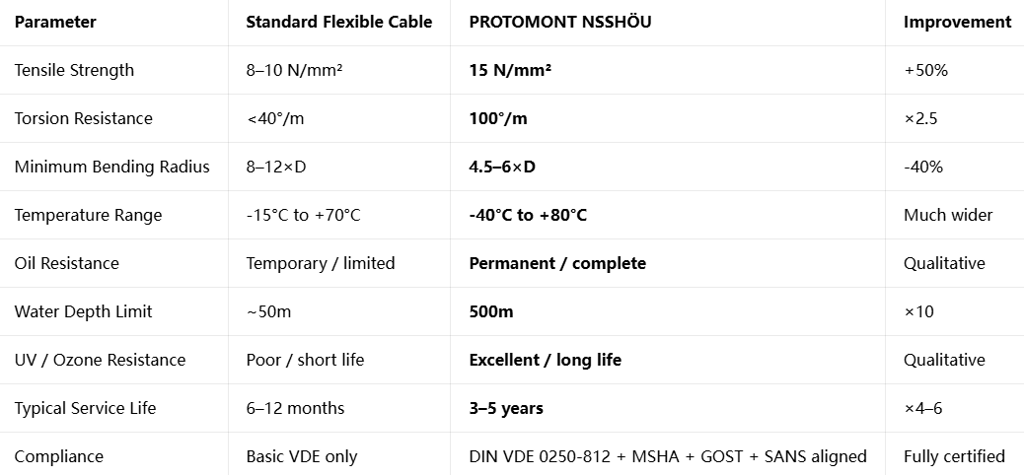
Performance Comparison: PROTOMONT vs Standard Mining Cables
The following comparison summarises the technical and practical differences:
Real-World Example
At a platinum mine in Limpopo, maintenance records showed that standard trailing cables required replacement every 4 months due to sheath damage and conductor corrosion. After switching to PROTOMONT NSSHÖU, the same cables have remained in service for over 3.5 years with no signs of degradation. The mine has reduced cable inventory costs by 70% and eliminated 12 major downtime events annually related to power cable failure.
Applications and Operating Conditions
PROTOMONT NSSHÖU 0.6/1kV is purpose-built for environments where reliability is critical and conditions are extreme. Its design aligns perfectly with the needs of South African industry.
Primary Application Areas
Mining Operations: Open-cast and underground mines, including coal, platinum, gold and diamond extraction. Used for drilling rigs, conveyor systems, dewatering pumps, loaders, shovels and mobile substations. Meets requirements for explosion-hazardous zones defined in SANS 60079.
Quarries and Stone Processing: High abrasion resistance handles dusty, rocky environments and heavy machinery movement.
Heavy Construction: Tower cranes, earthmoving equipment, site power distribution and temporary installations in road, dam and building projects.
Water and Wastewater: Permanent submersion applications including mine dewatering, dredging, port operations, water treatment and sewage pumping stations.
Industrial Plants: Steel mills, chemical facilities, smelters and refineries where exposure to heat, oil and chemicals is common.
Environmental Limits and Guidelines
Water Use: Safe for permanent use in wastewater up to 40°C and depth 500m; suitable for industrial water, cooling water, surface water and rainwater. Use in groundwater or seawater is possible but should be evaluated based on local water chemistry. In highly aggressive water, additional material testing is recommended.
Temperature: Strict adherence to limits ensures maximum life. Above 40°C water temperature, life expectancy reduces gradually.
Mechanical Handling: Maximum tensile load must not exceed 15 N/mm² of conductor cross-section. Bending radius limits apply strictly.
Alignment with South African Standards
The cable’s compliance with DIN VDE 0250-812 ensures it meets or exceeds the requirements of SANS 1520-1, the South African National Standard for mining cables. It is recognised by mining safety authorities and specified by major operators including Anglo American, BHP and Sibanye-Stillwater.
Full Technical Specifications
Electrical Data
Rated voltage: 0.6/1 kV (600/1000 V)
Maximum operating voltage: 0.7/1.2 kV AC; 0.9/1.8 kV DC
AC test voltage: 3 kV for 5 minutes
Conductor temperature: 90°C continuous; 250°C short-circuit
Electrical parameters (typical):
Conductor resistance: per IEC 60228 (e.g. 1.21 Ω/km for 16mm²)
Capacitance: approx 0.22–0.76 µF/km depending on size
Inductance: approx 0.23–0.33 mH/km
Size Range and Configurations
Available configurations cover all common requirements:
Core count: 1 to 24 cores
Cross-section: 1.5 mm² up to 300 mm²
Types:
NSSHÖU-O: Without protective earth conductor
NSSHÖU-J: With protective earth conductor
NSSHÖU-3E: With three-way split earth conductor (preferred for mining)
Physical Data
Tables for all sizes include:
Conductor diameter
Outer diameter (min/max)
Weight per kilometre
Permissible tensile force
Current-carrying capacity (in air and in ground)
Short-circuit current rating
All data is available in detailed technical datasheets matching the original Prysmian specifications.
Feichun PROTOMONT NSSHÖU: Equivalent and Better Alternative
For buyers in South Africa and across Africa, Feichun Cables offers an exact equivalent of PROTOMONT NSSHÖU 0.6/1kV, manufactured to identical specifications but with significant commercial advantages.
Why It Is a True Equivalent
Feichun produces this cable strictly according to DIN VDE 0250-812, using exactly the same materials and formulations as the original product:
Conductor: Tinned copper Class 5 per DIN VDE 0295 / IEC 60228
Insulation: EPR compound 3G13 to DIN VDE 0207
Inner sheath: EPR compound GM1B
Outer sheath: CPE compound 5GM5
Construction: Identical core arrangement, colour coding and dimensions
Performance parameters are identical: 15 N/mm² tensile strength, 100°/m torsion, 500m water depth, temperature range -40°C to +80°C. Certifications include MSHA, GOST, TR and ISO 9001 quality assurance, ensuring full acceptance in South African mines and industry.
Key Advantages Over European Brands
Competitive Pricing: Direct factory pricing eliminates intermediaries, offering savings of 20–35% compared to European manufacturers.
Faster Delivery: Standard sizes available within 4–6 weeks, compared to 12–16 weeks or longer for imported European stock.
Stock Availability: Wide range of sizes held in stock, with custom configurations available on request.
Technical Support: Engineering team provides specification assistance, installation guidance and compliance documentation tailored to South African standards.
Full Traceability: Every batch is fully tested and documented, meeting strict mining procurement requirements.
Quality Assurance
Feichun operates to ISO 9001, ISO 14001 and OHSAS 18001 standards. Every cable undergoes 100% electrical testing, mechanical verification and material checks before shipment, ensuring reliability matching or exceeding the original product.
Selection, Specification and Procurement Guide
How to Select the Correct Cable
Voltage: Always confirm system voltage — this cable is for 0.6/1kV systems only.
Core Configuration:
Choose -J or -3E for all mining, industrial and safety-critical applications. The 3E design is highly recommended for its superior safety and durability.
Use -O only where no earth connection is required.
Cross-Section Sizing:
Calculate based on load current, length of run and installation conditions.
Derate current capacity for high ambient temperatures or grouping.
For underwater or long-distance runs, add a minimum 20% safety margin in cross-section.
Application Type:
Fixed installation: Full temperature range applies; bending radius ≥4.5×D.
Reeling / frequent movement: Use minimum bending radius ≥6×D; ensure cable is suitable for continuous flexing.
Underwater: Confirm depth and water chemistry; always specify yellow outer sheath for visibility.
Ordering Example
Correct specification format:
PROTOMONT NSSHÖU-J 4×35mm² 0.6/1kV DIN VDE 0250-812
This describes a 4-core cable, 35mm² per core, with earth conductor, 0.6/1kV rating, built to the required standard.
Installation Best Practices
Bending Radius: Never bend tighter than specified. Tight bends create stress concentrations that shorten life.
Pulling Tension: Limit tension to 15 N/mm² of conductor area. Use proper pulling grips to avoid damaging the sheath.
Temperature: Do not install or handle when temperature is below -15°C unless special precautions are taken.
Storage: Keep in original packaging, protected from direct sunlight and rain until installation.
Frequently Asked Questions
Q: Is this cable approved for use in South African mines?
A: Yes. It meets DIN VDE 0250-812, which aligns fully with SANS 1520-1 requirements for mining cables. It carries relevant international certifications recognised by local mining safety authorities and is used by major mining houses throughout Southern Africa..
Q: What is the difference between NSSHÖU-O, NSSHÖU-J and NSSHÖU-3E?
A: -O has no protective earth conductor. -J includes a standard earth conductor. -3E features the special three-way split earth conductor for improved safety, redundancy and mechanical stability — the preferred choice for mining and heavy industry.
Q: Can it be used in seawater?
A: It is suitable for limited or temporary use in seawater. For permanent seawater applications, additional consultation is recommended to ensure compatibility with local salinity and chemical conditions.
Q: How long can I expect this cable to last?
A: In heavy-duty moving applications, typical life is 3–5 years, compared to 6–12 months for standard cables. In fixed installations, service life exceeds 10 years.
Q: Is Feichun’s version exactly the same quality as the original brand?
A: Yes. Feichun manufactures using identical material formulations, construction standards and testing procedures. Performance and compliance are identical, with the added benefits of better pricing and faster delivery.
Conclusion
PROTOMONT NSSHÖU 0.6/1kV DIN VDE 0250-812 flexible rubber cable represents a fundamental shift away from the concept of “standard” cables. It is not simply a heavier or reinforced version of common products — it is a purpose-engineered system where every material choice, structural detail and manufacturing process is guided by rigorous science and engineering principles.
By combining the chemical stability of EPR insulation and CPE sheathing, the mechanical intelligence of balanced core arrangements and fine-stranded conductors, and the safety benefits of redundant earthing, it solves the four main failure modes that plague ordinary cables: mechanical damage, environmental degradation, electrical breakdown and short service life.
For South African mining, construction and heavy industry, the value proposition is clear: it delivers reliable power in environments where nothing else works, drastically reduces maintenance and downtime costs, and improves operational safety. With Feichun’s fully equivalent version, operators now have access to this world-class technology with commercial advantages that make it even more attractive.
When standard cables fail because they were not designed for your conditions, PROTOMONT succeeds because it was built specifically for them.
If you require reliable, long-lasting power cables designed for extreme mechanical stress, oil, water and UV exposure for mining, construction, industrial or underwater applications, Feichun Cables is your trusted partner. We manufacture PROTOMONT NSSHÖU 0.6/1kV cables strictly to DIN VDE 0250-812 standards, with full certification and compliance for South African markets.
Our engineering team provides expert consultation, specification support, installation guidance and competitive pricing, with fast delivery directly to your site.
👉 Contact the Feichun team today: Li.wang@feichuncables.com
We are ready to support your project with the right cable solution built to survive and perform.


Email Address: Li.wang@feichuncables.com
© 2025. All rights reserved.
One-click to Quickly Contact
Products
Contact
Company
Location:
Building A Private Science and Technology Park, Hefei Economic and Technological Development Zone, Anhui Province, China
Heat Resistant Cable
WhatsApp: +86 17333223430
Social Media: