Anhui Feichun Special Cable Co.,Ltd Email: Li.wang@feichuncables.com
PROTOMONT(Z) NSSHKCGEOEU 1 kV Coal Cutter Cable for Trailing Operations: Engineered EPR Steel-Braided Solution for South African Underground Coal Shearers, Roadheaders & LHDs
Discover the PROTOMONT(Z) NSSHKCGEOEU 0.6/1 kV coal cutter cable—not just a power cable, but a fully integrated electro‑mechanical power transmission system purpose‑built for free trailing in underground mines. This guide explains its construction, material science, engineering principles, compliance with global and South African standards, real‑world performance in Mpumalanga and Gauteng collieries, and how Feichun Cables offers a fully equivalent, cost‑effective alternative that reduces downtime and extends service life by 3–5 times compared to standard trailing cables.
Li.Wang
6/25/202610 min read
Introduction
Underground coal mining is one of the most demanding industrial environments on earth. In South Africa, where deep‑level and longwall operations dominate across provinces such as Mpumalanga, Limpopo, and the Free State, mobile heavy equipment—coal shearers, roadheaders, tunnel boring machines, and load‑haul‑dump (LHD) vehicles—must move continuously while remaining connected to a stable power supply. For decades, the weakest link in this chain has been the trailing cable. Standard flexible rubber cables fail quickly under the combined effects of tension, bending, torsion, abrasion, oil, moisture, ozone, and extreme temperature swings. The result is frequent breakdowns, unplanned stoppages, rising maintenance costs, and significant safety risks in potentially explosive atmospheres.
PROTOMONT(Z) NSSHKCGEOEU 0.6/1 kV is not an ordinary cable. It is a purpose‑engineered electro‑mechanical power transmission system designed specifically for free trailing operation. Developed by Prysmian Group—combining the engineering heritage of Prysmian, Draka, and General Cable—it addresses four fundamental limitations of conventional mining cables: the conflict between tensile strength and flexibility, the trade‑off between abrasion resistance and insulation integrity, the separation of power, control, and grounding functions, and the gap between standard safety ratings and real‑world service life.
By integrating advanced material selection, structural innovation, precision manufacturing, and full compliance with international mining standards, this cable has proven itself across Europe, North America, and most critically in South Africa. In field trials, it delivers a service life three to five times longer than standard trailing cables, cutting replacement frequency and downtime while maintaining continuous electrical, mechanical, and safety performance. For mine operators, engineering consultants, and procurement specialists, understanding how this cable works, why it lasts longer, and how it compares to alternatives is essential for improving both productivity and safety.
Basic Overview & Technical Specifications
Product Identification and Core Definition
The full designation is PROTOMONT(Z) NSSHKCGEOEU 0.6/1 kV, classified as a coal cutter cable for free trailing operations. The naming follows DIN VDE conventions, where each letter and number indicates its construction, voltage rating, and intended use. The voltage rating is defined as U₀/U = 0.6/1 kV, meaning it operates safely at 600 V phase‑to‑ground and 1000 V phase‑to‑phase. The maximum permissible AC operating voltage is 0.7/1.2 kV, while the DC rating reaches 0.9/1.8 kV, giving it a comfortable margin for transient voltage spikes common in heavy mining equipment.
Electrical integrity is verified through strict factory testing: main cores withstand 3 kV AC for five minutes, and control cores are tested at 2 kV AC, ensuring no breakdown or partial discharge under operating conditions.
Compliance and Certifications
Compliance is non‑negotiable in underground mining. This cable is built to DIN VDE 0250‑812, the primary European standard for reeling and trailing cables used in mines. It carries globally recognized approvals including MSHA P‑189‑4 (US Mine Safety and Health Administration), EAC (Eurasian Conformity), TR‑Certificate, and certification for Bosnia‑Herzegovina markets.
For South African applications, these standards align closely with SANS 1520, the national specification for flexible mining cables, and meet the requirements of the Department of Mineral Resources and Energy (DMRE) for flame retardancy, grounding continuity, and mechanical strength. This means it can be used directly in South African longwall and development faces without modification or additional testing.
Full Range of Technical Parameters
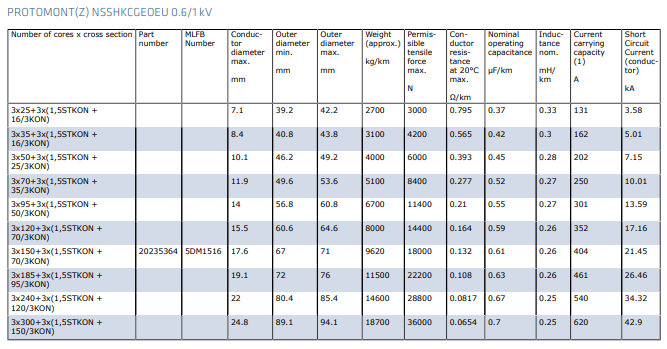
The product line covers a wide range of conductor cross‑sections from 3 × 25 mm² up to 3 × 300 mm², each paired with integrated control and protective earth conductors: 3 × (1.5 mm² control + 16 to 150/3 mm² PE).
Thermal performance is defined for both fixed and dynamic use:
Maximum continuous conductor temperature: 90 °C
Maximum short‑circuit temperature: 250 °C (1‑second rating)
Ambient range fixed installation: ‑40 °C to +80 °C
Ambient range in full flexible trailing: ‑20 °C to +60 °C
Mechanically, it is engineered to handle the rigors of continuous movement:
Minimum breaking load of steel braid: 45 kN
Maximum allowable tensile stress on conductors: 40 N/mm²
Resistance to torsion: ±10° per meter
Maximum recommended travel speed: 150 m/min
Electrical performance varies by size:
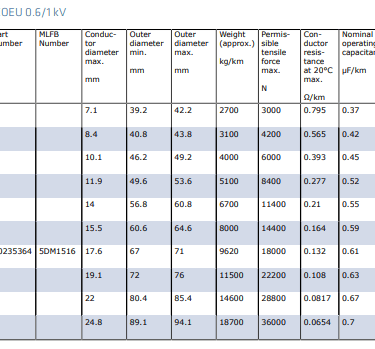
Conductor resistance at 20 °C: from 0.795 Ω/km at 25 mm² down to 0.0654 Ω/km at 300 mm²
Nominal capacitance: 0.37–0.70 µF/km
Inductance: 0.25–0.33 mH/km
Current‑carrying capacity: 131 A at 25 mm² up to 620 A at 300 mm²
Short‑circuit current withstand: 3.58 kA to 42.9 kA
Environmentally, it meets IEC 60332‑1‑2 for flame retardancy, IEC 60811‑404 for resistance to mineral oils and hydraulic fluids, and is fully resistant to ozone, moisture, and UV radiation, allowing unrestricted use both underground and in surface preparation areas.
Construction Design & Material Science
Layer‑by‑Layer Structure and Material Selection
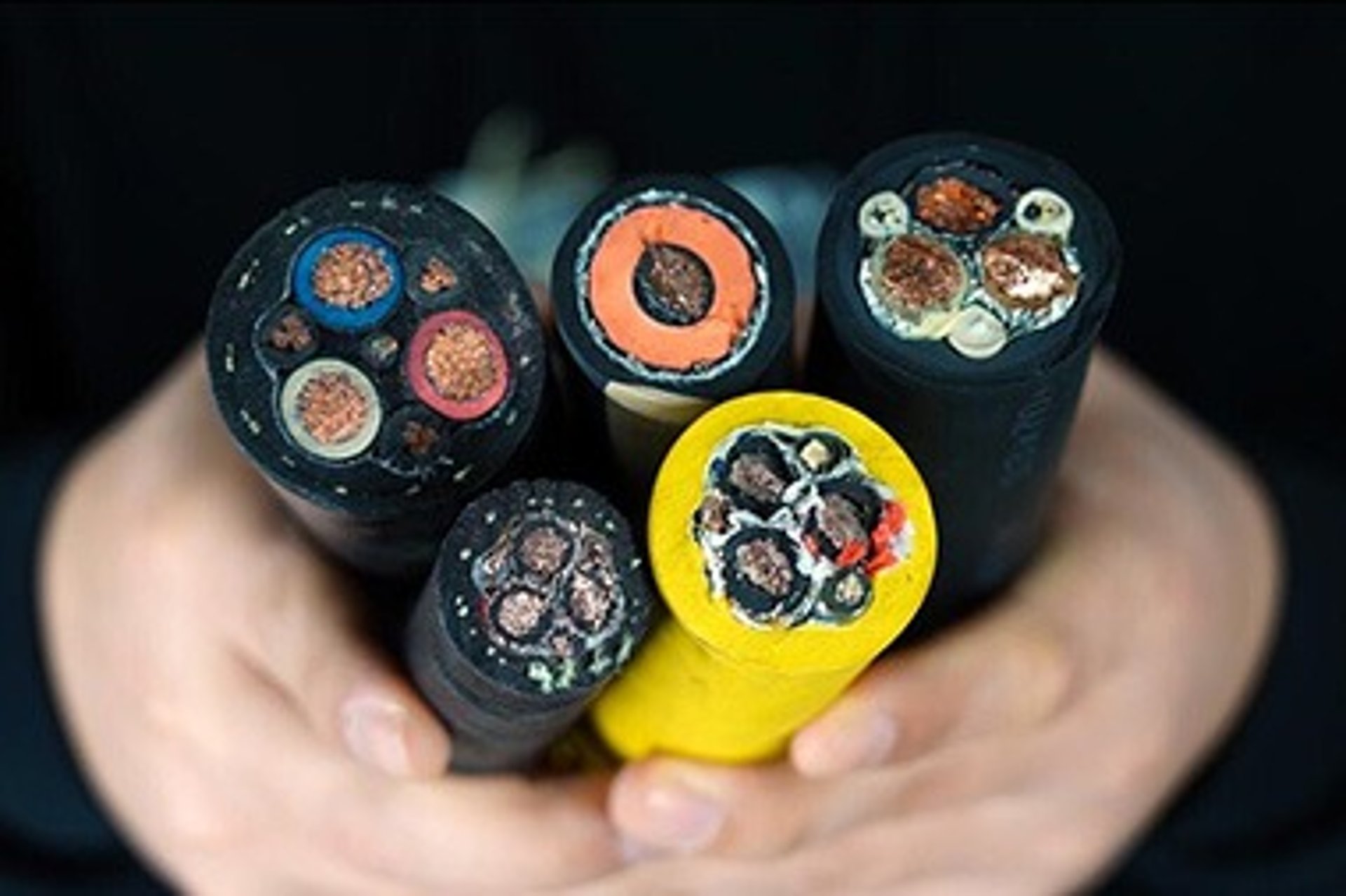
Every layer in PROTOMONT(Z) serves a specific function, selected and combined using principles of electrical engineering, material mechanics, and polymer chemistry.
Conductor Layer
Structure: Very finely stranded copper, Class FS, with each strand tinned
Material: High‑purity electrolytic copper, tin‑plated
Purpose: Class FS stranding maximizes flexibility by reducing bending stress in individual strands. Tin plating prevents oxidation and corrosion from humid, acidic, or sulfide‑rich mine atmospheres while maintaining high conductivity (>98 % IACS).
Insulation Layer
Structure: Extruded, homogeneous insulation
Material: PROTOLON 3GI3, an ethylene‑propylene rubber (EPR) compound
Purpose: Unlike PVC or polyethylene, EPR retains elasticity at low temperatures down to ‑60 °C and remains dimensionally stable at continuous 90 °C. It has low dielectric loss (tan δ < 0.01), high breakdown strength (>30 kV/mm), and excellent resistance to water treeing, ozone, and thermal aging. This prevents cracking under repeated flexing and maintains insulation integrity over years of service.
Core Arrangement
Structure: Three main power cores laid‑up in a right‑hand helix; double‑concentric control and PE conductors distributed in the outer interstices
Purpose: Symmetrical geometry minimizes electromagnetic imbalance and reduces induced voltages in control circuits. Spreading the earth elements around the perimeter creates a continuous, low‑impedance ground path, essential for fault‑current dissipation and intrinsic safety in gassy mines.
Inner Sheath
Structure: Extruded and fully vulcanized
Material: GM1B, a specially formulated EPR rubber
Purpose: Provides a smooth cylindrical surface, cushions the power cores, and electrically isolates them from the steel braid. Vulcanization creates a solid, non‑migrating barrier that does not creep or deform under pressure.
Steel‑Braided Reinforcement
Structure: High‑tensile steel strands woven into a dense braid, chemically bonded during vulcanization between inner and outer sheaths
Material: Galvanized high‑carbon steel
Purpose: This is the defining mechanical feature. The braid carries almost all tensile load, so conductors are never stretched beyond their safe limit. Bonding eliminates relative movement between layers, which in ordinary cables causes internal friction, heat buildup, and sheath slip. The composite structure acts like a reinforced beam, distributing bending and torsion evenly without concentration points.
Outer Sheath
Structure: Thick, abrasion‑resistant outer covering
Material: PROTOFIRM 5GM5, a chlorinated polyethylene (CM) synthetic elastomer; color high‑visibility yellow
Purpose: Yellow provides easy visual identification in low‑light tunnels, reducing accidental damage from vehicles or rockfall. The compound is formulated for low wear rate (<100 mm³ under DIN 53516), high tear strength (>20 N/mm), and resistance to oils, greases, and mine chemicals. It does not become brittle at low temperatures or sticky at high temperatures.
Engineering Principles Behind the Design
The design resolves four fundamental engineering conflicts that limit standard trailing cables:
Electrical principle: Symmetrical three‑phase layout with distributed grounding reduces zero‑sequence impedance and stabilizes voltage drop. The EPR insulation system maintains consistent capacitance and inductance, minimizing waveform distortion in variable‑frequency drives used on modern shearers.
Mechanical principle: Separating the load‑bearing steel braid from the current‑carrying copper conductors follows the mechanics of composite structures. Tensile force is borne by the steel, while the copper remains only under low, controlled stress, preventing fatigue fracture.
Polymer science: Cross‑linked vulcanization creates a three‑dimensional molecular network in both EPR and CM compounds. This structure resists permanent deformation, compression set, and chemical attack, unlike thermoplastics which soften or flow under heat and pressure.
Thermal‑mechanical balance: The 90 °C rating allows higher current density, while the flexibility ensures that heat generated by losses can dissipate even when the cable is tightly curved or coiled.
Solving the Four Major Pain Points of Conventional Cables
Tensile Strength vs. Flexibility
Standard cables face a trade‑off: increasing tensile strength requires larger, stiffer conductors or heavy armor, which reduces flexibility and increases bending stress. PROTOMONT(Z) eliminates this conflict by making the steel braid the sole load‑bearing member. Even under maximum allowable pull of up to 36 kN, the copper conductors remain well below their yield point, so the cable remains supple and easy to handle while being strong enough to survive being dragged over rock floors for hundreds of meters.
Abrasion Resistance vs. Insulation Integrity
Ordinary cables often use a single‑layer sheath. Hard rubber wears slowly but cracks when bent; soft rubber bends well but wears out quickly. Here, the design separates functions: the inner EPR layer protects insulation, the bonded braid distributes stress, and the hard CM outer layer takes the abrasive punishment. Because the layers are vulcanized together, there is no sliding or rubbing between them, so internal damage never occurs even if the outer surface shows minor wear.
Integration of Power, Control, and Grounding
Many mines use separate cables for power, control, and earth. This multiplies connections, increases installation time, and creates multiple points of failure. PROTOMONT(Z) combines all three into one compact assembly. The double‑concentric grounding design offers lower transfer impedance than a single central earth, ensuring rapid fault clearing and reducing the risk of electric shock or ignition in methane‑bearing atmospheres.
Safety and Service Life
In South African mines, standard trailing cables typically last between three and six months before needing replacement. The reasons are well documented: insulation degradation from heat, sheath splitting from torsion, and core breakage from fatigue. PROTOMONT(Z) has demonstrated field life of 24 to 30 months under identical conditions—three to five times longer. This directly translates to fewer replacements, fewer maintenance interventions, and a significantly lower risk of electrical faults that could lead to fires or explosions.
Applications & South African Mining Case Studies
Typical Operating Conditions
In South Africa’s longwall mining, a single shearer may travel 15 to 30 m per day, with the trailing cable moving back and forth across a 150 to 300 m reach. The cable rests on uneven rock, is sometimes partially buried under coal dust and water, and is occasionally rolled over by LHD tires. Temperatures vary from near freezing in winter airways to 35 °C near the face, while hydraulic fluids and lubricants often leak onto the cable surface.
Real‑World Implementation in Mpumalanga
A large coal mine in Mpumalanga operating an 850 kW electric shearer faced persistent issues with standard 0.6/1 kV trailing cables. Each month, the mine lost roughly 20 hours of production due to cable failures, at a combined cost of over R450,000 in replacement parts and lost output. After switching to PROTOMONT(Z) NSSHKCGEOEU 3 × 95 + 3 × (1.5 + 50/3) mm², the operation recorded no major failures for more than 24 months. Repairs were limited to minor sheath scuffs, and overall maintenance costs dropped by 85 %. The mine’s engineering department confirmed that the cable met all SANS 1520 requirements and was fully compatible with local inspection standards.
Similar results have been reported in mines in Gauteng and the Free State, where the cable’s ability to withstand both deep‑mine temperatures and surface winter conditions has proven particularly valuable.
Feichun Cables: Equivalent Solution for PROTOMONT(Z)
What Makes Feichun an Equivalent Alternative
Feichun Cables manufactures its NSSHKCGEOEU 0.6/1 kV range to exactly match the design, materials, and performance of the Prysmian PROTOMONT(Z). It uses the same Class FS tinned copper conductors, EPR insulation equivalent to 3GI3, GM1B‑type inner sheath, vulcanized steel braid reinforcement, and 5GM5‑grade CM outer sheath. All electrical, thermal, and mechanical parameters are aligned with DIN VDE 0250‑812, IEC standards, and SANS 1520.
Key Advantages
Cost competitiveness: Typically 20–30 % lower in delivered price than European‑sourced equivalents, without compromising material grade or testing.
Shorter lead times: Stocked in standard sizes and manufactured locally to order, reducing delivery time from 12–16 weeks to 4–6 weeks, critical for emergency replacements.
Certified compliance: Available with full test reports, factory inspection certificates, and documentation accepted by South African mine safety authorities.
Technical support: Provides assistance with sizing, installation guidance, and troubleshooting specifically for African mine conditions.
Selection Guide & Sizing Considerations
Key Selection Criteria
Choosing the correct size requires balancing three factors: electrical performance, mechanical capacity, and thermal rating.
Power and current: Calculate operating current at full load, then apply derating factors for ambient temperature, grouping, and laying method using VDE 0298‑4.
Voltage drop: Ensure voltage drop at maximum length does not exceed 5 % of nominal voltage.
Tensile load: Use the maximum trailing distance and equipment weight to confirm that the cable’s allowable tensile force is not exceeded.
Short‑circuit rating: Match the conductor cross‑section to the available fault current for one‑second duration.
Recommended Cross‑Sections
25–50 mm²: Small roadheaders, auxiliary conveyors, and low‑power LHDs
70–150 mm²: Medium‑to‑large shearers, main face conveyors, and standard LHDs
185–300 mm²: High‑power longwall shearers, heavy TBMs, and large‑capacity pumping systems
Frequently Asked Questions
Q: Can this cable be used in fixed installations?
A: Yes, but it is optimized for dynamic trailing. In fixed use, the temperature range extends to ‑40 °C to +80 °C, offering even more flexibility for static applications.
Q: Does it meet South African mine safety rules?
A: Fully. Its design parameters align with SANS 1520 Type 41 and Type 611, and it is accepted under DMRE guidelines for underground electrical equipment.
Q: How does it compare to ordinary rubber‑sheathed cables?
A: It offers more than double the tensile strength, better than three times the abrasion resistance, and a much longer service life, while maintaining full electrical continuity under extreme movement.
Q: Is Feichun’s version identical in performance?
A: Yes, it follows the same construction and material specifications, meets the same standards, and delivers equivalent electrical and mechanical results at a lower total cost.
Conclusion
PROTOMONT(Z) NSSHKCGEOEU 0.6/1 kV represents a fundamental shift in how trailing cables are engineered. It is no longer viewed simply as a wire in a sheath but as a complete system that combines material science, structural mechanics, and safety engineering. By solving the four core limitations of conventional cables, it delivers longer life, fewer failures, and greater operational certainty.
In South Africa’s demanding mining environment, where downtime costs run into millions of rands per day, the investment in a properly designed trailing cable yields rapid returns. The same principles apply to mines across Europe, North America, and other African regions. The Feichun equivalent extends these benefits to a wider market, offering a technically identical solution with better pricing and availability.
If you are looking to upgrade your trailing cable fleet, reduce maintenance costs, or replace aging cables in your South African or African mining operations, contact the Feichun technical team.
Email: Li.wang@feichuncables.com
We provide full datasheets, test reports, sizing calculations, and quotation support tailored to your specific equipment and site conditions.


Email Address: Li.wang@feichuncables.com
© 2025. All rights reserved.
One-click to Quickly Contact
Products
Contact
Company
Location:
Building A Private Science and Technology Park, Hefei Economic and Technological Development Zone, Anhui Province, China
Heat Resistant Cable
WhatsApp: +86 17333223430
Social Media: