Anhui Feichun Special Cable Co.,Ltd Email: Li.wang@feichuncables.com

RHEYCORD® (RTS) (N)SHTOEU-J: Extra Heavy Duty Reeling Cable – Engineering for Tensile & Torsion Stress in South African Mining & Ports
RHEYCORD® (RTS) (N)SHTOEU-J is an extra heavy duty reeling cable engineered to withstand simultaneous tension, torsion, bending and high speed — ideal for harsh South African mining, port, crane and industrial automation environments. This comprehensive guide explains its advanced design, material science, full technical data, performance advantages over standard cables, maintenance best practices, and local equivalent options from Feichun Cables. Perfect for engineers, procurement teams and project managers looking for long-lasting, reliable power & control solutions.
Li Wang
5/12/202622 min read
Introduction
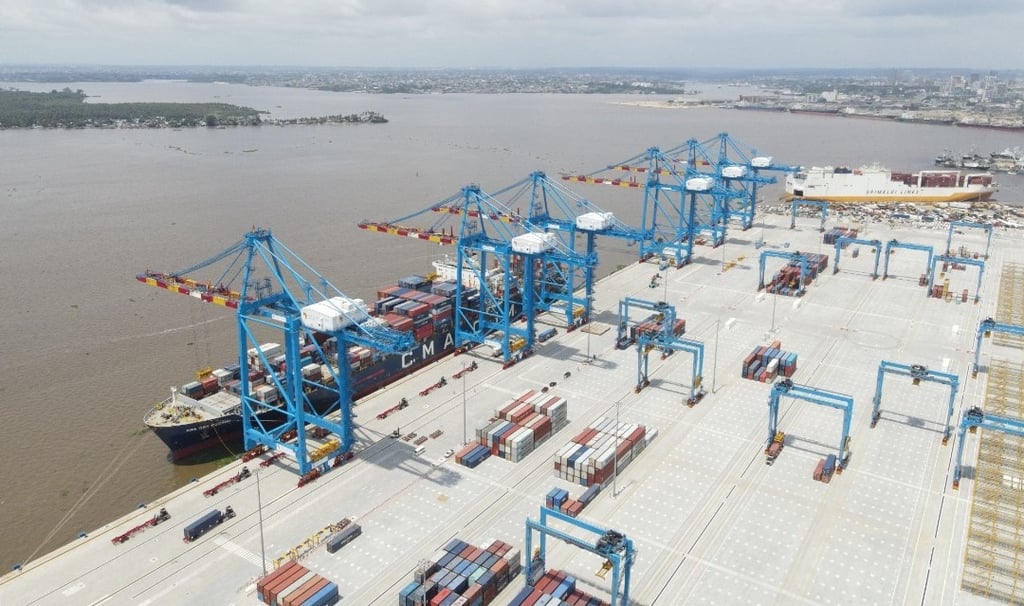
South Africa’s industrial economy is built on heavy industry, from deep-level platinum and coal mines in Limpopo and Mpumalanga to the bustling bulk commodity terminals of Durban, Richards Bay and Cape Town. Across these operations, moving machinery such as overhead cranes, ship-to-shore gantries, stacker-reclaimers and automated material handling systems rely entirely on reeling cables to deliver power and control signals. These cables operate in one of the most demanding environments imaginable, where they are constantly wound, unwound, lifted and swung while exposed to extreme heat, cold, dust, moisture and strong coastal winds. For decades, plant managers and engineers have faced the same persistent problem: standard industrial cables fail far too quickly, leading to unplanned shutdowns, expensive replacements and significant safety risks.
The root of this problem lies in the combination of forces that act on a cable during reeling operations. Unlike fixed installations or even standard flexible cables, reeling cables are subjected to multiple forms of mechanical stress acting at the same time. Most cables are designed to handle either tension or bending alone, but very few are engineered to withstand tension, torsion, bending and compression all at once. This is exactly the gap that RHEYCORD® (RTS) (N)SHTOEU-J was created to fill. As an extra heavy duty reeling cable built to the highest global standards, it is specifically designed to survive and perform in applications where simultaneous tensile and torsional stress is the norm. This article explains the engineering principles behind the cable, its complete technical specification, how it compares to alternatives, and why it has become the preferred choice for heavy industry across Southern Africa.
Stress Conditions in Industrial Reeling Operations and Causes of Premature Failure
To understand why specialised cables are necessary, it is important to first look at the physical environment inside a motor-driven reeling system. Every time a cable is wound onto or off a drum, it experiences a complex combination of forces that standard cables are simply not built to resist. The most obvious force is tensile stress, which comes from the weight of the cable itself, the load being lifted, and the tension applied by the reel to keep the cable neat and tight. In static conditions, this stress can reach 15 N/mm², but during dynamic operation such as rapid lifting or swinging, it can double to 30 N/mm². Over time, this constant pulling stretches conventional conductors and leads to permanent elongation, increased electrical resistance and eventual breakage of individual copper strands.
Torsional stress is perhaps even more damaging, yet often overlooked. As the drum rotates, the cable twists along its length, typically between 25 and 50 degrees per metre. In a system with 100 metres of cable, this means hundreds of degrees of total twist. Standard cables have no mechanism to absorb or resist this rotation, so the twist travels down the length of the cable and causes the internal cores to shift, rub against each other and compress. This movement tears the insulation, damages the conductor and creates a spiral or “corkscrew” shape in the cable. Once this deformation starts, the effective length of the cable shortens, tension spikes and failure becomes inevitable, often within just a few weeks of operation.
Bending stress occurs every time the cable passes over a drum, sheave or guide. As the cable curves, the material on the outer radius is stretched while the material on the inner radius is compressed. With every cycle, this creates microscopic fatigue cracks in the copper conductors and the insulation material. In high-speed systems operating at 120 metres per minute or more, this cycle repeats thousands of times per day, leading to rapid fatigue failure in cables designed only for light duty use. Additional forces include compression from layers of cable pressing against each other during multi-layer winding, abrasion from contact with metal surfaces, and lateral forces caused by wind or swinging loads, which are particularly severe in exposed South African ports and open-pit mines.
When standard industrial cables are used in these conditions, failure happens quickly for several key reasons. Most flexible cables are built to IEC Class 5 standards, which uses copper strands that are relatively thick. While this works well for fixed or lightly moving applications, thicker strands have a lower resistance to bending fatigue and break much faster under repeated flexing. The insulation and sheath materials used in standard cables are usually general-purpose rubber or PVC compounds. These materials have a narrow operating temperature range, typically between -20°C and +70°C, and degrade rapidly under exposure to ultraviolet radiation, ozone, oil and chemicals found in mines and industrial sites. In South Africa, where temperatures can drop well below freezing on the Highveld in winter and rise above 40°C in summer, these materials become brittle or soft, accelerating the rate of damage.
Most importantly, standard cables have no structural elements designed to manage torsion or distribute mechanical loads. There is no inner sheath to hold the cores in place, no anti-torsion layer to stop twist from travelling, and no strength member to carry the main tension force. As a result, all mechanical stress is borne directly by the electrical conductors and insulation, which are designed to carry current, not structural load. When these components are forced to do both jobs, they fail rapidly. The common industry mistake of choosing a cheaper standard cable leads to a situation where the cable might last only three to six months, whereas a properly engineered solution can last eight to ten years. The total cost of ownership, including downtime and replacement labour, is often ten times higher when using low-specification products.
Design Philosophy: Why RHEYCORD® RTS Is Built for Multi-Axis Stress
RHEYCORD® RTS was developed from the ground up with a completely different engineering philosophy. Instead of treating the cable as just a carrier of electricity, it is designed as a structural component that happens to conduct power and signals. Every element of its construction is chosen to work together to resist the full range of simultaneous forces found in motor-driven reels, drum spreaders and festoon systems. The core idea is separation of function, where different layers and materials handle different types of stress, ensuring that the electrical components remain protected and undamaged throughout the cable’s life.
The design starts with the understanding that tension, torsion and bending will always be present, so the cable must be flexible enough to bend tightly, yet strong enough to carry heavy loads, and stable enough not to twist out of shape. This balance of flexibility and strength is the most difficult challenge in cable engineering, and it is here that RTS outperforms all standard alternatives. The cable is built to comply with DIN VDE 0250 Part 814, the strictest global standard for heavy duty reeling cables, which mandates testing under conditions that closely replicate real-world operation, including alternating bending, roller bending and torsional resistance tests.
For South African applications, the design also prioritises environmental stability. The materials selected perform reliably across a temperature range from -40°C to +90°C, covering everything from freezing winter nights in Gauteng to extreme heat in the Northern Cape and humidity in coastal KwaZulu-Natal. Every compound is resistant to ultraviolet light, ozone, salt spray, moisture and common industrial oils and chemicals. This means the cable does not degrade or lose mechanical strength due to weather exposure, a critical feature for outdoor and mining installations.
The construction also includes features specifically for the unique requirements of drum spreaders and long-length lifting applications. An optional central strength member, available in the NSHTOEU-J version, carries the majority of the tensile load, removing almost all mechanical stress from the copper conductors. This functional separation ensures that the electrical parts only conduct current, while the structural parts handle the weight and tension. This is the single most important factor in extending service life and preventing unexpected failures. Combined with an integrated anti-torsion system and a multi-layer sheath design, the result is a cable that maintains its shape, electrical performance and mechanical integrity even after millions of cycles of operation.
Complete Technical Specification of RHEYCORD® (RTS) (N)SHTOEU-J
Product Overview and Standards
RHEYCORD® (RTS) (N)SHTOEU-J is classified as an extra heavy duty rubber reeling cable suitable for both power and control circuits. It is intended for use in environments with extreme mechanical stress, specifically where tension and torsion occur at the same time. Typical applications include motor-driven reels, spring-operated reels, drum spreaders, hoists and automated festoon systems found in ports, mines, steel mills and bulk handling facilities. The cable operates at a nominal voltage of 0.6/1 kV, with a maximum permissible voltage of 1.2 kV in alternating current systems and 1.8 kV in direct current systems. Power cores are tested at 3.0 kV AC, while control cores undergo a 2.0 kV AC test to ensure dielectric strength.
All production follows DIN VDE 0250 Part 814, with insulation performance exceeding the requirements of IEC 60502-1. The cable is yellow in colour, providing high visibility for safety on busy industrial sites, and is clearly marked with the type designation, core count, cross-section, voltage rating, manufacturer and year of production. Core identification follows DIN VDE 0293 Part 308 and HD 308 S2 standards, ensuring compatibility with international installation practices. For example, four-core cables use the sequence green-yellow, brown, black and grey, while cables with five cores or more use black cores printed with white sequential numbers, with the green-yellow protective earth core positioned in the outer layer of the cable structure.
Layer-by-Layer Construction
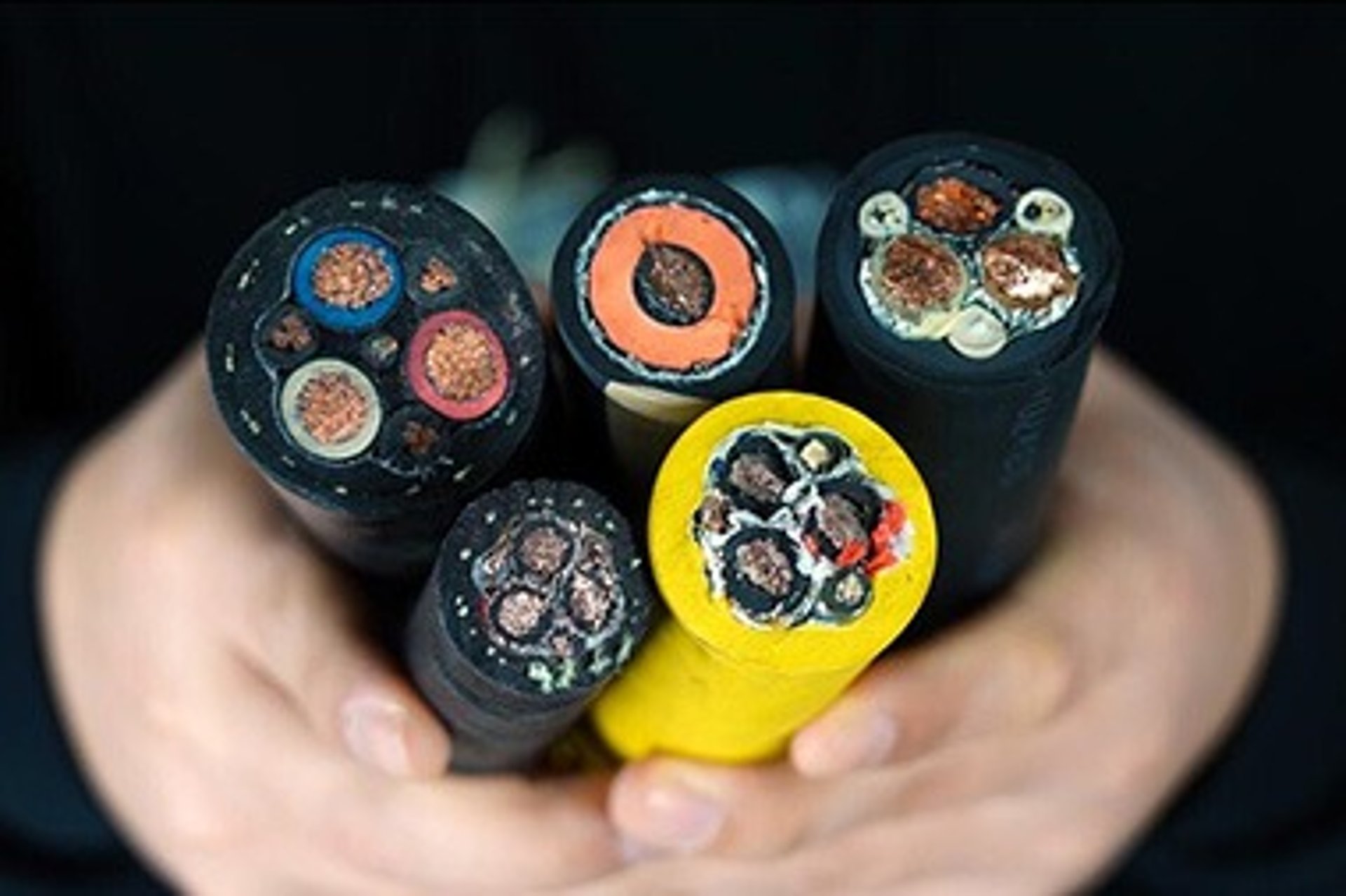
The construction of RHEYCORD® RTS is a masterpiece of layered engineering, with each component selected and positioned to perform a specific task. At the very centre are the conductors, made from flexible plain copper using the proprietary FSC stranding method. This design offers performance that is significantly better than IEC 60228 Class 5, the standard for flexible cables. The individual copper wires are much finer and stranded in multiple layers with a shorter lay length, creating a conductor that is extremely flexible yet very strong and resistant to fatigue.
Each conductor is insulated with RHEYCLEAN®-HEPR, a specialised material based on ethylene propylene diene monomer rubber that has been cross-linked using a peroxide process. This material is far superior to standard rubber compounds, offering excellent electrical properties, high heat resistance and outstanding mechanical elasticity. Around the insulated cores lies an inner sheath made from a special synthetic rubber based on polychloroprene (PCP). This layer binds the cores together into a circular assembly, prevents them from rubbing against each other and distributes bending forces evenly across the cross-section.
For applications such as drum spreaders or long vertical runs, the NSHTOEU-J variant includes a central strength member made from high-tensile synthetic fibres or aramid. This component is engineered to carry the entire static and dynamic tension load, ensuring that the copper conductors experience almost no mechanical stress. The outer sheath represents the most advanced part of the design, using a new sandwich construction that integrates an anti-torsion braid directly within the rubber layers. This braid is arranged at opposing angles to create a structure that resists rotation while remaining flexible. The rubber compound itself is highly resistant to abrasion, tearing, oil, weathering and flame, meeting the requirements of IEC 60332 Part 1 for flame retardancy.
Mechanical, Thermal and Environmental Properties
The mechanical performance figures highlight the suitability of this cable for heavy work. The conductor is rated for a static tensile stress of 15 N/mm² and a dynamic tensile stress of 30 N/mm², figures that are double or triple the capacity of standard cables. Bending radii are defined according to DIN VDE 298, requiring a minimum of six times the outer diameter for fixed installation and eight times the diameter for moving operation. The design allows reeling speeds of up to 240 metres per minute and hoisting speeds up to 160 metres per minute, enabling high throughput operations essential in modern ports and mines.
Thermal performance is equally impressive. The maximum continuous operating temperature at the conductor is +90°C, allowing high current carrying capacity without overheating. Under short-circuit conditions, the material can withstand temperatures up to +250°C for a maximum of five seconds without damage. The surface temperature range demonstrates the cable’s versatility, operating from -50°C to +80°C in fixed installations and from -40°C to +80°C during mobile use. This wide range ensures reliable service across every climate found in Southern Africa. Environmentally, the cable is resistant to moisture, UV radiation, ozone and oils, making it suitable for both indoor and outdoor use without degradation.
Specification Tables
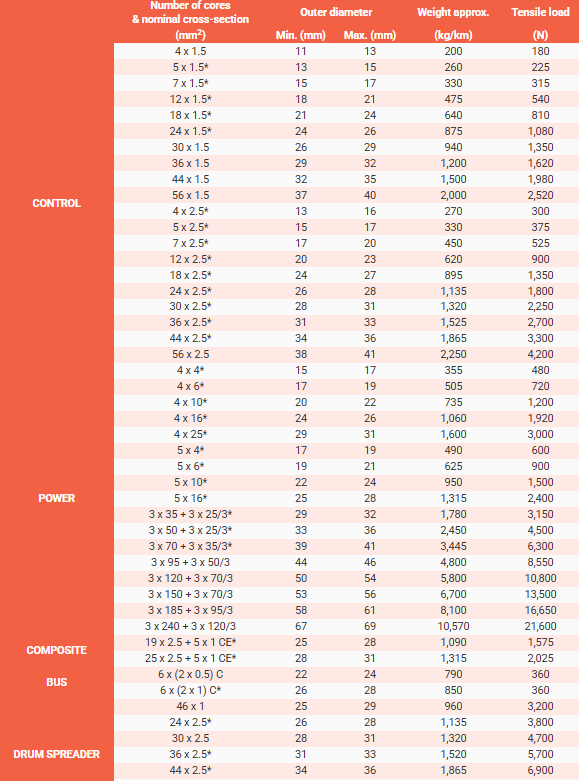
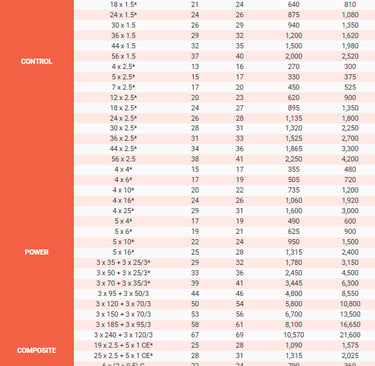
The product range covers every requirement from low-current control circuits to high-power transmission. Control cables are available from 4 cores up to 56 cores in cross-sections of 1.5 mm² and 2.5 mm². For example, the 24 x 2.5 mm² control cable has an outer diameter between 26 and 28 mm, weighs approximately 1,135 kg per kilometre and has a maximum tensile load rating of 1,800 N. Power cables range from small 4 x 4 mm² constructions up to heavy-duty composite designs such as 3 x 240 mm² plus 3 x 120 mm², which measures between 67 and 69 mm in diameter, weighs over 10 tonnes per kilometre and can safely handle a tensile load of 21,600 N.
Specialised versions are available for specific uses. Composite cables combine power and control cores into a single assembly, such as the 19 x 2.5 mm² plus 5 x 1 mm² design used on multi-function machinery. Bus cables are built for data transmission, with configurations like 6 pairs of 0.5 mm² or 1 mm² conductors. Drum spreader cables are reinforced for maximum strength, with the 56 x 2.5 mm² variant offering a tensile capacity of 8,800 N, ideal for the demanding conditions of container handling equipment. These tables allow engineers and procurement teams to select exactly the right size and construction for their specific load, length and speed requirements.
Deep Analysis of Core Technologies and Engineering Principles
RTS Conductor Technology: Extra-Fine Stranding Beyond IEC Class 5
The conductor is the heart of any cable, and in RHEYCORD® RTS, it is engineered to a higher standard than anything found in general-purpose products. Most flexible industrial cables use conductors built to IEC 60228 Class 5, which allows individual wire diameters up to 0.26 mm. While acceptable for light use, these relatively thick wires have a high stiffness and low resistance to repeated bending. When a cable flexes, the outer surface of each wire undergoes tension and compression cycles. Thicker wires experience higher levels of stress at their surface, leading to the formation of cracks that eventually grow until the wire breaks. This process, known as fatigue, is the leading cause of conductor failure in reeling applications.
The FSC conductor technology used in RTS solves this problem by using much finer individual strands, typically less than 0.15 mm in diameter, and many more of them. Reducing the diameter of each strand lowers the bending stress significantly, extending the fatigue life by a factor of five to eight compared to Class 5 designs. Additionally, the strands are arranged in multiple layers with a shorter lay length and a combination of directional stranding. This structure allows the individual wires to slide against each other slightly during bending, further reducing internal friction and stress concentration. The result is a conductor that is extremely flexible, highly resistant to breakage and capable of elongating by more than 20% without damage, enabling it to absorb dynamic tension surges that would snap standard conductors.
RHEYCLEAN® EPDM Insulation: Peroxide Cross-Linked Polymer Science
Insulation material science is another area where RTS technology sets itself apart. The insulation is made from RHEYCLEAN®-HEPR, a modified EPDM rubber that is processed using a peroxide cross-linking method rather than the traditional sulphur-based system used in cheaper cables. Cross-linking is a chemical process that connects the long molecular chains of the rubber into a permanent three-dimensional network structure. This change transforms the material from a thermoplastic that melts when heated into a thermoset that retains its properties even at high temperatures.
Peroxide cross-linking creates a much stronger, more stable and more elastic material compared to sulphur curing. It offers superior resistance to heat, oxidation, ozone and chemical attack, all of which are critical in South African environments. The material maintains its elasticity down to very low temperatures, remaining flexible at -40°C without becoming brittle or cracking. At the high end, it operates continuously at +90°C, allowing higher current ratings and reducing the risk of thermal breakdown. Mechanically, it has a high tensile strength and elongation at break, meaning it stretches and recovers without permanent deformation when the cable is bent or twisted. It also has excellent electrical properties, with low dielectric loss and high insulation resistance, ensuring signal integrity and safety over decades of service.
Physics of Stress Distribution in Motor-Driven Reels
Understanding the physics of how forces act on a cable helps explain why the design of RTS is so effective. When a cable is wound onto a drum, it follows a helical path, and the forces acting upon it can be described mathematically as a combination of axial tension, bending moment, torque, contact pressure and centrifugal force. These forces are not distributed evenly across the cable cross-section. The outer layers experience the highest tension and shear stress due to torsion, while the inner layers are subjected to compression and crushing forces. At the transition point between layers, the cable undergoes a sharp change in curvature and stress direction, creating a high-risk zone for fatigue failure.
Standard cables fail because they have no way to manage this uneven distribution. Torsion waves travel freely through the structure, causing core misalignment and insulation damage. In contrast, the anti-torsion braid in RTS acts as a barrier that absorbs torque before it can reach the inner cores. The inner sheath holds all components in a precise circular formation, ensuring that bending forces are spread equally rather than concentrated on individual cores. The graded hardness of materials, with softer inner layers and harder outer layers, further helps to equalise stress. By engineering the cable to react to these physical forces in a controlled way, RTS changes the failure mechanism from sudden catastrophic breakdown to gradual, predictable wear of the outer sheath.
Drum Spreader Engineering: Load Distribution and Bending Mechanics
Drum spreader applications, common in container terminals and bulk material handling, present perhaps the most difficult challenge for cable designers. These systems use cables up to 150 metres in length, where the dead weight alone creates high tension loads. The cable is wound in multiple layers under high pressure, and is subjected to constant swinging and lateral movement caused by wind and load shifts. The bending radius is often small relative to the cable diameter, creating severe bending stress that varies constantly along the length of the conductor.
In these systems, the physics of load distribution means tension is highest at the end fixed to the drum and gradually reduces toward the moving end. In standard cables, this uneven tension causes the cable to stretch unevenly, leading to permanent elongation and core misalignment over time. Furthermore, when the cable bends around the drum, the outer surface stretches while the inner surface compresses. If the construction is not perfectly balanced, this creates internal shear forces that grind against the insulation and weaken the assembly.
RHEYCORD® NSHTOEU-J, the reinforced version, addresses these mechanics through the inclusion of a central strength member made from high-modulus aramid or synthetic fibre. This component is designed to take up more than 70% of the total tensile load, completely isolating the copper conductors and insulation from mechanical tension. By separating the load-bearing and electrical functions, the design eliminates elongation and removes the primary cause of fatigue in spreader cables. The cabling geometry is also optimised so that every core follows exactly the same path and radius during bending, ensuring uniform stress distribution and preventing any one conductor from carrying a disproportionate share of the strain. This is why in installations such as the Durban Container Terminal, these cables have operated continuously for over three years without failure, compared to the six-month lifespan typically seen with standard alternatives.
High-Speed Capability: 200–240 m/min Operating Range
Speed is a defining factor in modern industrial operations, where higher throughput directly translates to better profitability. While conventional heavy-duty reeling cables are generally limited to speeds between 80 and 120 metres per minute, and premium standard types reach up to 180 m/min, RHEYCORD® RTS is engineered to perform reliably at 200 to 240 m/min. Achieving this level of performance requires solving several complex engineering challenges.
At high speeds, centrifugal force becomes significant, creating additional tension and causing the cable to press harder against drum flanges and guides, which increases friction and wear. The frequency of bending cycles also rises sharply; a cable moving at 240 m/min completes hundreds of flex cycles every minute, placing extreme demands on fatigue resistance. Heat generation is another critical issue: friction and conductor resistance combine to raise temperatures, which can soften standard materials and accelerate ageing.
Every element of the RTS design is optimised to counter these effects. The outer sheath compound has a specially formulated low coefficient of friction, less than 0.3, which reduces surface wear and heat build-up even at maximum speed. The FSC fine-stranded conductor has a large surface area relative to its cross-section, improving heat dissipation and keeping operating temperatures stable. The cabling lay length is mathematically calculated to match the drum diameter perfectly, ensuring the cable winds evenly without lateral slip or vibration. Materials are selected for high fatigue resistance and high-temperature stability, allowing them to withstand millions of cycles without degradation. The ability to operate at 240 m/min means ports and mines using this cable can increase handling rates by 40% to 60% compared to older installations, delivering a direct and measurable improvement in productivity.
Anti-Torsion and Anti-Spiralling Braid System
Torsion is often described as the silent killer of reeling cables. When a drum rotates, torque is transmitted down the length of the cable, creating a twisting force that standard designs simply cannot resist. Over time, this causes the cable to form a spiral or corkscrew shape, a deformation known as spiralling. This change in geometry shortens the effective length of the cable, causing tension to spike dramatically and leading to crushing of the internal cores, rupture of the insulation and ultimately electrical failure. In severe cases, spiralled cables jump out of grooves, jam in guides and cause mechanical damage to the reel system itself.
The anti-torsion system in RHEYCORD® RTS is a patented engineering solution that completely changes how the cable reacts to twisting forces. Unlike competitors that apply a single braid layer over the sheath, RTS uses a sandwich construction where a high-strength braid is embedded directly within the outer sheath rubber. This braid is manufactured from polyester or aramid yarns and arranged in two layers wound in opposing directions at angles close to ±45 degrees relative to the cable axis.
This geometry is critical. When a twisting force is applied, the braid layers interact with each other to generate an internal counter-force that opposes the rotation. Instead of twisting, the cable structure converts the torque into tension within the braid fibres, effectively locking the cable shape. Testing shows that less than 5% of applied torsion is transmitted through to the inner cores, compared to nearly 100% in standard cables. This system ensures the cable remains straight and stable regardless of how many times it is wound or unwound. It eliminates spiralling entirely, prevents core damage and removes the most common cause of premature failure in reeling applications.
Cable Reel Systems: Wind Load and Cyclic Fatigue
Operating conditions in Southern Africa present unique environmental challenges. At coastal ports like Cape Town and Richards Bay, and on open-pit mine sites, wind speeds regularly reach 25 to 40 metres per second. For suspended cables, this wind creates aerodynamic forces that cause the cable to swing, vibrate and oscillate. This movement subjects the cable to rapid, repeated changes in tension and bending direction, a phenomenon known as cyclic fatigue. Over time, these fluctuating stresses create microscopic cracks that grow until the material fails.
Standard cables are rated for approximately 100,000 to 150,000 bending cycles, which might last only a few months in windy locations. RHEYCORD® RTS is engineered with a design life exceeding 5 million cycles, representing a 30 to 50 times improvement in durability. This performance is achieved through several key features. The materials used have high fatigue resistance, meaning they can withstand repeated deformation without structural damage. The outer sheath is reinforced and designed with a smooth aerodynamic profile to reduce wind-induced vibration. The internal construction has high damping characteristics, absorbing energy from movement rather than transferring it into stress on the conductors.
The symmetrical balanced design also ensures that wind forces act equally around the cable, preventing uneven loading or twisting. By resisting the effects of wind and vibration, RTS significantly reduces maintenance requirements and downtime. In environments where operations run 24 hours a day, this reliability is not just a convenience but a critical safety and operational requirement.
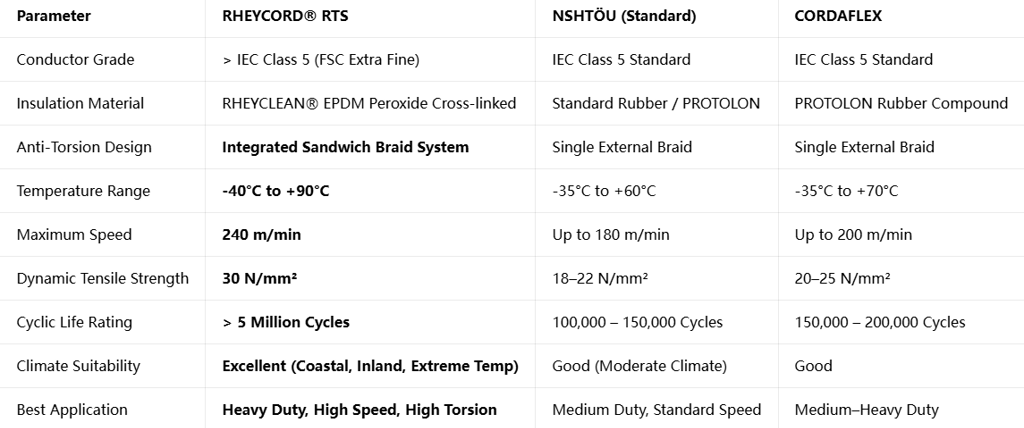
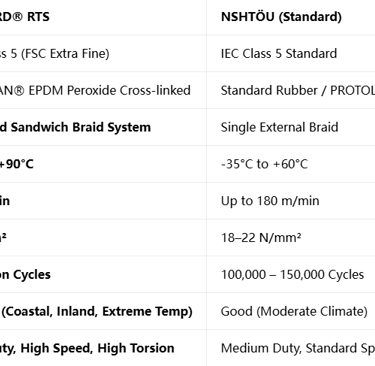
Comparative Analysis: RHEYCORD® RTS vs NSHTÖU vs CORDAFLEX
When selecting heavy-duty reeling cables, engineers often compare RHEYCORD® RTS against other leading products such as standard NSHTÖU and CORDAFLEX. While all three are marketed as heavy-duty solutions, there are significant technical differences that determine performance and service life, especially in harsh Southern African conditions.
Standard NSHTÖU cables represent the traditional baseline for heavy-duty use. They are robust but use standard Class 5 conductors and basic rubber insulation. Their temperature range is narrower, making them unsuitable for extreme Highveld winters or prolonged high heat. The anti-torsion layer is applied externally, offering limited protection and often wearing away quickly. CORDAFLEX is a premium upgrade, offering slightly better speed and temperature ratings, but still relies on standard materials and a single-layer anti-torsion system.
RHEYCORD® RTS differs fundamentally because every component is upgraded. The FSC conductor, peroxide-crosslinked insulation and unique sandwich anti-torsion braid combine to create a product that outperforms both competitors in every technical category. The wider temperature range is particularly relevant in South Africa, where standard cables frequently become brittle or overheat. For applications where simultaneous tension and torsion exist, RTS is the only cable engineered specifically to solve that exact combination of forces, resulting in a service life that is often five to ten times longer than alternatives.
Temperature Performance: -40°C to +90°C Operating Range
Temperature stability is one of the most critical performance factors in Southern Africa, where climatic extremes test equipment to its limits. A cable that works well in European conditions may fail rapidly when exposed to freezing nights at high altitude or intense summer heat. RHEYCORD® RTS is engineered with a broad operating window designed to cover every possible environment found in the region.
In cold conditions, the cable remains flexible and fully functional down to -40°C. This performance comes from the use of EPDM rubber with a low glass transition temperature and the absence of fillers or plasticisers that can crystallise and harden. Unlike PVC or standard rubber cables, which become rigid and prone to cracking below -20°C, RTS can be wound and unwound in freezing weather without risk of damage. This is vital for mines located at high altitude in Mpumalanga or the Free State, where winter temperatures regularly drop well below zero.
At the upper end, the cable is rated for continuous operation at +90°C conductor temperature, allowing high current carrying capacity without overheating or thermal ageing. The peroxide cross-linked structure ensures the material does not soften, melt or flow even when surface temperatures reach +80°C. This stability prevents insulation failure and extends life significantly in hot, exposed locations such as the Northern Cape or coastal yards where radiant heat is high. By maintaining its physical and electrical properties across this entire range, RTS eliminates seasonal performance variations and ensures consistent reliability year-round.
Maintenance, Inspection and Lifecycle Durability
The true value of a heavy-duty cable is measured not just by its technical specifications, but by how long it lasts and how easy it is to maintain. RHEYCORD® RTS is designed with a service life of 8 to 10 years under normal heavy-duty conditions, and 5 to 6 years even under extreme high-speed or high-load operation. This durability comes from building the cable so that failure occurs gradually and predictably, rather than suddenly. The design ensures that the outer sheath will show signs of wear long before any internal component is at risk, allowing maintenance teams to plan replacements and avoid unexpected outages.
For South African operations, a structured inspection routine is recommended to maximise life and safety. On a weekly basis or every 200 operating hours, visual checks should be carried out to look for cuts, cracks or abrasion on the outer surface. As long as wear depth remains less than one-third of the original sheath thickness, the cable can continue in service. It is also important to check that the cable is winding neatly without spiralling or crossing over itself, and that guides and rollers are free of sharp edges or debris that could cause damage.
Every three months or 1,000 hours, more detailed inspections should be performed. Electrical tests should measure insulation resistance, which should remain above 100 MΩ per kilometre to ensure integrity. Tension settings on the reel system should be calibrated to ensure the cable is not being over-stretched, and bending radii should be checked to ensure they never drop below the minimum of eight times the diameter for moving applications. Regular cleaning to remove dust, ore dust or grease is also recommended, as abrasive materials trapped against the sheath accelerate wear.
Repair is limited to minor damage to the outer sheath, which can be repaired using special vulcanising compounds supplied by Feichun. If damage extends to the inner sheath or conductors, the damaged section must be replaced in full — splicing is not recommended for dynamic reeling cables. By following these simple steps, operators can ensure the cable reaches its full design life and delivers the lowest possible total cost of ownership.
Specifications, Sourcing and Feichun Equivalent Cables
Selecting the correct cable requires understanding the application parameters and matching them to the right specification. The RHEYCORD® RTS range covers control, power, composite, bus and drum spreader applications, with core counts from 4 up to 56 and cross-sections from 1.5 mm² up to 240 mm². The suffix letters provide important information: SHTOEU-J indicates the standard version, while NSHTOEU-J includes the central strength member for heavy lifting or spreader duty. All designs meet or exceed DIN VDE 0250 standards and are marked clearly for easy identification.
When sourcing, it is essential to provide full details including the number of cores, cross-section, operating voltage, maximum speed, tension requirements and environmental conditions. This ensures the correct version is supplied, whether standard or reinforced. Documentation provided with every delivery includes factory test certificates, dimensional drawings and material compliance declarations, essential for quality assurance and project approvals.
Feichun Cables offers a complete range of 1:1 equivalent products that match RHEYCORD® RTS in fit, form and function, but with enhanced value and local availability. These equivalents carry the designation FC-SHTOEU-J and FC-NSHTOEU-J, and have been engineered to meet exactly the same performance specifications. In many cases, Feichun has improved upon the original design, with sheath compounds offering up to 20% better abrasion resistance and strength members with 15% higher tensile capacity.
The advantage of choosing Feichun equivalents is significant for Southern African buyers. They offer the same high performance and reliability, but with shorter lead times, competitive pricing and direct local technical support. Customisation is also easier, whether for special core configurations, specific colour requirements or extra marking. For procurement teams, this means accessing world-class heavy-duty cable technology without the delays or costs often associated with importing proprietary brands.
Frequently Asked Questions
Is this cable suitable for outdoor use in coastal areas like Durban or Cape Town?
Yes, the materials used are highly resistant to ultraviolet radiation, ozone and salt-laden moisture. The rubber compounds are formulated to withstand the corrosive effects of marine environments, and the cable will not degrade or become brittle even after years of exposure. It is widely used in port applications across South Africa.
What happens if the minimum bending radius is not maintained?
Operating below the specified minimum radius places excessive strain on the conductors and insulation. While RTS is more flexible and robust than standard cables, repeated tight bending will eventually lead to fatigue and reduced life. Following the guideline of 6 times diameter for fixed runs and 8 times diameter for moving applications ensures maximum durability.
Can RTS be used in underground mining applications?
Absolutely. The cable meets all relevant safety standards including flame retardancy according to IEC 60332-1. It is resistant to oils, greases and chemicals commonly found underground, and its robust construction makes it ideal for vertical shafts, stacker reclaimers and underground material handling systems.
How do I know which Feichun equivalent to order?
Simply match the core count, cross-section and suffix exactly. For example, if you previously used RHEYCORD RTS 12 x 2.5 SHTOEU-J, the Feichun replacement is FC 12 x 2.5 SHTOEU-J. If your application requires the reinforced strength member, use the FC-NSHTOEU-J version. All dimensions and electrical characteristics are identical.
Is it normal for the cable to feel stiff compared to standard cables?
RTS is designed for heavy duty and high stability, so it has a higher structural integrity and may feel slightly firmer than lightweight flexible cables. This stiffness is intentional — it helps maintain the cable shape, prevents twisting and ensures stability at high speeds. It does not affect flexibility or bending performance.
Conclusion
The challenges facing heavy industry in South Africa are unique, combining high mechanical loads, high operating speeds and some of the harshest environmental conditions in the world. Standard industrial cables, designed for general use, simply do not have the engineering required to survive these environments, leading to high costs and reliability issues.
RHEYCORD® (RTS) (N)SHTOEU-J represents a fundamental shift in how reeling cables are designed. By recognising that cables in motor-driven reels face simultaneous tension, torsion, bending and compression, and by engineering specifically to resist those forces, it solves the problem of premature failure at its root. From the extra-fine stranded conductor and peroxide-crosslinked insulation to the patented anti-torsion system and optional strength member, every element is designed to work together. The result is a product that performs reliably at speeds up to 240 m/min, operates safely from -40°C to +90°C, and lasts five to ten times longer than standard alternatives.
For engineers and procurement specialists, the message is clear: the lowest initial price rarely equals the lowest total cost of ownership. RHEYCORD® RTS and its Feichun equivalents may require a higher initial investment, but their reliability, long life and ability to prevent costly downtime make them the most economical and safest choice. Whether for a coal mine in Mpumalanga, a container terminal in KwaZulu-Natal or a heavy steel plant in Gauteng, this cable delivers performance that matches the scale and demands of South African industry.
If you need technical data sheets, samples or a custom quotation for RHEYCORD® (RTS) (N)SHTOEU-J Extra Heavy Duty Reeling Cable or equivalent Feichun cables, contact our specialist engineering team today:
We provide full application support, local stock availability, and delivery to all regions in South Africa and Southern Africa.
Email Address: Li.wang@feichuncables.com
© 2025. All rights reserved.
One-click to Quickly Contact
Products
Contact
Company
Location:
Building A Private Science and Technology Park, Hefei Economic and Technological Development Zone, Anhui Province, China
Heat Resistant Cable
WhatsApp: +86 17333223430
Social Media: