Anhui Feichun Special Cable Co.,Ltd Email: Li.wang@feichuncables.com
RHEYFIRM®(SI) NTMCGCWOEUS Cable Explained: EPDM-Insulated Flexible Medium Voltage Cable for Mining, Port and Heavy Industrial Applications
RHEYFIRM®(SI) NTMCGCWOEUS is a specialised single-core flexible medium voltage cable rated from 6/10 kV up to 12/20 kV, engineered to meet the strict requirements of DIN VDE standards. Designed with tinned copper conductors, advanced EPDM insulation, and a heavy-duty rubber sheath, this cable delivers reliable performance in applications requiring repeated movement, outdoor exposure, and high mechanical stress. Widely used across South Africa’s mining operations, port facilities, power utilities, and heavy manufacturing plants, it serves as the trusted connection solution between switchgear, circuit breakers, and mobile transformers. This guide details its engineering principles, material science, technical specifications, selection methods, procurement strategy, and how Feichun offers a fully equivalent, cost-effective alternative with faster delivery.
Li Wang
5/18/202623 min read
Introduction
In the demanding industrial landscape of Southern Africa, electrical systems face unique challenges. Operations ranging from deep-level mines in Limpopo and North West to bulk material handling terminals in Durban and Cape Town require power distribution solutions that are not only electrically safe but also mechanically robust and capable of performing reliably in extreme environmental conditions. Standard rigid power cables often fail in these settings because they cannot accommodate the movement, vibration, and frequent reconfiguration common in heavy industry. This is where the RHEYFIRM®(SI) NTMCGCWOEUS Cable establishes itself as a critical component in medium voltage networks.
This product is a flexible single-core connection cable designed specifically for short-distance power links in the 6/10 kV and 12/20 kV range. It fills the gap between low-voltage flexible cables and fixed-installation medium voltage cables. It is built to strict German DIN VDE standards, which are widely recognised and accepted in South Africa as equivalent to local SANS specifications. Whether connecting a mobile transformer to a distribution panel during load shedding events or linking switchgear to heavy machinery in a processing plant, this cable is engineered to perform where standard products cannot.
This article provides a comprehensive examination of the RHEYFIRM®(SI) NTMCGCWOEUS cable. It explores the engineering theories behind its design, the material science that grants it superior durability, the full scope of its applications within the South African context, and a detailed breakdown of its specifications and selection criteria. Additionally, it outlines how Feichun cables offer a fully compatible and technically identical alternative solution, providing procurement teams with a reliable option that balances performance, availability, and cost.
Engineering Principles: Design Logic and Operational Theory
Every layer within the RHEYFIRM®(SI) NTMCGCWOEUS cable serves a specific engineering purpose. The design follows the principles outlined in DIN VDE 0250 Part 813, which governs flexible power cables for medium voltage applications. The core objective of this design is to maintain electrical integrity while allowing significant mechanical movement without degradation or failure.
Conductor Design and Mechanical Strength
At the heart of the cable is the conductor, manufactured as a flexible tinned copper construction conforming to IEC 60228 Class 5. This classification means the conductor is made up of a high number of very fine copper strands. Unlike Class 2 conductors found in standard power cables, which are semi-rigid, Class 5 conductors can bend repeatedly without work hardening or breaking.
The engineering specification defines specific tensile stress limits to ensure reliability under dynamic load:
Static tensile stress: Minimum 15 N/mm²
Dynamic tensile stress: Minimum 30 N/mm²
These values are crucial in applications where the cable is subject to tension, vibration, or movement. The use of tin plating on the copper strands is another key engineering decision. In South Africa, where humidity, high temperatures, and corrosive atmospheres (such as near the coast or in chemical plants) are common, bare copper would oxidise rapidly. The tin coating acts as a barrier, preventing corrosion and ensuring low contact resistance throughout the cable’s service life. It also improves solderability and connection reliability when terminating the cable.
Bending performance is defined according to DIN VDE 0298. The minimum bending radius is set at six times the overall diameter for fixed installations and eight times the diameter when the cable is subject to movement or flexing. This is significantly tighter than rigid cables, which often require bending radii of 12 to 15 times the diameter. This capability is achieved because the fine strands distribute stress evenly across the cross-section, preventing fatigue failure even after thousands of bending cycles, as validated by alternating and reversed bending tests during production.
Insulation System and Electric Field Control
The most complex engineering aspect of this cable is its insulation system. Operating at voltages up to 20 kV requires precise control of the electric field. If the electric field becomes uneven or concentrated, it leads to partial discharges, which degrade insulation over time and eventually cause breakdown. To prevent this, the design utilises a triple-layer insulation system:
Inner Semi-conductive Layer: This layer is extruded directly over the conductor. It is made of a material with controlled conductivity, which effectively creates a smooth, equipotential surface over the stranded copper. Without this layer, air pockets between the strands and the insulation would create high-stress points where electrical discharge could occur. By filling these irregularities and equalising the electrical potential, the inner layer eliminates the risk of internal corona discharge.
RHEYCLEAN® Insulation Compound: The main insulation is a proprietary formulation based on Ethylene Propylene Diene Monomer (EPDM) rubber. The specification states that this compound exceeds the requirements of DIN VDE 207 Part 20. EPDM is chosen here because it possesses excellent dielectric properties, including high insulation resistance and low dielectric loss factor. Unlike thermoplastics, EPDM is elastomeric, meaning it remains flexible over its entire temperature range. It also maintains high electrical strength even when exposed to moisture—a critical feature for outdoor use in regions with high rainfall or humidity.
Outer Semi-conductive Layer – RHEYSTRIP®: Applied over the insulation, this layer ensures that the electric field remains contained within the insulation and does not interact with the outer screen or sheath. A distinct engineering feature of the RHEYSTRIP® compound is its "easy strip" design. It adheres sufficiently to maintain electrical performance but can be peeled away manually or with simple tools without leaving residue or damaging the underlying insulation. This significantly reduces installation time and the risk of insulation damage during termination, which is a major cause of faults in medium voltage systems.
This combination of layers ensures a homogeneous electric field distribution, keeping the stress within the material well below its breakdown threshold, even under surge conditions or high ambient temperatures typical in the Northern Cape or Limpopo regions.
Metallic Screen and Fault Protection
Surrounding the insulation system is the metallic screen, constructed by the close spinning of tinned copper wires or stranded wires. Spiral winding is preferred over braiding in this application because it offers better flexibility while maintaining high coverage (typically greater than 90%).
From an engineering perspective, the screen performs three vital functions:
Electromagnetic Shielding: It contains the electrical field within the cable and prevents interference with nearby control or communication cables.
Earth Continuity: In the event of an insulation fault, the screen provides a low-resistance path to earth, allowing protection relays to trip quickly and safely. In South African mining and industrial standards, proper earthing is non-negotiable, and the screen is designed to carry the necessary fault current levels specified in local grid codes.
Mechanical Containment: It holds the insulation system together and provides a degree of mechanical protection against penetration.
Outer Sheath and Environmental Resistance
The outermost layer is the sheath, manufactured from rubber compound type 5GM5, compliant with DIN VDE 0207 Part 21. This is classified as a heavy-duty compound designed for severe service conditions. The primary function of the sheath is to protect the electrical components from the external environment.
The engineering formulation ensures resistance against multiple hazards found in South Africa:
Abrasion and Notch Resistance: Essential where cables lie on the ground or are routed through areas with moving machinery, rocks, or debris.
Oil Resistance: Resists degradation from mineral oils, greases, and hydraulic fluids commonly found in factories and workshops.
Weathering Resistance: Formulated to withstand intense UV radiation from the sun, ozone cracking, and moisture ingress. This makes it suitable for permanent outdoor installation from the highveld to the coast.
Flame Retardancy: Tested and certified according to IEC 60332 Part 1, the material does not propagate fire and will self-extinguish if ignited, aligning with strict safety regulations in public and industrial infrastructure.
The sheath is coloured bright red, which serves an engineering purpose as well: high visibility reduces the risk of mechanical damage from plant operators or machinery, and it aids in quick identification of medium voltage circuits.
Electrical and Thermal Theory
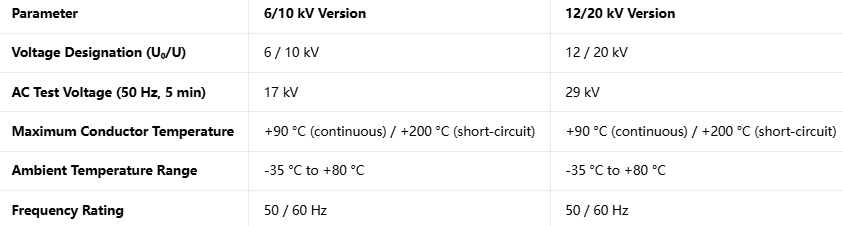
The cable’s performance is defined by its voltage designation U₀/U, where:
U₀ is the rated voltage between conductor and earth or screen (6 kV or 12 kV).
U is the rated voltage between phases (10 kV or 20 kV).
Test voltages are set at approximately 2.4 times the U value (17 kV AC for 6/10 kV versions and 29 kV AC for 12/20 kV versions) to ensure a robust safety margin during factory testing and commissioning.
Thermal management is central to the cable’s design life. The maximum continuous operating temperature at the conductor is +90 °C, which allows for higher current carrying capacity compared to cables rated at 70 °C. Under short-circuit conditions, the material is rated to withstand temperatures up to +200 °C for a duration of up to 5 seconds without suffering permanent damage or deformation. This capability is vital in networks where fault levels can be high, ensuring the cable survives until protection devices operate. The cable operates safely in ambient temperatures ranging from -35 °C up to +80 °C, covering every climate zone found within Southern Africa.
Materials Science: Why These Ingredients Matter
The performance of the RHEYFIRM®(SI) NTMCGCWOEUS cable is not just a result of how it is built, but what it is built from. Material science plays a defining role in determining the service life, reliability, and operational limits of the product. Every material choice is made based on a specific cause-and-effect relationship between composition and performance outcome.
Conductor Material: High-Purity Tinned Copper
Copper remains the standard conductor material in premium power cables due to its superior conductivity (58 MS/m or 100% IACS) and excellent mechanical properties. Aluminium, while cheaper, has roughly 60% of the conductivity of copper and is much more difficult to terminate reliably in flexible connections.
The decision to use tinned copper rather than bare copper is driven by environmental chemistry. When copper is exposed to sulphur dioxide, salt spray, or high humidity, it forms copper sulphide or oxide layers. These layers increase resistance and can lead to overheating at connection points. Tin is a noble metal relative to copper in most atmospheric conditions; it oxidises only to form a stable, impermeable layer that prevents further corrosion of the underlying copper. This material characteristic ensures that the cable performs consistently even in the industrial belt of Gauteng or the corrosive atmosphere of coastal cities like Richards Bay or Saldanha.
Insulation Material: Modified EPDM Rubber
The insulation compound RHEYCLEAN® is based on Ethylene Propylene Diene Monomer. EPDM belongs to the family of synthetic rubbers characterised by a saturated polymer backbone. This chemical structure is the key to its stability. Unlike natural rubber or styrene-butadiene rubber, EPDM has no double bonds in its main chain. This makes it highly resistant to oxidation, UV degradation, and ozone attack—agents that rapidly degrade other polymers when exposed to the South African sun.
From an electrical standpoint, EPDM has a non-polar molecular structure. This means it does not orient itself in an electric field, resulting in very low dielectric loss. Low loss translates to less heat generation within the insulation when voltage is applied, which is crucial for long-term thermal stability. The formulation exceeds DIN VDE 207 Part 20 standards by using high-purity base polymers and clean processing techniques. Fewer impurities mean fewer points where electrical stress can concentrate, leading to a higher dielectric strength and a longer service life.
Semi-conductive Compounds: Carbon Black Technology
Both the inner and outer semi-conductive layers are made by loading polymer bases with high-structure carbon black. The science here is to achieve a specific level of conductivity—too high and it becomes a conductor, too low and it remains an insulator. The precise loading creates a material with a resistivity between 10² and 10⁶ Ohm-centimetres.
For the RHEYSTRIP® outer layer, the material science is adjusted further. The polymer matrix is formulated to have low adhesion to the EPDM insulation compound. Interfacial chemistry ensures that during manufacturing, the layers bond sufficiently to prevent partial discharge, yet during installation, the installer can separate them cleanly. This balance is achieved through the use of specific processing aids and surface modifiers in the compound recipe.
Sheath Material: 5GM5 Heavy Duty Rubber
The 5GM5 compound is a blend of polychloroprene (Neoprene) and EPDM. Polychloroprene contributes excellent oil resistance, flame retardancy, and mechanical toughness, while EPDM adds weatherability and flexibility at low temperatures. This blend creates a sheath that is far superior to standard PVC or general-purpose rubber.
The material is formulated with high-performance fillers such as carbon black and silica to enhance tensile strength and abrasion resistance. Anti-aging additives are included to combat the effects of heat and UV radiation. The result is a material that retains its elasticity and protective properties for decades, rather than becoming brittle or cracking as inferior materials do. This is why these cables are often seen still performing reliably in installations that are 15 to 20 years old across the country.
Performance Advantages: Why This Cable Stands Out
When specifying medium voltage flexible connections, engineers weigh multiple factors. The RHEYFIRM®(SI) NTMCGCWOEUS design offers distinct advantages over generic alternatives, rigid cables, or low-quality imports. These advantages translate directly into lower maintenance costs, fewer outages, and improved safety for South African operations.
Superior Electrical Reliability
The combination of high-grade EPDM insulation and perfect electric field grading ensures that this cable operates with virtually zero partial discharge activity. In comparison, flexible cables using PVC or standard rubber insulation often suffer from partial discharge issues after a few years of outdoor exposure, leading to unexpected failures. The ability to withstand high test voltages (17 kV or 29 kV AC) provides a substantial safety margin against voltage surges common in networks with high levels of renewable energy or weak grid infrastructure.
The high operating temperature rating (+90 °C) also provides a performance advantage. For a given conductor size, this cable can carry significantly more current than a 70 °C rated cable. This allows engineers to potentially specify a smaller cross-section to achieve the same power rating, or simply enjoy a greater safety margin under high load conditions during peak demand.
Unmatched Mechanical Durability
The heavy-duty 5GM5 sheath combined with a robust screen and Class 5 conductor results in a cable that can survive abuse that would destroy standard cables.
Resistance to Tearing and Abrasion: In mines and quarries, cables are frequently dragged across rock or concrete surfaces. This cable resists wear, reducing the frequency of replacement.
Flexibility Without Fatigue: On mobile equipment or temporary power setups, cables are coiled, uncoiled, and moved repeatedly. The Class 5 construction prevents copper fatigue and breakage, maintaining conductivity and safety.
Impact Resistance: The thick rubber sheath absorbs impacts from falling objects or heavy vehicles better than thermoplastic sheaths that crack upon impact.
Broad Environmental Compatibility
One of the strongest selling points for the South African market is the "one cable fits all environments" capability.
Indoor and Outdoor: It performs equally well in air-conditioned control rooms or open-air switchyards.
Arid and Coastal: Whether installed in the dry heat of the Northern Cape or the humid, salt-laden air of KwaZulu-Natal, the materials resist degradation.
Chemical Exposure: Resistance to oils, greases, and industrial chemicals means it is safe to use in refineries, steel mills, and chemical processing plants where spillages are a risk.
Fire Safety: In confined spaces such as underground mines or tunnels, the flame-retardant properties help contain fires and prevent the spread of flames along cable routes.
Simplified Installation and Maintenance
The RHEYSTRIP® easy-strip feature is a practical advantage that should not be underestimated. Medium voltage termination is a skilled and time-consuming task. The ability to remove the outer semi-conductive layer quickly and cleanly reduces labour time and minimises the chance of human error or accidental damage to the insulation core. This makes the product popular with local electrical contractors and maintenance teams. Furthermore, the durable construction means maintenance requirements are minimal; inspections generally focus only on terminations and fixing points rather than the cable itself.
Applications: Where and How It Is Used in South Africa
Understanding where this cable fits into the broader electrical infrastructure helps in correct specification. The name "Connection Cable" is very descriptive; it is not intended for long-distance transmission but rather for linking equipment within a substation or plant. Its flexibility is its defining feature.
Primary Applications
The manufacturer defines the main use as: "Flexible high voltage cable 12/20 kV used normally in short lengths, e.g. between short-circuit breaker and mobile transformer." This description covers the vast majority of installations found in Southern Africa.
Mobile Transformers and Substations: This is the most critical application. In South Africa, mobile transformers are essential tools used by Eskom and municipalities to restore power quickly after failures or to provide temporary supply during maintenance and load shedding. These units must be connected and disconnected rapidly. Rigid cables cannot be used here because they cannot be easily coiled or transported. The RHEYFIRM®(SI) NTMCGCWOEUS cable is the standard choice for these connections because it handles the coiling, uncoiling, and outdoor exposure perfectly. It ensures that emergency power restoration is safe and efficient, minimising downtime for communities and industries alike.
Switchgear Connections: Within industrial substations and power distribution rooms, there is often a need to connect fixed switchgear panels to transformers or busbar systems where slight movement or vibration is expected. Rigid cables can suffer from mechanical stress fractures at termination points due to thermal expansion or equipment vibration. The flexibility of this cable absorbs that movement, preventing fatigue failures and extending the service life of the connection. This is common in large manufacturing plants, data centres, and mine surface infrastructure.
Heavy Industrial Machinery: Industries such as steel production, cement manufacturing, and mining processing plants utilise large motors, crushers, and conveyors that operate at medium voltage levels. In many cases, these machines are mounted on slide rails or foundations that allow for minor movement, or they require periodic disconnection for maintenance. This cable provides the necessary power link while accommodating these operational requirements. Its resistance to oil, dust, and high ambient temperatures makes it ideal for the harsh environments found in the industrial heartland of Gauteng and Mpumalanga.
Port and Terminal Operations: South Africa’s major ports, including Durban, Richards Bay, Saldanha, and Cape Town, rely heavily on mobile harbour cranes, container handlers, and bulk material loading equipment. These machines operate at high voltage and require flexible power connections that can withstand constant movement, salt-laden air, and heavy mechanical wear. The combination of UV stability, corrosion resistance, and high flexibility makes this cable perfectly suited for port environments, where reliability is critical to keeping supply chains moving.
Temporary Power and Events: Whether providing power for large outdoor mining camps, construction sites for new infrastructure projects, or major public events, the ability to deploy, retrieve, and store medium voltage cables is essential. This cable’s design allows it to be handled like a low-voltage cable while maintaining the safety standards required for 10 kV and 20 kV networks. It is frequently used by rental companies specialising in power generation and distribution solutions across the region.
Why Not Use Other Cable Types?
It is helpful to understand why alternative products are unsuitable for these applications.
Standard Rigid XLPE Cables: While excellent for fixed, long-distance installation, these cables have a stiff construction with copper or aluminium tape screens and thermoplastic sheaths. They have a minimum bending radius of 12 to 15 times the diameter, making them impossible to coil or install in tight spaces. Attempting to bend them too sharply causes permanent damage to the insulation and screen.
Low Voltage Flexible Cables: Cables designed for 0.6/1 kV use thinner insulation and different compounds that cannot withstand the electrical stress of medium voltage. Using them in 10 kV or 20 kV systems would lead to immediate breakdown and severe safety hazards.
Generic Rubber Cables: Many manufacturers produce rubber-insulated cables, but few adhere to the strict standards of DIN VDE 0250. Lower-quality versions often use EPDM blends with high impurity levels or inferior sheaths that crack within a few years when exposed to the South African climate. They also lack the precise semi-conductive layers required to control the electric field, leading to early failure.
The RHEYFIRM®(SI) NTMCGCWOEUS cable occupies a unique niche where electrical performance, mechanical flexibility, and environmental durability intersect.
Technical Specifications: Detailed Data and Ratings
To assist engineers and procurement professionals in selection and design, the following section outlines the complete technical data derived from the product specifications. All values conform to relevant DIN VDE and IEC standards.
Compliance and Standards
Adherence to recognised standards is the foundation of quality assurance. This cable is manufactured and tested according to:
DIN VDE 0250 Part 813: Flexible power cables with rated voltages from 3.6/6 kV up to 20/35 kV.
DIN VDE 0298: Application of power cables and accessories, covering current ratings and installation methods.
DIN VDE 0298 Part 4: Current rating calculation based on ambient conditions and grouping.
IEC 60228: Conductor sizes and class requirements.
IEC 60332 Part 1: Flame retardancy test for single cables.
These standards are widely referenced in South African engineering specifications and are considered equivalent in technical requirements to SANS standards, ensuring acceptance in local projects.
Electrical Characteristics
Current carrying capacity is calculated based on DIN VDE 0298 Part 4, assuming an ambient temperature of 30 °C in free air. Values must be derated for higher temperatures, direct sunlight, grouping of cables, or enclosed installations.
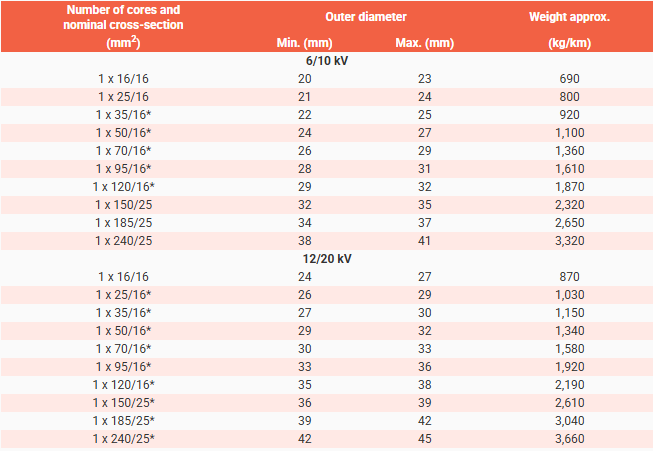
Dimensions and Weight Data
The following tables provide the outer diameter range and approximate weight per kilometre for all available cross-sections. The notation 1 x [Conductor Size]/[Screen Size] indicates the cross-sectional area of the current-carrying conductor and the metallic screen respectively.
Mechanical and Chemical Properties
Bending Radius: Minimum 6 x outer diameter for fixed installation; minimum 8 x outer diameter for dynamic or moving applications.
Tensile Strength (Conductor): Static load capacity ≥ 15 N/mm²; Dynamic load capacity ≥ 30 N/mm².
Elongation at Break: Insulation ≥ 250%; Sheath ≥ 300%.
Resistance Properties: Resistant to mineral oils, greases, acids, alkalis, moisture, UV radiation, and ozone.
Flame Retardancy: Self-extinguishing, meets IEC 60332-1.
Available Options
To accommodate specific project requirements, the following options are available upon request:
Pre-assembled Sealing Ends: Factory-fitted and tested terminations ensure water-tight seals and correct electrical grading, reducing on-site labour and eliminating the risk of poor termination workmanship.
Special Voltages: While the standard range covers 6/10 kV and 12/20 kV, other ratings such as 3.6/6 kV or 8.7/15 kV can be manufactured for specific network configurations.
Custom Lengths: Supplied cut to exact lengths on wooden drums or in coils, depending on the size and quantity required.
Configuration and Selection Guide
Selecting the correct cable variant is a critical step in project design. The following step-by-step guide outlines the process to ensure the right product is specified for the application, balancing safety, performance, and economy.
Step 1: Determine System Voltage
The first and most important decision is the voltage rating.
6/10 kV: Specify this version for networks operating at a nominal line-to-line voltage of 10 kV. This is common in older infrastructure, mining applications, and smaller industrial sites.
12/20 kV: Specify this version for 20 kV networks, which is the standard distribution voltage for Eskom, municipalities, and larger industrial users.
Using a cable rated too low for the system voltage is a safety hazard, while over-specifying results in unnecessary cost and larger cable dimensions that make handling more difficult.
Step 2: Calculate Load Current and Select Cross-section
Once the voltage is known, the required conductor size is determined by the full load current of the equipment, taking into account installation conditions. Engineers must refer to current rating tables based on DIN VDE 0298 Part 4.
Ambient Temperature: In South Africa, where summer temperatures can exceed 40 °C in the shade, derating factors must be applied. The standard rating assumes 30 °C.
Installation Method: Cables installed in free air carry more current than those bundled together or installed inside enclosures or cable ducts.
Short-Circuit Rating: Ensure the selected size can handle the prospective short-circuit current level of the network for the required clearing time. The 200 °C short-circuit temperature limit provides a robust safety margin.
Example Selection Logic:
A 20 kV mobile transformer rated at 2.5 MVA has a full load current of approximately 72 A. Allowing for a 20% safety margin and high ambient temperature derating, a 35 mm² or 50 mm² conductor size is typically selected. Referencing the table, 1 x 50/16 – 12/20 kV offers sufficient capacity and mechanical strength.
Step 3: Define Installation Conditions
Consider how the cable will be used to ensure compliance with mechanical specifications.
Fixed or Moving: If the cable will be moved frequently or subjected to vibration, ensure the bending radius is never less than 8 times the diameter.
Environmental Exposure: The standard 5GM5 sheath is suitable for all South African environments. No additional armour or special covering is required unless there is a specific risk of heavy mechanical impact or rodent damage, in which case separate protection measures should be designed.
Step 4: Specify Options
Decide whether to order bare cable lengths or pre-assembled units.
Pre-assembled ends: Highly recommended for medium voltage applications. They ensure a perfect termination and significantly reduce installation time and risk.
Lengths: Order lengths that minimise the number of joints required. Joints are potential fault points and should be avoided where possible.
Step 5: Finalise Ordering Code
Construct the order code using the format defined in the specifications.
Format: RHEYFIRM(SI) NTMCGCWOEUS 1x[Conductor]/[Screen] – [Voltage]
Example: RHEYFIRM(SI) NTMCGCWOEUS 1x120/16 – 12/20 kV
Feichun Equivalent: The Smart Alternative
While the RHEYFIRM®(SI) NTMCGCWOEUS cable is widely recognised as a premium solution, procurement teams in Southern Africa often face challenges regarding lead times and budget constraints. Feichun Cables offers a fully equivalent alternative designed to the exact same technical specifications, providing a viable option that meets all project requirements while offering distinct commercial advantages.
Technical Equivalence: Same Standards, Same Performance
Feichun manufactures their equivalent cable to comply strictly with DIN VDE 0250 Part 813, DIN VDE 0298, and IEC standards, mirroring the original design completely. From a technical perspective, the products are interchangeable.
Construction Comparison:
Conductor: Uses IEC 60228 Class 5 tinned copper strands, ensuring identical flexibility and corrosion resistance.
Insulation System: Utilises EPDM-based compounds with precisely engineered semi-conductive layers (inner and outer) matching the electrical grading performance of the original RHEYCLEAN® and RHEYSTRIP® technologies. The "easy strip" feature is replicated exactly to ensure familiar handling for installers.
Screen: Close-spiral tinned copper wire screen with equal coverage and conductivity for shielding and earthing purposes.
Sheath: Heavy-duty rubber compound equivalent to 5GM5 per DIN VDE 0207 Part 21, offering identical abrasion, weather, and oil resistance properties.
Performance Match:
Identical voltage ratings (6/10 kV and 12/20 kV).
Same temperature ratings (+90 °C continuous, +200 °C short-circuit).
Equal bending radii and mechanical strength characteristics.
Fully compliant with flame retardancy and environmental resistance requirements.
All technical data, including outer diameters, weights, and current ratings, align precisely with the tables provided earlier in this guide. Feichun provides full test certificates and declaration of conformity for every shipment, ensuring that the product is acceptable for use in all South African industrial, mining, and utility projects.
Key Advantages of Choosing Feichun
For engineering and procurement managers, the Feichun equivalent offers three major benefits:
1. Competitive Pricing
Due to optimised manufacturing processes and supply chain efficiencies, Feichun cables are typically priced 15% to 25% lower than the premium brand equivalent. For large projects or bulk procurement, this represents a substantial cost saving without any compromise on quality or safety. This allows capital budgets to be stretched further or allows for upgrades in other areas of the system.
2. Shorter Lead Times and Reliable Supply
Sourcing premium European-manufactured cables can involve long lead times due to production schedules and shipping logistics, which can delay project timelines. Feichun maintains a robust inventory system and streamlined export processes, ensuring shorter delivery times to South Africa. Reliable supply is critical in the local market, where project delays carry significant financial penalties.
3. Customisation and Support
Feichun offers a high degree of flexibility in production, including custom lengths, pre-assembled terminations, and special packaging requirements. The company provides direct engineering support, assisting clients with selection, technical queries, and documentation required for local authority approvals. This level of service is often more accessible than dealing with large multinational corporations.
Why It Is Accepted in South Africa
South African industry standards are performance-based rather than brand-based. As long as a product meets the required SANS, IEC, or DIN VDE standards and passes relevant type tests, it is approved for use. Feichun cables are widely accepted by consulting engineers, Eskom and municipal suppliers, and major mining houses because they consistently demonstrate compliance and reliability. The use of identical specifications means that design drawings and cable schedules do not need to be altered when switching to the Feichun solution. It serves as a drop-in replacement that simplifies procurement while maintaining the integrity of the electrical design.
Procurement and Buying Strategy
Effective procurement goes beyond simply selecting a product; it involves verifying quality, ensuring compliance, managing logistics, and planning for long-term value. The following section outlines a comprehensive procurement approach tailored for Southern African buyers.
Specification and Documentation Requirements
When issuing tenders or purchase orders, it is essential to define the product technically rather than solely by brand name. This ensures competition while maintaining quality standards. The specification should include:
Standard Reference: DIN VDE 0250 Part 813, DIN VDE 0298, IEC 60332-1.
Construction Details: Class 5 tinned copper conductor, EPDM insulation with semi-conductive layers, tinned copper spiral screen, 5GM5 type heavy-duty rubber sheath.
Rating: Explicitly state voltage (e.g., 12/20 kV), cross-section size, and length.
Test Requirements: Require submission of type test certificates and routine test reports prior to shipment. These reports should verify electrical integrity, dimensions, and material properties.
Marking: Specify that the cable must be clearly marked with voltage, standard, and manufacturer identification.
By focusing on these technical parameters, buyers can confidently accept the Feichun equivalent or other compliant products without risk, knowing they meet the exact performance criteria required.
Supplier Evaluation and Verification
Choosing the right supplier is as important as choosing the right cable. In the South African market, where counterfeit or substandard products occasionally enter the market, verification is critical.
Authorised Partners: Source products from recognised distributors or directly from manufacturers with a proven track record in the region. Feichun’s regional representatives provide assurance of authenticity and after-sales support.
Quality Assurance: Request details of the manufacturer’s quality management system. ISO 9001 certification is a baseline requirement.
Traceability: Ensure every drum of cable can be traced back to its production batch and test records.
Logistics, Storage and Handling
Medium voltage cables are robust, but incorrect handling can damage them before they are even installed.
Packaging: Cables are supplied on strong wooden drums suitable for road and sea transport. Drums should be marked with cable details, length, and weight.
Transport: Drums must be transported upright and secured to prevent rolling or falling. Do not drop drums from vehicles.
Storage: Store drums in a dry, well-ventilated area, preferably undercover to protect against direct sun and rain. If stored outdoors, ensure they are placed on a hard, drained surface and covered with breathable tarpaulins. Avoid long-term storage in areas with high heat or chemical exposure.
Uncoiling: Always uncoil by rolling the drum along the ground or using a cable jack. Never pull the cable off the side of the drum, as this creates loops and twists that can exceed the minimum bending radius and damage the core.
Cost Considerations: Initial Price vs Life Cycle Cost
While initial purchase price is a major factor, experienced engineers and procurement managers evaluate the Total Cost of Ownership (TCO).
Cheap Imports: Low-cost cables that do not meet DIN VDE standards may cost 30% less upfront but often fail within 3 to 5 years due to material degradation. The cost of replacement, downtime, and potential safety incidents far outweighs the initial saving.
Premium Brands: Offer excellent quality but come at a premium price and often long lead times.
Feichun Solution: Delivers premium DIN VDE quality, a lifespan of 15 to 20 years, and reliable performance at a mid-range price point. This represents the optimal balance for most South African projects, offering the lowest total cost of ownership over the asset lifecycle.
Frequently Asked Questions
Can this cable be buried directly underground?
A: The standard RHEYFIRM®(SI) NTMCGCWOEUS and its Feichun equivalent are designed as flexible connection cables and do not include steel wire or tape armour. Direct burial is not recommended because the sheath is designed for environmental protection, not heavy mechanical compression from soil or traffic. If underground installation is required, it should be routed inside a suitable duct or conduit. For direct burial applications, an armoured variant should be specified.
Is this cable suitable for use in mining applications?
A: Yes, it is highly suitable and widely used in both surface and underground mining operations in South Africa. Its flame-retardant properties, robust construction, and ability to withstand dust, moisture, and movement align perfectly with mining safety standards. It is commonly used for connections to mobile transformers, shuttle cars, and moveable conveyor drives.
What is the difference between the 6/10 kV and 12/20 kV versions?
A: The difference lies in the thickness of the insulation wall and the electrical stress levels they can withstand. The 12/20 kV version has approximately double the insulation thickness compared to the 6/10 kV version, resulting in a larger overall diameter and higher weight. They are not interchangeable; the voltage rating must match the system voltage exactly.
How do I terminate this cable?
A: Termination requires medium voltage cable glands or connectors specifically designed for flexible EPDM-insulated cables. The RHEYSTRIP® feature allows easy removal of the outer semi-conductive layer without special tools. It is critical to follow the termination manufacturer’s instructions regarding stripping lengths and stress control. Utilising factory-fitted pre-assembled sealing ends eliminates this complexity entirely.
Does Feichun provide the necessary test certificates for Eskom or mine approvals?
A: Yes. Feichun provides a complete documentation package including Type Test Certificates (TTC) issued by independent laboratories, Routine Test Reports (RTR) for each batch, and Declaration of Conformity. These documents are accepted by all major utilities, consulting engineers, and mining houses in Southern Africa.
Can I get custom lengths or special colours?
A: The standard colour is red for high visibility, but other colours are available upon request. Lengths can be manufactured to exact requirements to minimise joints on-site. Special voltage ratings such as 3.6/6 kV or 8.7/15 kV can also be produced for specific network configurations.
Conclusion
The RHEYFIRM®(SI) NTMCGCWOEUS Cable represents a pinnacle in flexible medium voltage cable technology. Through the application of rigorous engineering principles and advanced material science, it solves the complex challenge of providing safe, durable, and reliable power in applications where movement and harsh environments are unavoidable. Its design, governed by DIN VDE standards, ensures it performs consistently whether connecting mobile transformers during load shedding, powering heavy machinery in mines, or facilitating operations at busy ports.
For engineering teams, understanding the relationship between its construction and performance is key to correct specification. The triple-layer insulation system, the use of Class 5 tinned copper, and the heavy-duty 5GM5 sheath are not just features; they are solutions to specific operational risks found across Southern Africa.
Furthermore, the availability of a technically identical equivalent from Feichun Cables changes the procurement landscape. It offers a path to maintain high engineering standards while optimising budgets and improving supply chain reliability. By choosing the Feichun solution, buyers do not compromise on safety or quality; they simply choose a smarter, more accessible way to source the same essential technology.
As industry continues to evolve and the demand for reliable power grows, having a deep understanding of products like this ensures that infrastructure remains safe, efficient, and resilient. Whether you are designing a new plant, upgrading a substation, or managing maintenance for an existing network, this cable remains the gold standard for flexible medium voltage connections.
If you require further technical data, assistance with cable selection, or a competitive quotation for your next project, please contact the Feichun team directly. We provide full engineering support, compliance documentation, and reliable delivery throughout South Africa and neighbouring countries.
Email: Li.wang@feichuncables.com
Feichun Cables – Your trusted partner for high-performance power transmission and distribution solutions.
Email Address: Li.wang@feichuncables.com
© 2025. All rights reserved.
One-click to Quickly Contact
Products
Contact
Company
Location:
Building A Private Science and Technology Park, Hefei Economic and Technological Development Zone, Anhui Province, China
Heat Resistant Cable
WhatsApp: +86 17333223430
Social Media: