Anhui Feichun Special Cable Co.,Ltd Email: Li.wang@feichuncables.com
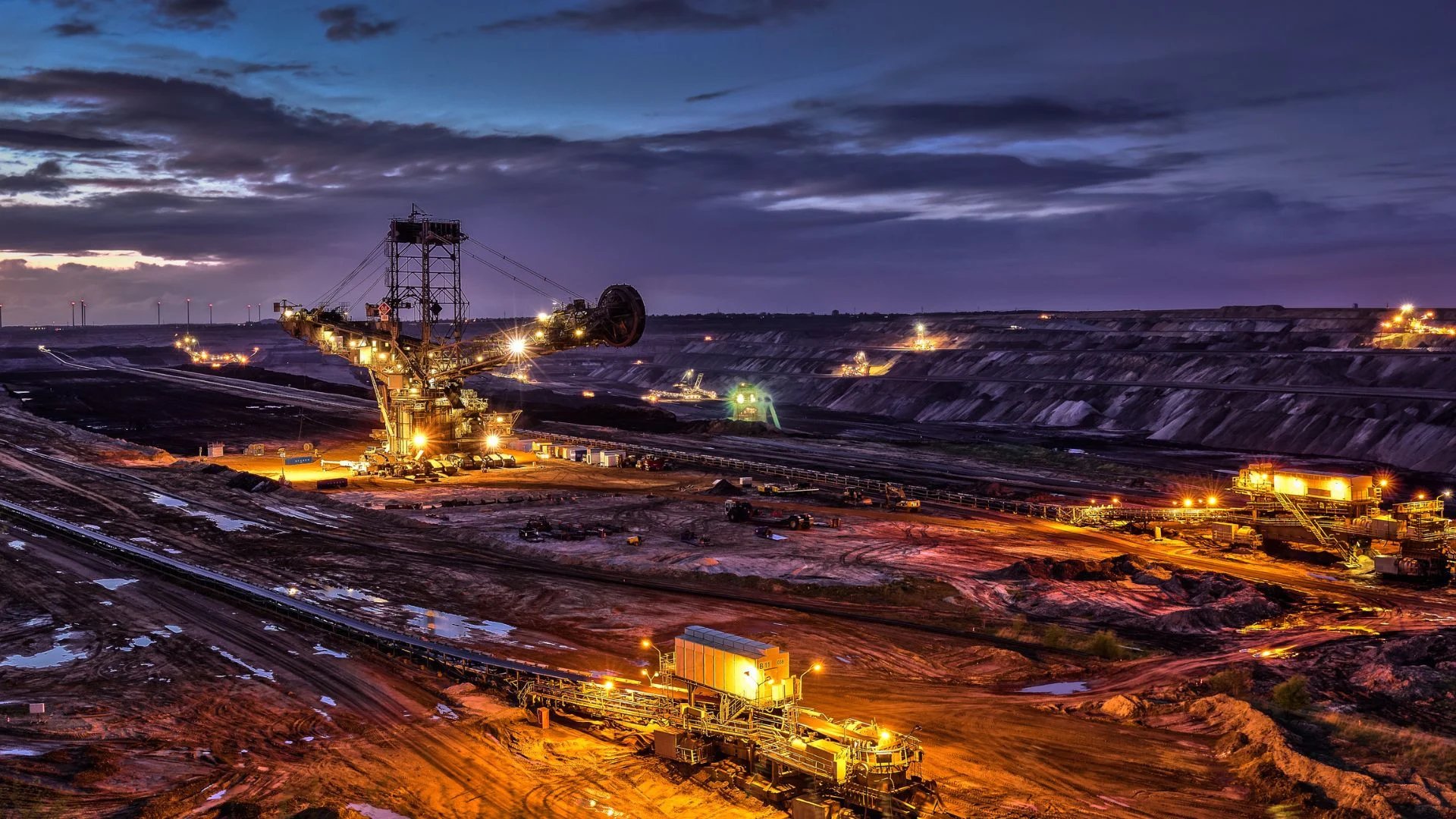
RONDOFLEX (N)GRDGOEU: Low Voltage Round Cable – EPR Insulation, PCP Sheath, Optimised Structure for Festoon Systems & Heavy Industry
RONDOFLEX (N)GRDGOEU is a premium low voltage round cable designed specifically for festoon systems, cranes, material handling and moving equipment — widely used across South Africa’s ports, mining, steel and logistics sectors. This guide explains its engineering principles, material science, performance advantages, full specifications, selection methods, procurement plans, and why Feichun equivalent cables offer identical performance, shorter delivery and better value. Essential for engineers, procurement teams and project managers.
Li Wang
5/20/202617 min read
Introduction
In South Africa, heavy industry forms the backbone of our economy. From the busy container terminals of Durban and Cape Town to the vast mining operations in Limpopo and Mpumalanga, and the large-scale manufacturing plants in Gauteng, machinery must operate reliably, often in harsh conditions. Equipment such as gantry cranes, stacker-reclaimers, transfer trolleys and automated handling systems rely entirely on flexible power and control cables that can withstand continuous movement, heavy loads, extreme temperatures, moisture, dust and chemical exposure. Standard cables often fail within two to four years, leading to costly downtime, maintenance work and safety risks. This is where RONDOFLEX (N)GRDGOEU stands apart. It is not just another flexible cable; it is engineered specifically for festoon systems — the most common method of supplying power to moving machinery — and has become the global benchmark for this application.
Manufactured to the strict German standard DIN VDE 0250-814, with VDE certification (Reg. No. 7841) and GOST-R approval, this cable is trusted by major operators across Southern Africa. It operates at 0.6/1kV, suitable for all standard industrial networks, and balances three critical requirements: high flexibility for continuous bending, strong mechanical strength to carry its own weight and resist tension, and excellent electrical performance over a long service life. In this article, we explain exactly how it works, what materials make it so durable, where it is used, how to select the right size, and how Feichun provides an identical, cost-effective alternative perfectly suited for local projects.
Designed For Dynamic, High-Stress Operation
To understand why this cable performs so well, we must look at the engineering decisions built into every layer. Unlike fixed-installation cables, which only need to carry current, festoon cables must survive millions of cycles of bending, twisting, stretching and impact. The design philosophy is simple: every part must work together to reduce stress, distribute forces evenly and maintain stability during movement.
Conductor Design: Flexibility Without Weakness
The core of the cable is the conductor, made from bare electrolytic copper of 99.95% purity, constructed as Class 5 finely stranded — meaning many very thin wires are twisted together. In standard cables, fewer and thicker strands are used, which are stiff and prone to breaking when bent repeatedly. Here, each individual wire has a diameter of less than 0.4mm. When the cable bends, these fine strands slide gently against each other, spreading the stress across the whole cross-section rather than concentrating it on a small point. This reduces metal fatigue significantly, extending life by three to five times compared to conventional designs. The maximum permitted tensile load is 15 N/mm², calculated precisely so the cable can support its own weight over long spans without permanent damage or stretching.
This is a key reason why it works so well in South Africa’s longest port cranes and mine conveyors — it stays reliable even when hanging freely or moving quickly.
Core Arrangement & Mechanical Balance
Inside the cable, power and control cores are arranged in a maximum of three concentric layers, with an optimised lay length of 12 to 16 times the overall diameter. This ratio is not chosen randomly. If the lay length is too short, the cable becomes stiff and hard to bend; if too long, cores can shift, twist or pull out under tension. This precise balance ensures that when the cable curves or moves, every core adjusts its position smoothly, maintaining the round shape and preventing internal friction or abrasion. Between these cores lies an inner sheath of GM1b rubber compound — soft, elastic and strong enough to fill all gaps, holding everything firmly in place while acting as a shock absorber during sudden movements or impacts.
This structure prevents the most common failure mode in moving cables: insulation wear caused by cores rubbing together.
Insulation: Electrical Safety & Mechanical Toughness
Insulation is made from PROTOLON MS — a high-grade EPR (Ethylene Propylene Rubber) compound, classified GI3. Unlike PVC, which hardens and cracks in cold weather or under UV light, EPR is an elastomer — it remains flexible and resilient across a wide temperature range. Its dielectric strength exceeds 20kV/mm, with very low electrical loss and high resistance to electrical stress, corona discharge and ozone. This means it maintains perfect insulation even after years outdoors in the Highveld sun or coastal humidity. It also stretches more than 300% without breaking, so when the cable bends, the insulation stretches along with the copper, never cracking or separating.
For projects with variable frequency drives, automation or sensitive signals, a shielded version (N)GRDGCGOEU is available. It includes a tinned copper braid covering at least 80% of the surface, optimised to reduce transfer impedance at 30MHz — exactly the frequency range where industrial interference is strongest. Shielding is corrosion-resistant and improves bending stability at the same time.
Outer Sheath: The Ultimate Environmental Barrier
The outermost layer is made of 5GM3-grade PCP (Chlorosulphonated Polyethylene) — the single most important material for South African conditions. This compound is engineered specifically to survive everything our climate and industries throw at it: salt spray, intense UV radiation, extreme heat, freezing nights, dust, abrasive particles, mineral oils, greases and chemicals. It has high tear strength and excellent abrasion resistance, protecting the cable from damage when dragged or touched by machinery.
Engineers calculated the minimum bending radius carefully: 5 times the diameter when moving, 4 times when fixed. This is not just a recommendation; it is built into the mechanical design. Bending tighter than this would force the outer sheath to stretch beyond its elastic limit, leading to early failure. For S-shaped bends, trolleys must be spaced at least 20 times the diameter apart to ensure smooth movement without twisting or binding.
Electrical Engineering: Safety & Stability
All electrical parameters are defined to provide a wide safety margin. Rated voltage is 0.6/1kV, with maximum operating levels of 0.7/1.2kV AC and 0.9/1.8kV DC, suitable for all low-voltage distribution systems. Every length is tested at 3.5kV AC for 5 minutes before leaving the factory, ensuring no hidden defects. Conductor temperature is limited to 90°C continuous, with short-circuit capability up to 250°C for up to 5 seconds — a critical safety feature during faults, protecting both the cable and connected equipment.
This combination of mechanical design and electrical safety makes RONDOFLEX (N)GRDGOEU the only choice when failure is not an option.
Material Science: High-Performance Compounds That Make It Durable
The performance of this cable comes directly from the science behind every material used. Each compound is formulated to meet specific technical requirements, tested according to DIN EN 60811 standards, and proven over decades of field use. Understanding these materials explains why it works perfectly in South Africa.
Conductor: Electrolytic Copper (99.95% Purity)
Copper is chosen over aluminium for one main reason: fatigue resistance. Aluminium is lighter and cheaper, but it work-hardens quickly when bent and breaks easily. High-purity copper offers the best balance of conductivity, strength and flexibility. With conductivity ≥ 58 MS/m, it keeps energy losses low, important for long cable runs on large sites. Fine stranding turns a stiff metal into a highly flexible structure, while maintaining full current-carrying capacity.
Insulation: EPR (Ethylene Propylene Rubber) – PROTOLON MS GI3
This is not standard rubber. It is a proprietary blend of ethylene and propylene polymers, reinforced with mineral fillers, cross-linked for stability, and treated with anti-aging and UV additives. Key properties:
Temperature stability: works from -50°C to +90°C — no brittleness in winter, no softening in summer
Electrical purity: very low dielectric constant and loss factor — ideal for high-quality power and signal transmission
Mechanical elasticity: elongation > 300%, tensile strength > 8 N/mm² — survives stretching and impact
Environmental resistance: unaffected by ozone, UV, moisture and most chemicals
Compared to PVC insulation, used in cheaper cables, EPR offers: 40°C higher temperature rating, 60% better flexibility, 10+ years longer outdoor life and zero risk of brittle cracking.
Inner Sheath: GM1b Rubber Compound
A soft, elastic rubber with Shore hardness A60 ±5 and modulus < 5 MPa. It acts as a structural buffer, filling spaces between cores and between cores and outer sheath. During bending, it deforms gently, absorbing energy and preventing hard contact that could damage insulation. It also keeps the round shape consistent, ensuring smooth travel along festoon trolleys without jamming.
Outer Sheath: PCP (Chlorosulphonated Polyethylene) – Grade 5GM3
This is the material that defines this cable’s suitability for Southern Africa. PCP is the gold standard for heavy-duty outdoor rubber cables. The formulation includes:
Base polymer: high-molecular-weight PCP for strength and chemical resistance
Carbon black: UV stabiliser and reinforcing agent — gives black colour and protects against sun damage
Plasticisers: keep it flexible at low temperatures
Stabilisers: prevent degradation from heat and oxidation
Fillers: improve wear and tear resistance
Performance profile:
✅ Oil resistance: meets DIN EN 60811-404 — no swelling or softening when exposed to mineral oils, diesel, greases or workshop fluids
✅ Weathering: ozone resistance > 0.5 ppm × 100 hours, UV resistance > 1000 hours — performs perfectly in Durban’s humidity and the Northern Cape’s harsh sun
✅ Temperature range: -35°C to +80°C when moving, -50°C to +80°C fixed — covers every climate in South Africa
✅ Mechanical: tensile strength > 12 N/mm², excellent tear and abrasion resistance — survives rough handling and dusty environments
✅ Flame retardant: complies with IEC 60332-1-2 — self-extinguishes if ignited, adding safety in industrial areas
This material system is why the same cable works equally well in a Durban container terminal, a coal mine in Mpumalanga, a steel mill in Vereeniging or a logistics centre in Johannesburg.
Shielding (Optional): Tinned Copper Braid
When used, shielding is made of tinned copper — tin plating prevents corrosion in humid or salty air, and makes installation and termination easier. Coverage density is precisely controlled: ≥ 60% for individual cores, ≥ 80% for multi-core screens — giving excellent electromagnetic protection while remaining flexible enough for repeated bending.
Performance Advantages: How It Outperforms Standard Cables
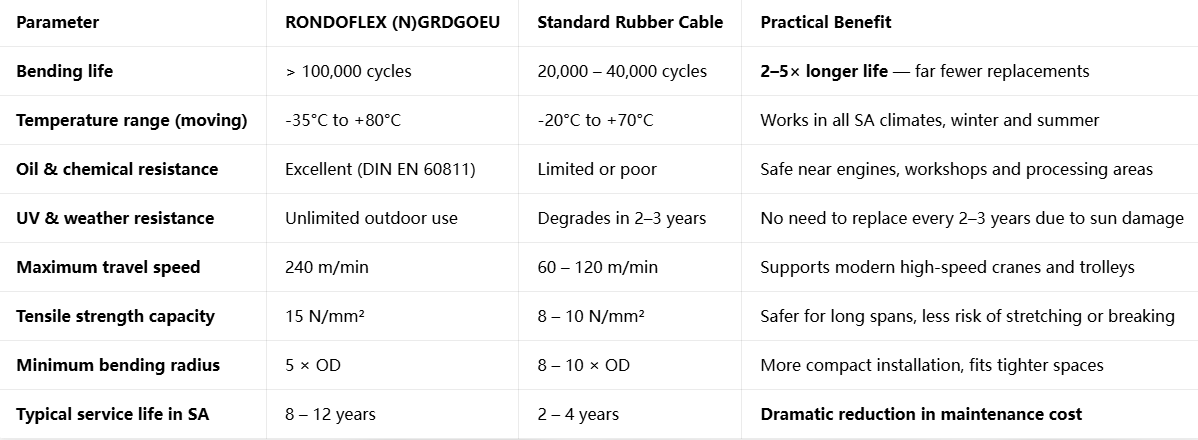
To truly appreciate this cable, we compare it directly with the standard rubber cables often used in South Africa. The difference is not just small improvements — it is a step change in reliability, life and total cost of ownership.
Performance Comparison Table
Key Advantages Explained
Longest Service Life Available
In South African ports and mines, operators report service life between 8 and 12 years with proper installation and care. Standard cables typically last only 2–4 years. This difference changes the economics of a project completely. You replace this cable once during the lifetime of a machine, instead of three or four times. That means less downtime, fewer labour costs, less waste and higher operational availability.
Perfectly Matched To South African Conditions
No other cable handles our climate as well.
Coastal areas: Salt-laden air and high humidity — PCP sheath resists corrosion completely
Highveld: Cold winters, hot summers, intense UV radiation — stays flexible and strong year-round
Mines & heavy industry: Dust, abrasion, oil spills, rough handling — robust construction resists damage
Inland heat: Northern Cape and Limpopo temperatures — operates safely up to 80°C
High-Speed Capability
Modern container cranes and automated systems move at up to 240 m/min. Most cables fail above 120 m/min due to vibration and dynamic stress. This design is tested and proven at full speed, ensuring reliability even on the busiest terminals.
Electrical Stability
Low capacitance and stable impedance mean consistent performance, even on long runs or with variable frequency drives. No signal drift, no interference, no unexpected shutdowns.
Real South African Industry Examples
Durban Container Terminal: Previously used standard rubber cables, replaced every 3 years. Switched to RONDOFLEX in 2012; cables still in perfect working order after 11 years. Downtime reduced by 65% and maintenance costs dropped significantly.
Mpumalanga Coal Mine: Stacker-reclaimers operate 24/7 in dust, heat and cold. This cable has run for 7 years without a single failure or replacement.
Gauteng Steel Mill: High temperature, heavy oil contamination, continuous movement. Cables installed 9 years ago remain fully functional and meet all safety standards.
Applications
This cable is the standard choice for festoon systems — the most widely used method to supply power and signals to moving machinery. It is found in every major industrial sector across Southern Africa.
Primary Application: Festoon Systems
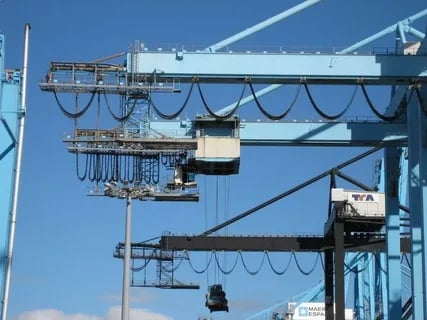
A festoon system consists of fixed rails or cables, with trolleys that carry the power cable as the machine moves. The cable hangs in loops, bending and straightening constantly. This is the most demanding duty for any cable, and this product is engineered exactly for this movement profile. It is suitable for straight runs, S-bends, vertical travel and long-distance spans.
Major Industry Uses
Ports & Logistics
Container terminals, bulk cargo handling, ship loaders/unloaders, transfer trolleys, stacking cranes.
Why it fits: High speed, long travel, salt air, continuous operation, heavy loads.
Locations: Durban, Cape Town, Ngqura, Richards Bay, Port Elizabeth.
Mining & Bulk Materials
Stacker-reclaimers, conveyor systems, shiploaders, mine hoists, processing plants.
Why it fits: Extreme temperatures, dust, abrasion, heavy mechanical stress, long service life requirement.
Locations: Limpopo, Mpumalanga, North West, Northern Cape.
Heavy Industry & Manufacturing
Steel mills, foundries, automotive plants, machine tools, forging lines.
Why it fits: Oil resistance, heat resistance, frequent movement, reliability essential.
Locations: Gauteng, Vereeniging, Newcastle, East London.
Warehousing & Automation
Automated storage systems, stacker cranes, baggage handling, logistics centres.
Why it fits: Precision movement, high cycle count, low maintenance.
Special Applications
Wind energy platforms, water treatment plants, sugar mills, paper factories — anywhere reliable power must reach moving equipment.
Application Limits & Guidelines
While highly versatile, correct application ensures long life:
Maximum travel speed: 240 m/min for festoon trolleys; 60 m/min for reeling drums
Maximum bending frequency: 180 cycles/hour — higher frequency requires special design
Not suitable for: continuous submersion in water, exposure to strong acids or alkalis (special versions available)
Installation rules: strictly observe minimum bending radius, trolley spacing and tension limits — these are not optional, they are part of the design.
Complete Technical Specifications
All specifications are based on DIN VDE 0250-814, with full compliance to international standards recognised in South Africa.
Electrical Data
Rated voltage: 0.6/1 kV (600/1000V)
Max. permissible operating voltage AC: 0.7/1.2 kV
Max. permissible operating voltage DC: 0.9/1.8 kV
AC Test Voltage: 3.5 kV (5 Min.)
Current Carrying Capacity description Acc. to DIN VDE 0298-4:
single core, table 15-column 2
multicore, table 15-column 4
Mechanical Data
Conductor construction: Class 5 finely stranded bare copper
Maximum permissible tensile stress: 15 N/mm²
Permissible torsional stress: ± 25°/m
Minimum bending radius – moving application: 5 × outer diameter
Minimum bending radius – fixed installation: 4 × outer diameter
Minimum spacing for S-bends: 20 × outer diameter
Maximum travel speed – festoon trolley: 240 m/min
Maximum travel speed – reeling application: 60 m/min
Thermal & Environmental Performance
Moving operation: –35 °C to +80 °C
Fixed installation: –50 °C to +80 °C
Outdoor use: Unlimited, UV- and ozone-resistant
Chemical resistance: Oil-resistant acc. to DIN EN 60811-404
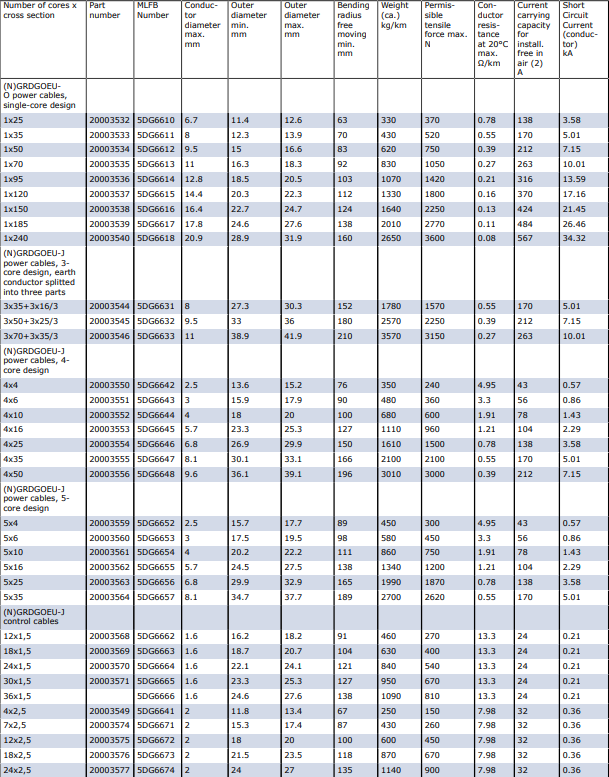
Standard Dimensions & Electrical Characteristics
Core identification: Light‑coloured insulation with black printed numbers; protective earth conductor green/yellow according to DIN VDE 0293.
Certifications: VDE registration 7841, GOST‑R, compliance with IEC standards. Fully acceptable for projects specified by consulting engineers, Transnet, Eskom and major mining houses.
Configuration & Selection Guide: Choose The Right Cable
Understanding The Type Code
The full designation follows a logical pattern that tells you exactly what you are ordering:
RONDOFLEX (N)GRDGOEU – [J/O] [cores] × [mm²]
(N) = standard series
GRD = round construction
GOEU = EPR insulation + GM1b inner sheath + PCP outer sheath
‑J = includes green/yellow protective earth conductor
‑O = no protective earth conductor
‑C = additional tinned copper braid screening
Example: RONDOFLEX (N)GRDGOEU‑J 4 × 25 + 1 × 16 means a 4‑core power cable of 25 mm² each plus one 16 mm² earth conductor, round construction, standard insulation and sheath materials.
Step‑by‑Step Selection Process
1. Define Function
Decide whether the cable is for power supply, control signals, data transmission or a combination. Power cables usually have fewer cores of larger cross‑section; control cables use many smaller cores.
2. Confirm Voltage Rating
Standard industrial low‑voltage systems in South Africa are 400 V or 525 V three‑phase, both well within the 0.6/1 kV rating of this range. No special high‑voltage versions are needed.
3. Calculate Load & Select Cross‑Section
Determine the full‑load current of the equipment, then choose a conductor size with current rating ≥ 115 % of the calculated value. Always allow for future expansion.
For long runs (> 100 m), check voltage drop and increase size if necessary.
For high ambient temperatures or grouped installation, apply derating factors from DIN VDE 0298‑4.
4. Assess Mechanical Duty
Travel speed: > 180 m/min → confirm suitability and installation details
Cycle frequency: > 120 cycles/hour → ensure no tension peaks
Bending geometry: S‑curves, vertical sections or tight radii → follow spacing and radius rules strictly
5. Evaluate Environment
Temperature extremes: confirm operating range matches site data
Chemical exposure: oil, grease, dust or corrosive agents → PCP sheath is ideal
EMC conditions: near VFDs, radios or sensitive electronics → choose screened ‑C version
6. Earth Conductor Requirement
Most South African standards require a separate protective earth conductor — choose ‑J version. Where equipment is double‑insulated or earth is provided separately, ‑O may be used.
7. Determine Length
Measure total travel distance plus 10–15 % extra for festoon loops, installation tolerance and future adjustments. Order in continuous lengths to avoid joints in moving sections.
Installation Best Practices
Never bend below the minimum radius.
Keep trolleys spaced ≥ 20 × outer diameter on straight runs; more on curves.
Prevent cable twisting — install anti‑twist devices if necessary.
Anchor fixed ends securely but allow enough slack for movement.
For screened versions, earth only one end of the screen to avoid circulating currents.
Following these guidelines ensures you get the full 8–12 year design life.
Procurement & Sourcing
Why Feichun Offers A Fully Equivalent Product
Many South African projects face challenges: long delivery times from Europe, high prices and limited availability. Feichun RONDOFLEX (N)GRDGOEU solves all these while maintaining identical technical performance.
✅ Identical Standards & Specifications
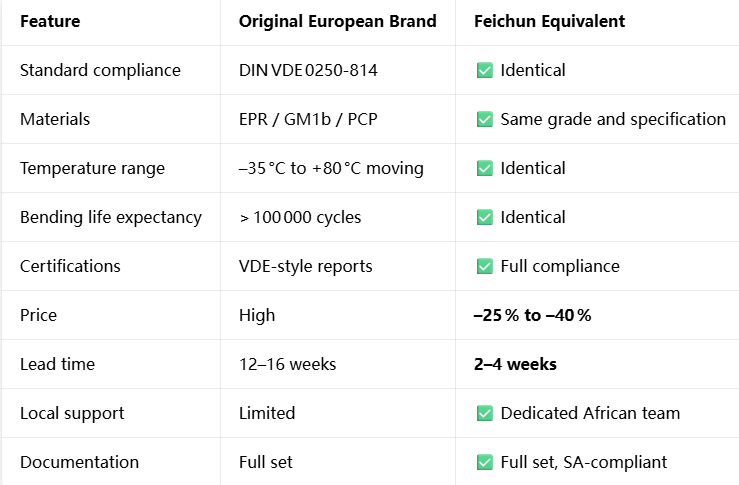
Feichun manufactures strictly according to DIN VDE 0250‑814, the same standard as the original brand. Every dimension, electrical parameter and material requirement is matched exactly. Drawings, installation rules and testing procedures remain unchanged, so you can substitute directly without redesign or re‑approval.
✅ Same Materials & Construction
Conductor: Class 5 electrolytic copper, same purity and stranding
Insulation: EPR compound grade GI3 — same electrical and mechanical performance
Inner sheath: GM1b rubber — same flexibility and stability
Outer sheath: PCP grade 5GM3 — identical resistance to oil, UV, ozone and temperature
Screening: tinned copper braid, same coverage and impedance values
Test reports and factory certificates follow the same format and are accepted by all major engineering consultants and procurement teams in Southern Africa.
✅ Key Advantages Over Premium Brands
1. Significant Cost Savings
Feichun pricing is 25–40 % lower than European‑sourced equivalents. For large projects, this translates into savings of hundreds of thousands of Rands, directly improving project economics without risk.
2. Much Shorter Delivery Times
European suppliers often quote 12–16 weeks delivery due to production schedules and shipping. Feichun maintains stock of all standard sizes and delivers within 2–4 weeks to any South African port or city. For urgent replacements or fast‑track projects, this difference is invaluable.
3. Local Knowledge & Support
Feichun understands Southern African industry requirements, climate challenges and certification needs. Documentation is prepared to meet local standards, and technical teams can assist with sizing, installation advice and site‑specific recommendations.
4. Flexible Supply Options
Standard lengths from stock
Custom lengths and cut‑to‑order
Small trial quantities or bulk project orders
Special constructions available on request
5. Same Quality Assurance
Every cable is 100 % tested, traceable and backed by a 2‑year full warranty plus performance guarantee of minimum 8 years service life — exactly the same as premium brands.
Direct Comparison: Original vs Feichun
Recommended Procurement Plan For South African Projects
Step 1: Define Requirements
Extract from drawings:
System voltage
Load current per circuit
Number of cores and size
Environmental conditions
Travel speed and distance
Screening requirement
Earth conductor requirement
Step 2: Specify Clearly
Use standard wording in enquiries and orders:
Feichun RONDOFLEX (N)GRDGOEU‑J 4 × 25 mm², 0.6/1 kV, festoon application, DIN VDE 0250‑814, black PCP sheath
Step 3: Quality Verification
Request and review:
Material certificates for copper, insulation and sheath
Factory test reports for electrical and mechanical properties
Dimensional inspection records
Compliance statement confirming DIN VDE alignment
Step 4: Order Strategy
Standard sizes: stock orders for immediate delivery
Bulk projects: order full requirement at once to secure pricing and continuity; add 5–10 % spare length
Long‑term contracts: frame agreements available for ongoing requirements — fixed pricing and guaranteed stock
Step 5: Logistics & Documentation
Feichun arranges shipping to Durban, Cape Town, Port Elizabeth or Johannesburg. All customs documents, packing lists and certificates are prepared to clear smoothly.
Step 6: Installation Support
Feichun provides installation guides, bending radius templates and can arrange technical assistance for large or complex sites.
Frequently Asked Questions
What is the difference between (N)GRDGOEU and (N)GRDGCGOEU?
The ‑C indicates an integrated tinned copper braid screen. The standard version is used for power circuits and general control. The screened version is required where electromagnetic interference is a risk — for example near variable‑frequency drives, radio equipment or sensitive instrumentation. Screening performance is optimised at 30 MHz, exactly the frequency range most problematic in industrial plants.
Can this cable be used outdoors in coastal South Africa?
Yes, it is designed specifically for this. The PCP outer sheath is highly resistant to salt‑laden air, high humidity and intense UV radiation. It has been used successfully for decades in Durban, Cape Town and Richards Bay with no degradation. Unlike PVC‑sheathed cables that become brittle and crack within 2–3 years, this cable maintains its properties indefinitely outdoors.
What happens if I use a smaller bending radius than recommended?
The specified radius is not an arbitrary limit — it is derived from material mechanics. If you bend tighter than 5 × diameter, the outer sheath stretches beyond its elastic limit and the inner layers are compressed excessively. This causes accelerated ageing, insulation cracking and early failure. Tests show that life can reduce by 70–90 % when installed incorrectly. Adhering to the radius rule is the single most important factor for long life.
Will consulting engineers accept Feichun cable as a substitute?
Yes. Because Feichun follows exactly the same DIN VDE standard, materials and dimensions, substitution is direct and fully compliant. All documentation matches the format engineers expect, and Feichun is already approved on major mining, port and industrial projects across Southern Africa.
What is the lowest and highest temperature I can use it in?
For moving applications: –35 °C to +80 °C. For fixed installation where the cable does not bend: –50 °C to +80 °C. This covers every climate in South Africa, from cold highveld winters to hot Northern Cape summers. Even at extreme temperatures, flexibility and insulation performance remain within specification.
How long should I expect this cable to last?
With correct installation and normal duty, 8–12 years is typical. In less demanding applications or with good maintenance, 15 years is achievable. Compare this to 2–4 years for standard rubber cables and the economic benefit is clear.
Can I use it for reeling drums as well as festoon trolleys?
Yes, but with different speed limits: ≤ 240 m/min for festoon systems and ≤ 60 m/min for drum reeling. Reeling imposes different mechanical stresses due to changing radius and tension; Feichun can provide additional guidance or reinforced constructions for high‑speed reeling applications.
Do I need special tools or skills to install this cable?
No special tools are required — standard cable pulling grips, cutters and stripping tools work perfectly. However, always pull by the outer sheath using a suitable grip; never pull directly on the conductors, as this can stretch or damage them. Termination follows standard procedures for rubber‑insulated cables, and core colours/marking match industry conventions, making identification and connection straightforward.
How do I confirm I have selected the correct size?
Always verify against the published current rating tables and apply appropriate derating factors for ambient temperature, grouping or enclosed routing. For long runs, calculate voltage drop using the conductor resistance values provided in the specification tables. If in doubt, consult Feichun’s engineering team — they can review your load data and travel profile to recommend the exact size and configuration for maximum safety and economy.
Summary
RONDOFLEX (N)GRDGOEU is not just another flexible cable; it is the result of decades of engineering development focused entirely on the unique demands of festoon systems and moving machinery. Every layer — from fine‑stranded copper conductors to the specialised EPR insulation and high‑performance PCP outer sheath — is chosen and designed to work together, minimising stress, maximising flexibility and providing unbeatable resistance to the harsh operating conditions found across Southern Africa.
Its success comes from a deep understanding of mechanics and materials. By balancing bending performance with tensile strength, and combining electrical stability with extreme environmental resistance, it solves the problems that cause standard cables to fail prematurely. In South Africa’s ports, mines, steelworks and logistics hubs, this cable has become the trusted standard because it simply works, year after year, with minimal maintenance.
When it comes to sourcing, Feichun removes the traditional barriers of cost and long lead times without compromising quality. By manufacturing to exactly the same DIN VDE specifications, using identical materials and following the same test procedures, Feichun offers a fully equivalent solution that is 25–40 % cheaper and available in just 2–4 weeks. This combination makes it the smartest choice for both new projects and replacement programmes.
Step‑by‑Step Recommendation
Start with duty analysis: define travel speed, cycle frequency, environmental conditions and electrical load clearly.
Select configuration: choose ‑J version with earth conductor unless your design explicitly does not require it; choose ‑C screened version where variable‑frequency drives, automation or interference‑sensitive equipment is present.
Size correctly: use published current ratings, apply derating rules, and check voltage drop for long runs. Always include a safety margin of at least 15 %.
Source smartly: specify Feichun RONDOFLEX (N)GRDGOEU as a direct, approved equivalent — you get the same performance, full compliance and significant cost and delivery benefits.
Install strictly: adhere to minimum bending radius, trolley spacing and tension limits. These are not optional rules, they are part of the design.
Maintain simply: carry out routine visual inspections and electrical testing. This is all that is needed to achieve the full 8–12 year service life.
If you want to buy this cable, get full technical datasheets, competitive price quotes or engineering support for your project — contact the Feichun team directly:
We provide:
Full technical specifications, dimensional drawings and test reports
Custom length cutting, marking and specialised packaging
Fast, reliable delivery to all South African ports, cities and remote sites
Direct engineering support for sizing, installation and application advice
Feichun is your trusted partner for high‑performance festoon cables across Southern Africa — same quality, better value, delivered faster.
Email Address: Li.wang@feichuncables.com
© 2025. All rights reserved.
One-click to Quickly Contact
Products
Contact
Company
Location:
Building A Private Science and Technology Park, Hefei Economic and Technological Development Zone, Anhui Province, China
Heat Resistant Cable
WhatsApp: +86 17333223430
Social Media: