Anhui Feichun Special Cable Co.,Ltd Email: Li.wang@feichuncables.com
SANS 1507: A Comprehensive Guide for South African Contractors and Engineers
Discover SANS 1507, the cornerstone South African National Standard for low- and medium-voltage PVC and XLPE SWA power cables. This in-depth guide compares SANS 1507-3 and SANS 1507-4 to IEC 60502-1, BS 5467, and UL equivalents, explores African-specific adaptations for termite resistance and 40 °C soil temperatures, and equips contractors with procurement tips, installation best practices, and a detailed FAQ for Eskom, municipal, and renewable energy projects.
Li.Wang
10/30/20258 min read

Why SANS 1507 Matters in South African
In a country where load-shedding has become part of daily vocabulary and the rollout of embedded generation is accelerating faster than the springboks on a rugby field, the reliability of low- and medium-voltage power cables is non-negotiable. From the dusty construction sites of Limpopo to the high-rise developments along Cape Town’s Atlantic Seaboard, contractors and engineers live or die by the quality of their cabling decisions. Enter SANS 1507 – the South African National Standard that governs extruded solid dielectric insulated cables rated from 300/500 V right up to 1.9/3.3 kV.
Administered by the South African Bureau of Standards (SABS) under compulsory specification VC 8075, SANS 1507 is not just another document gathering dust on a shelf; it is the legal backbone for every utility, municipal, and government infrastructure project in Mzansi. Miss it, and your tender is heading straight for the reject pile at Eskom or the local municipality. Specify it correctly, and you unlock local supply chains, dodge import duties, and future-proof installations against the harsh African sun, termite invasions, and grid harmonics from rooftop PV inverters.
This article takes you on a proper deep dive – no superficial skimming here. We will unpack the standard’s six parts with laser focus on SANS 1507-3 (PVC-insulated SWA distribution cables) and SANS 1507-4 (XLPE-insulated SWA distribution cables), benchmark them against global heavyweights like IEC 60502-1 and BS 5467, reveal the clever regional tweaks that make them Africa-ready, and arm you with procurement hacks and an FAQ section that actually answers the questions you shout across site offices. Whether you are pulling 185 mm² aluminium into a Joburg substation or feeding a 5 MW solar farm in the Northern Cape, this guide has your back.
Historical Evolution and Regulatory Framework of SANS 1507
The story of SANS 1507 begins in the early 1970s when the SABS first published specifications for PVC-insulated cables under the old SABS 97 banner. Back then, South Africa’s grid was expanding rapidly to electrify townships and power new mines, but imported British cables kept failing under local UV and rodent attack. By 1984, the standard had morphed into SANS 1507, incorporating lessons from catastrophic cable fires in Durban high-rises and conductor melting incidents in Kimberley’s 45 °C summer heat.
Fast-forward to the 2000s: globalisation forced alignment with IEC norms, yet the SABS refused to sacrifice hard-won African resilience. The 2014 revision introduced mandatory termite-resistance clauses for XLPE cables and raised soil thermal resistivity assumptions from 1.2 K.m/W (IEC default) to 2.0 K.m/W to reflect the Karoo’s bone-dry conditions. Today, VC 8075 – enforced by the National Regulator for Compulsory Specifications (NRCS) – makes SANS 1507 compliance compulsory for any cable sold for fixed installation in public infrastructure.
The standard is split into six parts, each laser-focused:
Part 1: General guidance – what to ask suppliers, how to verify quality, and installation do’s and don’ts.
Part 2: Wiring cables for flexible cords inside buildings.
Part 3: PVC-insulated, steel wire armoured distribution cables – the workhorse for municipal feeders.电缆
Part 4: XLPE-insulated, SWA distribution cables – the premium choice for solar plants and industrial parks.
Part 5: Halogen-free, low-smoke cables for tunnels and malls.
Part 6: Service connection cables from pole to plot boundary.
Enforcement is no paper tiger. Every reel must carry the SABS certification mark, a unique NRCS Letter of Authority (LOA) number, and a batch traceability code. Miss any of these, and the consignment gets red-flagged at the port or depot. Contractors who specify SANS 1507 also shield themselves from liability – if a cable fails, the SABS type-test report becomes your courtroom exhibit A.
Core Technical Specifications of SANS 1507-3 and SANS 1507-4 SWA Cables
Let’s roll up our sleeves and dissect these cables layer by layer, using the exact terminology you will see on Aberdare, CBI-electric, or Alvern datasheets.
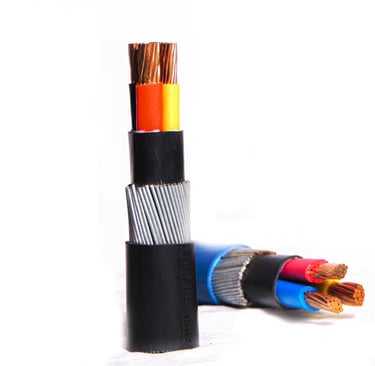
Conductor
Both parts mandate Class 2 stranded plain annealed copper to SANS 1411-2, with cross-sectional tolerances of +2 % / –1 %. Aluminium is permitted (Class 2 compacted to SANS 1411-4) but must be explicitly declared on the purchase order. Maximum conductor resistance at 20 °C for 16 mm² copper? 1.15 mΩ/m for Part 3, 1.16 mΩ/m for Part 4 – numbers you will need when calculating voltage drop on a 400 m feeder to a township RDP cluster.
Insulation
SANS 1507-3: General-purpose PVC Type TI 3, minimum average thickness 0.8 mm for 6 mm² cores, eccentricity ≤ 10 %. Operating temperature capped at 70 °C continuous, 160 °C short-circuit.
SANS 1507-4: Thermosetting XLPE Type GP 8, minimum average thickness 0.7 mm for 6 mm² cores, eccentricity ≤ 8 %. Rated 90 °C continuous, 250 °C short-circuit – the difference that lets you push 15 % more current through the same copper in a De Aar solar farm.
Bedding and Armour
An extruded PVC bedding (minimum 0.8 mm radial thickness) sits beneath galvanised steel wire armour (SWA). Armour wire diameter is calculated per SANS 1507-3 Table 5 to survive a 2 000 kg crushing force and repeated rodent gnawing – think bushveld jackals near Polokwane. Coverage must exceed 90 % optical, ensuring no gaps for moisture ingress during direct burial.
Outer Sheath
Part 3: UV-stabilised PVC Type ST 3, black only, minimum 1.8 mm thick for 4-core 35 mm².
Part 4: Enhanced PVC Type ST 8 or optional nylon 12 for termite-prone areas (mandatory in direct-burial XLPE installations). Sheath must pass SANS 60754-2 acid gas emission if low-smoke is specified.
Electrical Tests
Routine: Every production length undergoes partial discharge (≤ 5 pC at 1.73 U₀) and conductor resistance checks.
Type tests: High-voltage immersion (4 hours at 20 kV for 3.3 kV cables), bending (12 × overall diameter), and shrinkage (≤ 4 % at 130 °C).
Sample tests: Armour corrosion (1 000 hours salt spray) and insulation volume resistivity (≥ 10¹³ Ω.cm at 90 °C for XLPE).
Fire Performance
Flame propagation per SANS 60332-3 Category A is optional but increasingly demanded in Gautrain tunnels and Sandton skyscrapers. Compatibility ageing (7 days at 100 °C) ensures the insulation won’t crumble after 30 years in a Pretoria substation trench.
In-Depth Comparison with International Standards
Contractors tendering for multinational projects often face the question: “Can we import IEC cables and save 20 %?” The answer is a qualified “maybe” – here is the forensic breakdown.
a. SANS 1507 vs. IEC 60502-1
Construction is virtually identical: copper/XLPE/SWA/PVC, same voltage classes, same high-voltage test levels. The devil is in the annexes. SANS mandates termite resistance (nylon sheath or additive) and derates current for 40 °C soil temperature versus IEC’s 20 °C. Result? An IEC cable rated 145 A in Europe drops to 125 A in Upington sand.
b. SANS 1507 vs. BS 5467
Functionally interchangeable for 600/1 000 V fixed installations. Key differences: BS allows red or grey sheath (SANS insists on black UV stability), and armour wire diameter tolerance is ±5 % in BS versus ±3 % in SANS. In practice, a 4-core 25 mm² BS 5467 cable will pass SANS type-tests with an equivalence declaration.
c. SANS 1507 vs. UL 83/1569
Apples and oranges. UL caps at 600 V and obsesses over UL 1685 smoke emission for plenum spaces. SANS prioritises mechanical impact (2 500 N for SWA) and direct burial in coral-rich Free State soils. Importing UL cables for a 1.9/3.3 kV Eskom feeder is a non-starter.
d. Decision Matrix
Local municipal tender: Specify SANS 1507-3 to avoid SABS rejection.
Export to Zambia: IEC 60502-1 with SANS termite addendum.
Private factory: BS 5467 if the client’s insurer is Lloyd’s of London.
Regional Adaptations for African Operating Conditions
International standards are written in air-conditioned Geneva offices. SANS 1507 is forged in the crucible of African reality.
Thermal Performance
XLPE cables (Part 4) run at 90 °C continuous, letting you squeeze 173 A through a 50 mm² copper core in 40 °C ambient – critical when a Cape Town data centre hits peak load during a heatwave. PVC (Part 3) is limited to 70 °C, but still outperforms European PVC in 50 °C direct sunlight thanks to carbon black UV stabilisation.
Mechanical Durability
SWA is sized for direct burial in free-draining soils with 600 mm urban cover or 800 mm under roads (per SANS 10142-1). In the Northern Cape, where quartz pebbles act like cheese graters, armour wires are 2.0 mm minimum for 35 mm² cables – 15 % thicker than IEC.
Termite and Rodent Resistance
Mandatory nylon outer sheath or polyamide additive in Part 4 XLPE cables. A 2019 case study at the Kathu Solar Park showed untreated IEC cables devoured within 18 months; SANS-compliant reels survived five years without a single breach.
Grid Compatibility
Current-carrying capacity tables in SANS 1507-4 Annex B factor in South African earth fault levels (up to 40 kA for 1 s) and harmonic distortion from 1 000 V inverters. Eskom’s NRS 097-2-1 grid code explicitly references these tables for embedded generation tie-ins.
Procurement, Supply Chain, and Cost-Effectiveness Considerations
Tendering for a R150 million Eskom substation? Here is how SANS 1507 saves your bacon.
Local Manufacturing Edge
Aberdare’s Pietermaritzburg plant rolls out 4-core 16 mm² Cu/XLPE/SWA/PVC in 500 m drums within 14 days. Importing the same from Europe? Add 12 weeks shipping, 25 % duty, and VAT. SABS certification also waives SANS 1574 import conformity checks.
Stock Codes and Sizing Pitfalls
Common spec: SANS 1507-4, 3-core + E, 35 mm² Cu/XLPE/SWA/PVC, 1.9/3.3 kV. Undersizing armour for a 300 m pull through 90° bends is a rookie error – use minimum 1.6 mm wire diameter and check pulling tension ≤ 3 kN per core.
Lifecycle Cost Analysis
XLPE (Part 4) costs 18–22 % more upfront than PVC (Part 3), but I²R losses drop by 12 % at 90 °C. Over 25 years in a Kimberley solar farm, the payback is 4.2 years. Factor in zero insulation failures versus three PVC replacements, and the TCO swings decisively.
Common Applications and Installation Best Practices
SANS 1507 cables shine in:
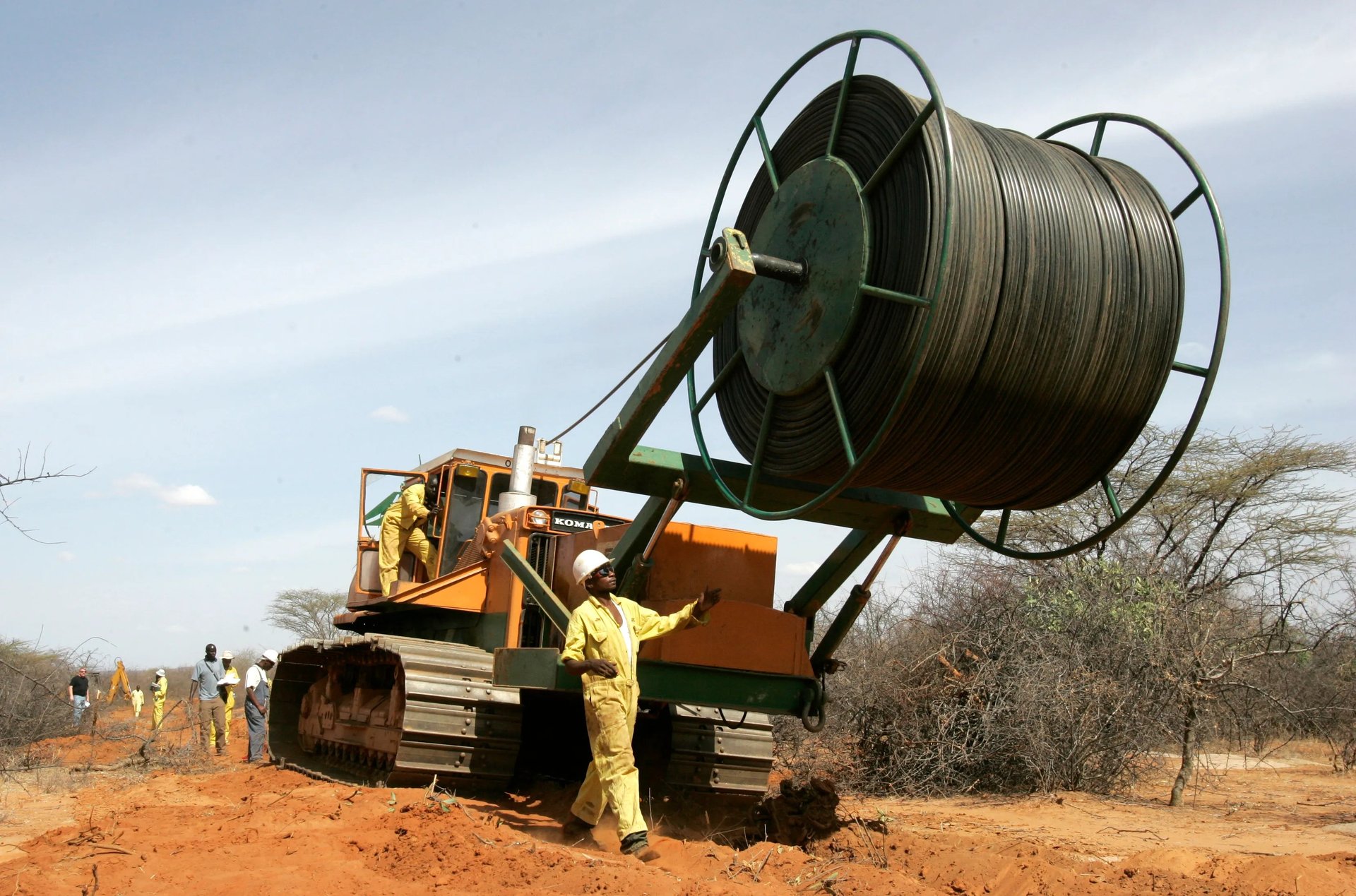
Underground municipal feeders: 185 mm² aluminium from substation to township.
Solar farm collector networks: 35 mm² copper XLPE for 1.9/3.3 kV strings.
Industrial risers: 4-core 10 mm² PVC in cable trays inside factories.
Installation Checklist
Trench depth: 600 mm urban, 800 mm road crossings, 1 000 mm under railways.
Bedding: 100 mm sand below, 150 mm above, warning tape at 300 mm.
Bending radius: 12 × overall diameter (≈ 360 mm for 30 mm cable).
Glanding: IP66 brass CW glands with earth tag; torque to 45 Nm.
Jointing: Resin-filled kits tested to SANS 1507 Clause 9.4.
A 2023 incident in Soweto saw a contractor fined R180 000 for using 8 × D bending radius – the SWA kinked, insulation cracked, and a fault blacked out 2 000 homes. Lesson: follow the standard, or pay the price.
Frequently Asked Questions (FAQ)
Is SANS 1507 mandatory for all South African projects?
Compulsory for public-sector and utility work under VC 8075. Private projects may reference it for liability protection – most insurers demand it anyway.
Can IEC 60502-1 cables be substituted without re-certification?
Only with an SABS equivalence declaration and the consulting engineer’s written approval. Termite resistance must still be proven.
What is the maximum operating temperature for SANS 1507-4 XLPE cables?
90 °C continuous, 250 °C short-circuit (5 s). Derating tables in Annex B for 45 °C ambient.
Are aluminium conductors permitted under SANS 1507-3?
Yes – Class 2 compacted aluminium to SANS 1411-4. Voltage drop must stay ≤ 4 % per SANS 10142-1.
How do I verify SABS mark authenticity on delivered reels?
Cross-check the NRCS LOA number, batch code, and SABS type-test report. Scan the QR code on newer reels for instant verification.
What fire-retardant options exist within SANS 1507?
Part 5 for full halogen-free low-smoke. Parts 3/4 offer optional flame-retardant compounds passing SANS 60332-3 Cat A.
Is termite resistance mandatory?
Yes for direct-burial XLPE (Part 4) via nylon sheath or additive. Optional but recommended for PVC in rural areas.
Can SANS 1507 cables be used for renewable energy installations?
Absolutely – XLPE/SWA is the default for DC strings and MV collector networks up to 3.3 kV. Check harmonic derating per NRS 097-2-1.
Conclusion
SANS 1507 is more than a standard – it is South Africa’s electrical DNA, encoding decades of local lessons into every metre of cable. Specify it, and you deliver reliability that survives load-shedding, termites, and 50 °C heatwaves. Ignore it, and you risk tender disqualification, costly failures, and sleepless nights. For contractors and engineers building Africa’s future, mastery of SANS 1507-3 and SANS 1507-4 is not optional – it is the difference between a legacy project and a liability nightmare. Now go forth, pull those cables with confidence, and keep the lights on.
Email Address: Li.wang@feichuncables.com
© 2025. All rights reserved.

One-click to Quickly Contact
Products
Contact
Company
Location:
Building A Private Science and Technology Park, Hefei Economic and Technological Development Zone, Anhui Province, China
Heat Resistant Cable
WhatsApp: +86 17333223430
Social Media: