Anhui Feichun Special Cable Co.,Ltd Email: Li.wang@feichuncables.com
SANS 1520 Type 63 1.9/3.3kV Flexible Trailing Cable for Mining: EPR‑Insulated Heavy‑Duty Power Cable for South African Mines
SANS 1520 Type 63 1.9/3.3 kV is the definitive medium‑voltage flexible trailing cable designed and standardised for South African mining conditions. This guide explains its engineering principles, EPR and CR material technology, full technical specifications, use across gold, platinum, coal and iron ore operations, and why Feichun cables offer a fully compliant, cost‑effective alternative with faster delivery and identical performance.
Li.Wang
5/26/202615 min read
Introduction
In South Africa, mining is not just an industry — it is the backbone of the economy, contributing around 7 % of GDP and nearly 25 % of export earnings. From the deep gold mines of the Witwatersrand to the vast platinum deposits of the Bushveld Complex, from coalfields in Mpumalanga to iron ore and manganese operations in the Northern Cape, the environment is among the most demanding on Earth. Equipment must withstand extreme temperatures, abrasive dust, moisture, chemical exposure, and continuous mechanical stress — especially mobile machinery such as shovels, draglines, drills, loaders and conveyors that move daily across long distances.
For these applications, no cable is more trusted or widely specified than SANS 1520 Type 63 1.9/3.3 kV. Defined under SANS 1520‑2, with materials and testing aligned to SANS 1411‑1 and SANS 1411‑3, this is the official South African standard for medium‑voltage flexible trailing and reeling cables. It sits perfectly in the product range: above low‑voltage Type 61 (≤ 1.1 kV) and below higher‑voltage Type 66 (3.8/6.6 kV) and Type 633 (19/33 kV), making it the ideal choice for medium‑sized equipment where power, safety and flexibility must all be balanced.
This article explains exactly how it is built, why each material is chosen, how it performs, where it is used, how to select the correct size, and where to source it — including why Feichun Cable has become the preferred equivalent replacement for mines across Southern Africa. Written for engineers, procurement specialists and technical managers, it draws directly from official standards, manufacturer data and real‑world operational experience.
Standardisation and Compliance Framework
South Africa has one of the most rigorous mining safety and quality systems in the world, governed by the South African Bureau of Standards (SABS) and enforced through regulations including the Mine Health and Safety Act, 1996. For cables used in hazardous or heavy‑duty environments, compliance is not optional — it is a legal requirement.
Understanding SANS 1520 Series
SANS 1520 is the national standard covering rubber‑insulated flexible cables for mining and industrial use, divided into three parts:
SANS 1520‑1: General requirements and definitions
SANS 1520‑2: Specification for individual types — this is where Type 63 is formally defined
SANS 1520‑3: Guidance on installation, operation and maintenance
Type 63 is classified as a medium‑voltage trailing cable, rated at U₀/U = 1.9/3.3 kV. This notation means:
U₀ = 1.9 kV: maximum voltage between any core and earth or screen
U = 3.3 kV: maximum voltage between any two live cores
This voltage level is optimal for machines drawing between 100 kVA and 2 MVA — exactly the range of most shovels, drills, pumps and mobile substations found in South African mines.
Supporting Standards
Every component and test method is governed by additional standards to guarantee consistency:
SANS 1411‑1: Requirements for conductors, stranding, tinning and dimensional tolerances
SANS 1411‑3: Specifications for rubber compounds — including exact formulations for EPR insulation and CR sheaths
SANS 60079‑0 / SANS 60079‑7: Explosion‑proofing requirements for use in methane‑rich underground or dust‑laden opencast environments
SANS 10163: Flame‑retardancy and fire‑performance testing
When a cable is marked SANS 1520 Type 63, it means it has passed every test in these standards, including:
10,000‑cycle bending test
High‑voltage endurance (11 kV AC for 5 minutes)
Thermal stability at 90 °C continuous
Ozone and UV exposure
Abrasion and tear resistance
Fault‑current carrying capacity
Certification is issued only by SABS‑approved laboratories such as The Cable Lab, which holds ISO/IEC 17025 and IECEE accreditation — the highest global benchmark for testing.
Engineering Principles: Design and Function
What makes Type 63 unique is that it is not just “a cable” — it is a complete engineered system designed to solve four conflicting demands: carry high power, remain highly flexible, resist extreme damage, and ensure total safety. Every layer serves a specific purpose, and the way they work together is what gives it its legendary reliability.
Complete Layer‑by‑Layer Construction
From centre to outside, the structure is: [Class 5 Tinned Copper Conductor] → [EPR Insulation] → [Composite Screen: Tinned Copper + Nylon Braid] → [Right‑Hand Lay‑up + Rubber (RD1) Filler Core] → [CR Inner Sheath] → [Open‑Weave Nylon Reinforcement Braid (≥ 16 strands)] → [CR Outer Sheath] + 1 Unscreened Pilot Core
This is the exact construction defined in SANS 1520‑2 and used by all certified manufacturers, including Eland, Cleveland and Feichun.
Electrical Safety: Individual Screening
The most critical design feature is that each power core is screened separately, rather than having one overall screen around all three cores. This is not just a detail — it is the core safety principle.
Electric Field Control: Without screening, high voltage creates an uneven electrical field around the conductor, leading to stress concentrations, partial discharge and eventual breakdown. The conductive braid around each core equalises the field, keeping stress below the breakdown threshold of the insulation.
Continuous Earth Path: The screen forms a permanent, low‑resistance connection to earth along the entire length. If insulation fails, fault current flows instantly to ground, triggering protection systems before a spark or arc can form. This is mandatory for hazardous areas under SANS 60079.
Pilot Core: One additional core is included, unscreened, typically 10 mm², 16 mm² or 25 mm². It is used for control signals, interlocks, temperature monitoring or emergency stop circuits. Being unscreened keeps the cable smaller and more flexible while still meeting functional requirements.
Mechanical Performance: Flexibility vs Strength
A fixed cable can be stiff and thick. A trailing cable must bend, twist, drag and roll — yet survive years of abuse.
Conductor Design: Uses Class 5 stranding — the finest stranding class defined in standards. Hundreds of very thin copper wires are twisted together in multiple layers. When bent, each wire moves independently, distributing stress evenly rather than concentrating it at one point. Minimum bending radius is only 6 × overall diameter, compared to 12–15 × OD for fixed cables. This is essential for winding onto drums and working in confined underground spaces.
Lay‑up and Filler: Cores are twisted together in right‑hand lay around a solid rubber filler core. This shape keeps the cable round under tension, prevents internal rubbing, and ensures that when the cable bends, cores slide gently past each other rather than being crushed.
Dual Sheath + Reinforcement: Two layers of chloroprene rubber (CR) are bonded together, with an open‑weave nylon braid in between.
Inner sheath: seals the core assembly, absorbs compression and prevents abrasion between cores.
Nylon braid: acts like a load‑bearing belt. Nylon has extremely high tensile strength but is woven loosely so it does not stiffen the cable. It takes most of the pulling force, protecting the copper and rubber.
Outer sheath: provides the final barrier against rocks, oil, chemicals, sunlight and fire.
The result: you can pull it, bend it, run a machine over it, or leave it in the sun — and it remains fully functional.
Thermal and Environmental Stability
Mines in South Africa range from the Northern Cape, where summer temperatures reach 45 °C, to highveld areas where winter nights drop below ‑20 °C, plus deep mines where rock temperature exceeds 50 °C. Type 63 is engineered to perform through all of it.
Temperature Rating: ‑25 °C to +90 °C continuous operation. Unlike PVC‑insulated cables which become brittle in cold or melt in heat, the materials here are chosen specifically for stability.
Thermal Expansion Matching: Copper expands when heated; rubber expands differently. If not matched, gaps form, air gets trapped, and breakdown occurs. EPR and CR compounds are formulated so their expansion rate closely matches copper, maintaining perfect contact at all temperatures.
Water and Chemical Blocking: Every layer is bonded or filled so moisture cannot travel along the cable length. CR is naturally resistant to oils, greases, acids and alkalis common in mining.
Material Science: Why These Materials Were Chosen
In cable engineering, materials define performance. Every component in Type 63 is specified down to the exact chemical formulation in SANS 1411‑3. There are no substitutes — using anything else makes it not Type 63 and invalidates certification.
Conductor: Class 5 Tinned Annealed Copper
Material: High‑purity electrolytic copper (≥ 99.95 %), annealed to maximum conductivity and softness, then every single wire is tinned with a thin layer of pure tin.
Why this choice?
Conductivity: Copper has the second‑highest conductivity of any metal (only silver is better), minimising power loss and heat generation.
Tinning: This is not optional. In mining environments, sulphur, ammonia, moisture and acids attack bare copper, causing rapid corrosion and high resistance. Tin creates a perfect barrier. It also improves electrical contact with the screen and bonds chemically to rubber, preventing separation.
Stranding: Class 5 is defined by maximum single‑wire diameter — 0.41 mm for 25–50 mm², 0.51 mm for 70–240 mm². Finer wires = more flexibility, but more complex manufacturing.
Insulation: EPR — Ethylene‑Propylene Rubber (Type RD3)
Material: Thermosetting copolymer of ethylene and propylene, cross‑linked during manufacture to form a solid elastic structure. This is the most critical material choice.
Why EPR instead of PVC, PE or natural rubber?
Electrical Performance: Extremely high dielectric strength (> 20 kV/mm), low capacitance, very low loss factor. It maintains perfect insulation even at 3.3 kV, with partial discharge levels below 5 pC — invisible defects that destroy other insulations.
Thermal Range: Remains flexible at ‑40 °C and works continuously at 90 °C, withstanding short‑circuit temperatures up to 250 °C without melting or flowing.
Chemical Stability: Inert to ozone, UV, oils, hydraulic fluids, acids and alkalis. It does not degrade or harden over decades.
Elasticity: Unlike thermoplastics which soften and flow, cross‑linked rubber always returns to its shape after bending or compression.
This combination makes EPR the undisputed industry standard for medium‑voltage mining cables globally.
Screen: Composite Tinned Copper + Nylon Braid
Structure: First layer — fine tinned copper wires woven tightly around insulation; second layer — fine nylon fibres braided over the copper.
Why composite?
Copper: Provides the conductivity required for fault‑current handling. For 25 mm² cables, screen resistance is below 1.1 Ω/km — low enough to carry fault current safely to earth.
Nylon: Copper braid is soft and easily cut by rocks or abrasion. Nylon is hard, tough and highly resistant to wear. It protects the copper so it never breaks or loses continuity.
Coverage: Minimum 85 % coverage required — meaning less than 15 % of the insulation surface is exposed.
Sheath: CR — Polychloroprene Rubber (Type RS6)
Material: Synthetic rubber produced by polymerisation of chloroprene, formulated exactly to SANS 1411‑3 Type RS6.
Why CR?
This is the “armour” of the cable, and CR is unmatched here:
Mechanical: Tensile strength ≥ 12 MPa, elongation ≥ 300 %, tear resistance ≥ 50 kN/m. It can be dragged over sharp rocks for years without wearing through.
Flame Resistance: Inherently flame‑retardant and self‑extinguishing — if cut by a spark or caught in a small fire, it stops burning immediately. Critical for coal and methane‑rich mines.
Weathering: Resists ozone, UV radiation, extreme temperatures and water absorption. It does not crack or rot in the African sun.
Bonding: CR is unique because it bonds chemically to itself and to nylon reinforcement during vulcanisation. The inner and outer sheaths become one solid unit, preventing delamination or water ingress.
Natural rubber? Too soft, burns easily, hardens with age.
PVC? Too stiff, brittle in cold, melts in heat.
Polyurethane? Expensive, poor chemical resistance in mining.
CR is the only material that meets all requirements — and it is why Type 63 lasts 5–8 years or more, compared to 1–2 years for cheaper alternatives.
Performance Advantages: Side‑by‑Side Comparison
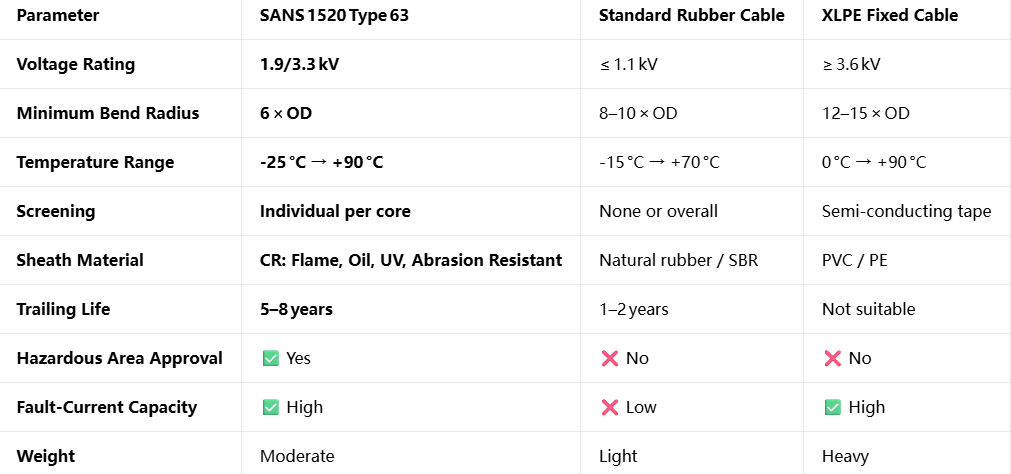
To understand why Type 63 is the standard, it helps to compare it against other cable types commonly found in industry.
Performance Comparison Table
Key Benefits in South African Mines
Safety Compliance First
Individual screening + continuous earth path + flame‑retardant sheath = fully compliant with Mine Health and Safety Act and SANS 60079. This eliminates risk of fines, shutdowns or accidents.
Lower Total Cost of Ownership
While initial cost is higher than basic rubber cables, Type 63 lasts 3–5 times longer. Mines report replacement frequency dropping from every 18 months to every 6–7 years. When downtime costs millions per day, reliability is priceless.
All‑Terrain Capability
Works perfectly:
Underground: confined bends, methane, wet conditions
Opencast: sun, dust, extreme heat, dragging over rock
Highveld: freezing nights, dry air
Coastal mines: salt spray, humidity
Electrical Efficiency
Low DC resistance and reactance mean less power loss and smaller voltage drop over long trailing lengths (often 200–500 m). This allows using smaller cable sizes while maintaining equipment performance.
Standardised Interchangeability
Because it follows a strict national standard, Type 63 from any certified manufacturer fits exactly the same connectors, reels and accessories. There is no “proprietary design lock‑in”.
Applications Across South Africa
South Africa’s mining regions are distinct, each with its own challenges — and Type 63 is the preferred choice in every single one.
Gold Mining — Witwatersrand Basin
Deep‑level gold mines near Johannesburg and Welkom operate at depths from 1 km to over 3.5 km. Temperatures exceed 50 °C at the rock face, humidity is high, and methane pockets are common.
Use: Powering loaders, scraper winches, conveyors and underground mobile substations.
Why Type 63: Must be flexible enough to move through narrow haulages, withstand high ambient heat, and provide explosion protection. Individual screening ensures safety where insulation damage from rock fall is a constant risk.
Platinum Group Metals — Bushveld Complex
Limpopo and North West provinces host 90 % of global platinum reserves. Here, ore bodies are shallower but extremely abrasive, and groundwater contains high sulphuric acid levels.
Use: Draglines, shovels, drilling rigs and mobile crushers.
Why Type 63: CR sheath resists chemical attack and abrasion better than any other cable. High tensile strength handles long‑distance trailing on rough ground.
Coal Mining — Mpumalanga & Limpopo
Open‑cast and underground coal mines present the highest explosion risk due to methane and coal dust. Regulations are strictest here.
Use: Continuous miners, shearers, section feeders, stackers and spreaders.
Why Type 63: Certified to SANS 60079‑7, flame‑retardant, and designed so no single fault can create an ignition source.
Iron Ore & Manganese — Northern Cape
Sishen, Kathu and Postmasburg are some of the hottest, driest places in South Africa. Temperatures above 40 °C in summer, intense UV radiation, and no shade.
Use: Heavy‑duty shovels, drills, stacker‑reclaimers and overland conveyor drives.
Why Type 63: Rated for 90 °C operation; UV‑stabilised CR does not crack or degrade after years of exposure.
Diamond Mining — Kimberley & Coastal Operations
Hard rock and alluvial mines face wet, corrosive conditions and heavy mechanical handling.
Use: Dredges, pumps, processing plants and mobile excavators.
Why Type 63: Fully water‑blocked construction and corrosion‑resistant tinned copper ensures long life even when partially submerged.
Typical Equipment List
Across all commodities, Type 63 is specified for:
Medium‑voltage mobile substations (up to 2 MVA)
Electric rope shovels (10–40 m³ capacity)
Blast‑hole drills (rotary and DTH)
Stackers, reclaimers and spreaders
Long‑distance conveyors and tripper cars
Underground load‑haul‑dump (LHD) machines
High‑capacity pumps and ventilation fans
Complete Technical Specifications
Based on official SANS 1520‑2 and manufacturer data, below are the full specifications, presented clearly for engineers and buyers.
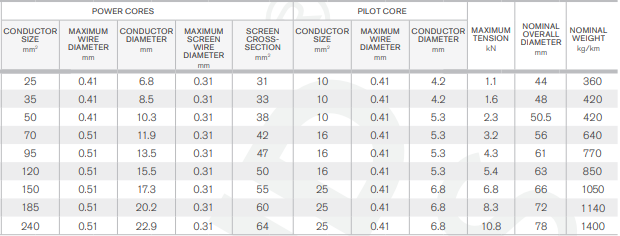
Available Sizes and Dimensions
Sizes range from 25 mm² to 240 mm², covering all power requirements.
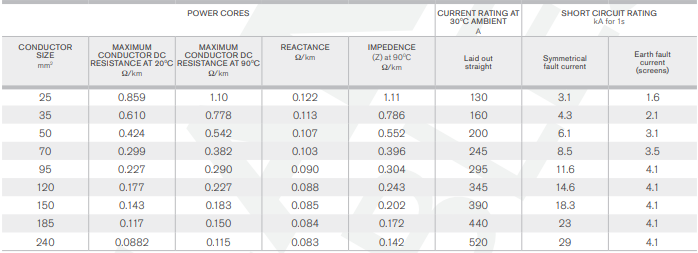
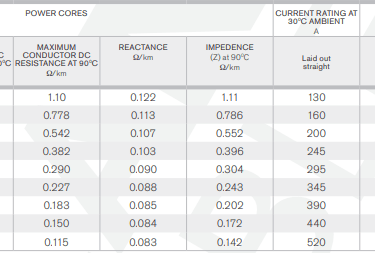
Electrical Characteristics
Critical for system design and protection coordination.
Key Notes:
Ratings assume 30 °C ambient; derate by ~5 % per 5 °C above 30 °C.
Short‑circuit values are the maximum current the cable can safely carry for 1 second without damage — essential for protection settings.
Mechanical and Environmental Ratings
Voltage: 1.9/3.3 kV AC, 50 Hz
Test Voltage: 11 kV AC for 5 minutes (routine test)
Partial Discharge: < 5 pC at 3.3 kV
Temperature: Operating ‑25 °C to +90 °C; Storage ‑40 °C to +70 °C
Bending Radius: 6 × OD (dynamic / reeling); 4 × OD (static)
Sheath Properties: Tensile ≥ 12 MPa; Elongation ≥ 300 %; Abrasion loss ≤ 100 mm³
Flame Performance: SANS 10163‑1 (self‑extinguishing)
Resistance: Ozone, UV, oil, acid, alkali, water, hydrolysis
Selection and Configuration Guide
Choosing the correct Type 63 cable is not just about power — it involves environment, length, duty cycle and protection requirements.
Step‑by‑Step Selection Method
Determine Operating Conditions
Voltage: Confirm equipment is designed for 3.3 kV class.
Ambient temperature: Use 30 °C as standard; adjust for hot mines.
Installation: Reeling (frequent bending) or trailing (fixed drag)?
Hazardous area: Confirm SANS 60079 compliance required.
Calculate Design Current
Formula: I = (P × 1000) / (√3 × U × cosφ × η)
Where:
P = Power (kW)
U = Voltage (3.3 kV)
cosφ = Power factor (~0.85–0.9)
η = Efficiency (~0.9–0.95)
Always add 15–20 % safety margin for future expansion or high‑load operation.
Example:
500 kW drill, cosφ = 0.88, η = 0.92
I = (500 × 1000) / (1.732 × 3300 × 0.88 × 0.92) ≈ 107 A
Select next size: 3 × 35 mm² (rated 160 A) or 3 × 50 mm² (rated 200 A) for long lengths or high temperature.
Check Voltage Drop
Maximum recommended drop is 5 % at full load.
Formula: ΔU = (I × L × (R × cosφ + X × sinφ)) / 1000
Where:
R = Resistance (Ω/km)
X = Reactance (Ω/km)
L = Length (m)
For lengths over 200 m, always verify or move up a size.
Choose Pilot Core Size
10 mm²: Basic on/off control, simple interlocks.
16 mm²: Multi‑function, monitoring, multiple signals.
25 mm²: Heavy‑duty, extra circuits, or long distance (> 300 m).
Special Options
Low‑temperature grade: Modified compounds down to ‑40 °C for high‑altitude mines.
Coloured cores: Red/Yellow/Blue power cores for easier phase identification.
Enhanced reinforcement: Double nylon braid for ultra‑long trailing (> 500 m).
LSZH: Low‑smoke, zero‑halogen variant for enclosed areas.
Accessory Matching
Type 63 is designed to work with standard mining accessories:
Connectors: SANS‑approved 3.3 kV quick‑connect couplers (Pfisterer, 3M, Minecab).
Joints: Vulcanised or resin‑filled splices.
Reels: Motorised or manual drums sized for minimum 6 × OD bend radius.
Earthing: Screen must be earthed at both ends per SANS 10142‑1.
Procurement and Sourcing Strategy
For mines and contractors in Southern Africa, procurement of Type 63 historically meant buying from local or European manufacturers: Eland, Cleveland, Aberdare or Draka. While these are excellent products, they come with challenges:
Long lead times: 8–14 weeks for production and shipping.
High pricing: Premium brand positioning and local logistics add cost.
Limited stock: Only standard sizes held locally.
Today, a better option exists: Feichun Cable, which has established itself as the leading equivalent replacement.
Key Procurement Checklist
When purchasing, always demand:
Certificate of Compliance: Issued by a SABS‑recognised body, referencing SANS 1520‑2, SANS 1411‑1, SANS 1411‑3.
Type Test Report: Full mechanical, electrical and environmental test data.
Material Declaration: Confirmation of EPR Type RD3, CR Type RS6, Class 5 tinned copper.
Dimensional Report: Actual measurements of OD, insulation thickness, sheath thickness.
RoHS / REACH Compliance: Mandatory for international supply chains.
Feichun SANS 1520 Type 63: Fully Equivalent Replacement
Feichun Cable is an ISO 9001‑certified manufacturer specialising in mining and heavy‑duty cables. Their Type 63 range is manufactured exactly to SANS 1520‑2 specifications, making it 100 % interchangeable with any other certified brand.
Compliance and Standard Match
Feichun does not “meet similar standards” — it follows the exact South African standards:
Construction: 3 screened + 1 unscreened core, Class 5 tinned copper, EPR insulation, CR inner/outer sheath, nylon reinforcement.
Materials: Same EPR Type RD3 and CR Type RS6 compounds, sourced from global suppliers.
Testing: All tests are performed to SANS 1411‑1/3 requirements, witnessed by independent laboratories.
Documentation: Every shipment includes full SANS‑format compliance certificates, test reports and material declarations — accepted by mines, engineers and regulators throughout Southern Africa.
Why Feichun Is Preferred
Identical Quality, Lower Price
Direct factory pricing means Feichun is typically 20–35 % cheaper than premium local brands. For a mine buying 10 km of 3 × 95 mm² annually, this saves over R 2.5 million — with zero compromise in safety or life.
Shortest Delivery Times
Standard sizes (25–240 mm²) are produced in high volume. Delivery to South Africa is 15–30 days, compared to 8–12 weeks from European or local manufacturers. This eliminates production delays and reduces inventory holding costs.
Full Range and Flexibility
All sizes available; custom modifications (colours, special lengths, enhanced strength) possible without long lead times.
Complete Technical Support
Feichun’s engineering team provides full sizing assistance, installation guidelines and compliance documentation. Local agents are based in Johannesburg, Cape Town and Durban for fast support.
Warranty and Reliability
Standard 24‑month warranty, backed by global liability insurance. Thousands of kilometres already in service across South Africa, Botswana, Zambia and DRC since 2018.
Sustainability and Compliance
Like all modern mining cables, Feichun Type 63 meets:
RoHS 2015/65/EU: No restricted heavy metals.
REACH EC 1907/2006: No SVHC substances.
ISO 14001: Environmentally responsible manufacturing.
Frequently Asked Questions
1. What is the difference between Type 63 and Type 66?
Type 63 = 1.9/3.3 kV, for medium power. Type 66 = 3.8/6.6 kV, for larger equipment. Construction is similar, but Type 66 has thicker insulation and different fault ratings. Do not substitute.
2. Can I use Type 63 underground?
Yes — it is one of very few cables certified for underground hazardous zones under SANS 60079. Individual screening is the key safety feature here.
3. What happens if I bend below 6 × OD?
Bending radius less than 6 × OD causes permanent deformation, cracks in insulation, and broken shield wires. This leads to early failure and safety risk.
4. How long should it last?
5–8 years is standard. With proper care, regular testing and correct installation, 10+ years is common.
5. Can I use Feichun cable on existing equipment?
100 % yes. Dimensions, connectors and performance are identical. It is a direct replacement, no changes needed.
6. Do I still need to test it?
Yes — always perform insulation resistance and continuity tests before installation, and every 3–6 months during service, as required by regulations.
Installation and Maintenance Best Practices
Unroll correctly: Never pull from the side or twist the reel.
Bending limits: Strictly observe 6 × OD; avoid tight loops or sharp edges.
Earthing: Ensure both ends of the screen are properly earthed. Poor earthing is the most common cause of early failure.
Protection: Use cable guides, rollers or troughs where cables cross roads or under tracks.
Storage: Keep reels dry, covered and off the ground; avoid direct sunlight for long periods.
Testing: Megger test at 5 kV DC. Insulation resistance should be > 1000 MΩ·km when new; replace when consistently below 100 MΩ·km.
Conclusion
SANS 1520 Type 63 1.9/3.3 kV is more than just a cable specification — it is the result of decades of South African engineering, developed specifically to solve the unique challenges of mining here. It represents the perfect balance of safety, durability, flexibility and electrical performance, built from materials chosen not for cost, but for performance.
Every layer, every compound, every dimension exists for a reason. Individual screening protects lives. EPR insulation guarantees decades of service. CR sheaths survive the harshest weather and mechanical abuse. It is no wonder it remains the standard choice across gold, platinum, coal and iron ore operations.
Today, mines and contractors have a smart choice: continue with traditional brands, or switch to Feichun Cable — identical compliance, identical quality, faster delivery and significantly lower cost. With full certification and proven performance, it has become the preferred equivalent replacement across Southern Africa.
For procurement engineers and technical managers, the message is clear: Type 63 is the right cable for the job — and Feichun is the smartest way to buy it.
Need SANS 1520 Type 63 1.9/3.3 kV flexible trailing mining cable?
Contact our engineering team for full datasheets, competitive pricing and delivery schedule to any mine in South Africa — from Rustenburg to Kimberley, from Witbank to Sishen.
We provide complete compliance documentation, sizing assistance and after‑sales support.
Email Address: Li.wang@feichuncables.com
© 2025. All rights reserved.
One-click to Quickly Contact
Products
Contact
Company
Location:
Building A Private Science and Technology Park, Hefei Economic and Technological Development Zone, Anhui Province, China
Heat Resistant Cable
WhatsApp: +86 17333223430
Social Media: