Anhui Feichun Special Cable Co.,Ltd Email: Li.wang@feichuncables.com
SANS 1520 Type 633 / 633-ECC 19/33 kV Flexible Trailing Cable for South African Mining: EPR-Insulated Heavy-Duty Mining Cable for Draglines, Shovels and Drills
For mining engineers, procurement managers, and operations teams across South Africa, this comprehensive guide explores the SANS 1520 Type 633 / 633‑ECC 19/33 kV flexible trailing cable — the industry standard for open‑pit mining equipment. Discover exactly why medium‑sized draglines, electric shovels, and drill rigs demand this specific cable design, its engineering principles, advanced material science, full technical specifications, proper selection methods, and how Feichun delivers a fully compliant, cost‑effective equivalent solution with faster delivery and proven performance.
Li Wang
5/26/202616 min read
Introduction
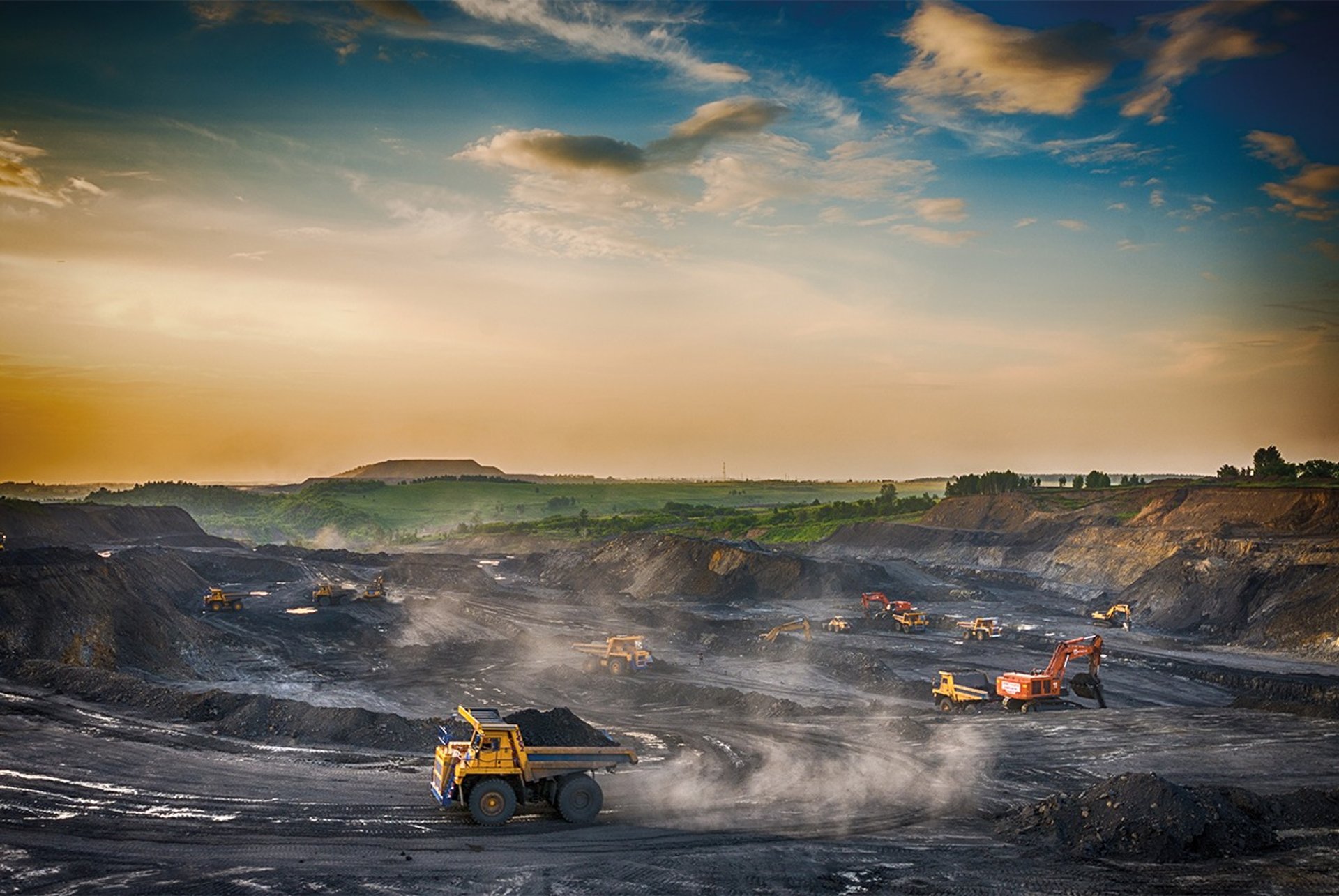
South Africa has long been recognised as a global leader in mining, with open‑pit operations forming the backbone of the country’s mineral extraction industry. From coal and platinum to iron ore and diamonds, the scale and intensity of these operations place extraordinary demands on every piece of equipment used. Among the most critical components is the power supply cable, which must perform reliably in conditions that would quickly destroy standard industrial cables.
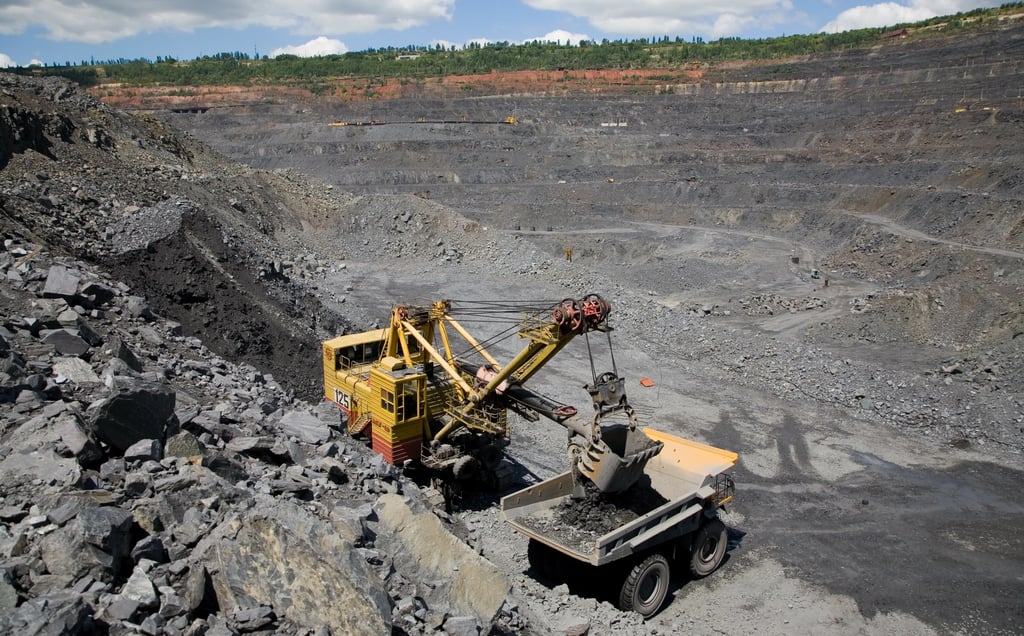
Medium‑sized draglines, electric shovels, and rotary or down‑the‑hole drill rigs operate continuously, moving across uneven, abrasive terrain while carrying high electrical loads. These machines rely on flexible trailing cables to deliver power from mobile substations or fixed distribution points. In this environment, cable failure does not just mean repair costs — it results in costly downtime, lost production, and potential safety hazards.
For decades, the SANS 1520 Type 633 / 633‑ECC 19/33 kV flexible trailing cable has been the specified standard across South African mines. Developed and tested to meet rigorous national standards including SANS 1520‑2, SANS 1411‑1, and SANS 1411‑3, this cable is engineered specifically to balance electrical safety, mechanical strength, and environmental resistance. This guide explains in detail what makes this cable essential, how it is built, how to select the right version, and why Feichun has become a trusted alternative supplier for mines across Southern Africa.
Cable Requirements for South African Open‑Pit Mining Equipment
Operating Environment and Load Profile
Open‑pit mines in South Africa are characterised by extreme conditions. Temperatures can range from well below freezing in high‑altitude winter regions to above 40°C in summer. Equipment operates under constant exposure to direct ultraviolet radiation, heavy dust, rain, and chemical contaminants including oils, greases, and acidic or alkaline mine waters.
Medium‑sized mining equipment such as draglines and shovels typically have power ratings between 500 kW and 3,000 kW, while drill rigs range from 200 kW to 1,200 kW. To deliver this power efficiently over distances of up to several hundred metres, a medium voltage system is required — 19/33 kV is the standard choice, reducing current levels and energy losses while keeping cable size manageable.
Unlike fixed installations, these machines are in almost constant motion. The cable is reeled, unreeled, dragged over rock and soil, twisted, and bent repeatedly throughout every shift. It must also operate safely in hazardous areas where flammable dust or gases may be present.
Key Performance Requirements
From the operating conditions, a clear set of requirements emerges that standard cables simply cannot meet:
Voltage Rating: Must be rated for continuous operation at 19/33 kV, with a design suitable for 36 kV systems. Insulation must be thick enough and of sufficient quality to prevent breakdown, partial discharge, or flashover.
Flexibility: A minimum bending radius of no more than 9 times the overall cable diameter is essential. This allows the cable to wrap tightly around reels and navigate tight corners without damage to conductors or insulation.
Conductor Design: Stranding must be fine and numerous — Class 5 flexible construction — to maintain conductivity even after millions of flex cycles. Tinning of copper strands is required to resist oxidation and corrosion from sulphur‑rich mine atmospheres and moisture.
Insulation Material: Must remain flexible at low temperatures and stable at high temperatures, while providing excellent dielectric strength. Materials like PVC or standard polyethylene become brittle or soften under these conditions; only specialised elastomers perform well.
Screening: Each power core must be individually screened. This serves two purposes: it contains the electrical field to prevent interference and ensures that fault currents have a defined path to earth.
Mechanical Strength: High tensile strength, tear resistance, and abrasion resistance are non‑negotiable. The cable must resist cutting from sharp rock and withstand the tension of being pulled or reeled under load.
Environmental Resistance: Outer sheathing must resist UV degradation, ozone cracking, oil absorption, and chemical attack. It must also be flame‑retardant and self‑extinguishing to comply with mine safety regulations.
Monitoring and Safety: Inclusion of pilot cores allows remote monitoring, control, and protection. The ‑ECC variant adds a dedicated earth continuity conductor to ensure a low‑resistance ground path at all times, even if screens become damaged.
Why Standard Cables Fail
General‑purpose power cables or lower‑grade mining cables often fail within months when used in these applications. Common failure modes include:
Conductor breakage due to insufficient flexibility
Insulation cracking from cold or repeated bending
Sheath degradation from sunlight or oil
Corrosion of copper strands leading to overheating
Inadequate screening resulting in interference or unsafe fault conditions
Regulations in South Africa mandate compliance with SANS standards for good reason: they ensure that cables will perform safely and reliably. SANS 1520 specifically addresses flexible cables for use in mines, and Type 633 is the design developed for the 19/33 kV voltage class — exactly what medium‑sized draglines, shovels, and drills require.
Engineering Principles, Material Science and Construction of Type 633 / 633‑ECC
Design Philosophy
The design of SANS 1520 Type 633 follows a core engineering principle: electrical safety independent, mechanical protection layered, environmental adaptation material‑matched. Every component is selected and positioned to perform a specific function, with redundancy built in where safety is critical.
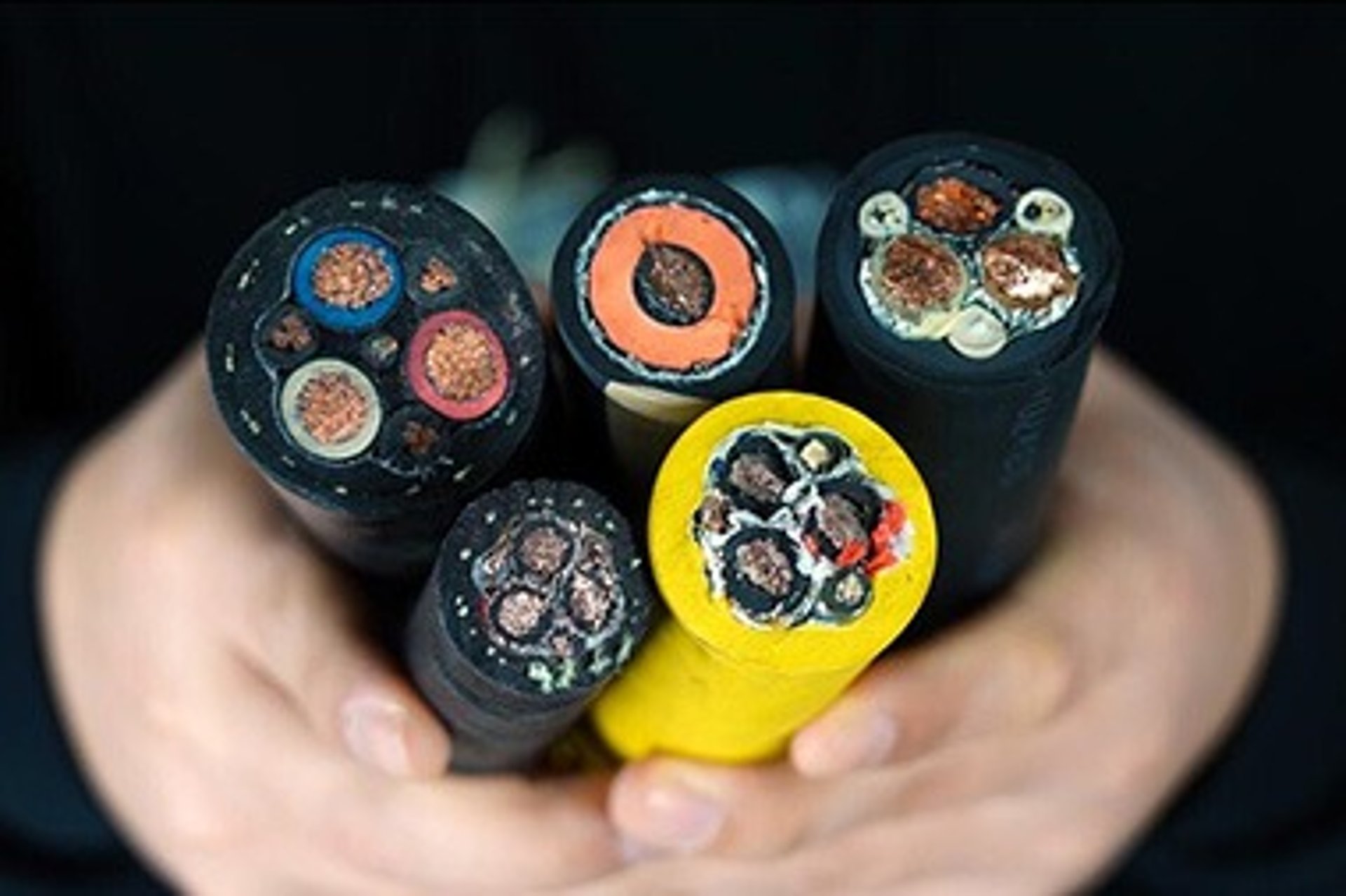
The cable has a multi‑core construction, with each power core fully insulated and screened before being assembled together. Additional layers provide mechanical reinforcement, sealing, and protection. This modular design ensures that damage to one layer rarely compromises the whole cable.
Material Science Breakdown
Conductor: Class 5 Tinned Annealed Copper
At the heart of every power core is the conductor, manufactured to IEC 60228 Class 5 specifications. This class uses very fine copper wires stranded together in multiple layers. The high number of individual strands allows the conductor to bend and flex easily without creating stress concentrations that lead to fatigue and breakage.
Each copper strand is tinned — coated with a thin layer of tin. This creates a copper‑tin alloy surface that is highly resistant to oxidation and chemical corrosion. In mining environments where humidity, sulphur compounds, and acidic dust are common, untinned copper would degrade rapidly, increasing resistance, causing overheating, and eventually failing electrically.
Electrically, the material offers high conductivity, with maximum DC resistance values ranging from 0.795 Ω/km (25 mm²) down to 0.164 Ω/km (120 mm²) at 20°C. Even at the maximum operating temperature of 90°C, resistance remains within safe limits, ensuring efficient power delivery.
Insulation: EPR (Ethylene Propylene Rubber) – Triple Extruded
The insulation system is perhaps the most advanced part of the design. Type 633 uses EPR — Ethylene Propylene Rubber, a thermosetting elastomer with a saturated molecular structure. Unlike thermoplastics, EPR does not melt or flow when heated; once formed, it retains its shape and properties permanently.
Key material properties include:
Wide Temperature Range: Remains flexible and functional from ‑25°C to +90°C, covering every climate found in Southern Africa.
Excellent Dielectric Performance: High dielectric strength (up to 20 kV/mm) and low dielectric loss factor mean it can reliably contain 19/33 kV stress levels for decades.
Chemical Stability: Resists ozone, UV, and most industrial chemicals, preventing degradation that could lead to tracking or breakdown.
Flexibility: Unlike rigid materials such as XLPE (Cross‑Linked Polyethylene), EPR remains soft and rubbery, moving easily with the conductor without cracking.
The insulation is applied using a triple‑extrusion process — insulation layer, inner semiconductive screen, and outer semiconductive screen are all applied in one continuous operation. This eliminates any air gaps between layers. The semiconductive layers smooth out electrical stress concentrations, ensuring the electric field is distributed evenly. This design effectively eliminates partial discharge, a major cause of premature insulation failure in medium‑voltage cables.
Screening System: Tinned Copper and Nylon Composite Braid
Each insulated power core is individually screened. The screen consists of two parts:
Tinned Copper Braid: Provides the electrical function. It acts as an earthed shield, preventing electric field radiation and interference. More importantly, during a fault, it carries the high short‑circuit current safely to earth. Coverage is greater than 85% to ensure effectiveness.
Nylon Textile Braid: Applied over the copper, this adds mechanical protection. It is tough, abrasion‑resistant, and prevents the copper braid from wearing through or breaking as the cable drags over rough surfaces.
Tinning of the copper again ensures corrosion resistance, maintaining low resistance even in aggressive environments.
Pilot Cores and the 633‑ECC Variant
Inside the overall cable assembly, alongside the three power cores, are three smaller cores insulated with EPM — Ethylene Propylene Monomer, a material similar to EPR but optimised for signal transmission. These pilot cores are used for control signals, interlocks, temperature monitoring, or communication between the machine and the control room.
The Type 633‑ECC variant introduces a critical modification: one pilot core is replaced with a dedicated, full‑size tinned copper conductor — the Earth Continuity Conductor. This conductor is designed specifically to provide a guaranteed low‑resistance path to earth at all times, independent of the screens. Combined screen + ECC resistance is as low as 0.23 Ω/km for the 120 mm² size. This ensures that in the event of an earth fault, current flows freely, protection relays operate instantly, and the risk of dangerous touch voltages is minimised. This feature makes the ECC version highly recommended for all hazardous or high‑risk installations.
Reinforcement: Open Nylon Braid
Between the inner and outer sheaths lies an open nylon braid with a minimum of 16 strands. This layer acts as the cable’s backbone. Nylon has extremely high tensile strength and low stretch. It distributes tension evenly across the cable cross‑section, preventing elongation or damage to the cores when the cable is pulled or wound onto a drum. It effectively increases the breaking load to between 1.1 kN and 5.4 kN, depending on conductor size.
Sheath System: CR (Polychloroprene Rubber)
The cable is protected by a dual sheath system made from CR — Polychloroprene Rubber, commonly known as Neoprene. This material is chosen because it offers the best balance of properties available:
Inner Sheath: Forms a tight, protective layer around the assembled cores and reinforcement. It seals the core against moisture ingress and cushions internal stresses during bending.
Outer Sheath: The primary barrier against the environment. CR is inherently resistant to UV light, ozone, weathering, oils, greases, and many chemicals. It is flame‑retardant and self‑extinguishing, meeting the strict requirements of SANS 1411 for mining cables. It remains flexible at very low temperatures and does not soften or flow even at 90°C. It has excellent abrasion resistance, making it ideal for dragging over rock and soil.
The black colour is standard, providing maximum absorption and dissipation of heat and resistance to sunlight degradation.
Full Construction Summary
From inside out, the structure is:
Class 5 tinned copper conductor
Triple‑extruded EPR insulation + semiconductive screens
Individual core screen: tinned copper + nylon braid
Laying‑up: 3 power cores + 3 pilot cores (or 2 pilot + 1 ECC)
Inner sheath: CR rubber
Reinforcement: open nylon braid
Outer sheath: CR rubber
Every layer contributes to the cable’s ability to survive the harsh mining environment while delivering power safely and efficiently.
Performance Advantages of Type 633 / 633‑ECC
Electrical Performance
Proven Voltage Rating: Designed and tested for 19/33 kV operation, suitable for use on systems up to 36 kV.
Low Losses: EPR insulation and high‑conductivity copper combine to keep energy losses low. Reactance values range from 0.119 to 0.155 Ω/km, contributing to high transmission efficiency.
Fault Withstand: Short‑circuit ratings are engineered to match typical mine protection settings, ranging from 3.1 kA to 14.6 kA (1‑second rating). The cable safely conducts these high currents without damage.
Stable Dielectric: Triple extrusion ensures no voids, meaning partial discharge levels are effectively zero. This guarantees a long service life without electrical breakdown.
Mechanical Performance
Superior Flexibility: With a minimum bending radius of just 9× overall diameter, it is significantly more flexible than medium‑voltage cables using rigid insulation like XLPE. This reduces strain on equipment reels and allows operation in confined spaces.
High Tensile Strength: Reinforcement layers prevent stretching or snapping, even under heavy tension.
Extreme Durability: CR sheath and nylon braids provide outstanding resistance to abrasion, cutting, and tearing. Tests show it can withstand years of dragging over rock without exposing internal components.
Fatigue Resistance: Class 5 conductors and elastomeric materials are designed for over 10,000 bending cycles — more than the typical operational life in a mine.
Environmental and Safety Advantages
All‑Climate Operation: Performs reliably through South Africa’s hot summers, cold winters, and rainy seasons.
Resistance Properties: Fully resistant to UV radiation, sunlight ageing, oil immersion, and chemical attack. Meets all relevant SANS environmental standards.
Flame Safety: Non‑propagating flame characteristics meet SANS 1411 requirements. If exposed to fire, the cable will not continue burning once the source is removed.
Compliance: Manufactured to SANS 1520‑2, SANS 1411‑1, and SANS 1411‑3, ensuring it meets legal and safety requirements for mining use. It also complies with RoHS and REACH directives regarding hazardous substances.
Enhanced Safety with ECC: The dedicated earth conductor in the 633‑ECC design offers the lowest possible earth fault loop impedance, maximising protection speed and reducing shock hazard risks.
Total Cost of Ownership
While the initial purchase price is higher than standard cables, the long life and reliability of Type 633 result in much lower total cost of ownership. A properly installed and maintained Type 633 cable typically lasts 5 to 10 years, compared to 1 to 3 years for inferior alternatives. Fewer replacements, less downtime, and lower maintenance labour costs quickly offset the investment. On large mining operations, avoiding a single day of downtime can save more than the cost of the entire cable installation.
Typical Applications
Primary Applications
Type 633 / 633‑ECC is the standard choice wherever 19/33 kV power needs to be supplied to moving equipment in open‑pit mines. Key applications include:
Medium‑Sized Draglines: The workhorses of overburden removal, typically requiring 70 mm² to 120 mm² cables.
Electric Shovels: Used for loading ore and waste rock, often powered by 50 mm² to 95 mm² cables.
Rotary and Down‑the‑Hole Drills: Essential for blast hole drilling, usually specified with 35 mm² to 70 mm² cables.
Section Feeders: Mobile distribution points that supply power to multiple machines across a mining block.
Mobile Substations: The link between fixed high‑voltage networks and moving medium‑voltage equipment.
Hazardous Areas: Suitable for use in areas where explosive dust or gas may be present, thanks to flame‑retardant construction and screened cores.
Operating Parameters
Ambient Temperature Range: ‑25°C to +55°C
Installation Conditions: Direct contact with soil, rock, water, or mud; no need for conduit or fixed supports.
Movement: Designed for continuous trailing or reeling/unreeling on motorised or manual cable drums.
Industry Acceptance: Approved and used by major mining houses across Southern Africa including Anglo American, BHP, Glencore, and Exxaro.
Comparison with Other SANS Types
South Africa uses a numbered type system for mining cables. Understanding the differences is vital for correct selection:
Type 611: Rated 6.35/11 kV. Used for low‑to‑medium power equipment. Not suitable for 33 kV systems or large machines.
Type 622: Rated 12.7/22 kV. Covers mid‑voltage applications but insufficient insulation for 33 kV networks.
Type 633: Rated 19/33 kV. The correct specification for medium and large‑scale open‑pit equipment.
Within Type 633, always choose ‑ECC version where possible. The safety benefits of the dedicated earth conductor outweigh the minor increase in weight and cost, and it is fast becoming the preferred standard in new mine developments.
Complete Technical Specifications
General Specifications
Standard: SANS 1520‑2, SANS 1411‑1, SANS 1411‑3
Voltage Rating: U₀/U = 19/33 kV, system voltage 36 kV
Temperature Rating: Continuous: ‑25°C to +90°C, Short‑circuit: ≤ 250°C (max 5 seconds)
Minimum Bending Radius: 9 × Overall Diameter
Conductor Material: Class 5 tinned annealed copper
Insulation Material: EPR (Ethylene Propylene Rubber), triple extruded
Sheath Material: CR (Polychloroprene Rubber), black
Compliance: RoHS, REACH, ISO/IEC 17025 tested
Electrical and Dimensional Data
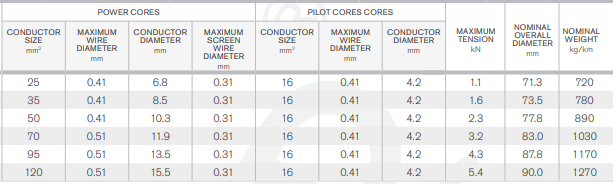
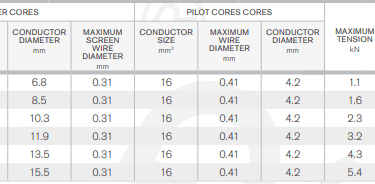
The following table summarises the key parameters for standard sizes from 25 mm² to 120 mm², derived directly from the official technical datasheet:
Data shows clearly how larger conductors reduce resistance and increase current capacity and fault current capability, while physical size and weight increase accordingly.
Configuration Selection and Sizing Guide
Step‑by‑Step Selection Process
1. Confirm Voltage Requirement
The most critical step. If your system operates at 19/33 kV or 33 kV line‑to‑line, Type 633 is the only correct choice. Lower numbered types will be overstressed and unsafe.
2. Select Conductor Size
Size selection balances current‑carrying capacity, voltage drop, mechanical load, and short‑circuit requirements:
Current Rating: Calculate the full‑load current of the machine, plus starting inrush (typically 1.2–1.5×). Compare with the table above and apply correction factors for ambient temperature, grouping, and installation method. Always select a size with sufficient margin.
Voltage Drop: Keep total voltage drop below 5% of nominal voltage under full load. For long distances (over 200 m), moving to a larger size reduces losses and improves efficiency.
Short‑circuit Withstand: Ensure the cable’s short‑circuit rating exceeds the maximum prospective fault current at the connection point.
Mechanical Robustness: Larger cables are physically stronger. For very heavy draglines or rough terrain, engineers often select one size larger than strictly required electrically for extra durability.
Typical guidelines used in South African mines:
Drill Rigs: 35 mm² – 70 mm²
Small‑Medium Shovels: 50 mm² – 70 mm²
Large Shovels / Draglines: 70 mm² – 120 mm²
3. Choose Standard or ECC Version
Standard 633: Suitable where existing earthing systems are robust and continuous monitoring is in place.
633‑ECC: Recommended Best Practice. Essential in older mines, high‑risk areas, or where compliance with the latest safety codes is required. The dedicated earth conductor provides a guaranteed path and lower resistance, making protection faster and more reliable.
4. Determine Length and Accessories
Length should include the working radius of the machine plus reserve length for the reel (typically 10–15%). Always specify matching SANS‑approved terminations, joints, and cable glands. Poor accessories can ruin the performance of even the best cable.
Practical Example
Selection for a 2,000 kW dragline operating at 33 kV, 300 m distance:
Full‑load current ≈ 45 A
Apply factor for temperature and duty cycle → 65 A required
Check voltage drop: at 300 m, 70 mm² gives <2% drop
Check fault level: 8.5 kA rating exceeds system 6 kA fault level
Select 70 mm² Type 633‑ECC
Order length: 300 m + 15% reserve = 345 m
Procurement and Sourcing: Feichun as an Equivalent Alternative
Why Choose Feichun Type 633 / 633‑ECC?
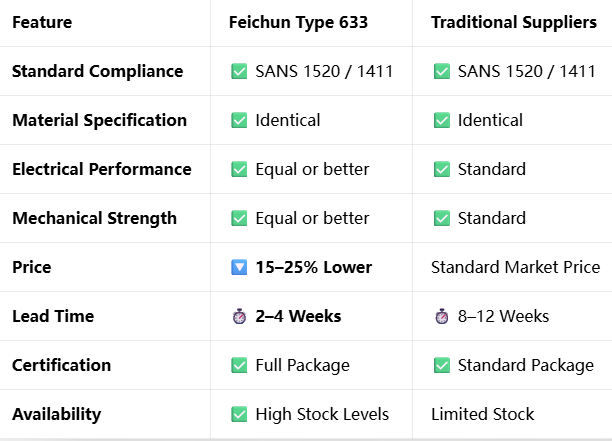
For many years, mines in Southern Africa have relied on a small number of established manufacturers. However, supply chain challenges, long lead times, and premium pricing have led procurement teams to seek reliable alternatives. Feichun Cable has emerged as a leading supplier, recognised across the region for cables that meet or exceed original specifications while offering significant commercial advantages.
✅ Full Compliance and Performance Equivalence
Feichun manufactures Type 633 / 633‑ECC cables strictly according to SANS 1520‑2, SANS 1411‑1, and SANS 1411‑3 standards. Every stage of production follows the exact material specifications and construction methods detailed earlier in this guide:
Conductors: Class 5 tinned annealed copper, sourced from high‑purity suppliers, meeting IEC 60228.
Insulation: EPR triple extrusion, identical compound formulation, tested for dielectric strength and flexibility.
Screening: Copper and nylon braids with coverage >85%.
Sheathing: CR rubber compound formulated for maximum UV, oil, and abrasion resistance.
Dimensions: Outer diameter, core sizes, and overall weight match the standard tables exactly, ensuring compatibility with existing reels and terminations.
Testing: Every production batch undergoes full type and routine testing in ISO/IEC 17025 accredited laboratories. Reports are available for every shipment.
Feichun Type 633 is a direct, drop‑in equivalent for cables from traditional suppliers like Eland, Cleveland, or Znergy. It carries all necessary certifications and is accepted by major mining houses and consulting engineers throughout South Africa.
✅ Key Advantages Over Traditional Suppliers
1. Competitive Pricing
By optimising manufacturing efficiency and sourcing, Feichun offers pricing that is typically 15% to 25% lower than European or locally manufactured equivalents. On large orders, this represents significant savings without compromising quality or safety.
2. Short Lead Times
One of the biggest pain points in mining procurement is long delivery times. Local or imported brand orders often take 8 to 12 weeks to deliver. Feichun maintains stock of standard sizes and has streamlined production and logistics, delivering to ports in Durban, Cape Town, or Port Elizabeth in just 2 to 4 weeks. For urgent requirements, expedited shipping is available.
3. Complete Technical Support
Feichun employs a team of mining cable specialists familiar with South African standards and applications. They provide:
Full datasheets and certification packages
Assistance with sizing and selection
Installation guidance
Customisation options (lengths, marking, special packaging)
4. Documentation and Compliance
Every shipment comes with a complete documentation set including Certificate of Compliance (CoC), material test reports, dimensional inspection reports, and declaration of conformity to SANS standards. This makes customs clearance and mine site acceptance straightforward.
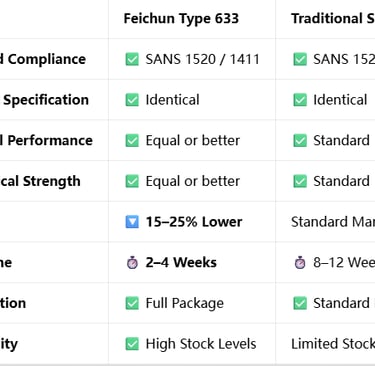
Comparison Summary
Supply Chain and Delivery
Feichun operates a factory‑direct supply model. Orders are shipped directly from production facilities to major South African ports, with door‑to‑door delivery to mine sites available through established logistics partners. Customs clearance and compliance documentation are handled as part of the service, ensuring a seamless procurement experience.
Frequently Asked Questions
Q: What is the main difference between Type 633 and Type 633‑ECC?
A: The standard version includes three pilot cores for control. In the ECC version, one pilot core is replaced with a dedicated, full‑size tinned copper earth conductor. This provides a guaranteed low‑resistance path to earth, improving safety and making protection systems faster and more reliable. ECC is strongly recommended for all mining applications.
Q: Can I use Type 622 cable instead of Type 633 to save cost?
A: No. Type 622 is rated for 12.7/22 kV systems. Using it on a 19/33 kV network places excessive electrical stress on the insulation, leading to rapid degradation, breakdown, and dangerous failure. Compliance regulations strictly prohibit this substitution.
Q: What is the minimum bending radius I must follow?
A: The minimum allowable bending radius is 9 times the overall cable diameter. Bending tighter than this damages the conductor strands and insulation, reducing service life significantly. This applies during installation, operation, and storage.
Q: Does this cable work in extreme temperatures?
A: Yes. It is designed for continuous operation between ‑25°C and +90°C. It remains flexible in freezing conditions and does not soften or degrade in high heat or direct sunlight.
Q: How long should I expect this cable to last?
A: With correct selection, installation, and maintenance, a service life of 5 to 10 years is typical. This is significantly longer than general‑purpose or lower‑grade mining cables.
Q: Is Feichun cable approved for use in South African mines?
A: Yes. Feichun Type 633 / 633‑ECC is manufactured strictly to SANS standards and carries full certification. It has been approved and successfully installed at numerous sites across South Africa, Botswana, Namibia, and Zambia.
Q: What is the typical lead time for delivery?
A: Standard sizes are available from stock or short production runs, with delivery to South African ports in 2–4 weeks. Special lengths or custom requirements take 4–6 weeks.
Q: Do you supply accessories like terminations and joints?
A: Yes. Feichun supplies a full range of matching, SANS‑approved cable accessories designed specifically for Type 633 cables, ensuring a complete, compliant system.
Conclusion
The SANS 1520 Type 633 / 633‑ECC 19/33 kV flexible trailing cable is more than just a product — it is the result of decades of engineering development tailored specifically to the harsh realities of South African open‑pit mining. From the Class 5 tinned copper conductors and triple‑extruded EPR insulation to the composite braids and robust CR sheathing, every element is engineered to solve a specific problem found in dragline, shovel, and drill operations.
Understanding the material science and engineering principles behind this cable explains why it is the only acceptable choice for medium‑voltage mobile power supply. Its performance advantages in flexibility, durability, safety, and efficiency translate directly into better productivity and lower operating costs for mine operators.
When sourcing this essential equipment, mines no longer need to choose between quality, compliance, and affordability. Feichun Cable offers a fully equivalent, SANS‑compliant alternative that matches the technical performance of traditional brands while delivering significant cost savings and much shorter delivery times. With full technical support and documentation, Feichun has established itself as a reliable partner for mining operations across Southern Africa.
For engineers and procurement teams, selecting Type 633‑ECC and partnering with a proven supplier like Feichun ensures that power supply remains one less thing to worry about — allowing focus on what matters: safe, efficient, and profitable mineral extraction.
If you require SANS 1520 Type 633 / 633‑ECC 19/33 kV flexible trailing mining cable – compliant, high‑quality, fast delivery and competitive price – contact the Feichun team today:
We provide full technical data sheets, detailed quotations, and engineering support tailored exactly to your mine’s requirements.
Email Address: Li.wang@feichuncables.com
© 2025. All rights reserved.
One-click to Quickly Contact
Products
Contact
Company
Location:
Building A Private Science and Technology Park, Hefei Economic and Technological Development Zone, Anhui Province, China
Heat Resistant Cable
WhatsApp: +86 17333223430
Social Media: