Anhui Feichun Special Cable Co.,Ltd Email: Li.wang@feichuncables.com
Shocking Truths: Why Your Electric Cables Could Be a Hidden Hazard in South Africa
Dive into the essential world of electric cables in South Africa – from voltage ratings and current carrying capacity to SABS standards, NRCS regulations, and spotting substandard fakes. Learn about common types like PVC housewire, XLPE insulated cables, and anti-theft solutions, plus real case studies from Johannesburg, Cape Town, and Durban to ensure safe, reliable power for homes and industries.
Li. Wang
11/26/20258 min read
Understanding Electric Cables: Purpose and Key Attributes
At their core, electric cables serve one fundamental purpose: to safely and reliably convey electrical energy from where it's generated or supplied to where it's needed. Think of them as the veins of our electrical systems, pumping power without leaks or bursts. In South Africa, this means everything from lighting up Soweto townships to fueling the massive operations at Richards Bay ports. But to do this effectively, cables must tick several boxes – attributes honed through decades of engineering and real-world testing.
First up is voltage rating, the cable's ability to handle the electrical pressure without breaking down. It's expressed in two numbers: phase-to-earth and phase-to-phase. For instance, a 300/500 V cable is perfect for your average Pretoria household wiring, where the first number (300 V) guards against shocks from live wires to ground, and the second (500 V) handles the full system voltage between phases. Jump to municipal distribution, and you'll see 6,35/11 kV cables dominating – the go-to for Eskom's urban grids. Higher ratings like 19/33 kV or even 275 kV for high-voltage lines ensure safe transmission over long distances, preventing arcs or failures that could black out entire suburbs.
But voltage is just the start. Current carrying capacity – how much amperage the cable can handle without overheating – is equally vital. This depends on conductor size, starting from tiny 1,5 mm² for light switches up to beefy 2 500 mm² for industrial feeders. Manufacturers provide tables, but real-world de-rating factors kick in: ambient temperatures in scorching Limpopo summers can slash capacity by 20-30%, while solar radiation on exposed cables adds another hit. Installation matters too – cables buried in trenches might run cooler than those bundled in ducts, and spacing prevents mutual heating. Ignore these, and you're courting meltdowns, literally.
Short circuit and earth fault ratings protect against sudden surges, like a lightning strike or faulty appliance. For XLPE-insulated cables with copper conductors, calculate by multiplying the cross-sectional area by 143 A/mm² for a one-second fault – so a 50 mm² conductor could handle 7,150 A briefly. Aluminium drops to 92 A/mm². Earth faults use similar math: 143 A/mm² for copper screens on MV XLPE. These ratings ensure the cable survives long enough for breakers to trip, averting fires or explosions – a lesson learned hard in South Africa's storm-prone regions.
Environmental compatibility can't be overlooked. Cables must withstand moisture in KwaZulu-Natal's humid coasts, chemicals in mining shafts, or ground shifts from Gauteng's old mine voids. Voltage drop – the energy lost along the cable – is another sneaky issue; too much, and your appliances underperform. For inductive loads like motors, this demands oversized conductors. In essence, selecting a cable isn't guesswork; it's a blend of physics, site surveys, and standards to guarantee uptime in our diverse landscape.
From my years consulting on installations across the provinces, I've seen how overlooking these attributes leads to costly rewires. But get it right, and your system runs like a well-oiled bakkie.
Components of Electric Cables
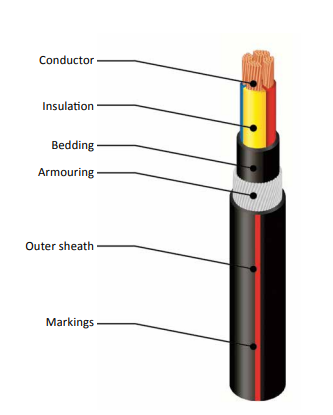
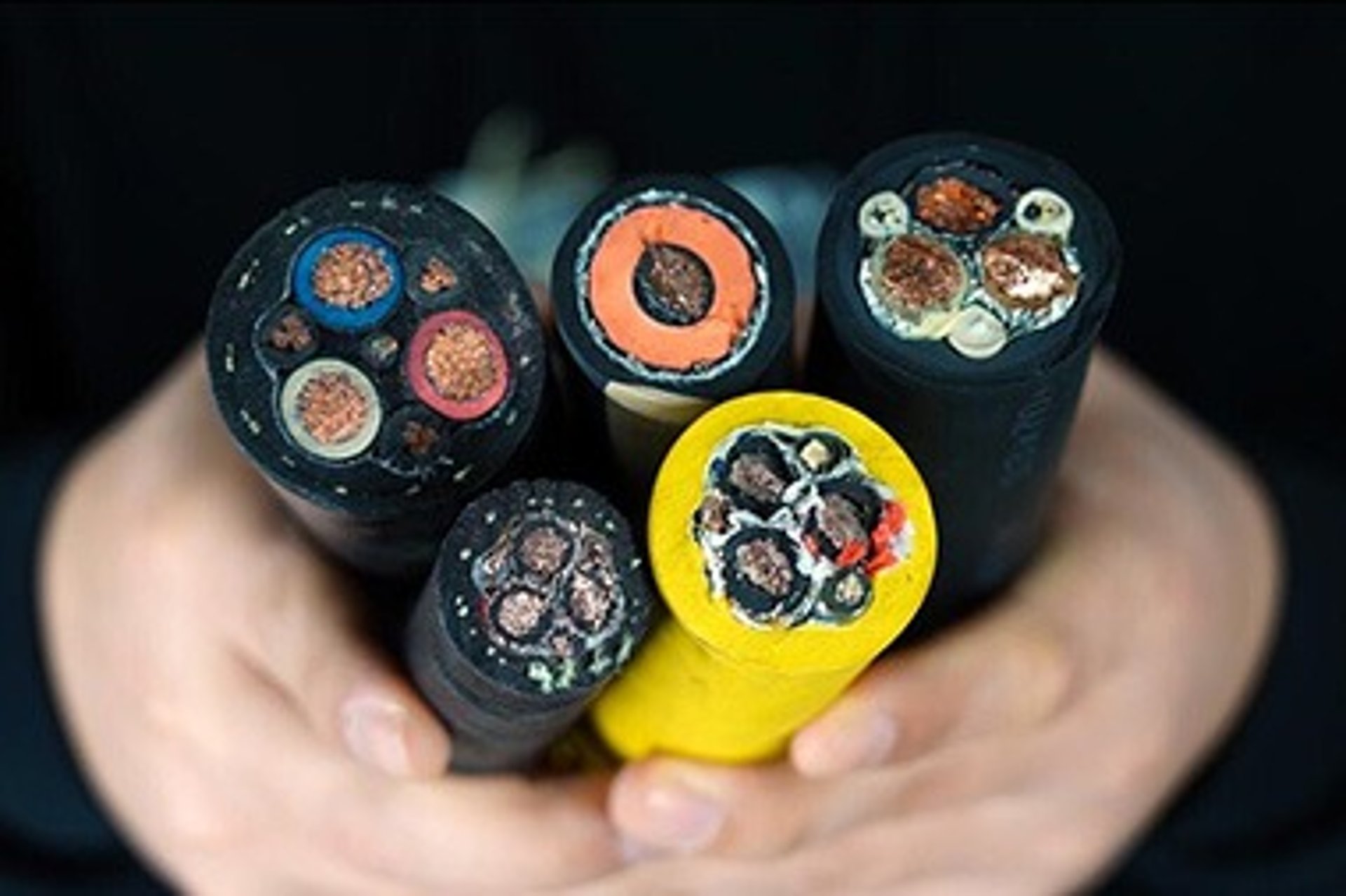
Peeling back the layers of an electric cable reveals a symphony of components, each engineered for synergy. As someone who's dissected countless samples in labs and on-site, I can attest: skimping on any part spells trouble.
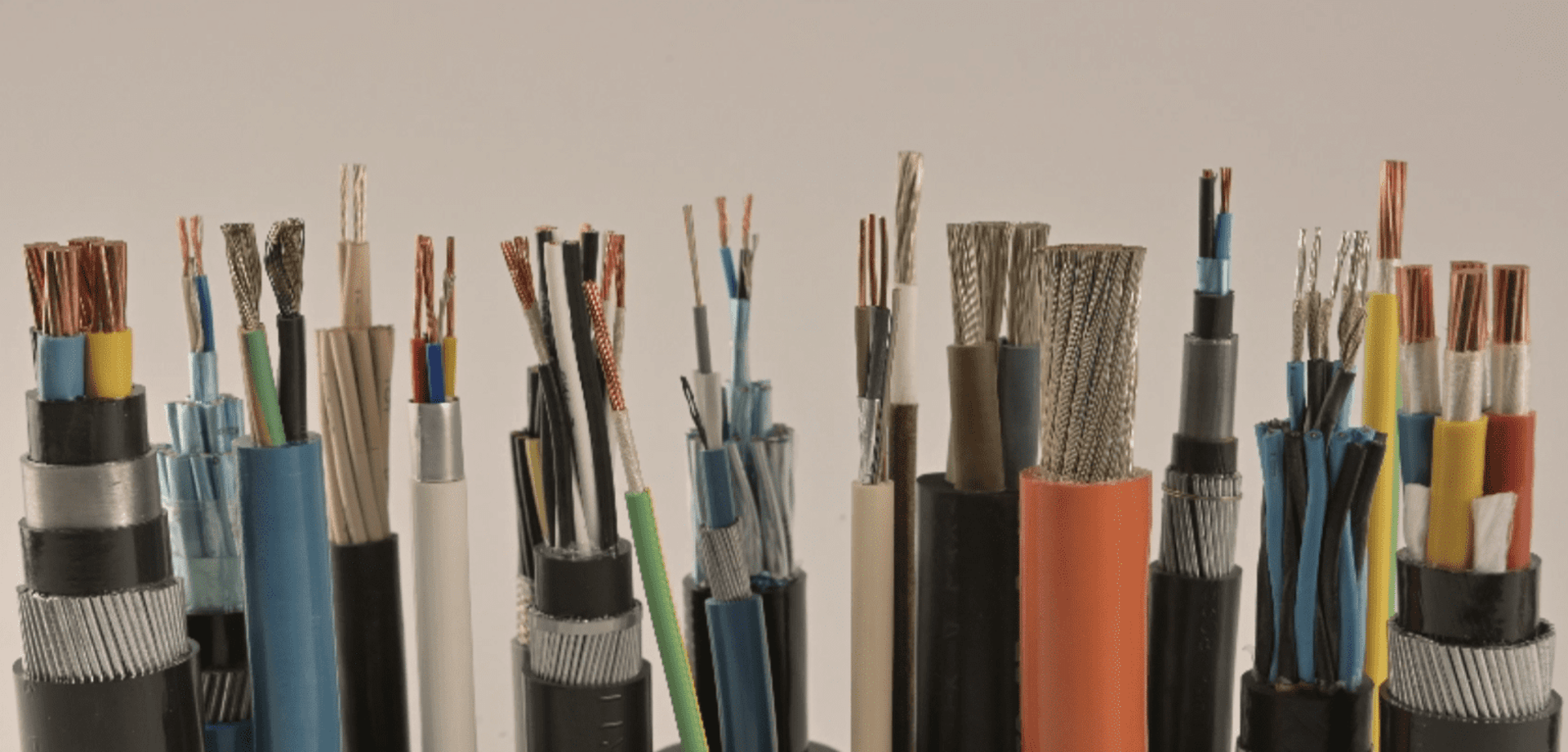
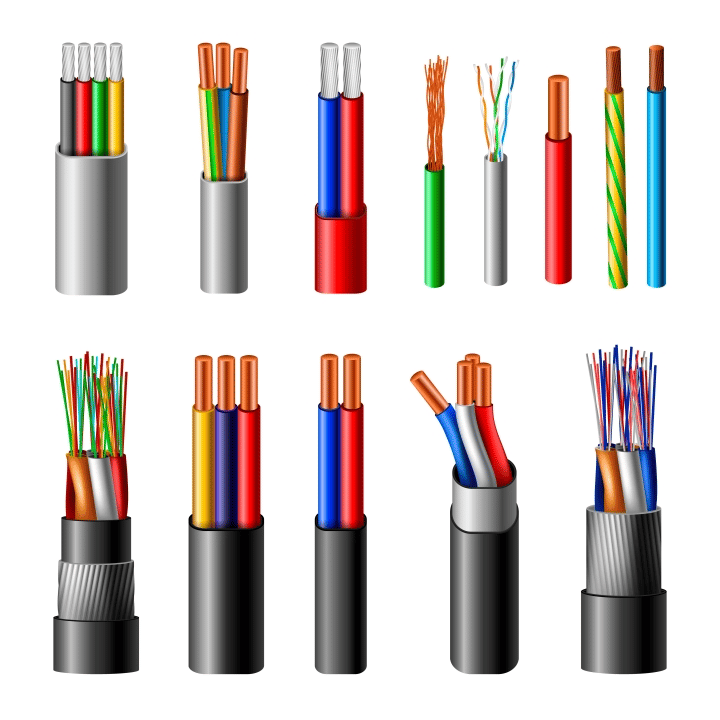
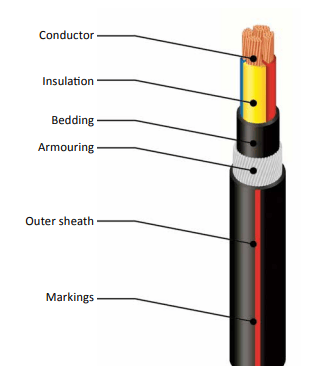
The conductor is the heart, ferrying current with minimal resistance. Copper reigns supreme for its superior conductivity (about 1.7 µΩ·cm resistivity) and ductility, making it ideal for flexible strands in cabtyre cables. Aluminium, lighter and cheaper, suits overhead lines but needs larger sizes for equivalent ampacity. Shapes vary: solid circular for small gauges like 1,5 mm² housewire, stranded for flexibility in trailing cables, or shaped (sectoral) for compact MV designs. Water-blocking options, like yarn swells in wet-prone areas, prevent moisture migration – essential in flood-vulnerable Free State farms.
Insulation wraps the conductor, providing dielectric strength to contain voltage. PVC (polyvinyl chloride) is the workhorse for low-voltage (LV) at 70-90°C operating temps, extruded seamlessly for housewires. XLPE (cross-linked polyethylene) shines in medium-voltage (MV), handling 90°C continuous and 250°C shorts, extending lifespan to 40+ years. Its molecular cross-linking resists melting, crucial for underground cables in hot soils. Insulation thickness – radials – must meet specs; too thin, and breakdowns loom.
Bedding, often overlooked, cushions under armour. Fire-retardant PVC forms a soft barrier, protecting insulation during steel wire armouring. It's not glamorous, but subpar bedding leads to inner damage during pulls through conduits.
Armouring fortifies against mechanical abuse. Steel wire armour (SWA) – galvanised for corrosion resistance – is king, offering tensile strength (up to 10 kN/m) for direct burial in shifting grounds like those post-mining in Mpumalanga. Aluminium wire armour (AWA) suits single-core to avoid magnetic hysteresis, while steel tape is cheaper but weaker. In theft hotspots, armour doubles as a deterrent.
The outer sheath seals the deal, blocking moisture and weathering. PVC works for most, but MDPE (medium-density polyethylene) excels in submersion, like submersible pump cables in boreholes. Thickness per SANS ensures durability; breaches invite corrosion.
Finally, marking: SANS mandates manufacturer name, spec (e.g., SANS 1507), cores, and voltage. Custom prints like "Property of Eskom" or metre marks aid theft recovery – a boon in cable-stripping plagues.
These components aren't isolated; they interact. A robust conductor with weak insulation fails under stress. Industry pros stress holistic design for South Africa's extremes.
Types of Electric Cables Commonly Used in South Africa
South Africa's cable landscape is as varied as its terrain, from urban grids to rural renewables. Low-voltage (LV) dominates domestics: 300/500 V or 600/1,000 V for homes and shops.
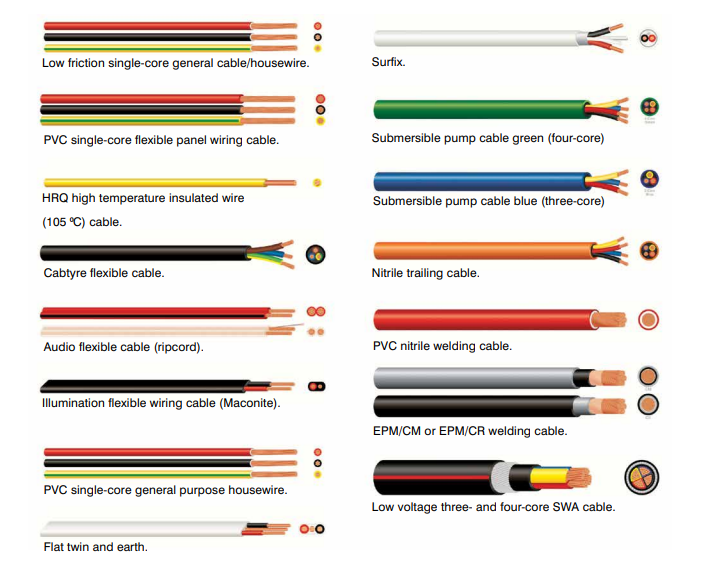
Standard installs include trenches for buried SWA, sleeves for protection, or ladders for overhead racking. PVC single-core housewire (general purpose) wires panels; flexible variants handle bends. Flat twin and earth – two cores plus earth – suits concealed wiring, while Surfix adds a sheath for surface runs. Cabtyre flexible cables power appliances, ripcord for audio, and Maconite for illumination. Submersible pump cables (green four-core or blue three-core) thrive underwater, nitrile trailing for mines, and welding cables (PVC nitrile or EPM/CR) endure arcs.
MV cables (1,9/3,3 kV to 19/33 kV) feed industries: three/four-core SWA for distribution. High-voltage (44-275 kV) XLPE handles transmission.
Specialised types abound: fire-performance cables halt spread in high-rises; aerial bundled conductors (ABC) reduce outages in windy Western Cape; rubber-insulated trailing (300/500 V to 19/33 kV) for draglines; overhead lines like ACSR (aluminium conductor steel-reinforced) for long spans; Solarflex for PV arrays, UV-resistant; locomotive cables for Transnet; anti-theft with embedded markers.
Contexts vary: domestics favor PVC, industries trailing rubber, municipals XLPE SWA. With renewables booming, Solarflex ensures efficiency in sunny Northern Cape.
Standards, Regulations, and Policing in the South African Electric Cable Industry
In a nation grappling with energy equity, robust oversight keeps cables safe. The Association of Electric Cable Manufacturers of South Africa (AECMSA) bridges consumers and makers, advocating quality.
The South African Bureau of Standards (SABS) crafts national norms, like SANS 1507 for LV PVC/XLPE (including armoured), and runs voluntary certification for ongoing compliance. The National Regulator for Compulsory Specifications (NRCS) enforces mandates, inspecting markets to weed out duds.
Key compulsories: SANS 1574 for flexibles (panel wire, cabtyre); SANS 1418 for ABC; SANS 1520 for rubber (LV/MV); SANS 97 for PILC up to 33 kV; SANS 1339 for MV XLPE; SANS 182 for overhead. Welding (SANS 1576) is voluntary.
These ensure hazards are minimised in our infrastructure, from informal settlements to mega-projects. Non-compliance? Fines, recalls, and risks like the 2021 KZN fires traced to faulty wiring.
Substandard Cables in South Africa
Substandard cables plague SA, inflating resistance, shortening life, and sparking dangers. Here's the shockers from the field.
Case Study 1: Copper-Coated Aluminium/Steel Fraud in Johannesburg
In 2022, Gauteng raids uncovered cabtyre leads sold as pure copper but laced with steel cores. A 2,5 mm² sample clocked 20 Ω/km resistance – far over 13,3 Ω/km spec – causing overheating in Soweto homes. Nominal area matched, but magnets revealed steel. Overloads fried appliances; one fire injured three. NRCS fined importers R500,000, highlighting informal market vulnerabilities.
Case Study 2: Alloy Substitutions and Undersized Insulation in Cape Town
Industrial sites in Atlantis reported brass-alloy "copper" in welding cables, stiffening joints and failing under flex. Insulation radials dipped to 0.6 mm vs. 0.8 mm spec, risking shocks. A 2023 factory outage traced to this; electrocution narrowly averted. SABS tests showed 30% resistance hike. Lessons? Stiffness signals alloys; radials prevent domestic perils.
Case Study 3: Cheapened Compounds and Sheaths in Durban
NRCS 2024 inspections in uMlazi markets found PVC fillers in sheaths, brittling under sun. Cables cracked post-install, ingress moisture causing shorts. A school fire linked to this; no injuries, but R200,000 damage. Surveillance yanked 10,000 m; consumers urged weight checks – light cables scream fillers.
Learned: SABS marks, magnet tests, and reputable sourcing combat these, rampant in unregulated stalls.
What to Look for When Buying Electric Cables in South Africa
Don't get zapped by fakes. Spot SABS marks and SANS indications (e.g., SANS 1507). Recognise manufacturers like CBI or Aberdare? Good sign. SAFEhouse logos on packs affirm quality.
Inspect visually: Inconsistent radials, rough sheaths, bulges? Red flags. Magnet test for copper (non-magnetic); light feel or bargain prices suggest clad aluminium.
Best bets: Buy from vetted suppliers, grab brochures for ratings, opt for anti-theft marks in high-risk spots. Consult pros – it's worth the peace.
Frequently Asked Questions (FAQ)
What voltage rating should I choose for my home wiring?
For typical SA homes, 300/500 V or 600/1,000 V suffices. Match your system's needs; an electrician assesses for safety.
How do I calculate short circuit rating for a cable?
Multiply area by factors: 143 A/mm² for XLPE copper. For 25 mm², that's 3,575 A for one second. Brochures detail durations.
What's the difference between PVC and XLPE insulation?
PVC handles LV at lower temps;
XLPE excels in MV with 90°C rating, better for heat and longevity.
Are substandard cables common in South Africa, and how to avoid them?
Yes, especially informal trades. Seek SABS cert, magnet tests, and avoid cheap deals.
Can I install cables myself?
No, unless certified. Hire registered electricians for NRCS compliance and safety.
What about cables for renewable energy setups?
Solarflex for PV;
UV-resistant, flexible for panels. Ensure weatherproofing for SA's sun.
Conclusion
Electric cables underpin South Africa's power story – from humble housewires to mighty MV lines. We've unpacked their attributes, components, types, standards, and the perils of subs, backed by local cases.
Prioritise certified gear; support AECMSA members for jobs and reliability. Stay educated amid energy shifts – knowledge is your best insulation against shocks. Let's keep the lights on, safely.
Introduction
Imagine flipping a switch in your Johannesburg home, only for the lights to flicker erratically – or worse, spark a fire. That's the stark reality when substandard electric cables lurk in your walls. In South Africa, where electricity powers everything from bustling Gauteng factories to remote Eastern Cape farms, electric cables are the unsung heroes (or villains) of our daily lives. They silently transmit energy from Eskom's grids to your kettle, fridge, or heavy-duty mining equipment, ensuring that life hums along without a hitch. But with load-shedding woes and a thriving informal market rife with counterfeits, understanding these vital conduits is more crucial than ever.
This article aims to arm you, the South African reader, with in-depth knowledge on electric cables – their purpose, attributes, components, types, and the pitfalls that could turn a simple wiring job into a disaster. Drawing from industry expertise and local insights, we'll explore how these cables keep our rainbow nation powered safely. Our focus? Primarily low and medium voltage cables used in homes, small businesses, and municipal networks, all while nodding to South Africa's unique challenges like theft, harsh weather, and regulatory oversight. Whether you're a DIY enthusiast in Durban, a contractor in Cape Town, or just curious about what powers your braai lights, buckle up for a jolt of enlightenment.
Electric cables aren't just wires; they're engineered marvels designed to handle volts, amps, and ohms with precision. In a country where electricity access is a right but reliability is a battle, knowing your PVC from your XLPE could save lives and loadshedding frustration. Let's plug in and uncover the currents beneath the surface.
Email Address: Li.wang@feichuncables.com
© 2025. All rights reserved.

One-click to Quickly Contact
Products
Contact
Company
Location:
Building A Private Science and Technology Park, Hefei Economic and Technological Development Zone, Anhui Province, China
Heat Resistant Cable
WhatsApp: +86 17333223430
Social Media: