Anhui Feichun Special Cable Co.,Ltd Email: Li.wang@feichuncables.com
SPREADERFLEX 3GSLTOE: Ultimate Spreader Cable for Basket Operation in Automated STS Cranes
Discover SPREADERFLEX 3GSLTOE — the most technically complete spreader cable designed specifically for basket operation in automated STS container cranes. Learn its working principles, full technical specifications, core engineering technologies, real-world applications in South Africa, and how it compares to SYSLTOE FO and TRATOSCOILFLEX. Ideal for port engineers, procurement teams, and crane system designers seeking reliable, long-lasting cable solutions.
Li Wang
5/9/202616 min read
Introduction
Automated container terminals have become the backbone of global maritime logistics, delivering speed, safety, and efficiency that manual operations simply cannot match. At the heart of every ship-to-shore (STS) crane lies a critical system: the spreader cable, responsible for transmitting power, control signals, data, and video between the crane’s electrical house and the moving spreader. When this cable is designed for basket operation — the most demanding type of vertical storage and retraction — performance requirements shift from standard durability to extreme reliability under continuous, high-stress movement. For engineers, procurement specialists, and terminal operators, choosing the right cable means balancing flexibility, strength, temperature resistance, electromagnetic compatibility, and service life.
SPREADERFLEX 3GSLTOE has emerged as the benchmark solution in this field. Engineered exclusively for basket operation, it combines every key technology developed over decades for vertical crane applications into one unified structure. Unlike general-purpose reeling cables or partially optimized alternatives, this product meets every requirement of modern automated ports without compromise. This guide explores how basket operation works in real-world terminals, why 3GSLTOE stands above all competitors, its complete technical specifications, the engineering principles behind its performance, and practical guidance for selection and application. The insights here are drawn from field experience across major international ports, including extensive deployments in South Africa, where harsh environmental conditions place some of the highest demands on cable systems.
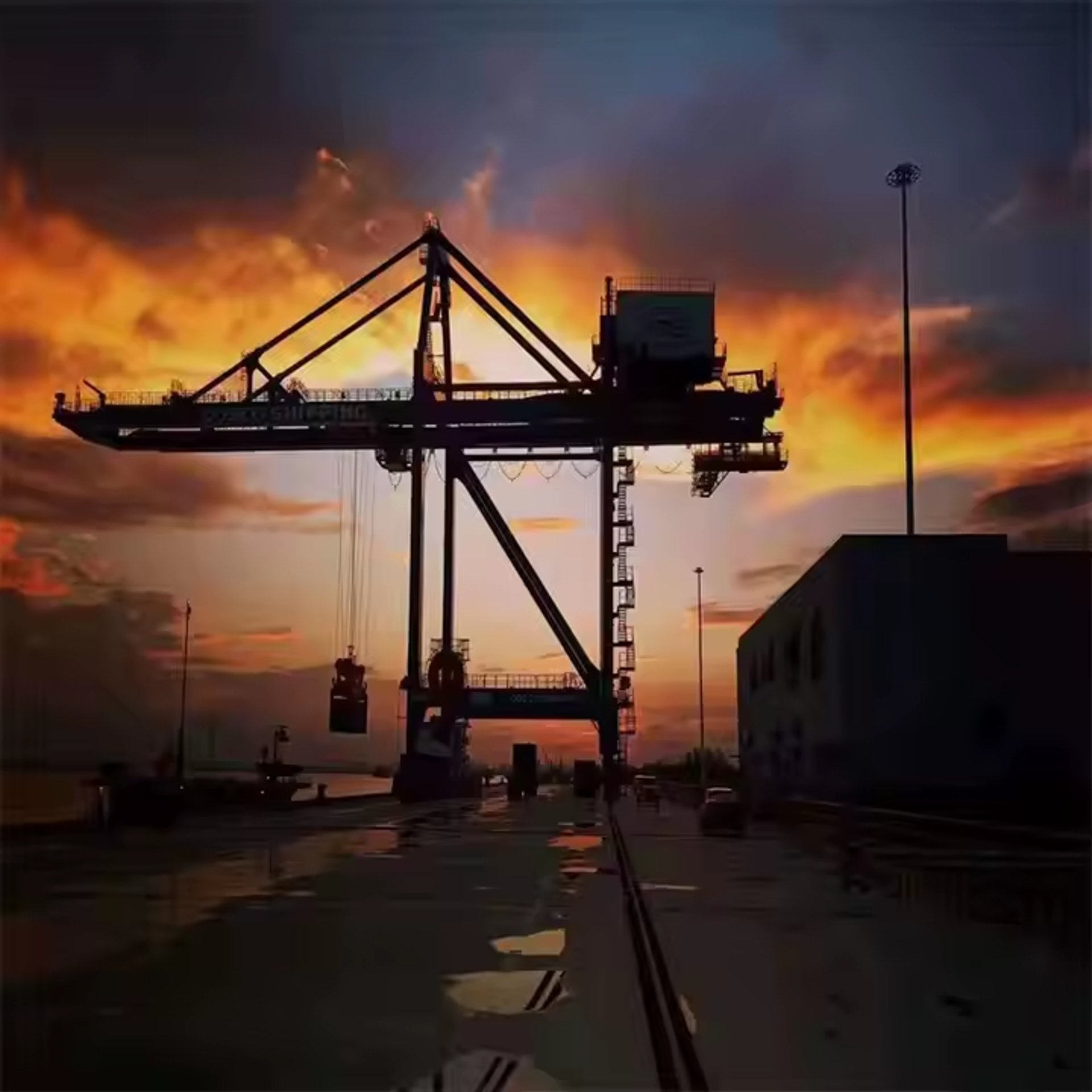
Vertical Basket Operation of Automated STS Cranes in South Africa
How Basket Operation Works
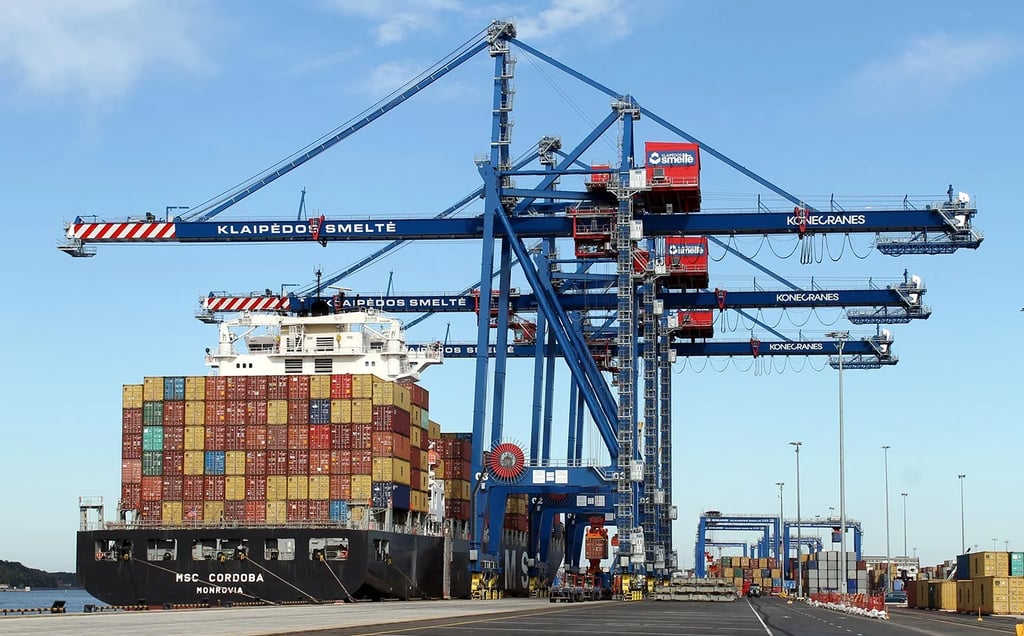
Basket operation describes the method of storing and moving the spreader cable as the container lifting frame moves vertically between the ship’s holds and the quay level. In this design, the cable hangs freely from the upper structure and coils naturally inside a rigid or flexible basket frame mounted just above the spreader. As the spreader descends, the cable is released and forms orderly loops within the basket. When lifting begins, the cable is pulled upward and unwinds smoothly from the bottom of the coil. This system eliminates the need for complex drum winding mechanisms and reduces mechanical complexity, but it places unique physical demands on the cable itself.
Every movement involves repeated bending, twisting, tension changes, and exposure to wind, temperature shifts, and vibration. In automated terminals, the system operates twenty-four hours a day, seven days a week, with lifting speeds reaching up to 160 meters per minute and lifting heights exceeding 50 meters. Even small performance failures — such as signal loss, conductor breakage, or jacket damage — can cause costly downtime, safety risks, or damage to containers and equipment.
Practical Example: Durban and Cape Town Ports
South Africa’s major container terminals in Durban and Cape Town represent some of the most challenging operating environments on the continent. Located on the coast, these ports experience strong prevailing winds, high humidity, and significant temperature variation — from cool winter nights to hot summer days. In Durban, the STS cranes handle thousands of containers daily, with basket operation as the standard design for cable management.
In a typical operating cycle, the spreader lowers from its parking position at 48 meters above the quay down to the bottom of a ship hold. During this descent, the cable feeds out and forms consistent, evenly spaced loops inside the basket. Even when wind speeds reach 22 meters per second, the cable remains perfectly vertical and stable, without swinging or tangling against the basket frame or crane structure. As the spreader grips a container and rises, the cable unwinds sequentially from the lowest loop upward, maintaining constant tension and smooth movement. Throughout this process, power remains uninterrupted to the spreader’s motors, and signals from cameras, position sensors, and locking mechanisms transmit without interference.
Before adopting SPREADERFLEX 3GSLTOE, these terminals faced recurring issues with older cable designs. Cables would develop twists, suffer jacket cracking in cold weather, or experience signal drop-outs due to electromagnetic interference. Replacement cycles were frequent, often every two to three years, leading to high maintenance costs and operational delays. With 3GSLTOE in service, operators report stable performance over more than ten years, with no unplanned failures related to the cable system. This improvement stems directly from the way the cable is engineered to match every physical and electrical demand of South African port conditions.
Core Challenges of Basket Operation
What makes this application so difficult is that no single material or design feature can solve every problem. A cable that is strong enough to support its own weight might be too stiff to bend millions of times. A design that works well in warm climates may fail in cold weather. A cable with excellent electrical performance might not withstand mechanical fatigue. For basket operation, the cable must perform as an integrated system — mechanically, electrically, and thermally. This explains why standard industrial cables cannot meet the requirements and why specialized products like 3GSLTOE have become essential.
Why SPREADERFLEX 3GSLTOE Is The Most Technically Complete Basket Operation Spreader Cable
Integration of All Key Technologies
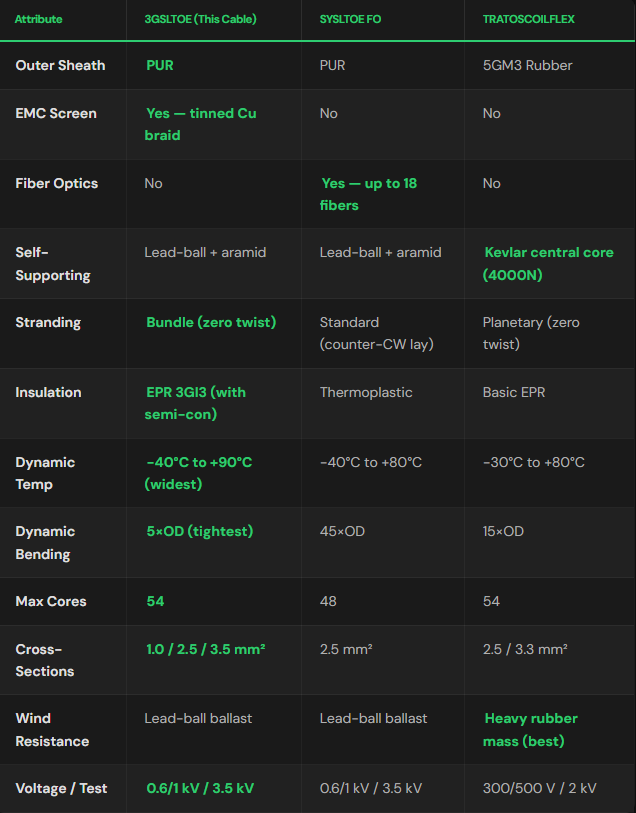
The defining advantage of SPREADERFLEX 3GSLTOE is that it brings together every innovation developed specifically for vertical basket operation into one single construction. Other products on the market focus on one or two features but make compromises elsewhere, limiting their effectiveness. For example, SPREADERFLEX BSKT XPRT SYSLTOE FO includes optical fibers for high-speed data transmission but relies on thermoplastic insulation, which becomes brittle in cold temperatures and softens in extreme heat. TRATOSCOILFLEX uses a durable rubber-based structure but has no electromagnetic shielding, making it unsuitable for modern cranes driven by variable frequency drives.
By contrast, 3GSLTOE incorporates six critical technologies, each addressing a specific operational need, with no trade-offs. It features a lead-filled aramid self-supporting structure that ensures vertical alignment, resists wind sway, and allows zero-elongation suspension over long heights. It uses bunched stranding throughout the core, which eliminates torsion and enables perfect, fatigue-free coiling. A high-density tinned copper braid provides comprehensive EMC shielding to block electrical noise generated by VFD systems. The conductors are built to FS-class ultra-flexible standards, capable of surviving more than five million folding cycles without damage. Insulation uses EPR 3GI3 rubber, delivering superior dielectric strength and long-term stability across extreme temperatures. Finally, the outer sheath is made of special PUR material, offering the widest available operating temperature range combined with low surface friction and exceptional resistance to abrasion, oil, and weathering.
Matching Modern Crane Requirements
This complete integration makes 3GSLTOE the default specification for new-generation automated STS cranes. Modern cranes operate in environments that demand every one of these features simultaneously. They run in electromagnetic environments filled with noise from variable frequency drives, requiring effective shielding to protect signals from dozens of sensors, cameras, and actuators on the spreader. They are deployed globally, from Arctic terminals to equatorial ports, needing materials that perform reliably from -40°C to +90°C. High lifting speeds and long service life require designs that resist fatigue and torsion, while windy locations demand built-in weight and strength to maintain stability.
No other cable currently available satisfies all these requirements without compromise. Some products may offer good flexibility, but lack shielding. Others have strong insulation, but fail to manage torsion. 3GSLTOE is the only solution engineered so that every part of its design supports the full range of operational demands. For terminal operators and engineering teams, this means selecting one product that works everywhere, reducing inventory complexity, simplifying maintenance, and eliminating the risk of performance gaps.
Complete Technical Specifications — SPREADERFLEX 3GSLTOE
Basic Product Details and Standards
SPREADERFLEX 3GSLTOE is rated at 0.6/1kV, making it suitable for medium-power distribution and control circuits common in crane systems. It is manufactured in compliance with DIN VDE 0250, VDE 0207, VDE 0295, IEC 60228, and EN 60811 standards, ensuring consistency and quality recognized across international markets. Its design is optimized exclusively for basket operation, vertical reeling, and continuous flexing applications in automated ports, container terminals, and heavy material handling systems.
Layer-by-Layer Construction
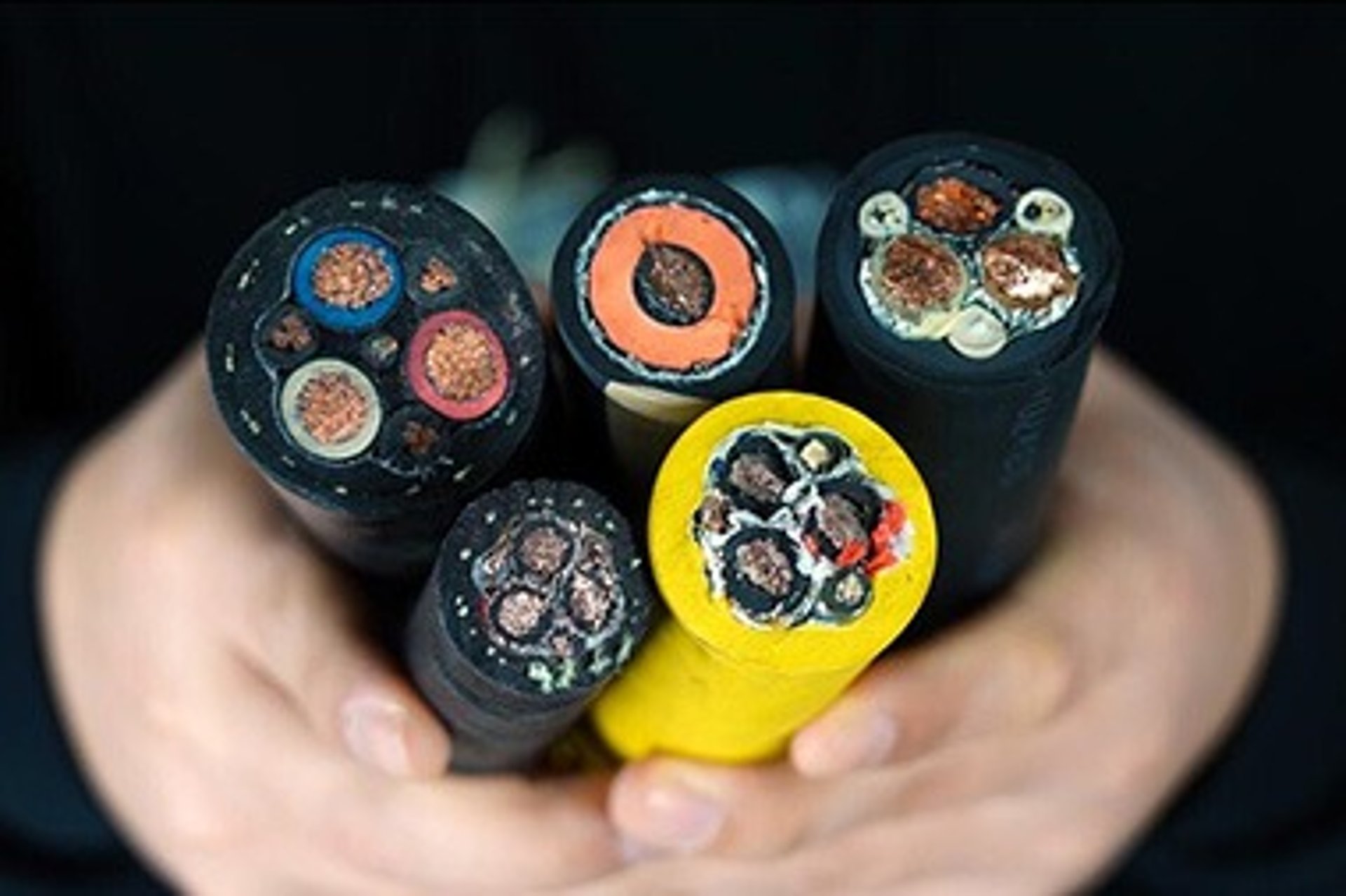
The cable is built from the center outward, with each layer chosen and engineered to contribute to overall performance. The innermost component is the conductor, made from bare electrolytic copper stranded into extremely fine wires to meet FS-class ultra-flexible requirements. This construction gives low electrical resistance while allowing repeated bending without metal fatigue or breakage.
Over each conductor, insulation is applied using EPR 3GI3 rubber. This material is chosen for its excellent dielectric strength, which exceeds 20kV per millimeter, and its ability to remain stable over a wide temperature range. It resists ozone, moisture, and long-term aging, ensuring consistent electrical performance for the entire service life. Cores are identified by colored insulation with black numerical printing, while the protective earth core uses the standard green-yellow color combination for safety compliance.
Cores are arranged using a bunched stranding method, where all conductors are grouped together and stranded in the same direction without forming distinct layers. This arrangement is key to achieving zero torsion and smooth bending. At the center of the cable, a strength member combines lead bead bundles with an aramid fiber braid. The lead provides controlled weight to keep the cable vertical and stable in wind, while the aramid delivers high tensile strength and virtually zero elongation, ensuring length consistency and safety under maximum load.
Surrounding the cored assembly is an electromagnetic shield made from tinned copper wires woven into a tight braid with coverage above 80%. Tinning prevents oxidation and maintains stable conductivity over decades, while the braided structure remains flexible enough to bend millions of times without cracking or breaking. The shield ensures that external noise does not interfere with signals and that signals inside the cable do not cause interference with other equipment.
The outermost layer is the outer sheath, extruded from a specially formulated polyurethane compound. This material offers the widest temperature range available in basket cables, operating reliably from -40°C up to +90°C in moving applications and even lower in fixed installations. It has very low surface friction, which reduces wear both on the cable and on contact points within the basket. It is highly resistant to oil, chemicals, ultraviolet radiation, and abrasion, making it suitable for harsh outdoor port environments.
Key Electrical and Mechanical Parameters
Electrical performance is defined by a rated voltage of 0.6/1kV, with a maximum operating voltage of 0.7/1.2kV AC or 0.9/1.8kV DC. Every cable undergoes a 5-minute withstand test at 3.5kV AC to ensure insulation integrity. The conductor can operate continuously at a maximum temperature of +90°C, and withstand short-circuit conditions up to +250°C for periods of up to five seconds.
Mechanically, the cable is designed for long life and safe operation. The minimum bending radius is set at 45 times the outer diameter for moving applications and 30 times the diameter for fixed installation, values derived from extensive testing to prevent internal damage. It is approved for operating speeds up to 160 meters per minute and vertical suspension heights up to 50 meters. Under correct operating conditions, the expected service life exceeds ten years, withstanding more than five million bending cycles.
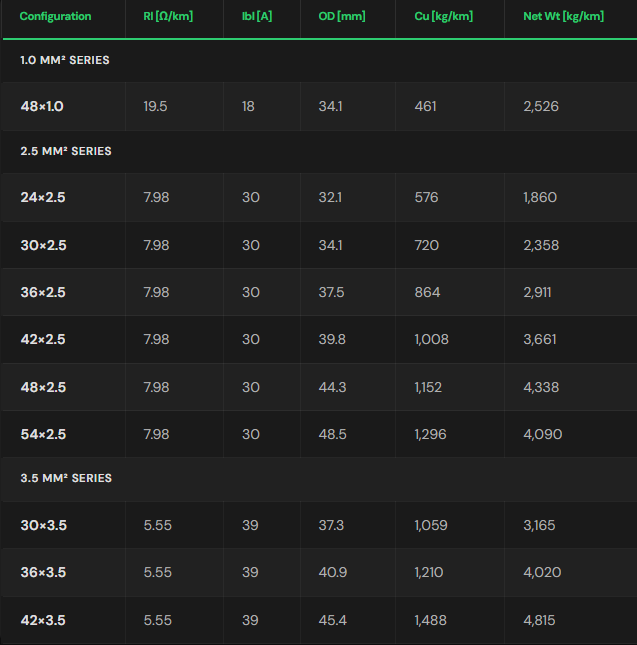
Standard Configuration Range
SPREADERFLEX 3GSLTOE is available in a wide range of standard configurations to match different crane designs and spreader requirements. Common sizes include 24, 30, 36, 42, and 48 cores, with conductor cross-sections of 1.5mm² or 2.5mm². Each size is optimized to balance current-carrying capacity, outer diameter, weight, and flexibility. For example, the 24×1.5mm² version has an outer diameter of approximately 28.4mm, a total weight of around 1320kg per kilometer, and a current rating of 21 amperes at 30°C ambient temperature. The larger 48×2.5mm² version measures about 42.0mm in diameter, weighs roughly 4120kg per kilometer, and carries 30 amperes per core.
Custom versions are also available, including different core counts from 2 to 61 cores, conductor sizes from 0.75mm² up to 4mm², and options such as integrated optical fibers, double shielding, or flame-retardant compounds. This flexibility allows exact matching to the electrical and physical requirements of any terminal design.
In-Depth Engineering Analysis — Core Technologies Explained
Bunched Stranding vs. Layer Stranding: Physics of Perfect Winding
One of the most important differences between 3GSLTOE and traditional cables is how the conductors are arranged inside. Older designs use layer stranding, where cores are grouped in concentric circles around a central element, with each layer stranded in the opposite direction to the one below. While this creates a round, stable shape, it creates fundamental problems for repeated bending. When the cable curves, cores on the outside stretch while those on the inside compress, creating uneven stress. Over time, this stress leads to permanent deformation, twisting, and eventually fatigue failure. Layer-stranded cables often develop tight knots or twists inside the basket, increasing friction and accelerating wear.
SPREADERFLEX 3GSLTOE uses bunched stranding instead. In this construction, all conductors are stranded in the same direction without forming fixed layers. Each core is free to shift its position slightly within the bundle as the cable bends. This simple change changes the physics of movement entirely. During bending, tension equalizes across all cores, eliminating internal stress concentrations. When the cable twists, the entire bundle rotates together, resulting in zero net torsion. This is why 3GSLTOE coils smoothly, evenly, and without knotting, even after millions of cycles. The design follows a carefully calculated pitch ratio — approximately 15 times the bundle diameter for stranding and 10 times the overall diameter for cabling — balancing structural stability with maximum flexibility. The result is a cable that wears evenly and lasts five to ten times longer than layer-stranded alternatives in the same application.
Lead-filled Aramid Core: The Pendulum Skeleton
Maintaining vertical alignment and stability is critical in basket operation, especially in windy coastal ports like those in South Africa. Without proper weight and strength, a cable will swing, drift, or coil unevenly, increasing the risk of damage or downtime. 3GSLTOE solves this with a dual-function central strength member that acts as both a weight and a reinforcement.
Inside the core, bundles of lead beads provide controlled mass. This weight ensures the cable always hangs straight down and forms consistent loops in the basket, regardless of how much cable is paid out. The lead is contained within a braid of aramid fibers, which provides exceptional tensile strength and almost zero elongation. Unlike steel wire reinforcements, which stretch under load and become rigid, aramid is lightweight, flexible, and dimensionally stable. It supports the full weight of the suspended cable with a safety factor of five times the working load, ensuring no risk of breakage even at maximum height.
This combination works like a pendulum skeleton. The weight pulls downward to maintain verticality, while the aramid provides strength and stability. Wind forces are countered by the built-in weight, keeping the cable clear of the crane structure. This design is exclusive to high-performance basket cables and is a key reason why 3GSLTOE performs reliably in exposed port locations.
EMC Shielding: Tinned Copper Braid for VFD Era Spreaders
Modern automated cranes rely heavily on variable frequency drives to control motor speed and torque efficiently. While these systems improve energy efficiency and precision, they also generate high-frequency electrical noise across a wide spectrum from 10kHz to 30MHz. Without proper protection, this noise can travel along cables, disrupting signals from cameras, encoders, limit switches, and communication buses. For spreader cables that carry power and signals in the same bundle, shielding is not optional — it is essential.
SPREADERFLEX 3GSLTOE uses a tinned copper braid shield engineered specifically for this environment. The braid is woven with high coverage, above 80%, creating a continuous conductive barrier around the core. Tinning the copper wires prevents oxidation and corrosion, which is important in humid or salty coastal air, and maintains stable electrical performance over decades. The braided structure is far more flexible than foil or tape shields, moving with the cable without cracking or breaking during repeated bending.
Performance testing shows this design achieves noise attenuation of more than 60 decibels, effectively eliminating interference. By comparison, TRATOSCOILFLEX has no shielding at all, making it unsuitable for VFD-equipped cranes. SYSLTOE FO uses only a light aluminum foil shield, which offers limited protection and degrades quickly in dynamic use. 3GSLTOE’s shielding is part of the core design, ensuring signal integrity and operational reliability in even the most electrically noisy environments.
-40°C to +90°C: Widest Temperature Range in Basket Cables
Global port operations mean cables must work in climates ranging from freezing Arctic winters to scorching tropical summers. A cable that becomes stiff in cold weather or softens in heat will fail prematurely. 3GSLTOE achieves the widest operating temperature range in the industry through a careful combination of materials: EPR rubber insulation and PUR outer sheath.
EPR 3GI3 rubber insulation is chosen because it remains flexible down to -55°C, far below the lowest operating temperature, and retains its physical and electrical properties up to +90°C. Unlike thermoplastic materials used in some alternatives, it does not become brittle or crack when cold, nor does it flow or deform when hot. The outer sheath uses a special polyurethane formulation that shares this wide stability. It resists low-temperature brittleness and high-temperature softening, while offering superior resistance to oils, chemicals, and ultraviolet light.
This combination means 3GSLTOE can be installed anywhere in the world without modification. It performs equally well in the cold winters of northern Europe, the high heat of Middle Eastern ports, and the variable climate of South Africa. Competing products typically limit operation to between -25°C and +70°C, requiring different cables for different regions and increasing complexity for global operators.
Basket Size: 30×D and 45×D Engineering Formula
Correct basket sizing is as important as cable design itself, and 3GSLTOE is engineered around a clear engineering formula: minimum bending radius equals 30 times the outer diameter for fixed installation and 45 times the outer diameter for moving operation. These values are not arbitrary; they come from extensive fatigue testing and mechanical analysis.
If the basket diameter is smaller than 45 times the cable diameter, bending stress becomes too high, accelerating conductor fatigue and causing premature failure. If the basket is significantly larger, the cable may coil loosely, shift during movement, or rub against the frame, leading to unnecessary wear. By following this formula, operators ensure the cable forms smooth, consistent loops with even tension across all cores.
For example, a 3GSLTOE cable with an outer diameter of 37.5 millimetres requires a basket with an internal diameter of at least 1687.5 millimetres for moving operation. This matches the dimensions of standard STS crane baskets used across South African terminals. Adhering to this rule ensures that every part of the cable’s construction — from the bunched cores to the shield and sheath — operates within its designed stress limits, directly translating into longer service life and lower maintenance costs.
Full Basket Cable Series: 3GSLTOE vs. SYSLTOE FO vs. TRATOSCOILFLEX
Understanding how 3GSLTOE compares to other available options helps in making informed selection decisions. SYSLTOE FO is often chosen when optical fibre integration is a priority. It does include fibre elements for high-speed data transfer, but it relies on thermoplastic insulation and a simpler construction. While suitable for shorter lifting heights, moderate speeds, and mild climates, it cannot match 3GSLTOE’s temperature range or mechanical durability. Its shielding is limited, and it lacks the lead-filled aramid core, making it prone to sway in windy locations. It serves well in semi-automated terminals but is not recommended for fully automated high-performance ports.
TRATOSCOILFLEX takes a different approach, using rubber insulation and sheath for good flexibility and strength. However, it is manufactured without any electromagnetic shielding, which immediately rules it out for modern cranes with variable frequency drives. It also lacks the self-supporting weighted core, so stability in wind is poor, and torsion control is less precise. This product is best suited for older, non-automated terminals or applications where electrical noise is not a concern and operating speeds are low.
SPREADERFLEX 3GSLTOE stands apart by combining the best features of all designs while eliminating their weaknesses. It has the optical fibre capability as an option, the robust rubber-based electrical performance, comprehensive shielding, superior temperature resistance, and the unique self-supporting structure. It is the only product engineered to meet the highest specification requirements of fully automated global terminals.
Cost-Effective Alternative Solutions
While 3GSLTOE is the premium solution, there are variations and alternatives for applications where full performance is not required. The 3GSLTOE-Light version retains the core bunched stranding, EPR insulation, and PUR sheath, but simplifies the strength member and reduces shield coverage slightly to 70%. This reduces cost by around 15% while still delivering reliable performance. It is ideal for terminals in milder climates, with lifting heights below 30 metres, or where a service life of eight years is acceptable instead of ten.
SYSLTOE FO remains a good mid-range choice when optical fibre is essential and budgets are tighter. It works well for speeds up to 120 metres per minute and heights up to 40 metres, provided the climate does not experience extreme cold or heat. TRATOSCOILFLEX is the most economical option, suitable only for traditional terminals without VFD systems, low lifting speeds, and non-critical signal paths.
For any alternative, it is important to balance lower initial cost against the total cost of ownership, including maintenance, downtime, and replacement frequency. In high-performance ports, the premium of 3GSLTOE is quickly offset by its reliability and long service life.
Frequently Asked Questions
Why use a lead-filled aramid core instead of steel wire reinforcement?
Steel wire is sometimes used for strength, but it has significant disadvantages for basket operation. Steel stretches under tension, which changes the effective length of the cable and creates uneven tension across cores. It is also rigid, making the cable stiffer and harder to coil smoothly. Lead-filled aramid provides the necessary weight to maintain vertical alignment and stability in wind, while aramid itself has almost zero elongation and high tensile strength. The combination delivers the perfect balance of weight, strength, and flexibility that steel cannot achieve.
Is PUR sheath better than rubber sheath?
Yes, for automated port applications, polyurethane offers clear advantages over standard rubber compounds. PUR has a much wider operating temperature range, performs better in both extreme cold and heat, and has significantly lower surface friction. Low friction reduces wear on the cable and on basket components. It also resists oils, chemicals, and ultraviolet radiation far better than rubber, and it does not absorb water or swell over time. While rubber is cheaper, it is heavier, wears faster, and has a shorter service life in dynamic outdoor environments.
Does the shielding reduce flexibility?
The tinned copper braid shielding used in 3GSLTOE is designed specifically to maintain flexibility. Unlike foil or tape shields, which are stiff and prone to cracking, a braid moves with the cable’s core. During bending and twisting, the individual wires slide against each other without breaking or creating internal stress. Extensive testing confirms that this shielding design has no negative impact on the cable’s bending life or flexibility. It provides protection without compromising mechanical performance.
Can the cable be customized?
SPREADERFLEX 3GSLTOE is highly customizable to match specific project requirements. Standard production covers core counts from 2 up to 61 cores and conductor cross-sections from 0.75mm² to 4mm². Options include integrated single-mode or multi-mode optical fibres, double shielding for extra protection, flame-retardant or low-smoke compounds, and special colour coding. Custom configurations are engineered and tested to ensure they meet the same high standards as standard versions.
What installation practices are required?
Correct installation is essential to achieve the full design life. The cable should be wound counter-clockwise into the basket to match the stranding direction, which helps maintain zero torsion. The basket internal diameter must be at least 45 times the cable’s outer diameter to avoid over-bending. Contact surfaces should be smooth and free of sharp edges or abrasive materials. Proper tension control during installation prevents slack or over-tightening. Following these simple rules ensures trouble-free operation for more than a decade.
Conclusion
SPREADERFLEX 3GSLTOE represents the result of decades of engineering development focused entirely on the unique challenges of basket operation in automated STS cranes. It is not just a cable; it is a complete system designed to solve every problem faced by terminal operators — from signal interference and wind sway to extreme temperatures and mechanical fatigue. Its presence in major South African ports and across global terminals proves its ability to perform reliably in real-world conditions.
By integrating lead-filled aramid strength members, bunched stranding, EPR insulation, PUR sheathing, and high-performance shielding into one unified construction, it sets a standard that no other product has yet matched. For engineers and procurement teams, choosing 3GSLTOE means choosing a solution that works consistently, reduces maintenance, and protects long-term investment.
If you need further technical details, help selecting the right configuration, or a quotation for your terminal project, please contact the Feichun Special Cable engineering team at Li.wang@feichuncables.com. Our specialists will work with you to understand your exact operating conditions and recommend the best solution for your application.
Email Address: Li.wang@feichuncables.com
© 2025. All rights reserved.
One-click to Quickly Contact
Products
Contact
Company
Location:
Building A Private Science and Technology Park, Hefei Economic and Technological Development Zone, Anhui Province, China
Heat Resistant Cable
WhatsApp: +86 17333223430
Social Media: