Anhui Feichun Special Cable Co.,Ltd Email: Li.wang@feichuncables.com
SUPROMONT (N)3GHSSHCH Halogen-Free EPR MV Flexible Feeder Cable for Underground Mining in South Africa: Ultimate Solution for TBMs and Shiftable Equipment
Explore the engineering design, material science, and field-proven performance of Prysmian SUPROMONT (N)3GHSSHCH MV flexible cables. Learn how they solve extreme conditions in South Africa’s deep mines, meet DIN VDE and SANS standards, and compare with equivalent alternatives from Feichun Cables.
Li.Wang
6/26/202612 min read
Introduction
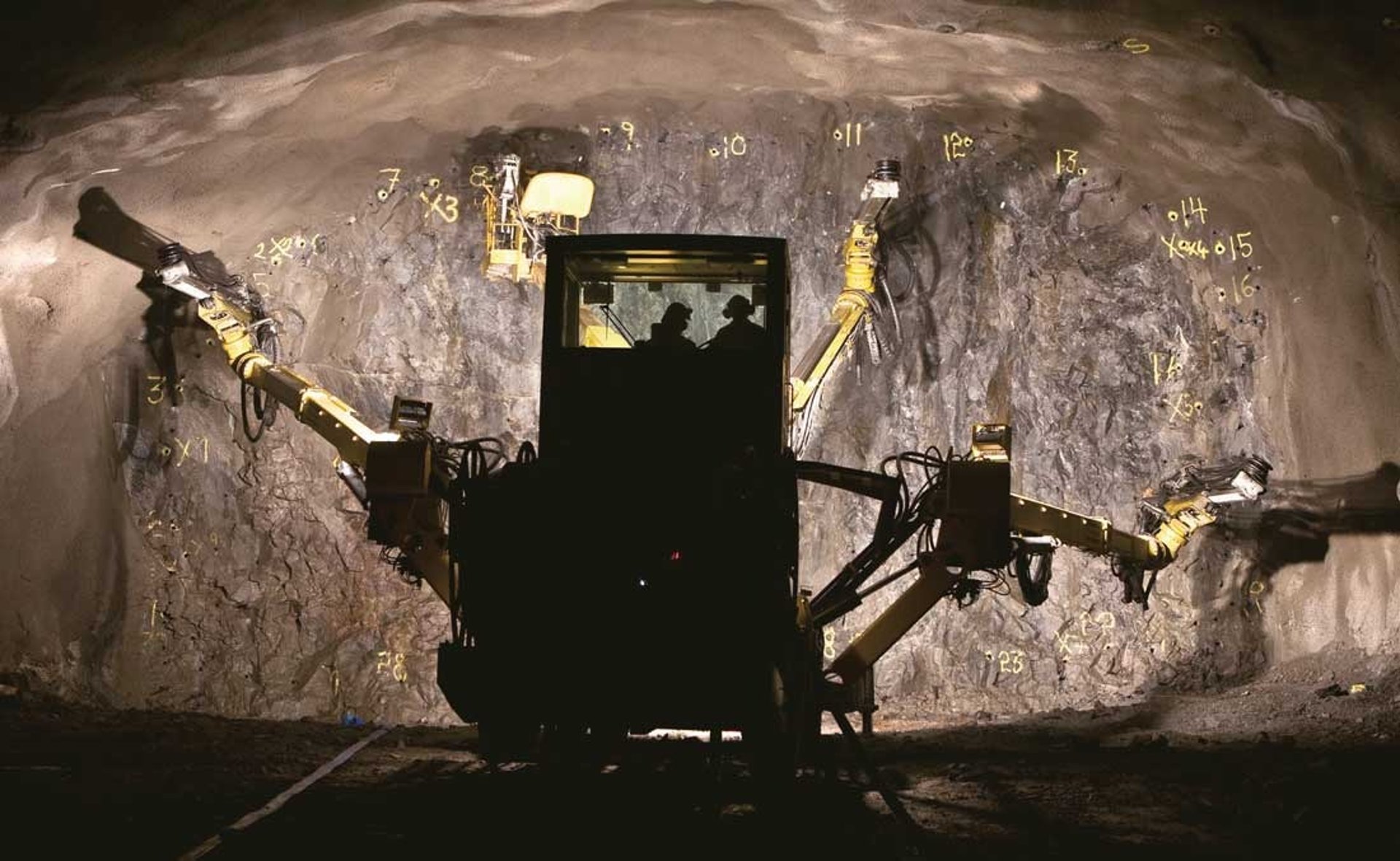
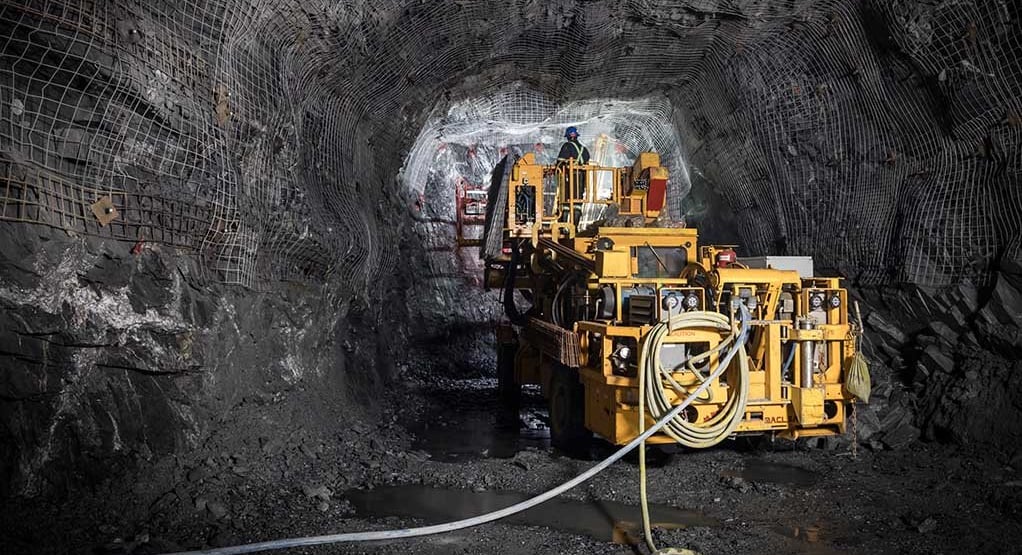
South Africa is home to some of the deepest and most technically demanding mines on the planet. Gold and platinum operations regularly reach depths between 2,000 and 4,000 meters, creating an environment unlike any other industry. Temperatures can rise above 40°C, humidity stays near saturation levels, and the atmosphere often contains methane, hydrogen sulfide, and ozone. Add to this the constant mechanical stress of rock movement, heavy equipment traffic, and the need to relocate power infrastructure as working faces advance, and the challenge of delivering reliable electricity becomes immense.
For decades, mining operators have faced a persistent problem: standard medium voltage cables fail far too quickly under these conditions. Rigid constructions break when bent repeatedly, insulation degrades rapidly in high heat and chemical exposure, and conventional sheaths release toxic smoke and corrosive gases during a fire, putting lives and equipment at risk. Many cables are designed for fixed installation, not for the dynamic, semi-mobile duty required to power shiftable transformers, tunnel boring machines, crushers, and pumping stations.
This is where the SUPROMONT (N)3GHSSHCH series from Prysmian Group stands apart. It is not merely an upgraded version of an ordinary cable; it is a solution reverse-engineered from the ground up specifically for underground mining and tunnel environments. It represents the fusion of four critical engineering disciplines: electrical science, material technology, mechanical design, and safety compliance. By integrating these elements, the cable addresses the root causes of failure rather than just their symptoms.
In this article, we will examine the complete profile of SUPROMONT (N)3GHSSHCH. We will look at its technical specifications, break down its construction and material composition, explain the scientific principles behind its design, and review real-world performance data from South African mines. We will also discuss how it compares to standard options, introduce equivalent alternatives, and provide practical guidance for selection and installation.
Technical Standards & Electrical Specifications
To understand why this cable performs so reliably, one must first look at the standards it follows and the precise electrical parameters it maintains. SUPROMONT (N)3GHSSHCH is built according to DIN VDE 0250 Part 605, the German standard specifically for flexible power cables used in underground mining and heavy industry. It also complies with DIN VDE 0118, which governs electrical installations in potentially explosive atmospheres, ensuring it meets the strictest safety requirements for hazardous zones.
Voltage Ratings and Electrical Limits
The cable is available in four distinct voltage classes to match common distribution systems used in mines:
3.6/6 kV: Suitable for networks up to 6 kV; maximum continuous AC operating voltage 4.2/7.2 kV, DC 5.4/10.8 kV
6/10 kV: For 10 kV systems; maximum AC 6.9/12 kV, DC 9/18 kV
8.7/15 kV: For 11 kV and 15 kV networks; maximum AC 10.4/18 kV, DC 13.5/27 kV
12/20 kV: For high-power 20 kV systems; maximum AC 13.9/24 kV, DC 18/36 kV
Before leaving the factory, every cable undergoes rigorous testing. The main cores withstand AC voltages of 11 kV, 17 kV, 24 kV, and 29 kV respectively for five minutes, while control and monitoring cores are tested at 2 kV. This ensures that the insulation system is free from defects and voids that could cause partial discharge over time.
Thermal and Electrical Performance
The insulation system is rated for a maximum continuous conductor temperature of 90°C, allowing high power transfer without overheating. In the event of a short circuit, the design safely handles temperatures up to 250°C for a duration of up to five seconds, a critical safety feature in high-energy networks.
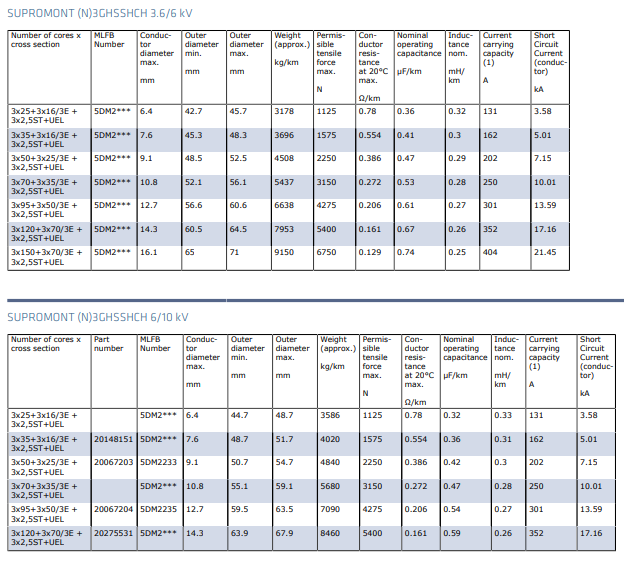
Available cross-sections range from 3×25 mm² up to 3×150 mm², with integrated protective earth cores, control cores, and monitoring elements. Electrical performance is consistent across the range:
Conductor resistance at 20°C ranges from 0.78 Ω/km for 25 mm² down to 0.129 Ω/km for 150 mm²
Current carrying capacity varies from 131 A to 428 A when installed on the surface at 30°C ambient temperature
Short-circuit withstand capability spans 3.58 kA to 21.45 kA, depending on conductor size
Capacitance and inductance values are optimized to reduce reactive power losses and maintain stable voltage under variable load conditions
These specifications align closely with South African requirements, where SANS 1520 and SANS 1411 standards dictate the performance of electrical equipment in mines. While originating from European norms, the design is fully compatible with local regulations enforced by the Department of Mineral Resources and Energy (DMRE).
(3.6/6KV-6/10KV for Example)
Structural Design & Material Science
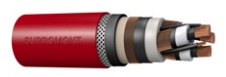
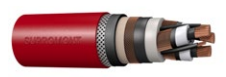
The reliability of SUPROMONT (N)3GHSSHCH comes from a carefully engineered layered construction. Every material choice and design decision serves a specific technical purpose, balancing electrical function, mechanical strength, and environmental resistance. Below is a detailed look at the structure from the inside out, along with the scientific principles behind each layer.
Layer-by-Layer Construction
1. Conductor
The core current path is made of bare electrolytic copper, finely stranded to Class 5 according to EN 60228. Unlike solid or rigid stranded conductors, Class 5 construction uses many thin wires twisted together in multiple layers.
Electrical Principle: This reduces the “skin effect,” ensuring uniform current distribution and lowering resistance. It also improves conductivity at high frequencies and under fluctuating loads.
Mechanical Principle: Fine stranding increases flexibility and distributes bending stress across thousands of individual strands rather than a few large ones. This drastically reduces fatigue failure, even after thousands of bending cycles. The maximum permissible tensile load is 15 N/mm², far higher than standard cables.
2. Inner Semiconductive Layer
Applied directly over the conductor is a smooth layer of semiconductive rubber.
Function: It eliminates the air gaps between the copper strands and the insulation. Without this layer, the uneven surface of the conductor would create localized high electric fields, leading to partial discharge and eventual insulation breakdown.
Principle: It equalizes electrical potential, ensuring the field stress is distributed evenly rather than concentrated at sharp points.
3. Insulation
The primary insulation is high-grade Ethylene Propylene Rubber (EPR or HEPR).
Electrical Properties: EPR has a low dielectric constant (~2.5), very low power loss factor, and high dielectric strength. It remains stable under high electrical stress and does not degrade easily under continuous voltage.
Chemical & Thermal Properties: It is a thermoset polymer, meaning it does not melt but retains its elasticity across a wide temperature range. It resists ozone, moisture, and mineral oils, and remains flexible down to -40°C and up to 90°C.
4. Outer Semiconductive Layer
Applied over the insulation is another semiconductive rubber layer.
Function: It works in tandem with the inner layer to create a “capacitive” system. It ensures the electric field is confined within the insulation material, preventing surface tracking and maintaining consistent radial stress distribution.
5. Earth and Control Cores
Three protective earth cores are laid concentrically around the main cores, plus three control cores and an integrated UEL monitoring element.
Safety Principle: The earth cores provide a low-resistance path for fault currents, ensuring rapid tripping of protection devices and limiting touch voltage. The monitoring circuit allows continuous real-time detection of insulation damage or sheath faults, enabling maintenance before a catastrophic failure occurs.
6. Inner Sheath
A layer of HM4 thermoplastic compound forms the first mechanical barrier.
Purpose: It binds the core assembly into a round, compact structure, provides moisture sealing, and acts as a cushion to absorb mechanical shocks. HM4 is specifically formulated as a halogen-free, low-smoke (LSZH) material, meeting IEC 60332-1-2 and IEC 60754 standards.
7. Monitoring Layer
Beneath the armour lies a conductive tape combined with a concentric copper wire braid.
Function: This layer is connected to the monitoring system. If the outer sheath is cut or worn, the conductive layer makes contact with the armour or ground, triggering an alarm. This turns the cable from a passive component into an active safety system.
8. Intermediate Sheath
Another HM4 layer separates the monitoring system from the armour.
Reason: It prevents electrical contact between the monitoring circuit and the steel armour, which would cause false readings and disable the fault detection function.
9. Armour
The mechanical backbone is a braid of galvanized steel wires.
Mechanical Principle: Unlike a helical armour, a braided structure remains flexible while providing high tensile strength and crush resistance. It distributes external forces evenly, protecting the internal components from rock falls, heavy equipment impact, and friction during dragging or reeling. It supports reeling speeds up to 120 m/min and towing speeds up to 60 m/min.
10. Outer Sheath
The final layer is again HM4 compound, colored bright red.
Environmental Resistance: It is impermeable to water, resistant to UV radiation, and chemically stable against acids, alkalis, and gases found in mines.
Safety Feature: Being halogen-free, it produces no toxic hydrogen chloride gas or dense smoke when exposed to fire. Visibility remains high, and corrosive damage to switchgear is eliminated.
Core Advantages vs. Conventional Mining Cables
The construction of SUPROMONT (N)3GHSSHCH translates directly into operational benefits that solve the limitations of standard cables. To understand its value, it helps to compare it against common alternatives used in South African mines, such as SANS Type 61, Type 66, or generic chloroprene (CR) sheathed trailing cables.
Electrical Reliability
Standard Cable: Often uses PVC or low-grade rubber insulation with only basic shielding. High electric stress causes partial discharge, leading to insulation failure in 2–3 years.
SUPROMONT: Double semiconductive control + EPR insulation maintains low partial discharge levels for decades. The design ensures stable electrical performance even when bent or compressed.
Mechanical Durability
Standard Cable: Rigid construction, low tensile strength (~5–8 N/mm²). Bending radius requirement is large, and repeated movement causes conductor breakage and sheath cracking.
SUPROMONT: Class 5 copper + elastic materials + braided steel allows operation with a minimum bending radius of 20× cable diameter, and survives over 10,000 flex cycles without fatigue. It handles the constant repositioning required for shiftable transformers and TBMs.
Fire and Environmental Safety
Standard Cable: Most use CR or PVC containing halogens. In a fire, they release toxic smoke and corrosive acid gases, which obscure escape routes and damage electrical systems.
SUPROMONT: Fully LSZH. When burned, it emits only water vapor and carbon dioxide, with high light transmittance (>60%). This is critical in South Africa, where regulations since 2018 require low-smoke cabling in new deep-level mines.
Total Cost of Ownership
Standard Cable: Initial cost is lower, but service life is only 12–24 months in mobile applications. Frequent replacements cause production downtime and higher labor costs.
SUPROMONT: Service life extends to 6–10 years, reducing failure rates to less than 3% annually. While the upfront price is higher, the reduction in downtime and maintenance delivers a much lower long-term cost.
Why It Solves Unmet Needs
SUPROMONT was engineered specifically for the “semi-fixed + frequently moving + high-risk” operating profile. It is the only cable in its class that simultaneously delivers:
Electrical stability under continuous flexing
High tensile strength without sacrificing flexibility
Built-in fault detection
Compliance with the strictest European and South African safety standards
Applications & South African Mine Case Studies
The true test of any cable is how it performs in the field. In South Africa, where mining conditions are among the most extreme in the world, SUPROMONT (N)3GHSSHCH has established a proven track record in several major mining regions.
Typical Applications
The cable is designed primarily as a feeder cable for shiftable medium voltage equipment. This includes:
Mobile and compressure-resistant transformers
Tunnel Boring Machines (TBMs) and roadheaders
Mobile substations and switchgear
Pumps, ventilation fans, and crushers
Semi-fixed distribution lines in declining shafts and galleries
Case 1: Platinum Mine – North West Province
At a platinum mine operating at 2,800 meters depth, the ambient temperature reaches 38°C, humidity is 98%, and methane is present in the working areas. The site previously used conventional CR-sheathed trailing cables rated for 11 kV. These cables required replacement every 14 to 18 months, with an annual failure rate of nearly 27% due to core breaks and insulation damage.
In 2019, the mine switched to SUPROMONT (N)3GHSSHCH 8.7/15 kV, 3×95 mm². The cable is repositioned every three weeks as the face advances, dragged over rock surfaces and routed around sharp corners. After more than seven years of service, inspections show no signs of core damage or insulation degradation. The failure rate dropped to below 3% annually. During a minor ventilation duct fire in 2022, the cable did not propagate flames or release thick smoke, allowing workers to evacuate safely without visibility issues. The mine estimates savings of over R1.2 million per year in replacement costs and avoided downtime.
Case 2: Deep Gold Mine – Free State Province
This gold mine operates at 3,200 meters, where geothermal heat pushes temperatures to 45°C before ventilation. The site uses a 20 kV network to power large TBMs and mobile substations. Previous cables failed frequently due to ozone cracking and thermal aging.
The solution implemented was SUPROMONT (N)3GHSSHCH 12/20 kV, 3×120 mm². It is operated at towing speeds up to 60 m/min and bent through S-curves with a radius of 20× the cable diameter. After five years of continuous use, electrical testing confirmed that insulation resistance and capacitance remain within factory specifications. The cable has been officially approved by the mine safety inspectorate under SANS 1520, confirming its compliance with local regulations.
These examples demonstrate that SUPROMONT does not just meet specifications on paper—it delivers the required performance under the most demanding real-world conditions.
Feichun Cables: Equivalent Alternative to SUPROMONT
While Prysmian’s SUPROMONT is the industry benchmark, market demand often requires alternatives that offer the same technical performance but with improved availability and cost efficiency. Feichun Cables has developed a direct equivalent, the Feichun (N)3GHSSHCH, designed to match the original specification exactly.
Technical Equivalence
Feichun follows the same design philosophy and standards:
Construction: Class 5 copper conductors, EPR insulation, double semiconductive layers, HM4 LSZH sheaths, steel braid armour, and integrated monitoring core
Standards: Fully compliant with DIN VDE 0250 Part 605, IEC 60332, and SANS 1411
Performance: Identical voltage ratings, temperature range (-40°C to +90°C), tensile strength, bending radius, and electrical characteristics
Testing: Every production run undergoes the same AC withstand, partial discharge, and mechanical fatigue tests as the original product
Key Advantages
Competitive Pricing: Typically 15–25% lower in cost compared to European imports, without compromising safety or quality
Shorter Lead Times: Standard delivery is 4–6 weeks, versus 12–16 weeks for imported cables, reducing project delays
Local Support: Feichun maintains stock and service partners in Johannesburg, Durban, and Cape Town, ensuring faster delivery and technical assistance
Certifications: ISO 9001, ISO 14001, CE marking, and VDE-type approval documentation are available for mine regulatory submissions
This equivalent option provides procurement teams with flexibility, especially for large-volume projects or maintenance budgets where cost control is essential.
Selection Guide & Engineering Considerations
Choosing the correct cable requires matching its capabilities to the specific operational profile. Here is a practical guide based on the technical data provided.
Voltage Class Selection
3.6/6 kV: Systems with nominal voltage up to 6 kV
6/10 kV: Standard 10 kV distribution networks
8.7/15 kV: For 11 kV or 15 kV networks, common in South African deep mines
12/20 kV: High-power applications, TBMs, and large mobile substations
Conductor Sizing
Selection must consider load current, cable length, voltage drop, and short-circuit duty.
Example: A 3×70 mm² cable at 8.7/15 kV carries 265 A at 30°C, withstands 10.01 kA short-circuit current, and has a maximum tensile load of 3,150 N
Derating factors apply for ambient temperatures above 30°C or when multiple cables are installed in close proximity, as outlined in VDE 0298-4
Installation Best Practices
Do not exceed the maximum tensile force (15 N/mm²) during pulling or reeling
Maintain minimum bending radius of 20× cable diameter
Use rubber-lined rollers to avoid abrasion against rock or metal edges
Terminate the monitoring core to a dedicated fault detection system to utilize the full safety benefit
Ensure glands and connectors are rated for hazardous zones
Frequently Asked Questions
Is SUPROMONT (N)3GHSSHCH suitable for permanent fixed installation?
It can be used for fixed runs, but it is optimized for semi-fixed and mobile duty. For purely static applications, a lower-cost fixed MV cable may be more economical.
What is the difference between (N)3GHSSHCH and (N)3GHSSYCY?
The key difference is the outer sheath material. SSHCH uses HM4 LSZH, while SSYCY uses PVC. The LSZH version is mandatory in modern mines due to its superior fire safety profile.
Does it meet South African mining regulations?
Yes. While based on VDE standards, the construction and test results satisfy the requirements of SANS 1520, SANS 1411, and the DMRE for use in South African underground operations.
Can it be used in TBM tunnels?
Absolutely. Its flexibility, high tensile strength, and resistance to abrasion make it the preferred choice for powering TBMs in both hard rock and soft ground tunnels.
What is the expected service life?
In normal semi-mobile mining conditions, it will reliably operate for 6–10 years, depending on how frequently it is moved and the environmental temperature.
Conclusion
SUPROMONT (N)3GHSSHCH represents more than just a cable; it is a system solution engineered to solve the unique challenges of underground mining and tunneling. By combining electrical precision, mechanical resilience, chemical stability, and integrated safety, it bridges the gap between fixed installation cables and light-duty trailing cables.
The design philosophy is clear: move away from simply transmitting power, toward actively adapting to the environment. This is achieved through the use of EPR insulation, double semiconductive field control, braided steel armour, and LSZH compounds. The result is a cable that operates reliably in heat, moisture, ozone, and fire-prone areas, while resisting the mechanical fatigue that destroys ordinary cables.
Field experience in South Africa confirms its value. Mines that have adopted SUPROMONT or its equivalent from Feichun have seen a dramatic reduction in unplanned downtime, lower maintenance costs, and improved safety records. It is a long-term investment that protects equipment, people, and production.
As mining continues to go deeper and more complex, the demand for cables that can keep pace will only grow. SUPROMONT (N)3GHSSHCH stands as the benchmark for this new generation of mining infrastructure.
Contact Us
If you are planning a mine expansion, replacing existing cables, or need technical advice for your next tunnel project, the Feichun Cables team is ready to assist. We provide full technical data sheets, certification packages, and customized logistics solutions for South Africa and surrounding regions.
Email Address: Li.wang@feichuncables.com
© 2025. All rights reserved.
One-click to Quickly Contact
Products
Contact
Company
Location:
Building A Private Science and Technology Park, Hefei Economic and Technological Development Zone, Anhui Province, China
Heat Resistant Cable
WhatsApp: +86 17333223430
Social Media: