Anhui Feichun Special Cable Co.,Ltd Email: Li.wang@feichuncables.com
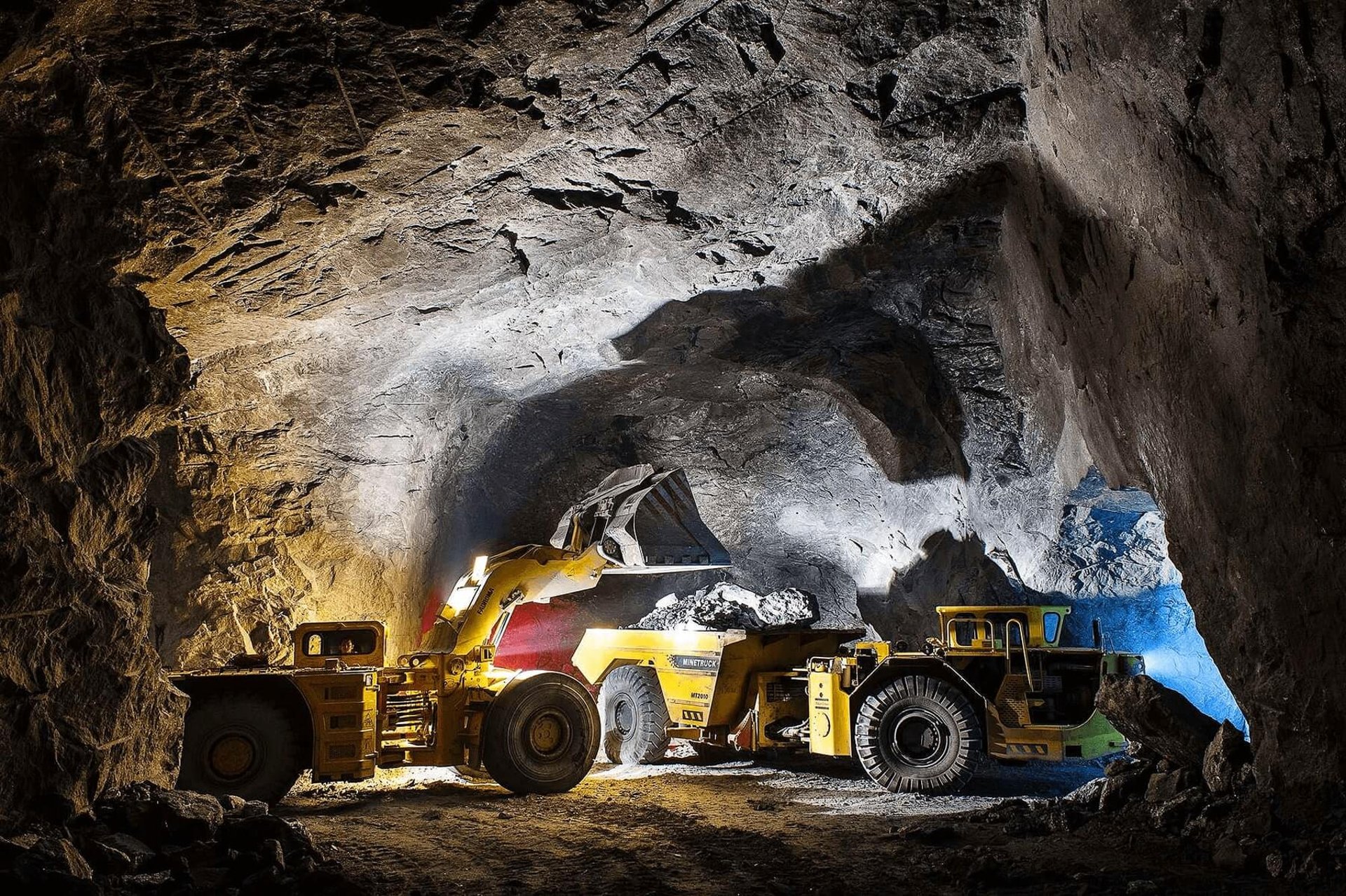
SUPROMONT (N)3GHSSYCY 6–30 kV Rubber Insulated Flexible Cables: High-Performance MV Feeder Cables for Shiftable Transformers in South African Underground Mining and Tunnelling Operations
For South African deep-level mining and tunnelling projects, the SUPROMONT (N)3GHSSYCY series represents a significant advancement in medium-voltage power distribution. Designed and tested to DIN VDE standards, these rubber-insulated flexible cables combine advanced electrical field control, robust mechanical construction, and integrated condition monitoring. This article explains their engineering principles, material science, technical specifications, real-world performance in South African mines, and how they compare with conventional cabling solutions, including cost-effective equivalents from Feichun Cables.
Li.Wang
6/26/202614 min read
Introduction: The Power Challenge in South African Underground Mining
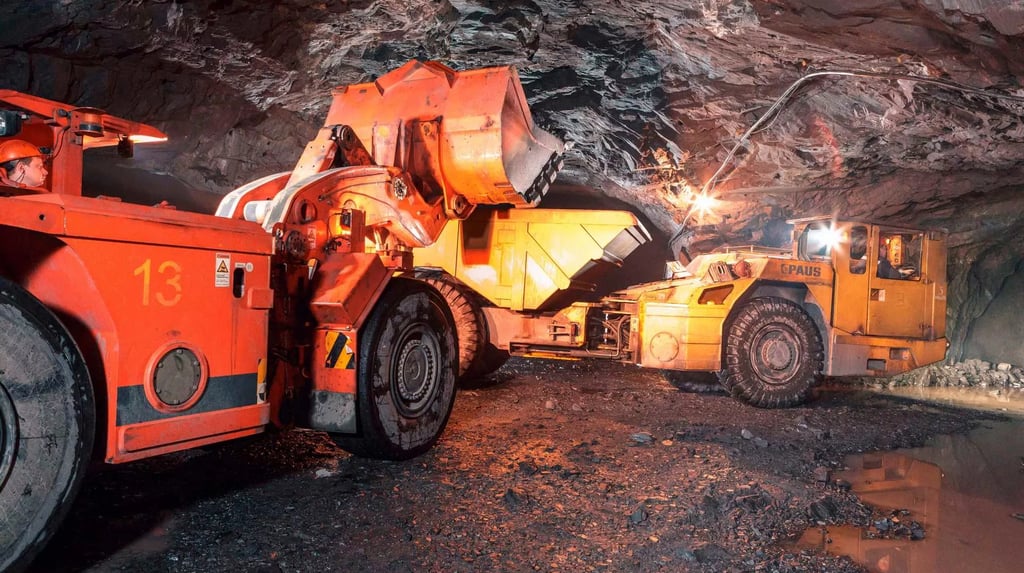
South Africa remains one of the world’s most significant mining nations, responsible for a large share of global gold, platinum group metals, chrome, and manganese production. Unlike many open-pit operations elsewhere, a substantial portion of South Africa’s mineral wealth lies deep beneath the earth’s surface, often at depths ranging from 2,000 to 4,000 metres. These deep-level mines present some of the most challenging operating conditions found anywhere in the industry.
At these depths, ambient temperatures can reach 35°C to 45°C, while relative humidity often exceeds 90 per cent. The atmosphere contains traces of methane, hydrogen sulphide, and coal dust, creating an environment that is both chemically aggressive and potentially explosive. Additionally, the mining process itself requires equipment to be moved regularly as the working face advances. This includes shiftable compression-resistant transformers, mobile substations, tunnel boring machines, belt conveyors, and heavy-duty pumps.
For decades, electrical engineers and mine managers faced a persistent problem: standard medium-voltage cables designed for fixed installation simply did not survive in these conditions. Rigid cross-linked polyethylene (XLPE) insulated cables with steel tape armour were too stiff to bend repeatedly, leading to fatigue cracks and insulation failure. Ordinary rubber-sheathed trailing cables lacked proper electrical stress control and mechanical strength, resulting in service lives of only 12 to 24 months. Every failure meant costly replacements, extended downtime, and increased safety risks.
It is against this backdrop that the SUPROMONT (N)3GHSSYCY series was developed. This cable is not merely another type of rubber-sheathed wire. It is an integrated power supply system engineered specifically for semi-fixed and mobile applications in underground environments. It merges the reliability required for permanent installations with the flexibility demanded by dynamic mining operations. By combining over a century of cable manufacturing expertise with rigorous testing to VDE standards, this design addresses the limitations of conventional cables and delivers measurable improvements in safety, operational life, and total cost of ownership.
Standards, Ratings and General Specifications
To understand the value of the SUPROMONT (N)3GHSSYCY series, it is essential to begin with the technical framework that defines its performance. The cable is manufactured in strict accordance with DIN VDE 0250 Part 605, a German standard widely recognised as one of the most stringent specifications for power cables used in industrial and mining applications. It also complies with DIN VDE 0118, which governs electrical installations in underground mines, and meets the flame retardancy requirements of IEC 60332-1-2. In South Africa, these standards align closely with the requirements of the SANS 1411 and SANS 1520 series, ensuring compatibility with local regulations and the Mine Health and Safety Act.
Electrical Ratings
The range covers six standard voltage classes, each engineered to handle specific transmission distances and power demands:
3.6/6 kV: Suitable for short runs up to approximately 500 metres
6/10 kV: Designed for medium-distance circuits between 500 and 1,000 metres
8.7/15 kV: The most common choice for deep-level South African mines, covering distances from 1,000 to 2,000 metres
12/20 kV, 14/25 kV, and 18/30 kV: Used for longer transmission lines and higher power applications
For each voltage class, the cable is rated for continuous operation at the specified voltage, with defined maximum limits for transient conditions. The maximum permissible AC operating voltage ranges from 4.2/7.2 kV for the lowest rating up to 20.8/36 kV for the highest. For DC applications, the limits are 5.4/10.8 kV and 27/54 kV respectively. During factory testing, main cores withstand voltages of 11 kV up to 43 kV depending on class, while the integrated control cores are tested at 2 kV AC to ensure auxiliary circuit integrity.
Thermal and Environmental Ratings
The thermal design parameters reflect the cable’s ability to perform under varying heat loads and ambient conditions. The conductor is rated for a maximum continuous operating temperature of 90°C, which allows for high current carrying capacity without degrading the insulation. In the event of a short circuit, the conductor can safely withstand temperatures up to 250°C for the duration of the fault.
For installation and operation, the cable maintains its properties across a wide temperature spectrum. When installed in a fixed or semi-fixed manner, it operates reliably from -40°C up to +80°C. When used in fully flexible, frequently moved applications, the recommended range is +5°C to +60°C, ensuring the polymeric materials remain flexible and resistant to cracking.
Chemically, the construction is engineered for durability. It is resistant to ozone, moisture, mineral oils, and common chemicals found in mine workings. The outer sheath and insulation materials do not support combustion, and the design limits the emission of toxic gases in the event of fire, a critical safety feature in confined underground spaces.
Standard Construction Configurations
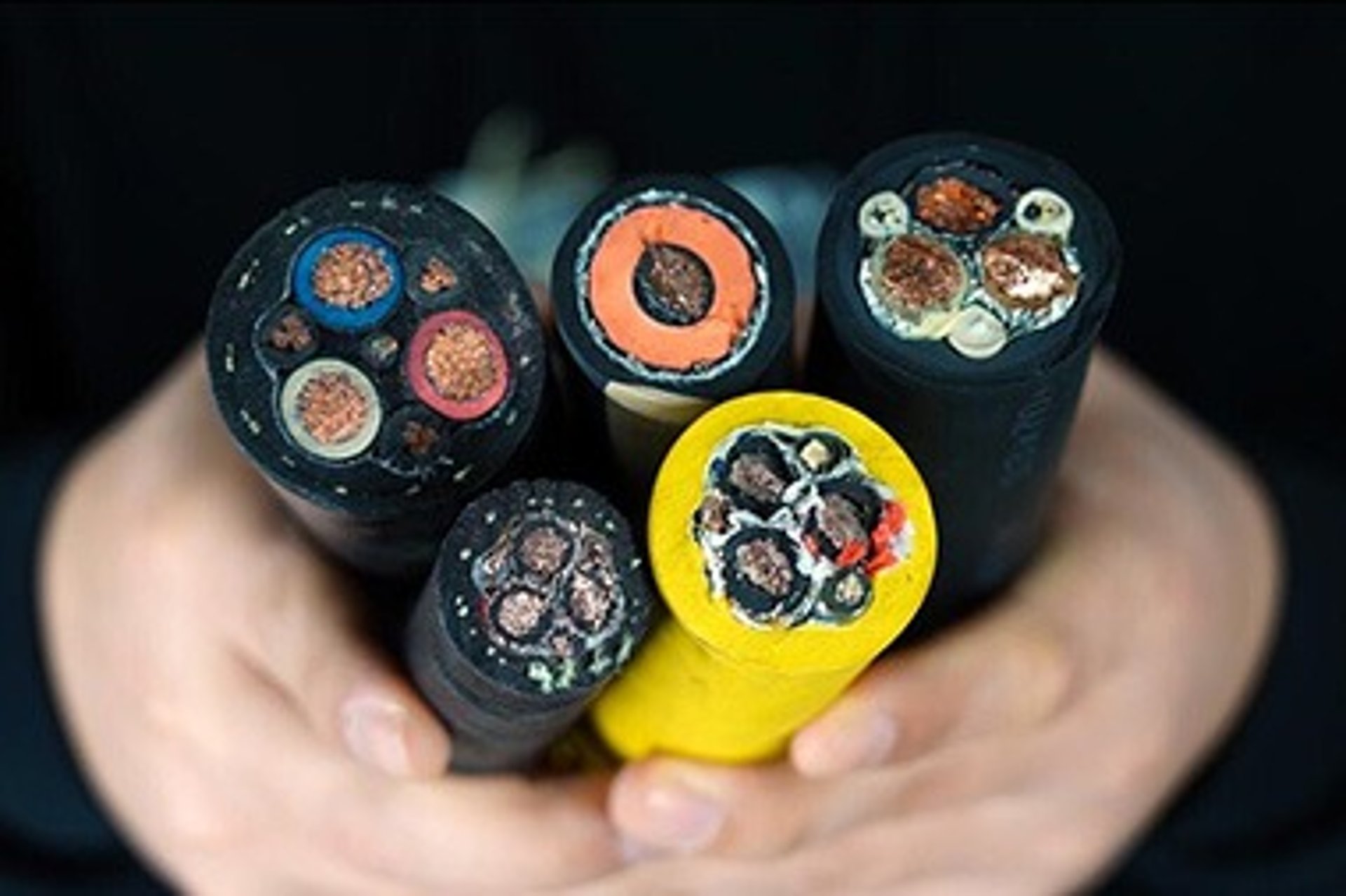
The standard configuration follows a proven layout optimised for mining use: 3 power cores + 3 concentric protective earth cores + 3 monitoring/control cores of 2.5 mm² each. This arrangement consolidates power delivery, grounding, and system monitoring into a single cable assembly, reducing the number of separate cables required in a drift or tunnel.
Conductor cross-sections are available from 25 mm² up to 185 mm², providing flexibility to match the exact current and short-circuit requirements of the load. A typical designation example would be (N)3GHSSYCY 8.7/15 kV 3×70+3×35/3E+3×2.5ST+UEL, which clearly identifies the voltage rating, conductor sizes, and auxiliary components.
Construction and Material Science: Layer-by-Layer Analysis
The performance of the SUPROMONT (N)3GHSSYCY series is derived from its layered construction, where every component serves a specific engineering purpose. Moving from the inside out, the design follows principles of electrical field management, mechanical stress distribution, and environmental protection.
1. Conductor
At the core is the bare electrolytic copper conductor, manufactured as Class 5 finely stranded wire according to VDE 0295 and IEC 60228 standards. Class 5 stranding involves many small-diameter wires twisted together in multiple layers. From a mechanical perspective, this design significantly increases the cable’s ability to bend repeatedly without breaking. While a solid or Class 2 stranded conductor might fail after a few thousand bending cycles, a Class 5 conductor can endure more than 100,000 cycles, making it ideal for equipment that shifts position regularly. Electrically, high-purity copper ensures low resistance, minimising energy loss and heat generation.
2. Inner Semiconductive Layer
Directly applied over each conductor is a thin layer of semiconductive rubber. This material has controlled electrical conductivity, sitting between a conductor and an insulator. Its purpose is to smooth out the electrical field around the copper. Without this layer, microscopic gaps and irregularities between the copper and insulation would create areas of high electric field stress, leading to partial discharges that erode the insulation over time. By forming a uniform equipotential surface, the inner semiconductive layer ensures the electric field is distributed evenly.
3. Insulation
The primary insulation is Ethylene Propylene Rubber (EPR), specifically type 3GI3 as defined by VDE 0207-20. EPR is chosen over the more common XLPE for underground applications due to its unique molecular structure. It is a cross-linked elastomer with a dielectric constant of approximately 2.3 and very low dielectric loss. Most importantly, EPR is highly resistant to water treeing—a phenomenon where moisture and electrical stress create tree-like channels inside the insulation, eventually causing breakdown. In the high-humidity environment of a South African mine, EPR insulation can last up to ten times longer than XLPE under identical conditions. It also retains its flexibility at low temperatures and has excellent resistance to ageing.
4. Outer Semiconductive Layer
Applied over the insulation is a second layer of semiconductive rubber. This layer completes the field control system. It ensures that the outer surface of the insulation is also at a controlled potential, preventing the formation of air gaps between the insulation and the outer protective layers. This triple-layer system—conductor, inner semiconductive, insulation, outer semiconductive—forms the foundation of the cable’s long-term electrical reliability.
5. Concentric Protective Earth
Wrapped helically around each insulated core is a layer of copper wires forming a concentric protective earth conductor. This is a departure from cables that use a single, separate earth wire. By placing the earth screen directly around each phase, the design achieves two goals: it provides a low-resistance path for fault current, and it acts as an electromagnetic shield, reducing interference between phases and with external equipment. It also ensures that any electrical stress is contained within the insulation system.
6. Inner Sheath
The assembled cores are wrapped with an inner sheath made from PVC compound type DMV6. This thermoplastic compound acts as a buffer zone. It separates the electrical assembly from the mechanical protection layers, preventing abrasion and chemical ingress. It also helps maintain the round profile of the cable, which is essential for consistent bending characteristics.
7. Monitoring Conductor
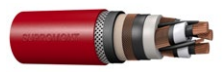
One of the defining features of this series is the integrated monitoring system. A layer consisting of conductive tape and a concentric winding of fine copper wires is placed over the inner sheath. This forms a continuous electrical loop. In normal operation, the resistance of this loop remains stable. If the outer sheath is damaged or moisture penetrates the cable, the resistance changes, which can be detected by monitoring equipment on the surface or in the control room. This allows operators to identify potential faults before they escalate into dangerous short circuits or fires—a feature particularly valuable in unmanned or remote sections of a mine.
8. Intermediate Sheath
A second layer of DMV6 PVC compound is applied over the monitoring assembly. This serves as an electrical separator, ensuring that the monitoring circuit is electrically isolated from the subsequent armour layer, preventing false readings caused by contact with the steel components.
9. Armour
For mechanical protection, the cable uses a braid of galvanised steel wires, rather than the steel tape armour found on fixed cables. Braid armour offers a distinct advantage: it provides high tensile strength while remaining flexible. The steel braid carries the majority of the load when the cable is pulled or suspended, limiting the tension on the copper conductors to a maximum of 15 N/mm², well below the yield strength of the material. This design also resists crushing forces and torsion, capable of withstanding twisting movements of up to ±100° per metre without structural damage.
10. Outer Sheath
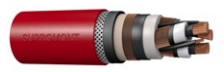
The final layer is the outer sheath, also made from DMV6 PVC compound and coloured bright red. The red colour is not arbitrary; it is chosen for high visibility in the dim lighting conditions of underground workings, reducing the risk of accidental damage from heavy machinery. The DMV6 formulation is engineered to resist abrasion, sunlight degradation, ozone, and chemical attack. It is also flame-retardant, self-extinguishing, and does not propagate fire.
Core Advantages vs. Conventional Mining Cables
The layered design and material selection give the SUPROMONT (N)3GHSSYCY series a distinct set of advantages over the cables traditionally used in South African mines. The difference lies not just in specifications, but in how the cable performs over its entire service life.
Electrical Performance
The triple-layer field control system virtually eliminates partial discharge activity. In high-humidity environments, this prevents the formation of water trees and ensures the insulation retains its dielectric strength for decades. Conventional cables without this control often show signs of insulation degradation within two years, leading to increasing leakage currents and eventual failure.
Mechanical Durability
The combination of Class 5 conductors, EPR insulation, and steel braid armour creates a structure that absorbs mechanical stress. When the cable is dragged around corners or pulled along a drift, the armour distributes tension evenly, while the elastomeric materials flex without cracking. In contrast, steel tape armour tends to become rigid and prone to buckling when bent repeatedly, while XLPE insulation can develop micro-cracks at low temperatures.
Environmental Resistance
The use of EPR and DMV6 compounds ensures stability across the full range of mine conditions. The materials resist hydrolysis, oxidation, and chemical attack. This means the cable does not become brittle in cold sections of the mine or soften and deform in hot, humid areas.
Integrated Safety and Monitoring
Perhaps the most significant operational advantage is the built-in monitoring system. In South African mines, where safety regulations are strict, being able to detect sheath damage or insulation degradation early allows for proactive maintenance rather than reactive repairs. This reduces the risk of arc flash incidents and fires, which are major hazards in underground environments.
Economic Value
While the upfront purchase price of the SUPROMONT series is higher than that of standard cables, the total cost of ownership tells a different story. In the deep mines of South Africa, conventional cables typically require replacement every 18 to 24 months. The SUPROMONT design consistently delivers service lives of 4 to 5 years. When factoring in the costs of labour, equipment hire, and production downtime associated with replacements, the longer life cycle results in a 30 to 35 per cent reduction in total expenditure over a five-year period.
Application and Operating Conditions
The design of the SUPROMONT (N)3GHSSYCY series targets a specific operational profile: semi-fixed installation. This means the cable is not intended to be dragged continuously at high speed like a fully trailing reeling cable, but it is designed to be moved, repositioned, and adjusted as the mining face advances.
Primary Applications
The most common use is as a feeder cable for shiftable compression-resistant transformers. These transformers step down the medium voltage from the main distribution network to lower voltages suitable for heavy machinery. They are installed on skids or rails and moved forward every few weeks or months. Other applications include:
Mobile substations in development tunnels
Tunnel Boring Machines (TBMs) and roadheaders
Longwall shearers and face conveyors
Pump stations and ventilation equipment
Temporary power supplies during mine expansion or maintenance
Operating Limits
To ensure maximum lifespan, the design imposes clear operating boundaries. The minimum bending radius is specified according to VDE 0298 Part 3, typically between 8 and 10 times the overall diameter of the cable. This prevents excessive stress on the armour and insulation. The maximum travel speed when being repositioned is 60 metres per minute, and it can withstand reeling speeds of up to 120 metres per minute during installation or retrieval.
The maximum tensile load on the conductor is capped at 15 N/mm², which translates to a safe pulling force for each size listed in the technical tables. Adhering to these guidelines ensures the cable operates within its design parameters and achieves its expected service life.
South African Mining Case Studies
The theoretical advantages of the SUPROMONT series are validated by real-world performance in the harsh conditions of South Africa’s mining sector. Two examples illustrate the value this technology brings to operations.
AngloGold Ashanti – Deep Gold Mine, Free State
In the Free State Goldfields, AngloGold Ashanti operates shafts reaching depths of over 3,200 metres. In these workings, the ambient temperature often reaches 42°C, and humidity is consistently above 90 per cent. Prior to switching to the SUPROMONT series, the mine used standard 11 kV XLPE cables with steel tape armour to feed power to its shiftable transformers. These cables required replacement every 18 to 22 months due to a combination of water treeing in the insulation and fatigue failure of the armour.
The mine began installing SUPROMONT (N)3GHSSYCY 8.7/15 kV 3×70+3×35+3×2.5 cables. After more than four years in service, inspections revealed the insulation and sheath remained in excellent condition. The fault rate dropped from 0.28 faults per kilometre per year to just 0.07 faults per kilometre per year. This reduction in failures translated to approximately 120 hours of saved production time annually, while also reducing the exposure of maintenance crews to hazardous underground conditions.
Impala Platinum – Bushveld Complex
At Impala Platinum’s operations in the Bushveld Complex, the environment is characterised by high temperatures, dust, and the need to move equipment frequently as new ore bodies are accessed. The mine’s electrical engineering team faced challenges with cables failing due to abrasion and chemical attack.
By adopting the same cable design, Impala Platinum achieved a service life of over 50 months. The ability of the EPR insulation to resist water ingress and the robust DMV6 outer sheath reduced the rate of damage. The integrated monitoring system also allowed the team to schedule replacements during planned maintenance stops, eliminating unplanned outages. As a result, the mine reduced its annual expenditure on cable replacements by approximately 32 per cent.
These experiences align with the observations of many other operators across South Africa: in an environment where standard cables struggle to last two years, the SUPROMONT design delivers reliability and longevity.
Selection Guide and Technical Data
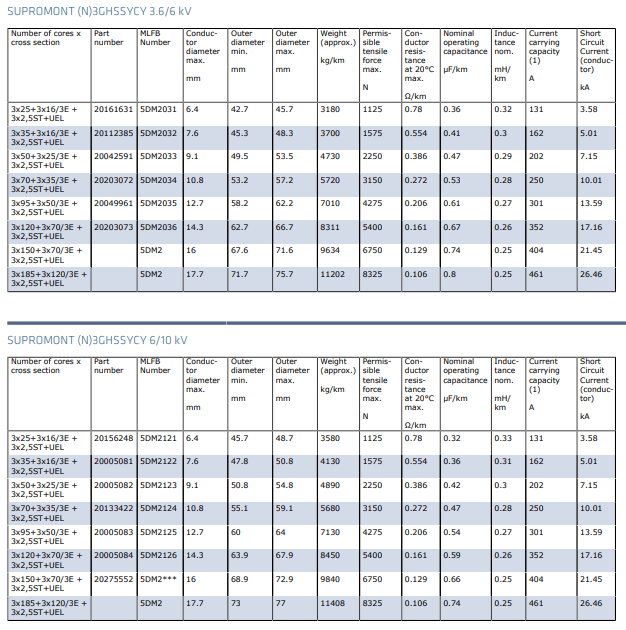
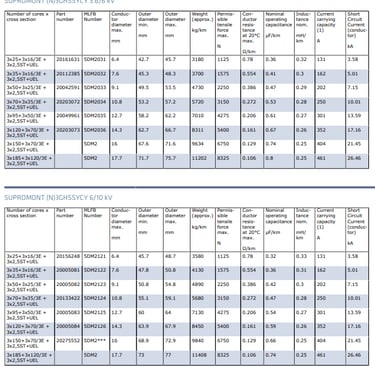
Choosing the correct configuration requires an understanding of the electrical load, transmission distance, and environmental conditions. The technical data provided in the manufacturer’s catalogue serves as a reference point.
Voltage Selection
3.6/6 kV: Recommended for circuits up to 500 metres and loads below 600 kVA
6/10 kV: Suitable for distances up to 1,000 metres and loads up to 1.5 MVA
8.7/15 kV: The preferred choice for deep mines, covering distances up to 2,000 metres and loads up to 3 MVA
12/20 kV and above: Used for longer runs and higher power requirements
Conductor Sizing
Selection must consider three factors: continuous current carrying capacity, voltage drop, and short-circuit withstand. For example, at 8.7/15 kV:
3×70 mm²: Rated for 265 A, can withstand a short-circuit current of 10.01 kA for one second, with an outer diameter of 57.6 to 61.6 mm
3×120 mm²: Rated for 371 A, with a short-circuit rating of 17.16 kA
3×185 mm²: Rated for 488 A, with a short-circuit rating of 26.46 kA
All current ratings are based on installation on a surface at an ambient temperature of 30°C. For higher temperatures, appropriate derating factors must be applied according to VDE 0298-4.
Feichun Cables – Equivalent Alternative
While the SUPROMONT series is recognised as a premium solution, market demand often requires a balance between quality, availability, and cost. This is where Feichun Cables offers a viable and technically equivalent alternative.
Feichun manufactures its PROTOMONT / (N)3GHSSYCY type cables to the same DIN VDE 0250 Part 605 specifications and IEC standards. The construction mirrors the original design: Class 5 copper conductors, EPR insulation, triple-layer field control, DMV6-equivalent sheathing compounds, steel braid armour, and integrated monitoring cores.
From a performance perspective, the electrical ratings, temperature limits, and mechanical properties are identical. The cables meet the same flame retardancy and environmental resistance criteria, making them fully compatible with South African mining standards.
The key advantages of choosing Feichun include:
Competitive Pricing: Typically 15 to 25 per cent lower than European-sourced equivalents, without compromising quality
Shorter Lead Times: Delivery is generally available within 2 to 4 weeks, compared to 8 to 12 weeks from European manufacturers
Global Support: Feichun provides full technical documentation, test reports, and certification packages required for mine approval processes
This makes Feichun an excellent choice for projects where specifications demand the performance of the original design, but where budget and schedule constraints are critical.
Frequently Asked Questions
Q: Can this cable be used for continuous reeling applications?
A: It is designed for semi-fixed and shiftable use. While it can handle reeling during installation and occasional movement, for continuous high-speed reeling, a dedicated trailing cable such as the PROTOLON-R series is recommended.
Q: Is it safe for use in gassy mine sections?
A: Yes. It meets IEC 60079 requirements for explosive atmospheres, has low gas emission properties, and is flame-retardant. It is approved for use in areas classified as Zone 1 and Zone 2.
Q: How does the monitoring system work?
A: The monitoring conductors form a closed loop. By measuring the electrical resistance or capacitance of this loop, changes caused by sheath damage or moisture ingress can be detected, allowing early intervention.
Q: Can I replace an XLPE cable with this model?
A: Yes, provided the voltage and current ratings match. In fact, replacing XLPE cables in humid or moving applications often results in improved reliability and longer life.
Conclusion
The SUPROMONT (N)3GHSSYCY series represents a fundamental shift in how medium-voltage cables are designed for underground mining. It moves beyond the concept of a simple conductor-insulator combination and instead functions as an integrated system, bringing together electrical field control, mechanical flexibility, environmental resistance, and safety monitoring.
In the context of South Africa’s deep-level mining industry, this design answers a specific need: the requirement for a cable that can survive and perform reliably in conditions that quickly degrade standard products. By applying principles of material science and electrical engineering, the design achieves a service life two to three times longer than conventional alternatives. This translates directly into safer operations, fewer interruptions, and lower overall costs.
The lesson for engineers and procurement professionals is clear: when selecting cables for dynamic and harsh environments, the initial purchase price is only one part of the equation. Factors such as insulation technology, mechanical construction, and integrated protection systems determine the true value of the investment. The SUPROMONT series, and its equivalent from Feichun Cables, demonstrates that a higher initial investment in technology and quality delivers a significantly better return over the long term.
If you are specifying, procuring, or maintaining power distribution systems for underground mining or tunnelling projects, and require cables that combine long life, safety, and cost efficiency, consider the SUPROMONT (N)3GHSSYCY series or its equivalent from Feichun Cables.
For full technical data sheets, pricing, compliance documentation, and technical support, please contact the Feichun Cables team directly:
Email: Li.wang@feichuncables.com
Email Address: Li.wang@feichuncables.com
© 2025. All rights reserved.
One-click to Quickly Contact
Products
Contact
Company
Location:
Building A Private Science and Technology Park, Hefei Economic and Technological Development Zone, Anhui Province, China
Heat Resistant Cable
WhatsApp: +86 17333223430
Social Media: