Anhui Feichun Special Cable Co.,Ltd Email: Li.wang@feichuncables.com
The Ultimate Guide to 6.35/11kV XLPE Insulated, MDPE Sheathed, Armoured Medium Voltage Cables — And Why South Africa Can’t Operate Without Them
A complete expert guide to 6.35/11kV XLPE insulated, MDPE sheathed, armoured medium voltage cables for South Africa’s mining, industrial and utility sectors. Learn how 11kV MV cables work, their construction, standards, applications, specifications and a real South African case study.
Li Wang
12/9/20255 min read
Why 11kV MV Cables Matter in South Africa
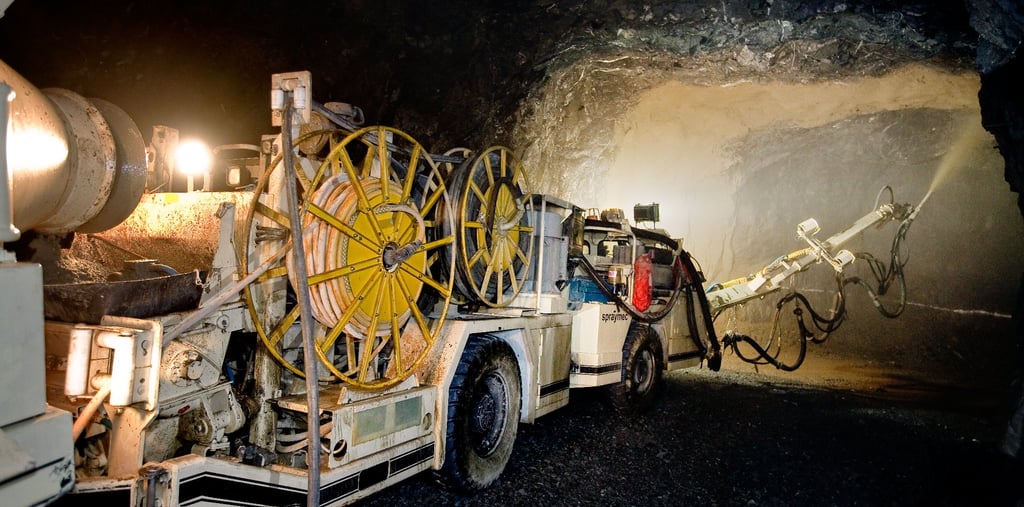
South Africa’s energy landscape has always relied heavily on robust medium-voltage (MV) distribution systems. Whether it is powering deep-level platinum shafts in Rustenburg, feeding coal operations in Mpumalanga, or running long overhead and underground feeders in the Northern Cape, the country’s industries run on reliable 11kV circuits.
This is where 6.35/11kV XLPE insulated, MDPE sheathed, armoured medium voltage power cables—commonly known by international type designations such as N2XSYB2Y (ATA armoured) and N2XSYR2Y (AWA armoured)—play a crucial role.
Why the demand is rising
South Africa’s mining and heavy industrial sectors are electrifying further, introducing:
✔ Longer MV feeders
✔ Higher motor loads
✔ More underground electrification
✔ Tougher requirements for moisture, abrasion and chemical resistance
As a result, 11kV MV cables have become the “sweet spot” for balancing voltage drop, safety and installation flexibility.
Quick definition
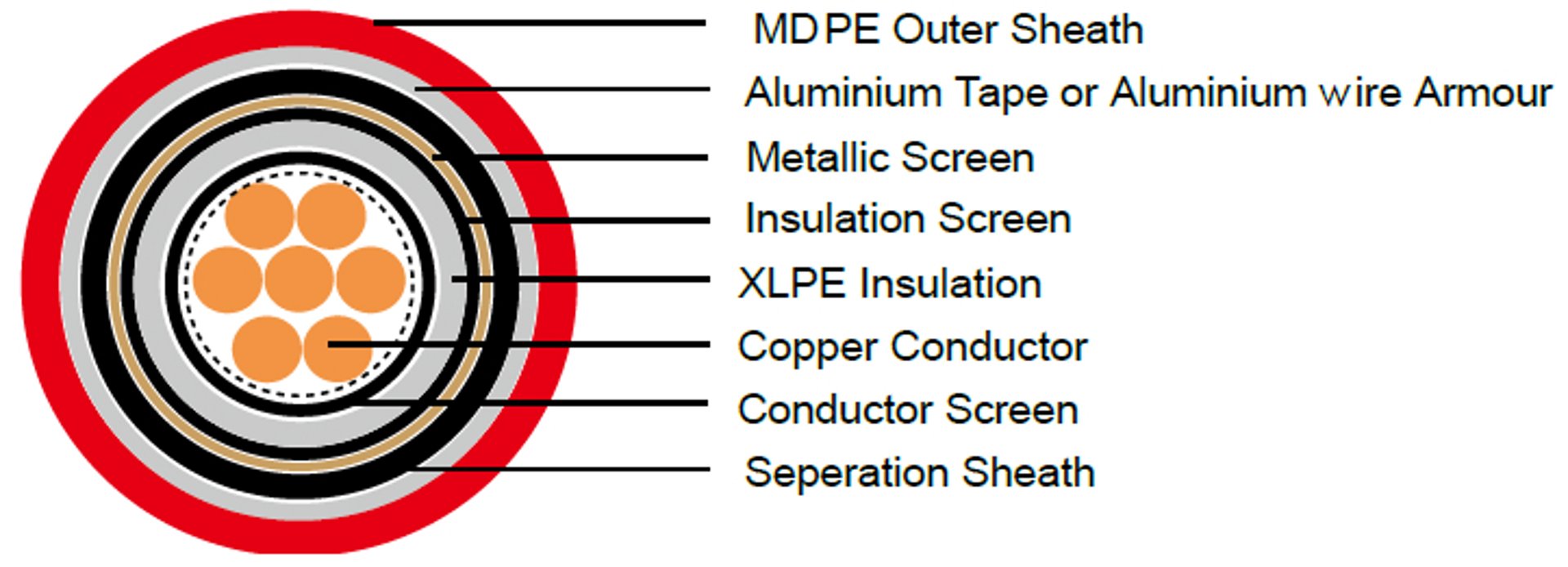
This cable type generally includes:
XLPE insulation
MDPE outer sheath (ST7)
Armour (ATA or AWA)
Copper conductor (Class 2)
These components create a cable capable of handling harsh African conditions—heat, UV, moisture, and aggressive ground chemicals.
Keywords introduced
11kV cable, XLPE insulated cable, MDPE sheathed cable, medium-voltage armoured cable, MV power cable
Purpose of this article
This guide breaks down:
Construction
Technical specifications
Electrical performance
South African installation practices
Real case studies
Selection guidance
Troubleshooting and FAQs
Applicable Standards & Compliance Requirements
The design and construction of 11kV MV cables follow strict global and South African requirements.
IEC 60502-2 — Core Design Standard
Defines construction, dimensions, insulation levels, testing and performance for MV cables (1–30 kV).
Conductor Requirements — BS EN 60228 Class 2
Stranded copper conductor
Ensures conductivity stability
Provides mechanical durability during installation
Fire, UV, Water & Hydrocarbon Resistance
These cables may include:
UV-resistant MDPE
Oil- and hydrocarbon-resistant sheath
Anti-rodent materials
Water blocking
Especially important in wet mining tunnels, fuel-rich industrial sites, and sun-exposed tray installations.
South African Context
Eskom Requirements
Eskom’s distribution networks require cables that:
Withstand long MV runs
Maintain low charging current
Have robust metallic screens for fault clearing
Municipal Distribution Norms
Cities like Johannesburg, Tshwane and eThekwini commonly specify XLPE/MDPE construction.
Mining Sector Expectations
Mines require:
Strong armour resistance
Wet-location performance
High screening capability
Corrosion-resistant sheaths
Why MDPE Matters in South Africa
MDPE (Medium-Density Polyethylene):
✔ Superior moisture resistance
✔ High abrasion resistance
✔ Better impact toughness
✔ UV stability for tray/solar installations
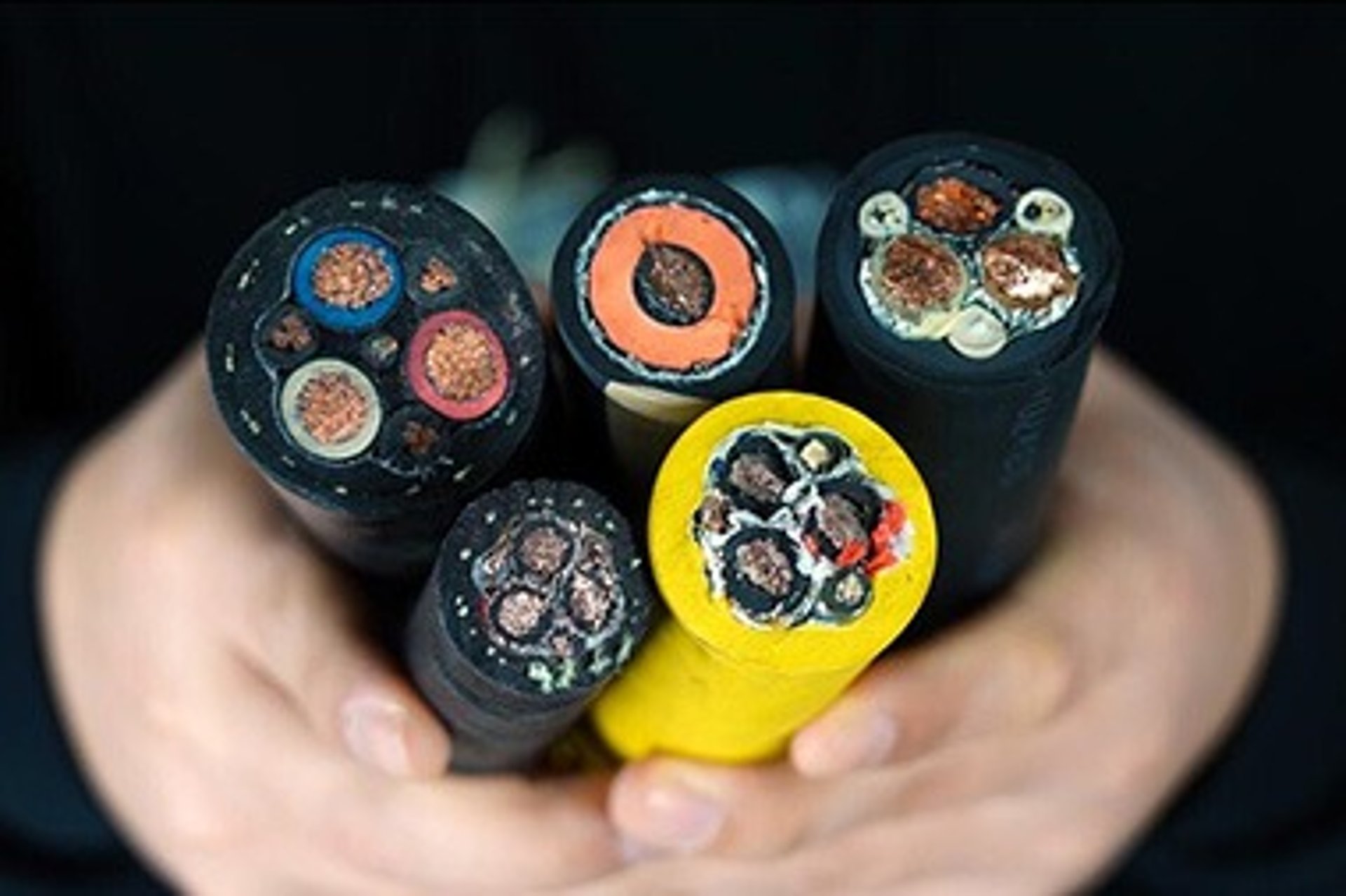
Cable Construction Explained Step-by-Step
Below is a deep technical breakdown of every layer and its purpose.
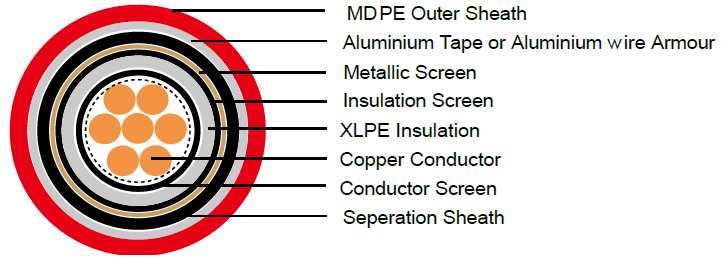
Conductor — Plain Annealed Copper, Class 2
Cross-sections: 70 to 630 mm²
Excellent conductivity
Mechanically stable for long pulls and bends
SA relevance: Useful for long runs in open-pit mines and cable routes with vertical drops.
Conductor Screen
A semi-conductive extruded layer that:
Smooths electrical stress around the conductor
Prevents partial discharge
Ensures uniform electric field distribution
XLPE Insulation
Thermal rating: 90°C continuous
Short-circuit rating: 250°C
Low dielectric losses
High chemical and moisture resistance
Why XLPE suits Africa:
It handles hot climates (Northern Cape temperatures > 40°C) without performance loss.
Insulation Screen
A second semi-conductive layer that ensures:
Full bonding between insulation and metallic screen
Enhanced insulation integrity under MV stress
Metallic Screen (Copper Tapes and/or Wires)
Purpose:
Provides earth fault return path
Ensures reliable fault clearance
Controls electromagnetic interference (EMI)
Wire vs tape combinations:
Copper wires: Higher fault current capability
Copper tapes: More uniform coverage
Hybrid: Common in mining to maximise protection
Separation (Bedding) Layer — PVC
Separates the metallic screen from armour, providing:
Cushioning
Mechanical stability
Thermal buffering
Armour Options
ATA — Aluminium Tape Armour
Good mechanical protection
Lower cost
Suitable for fixed installations
AWA — Aluminium Wire Armour
High tensile strength
Ideal for long vertical drops
Common in mining conveyors and pump areas
Rule of thumb in South Africa:
ATA for industrial & municipal networks
AWA for mining and high-mechanical-stress routes
Outer Sheath — MDPE (ST7)
Why MDPE is preferred over PVC:
Better water resistance
Higher abrasion resistance
Outstanding UV protection
Suitable for underground, wet, and exposed environments
Colour: Red — standard for MV power cables.
Optional enhancements:
Anti-rodent
Oil-resistant
Hydrocarbon-resistant
Technical Specifications Deep Dive
Voltage Levels
Rated VoltageOperating VoltageTest Voltage6.35/11kV12kV25.5kV AC
Temperature Ratings
Operating: 90°C
Short-circuit: 250°C
Minimum installation temp: -5°C
Bending radius: 20 × overall diameter (OD)
Mechanical Properties
High impact strength
Suitable for underground and duct installations
Resists crushing in mining haul roads
MDPE vs PE vs PVC
PropertyMDPEHDPEPVCWater resistanceExcellentExcellentGoodUV resistanceHighModeratePoorChemical resistanceHighVery highModerateMechanical toughnessHighModerateLow
MDPE is the best balance for SA conditions.
Dimensional Data & Interpretation
N2XSYB2Y (ATA Armoured)
Table provided in outline—typical values include:
Insulation thickness: 3.4 mm
Sheath thickness: 1.9–2.6 mm
OD: 30.8–54.4 mm
Weight: 1700–7590 kg/km
N2XSYR2Y (AWA Armoured)
Heavier due to wire armour, offering higher tensile strength.
Practical Meaning for SA Installers
Understanding OD and mass helps determine:
Trench width
Cable tray loading
Pulling tension
Minimum bending radius
Electrical Performance Analysis
AC vs DC Resistance
AC resistance increases due to skin effect—important for long 11kV runs.
Short-Circuit Ratings
Copper screen + conductor must withstand 250°C for 5 seconds.
Capacitance & Charging Current
Affects long-feeder performance—especially in mining and solar farms.
Impedance and Inductance
Trefoil reduces inductance, making it preferred for single-core routes.
SA Application
Long MV feeders in mines (500–1500 m) require careful charging current calculations.
Current Ratings in Various Installations
IEC 60287 Thermal Model
Used for current rating calculations.
Installation Methods
Buried in ground
In ducts
In air/tray
Trefoil vs flat vs spaced
Soil Thermal Resistivity in SA
Limpopo clay soils: higher resistivity, derating needed
Northern Cape sandy soils: lower resistivity, better heat dissipation
Temperature
Derate above 30°C ambient.
Applications Across South Africa
Mining Sector
Used for:
Underground pumps
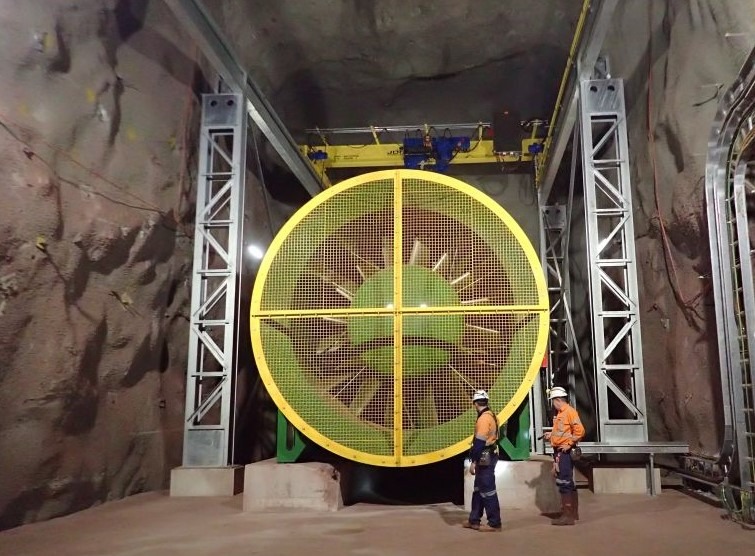
Ventilation fans
Conveyor motors
Main 11kV feeders
Locations:
Platinum mines — Rustenburg
Coal mines — Mpumalanga
Iron ore — Northern Cape
Power Utilities
Common in:
Mini-substations
RMUs
MV switchgear
Industrial
Used in:
Cement plants
Smelters
Steel mills
Petrochemical facilities
Renewable Energy
Solar and wind farms use 11kV MV collector circuits.
South African Case Study (Real Example)
Platinum Mine MV Feeder Upgrade — Rustenburg
Problem
Frequent MV cable failures due to:
Water ingress
Armour corrosion
High charging current
Mechanical damage from haul trucks
Solution
Replaced old PVC-sheathed cable with:
N2XSYR2Y 185 mm²
AWA armour for mechanical strength
MDPE sheath (ST7) for moisture and abrasion protection
Trefoil installation over 1.2 km
Results After 3 Years
✔ Zero moisture-related failures
✔ Charging current reduced by 35%
✔ Improved fault clearing from enhanced copper screen
✔ Reduced downtime
This upgrade became a benchmark for other platinum operations.
Selection Guide for 11kV MV Cables
ATA vs AWA
ATA: Low mechanical stress
AWA: High mechanical stress (mining, long pulling)
Screen Size Selection
Based on fault current.
Conductor Size
Choose based on voltage drop + load.
When MDPE Sheath is Mandatory
Wet areas
Chemical exposure
Sun-exposed trays
Optional Properties
UV-resistance for solar
Anti-rodent for mining tunnels
Cross-Section Selection
70–150 mm²: Short feeders
185–300 mm²: Mining circuits
400–630 mm²: Utility & industrial networks
Quick Checklist
Voltage?
Armour type?
Soil conditions?
Installation route?
Fault level?
Screen size?
Installation Best Practices in South Africa
Trenching Depth
Typically 700–900 mm, depending on municipal requirements.
Minimum Bending Radius
20 × OD.
Earthing
Single-core cables require careful screen bonding.
Trefoil Installation
Reduces electromagnetic forces.
Avoid Induced Voltage
Ensure proper spacing.
Testing Before Energisation
VLF test
Insulation resistance
Sheath integrity test
Common Problems & Troubleshooting
Water Ingress
Use MDPE or water-blocked versions.
Armour Corrosion
AWA performs better in mines.
Incorrect Spacing
Causes overheating.
Pulling Damage
Use rollers and avoid sharp bends.
Screen Overheating
Due to undersized screen.
Poor Terminations
Common cause of partial discharge.
FAQ Section
Q1: What is the difference between N2XSYB2Y and N2XSYR2Y?
ATA vs AWA armour.
Q2: Can these cables be installed underwater or in wet soil?
Yes—MDPE sheath is ideal.
Q3: Why is MDPE better than PVC for South Africa?
Better water, UV and chemical resistance.
Q4: 185 mm² or 240 mm² for a mine feeder?
Depends on voltage drop and load.
Q5: Why use aluminium wire armour?
Higher tensile strength.
Q6: Required MV tests?
VLF, insulation resistance, sheath testing.
Q7: Cable lifespan in SA mines?
15–25 years with proper installation.
Q8: Can they be used in sunlight?
Yes—MDPE is UV-resistant.
Q9: Why trefoil?
Reduces magnetic field imbalance and heating.
Why 6.35/11kV XLPE/MDPE Armoured Cables Matter in South Africa
South Africa’s mining, industrial and utility sectors rely heavily on cables that can withstand extreme environments. 6.35/11kV XLPE insulated, MDPE sheathed, armoured MV cables offer:
Long-term reliability
Excellent electrical performance
Superb resistance to moisture, UV and abrasion
Suitability for harsh African conditions
Proven track record across mines and utilities
Choosing the right construction (ATA vs AWA, MDPE, screen size) ensures safe, efficient and long-lasting MV networks.
Contact Anhui Feichun Special Cable Co., Ltd.
For comprehensive technical specifications and quotations, please contact our specialized mining cable engineering team:
Technical Engineering Support:
Sales Engineering Department:
WhatsApp Contact:
Manufacturer: Anhui Feichun Special Cable Co., Ltd. (安徽飞纯特种电缆有限公司)
Manufacturing Headquarters: Building A, Private Science and Technology Park, Hefei Economic and Technological Development Zone, Anhui Province, People’s Republic of China
+86 17333223430
Email Address: Li.wang@feichuncables.com
© 2025. All rights reserved.

One-click to Quickly Contact
Products
Contact
Company
Location:
Building A Private Science and Technology Park, Hefei Economic and Technological Development Zone, Anhui Province, China
Heat Resistant Cable
WhatsApp: +86 17333223430
Social Media: