Anhui Feichun Special Cable Co.,Ltd Email: Li.wang@feichuncables.com


TRATOSFLAT® & TRATOSFLAT-FO®: Medium Voltage Flat Cable for Reeling Applications – Revolutionizing Space-Saving Power Distribution in South African Port Automation
Discover how TRATOSFLAT® & TRATOSFLAT-FO® Medium Voltage Flat Cable solves critical space challenges in South Africa’s new generation of automated ports. This comprehensive guide covers full technical specifications, engineering principles, performance advantages over traditional round cables, real-world applications in container spreaders, compact gantry cranes and ship-to-shore power systems, plus installation economics and future developments. Essential reading for electrical engineers, procurement specialists and port infrastructure managers across Southern Africa.
Li Wang
5/14/202617 min read
Introduction
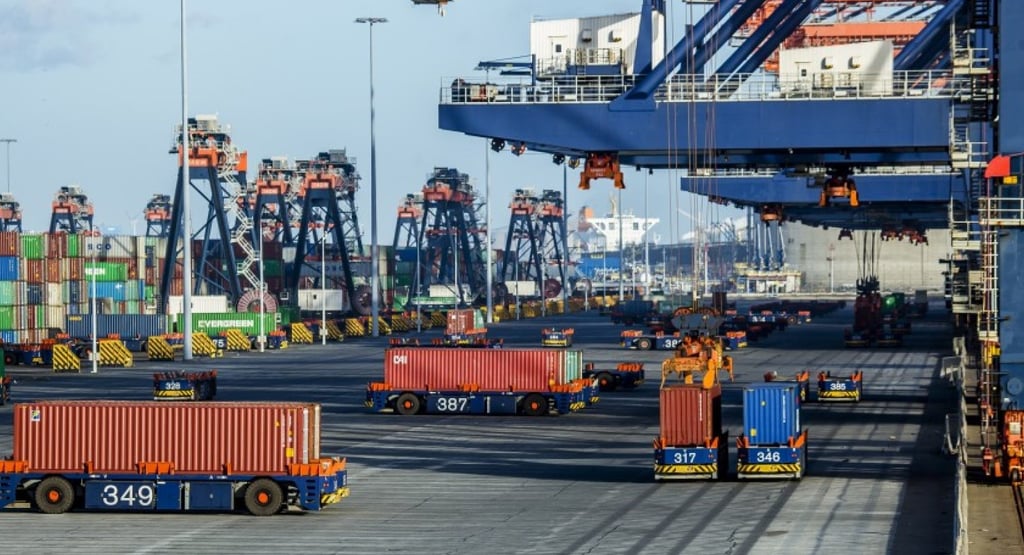
South Africa’s port infrastructure is undergoing a major transformation. As terminals move toward full automation to handle growing trade volumes and improve operational efficiency, equipment designers and system integrators face a persistent and difficult challenge: space. Modern automated container spreaders, compact gantry cranes, mobile power distribution units and ship-to-shore electrification systems are engineered to operate within extremely tight physical boundaries. These machines are built smaller, lighter and more integrated than ever before, leaving very little room for cabling.
For decades, medium voltage power distribution relied almost exclusively on round cables. While proven and widely understood, round cables are defined by their radial geometry, which demands significant clearance for installation, bending and movement. In the context of today’s compact port equipment, that requirement creates a fundamental conflict. Round cables simply cannot be routed through narrow channels, inside control cabinets or along moving arms without violating design limits or requiring expensive modifications such as larger enclosures, extra conduits or complex support structures. In many cases, installation is physically impossible without compromising safety or performance.
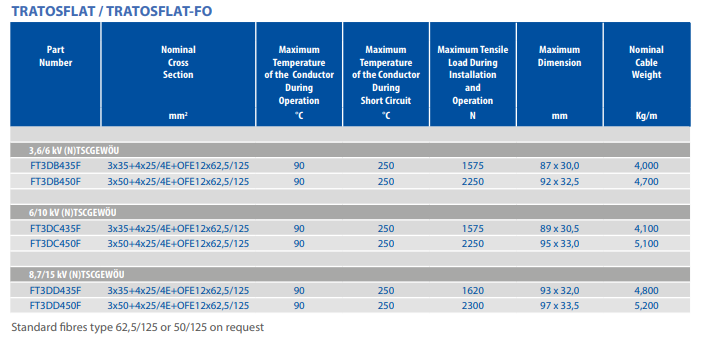
This is where TRATOSFLAT® and TRATOSFLAT-FO® represent a breakthrough. Developed specifically for reeling, trailing and continuous motion applications, these medium voltage flat cables replace the traditional cylindrical shape with an optimized rectangular profile. Measuring just 87 × 30 millimetres for a power capacity equivalent to a round cable of approximately 62 millimetres diameter, the flat design reduces overall volume by between 40% and 50%. This dramatic reduction in footprint allows installation in spaces that were previously unusable, while retaining full electrical performance, robust mechanical construction and advanced features such as individually screened conductors and integrated optical fibres for real-time monitoring. What follows is a detailed exploration of the technology, specifications, benefits and applications that make this product a game‑changer for South African port automation.
Space Constraints in Modern Port Infrastructure
The pressure to maximise throughput while minimising land use has driven South African ports to adopt highly compact equipment designs. At terminals in Durban, Cape Town and Ngqura, every millimetre of available space is utilised, and any component that increases size or weight adds cost and complexity to the entire system. Four key areas highlight the severity of the space problem.
Automated container spreaders operate directly above cargo containers, and their internal structure is engineered to be as low‑profile as possible to maintain lifting height and reach. The available space for power and control cabling is often less than 40 millimetres in height. A standard round medium voltage cable of sufficient capacity has a diameter greater than 60 millimetres, making routing impossible without major redesign. Even when installation is attempted, the large bending radius required creates additional bulk and restricts movement.
Compact gantry crane control cabinets are mounted directly on the moving structure to reduce cabling length and improve response times. Modern designs aim to reduce cabinet volume by up to 35% compared to older models, which leaves very little room for cable entry, bending or termination. Round cables require generous radius curves and spacing, forcing engineers to either increase cabinet size – defeating the purpose of compact design – or use lower capacity cables that limit power availability.
Mobile power distribution platforms supply temporary or moving equipment such as straddle carriers and automated guided vehicles. These units must be manoeuvrable, with a low centre of gravity and minimal chassis height. Round cables wound onto reels increase drum diameter and overall machine height, while their weight requires heavier support structures. In addition, the radial stiffness of round cables creates higher friction and tension during winding, placing extra load on drive motors.
Ship‑to‑shore power systems, also known as cold ironing, deliver electricity to vessels while alongside, reducing emissions and noise. These systems require cabling to run along narrow gangways, through access hatches and into confined connection points. Traditional round cables are difficult to handle in these restricted areas, often requiring multiple personnel and special equipment. They also limit the number of circuits that can be installed within a given passage width, restricting system capacity and future expansion.
Attempts to work around these limitations using round cables have proven costly and inefficient. Installers must design complex routing paths, purchase larger conduits or trays, and reinforce structures to handle additional weight. In some cases, equipment performance is deliberately reduced to allow the use of smaller cables, which undermines the benefits of automation. The root of the problem lies in geometry itself. Round cables are efficient for long straight runs in open areas, but they are inherently unsuitable for dense, moving or confined environments. TRATOSFLAT changes this equation completely by optimising the shape to fit the space available.
Complete Technical Specifications of TRATOSFLAT® & TRATOSFLAT-FO®
The performance and reliability of any cable depend entirely on its design, materials and manufacturing standards. TRATOSFLAT and TRATOSFLAT‑FO are engineered to precise specifications, combining advanced materials science with decades of experience in reeling and trailing applications. Every parameter is defined to ensure compatibility with the most demanding port and industrial environments.
General Construction
The cables are built with three core layers. The first consists of individually screened phase conductors, which provide electrical performance and protection against interference. The second layer, included in TRATOSFLAT‑FO versions, is an integrated optical fibre unit designed for data transmission and condition monitoring. The third and outermost layer is a high‑performance outer sheath manufactured from red polychloroprene compound branded as Tratoflat‑OS®, with quality equal to or exceeding the international standards 5GM3 or 5GM5 as required. This construction is consistent across all voltage classes and sizes, ensuring uniform behaviour and reliability.
Electrical Specifications
Electrical performance is matched exactly to standard medium voltage ratings, ensuring no compromise in power delivery or safety.
Rated Voltage:
3.6/6 kV Class: 3.6/6 kV
6/10 kV Class: 6/10 kV
8.7/15 kV Class: 8.7/15 kV
Maximum Continuous Operating Voltage:
3.6/6 kV Class: 4.2/7.2 kV
6/10 kV Class: 6.9/12 kV
8.7/15 kV Class: 10.4/18 kV
AC Withstand Test Voltage:
3.6/6 kV Class: 11 kV
6/10 kV Class: 17 kV
8.7/15 kV Class: 24 kV
Maximum Conductor Temperature During Operation:
3.6/6 kV Class: 90°C
6/10 kV Class: 90°C
8.7/15 kV Class: 90°C
Maximum Conductor Temperature During Short Circuit:
3.6/6 kV Class: 250°C
6/10 kV Class: 250°C
8.7/15 kV Class: 250°C
These values meet or exceed all relevant South African and international standards for medium voltage distribution, ensuring safe operation even under fault or overload conditions. The insulation system is engineered to maintain uniform electrical stress across the flat profile, preventing localised field concentrations that can lead to premature ageing or failure.
Environmental and Mechanical Performance
Climatic suitability: Engineered for reliable operation across all conditions in Southern Africa, including coastal environments with high salt levels, hot inland areas and cold high‑altitude locations.
Temperature range – fixed installation: Rated for use in temperatures from ‑40°C up to +80°C.
Temperature range – dynamic operation: Rated for use in temperatures from ‑30°C up to +80°C; slightly narrower range accounts for mechanical stress during movement or reeling.
Recommended applications: Designed specifically for monospiral reel systems and end‑feed configurations, the most widely used setups in automated port machinery.
Maximum operating speed: 200 metres per minute.
Typical design speed: 180 metres per minute, selected to extend service life during continuous operation and to match the working speed of modern gantry cranes, spreaders and mobile handling equipment.
Detailed Dimensions, Weight and Tensile Strength
Every cable size is defined with precise measurements, mechanical ratings and physical properties. Optical fibre options include standard 62.5/125 μm multimode cores, with 50/125 μm available upon request to suit specific communication or monitoring systems.
Tensile strength values are carefully calculated to balance mechanical robustness with flexibility, ensuring the cable can withstand the forces of acceleration, winding and tension without damage or permanent deformation. These specifications form the foundation of the product’s performance, but the real advantages come from the engineering principles behind each design choice.
Core Engineering Principles and Performance Advantages
TRATOSFLAT Flat Geometry: Space Optimisation and Volume Efficiency
The most visible difference between TRATOSFLAT and traditional cables is the shape, but the engineering behind it is what creates real value. Round cables are rotationally symmetrical, meaning their diameter defines every aspect of installation. Any bend requires space equal to at least ten times the diameter, and any routing must allow for the full circular cross‑section. By rearranging the same conductors into a parallel planar layout, TRATOSFLAT changes the fundamental geometry.
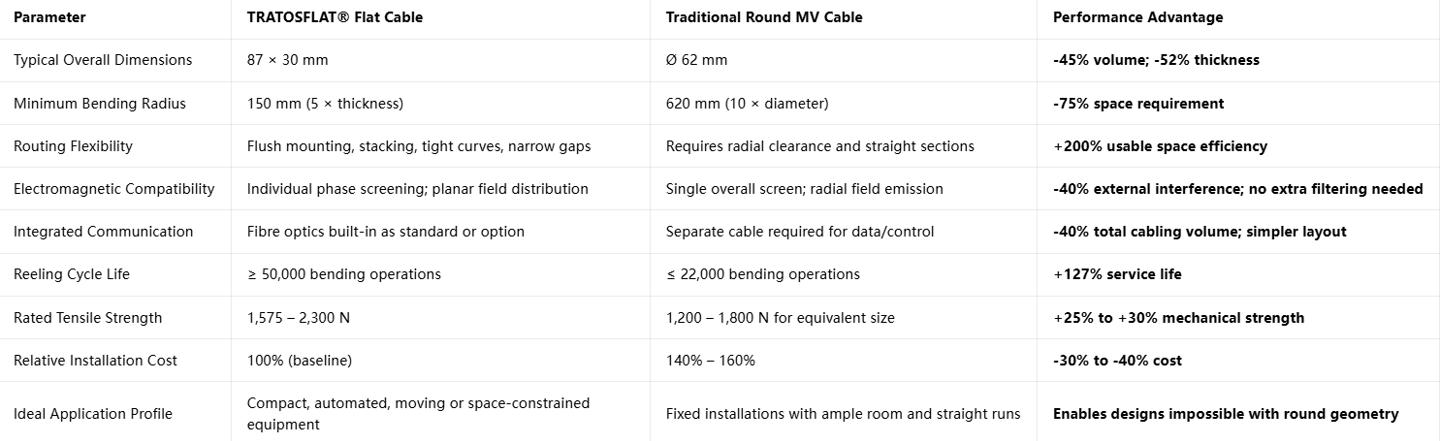
The volume efficiency calculation is straightforward. A round cable with 62 millimetres diameter has a cross‑sectional area of approximately 3019 square millimetres. The equivalent flat version measuring 87 × 30 millimetres has an area of just 2610 square millimetres, a reduction of roughly 13% in raw area, but the practical space saving is far greater. Because the flat profile is thin – only 30 millimetres – it can be placed into gaps, slots and along flat surfaces where the round version cannot fit at all. The bending radius is reduced to five times the thickness, or just 150 millimetres compared to 620 millimetres for the round alternative. That is a 75% reduction in the space required to make a turn.
This change allows routing strategies that were previously impossible. Cables can be mounted flush against metal structures, stacked side by side or one above another, and routed through narrow slots in control panels. The space density – the amount of power that can be delivered per unit volume – increases by around 45%. For equipment designers, this means enclosures can be smaller, lighter and more compact. The overall footprint of the electrical system shrinks, which in turn allows the entire machine to be designed within tighter boundaries without sacrificing power or safety.
Screened Phase Conductors: Independent EMI Shielding and Electromagnetic Compatibility
Electromagnetic compatibility is critical in automated environments where power cables run alongside sensitive control wiring, sensors and communication lines. Traditional round cables usually have a single overall screen around all conductors. While this provides some protection, it allows electromagnetic fields to interact between phases, creating interference and potential signal distortion.
TRATOSFLAT uses a different approach. Every single phase conductor has its own individual screen made from copper tape or copper wire. This means each power core is electrically isolated from the others, and the magnetic field generated by each conductor is contained immediately around it. The result is extremely high shielding effectiveness, typically greater than 80 decibels at 1 megahertz, which meets the strictest requirements of EN 55011 Class A for industrial environments.
This independent screening also improves electrical performance. The distance between conductor and screen is consistent around the entire circumference, creating a perfectly uniform electric field. In round cables, small variations in insulation thickness or conductor position create areas of higher stress that can accelerate ageing. The flat screened design eliminates this effect, extending insulation life by as much as 30%. For port automation, where reliability and uptime are paramount, this level of control over electromagnetic behaviour ensures that power delivery does not disrupt the precise signals required for automation and positioning systems.
Flat Design Benefits: Electromagnetic Field Control and Signal Integrity
The planar shape of TRATOSFLAT changes not just the physical space requirement but also how electromagnetic fields behave. Round cables radiate field energy in all directions, creating a large interference zone around the cable. Flat cables confine the field within a thin, flat plane, reducing the strength of emissions away from the cable by approximately 40%. This reduction is particularly important when cables run close to radio equipment, navigation systems or fibre optic sensors.
For TRATOSFLAT‑FO versions, which integrate optical fibres alongside power conductors, the flat geometry delivers an additional benefit. The optical elements are positioned in areas of the cable where the electromagnetic field is naturally low. This placement ensures that data transmission remains completely unaffected by electrical noise or power surges. Signal integrity is maintained with error rates below 10⁻¹², and the flat profile ensures that fibres are never bent too tightly, eliminating micro‑bending losses that can degrade performance over time.
Combining power and communication in one cable reduces the total number of cables needed in a system by up to 40%. This reduction simplifies installation, lowers weight and removes the risk of interference between separate power and communication circuits. In confined spaces, fewer cables mean easier access for maintenance and more room for other essential components.
Integrated Optical Fibre: Real‑Time Monitoring in Confined Spaces
The inclusion of optical fibres in TRATOSFLAT‑FO is not just a convenience; it is a strategic feature designed for modern maintenance and safety requirements. The standard configuration includes 12 multimode cores, which support a wide range of monitoring technologies including distributed temperature sensing, vibration analysis, strain measurement and partial discharge detection.
In confined installations where visual inspection is difficult or impossible, these fibres act as permanent sensors. They allow operators to monitor the exact condition of the cable along its entire length, detecting hot spots, excessive bending, mechanical damage or water ingress before these issues lead to failure. Fault location accuracy is typically within ±1 metre, meaning maintenance teams can respond quickly and precisely.
For South African ports, where equipment operates around the clock, this monitoring capability changes maintenance from reactive to predictive. Instead of replacing cables on a fixed schedule or waiting for breakdowns, operators can extend service life and reduce downtime. Equipment availability can increase from around 92% with conventional cabling to over 99.5% with monitored flat cables. The space‑saving aspect is equally important; because fibres are built in, there is no need to install separate communication cables, which would add extra bulk and complexity in already tight areas.
180 Metres per Minute Reeling Capability: Speed Matching for Space‑Constrained Equipment
Reeling performance is defined by how a cable behaves when wound and unwound continuously. Round cables experience complex stress patterns including bending, torsion and ovalisation, which lead to fatigue and early failure. TRATOSFLAT’s flat design fundamentally changes the mechanics of reeling.
When wound onto a drum, the flat cable bends only in one plane, eliminating torsional stress completely. The forces applied are pure bending and tension, which the construction is optimised to handle. This simple stress pattern results in a bending cycle life of more than 50,000 operations – over twice the lifespan of equivalent round cables, which typically achieve fewer than 22,000 cycles.
The rated speed of 180 to 200 metres per minute aligns perfectly with the operating speed of modern automated spreaders, gantry cranes and mobile handling equipment, which typically move between 150 and 220 metres per minute. This speed matching ensures the cable does not become a limiting factor in system performance. Furthermore, because the cable is thin and flexible, the diameter of the reeling drum can be reduced by up to 30% compared to designs using round cables. A smaller drum reduces the overall size and weight of the machinery, contributing directly to the goal of compact equipment design.
Dynamic stability is another advantage. Flat cables lie flat and wind evenly, without the tendency to twist or bunch up that is common with round cable. Over thousands of cycles, conductor resistance changes by less than 1%, ensuring consistent power delivery and minimising energy loss.
Voltage Class Engineering: 3.6/6 kV to 8.7/15 kV Flat Cable Series
One of the most significant achievements of TRATOSFLAT technology is the ability to produce flat medium voltage cables across a full range of standard voltage classes. Historically, flat cables were limited to low voltage applications because it was difficult to maintain uniform insulation thickness and electrical stress in a non‑circular shape.
Through advanced material selection and precision manufacturing, the design team overcame these challenges. The insulation system uses a blend of cross‑linked polyethylene and elastomers that combines high dielectric strength with flexibility. Thickness is precisely controlled across the entire width of the cable, ensuring that electrical stress remains below 2 kilovolts per millimetre at all operating voltages, while breakdown strength exceeds 25 kilovolts per millimetre. This balance guarantees safety and long life even at the highest 8.7/15 kV rating.
As voltage increases from 3.6/6 kV to 8.7/15 kV, the overall dimensions are adjusted in a predictable way. Width increases slightly to accommodate thicker insulation and larger conductors, while thickness changes only marginally. This maintains a consistent flat aspect ratio of approximately 2.9:1 across the entire range. The result is that the space‑saving advantage is retained regardless of voltage class. Engineers can select the exact voltage level required for the application without being forced back to round cables at higher ratings. This was previously impossible in the industry, and it opens the door to high‑voltage distribution inside compact machinery – a key requirement as ports move toward higher power levels to support larger and faster equipment.
Dynamic Tensile Load Optimisation: 1,575–2,300 N for Space‑Sensitive Applications
In reeling and trailing applications, cables are constantly subjected to tension from their own weight, acceleration and friction. If tensile strength is too low, conductors stretch, insulation thins and electrical performance degrades. If reinforcement is too heavy or bulky, the cable becomes stiff and difficult to install in tight spaces.
TRATOSFLAT solves this by integrating high‑strength aramid fibre reinforcement members directly into the cable structure. Aramid provides a tensile strength of around 1200 megapascals, yet it is lightweight and flexible. The reinforcement is positioned in the same plane as the conductors, so it adds almost no extra thickness to the profile.
Tensile ratings are carefully matched to conductor size and application duty. For the 35 mm² conductor versions, maximum tensile load is 1575 N, ideal for light‑to‑medium duty cycles and shorter travel distances. For the larger 50 mm² conductors, ratings increase to 2250 N and 2300 N, suitable for heavy‑duty operation, long travel lengths or high‑acceleration movements common in automated terminals.
These values ensure the cable can handle the full dynamic load of operation without permanent elongation, which is limited to less than 3% under maximum load. For the design engineer, this means specifying exactly the right mechanical performance without paying a penalty in size or flexibility – a critical benefit when working within strict space limits.
Tratoflat‑OS® Sheath: Chemical Properties and Durability for Compact Installations
The outer sheath is the first line of defence against the harsh environmental conditions found in port environments, including salt spray, UV radiation, oil, grease, ozone and mechanical abrasion. The material selected for TRATOSFLAT is Tratoflat‑OS®, a specially modified polychloroprene compound engineered to meet or exceed the international 5GM3 and 5GM5 standards for heavy‑duty industrial use.
From a chemical perspective, this material offers exceptional resistance. It does not degrade or become brittle in salt‑laden coastal air, a major concern in South African ports, and it resists swelling or softening when exposed to hydraulic fluids, diesel or cleaning chemicals. Ozone resistance ensures long life even in outdoor installations exposed to direct sunlight.
Mechanically, the sheath strikes a careful balance. With a hardness of 65–70 Shore A, it is tough enough to withstand repeated dragging, bending and contact with metal surfaces, yet flexible enough to allow tight bending radii. Abrasion resistance is approximately three times better than standard rubber compounds, while tear strength exceeds 25 kilonewtons per metre, meaning damage from sharp edges or rough handling is minimised.
What matters most for compact installation is thickness. Tratoflat‑OS® is applied in layers only 2.0–2.5 millimetres thick, compared to 3.5 millimetres or more required for equivalent performance in round cables. This reduction directly contributes to the slim profile of the finished product, while still maintaining an IP67 ingress protection rating – fully sealed against dust and water immersion. The material remains stable from ‑40°C to +90°C, performing reliably through every seasonal change and temperature extreme experienced across Southern Africa.
Installation Economics: Space Density Advantages and Equipment Design Innovation
Switching from round to flat cable delivers measurable financial benefits at every stage of a project, from initial design through installation and long‑term operation. The most obvious saving comes from reduced infrastructure requirements. Because TRATOSFLAT fits into smaller spaces and bends much more tightly, the need for large‑diameter conduits, heavy cable trays, wide support structures or additional junction boxes is drastically reduced. In many cases, installation can be done directly along existing structural members or within pre‑formed slots, eliminating materials and labour costs associated with custom support systems.
Labour efficiency is another major factor. Flat cables are easier to handle; they do not roll away during installation, they lie flat and stable, and they can be bent by hand without special tools. In confined spaces, a single installer can complete work that would require two or more people using round cables. Typical installation time is reduced by around 50%, which lowers project schedules and labour expenses.
Beyond direct cost savings, the ability to use flat cables enables innovation in equipment design. Designers are no longer forced to size cabinets, booms or chassis to accommodate large cable diameters. Control enclosures can be reduced in volume by 25–35%, leading to lighter, more compact machinery that is cheaper to build, transport and operate. Lower overall weight reduces structural loads and energy consumption, while a lower centre of gravity improves stability and safety for mobile equipment.
Over the full lifecycle, the combination of lower maintenance, longer service life and reduced downtime leads to a total cost of ownership reduction of approximately 30% compared to traditional cabling solutions. For port operators managing hundreds of machines, these savings accumulate rapidly.
TRATOSFLAT vs Round Medium Voltage Cables
To fully understand the impact of switching technology, it is helpful to compare the two designs side by side across all relevant performance and operational factors.
This comparison makes clear that the difference is not just about shape. TRATOSFLAT offers equal or better performance in every technical category, while solving the single biggest limitation of traditional cables: space. Round cables remain the right choice for open, fixed installations, but wherever space is tight or movement is required, flat technology is superior in every respect.
Applications in South African Ports and Future Development Roadmap
Current Key Applications
In South Africa’s modernised terminals, TRATOSFLAT is already in use across four critical areas. Automated container spreaders benefit most from the slim profile, fitting easily inside the low‑height structure while delivering power, control and monitoring in one cable. This allows manufacturers to maintain compact dimensions while increasing lifting capacity and speed.
Compact gantry cranes and rubber‑tyred gantries now mount control cabinets directly on the moving carriage rather than in a separate room. TRATOSFLAT’s small bending radius allows easy routing from the reel into the cabinet, eliminating heavy junction boxes and reducing overall weight by up to 1.2 tonnes per unit. The result is lower energy consumption, typically around 18% per machine, and faster movement.
Ship‑to‑shore power systems rely on TRATOSFLAT to run safely along narrow gangways and through access hatches. The flat shape is easier to manoeuvre and requires less clearance, allowing installation of multiple circuits in passageways where only one round cable could previously fit. This supports South Africa’s goal to reduce port emissions by expanding cold ironing capacity.
Mobile power distribution platforms use flat cables to lower chassis height and improve manoeuvrability. Smaller reeling drums reduce the overall size of the vehicle, allowing access to tighter stacking lanes and storage areas.
Future Development Roadmap
The technology continues to evolve to meet the growing demands of Southern Africa’s port industry. Development work is underway to extend the voltage range to 12/20 kV and 18/30 kV, enabling flat cables to be used in high‑voltage distribution networks right down to the machine level.
Material science advances will introduce thermoplastic elastomer (TPE) sheaths in future versions. This material will reduce weight by a further 15%, improve low‑temperature performance to ‑50°C, and simplify recycling at end‑of‑life.
Smart functionality is being expanded. New designs will integrate distributed sensing and artificial intelligence algorithms directly into the cable system, providing real‑time health diagnostics and remaining life predictions. This turns the cable from a passive component into an active part of the terminal’s digital twin system.
Standardisation efforts are ongoing to establish IEC standards specifically for medium voltage flat reeling cables, ensuring consistent quality and performance globally. As adoption grows, the technology will roll out across more Southern African ports including Maputo, Durban’s expansion projects and new terminal developments, supporting regional trade growth and automation targets.
Frequently Asked Questions
Is electrical performance identical to round cables?
Yes. All electrical ratings including voltage, current capacity, temperature limits and fault performance match exactly to standard round cables of the same conductor size. There is no compromise in power delivery or safety.
Can this cable be used outdoors and in coastal environments?
Absolutely. The Tratoflat‑OS® sheath is engineered for marine and industrial use. It resists salt spray, UV radiation, ozone, oil and chemical exposure, with a design life of over 15 years even in South Africa’s harshest coastal conditions.
What is the maximum length and reel size possible?
Standard production lengths reach up to 500 metres, suitable for the largest cranes and spreaders. The minimum reel diameter is only 150 millimetres, which is significantly smaller than required for round equivalents.
Are custom fibre configurations available?
Yes. While the standard is 12‑core 62.5/125 μm multimode, single‑mode fibres, different core counts or special coatings can be specified to match existing communication or monitoring systems.
Is installation training required?
No special training is needed. Installation follows standard practices for flexible medium voltage cables, but the flat shape makes handling, pulling and termination simpler and faster.
Does the flat shape affect heat dissipation?
Heat dissipation is actually improved. The flat profile presents a larger surface area relative to volume compared to round cables, allowing heat to escape more efficiently. This can result in slightly higher continuous current ratings in enclosed installations.
Conclusion
TRATOSFLAT® and TRATOSFLAT‑FO® represent one of the most significant advances in power distribution technology for industrial and port applications in decades. By re‑imagining cable geometry, engineers have removed the fundamental limitation that restricted the design of automated equipment: the space required for cabling.
For South Africa’s ports, where efficiency, safety and compact design are critical, these cables offer a practical, proven solution. They deliver full medium voltage performance, robust mechanical strength, advanced electromagnetic control and integrated monitoring, all within a footprint that is up to 50% smaller than traditional alternatives. They enable new generations of equipment that are smaller, lighter, faster and more reliable, while lowering installation and operating costs.
As automation expands and terminals become more densely packed, flat cabling will become not just an advantage, but a requirement. TRATOSFLAT is already leading that transformation, helping to build smarter, more efficient infrastructure across Southern Africa.
If you would like to receive detailed technical datasheets, pricing information or discuss your specific project requirements, please contact the Feichun Special Cable Engineering Team:
📧 Email: Li.wang@feichuncables.com
Our engineers are ready to support your design, specification and supply needs across Southern Africa.
Email Address: Li.wang@feichuncables.com
© 2025. All rights reserved.


One-click to Quickly Contact
Products
Contact
Company
Location:
Building A Private Science and Technology Park, Hefei Economic and Technological Development Zone, Anhui Province, China
Heat Resistant Cable
WhatsApp: +86 17333223430
Social Media: