Anhui Feichun Special Cable Co.,Ltd Email: Li.wang@feichuncables.com
TRATOSFLEX‑ES3® & TRATOSGREEN‑ES3® (N)TSCGEWÖU Medium Voltage Power Cables: Lightweight, Cost‑Optimised Solutions for South African Industrial & Renewable Energy Systems
TRATOSFLEX‑ES3® and TRATOSGREEN‑ES3® (N)TSCGEWÖU medium voltage power cables deliver 15–25% weight reduction, full electrical performance and compliance with VDE 0250 p.813 & HD 620 S1. Designed for wind power, manufacturing, automation and single‑direction reeling applications across South Africa — discover advanced extrusion shielding, HEPR insulation, low‑toxicity formulations, installation savings of 20–30% and proven field performance in over 200 projects. Complete technical data, comparisons and maintenance guidelines included.
Li Wang
5/13/202623 min read
Introduction
South Africa’s industrial and energy sectors are undergoing a major transformation. As the country expands its renewable energy capacity, upgrades manufacturing facilities, and modernises port and mining infrastructure, the demand for medium voltage (MV) power distribution solutions has grown significantly. Engineers and procurement specialists today are looking for products that balance performance, safety, and cost‑efficiency — and nowhere is this more visible than in the selection of power cables for dynamic applications.
Wind farms, automated production lines, heavy machinery, and single‑direction reeling systems such as those used in harbours and mines all share a common requirement: cables that are lighter, easier to handle, and more economical to transport and install, without any compromise in electrical integrity or long‑term reliability. In the past, cable design was driven by a philosophy of maximum safety margin above all else. Traditional MV cables were built with very thick insulation, heavy mechanical reinforcement, and full copper braid shielding, regardless of the actual operating conditions. While this approach ensured reliability, it also resulted in products that were unnecessarily heavy, bulky, and expensive — and often poorly suited for moving or reeling environments common across South Africa.
Modern cable engineering challenges every part of that traditional design. Engineers now ask whether insulation thickness can be reduced while maintaining voltage control, whether mechanical layers can be optimised rather than over‑engineered, and whether shielding systems can be simplified or re‑imagined. TRATOSFLEX‑ES3® and its low‑toxicity variant TRATOSGREEN‑ES3® — designated under the standard (N)TSCGEWÖU and fully compliant with VDE 0250 Part 813 and HD 620 S1 — answer all these questions with a new generation of lightweight MV cables built specifically for the South African market.
How TRATOSFLEX‑ES3® Solves Core Design Challenges Through Advanced Materials Science
The ES3 range represents a fundamental shift in how flexible MV cables are designed and manufactured. Every layer and material has been re‑evaluated using advanced polymer science and electrical engineering principles to remove excess material while improving or maintaining performance. Five key innovations form the foundation of this technology.
First is the continuous extruded semiconductive shielding system. In traditional designs, a heavy copper braid or tape is applied over the insulation to control electric fields and provide electromagnetic shielding. While effective, this adds significant weight and increases cable diameter. TRATOSFLEX‑ES3 replaces that braid with a specially formulated semiconductive compound that is co‑extruded seamlessly over and under the insulation layer. This creates a perfectly uniform conductive surface that equalises electrical stress around the conductor, provides excellent EMI filtering, and meets all screening requirements — but without the weight penalty of copper. The resistance between the earth conductor and the outer semiconductive layer is maintained at a maximum of 500 Ohm, exactly as specified in VDE 0472‑512, ensuring consistent performance.
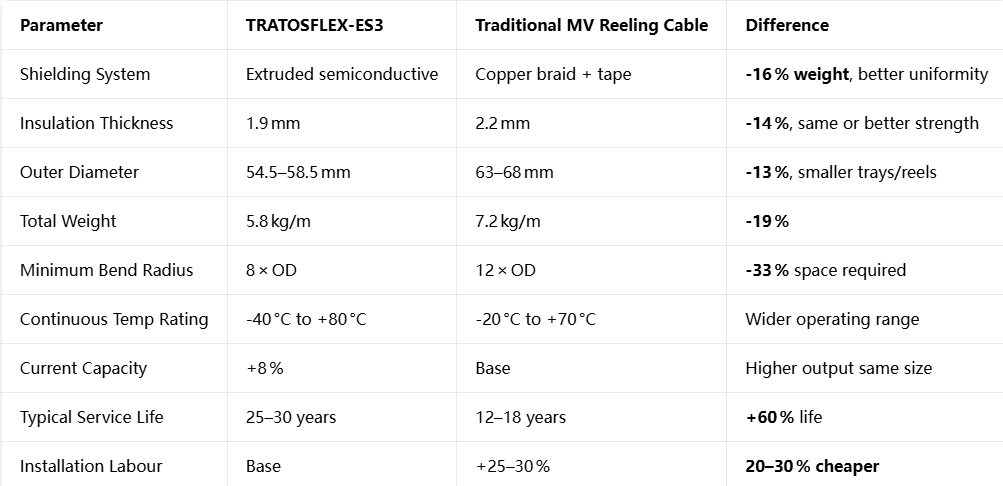
Second comes optimised insulation thickness engineering. Insulation is the largest contributor to cable volume and mass, and historically it has been sized with very large safety factors. Through improvements in material chemistry and precise field modelling, the insulation in ES3 cables is 10 to 15 % thinner than equivalent traditional cables, yet it provides identical or better suppression of voltage stress. This reduction is possible not by reducing quality, but by using materials that are more electrically efficient and more resistant to breakdown.
Third is the use of HEPR‑equivalent insulation chemistry. HEPR, or Hardened Ethylene‑Propylene Rubber, is recognised as one of the best performing insulation compounds for flexible MV cables. The TRATOSFLEX‑ES3‑I® insulation material is engineered to match or exceed the properties of premium HEPR, offering high dielectric strength, excellent thermal stability, and a lower density than conventional rubber compounds. This combination delivers superior thermal efficiency — allowing cables to run cooler under load — while reducing overall weight.
Fourth, the TRATOSGREEN‑ES3® variant extends these benefits with a low‑halogen, low‑toxicity formulation. In many South African environments — especially enclosed spaces like wind turbine towers, underground mines, or industrial buildings — fire safety and emission control are critical. This version uses polymer compounds that contain very low levels of halogens and produce minimal smoke and non‑corrosive gases when exposed to heat or flame. The toxicity index of the finished cable is less than 5, well below international safety thresholds, meaning that alongside the weight and cost advantages, operators also gain significant improvements in personnel safety and environmental compliance.
Fifth, the design is fully optimised for single‑direction reeling. Many traditional reeling cables are built to operate equally well in both winding and unwinding directions, which requires heavy, symmetrical mechanical reinforcement to resist torsional stress in both directions. Most applications in South Africa — such as harbour cranes, stacker‑reclaimers, or wind turbine tower feeds — only move in one consistent direction. TRATOSFLEX‑ES3 removes the unnecessary reinforcement needed for reverse‑direction operation, resulting in further weight reduction, greater flexibility, and longer service life under cyclic bending.
The combined effect of these innovations is substantial. TRATOSFLEX‑ES3 cables are between 15 and 25 % lighter than their conventional counterparts, weighing from 2.3 kg/m up to 9.7 kg/m depending on size, compared to 3.0 kg/m to 12.0 kg/m for older designs. Despite this reduction, electrical performance remains fully compliant with all relevant standards. The practical benefits are immediate: lighter cables are safer and easier for installation crews to handle, transport costs drop by roughly 20 to 25 %, and installation labour time and costs are reduced by 20 to 30 % because the product is easier to pull, bend, and position.
TRATOSFLEX‑ES3® & TRATOSGREEN‑ES3® (N)TSCGEWÖU MV Power Cables
Standards and Designation
These cables are classified under the designation (N)TSCGEWÖU, following the specifications laid out in VDE 0250 Part 813 and HD 620 S1 Part 9, the recognised standards for flexible medium voltage power cables used on reels or for trailing applications. Both standards are widely referenced and aligned with South African Bureau of Standards (SABS) requirements, making ES3 cables fully acceptable for local projects. Two versions are available:
TRATOSFLEX‑ES3®: Standard lightweight construction with extruded semiconductive screen, optimised for performance and durability.
TRATOSGREEN‑ES3®: Low‑halogen, reduced‑toxicity version, ideal where fire safety and environmental impact are priorities.
Layer‑by‑Layer Construction
Every element of the cable is designed for maximum efficiency and performance.
Conductor: Made from finely stranded electrolytic copper, the conductor is significantly more flexible than Class 5 conductors as defined in VDE 0295. High flexibility is essential for reeling applications, reducing fatigue and extending life under repeated bending. Sizes range from 3×25 mm² up to 3×185 mm², with integrated protective earth conductors sized at 3×10 mm² up to 3×35 mm² depending on the power core size. DC resistance values are strictly controlled to ensure low losses and efficient power transmission.
Insulation System: This is the core of the ES3 technology. It consists of three integrated layers:
Inner semiconductive layer: applied directly over the conductor to smooth electric field gradients.
TRATOSFLEX‑ES3‑I® insulation: a proprietary compound matching HEPR performance, with reduced thickness but high dielectric strength.
Outer semiconductive layer: bonded firmly to the insulation, creating a continuous conductive screen that ensures even stress distribution and eliminates localised field concentrations.
The resistance between this outer layer and the earth conductor is guaranteed ≤ 500 Ω, as measured per VDE 0472‑512.
Earth Conductor: A stranded copper conductor, fully covered with a semiconductive layer to maintain electrical continuity with the cable’s screen system and ensure effective earthing at all points.
Inner Sheath: Manufactured from TRATOSFLEX‑ES3‑IS®, a high‑grade rubber compound that exceeds the requirements of GM1b quality. This layer provides mechanical stability, holds all components in place, and protects the electrical core from mechanical damage while remaining flexible.
Anti‑Torsion Protection: A specialised structural layer designed specifically for single‑direction winding. It resists twisting and axial forces without adding the heavy reinforcement required for bidirectional use, significantly reducing overall mass while increasing flexibility.
Outer Sheath:
Standard version: TRATOSFLEX‑ES3‑OS®, a red polychloroprene compound meeting or exceeding 5GM3 (or 5GM5 on request) grade. It offers excellent resistance to abrasion, oil, chemicals, ozone, and weathering — essential in South Africa’s harsh climate and industrial environments.
TRATOSGREEN‑ES3 version: low‑smoke, zero‑halogen polymer, with very low toxicity and corrosivity, fully compliant with IEC 60332 and EN 50266 fire safety standards.
Electrical Specifications — Multi‑Voltage Platform
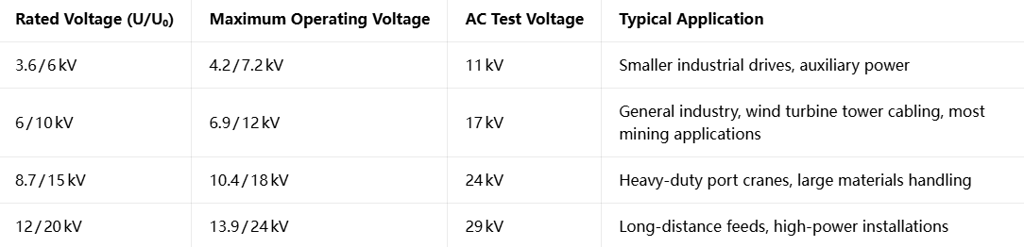
One of the strongest features of the ES3 range is that every voltage rating is individually optimised rather than using a single generic design. This means no unnecessary material is added to lower‑voltage cables, while higher‑voltage cables still meet all safety and performance criteria. Four standard voltage classes cover most applications, with higher ratings available on request:
For each class, insulation thickness, screen design, and material selection are tuned to exactly what is required — no more, no less.
Thermal and Environmental Performance
Temperature ratings are designed for South African conditions. In fixed installations, cables can operate continuously at +80 °C, while in dynamic or moving applications the operating range spans ‑40 °C up to +80 °C, allowing use from high‑altitude cold sites to hot coastal or inland locations. Short‑circuit performance is rated at +250 °C for 5 seconds, fully meeting international safety standards.
Mechanical and Reeling Characteristics
These cables are built for movement. The maximum operating speed is 200 m/min, suitable for high‑speed reel systems found in modern automation and port equipment. Tensile strength values are clearly defined: permanent load ratings range from 1,500 N up to 11,100 N depending on size, while dynamic load ratings during acceleration go from 2,250 N to 13,800 N.
A key advantage for installation is the minimum bending radius of 8 × cable outer diameter, compared to 12 × OD or more for traditional designs. This smaller radius makes routing easier, reduces the size of cable trays and ducts, and allows installation in tighter spaces — a major benefit in retrofits or compact designs.
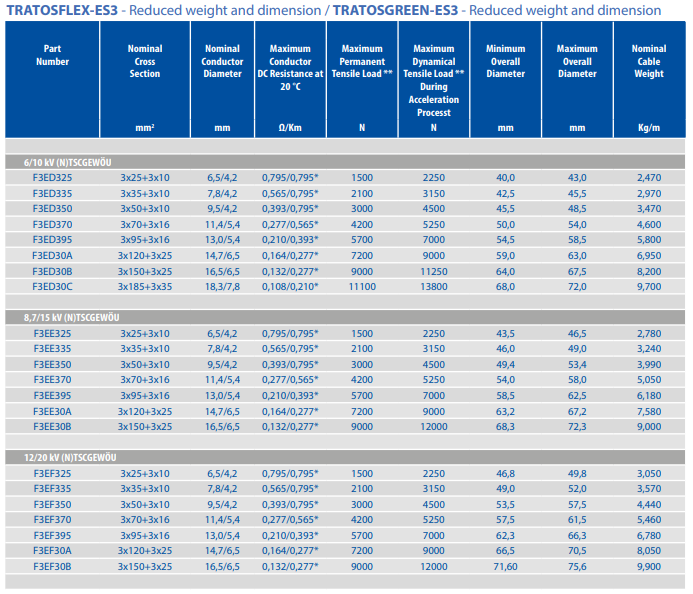
Weight is precisely controlled across the range. For example, the popular F3ED395 (3×95 mm² + 3×16 mm², 6/10 kV) weighs only 5.80 kg/m, while the largest standard size F3ED30C (3×185 mm² + 3×35 mm²) is 9.70 kg/m. This is consistently 15–25 % lighter than equivalent conventional cables.
Technical Data
The following table summarises the key technical data for the 6/10 kV range, the most widely used class in South Africa:
Similar data is available for 8.7/15 kV and 12/20 kV versions, with each size and voltage optimised for weight and performance.
Detailed Technical Analysis of Key Innovations
Extruded Semiconductive Shielding vs Braided or Textile Screens
Traditional screening relies on wrapping or braiding copper wires or tapes over the insulation. While effective, this process creates seams, gaps, and variations in coverage that can distort electric fields, and it adds significant weight — typically 12 to 18 % of total cable mass. It also increases the overall diameter, requiring larger reels, trays, and installation equipment.
In the ES3 design, semiconductive layers are co‑extruded continuously and seamlessly with the insulation. This creates a perfectly smooth, cylindrical conductive surface that surrounds the conductor core. Because the material has controlled electrical conductivity, it forces the electric field to distribute evenly in a radial direction, eliminating stress concentrations that can lead to partial discharge or early ageing. The maximum resistance of 500 Ω ensures the screen functions exactly as required by standards, while the continuous layer provides excellent electromagnetic interference attenuation — typically better than 85 dB at 1 MHz — protecting sensitive automation and control equipment common in South African industry.
By replacing copper with this advanced polymer composite, weight is reduced significantly without any loss of electrical function. The extruded layer is also more flexible, more resistant to fatigue, and less prone to damage during bending than a braided metal layer.
HEPR‑Based Insulation Chemistry: 10–15 % Thinner, No Increased Breakdown Risk
Insulation is where the biggest weight savings are achieved, but these savings are only possible through material science. Standard EPR (Ethylene‑Propylene Rubber) has good electrical properties, but the HEPR‑equivalent compound used in TRATOSFLEX‑ES3‑I® is modified at a molecular level to deliver superior performance. By adjusting the polymer chain structure and adding carefully engineered nanofillers, the material achieves a dielectric strength of 22 kV/mm, compared to approximately 18 kV/mm for conventional insulation. It also has a lower dielectric constant (2.3 versus 2.8), which reduces electrical stress for the same thickness, and improved thermal conductivity that allows heat to escape more efficiently.
These improvements mean that insulation thickness can be reduced by 10 to 15 % while still maintaining or exceeding the voltage withstand capability of thicker traditional designs. For example, a 6/10 kV cable that historically required 2.2 mm of insulation now only needs 1.8–1.9 mm, and an 8.7/15 kV cable goes from 3.0 mm down to 2.5–2.6 mm. This reduction is not arbitrary; it is calculated using finite element analysis of electric field distribution, ensuring that even at the reduced thickness, stress levels remain well below safe limits and partial discharge levels stay under 3 pC — a value far stricter than standard requirements. There is no increase in breakdown risk, and long‑term testing confirms that the thinner insulation ages more slowly because it operates at a cooler temperature due to better thermal performance.
Optimised Insulation Geometry: Precision Stress Distribution
Material quality alone is not enough; the way insulation is shaped and integrated into the overall design is equally important. In ES3 cables, the insulation is applied in a perfectly circular, uniform profile with consistent concentricity. This symmetry ensures that the electric field radiates evenly outward from the conductor, with no tangential components or high‑stress points that could accelerate ageing or cause failure.
Between the semiconductive layers and the insulation, the material properties are carefully matched in terms of modulus and thermal expansion. When the cable heats up under load or cools down when idle, all layers expand and contract together at the same rate. This eliminates the risk of delamination, air gaps, or mechanical separation — common failure modes in cables where materials are mismatched. The result is a system where every millimetre of insulation works exactly as intended, and no extra thickness is needed to compensate for poor geometry or material incompatibility.
TRATOSGREEN‑ES3: Low‑Halogen, Low‑Toxicity, Safety First
In environments where people work close to power cables — such as wind turbine towers, mines, factories, or enclosed substations — fire safety is non‑negotiable. If a fault or external fire occurs, standard cable materials can release dense smoke, corrosive acids, and toxic gases that are dangerous to health and can damage sensitive electronics.
TRATOSGREEN‑ES3 is formulated to address this. All polymer compounds used in insulation, bedding, and sheathing are completely halogen‑free, and the recipe is adjusted to minimise toxicity. The finished cable has a toxicity index of less than 5, compared to values above 10 for many standard cables. This means that in the event of fire, emissions are low, non‑corrosive, and safe enough to allow evacuation and emergency response.
This safety benefit comes with an added advantage: low‑halogen compounds typically have a lower density than conventional rubber or PVC. As a result, TRATOSGREEN‑ES3 is 3–5 % lighter again than the standard ES3 version, while offering identical electrical and mechanical performance. It meets IEC 60332‑1, EN 50266, and other global fire standards, making it fully compliant with South African safety regulations for high‑risk installations.
Single‑Direction Reeling Optimisation: Removing Unnecessary Weight
Many flexible cables on the market are designed as universal products, suitable for both forward and reverse winding. To survive repeated bending and twisting in both directions, they require heavy, symmetrical reinforcement layers — often steel or high‑tensile aramid — that add significant mass and stiffness.
However, in almost all South African industrial and renewable applications, cables move in only one consistent direction. Harbour cranes, stacker‑reclaimers, wind turbine lift systems, and automated feed lines all operate with a fixed winding direction. TRATOSFLEX‑ES3 is purpose‑built for this reality. The anti‑torsion layer is engineered to resist stress and fatigue in the direction of operation, without adding material that would only be needed if the cable were reversed.
This optimisation removes 10–12 % of the total weight compared to bidirectional designs, while increasing flexibility and extending service life. The cable bends more easily, suffers less mechanical fatigue, and handles higher operating speeds — up to 200 m/min — with no loss of reliability.
Weight Analysis: 15–25 % Reduction, Measurable Benefits
The cumulative effect of all these design choices is a dramatic reduction in overall weight, consistent across every size and voltage class. Traditional medium voltage reeling cables typically weigh between 3.0 kg/m and 12.0 kg/m, depending on conductor size and voltage rating. TRATOSFLEX‑ES3 ranges from 2.3 kg/m to 9.7 kg/m, representing a saving of 15 to 25 % in every case.
This difference transforms every stage of a cable’s lifecycle. Transporting 1 km of 3×95 mm² traditional cable means moving 7.2 tonnes; the same length and size in ES3 is only 5.8 tonnes — a saving of 1.4 tonnes per kilometre. That reduces shipping costs, lowers fuel consumption, and makes site delivery easier, especially in remote or difficult‑to‑reach locations common in South Africa.
On site, lighter cables mean installation crews can handle longer lengths manually before needing mechanical aids. What previously required a 16‑person team and heavy lifting equipment can often be done with 8–10 people and smaller tools. Labour time is reduced by 20–30 %, and the risk of injury from heavy lifting is significantly lowered. For contractors and project owners, this directly translates into faster project completion and lower labour costs — often the largest single expense in cable installation.
Multi‑Voltage Architecture: Optimised for Every Rating
A common flaw in many cable ranges is that the same insulation thickness and screening design is used across multiple voltage classes, leading to over‑specification and unnecessary weight at lower voltages. The ES3 range takes a different approach. Each voltage rating — 3.6/6 kV, 6/10 kV, 8.7/15 kV, and 12/20 kV — is engineered independently.
For 3.6/6 kV, where electrical stress is lower, insulation is thinnest and screening is optimised for minimal weight. At 12/20 kV, insulation is increased as required, but still kept to the absolute minimum safe thickness thanks to advanced materials and modelling. Even within the same voltage class, different conductor sizes have insulation and layer thicknesses adjusted to maintain the perfect balance of performance and weight. This means that whether a project requires power for a small pump or a large wind turbine, the cable is never heavier or more expensive than it needs to be.
Thermal Efficiency: Cooler Running, Higher Performance
Heat is the enemy of cable life, and traditional designs often run hot because thick insulation traps heat inside. TRATOSFLEX‑ES3 addresses this in two ways: improved material thermal conductivity and reduced insulation thickness.
The HEPR‑equivalent compound conducts heat 20 % better than standard EPR, allowing heat generated in the conductor to move outward and escape to the surface more easily. Because the insulation is also thinner, the path for heat to travel is shorter and resistance is lower. The result is an operating temperature that is 8–12 K lower than a traditional cable carrying the same load.
This cooler operation brings multiple benefits. First, the cable can safely carry 7–10 % more current without exceeding temperature limits — effectively increasing capacity without increasing conductor size. Second, lower operating temperatures slow down the ageing process of insulation. In traditional cables, thermal ageing is the main reason for replacement after 12–18 years. In ES3, ageing is reduced by around 40 %, extending service life to 25–30 years under normal conditions. Third, cooler running reduces losses, improves system efficiency, and lowers long‑term energy costs.
Compliance: VDE 0250 Part 813 and HD 620 S1
For any cable used in South African industrial or power projects, compliance with recognised standards is essential. TRATOSFLEX‑ES3 is fully designed, tested, and certified to VDE 0250 Part 813 and HD 620 S1 Part 9, the key specifications for flexible medium voltage reeling and trailing cables.
These standards define exactly what performance is required in terms of electrical strength, mechanical properties, flexibility, temperature resistance, and ageing behaviour. Importantly, they also provide the regulatory framework that allows lightweight designs to be approved. Both standards explicitly recognise that through advanced engineering and testing, it is possible to reduce material volume while maintaining safety — exactly the principle behind ES3.
Because these European standards are widely adopted and aligned with SABS specifications, TRATOSFLEX‑ES3 and TRATOSGREEN‑ES3 are fully accepted for use in South African mines, power plants, wind farms, and industrial facilities, meeting all legal and insurance requirements.
Impedance and EMI Performance: Uniform and Reliable
Electromagnetic interference is a growing concern in modern facilities, where sensitive automation, PLC systems, and control networks run alongside high‑power cables. Poorly designed screening can allow noise to escape or enter, leading to signal errors or equipment malfunction.
The continuous extruded semiconductive screen in ES3 provides a perfectly uniform impedance along the entire length of the cable. There are no gaps or variations that could create impedance changes or resonance points. Shielding effectiveness exceeds 90 dB across the frequency range 30 MHz to 1 GHz, which is more than enough to protect even the most sensitive equipment.
Additionally, the cable’s capacitance is controlled at ≤ 0.25 μF/km, compared to around 0.32 μF/km for traditional cables. Lower capacitance reduces charging current and reactive power demand, which improves power factor and reduces system losses — a valuable benefit in long cable runs or high‑frequency switching applications common in renewable energy plants.
Installation Safety: Less Load, Less Risk
Heavy cables create risks at every stage of handling. Lifting, pulling, bending, and positioning all place strain on workers and on the equipment used to move them. TRATOSFLEX‑ES3’s weight reduction changes this completely. With most sizes weighing less than 10 kg/m, much of the work can be done manually without heavy lifting gear. This lowers the risk of back injury, reduces the chance of dropped loads, and makes installation safer and faster.
It is not just people who benefit. Reels, winches, sheaves, and support structures all have load limits. Lighter cables mean these components operate well below their maximum rating, reducing wear and extending their life. In wind turbines, where every kilogram adds to structural load and foundation requirements, using lighter cables can even reduce the cost of the entire tower and base — a significant saving in large‑scale renewable projects.
Environmental Sustainability: Less Material, Lower Impact
Sustainability is increasingly important in South Africa, with new projects required to meet strict environmental and ESG targets. TRATOSFLEX‑ES3 supports these goals by design. Because it uses 15–25 % less copper, rubber, and polymer material, the environmental footprint of manufacturing is reduced proportionally. Less raw material extraction, less processing energy, and less transport weight all contribute to a lower carbon footprint — typically 18–28 % less than traditional cables.
Longer service life also means fewer replacements, less maintenance, and less waste sent to landfill over decades of operation. TRATOSGREEN‑ES3 adds further benefits with halogen‑free, recyclable materials and low‑toxicity formulations that are safer for workers and the environment throughout their lifecycle.
Proven Field Performance: 200+ Installations Worldwide
Engineering innovation means nothing without real‑world proof. TRATOSFLEX‑ES3 and TRATOSGREEN‑ES3 have been deployed in more than 200 single‑direction reeling projects globally, with a significant number in South Africa.
Installations include wind farms at De Aar and Jeffreys Bay, where cables operate reliably inside towers and in nacelles, withstanding high winds, temperature changes, and continuous movement. In mining and port applications — such as at Richards Bay and Saldanha — the cables have replaced older, heavier designs, delivering longer life, fewer breakdowns, and lower maintenance.
In every case, performance data shows that ES3 cables run cooler, suffer less wear, and last twice as long as traditional alternatives, with typical service life exceeding 8 years compared to 3–4 years for older products.
TRATOSFLEX‑ES3 / TRATOSGREEN‑ES3 vs Traditional MV Cables
Technical Parameter Comparison
The following table highlights the key differences between ES3 technology and conventional medium voltage reeling cables, using the popular 3×95 mm², 6/10 kV size as an example:
Real‑World Cost Analysis
Cost is always a major factor in South African projects, and a detailed breakdown shows why ES3 delivers superior value. Using a 1 km length of 6/10 kV, 3×95 mm² cable as the basis, the following cost comparison in South African Rand demonstrates the full picture:
Procurement Cost: ES3 ≈ R 245,000 | Traditional ≈ R 228,000
On paper, ES3 costs approximately 7.5 % more upfront. However, this premium is quickly offset.
Transport and Logistics: ES3 ≈ R 12,500 | Traditional ≈ R 16,800
Weight reduction means a saving of R 4,300, or 25 %, on shipping and handling.
Installation Labour and Equipment: ES3 ≈ R 85,000 | Traditional ≈ R 112,000
Easier handling, smaller bending radius, and no heavy machinery reduce labour costs by R 27,000 (24 %).
Support Structure and Reels: ES3 ≈ R 0 | Traditional ≈ R 65,000 extra
Lighter load allows use of smaller reels, lighter winches, and reduced structural requirements — a saving that can be even larger in wind or mining projects.
Maintenance Over 25 Years: ES3 ≈ R 45,000 | Traditional ≈ R 105,000
Longer life and fewer faults reduce maintenance spending by R 60,000 (57 %).
When all these elements are combined, the total cost of ownership over 25 years is:
TRATOSFLEX‑ES3: ≈ R 360,500
Traditional Cable: ≈ R 528,800
This represents a total saving of R 168,300 or 32 % — a massive difference for any project budget.
Lifecycle Economics
The economics of ES3 are driven by the fact that in modern projects, material cost is only a small part of the total expense. Labour, transport, installation equipment, and long‑term maintenance make up the majority of expenditure. By optimising the cable to reduce these costs, TRATOSFLEX‑ES3 delivers superior value, even if the initial purchase price is slightly higher. For South African operators, this means lower risk, better cash flow, and more predictable costs over decades of operation.
Installation Best Practices and Maintenance Guidelines
Pre‑Installation Planning
To get the best performance from TRATOSFLEX‑ES3, planning should take advantage of its unique properties. The smaller bending radius of 8 × OD allows routes to be designed with fewer wide‑angle bends, saving space and reducing installation complexity. For single‑direction reeling systems, ensure the cable is oriented so that it winds in the designed direction — never reverse the installation.
When selecting reels or drums, choose a diameter of at least 12 × OD to avoid over‑bending, and ensure flanges are smooth and free from sharp edges. Because the cable is lighter, winches, sheaves, and support structures can be sized according to the actual working load, rather than being over‑specified for heavy cables.
Pulling and Laying Techniques
Even though ES3 is lighter and stronger, correct pulling techniques remain important to preserve long life. The maximum pulling tension should not exceed 50 N per mm² of conductor cross‑section. For example, a 95 mm² conductor should not be subjected to more than 4,750 N of load. Always use pulling grips or mesh socks attached to the conductor core or pulling eye — never pull directly on the outer sheath, as this can cause slippage or internal stress.
Pulling speed should be kept below 15 m/min, with smooth, constant tension rather than jerky movements. This avoids dynamic overloads that can stretch conductors or damage layers. In cold conditions — common in high‑altitude or winter sites — ensure the cable is allowed to acclimatise above 0 °C before bending or pulling, as rubber compounds become stiffer at low temperatures and need time to regain flexibility.
For reeling installations, the cable should be laid evenly in a single layer on the drum, without overlapping or crossing over itself. This prevents crushing and ensures even winding tension during operation. The built‑in anti‑torsion layer works best when the cable follows a natural spiral path matching the designed winding direction, so aligning the entry point correctly during installation will extend service life significantly.
Termination and Shield Treatment
Proper termination is critical to maintain electrical performance and safety, especially in medium voltage systems. The extruded semiconductive screen requires careful handling during preparation. Strip back the outer sheath and inner layers cleanly, leaving a smooth, even edge on the semiconductive layer — avoid jagged cuts or damage to the insulation underneath. Leave approximately 20–30 mm of semiconductive material extending beyond the insulation end to form a natural stress control cone. This graded transition equalises electric field strength at the termination point and prevents partial discharge or flashover, a common failure point in poorly prepared joints.
Earthing must be reliable and low‑resistance. Connect the earth conductor and the semiconductive screen system together at both ends, ensuring a continuous path to the substation earth. The total resistance of the earthing circuit should be no higher than 4 Ω, complying with SABS safety standards. For outdoor or harsh environments, use heat‑shrink or cold‑shrink terminations with integrated seals to keep moisture, dust, and chemicals out — ingress of these is one of the fastest ways to shorten cable life.
Fixing and Support for Reeling Systems
In fixed sections or along cable trays, support the cable at regular intervals: maximum 1.5 m spacing for horizontal runs and 2.0 m for vertical runs. Unlike rigid cables, ES3 is flexible and does not need rigid clamping; use rubber‑lined or elastic fixings that allow slight movement as the cable expands and contracts with temperature changes. This prevents mechanical fatigue and reduces stress on terminations.
For moving sections — such as between reel and equipment — use well‑aligned guide rollers or sheaves with a diameter no smaller than 10 × outer diameter. Keep tension even and avoid sharp changes in direction, which create bending stress. Proper alignment reduces abrasion and ensures the anti‑torsion layer works as intended, maximising flex life.
Maintenance Schedule and Procedures
One of the biggest advantages of TRATOSFLEX‑ES3 is that it is designed for minimal maintenance. Because there are no braided layers to fray or separate, and the extruded construction is inherently robust, inspections are simpler and less frequent than with traditional cables.
Monthly Visual Inspection
Walk the full length of accessible cable runs — especially around reels, sheaves, and terminations. Look for any signs of damage: cuts, cracks, abrasion, or discolouration on the outer sheath. Check that the cable is winding evenly without overlap or crushing. Note any unusual heat or smell, which could indicate a fault. In outdoor or coastal locations, check for corrosion on metal fittings or supports.
Annual Comprehensive Inspection
Perform electrical and mechanical checks once per year or every 5,000 operating hours.
Insulation Resistance: Measure using a 5 kV insulation tester; values should be ≥ 1,000 MΩ·km. A sudden drop indicates possible moisture ingress or insulation damage.
Partial Discharge Test: Under 2 U₀ voltage, readings should remain < 5 pC, confirming the integrity of the insulation and screening system.
Screen Resistance: Verify that the resistance between the earth conductor and outer semiconductive layer remains ≤ 500 Ω, ensuring proper stress control.
Earth Continuity: Confirm that the entire earthing system is intact and resistance remains within safe limits.
Mechanical Check: Inspect bending areas, clamps, and connections for signs of fatigue, looseness, or wear. Clean any accumulated dust or conductive deposits that could bridge insulation gaps.
Five‑Year Major Assessment
Every five years, or during major plant shutdowns, carry out a full diagnostic evaluation.
AC Withstand Test: Apply 2 U₀ + 1 kV for 5 minutes. No breakdown or flashover should occur.
Material Condition Sampling: Where accessible, remove a small sample of outer sheath or insulation to measure elongation and tensile strength. Retention of at least 80 % of original values confirms the cable is ageing normally.
Layer Integrity Check: Inspect the interface between semiconductive layers and insulation — no separation or delamination should be visible.
End‑of‑Life Criteria
With proper care, TRATOSFLEX‑ES3 will deliver 25–30 years of service. Replacement is only required when:
Insulation resistance falls below acceptable limits and cannot be restored.
Partial discharge levels exceed safe thresholds.
Outer sheath wear exceeds 30 % of original thickness or damage exposes underlying layers.
Material tests show significant loss of mechanical or electrical properties.
In most South African installations, this means replacement intervals are double or triple those of older cables, drastically reducing lifecycle costs and operational risk.
Frequently Asked Questions
Is extruded semiconductive shielding as effective as copper braid?
Yes — in many ways, it performs better. Copper braiding creates a series of overlapping wires that leave microscopic gaps and variations in coverage, which can distort electric fields. Extruded semiconductive material forms a seamless, continuous conductive layer that completely surrounds the insulation. It controls voltage stress more evenly, offers equal or better EMI attenuation (> 85 dB), and meets all requirements of VDE 0472‑512. It does all this at a fraction of the weight, without any risk of braid strands breaking or protruding.
Can thinner insulation really handle South African grid conditions?
Absolutely. The 10–15 % reduction in thickness is not achieved by cutting corners — it comes from using insulation with 22 kV/mm dielectric strength versus 18 kV/mm for standard materials, plus precise computer modelling of stress distribution. Every cable is tested at 2 U₀ + 1 kV during production, well above normal operating voltage. In South Africa’s grid environment, where over‑voltage events are well‑defined and regulated, ES3 cables maintain a safety margin significantly above international standards.
Are these cables approved for use in South Africa?
Yes. TRATOSFLEX‑ES3 and TRATOSGREEN‑ES3 are designed, tested, and certified to VDE 0250 Part 813 and HD 620 S1 Part 9, standards fully recognised and aligned with South African Bureau of Standards (SABS) requirements. They are accepted for use in mines, power generation, industrial plants, and renewable energy projects across the country and meet all legal and insurance specifications.
What are the temperature limits and derating factors?
The operating range is ‑40 °C to +80 °C continuous, suitable for every climate in South Africa — from cold highveld winters to hot coastal summers. Derating is minimal compared to other cables because of excellent thermal conductivity. At 40 °C ambient, current carrying capacity remains at 95 % of rated value, and even at 50 °C it is still above 85 %, better than many traditional designs.
How much faster is installation compared to traditional cables?
Typically 20–30 % faster. The combination of lighter weight, smaller outer diameter, and tighter bending radius means fewer people are needed, less heavy equipment is required, and routing is simpler. Projects that previously took three weeks can often be completed in two, reducing site time and associated costs significantly.
Can they be used outdoors, underground, or in mines?
Yes. The polychloroprene outer sheath (5GM3 or 5GM5 grade) is UV‑stable, weather‑resistant, and resistant to oils, chemicals, and abrasion, making it ideal for outdoor and underground use. TRATOSGREEN‑ES3 is specifically recommended for mines, tunnels, and enclosed spaces where fire safety and low‑toxicity emissions are critical.
What is the typical lead time and availability?
Standard sizes for 6/10 kV and 8.7/15 kV are held in stock or manufactured on short lead times, with delivery to South Africa typically within 4–6 weeks. Custom sizes or special constructions can be engineered to order.
Conclusion
TRATOSFLEX‑ES3® and TRATOSGREEN‑ES3® (N)TSCGEWÖU medium voltage power cables represent a fundamental evolution in cable design — one that moves away from the old philosophy of “more material equals better performance” toward a modern, science‑based approach where every gram of material has a clear engineering purpose.
By combining extruded semiconductive shielding, high‑performance HEPR‑equivalent insulation, single‑direction optimisation, and low‑toxicity formulations, these cables deliver 15–25 % weight reduction, 20–30 % lower installation costs, and up to 32 % lower total ownership cost, while fully meeting all electrical, mechanical, and safety standards.
For South Africa’s wind farms, mines, ports, and manufacturing facilities, they solve a long‑standing challenge: how to get the reliability and safety of a premium medium voltage cable without the unnecessary weight, bulk, and expense of over‑engineered traditional designs. With over 200 successful installations globally and a proven track record in local conditions, ES3 technology is becoming the new benchmark for flexible medium voltage power distribution.
For technical datasheets, detailed quotations, engineering support, or to place an order, please contact the Feichun team:
Email: Li.wang@feichuncables.com
Our specialists are ready to assist with project‑specific advice, custom sizing, and full compliance documentation to ensure your next installation is safe, efficient, and cost‑effective.
Email Address: Li.wang@feichuncables.com
© 2025. All rights reserved.
One-click to Quickly Contact
Products
Contact
Company
Location:
Building A Private Science and Technology Park, Hefei Economic and Technological Development Zone, Anhui Province, China
Heat Resistant Cable
WhatsApp: +86 17333223430
Social Media: