Anhui Feichun Special Cable Co.,Ltd Email: Li.wang@feichuncables.com
TRATOSLIGHT-VRDB® Vertical Reeling Cables: Overcoming Engineering Challenges in South Africa’s Harsh Industrial Environments
Discover how TRATOSLIGHT‑VRDB® vertical reeling cables solve gravity stress, creep and dynamic load challenges in South Africa’s harsh industrial environments. Learn key engineering innovations, performance benefits, comparisons with standard cables, installation guidance and real‑world applications for wind farms, cranes and mining. Contact Feichun Cables for expert solutions.
Li Wang
5/6/202613 min read
Introduction
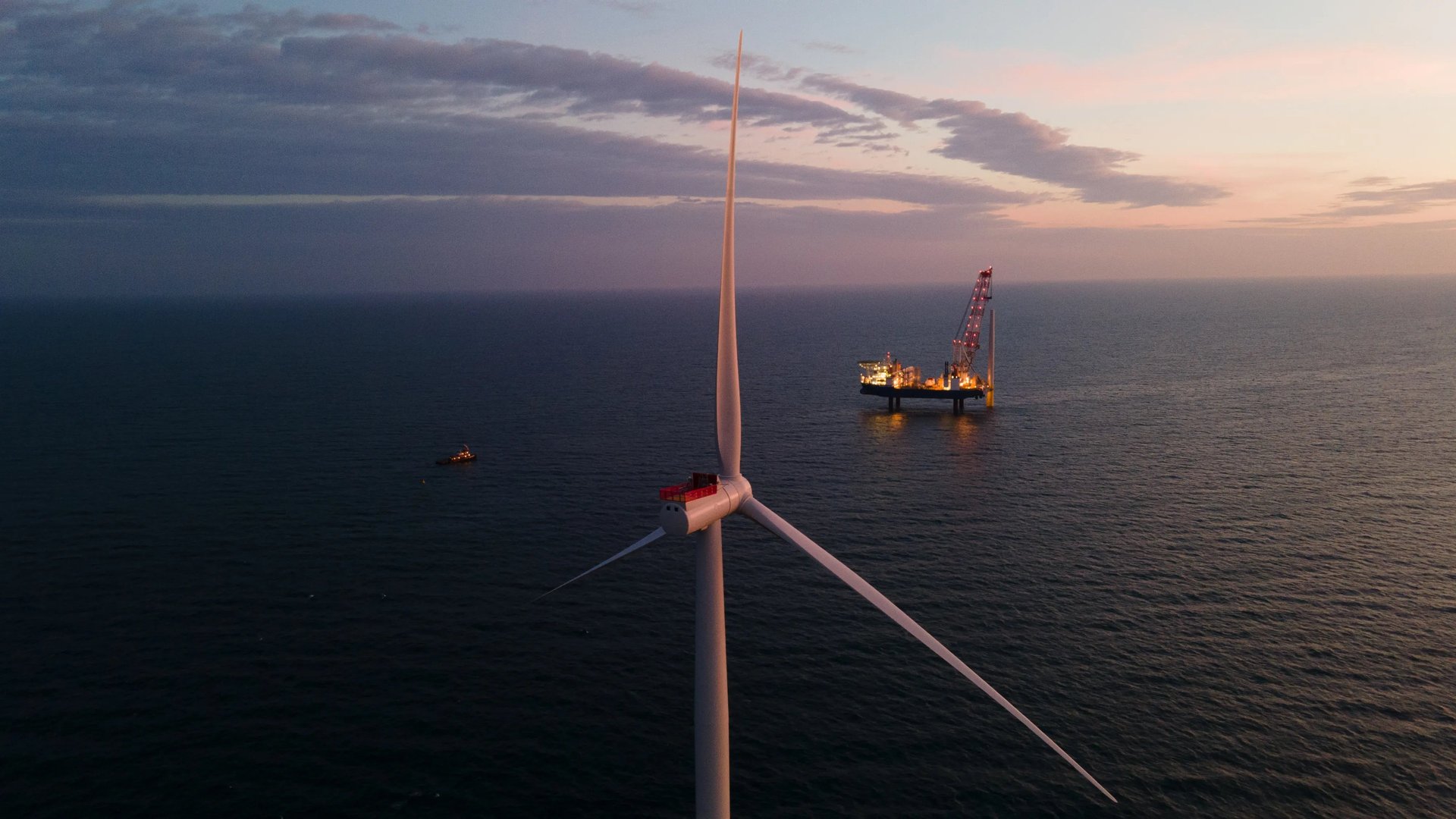
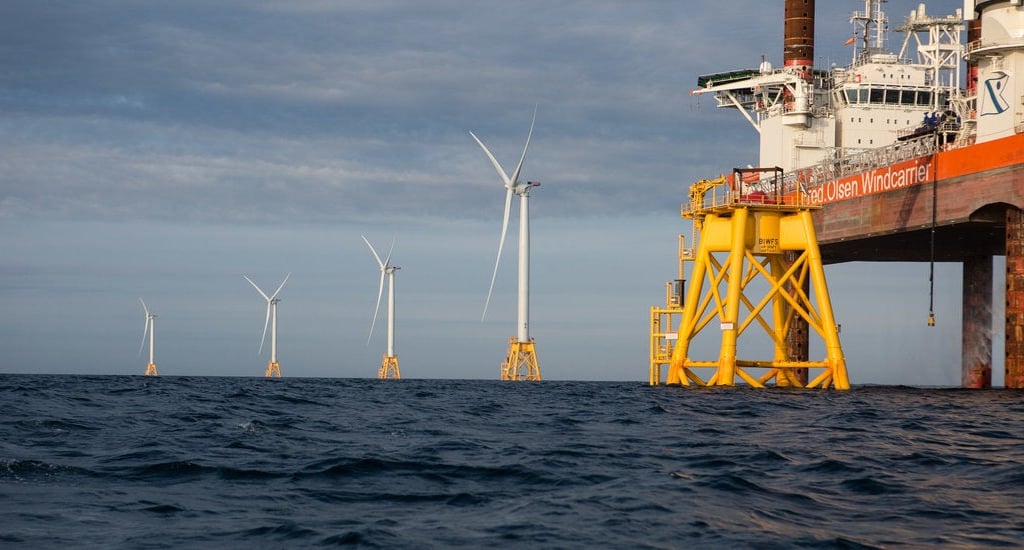
South Africa has emerged as a key hub for heavy industry, renewable energy development and maritime operations across the African continent. From the growing network of offshore wind farms along its coastlines to busy port facilities and deep-level mining operations inland, reliable power and data transmission form the backbone of productivity and safety. Within these sectors, vertical cable systems perform a critical yet often underappreciated role. Whether running inside wind turbine towers, feeding power to shipboard cranes or supporting monitoring equipment on tall infrastructure, these cables must operate reliably in conditions that push conventional designs to their absolute limits. Many project teams initially assume that standard horizontal reeling cables can be adapted for vertical use, only to face unexpected failures, costly downtime and safety risks. This article explores why vertical applications present such unique engineering demands, explains the mechanisms behind common failures and introduces the TRATOSLIGHT-VRDB® range – a family of cables purpose-engineered to solve the challenges of gravity, dynamic stress and harsh environmental conditions found across South Africa.
Vertical vs Horizontal Reeling Cables: Core Differences and Local Challenges
To understand why specialised cables are required, it is first necessary to recognise the fundamental differences between vertical and horizontal installations, as well as the specific operating conditions found in South Africa. In horizontal applications such as gantry cranes or conveyor systems, cables are subjected primarily to repeated bending and twisting as they move back and forth. Tensile forces are usually low and intermittent, acting only when the cable is pulled taut or accelerated. Vertical systems, by contrast, operate under entirely different physical conditions. Here, the most significant load comes from the cable’s own weight, creating a continuous axial tension that acts on every centimetre of the conductor and insulation. Over time, this static force drives material deformation and fatigue in ways that horizontal cables are not designed to resist.
South Africa adds further complexity through its diverse and demanding climate. Coastal regions experience high humidity, salt-laden air and intense ultraviolet radiation, all of which accelerate material ageing. Inland mining areas face wide temperature swings, from freezing nights in winter to scorching heat during summer, combined with abrasive dust and high winds. At heights or depths, such as inside wind turbine towers or mine shafts, temperature stratification and air movement can create fluctuating thermal conditions that place additional stress on cable components. In offshore wind developments, cables must also withstand the constant vibration and sway caused by strong prevailing winds and ocean swells. These environmental factors amplify the effects of mechanical loading, making correct cable selection even more critical.
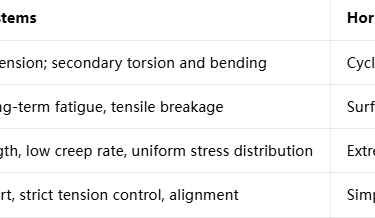
The following table summarises the key differences between the two application types and the resulting design priorities:
From this comparison, it becomes clear that specifying a cable designed for horizontal use in a vertical installation is not simply a matter of over-sizing or increasing safety factors – it involves applying a product whose fundamental structural and material characteristics are mismatched to the operating environment.
Why Standard Horizontal Cables Fail in Vertical Service
Many operators in South Africa have experienced costly failures after deploying standard horizontal reeling cables in vertical setups. These issues rarely appear immediately; instead, they develop gradually over weeks or months, making them difficult to predict until permanent damage has occurred. The root cause lies in the conflict between the design intent of these cables and the physical realities of vertical operation. Horizontal cables are constructed using materials and geometries optimised for flexibility and resistance to repeated bending. Conductors are usually sized for current-carrying capacity rather than mechanical strength, and insulation and sheathing compounds are chosen for their ability to deform elastically under cyclic loads. While ideal for horizontal motion, these properties become liabilities when subjected to sustained gravity-induced tension.
One of the most common failure modes is progressive elongation caused by polymer creep. All plastics and elastomers will slowly deform under constant stress, a process known as creep. In horizontal use, stresses are temporary, so creep does not accumulate to problematic levels. In vertical installations, however, the load is permanent. Over time, the insulation and jacket materials stretch, causing the overall length of the cable to increase. As elongation progresses, the copper conductors are pulled beyond their safe working limits. Copper is a ductile material, but once stretched past a certain threshold, its internal crystalline structure begins to break down, creating microscopic defects. When this weakened conductor is then subjected to the dynamic forces caused by wind sway or equipment movement, fatigue cracks form and propagate rapidly. In many documented cases across South African sites, this sequence of events has led to complete conductor breakage within six to twelve months of installation, even when cables were operated well within their electrical ratings.
Insulation performance also suffers. As polymer materials creep, their thickness reduces and their physical properties change. The gradual thinning of insulation layers increases the risk of electrical breakdown, while changes in molecular structure can reduce resistance to heat, chemicals and environmental ageing. In extreme cases, differential movement between the conductors and surrounding layers causes internal abrasion, further accelerating insulation failure. Taken together, these mechanisms create what can be described as a gravity stress paradox: the very features that make horizontal cables effective in their intended role – flexible materials and lightweight construction – become the cause of premature failure when gravity becomes the dominant force. This is why vertical applications require cables built from the ground up with entirely different engineering principles.
Solving the Gravity Stress Paradox: The TRATOSLIGHT-VRDB® Solution
Feichun Cables has developed the TRATOSLIGHT-VRDB® range specifically to address the challenges of vertical operation, drawing on decades of experience in heavy industrial and renewable energy sectors. Every element of the design has been reimagined to withstand sustained tension, dynamic loading and harsh environmental conditions, effectively resolving the conflicts that cause standard cables to fail. The solution rests on five key technical innovations, each addressing a specific aspect of the gravity stress paradox.
At the heart of the design is a reinforced central strength member. Unlike conventional cables where conductors carry both electrical current and mechanical load, TRATOSLIGHT-VRDB® incorporates a high-tensile central element capable of bearing the entire weight of the cable and any additional dynamic forces. This component is engineered to have a breaking strength comparable to steel wire rope but with a much smaller cross-section and lighter weight. By transferring axial loads away from the conductors and insulation, the strength member ensures that electrical components operate within stable mechanical conditions throughout their service life. The result is a system where permanent elongation is limited to less than 0.2% over 20 years – a dramatic improvement compared to the 3% to 5% typically seen in standard cables under similar loads.
Supporting this structural innovation is the use of Tratoslight-IR®, a proprietary engineering polymer developed specifically for high-stress vertical applications. This advanced thermoplastic polyester is formulated to exhibit extremely low creep characteristics, even when subjected to continuous tension at elevated temperatures. Its molecular structure is arranged to resist the chain slippage that causes deformation in conventional plastics, resulting in a creep rate roughly one-tenth that of standard PVC or rubber compounds. Beyond its mechanical performance, Tratoslight-IR® maintains stable electrical properties across a wide temperature range and offers excellent resistance to UV radiation, salt spray and chemical attack – essential qualities for South African operating environments.
Conductor design has also been fundamentally rethought. TRATOSLIGHT-VRDB® uses VDE 0295 Class 6 ultra-fine bare copper conductors, made from hundreds of individual strands measuring just 0.05 to 0.1 millimetres in diameter. This construction delivers two important benefits. First, the high number of strands means that tensile loads are distributed across thousands of individual copper sections, significantly reducing stress concentration and preventing the formation of fatigue cracks. Even if a small number of strands break due to unexpected overloads, the remaining conductors continue to carry current safely. Second, the fine-stranded design provides exceptional flexibility, allowing the cable to navigate small radius bends and operate smoothly at high reeling speeds without imposing excessive strain on internal components.
To address the twisting forces that occur when vertical cables sway or oscillate, TRATOSLIGHT-VRDB® includes an integrated anti-torsion braid embedded within the cable structure. This layer consists of high-strength synthetic or metallic filaments arranged at precise angles to create a self-stabilising effect. When the cable begins to twist under the influence of gravity-induced movement, the braid generates opposing forces that limit rotation to less than 360 degrees per metre. This suppression of torsional stress prevents the spiral distortion that often damages standard cables and ensures that internal components remain correctly aligned even during prolonged periods of vibration or sway.
For applications requiring both power and data transmission, the TRATOSLIGHT-VRDB-FO® variant adds optional integrated fibre optic capability. Between 6 and 24 optical fibres are embedded within the cable core during manufacture, protected by dedicated buffer tubes and strengthening elements. This integrated approach eliminates the need for separate signal cables, reducing overall installation complexity and cutting total system weight by between 30% and 40% – a significant advantage in long vertical runs where every kilogram adds to the load. More importantly, these fibres enable real-time structural health monitoring, allowing operators to measure strain, temperature and vibration along the entire length of the cable. This data can be used to detect early signs of stress or damage, supporting predictive maintenance strategies and reducing the risk of unexpected failures.
Technical Performance and Operational Advantages
The engineering innovations built into TRATOSLIGHT-VRDB® translate directly into measurable operational benefits across the full range of vertical applications found in South Africa. The range offers multi-core configurations from 18 to 54 cores, providing flexibility to suit everything from simple power feeds to complex control and communication systems. Core arrangements are carefully optimised to balance electrical performance with mechanical stability. Conductors and optical fibres are grouped into functional units and separated by specialised filler materials that maintain the cable’s circular profile even under tension. This symmetrical construction ensures uniform stress distribution and prevents the cable from developing a preferred bending plane, reducing fatigue during repeated movement.
Performance has been validated for high-speed operation, making the cables suitable for the demanding duty cycles of modern cranes and hoists. TRATOSLIGHT-VRDB® can operate at hoist drum speeds up to 300 metres per minute and cable haulage speeds of 180 metres per minute, while maintaining stable electrical characteristics and mechanical integrity. This capability supports faster cycle times and higher productivity without compromising safety or service life. Even at these speeds, the combination of high-tensile strength member, fine-stranded conductors and anti-torsion braid ensures that dynamic loads are managed effectively and internal components remain undamaged.
Thermal performance is equally impressive, with the cables designed to operate reliably across a temperature range of -25°C to +80°C. This wide operating window covers the extreme conditions found in South Africa, from cold high-altitude locations to heat-affected zones inside turbine towers or mining shafts. Unlike some materials that become brittle at low temperatures or soften excessively at high heat, Tratoslight-IR® insulation maintains consistent mechanical and electrical properties throughout the range. Furthermore, careful selection of materials ensures that all components have closely matched coefficients of thermal expansion. This minimises internal stress when temperatures change, preventing the separation or relative movement of layers that can occur in less well-engineered designs.
These technical capabilities have been proven in real-world conditions, with more than 500 successful installations completed globally to date. In South Africa specifically, TRATOSLIGHT-VRDB® cables have been deployed across a diverse range of sites. In offshore wind farms, they provide reliable power and monitoring connections inside turbine towers, where they withstand continuous sway, salt spray and temperature variations. At major port facilities, they supply power to shipboard and gantry cranes, operating safely through thousands of lifting cycles per year. In mining applications, they deliver power and data down shaft systems hundreds of metres deep, performing reliably in dusty, humid and thermally variable environments. Each installation demonstrates how purpose-engineered design can overcome the limitations of standard products.
Comparative Analysis: TRATOSLIGHT-VRDB® vs Standard Horizontal Cables
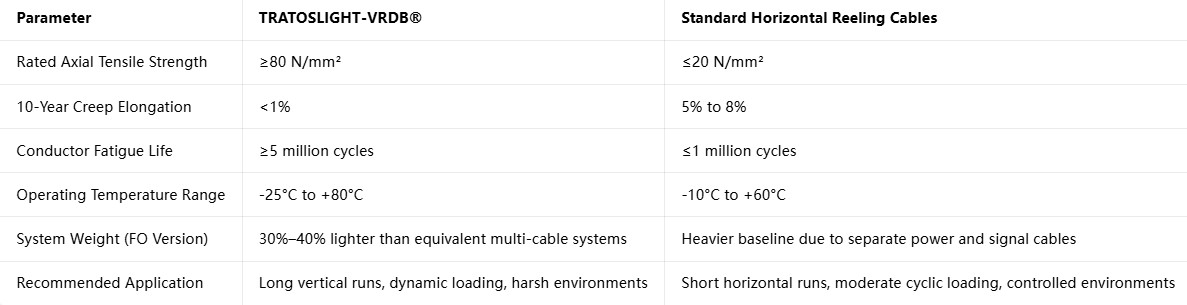
To fully appreciate the performance advantages of the TRATOSLIGHT-VRDB® range, it is helpful to compare its key characteristics against those of conventional horizontal reeling cables. The following table highlights the most important differences in terms relevant to specification engineers and project managers:
These figures clearly illustrate the performance gap. The significantly higher tensile strength rating means TRATOSLIGHT-VRDB® can safely support its own weight over much greater lengths without risk of damage. The vastly improved creep performance ensures that cable length remains stable over decades, eliminating the need for regular tensioning or adjustment. Longer fatigue life translates directly into reduced maintenance requirements and extended service life, while the wider temperature range allows use across more diverse locations. Where fibre optic integration is utilised, the weight reduction not only lowers mechanical loading but also simplifies installation logistics and reduces material costs.
Long-Term Behaviour and Performance Guarantees
One of the most common concerns raised by project engineers is how cables will perform over their full design life, particularly given the time-dependent nature of creep and fatigue processes. Feichun Cables addresses this through a rigorous programme of material testing and computer modelling. Long-term performance is predicted using mathematical models that integrate laboratory data on material behaviour with the physical characteristics of the cable design. These models take into account key variables including stress level, operating temperature, frequency of movement and environmental conditions, allowing accurate forecasts of performance over periods of 20 years or more.
Based on this analysis, Feichun offers formal performance guarantees for TRATOSLIGHT-VRDB® cables, giving specifiers and operators confidence in their investment. Under defined operating conditions, the cables are guaranteed to show no more than 1.5% permanent elongation after 20 years of service, ensuring that electrical and mechanical performance remains within original specifications. Conductor fatigue life is guaranteed to exceed 5 million cycles under normal operating loads, a figure five times higher than typical standard cables. Even in the harshest environments, insulation resistance is expected to remain above 80% of its initial value after two decades, confirming the stability of Tratoslight-IR® material. These guarantees are backed by extensive accelerated ageing tests conducted in-house and through independent third-party laboratories, mirroring the conditions found in South African installations.
Installation, Maintenance and Emergency Procedures
Even the best-engineered cables will only perform as expected if installed and maintained correctly. Feichun has developed comprehensive guidelines specifically for vertical applications, drawing on experience from hundreds of projects worldwide. During installation, route planning is critical. Where possible, cable paths should be straight and free from obstructions, with support points spaced at intervals no greater than 20 metres to limit unsupported length and reduce tension at individual fixings. Tension control is equally important; pulling forces during installation should never exceed 15% of the cable’s rated breaking strength, and final operating tension should be kept below 25% to maximise service life. Minimum bend radii of eight times the cable diameter must be observed to prevent damage to internal components, particularly the anti-torsion braid and optical fibres where fitted.
For ongoing maintenance, a simple but effective programme is recommended. Visual inspections should be carried out every six months, looking for signs of sheath damage, excessive elongation or twisting. Electrical testing, including measurement of insulation resistance and conductor continuity, should be performed every two years to identify potential issues before they become critical. Where TRATOSLIGHT-VRDB-FO® cables are installed, the integrated fibre system allows continuous remote monitoring. By analysing strain, temperature and vibration data, operators can detect abnormal conditions immediately, enabling proactive intervention rather than reactive repair. This capability is particularly valuable in remote or hard-to-access locations common in South Africa.
In the event of damage or failure, clear emergency procedures have been established. Fault location is simplified using either traditional electrical test methods or the built-in fibre system, allowing rapid identification of the problem area. Minor damage to the outer sheath can often be repaired using purpose-designed materials, restoring environmental protection without needing to replace the entire length. For more serious issues, replacement cables can be installed following the same procedures as for new projects, with tension monitoring ensuring that the new installation meets specification. Detailed documentation and technical support are available from Feichun Cables to guide maintenance teams through every stage of the process.
Frequently Asked Questions
Q: Can TRATOSLIGHT-VRDB® cables be retrofitted into existing systems originally designed for standard cables?
A: In most cases, yes. Because the cables are lighter and have smaller outer diameters for equivalent current ratings, they can usually be installed using existing infrastructure such as guides, drums and fixings. However, it is advisable to conduct a review of the system’s mechanical capacity to ensure it is suitable for the improved performance characteristics.
Q: What is the maximum length of cable that can be supplied in a single continuous length?
A: Lengths up to 2,000 metres can be manufactured and supplied as a single continuous length, depending on the exact configuration and core count. This makes the cables suitable for even the tallest wind turbine towers or deepest mine shafts found in South Africa.
Q: Is the fibre optic system compatible with standard industry monitoring equipment?
A: Yes. The optical fibres used conform to international standards and are compatible with all commonly available optical sensors, interrogators and data acquisition systems. Feichun can advise on suitable equipment partners and integration approaches.
Q: How do the cables perform in coastal environments with high salt levels?
A: All materials used in TRATOSLIGHT-VRDB® are selected for excellent resistance to salt corrosion. Extensive testing has shown no significant degradation after years of continuous exposure to marine atmospheres, making them ideal for offshore wind and port applications.
Q: Are custom core configurations available for specialised applications?
A: Absolutely. Feichun can tailor the exact number, size and type of cores to meet specific project requirements, whether that involves combining power conductors, control cores, coaxial cables or specialised fibre types. This flexibility ensures that every installation gets a cable perfectly matched to its needs, eliminating unnecessary complexity and reducing overall system cost.
Conclusion
Vertical cable systems are among the most challenging applications in modern electrical engineering, and nowhere is this truer than across South Africa’s diverse industrial landscape. The combination of sustained gravity loading, dynamic movement and harsh environmental conditions creates an operating environment that standard horizontal cables are simply not designed to survive. As we have explored, the consequences of using the wrong type of cable are serious: progressive elongation, insulation breakdown and sudden conductor failure can lead to costly downtime, lost productivity and potential safety hazards.
Through the TRATOSLIGHT-VRDB® range, Feichun Cables has addressed every aspect of these challenges with a holistic engineering approach. By rethinking almost every element of cable design – from the high-tensile central strength member and low-creep insulation material to the ultra-fine stranded conductors and anti-torsion braiding – it has been possible to resolve the gravity stress paradox and deliver reliable long-term performance. The optional integration of optical fibres takes this a step further, transforming the cable from a simple power transmission component into an intelligent monitoring system capable of safeguarding both the cable itself and the wider infrastructure it serves.
The benefits are clear to see across hundreds of installations globally and a growing number here in South Africa. Longer service life, reduced maintenance, improved safety and lower total cost of ownership all combine to make TRATOSLIGHT-VRDB® the logical choice for engineers and project managers looking to mitigate risk and maximise performance. Whether you are developing a new offshore wind farm, upgrading port infrastructure or improving mining operations, choosing the right cable is one of the most important decisions you will make – and with TRATOSLIGHT-VRDB®, you can be confident that you have selected a solution built specifically for the job.
If you would like to learn more about the TRATOSLIGHT-VRDB® and TRATOSLIGHT-VRDB-FO® ranges, discuss a specific project requirement or request a formal quotation, please get in touch with the Feichun Cables team directly. Our experienced engineers are available to provide technical advice, detailed specifications and full support from initial concept through to final installation.
📧 Contact us at: Li.wang@feichuncables.com
We look forward to helping you find the ideal cabling solution for your vertical application in South Africa and beyond.

Email Address: Li.wang@feichuncables.com
© 2025. All rights reserved.
One-click to Quickly Contact
Products
Contact
Company
Location:
Building A Private Science and Technology Park, Hefei Economic and Technological Development Zone, Anhui Province, China
Heat Resistant Cable
WhatsApp: +86 17333223430
Social Media: