Anhui Feichun Special Cable Co.,Ltd Email: Li.wang@feichuncables.com
What Are the Key Differences Between Type W and Type G Cables? Which One Should You Choose for Industrial and Mining Applications in South Africa?
Explore the differences between Type W and Type G cables in South Africa. Learn their technical specs, applications in mining and industry, grounding features, flexibility, and expert installation tips. Choose the right cable for your project.
Li Wang
12/29/20256 min read
Why Compare Type W and Type G Cables?
In South Africa’s industrial and mining sectors, choosing the right power cable can significantly affect both operational efficiency and safety. Among the most commonly used industrial-grade cables are Type W and Type G cables. Both are rugged, flexible, and designed to perform reliably under harsh conditions, but subtle differences in construction and application can make one more suitable than the other depending on the specific industrial or mining scenario.
Type W and Type G cables are popular because they balance mechanical durability, electrical performance, and environmental resistance. In mines across Rustenburg, Witbank, and Johannesburg, for instance, these cables are often tasked with powering heavy-duty pumps, conveyor systems, and portable industrial equipment. Understanding their similarities and differences is essential for engineers, safety officers, and procurement teams looking to optimize operations and comply with South African safety standards.
South African mining and industrial environments present unique challenges: high temperatures, chemical exposure, dust, water, and the need for robust grounding. Selecting the appropriate cable—Type W or Type G—ensures reliable power delivery, compliance with standards such as MSHA, UL, CSA, and RoHS, and extended service life.
What Is Type W Cable and Where Is It Used?
Type W cable is often described as the workhorse of industrial portable power. It is versatile, durable, and suitable for temporary or semi-permanent applications. Its construction allows it to endure extreme conditions while maintaining flexibility for portable setups.
What Are the Technical Specifications of Type W Cable?
Type W cables are typically rated for 2,000 volts, with EPDM (ethylene propylene diene monomer) rubber insulation providing excellent thermal and chemical resistance. The conductors are fully annealed Class K stranded copper per ASTM B174, ensuring excellent flexibility and current-carrying capacity.
Conductor Sizes: Type W cables range from 8 AWG to 500 MCM, with options for single- or multi-conductor configurations (up to 5 conductors).
Ampacity: A notable advantage of Type W cables over SOOW equivalents is higher ampacity. For example, an 8 AWG, 3-conductor Type W cable can carry 74 amps, whereas a similar SOOW cable carries only 40 amps.
Temperature Range: -40°C to +90°C, suitable for South Africa’s variable climate and mine temperatures.
Grounding: Type W features a single green ground wire, standard across all conductor configurations.
Flexible single- and multi-conductor options make Type W ideal for temporary setups, such as entertainment events or portable industrial equipment.
What Are the Common Applications of Type W Cable in South Africa?
Type W cables find use in various industrial and mining scenarios:
Mining: Light- to medium-duty operations, mobile workshops, temporary power distribution.
AC Systems and Warehouses: Providing reliable power supply to machinery and lighting systems.
Entertainment Industry: Stage lighting, video production, mobile communication vans, and sound systems for events such as the Johannesburg Festival.
Welding and Heavy Equipment Applications: Supplying power to welding machines, compressors, and other portable equipment.
Environmental Resistance: Type W cables withstand oils, acids, alkalis, heat, moisture, and most chemicals, making them suitable for South African industrial and mining environments where equipment may encounter harsh conditions.
Type W cables are prized for their combination of flexibility, durability, and ease of handling, especially in temporary setups requiring frequent movement.
What Is Type G and G-GC Cable and Where Is It Used?
Type G and G-GC cables are heavy-duty, multi-conductor industrial cables designed for enhanced safety through additional grounding features. They are widely used in mining and industrial applications where robust grounding and impact resistance are critical.
What Are the Technical Specifications of Type G and G-GC Cable?
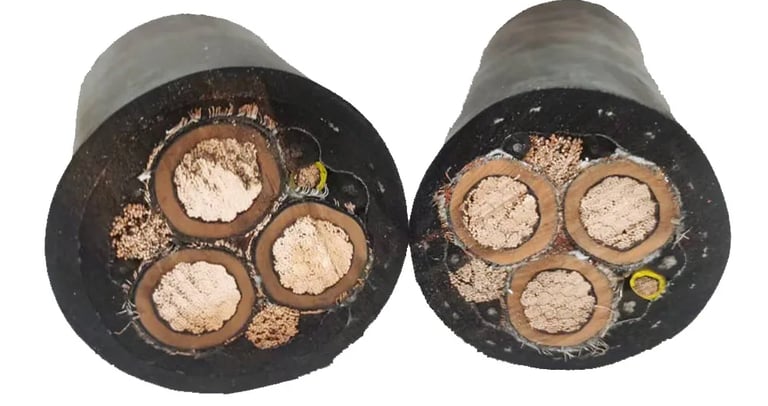
Conductor and Ground Wire Configuration: Type G has additional ground wires corresponding to each main conductor. Type G-GC features a ground-check conductor, providing a built-in safety mechanism to ensure proper grounding.
Voltage Rating: Both Type G and G-GC cables are rated at 2,000 volts.
Insulation: EPDM rubber insulation provides resistance to high temperatures, oils, chemicals, and mechanical wear.
Temperature Tolerance: -40°C to +90°C.
Flexibility: Rope-lay stranding maximizes cable flexibility and lifespan, essential for portable power in industrial and mining setups.
The additional grounding makes Type G cables ideal for safety-critical applications, where grounding failures could lead to equipment damage or electrical hazards.
What Are the Applications of Type G Cables in South Africa?
Type G and G-GC cables are particularly suited for:
Mining Equipment: Pumps, conveyors, and shuttle cars, often operating in underground or open-cast mines where reliability and safety are paramount.
Portable Industrial Power: Temporary distribution of power for maintenance, workshops, and mobile machinery.
Ground Check Requirements: Applications requiring continuous monitoring of grounding integrity, often in high-risk environments.
Type G cables are typically preferred for heavy-duty, high-safety applications, while Type W is more versatile for lighter-duty or portable setups.
What Are the Main Similarities Between Type W and Type G Cables?
Despite their differences, Type W and Type G cables share many characteristics that make them reliable for South African industrial and mining conditions:
Voltage Rating: Both rated at 2,000 volts.
EPDM Insulation: Provides excellent chemical, heat, and mechanical resistance.
Temperature Tolerance: Operate effectively from -40°C to +90°C.
Durability and Flexibility: Heavy-duty construction suitable for portable and semi-permanent applications.
Standards Compliance: UL, CSA, MSHA, and RoHS certified.
Environmental Resistance: Resistant to abrasion, oils, chemicals, UV, water, and mechanical impact.
Water and Marine Suitability: Both can be used for water-submersible and industrial marine applications.
In essence, both cable types are robust, flexible, and reliable, capable of powering industrial and mining equipment under challenging South African conditions.
What Are the Key Differences Between Type W and Type G Cables?
While similar, the choice between Type W and Type G hinges on grounding, flexibility, and application suitability.
How Do Ground Wires Affect Their Use?
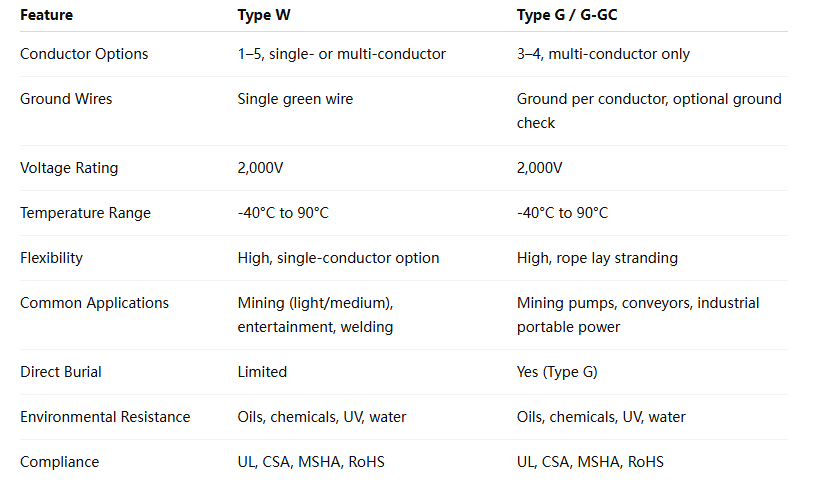
Type W: Single standard green ground wire for all conductors.
Type G: Additional ground wires for each conductor; G-GC includes a ground-check wire.
Impact: Type G cables offer enhanced grounding for safety-critical systems. This is particularly important in mining and industrial environments where electrical faults can cause equipment damage or safety hazards.
Are There Differences in Flexibility and Burial Applications?
Flexibility: Type G and G-GC cables are generally more flexible due to rope-lay stranding.
Burial Applications: Type G is often rated for direct burial, making it suitable for permanent installations in mines or industrial sites. Type W single-conductor options are less suited for burial but ideal for portable setups.
Which Applications Prefer Type W vs. Type G?
Type W: Entertainment, stage lighting, temporary industrial power, light- to medium-duty mining.
Type G: Mining pumps, conveyors, heavy-duty grounded systems, portable or permanent industrial power installations requiring ground monitoring.
Comparative Table: Type W vs Type G Cables
Installation Recommendations for Type W and Type G Cables
Proper installation maximizes cable lifespan and ensures operational safety.
Type W: Ideal for portable setups. Avoid long-term burial or exposure to sharp mechanical stress. Coil carefully to prevent kinking and damage to the single ground wire.
Type G: Suitable for heavy-duty and permanent installations, including direct burial. Ensure all ground wires are correctly connected and monitored, particularly with G-GC cables.
General Tips:
Avoid dragging across sharp edges.
Inspect regularly for abrasion, chemical damage, or heat stress.
Store in a cool, dry area when not in use.
South African Applications
Type W Cable in South African Mining and Entertainment
Mining Workshops: Temporary power distribution in light- to medium-duty operations in Johannesburg and Rustenburg.
Entertainment Industry: Stage lighting and temporary video setups at Johannesburg festivals. The flexibility and portability of Type W make it ideal for setups that require frequent movement and handling.
Type G Cable in Heavy-Duty Mining Applications
Platinum Mines in Rustenburg: Conveyor systems powered by Type G cables, providing reliable grounding and flexibility for mobile heavy equipment.
Mobile Pumps: G-GC cables ensure ground integrity monitoring, essential for operational safety in water-intensive environments.
FAQ: Type W and Type G Cables
Q: Can Type W cable be used for permanent industrial power supply?
A: While possible for light-duty installations, Type W is primarily designed for portable and temporary setups. Type G is preferred for permanent installations.
Q: What is the difference between Type G and G-GC cables?
A: G-GC cables include a ground-check conductor for monitoring grounding integrity, enhancing safety in critical industrial applications.
Q: Are Type W and Type G cables suitable for water submersion?
A: Yes, both are suitable for water-submersible and industrial marine applications, but proper installation is essential to maintain insulation integrity.
Q: Which cable is safer for mining applications?
A: Type G and G-GC are generally safer due to additional ground wires and optional ground-check features.
Q: How do I choose between Type W and Type G cables for my site?
A: Consider application type, grounding requirements, flexibility needs, and whether the installation is temporary or permanent. For heavy-duty mining, pumps, or conveyors, Type G is preferred. For portable power or entertainment setups, Type W is more suitable.
Conclusion and Recommendations
In South Africa’s demanding industrial and mining environments, Type W and Type G cables each offer unique advantages.
Type W: Portable, versatile, suitable for temporary power setups, entertainment, light- to medium-duty mining, and mobile workshops.
Type G / G-GC: Heavy-duty, flexible, optimized for permanent installations, mining pumps, conveyors, and applications requiring enhanced grounding and safety monitoring.
By understanding the technical specifications, grounding configuration, and environmental resistance, South African engineers and procurement teams can select the most appropriate cable for their operations, ensuring both safety and efficiency.
Contact Feichun today for expert advice on selecting, supplying, and installing Type W and Type G cables for industrial and mining applications in South Africa.


Email Address: Li.wang@feichuncables.com
© 2025. All rights reserved.
One-click to Quickly Contact
Products
Contact
Company
Location:
Building A Private Science and Technology Park, Hefei Economic and Technological Development Zone, Anhui Province, China
Heat Resistant Cable
WhatsApp: +86 17333223430
Social Media: