Anhui Feichun Special Cable Co.,Ltd Email: Li.wang@feichuncables.com
What Is DIN VDE NGFLGÖU CRANEFLEX Crane Cable and Where Is It Best Used?
DIN VDE NGFLGÖU CRANEFLEX is a high-flex flat crane cable designed for festoon systems, cranes, conveyors and elevators. This in-depth guide explains its construction, standards, performance, applications, and why Feichun NGFLGÖU is trusted in demanding industrial environments, including South African material-handling projects.
Li.Wang
1/6/20266 min read
Introduction
Modern cranes, hoists, and material-handling systems demand far more from cables than simple power transmission. In industries such as mining, ports, steel processing, and manufacturing, cables are subjected to continuous movement, tight installation spaces, high mechanical stress, and harsh environmental conditions.
This is where DIN VDE NGFLGÖU – CRANEFLEX crane cable stands out.
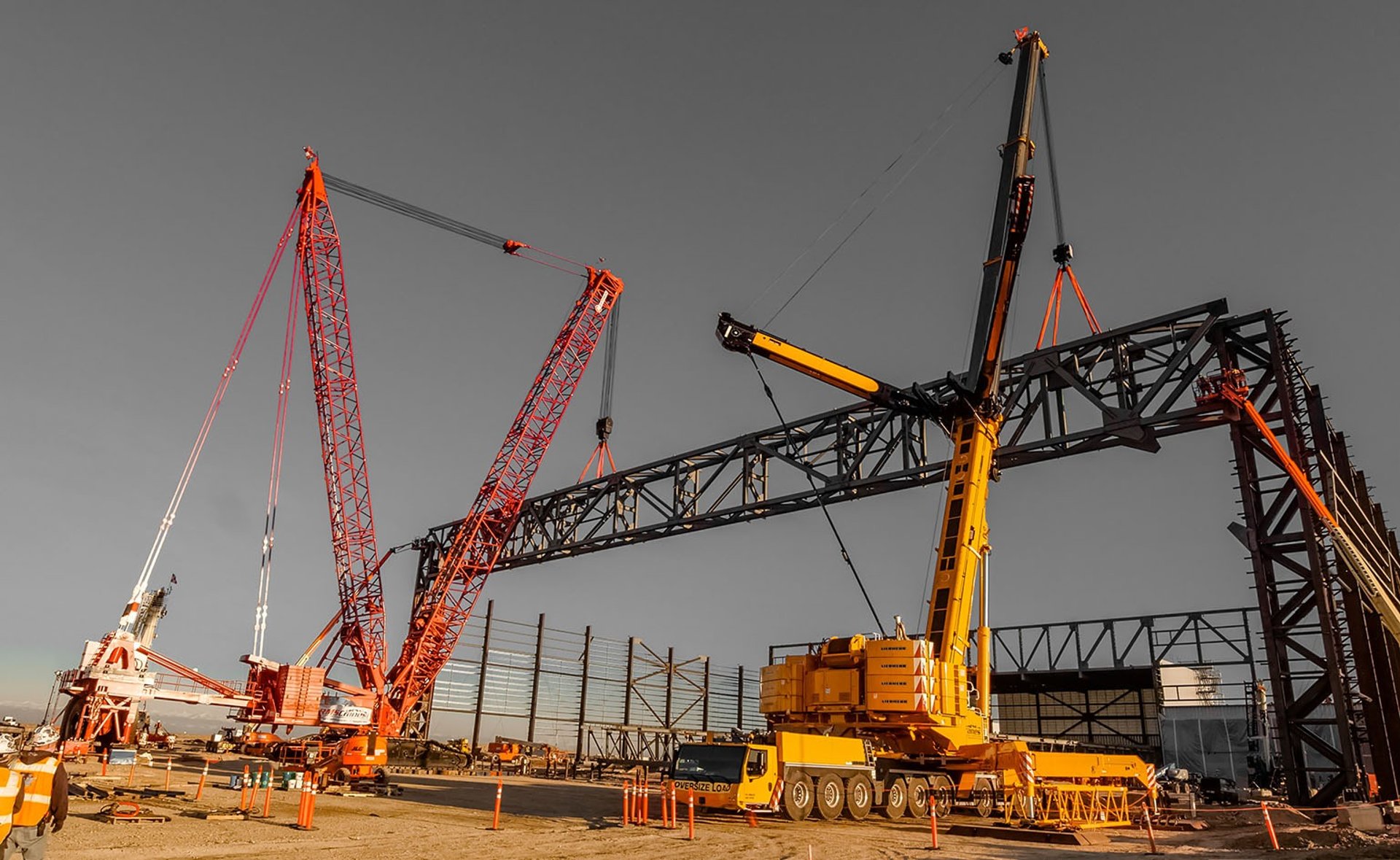
Designed specifically for festoon systems and moving applications, NGFLGÖU is a flat, highly flexible rubber crane cable that combines compact geometry with excellent mechanical endurance. In South Africa, where cranes and conveyors operate in dusty mines, coastal ports, and high-temperature industrial plants, selecting the right crane cable is not optional—it is critical for safety, uptime, and cost control.
This article provides a deep technical and practical explanation of Feichun DIN VDE NGFLGÖU – CRANEFLEX, covering construction, standards, electrical performance, flexibility, selection principles, installation practices, and real-world application insights relevant to South African users.
What Is Feichun DIN VDE NGFLGÖU – CRANEFLEX Cable?
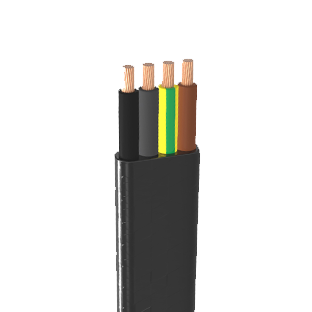
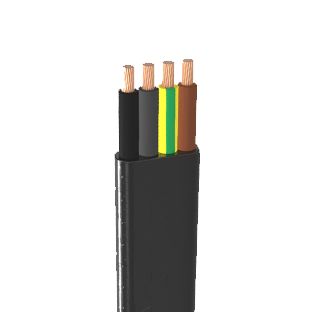
DIN VDE NGFLGÖU is a rubber-insulated, rubber-sheathed flat crane cable manufactured in accordance with DIN VDE 0250-809. The CRANEFLEX designation highlights its optimisation for continuous flexing, small bending radii, and restricted installation spaces.
Feichun NGFLGÖU is primarily intended for:
Cranes and hoisting systems
Festoon systems
Floor conveyor lines
Elevators and lifting platforms
Its flat geometry allows the cable to travel smoothly on trolleys without twisting, overlapping, or excessive mechanical stress—issues commonly encountered with round crane cables.
Is NGFLGÖU a flat cable or a round crane cable?
NGFLGÖU is a flat cable, not a round one.
The conductors are arranged in a parallel configuration, forming a rectangular cross-section. This flat design is essential for:
Stable movement in festoon systems
Even load distribution during travel
Reduced torsional stress
In contrast, round cables may rotate or twist during motion, leading to uneven wear and premature failure in high-speed crane systems.
Why is the CRANEFLEX design optimised for limited installation space?
Many modern cranes, especially overhead and gantry cranes, have very limited space for cable routing. The flat structure of NGFLGÖU:
Requires less vertical clearance
Allows smaller bending radii
Enables compact festoon layouts
This makes CRANEFLEX particularly suitable for retrofits or installations where expanding cable trays or festoon rails is not feasible.
What Are the Typical Applications of NGFLGÖU CRANEFLEX Crane Cable?
Why is NGFLGÖU widely used in cranes and hoisting systems?
Cranes involve repeated acceleration, deceleration, and direction changes. NGFLGÖU is engineered to handle:
Continuous flexing
High tensile loads during travel
Mechanical shocks during crane operation
With a travel speed of up to 180 m/min in festoon systems, Feichun NGFLGÖU supports fast, efficient material handling without compromising cable life.
How does it perform in festoon systems and conveyor lines?
In festoon systems, cable reliability depends on:
Smooth movement
Minimal bending stress
Stable cable geometry
The flat profile of NGFLGÖU ensures that each conductor experiences similar mechanical loads. This results in:
Reduced internal friction
Longer service life
Lower maintenance costs
In South African steel plants and port conveyor systems, this translates directly into improved operational uptime.
Is NGFLGÖU suitable for elevators and floor conveyor systems?
Yes. NGFLGÖU is frequently used in:
Industrial elevators
Automated floor conveyors
Transfer cars and lifting platforms
Its small bending radius and excellent flexibility allow it to operate reliably in vertical and horizontal movement systems where space and motion cycles are constrained.
How Is DIN VDE NGFLGÖU CRANEFLEX Cable Constructed?
What type of conductor is used and why does it matter?
Feichun NGFLGÖU uses fine-stranded copper conductors:
Up to 25 mm²: Class 6 (extra-flexible)
Above 25 mm²: Class 5 (flexible)
Class 6 conductors offer superior flexibility, making them ideal for continuous movement. For corrosive environments, tinned copper conductors are available on request, improving resistance to moisture and industrial atmospheres—an important consideration in coastal regions such as Durban and Richards Bay.
What role does the separator tape play in cable longevity?
A separator tape is applied over the conductor assembly to:
Prevent adhesion between insulation and conductors
Improve mechanical stability during flexing
Reduce internal abrasion
This small but critical design detail significantly enhances cable life under dynamic conditions.
Why is 3GI3 rubber used for insulation?
3GI3 rubber compound provides:
Excellent elasticity
High thermal stability
Strong resistance to mechanical fatigue
It maintains insulation integrity even under repeated bending and temperature fluctuations common in crane operations.
How does the 5GM3 elastomer sheath improve flexibility and durability?
The outer sheath is made from 5GM3 elastomer, offering:
High abrasion resistance
Oil and grease resistance
Good weather and ozone resistance
This makes NGFLGÖU suitable for harsh industrial environments, including mining and heavy manufacturing facilities across South Africa.
Which DIN VDE Standards Does NGFLGÖU CRANEFLEX Comply With?
Which construction and general standards apply to NGFLGÖU?
DIN VDE 0250-809 – Flat rubber crane cables
DIN VDE 0250-1 – General requirements
These standards define materials, construction principles, and performance expectations.
Which electrical and non-electrical tests ensure reliability?
NGFLGÖU undergoes extensive testing, including:
Electrical tests: DIN VDE 0472-501, 503, 508
Non-electrical tests: DIN VDE 0472-401, 402, 602, 303, 615
These ensure consistency, safety, and long-term reliability.
How is flame retardancy tested according to DIN and IEC standards?
The cable is flame-retardant according to:
DIN EN 60332-1-2
IEC 60332-1
VDE 0482-332-1-2
This is especially relevant in confined industrial spaces where fire risk must be strictly controlled.
Is NGFLGÖU oil-resistant and suitable for industrial environments?
Yes. Oil resistance is tested according to HD/EN/IEC 60811-2-1, ensuring compatibility with lubricants, hydraulic oils, and industrial contaminants.
What Are the Electrical and Operating Characteristics of NGFLGÖU?
What are the rated and maximum operating voltages?
Rated voltage: 300/500 V (0.6/1 kV)
Max AC voltage: 0.7/1.2 kV
Max DC voltage: 0.9/1.8 kV
This makes NGFLGÖU suitable for most low-voltage crane and control systems.
What temperature ranges can the cable safely operate in?
Fixed installation: –50 °C to +90 °C
Mobile installation: –35 °C to +90 °C
These ranges cover both cold outdoor environments and high-temperature industrial halls.
How does short-circuit temperature rating improve safety?
With a short-circuit temperature rating of 250 °C, NGFLGÖU maintains conductor integrity during fault conditions, reducing fire and equipment damage risks.
What tensile loads can the cable withstand in dynamic applications?
Static: 15 N/mm²
Dynamic: 30 N/mm²
This ensures safe operation under continuous movement and mechanical stress.
How Flexible Is NGFLGÖU CRANEFLEX During Movement?
What is the minimum bending radius and why is it critical?
The minimum bending radius follows VDE 0298-3, allowing significantly tighter bends than round cables. Smaller bending radii reduce space requirements and mechanical stress.
Why is NGFLGÖU suitable for continuous movement but not reeling drums?
NGFLGÖU is designed for linear movement, not torsional stress. Reeling drums introduce twisting forces, which flat cables are not intended to handle. For drum applications, round reeling cables are recommended.
How does flat cable geometry reduce mechanical stress?
Flat geometry distributes bending stress evenly across conductors, preventing localised fatigue and extending service life.
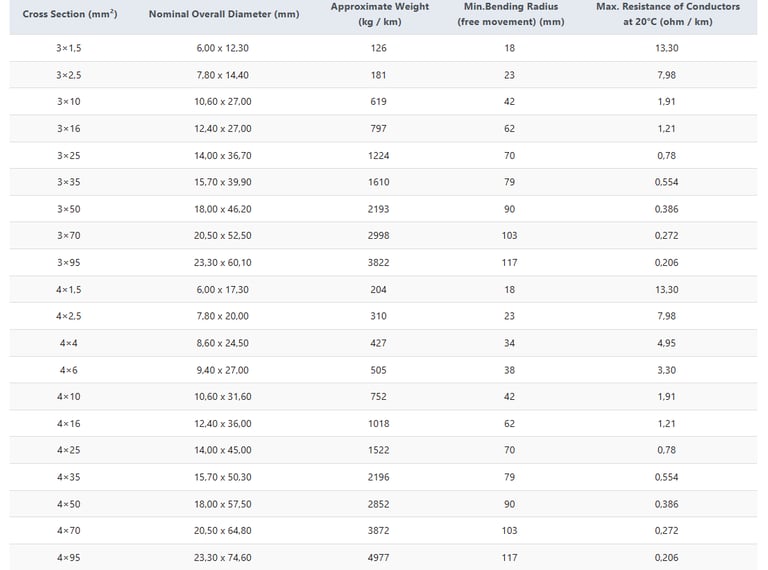
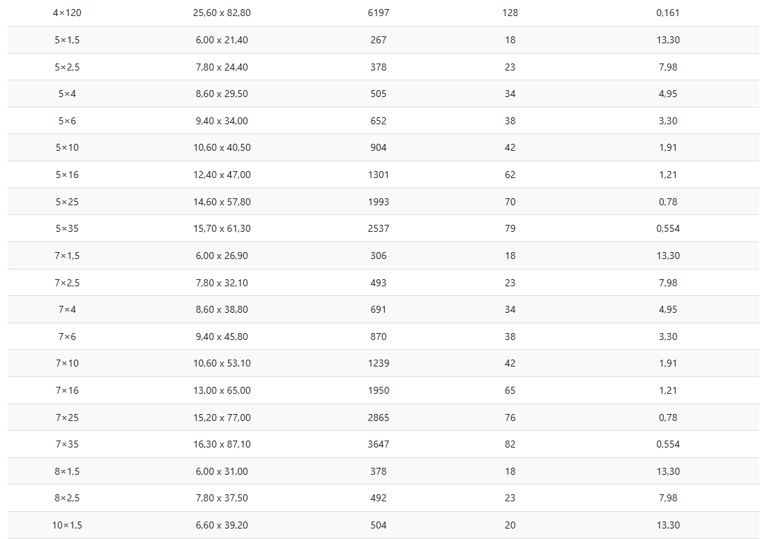
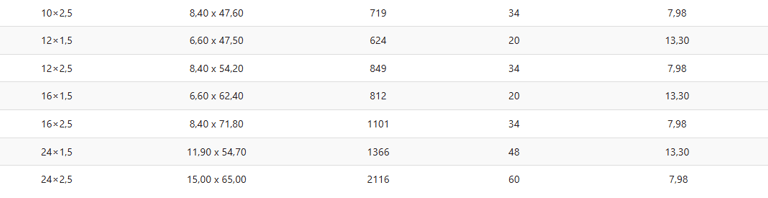
What Technical Specifications and Sizes Are Available?
Feichun NGFLGÖU is available in a wide range of configurations:
Core counts: 3 to 24 cores
Cross-sections: 1.5 mm² to 120 mm²
Dimensions, weights, bending radii, and conductor resistance values are carefully engineered to meet system design requirements and energy efficiency expectations.
How Do You Select the Right NGFLGÖU Size for Your Application?
How does current carrying capacity influence cable selection?
Current ratings must follow VDE 0298-4, considering ambient temperature and grouping factors.
Why should bending radius and cable weight be considered together?
Heavier cables increase trolley load and wear. Selecting the optimal cross-section balances electrical performance and mechanical efficiency.
What mistakes should be avoided during specification?
Common errors include:
Oversizing conductors unnecessarily
Ignoring bending radius constraints
Using flat cables for drum applications
What Are the Best Installation Practices for NGFLGÖU CRANEFLEX?
How should flat cables be installed in festoon systems?
Use proper cable trolleys
Maintain even spacing
Avoid sharp edges
What spacing and support recommendations improve service life?
Correct trolley spacing prevents sagging and uneven stress distribution.
How can improper installation reduce flexibility and durability?
Incorrect installation can negate the benefits of high-quality cable design, leading to early failure.
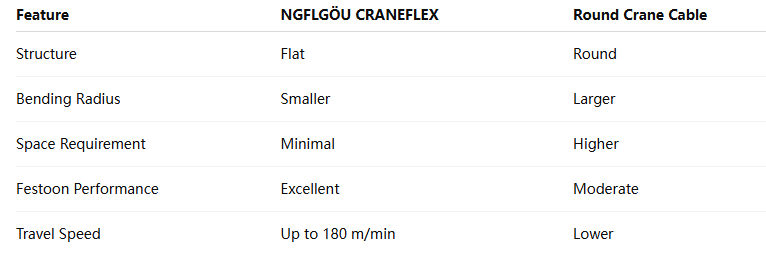
Can You Compare NGFLGÖU With Other Crane and Festoon Cables?
How does NGFLGÖU compare with rubber round crane cables?
NGFLGÖU excels in space-limited festoon systems, while round cables are better for torsional movement.
When is a flat crane cable the better engineering choice?
Flat cables are ideal when:
Space is limited
Movement is linear
High travel speed is required
Frequently Asked Questions About DIN VDE NGFLGÖU CRANEFLEX
Is DIN VDE NGFLGÖU suitable for continuous flexing applications?
Yes, it is specifically designed for continuous movement in festoon systems.
Can NGFLGÖU be used outdoors?
Yes, within the specified temperature range and with appropriate installation protection.
What is the service life compared to standard crane cables?
Typically longer due to reduced mechanical stress and optimised materials.
Is custom colour or tinned conductor available?
Yes, on request.
Why is NGFLGÖU not recommended for reeling drum operation?
Because flat cables are not designed for torsional stress.
Why Choose Feichun NGFLGÖU – CRANEFLEX Crane Cable?
How does Feichun ensure consistent DIN VDE compliance?
Feichun applies strict material control, in-house testing, and compliance verification to ensure every NGFLGÖU cable meets DIN VDE requirements.
What advantages does Feichun offer for OEM and project customers?
Technical selection support
Custom configurations
Reliable project delivery
Looking for a reliable flat crane cable for festoon or lifting systems?
👉 Contact Feichun Cable today to receive:
Professional technical support
Customised NGFLGÖU CRANEFLEX solutions
Competitive project-based quotations
Feichun NGFLGÖU – Engineered flexibility, proven reliability, and trusted performance for demanding crane applications.
Email Address: Li.wang@feichuncables.com
© 2025. All rights reserved.
One-click to Quickly Contact
Products
Contact
Company
Location:
Building A Private Science and Technology Park, Hefei Economic and Technological Development Zone, Anhui Province, China
Heat Resistant Cable
WhatsApp: +86 17333223430
Social Media: