Anhui Feichun Special Cable Co.,Ltd Email: Li.wang@feichuncables.com
What Makes Feichun DIN VDE (N)SHTÖU – FO (LWL) Crane Cable Ideal for Heavy-Duty Reeling Applications?
Explore the Feichun DIN VDE (N)SHTÖU – FO (LWL) crane cable, featuring fiber-optic integration, exceptional mechanical performance, and suitability for heavy-duty reeling operations. Learn installation tips, technical specifications, and South African case studies.
Li Wang
1/6/20265 min read
What is the Feichun (N)SHTÖU – FO (LWL) Cable and Where is it Used?
In modern industrial operations, cranes and heavy lifting systems are expected to perform reliably under extreme mechanical stress while transmitting both power and data. The Feichun DIN VDE (N)SHTÖU – FO (LWL) crane cable addresses these dual requirements, combining high-strength electrical conductors with integrated fiber-optic communication capabilities.
What Are the Main Applications of (N)SHTÖU – FO (LWL) Crane Cables?
Feichun’s (N)SHTÖU – FO (LWL) cable is primarily designed as a reeling cable for power supply and control, enhanced by embedded fiber optics for data transmission. Typical applications include:
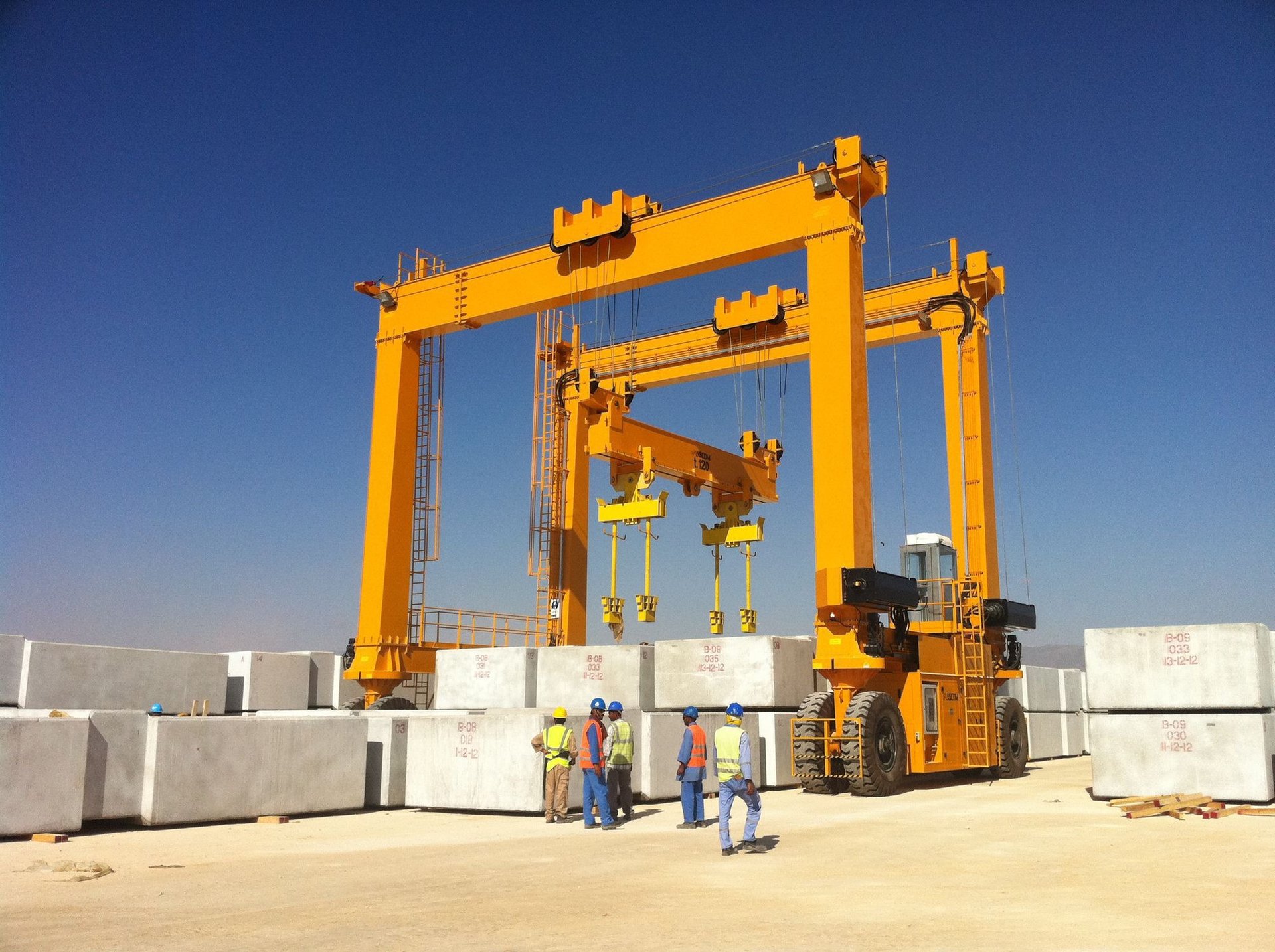
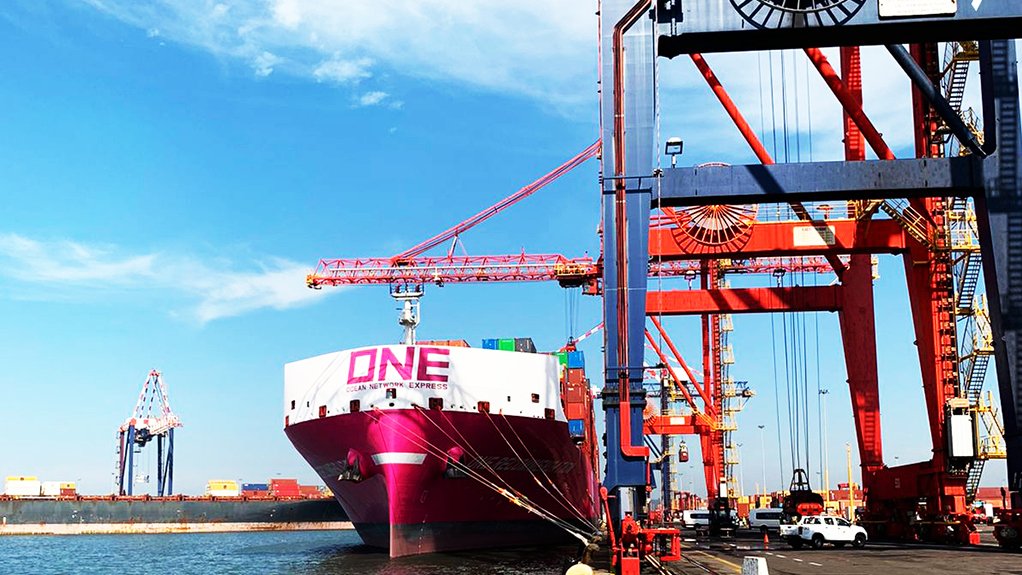
Electrified Rubber Tyred Gantry (ERTG) Cranes: Often used in ports for container handling, requiring both high mechanical endurance and reliable signal transmission.
Hoists and Lifting Devices: Ideal for industrial lifting operations where torsional and tensile stresses are frequent.
Material Handling Systems: Factories, mining operations, and warehouses with moving or rotating machinery.
Environmental Versatility: Suitable for dry, damp, wet, or industrial environments, including harsh South African mining conditions.
How Does It Differ from Standard Power or Control Cables?
Unlike standard cables, the (N)SHTÖU – FO (LWL) integrates fiber-optic cores directly into the cable structure, enabling data transmission alongside power. Key differentiators include:
Tensile and Torsional Stress Handling: The cable is engineered to withstand continuous bending, twisting, and heavy loads.
Abrasion and Chemical Resistance: Outer sheathing resists oils, chemicals, and mechanical wear common in industrial and port environments.
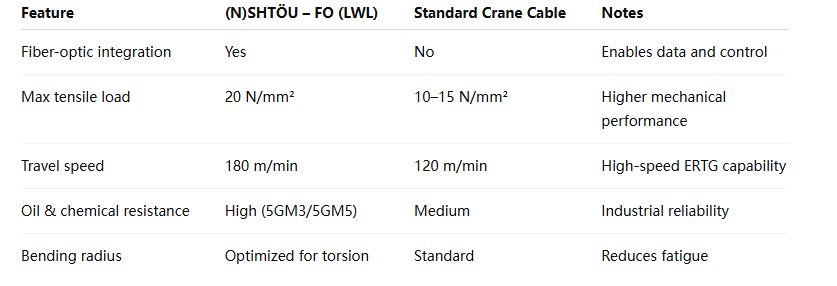
High-Speed Reeling Capability: Suitable for horizontal travel up to 180 m/min, surpassing standard crane cables.
How is the Feichun (N)SHTÖU – FO (LWL) Cable Structured?
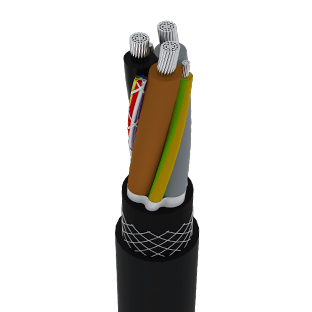
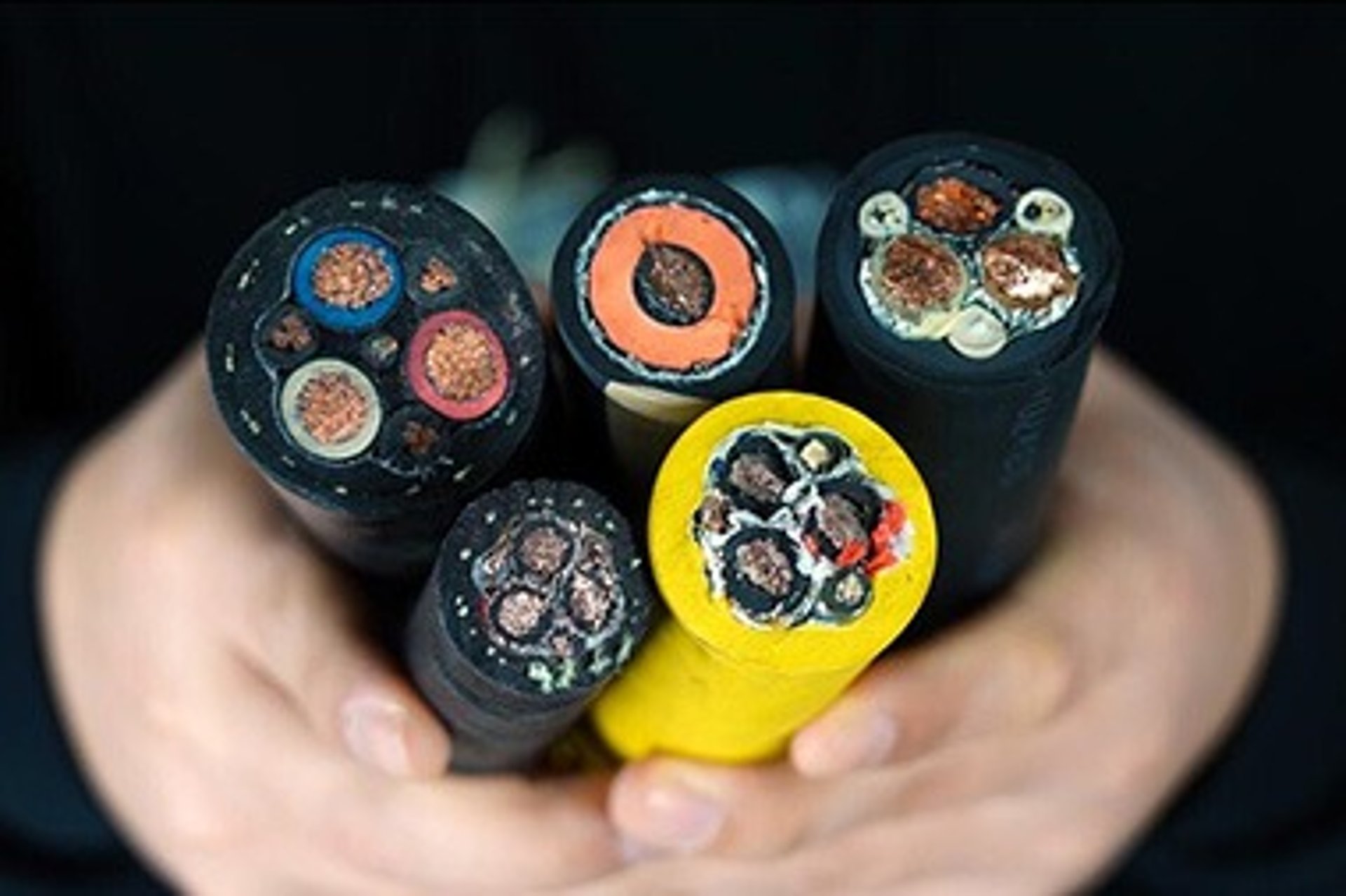
The superior performance of (N)SHTÖU – FO (LWL) lies in its innovative multi-layer design, balancing electrical efficiency, mechanical strength, and optical integrity.
What Materials Are Used in the Conductor, Insulation, and Sheath?
Conductor: Electrolytic annealed, class 5 stranded tinned copper wires, with plain copper optional. This ensures excellent conductivity and flexibility.
Insulation: Special HEPR-based elastomer (≥3GI3 quality) provides high resilience against heat, cold, and mechanical stress.
Sheath: Heavy-duty rubber compound, oil and chemical-resistant, and certified abrasion and notch-resistant (5GM3/5GM5).
How is the Fiber-Optic Element Integrated?
Feichun integrates fiber optics seamlessly to ensure signal integrity without compromising mechanical strength:
Core diameters: 9 μm, 50 μm, or 62.5 μm, supporting designs with up to 24 fibers.
Color coding and buffer tubes: Facilitate fiber identification and reduce installation errors.
Hollow core with ETFE filling compound: Protects fibers from moisture and mechanical stress.
Arrangement: Six fiber cores per layer, laid around the central support element for uniform stress distribution.
How is the Cable Laid Up for Torsion and Tensile Stress?
The cable uses a layered structure optimized for mechanical performance:
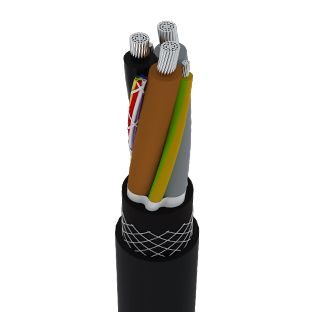
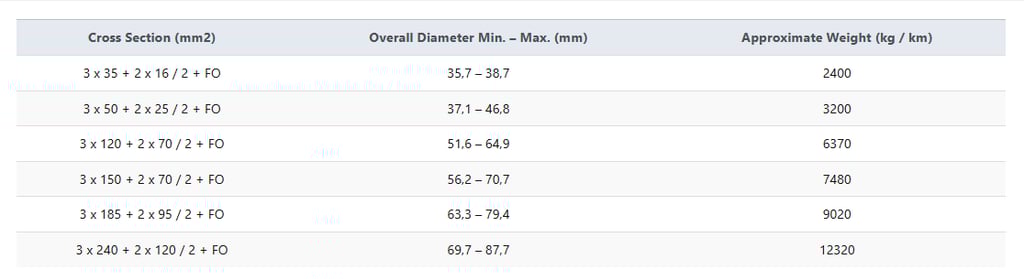
Inner layout: Three main conductors with two earth cores; fiber-optic elements in the outer interstice.
Inner sheath: Elastomer layer exceeding GM1b specifications.
Sheath reinforcement: Textile braid anti-torsion layer embedded within the outer sheath.
Outer sheath: Rubber-based heavy-duty material ensuring oil, chemical, and abrasion resistance.
What Are the Standards and Main Characteristics of (N)SHTÖU – FO (LWL)?
Feichun (N)SHTÖU – FO (LWL) is certified under rigorous DIN VDE standards, ensuring electrical safety, mechanical reliability, and fire resistance.
Which DIN VDE Standards Does It Comply With?
DIN VDE 0250-814: Construction of power cables.
DIN VDE 0250-1: General requirements for low-voltage cables.
DIN VDE 0298-3: Installation guidelines for flexible cables.
How Is Its Safety and Durability Ensured?
Electrical testing: VDE 0472-501/502/503/508 confirms insulation integrity and current handling.
Mechanical testing: VDE 0472-401/402/602/303/615 verifies tensile strength, bending, and torsion resistance.
Fire safety: Flame-retardant according to VDE 0482-332-1-2, IEC 60332-1, ensuring compliance in high-risk environments.
How Does It Perform Under Fire or Extreme Conditions?
Fire tests (VDE 0472-803/804) confirm integrity during flame exposure.
Temperature ranges:
Fixed installations: -40°C to +80°C
Mobile operations: -25°C to +80°C
Short-circuit endurance: up to 250°C, ensuring cable survival under fault conditions.
What Are the Electrical and Mechanical Specifications?
Rated and Maximum Operating Voltage
Rated voltage: 0.6 / 1 kV
Maximum operating AC voltage: 0.7 / 1.2 kV
Maximum operating DC voltage: 0.9 / 1.8 kV
AC test voltage: 3.5 kV
Current Carrying and Temperature Capacities
Conductor operating temperature: 90°C
Short-circuit temperature: 250°C
Mechanical Capabilities
Maximum tensile load: 20 N/mm²
Minimum bending radius: Per VDE 0298-3 guidelines
Travel speeds:
Festoon systems: up to 180 m/min horizontal
Reeling applications: horizontal operation optimized for gantry cranes
How Does Feichun (N)SHTÖU – FO (LWL) Compare with Other Crane Cables?
Feichun’s innovative design surpasses conventional DIN VDE crane cables in mechanical resilience, fiber-optic integration, and operational speed.
Fiber Optic Capabilities Comparison
Supports up to 24 fibers for complex data and monitoring.
Color-coded fibers with ETFE protection outperform standard 4–12 fiber layouts.
What Are the Installation Guidelines for Heavy-Duty Applications?
Proper installation ensures the cable achieves its full operational lifespan.
Installation in Reeling and Festoon Systems
Adhere to recommended bending radius to prevent internal damage.
Ensure strain relief at entry/exit points on reels and festoons.
Protecting the Fiber-Optic Cores
Avoid excessive torsion and stretching during installation.
Ensure fibers remain untwisted within buffering tubes.
Maintenance and Inspection
Mechanical and electrical testing at regular intervals.
Inspect sheath integrity and fiber transmission for early fault detection.
What Are the Typical Applications in South Africa and Case Studies?
South Africa’s industrial and mining sectors demand high-performance reeling cables capable of withstanding harsh mechanical and environmental conditions.
Typical South African Applications
Ports: Durban Port’s ERTG cranes for container handling.
Mining operations: Johannesburg gold and platinum mines for heavy lifting and material handling.
Industrial plants: Steel, cement, and chemical plants with continuous crane operation.
1: Durban Port ERTG Reeling System
Feichun (N)SHTÖU – FO (LWL) cables enabled high-speed crane operation, integrating power and control signals while withstanding coastal environmental stresses, including salt spray and high humidity.
2: Johannesburg Mining Operations
In a platinum mine, the cable powered heavy lifting systems underground. The integrated fiber-optic cores allowed real-time monitoring, reducing downtime and improving operational safety in dusty, abrasive conditions.
Frequently Asked Questions (FAQ)
Q1: Can (N)SHTÖU – FO (LWL) be used in outdoor wet conditions?
A: Yes. The outer sheath is oil, chemical, and moisture-resistant, making it suitable for wet or damp environments.
Q2: What is the maximum travel speed and load?
A: Up to 180 m/min in horizontal festoon systems; maximum tensile load 20 N/mm².
Q3: How many fibers can the cable support?
A: Designs support up to 24 fibers, enabling advanced data transmission.
Q4: Is it compatible with standard DIN VDE crane systems?
A: Yes, fully compliant with DIN VDE standards and compatible with most existing crane installations.
Q5: How do I choose the right cross-section for my load?
A: Selection depends on current carrying capacity, travel speed, and environmental factors; consulting a Feichun expert is recommended.
Q6: How often should maintenance checks be performed?
A: Regular inspection every 6–12 months, or more frequently in high-use or abrasive environments.
Q7: What differentiates it from older generation crane cables?
A: Integration of fiber optics, higher tensile strength, optimized torsion resistance, and faster travel capability.
Conclusion
The Feichun DIN VDE (N)SHTÖU – FO (LWL) crane cable sets a benchmark for heavy-duty reeling applications, combining:
High-strength conductors and flexible elastomer insulation.
Integrated fiber-optic cores for reliable communication.
Exceptional mechanical resilience against torsion, tensile stress, and abrasion.
Compliance with rigorous DIN VDE standards for electrical and fire safety.
From ports to mines, this cable demonstrates durability, versatility, and operational efficiency, making it a trusted choice in South African heavy lifting and material handling operations.
Email Address: Li.wang@feichuncables.com
© 2025. All rights reserved.
One-click to Quickly Contact
Products
Contact
Company
Location:
Building A Private Science and Technology Park, Hefei Economic and Technological Development Zone, Anhui Province, China
Heat Resistant Cable
WhatsApp: +86 17333223430
Social Media: