Anhui Feichun Special Cable Co.,Ltd Email: Li.wang@feichuncables.com

What Makes Industrial Cables the Lifeline of South Africa’s Factories, Mines and Power Plants?
Discover industrial cables – from SANS 1507 power cables to Ex-rated instrumentation cables – powering Eskom, Sasol and Gold Fields. Learn selection, installation and maintenance in South African English. Keywords: industrial cable, power cable, control cable, instrumentation cable, Profinet, XLPE, LSZH, SANS 1574.
Li. Wang
10/29/20254 min read
Why Industrial Cables Matter to Every South African Industry
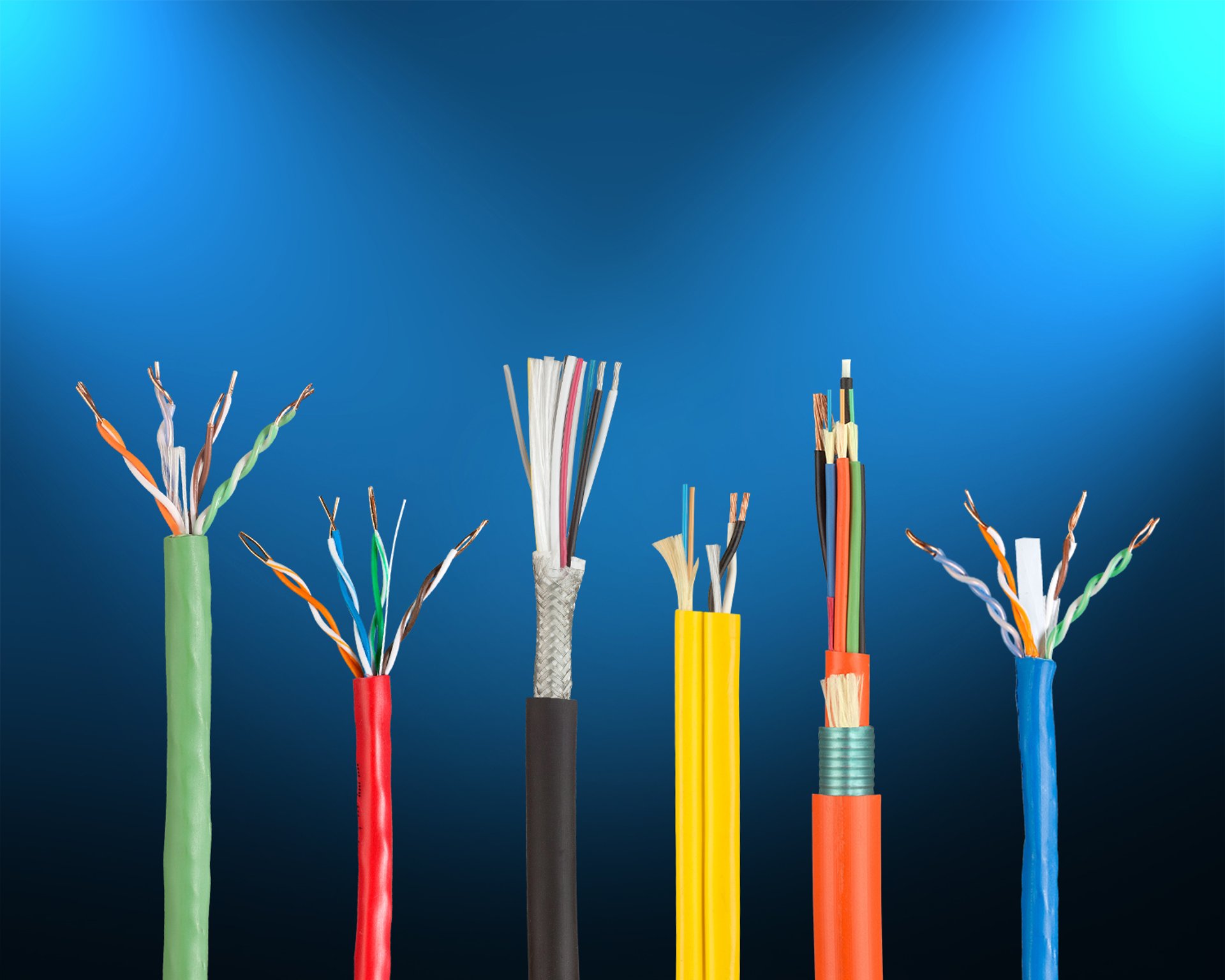
An industrial cable is any purpose-engineered conductor assembly rated for harsh mechanical, thermal, chemical and electromagnetic interference (EMI) environments. Unlike domestic NYY or house-wire, it carries SABS certification, SANS 1507 or SANS 1574 markings, and often MASC Ex certificates for Group I (mines) or Group II (petrochemical) zones.
In South Africa, cables must also shrug off load-shedding voltage spikes, UV on the Highveld, termites in KZN and corrosive H₂S in gold tailings. This article unpacks every layer, standard, selection rule and FAQ so that engineers, artisans and students can spec, install and maintain the right industrial cable first time.
Classification of Industrial Cables – Know Your Cable Before You Spec It
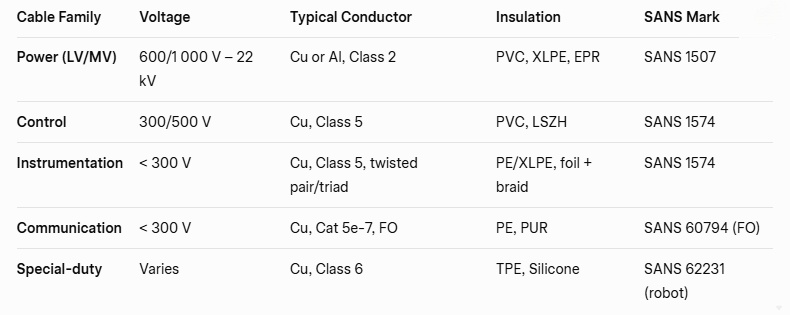
South African plants use five core families plus special-duty variants.
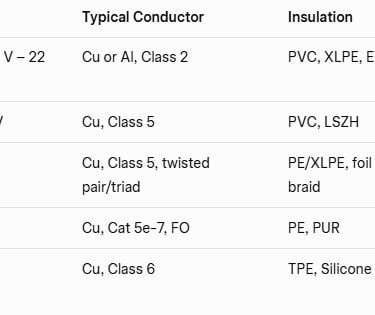
Power Cables (LV/MV)
Example: 4-core 70 mm² Cu XLPE/SWA/PVC 0.6/1 kV feeds a 400 kW compressor at ArcelorMittal Vanderbijlpark.
Must handle 100 % load factor, 90 °C conductor temperature and fault currents up to 25 kA for 1 s.
Control Cables
Multi-core (7–60 cores), 0.5–2.5 mm², numbered cores, used for MCC-to-field interlocks.
At Anglo American Platinum’s Waterval smelter, 37-core 1.5 mm² LSZH control cables run in stainless trays above acid plants.
Instrumentation Cables
Twisted pairs/triads, individual + overall foil shield, < 100 pF/m capacitance.
Impala Platinum’s Rustenburg base-metal refinery uses 12-pair 0.5 mm² PE/XLPE instrumentation cables for pH loops.
Communication/Network Cables
Profinet Type A (green), Profibus (violet), Industrial Ethernet Cat 6A, single-mode fibre.
Sibanye-Stillwater’s Kloof shaft installed 12-core armoured OS2 fibre in 2023 for 10 Gbps CCTV and VoIP.
Special-Duty Cables
Robot flex: Class 6 tinned Cu, TPE sheath, >20 million torsion cycles – FANUC weld robots at BMW Rosslyn.
Crane reeling: 0.6/1 kV medium-voltage reeling cable with Kevlar braid – Durban Container Terminal stacker-reclaimers.
Trailing: Festoon cables for surface coal draglines at Exxaro Grootegeluk.
Anatomy of an Industrial Cable – Layer by Layer
Figure 1: Exploded 3-D view of a 4-core 35 mm² Cu XLPE/SWA/PVC 0.6/1 kV power cable (SANS 1507).
Conductor
Copper: 1.78 × 10⁻⁸ Ω·m resistivity, Class 2 (7-strand) for fixed, Class 5 (30-strand) for light flex, Class 6 (>100 ultra-fine) for robots.
Aluminium: 2.82 × 10⁻⁸ Ω·m, 61 % conductivity of Cu, but 30 % weight. At 120 mm² MV feeder to Medupi Unit 4, Al saves 1.2 t per km. Use bi-metallic lugs + oxide inhibitor paste (Penetrox).
Insulation
Bedding & Fillers Extruded PVC or PP tapes keep cores circular under armour pressure.
Shielding
Instrumentation: Al-PET foil (100 % optical coverage) + tinned Cu drain wire + 85 % tinned Cu braid = 70 dB EMI attenuation @ 10 MHz.
Network: Double shield (foil + braid) mandatory near 525 V VSDs.
Armouring
SWA (steel wire armour) for direct burial – 2.5 mm wire on 35 mm² cable.
AWA (aluminium wire) on single-core to avoid eddy currents.
Outer Sheath
PVC ST2: UV-stabilised black, SANS 1574 Table 6 oil resistance 24 h @ 100 °C.
CSP (chlorosulphonated PE): Sasol Synfuels pipe bridges.
PU: Robot drag chains – tear strength >60 N/mm.
Standards & Compliance – The South African & International Rulebook
Local
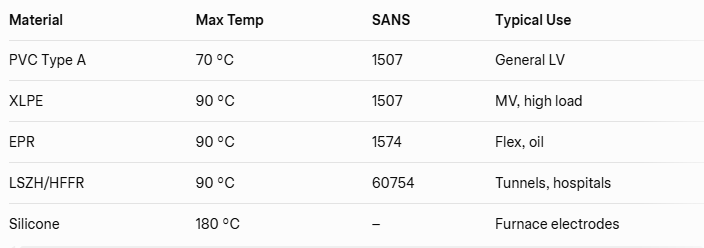
SANS 1507: Power cables 0.6/1 kV to 22 kV.
SANS 1574: Instrumentation & control.
SANS 10142-1: The Wiring Code – cable spacing, derating, glanding.
NRCS LoA: Compulsory for all imported cables.
MASC Ex certificates: Group I (methane) blue sheath, Group II (petrochemical) orange.
International
IEC 60502-1: 1–30 kV power.
IEC 60228: Conductor stranding.
IEC 60332-3: Flame propagation Cat A/B/C.
IEC 60079-14: Ex installation.
Marking Example
H07RN-F 4G6 mm² 450/750 V SANS 1574
H = harmonised, 07 = 70 °C, RN = neoprene, F = flexible, 4G6 = 4 cores + 6 mm² earth.
Selection Criteria – Getting the Spec Right First Time
Electrical
Current rating: SANS 1507 Table 8, clipped direct 35 mm² Cu = 171 A @ 30 °C air.
Voltage drop: 400 m run, 180 A, 35 mm² Cu → ΔV = (√3 × I × L × (R cosφ + X sinφ))/1 000 = 5.8 % (limit 4 % → upsize to 50 mm²).
Short-circuit: I²t = 145² × k² × S² → 35 mm² XLPE withstands 25 kA for 1 s.
Environmental
Temperature derating: 50 °C ambient → 0.82 factor (SANS 1507 Table 11).
Chemical: SANS 1574 Table 6 – diesel 7 days @ 40 °C → PU sheath.
UV: Carbon black >2 % in PVC.
Termite: Nylon 12 outer or HDPE.
Mechanical
Bend radius: Fixed 8 × OD, flex 12 × OD.
Tensile: Robot cable 50 N/mm² conductor stress.
Torsion: ±360°/m for 20 M cycles.
Installation Method
Tray: 300 mm separation power vs instrumentation.
Reeling: Max 2 m/s, 30° fleet angle.
Lifecycle Cost
CAPEX 35 mm² Cu = R280/m, Al = R160/m. OPEX Al joints fail 3× more often → TCO favours Cu over 25 y.
Installation Best Practice – Avoid the “Friday Afternoon Pull”
Bend radius: 12 × 240 mm OD = 2.88 m minimum for 4×95 mm² MV.
Pulling tension: Max 50 N/mm² Cu → 95 mm² = 4.75 kN. Use swivel + stocking grip.
Sidewall pressure: < 2 kN/m in 90° bend.
Support spacing: SANS 10142-1 Table 4.1 – 900 mm horizontal for 35 mm².
Segregation: 300 mm or steel divider.
Glanding: CW20 brass gland torque 35 Nm, IP66 with shroud.
Case study: During 2022 load-shedding, a Gauteng food plant pulled 4×50 mm² Cu through conduit without lubricant. Cable jammed, insulation scored, failed Megger at 500 V. Lesson: always use Polywater J.
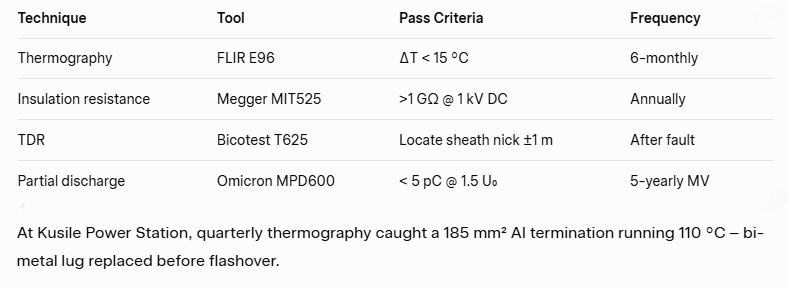
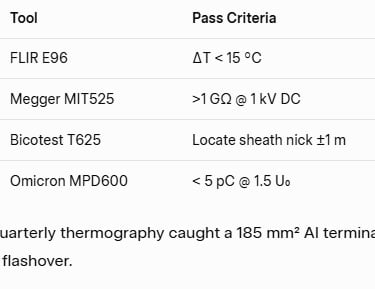
Predictive Maintenance & Fault Finding
FAQ
1.Q: Can I use domestic NYY cable in a factory?
A: No – lacks oil/UV resistance, wrong flame rating.
2. Q: Aluminium or copper for 120 mm² MV feeder?
A: Aluminium cheaper, but jointing needs bi-metal lugs & oxide inhibitor.
3. Q: Why does my Profinet drop packets near VSDs?
A: EMI – use Cat 5e/6 double-shielded, proper 360° gland earthing.
4. Q: LSZH mandatory in all plants?
A: Only where SANS 10142-1 demands low smoke (tunnels, malls, hospitals).
5. Q: How to calculate voltage drop on a 400 m 35 mm² Cu cable at 180 A?
A: Use SANS 1507 Table 9; ≈ 7.5 % drop → upsizing needed.
6. Q: SABS mark for Ex i cables?
A: SANS/IEC 60079-11; blue sheath, MASC certificate.
Conclusion & Call to Action
The right industrial cable is not a commodity – it is engineered insurance against downtime, fire and fatality. From SANS 1507 power cables feeding MV motors to Ex i instrumentation cables in Group I mines, every layer and certificate matters.
Email Address: Li.wang@feichuncables.com
© 2025. All rights reserved.


One-click to Quickly Contact
Products
Contact
Company
Location:
Building A Private Science and Technology Park, Hefei Economic and Technological Development Zone, Anhui Province, China
Heat Resistant Cable
WhatsApp: +86 17333223430
Social Media: