Anhui Feichun Special Cable Co.,Ltd Email: Li.wang@feichuncables.com
What Makes NSHTÖU Reeling Cables Ideal for Heavy-Duty Industrial Applications?
Discover why NSHTÖU reeling cables are the preferred choice for heavy-duty industrial applications in South Africa. Explore their structure, materials, electrical parameters, compliance with DIN VDE standards, and real-world performance in mining, hoisting, and industrial systems.
Li Wang
1/4/20267 min read
In heavy-duty industrial environments, the reliability and durability of power and control cables are paramount. Machines, hoists, and transport systems require cables that can endure repetitive bending, torsion, tensile stress, and exposure to harsh environments. Among the various options available, NSHTÖU reeling cables have emerged as a benchmark for performance and safety, particularly in South African mining, lifting, and industrial operations.
NSHTÖU cables are designed for demanding applications where mechanical and environmental stresses are unavoidable. From underground mining shafts to automated material handling systems in factories, these cables ensure continuous power delivery and long service life, while complying with stringent DIN VDE and international standards.
This article provides an in-depth exploration of NSHTÖU cables, covering their structure, materials, technical specifications, certifications, applications, installation practices, and real-world case studies in South Africa.
What Is NSHTÖU Cable and How Is It Structured?
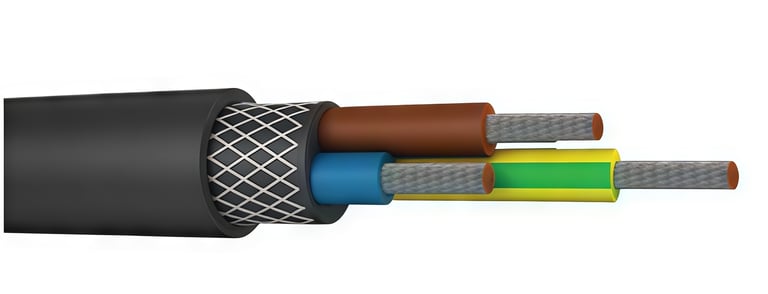
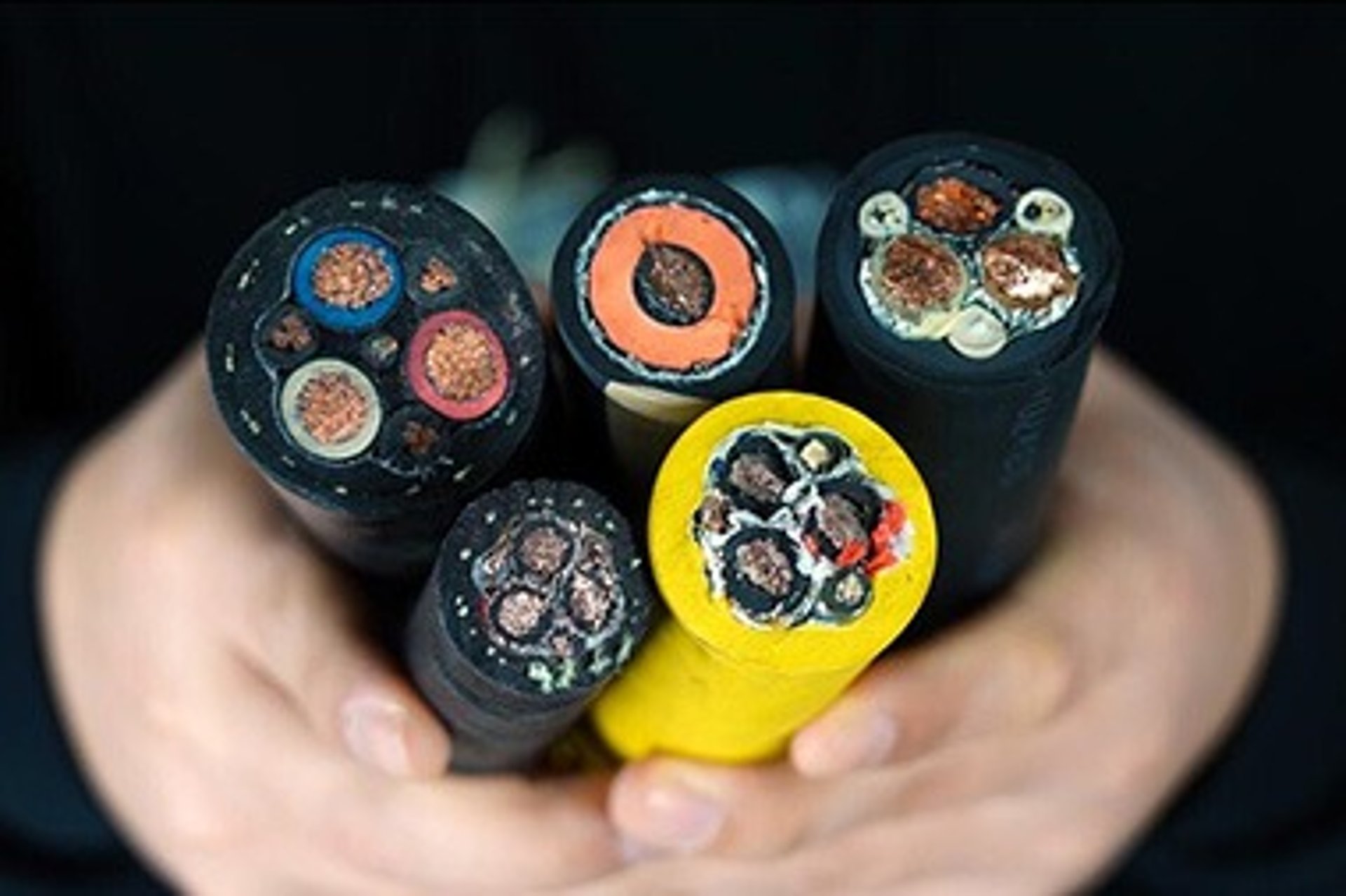
Understanding the structure of NSHTÖU cables is key to appreciating their performance advantages. These cables are designed to withstand tensile and torsional stress, making them ideal for reeling, hoisting, and mobile applications.
What materials are used in NSHTÖU cables?
The NSHTÖU cable combines multiple high-quality materials for optimal performance:
Conductor: Electrolytic annealed class 5 stranded tinned copper, offering high conductivity and flexibility. Plain copper conductors are also available upon request for cost-effective applications.
Insulation: 3GI3 type HEPR (Hard Elastic Polyolefin Rubber) elastomer, resistant to heat, chemicals, and mechanical stress.
Core identification: Follows VDE 0293-308 color coding for easy identification in multi-core applications.
Inner sheath: GM1b elastomer, providing additional electrical insulation and mechanical protection.
Anti-torsion reinforcement: Textile braid embedded in the sheath improves torsional resistance and ensures stability during repeated twisting.
Outer sheath: 5GM3 heavy-duty rubber, engineered for abrasion resistance, oil resistance, and durability in dry, damp, or wet industrial conditions.
Color options: Black or yellow for visibility and identification in industrial environments.
The combination of flexible copper strands, HEPR insulation, and heavy-duty rubber sheaths ensures NSHTÖU cables maintain integrity under high stress, making them suitable for hoisting systems, lifting devices, and mobile machinery.
How does the cable’s structure support tensile and torsional stress?
NSHTÖU cables are not merely electrically optimized—they are mechanically engineered for the rigors of industrial use:
Textile braid reinforcement: The anti-torsion textile layer reduces the impact of twisting forces, particularly in reeling or festoon applications. This reinforcement prevents conductor deformation and maintains cable shape under repetitive bending.
Layered sheath design: The inner GM1b layer cushions the conductors, while the outer 5GM3 sheath absorbs mechanical shocks and chemical exposure.
Flexibility in mobile applications: By combining elastic insulation with braided reinforcement, NSHTÖU cables can travel horizontally or vertically at high speeds without compromising performance.
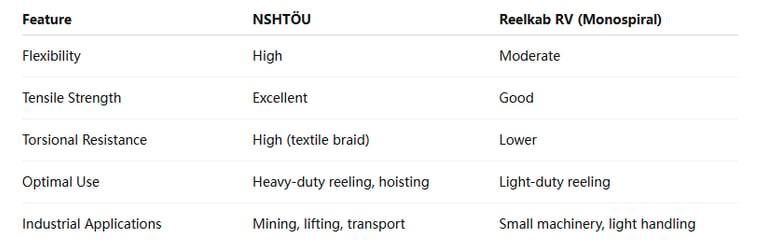
These structural features make NSHTÖU a preferred choice over monospiral reeling cables, which, while flexible, often lack torsional stability in demanding industrial conditions.
What Are the Technical Specifications and Electrical Parameters of NSHTÖU Cables?
NSHTÖU cables are designed to deliver both mechanical resilience and consistent electrical performance. Their technical specifications reflect precision engineering for industrial environments.
What are the rated voltages and operating limits?
NSHTÖU cables typically operate at:
Rated voltage: 0.6/1 kV
Maximum AC voltage: 0.7/1.2 kV
Maximum DC voltage: 0.9/1.8 kV
AC test voltage: 3.5 kV
Temperature limits:
Conductor operating temperature: Maximum 90°C
Short-circuit temperature: Maximum 250°C
The combination of high-voltage tolerance and thermal endurance ensures that NSHTÖU cables can handle transient loads, high-current conditions, and industrial short circuits safely.
What are the bending radius and mobility specifications?
Mechanical mobility is a key factor in reeling applications. NSHTÖU cables maintain operational integrity within the following limits:
Working temperature range:
Fixed installation: -40°C to +80°C
Mobile use: -25°C to +80°C
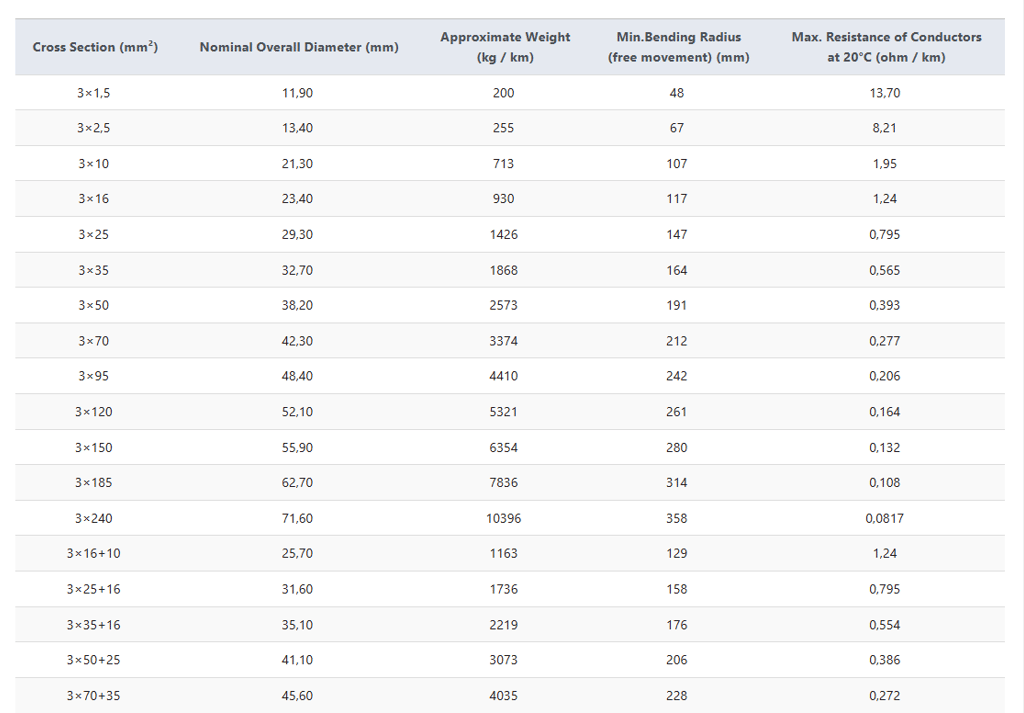
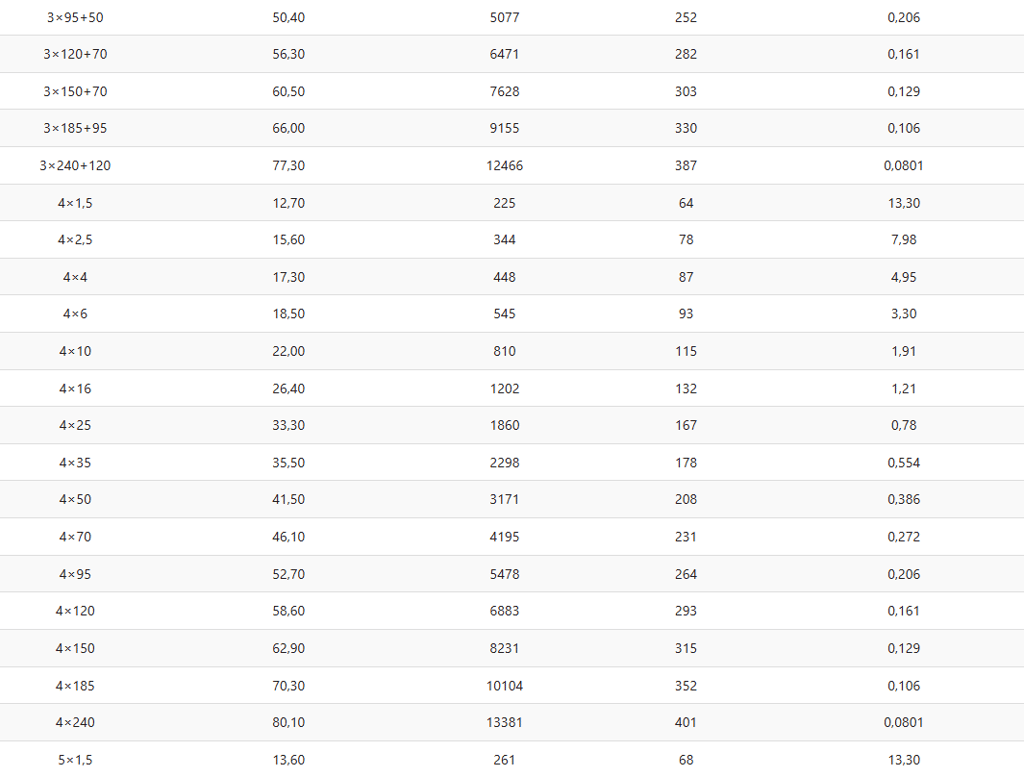
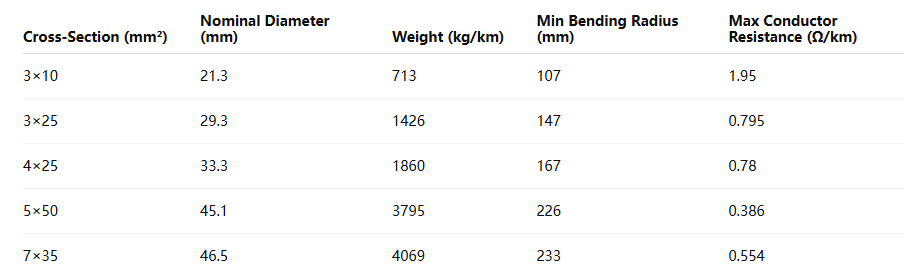
Minimum bending radius: Defined according to VDE 0298-3. For example, a 4×25 mm² NSHTÖU cable has a minimum free-movement bending radius of 167 mm.
Travel speeds:
Festoon systems: up to 240 m/min
Reeling applications (horizontal): up to 120 m/min
These parameters ensure safe operation during repetitive bending, hoisting, and dragging operations, critical in South African mining and industrial plants.
How is current carrying capacity determined for NSHTÖU cables?
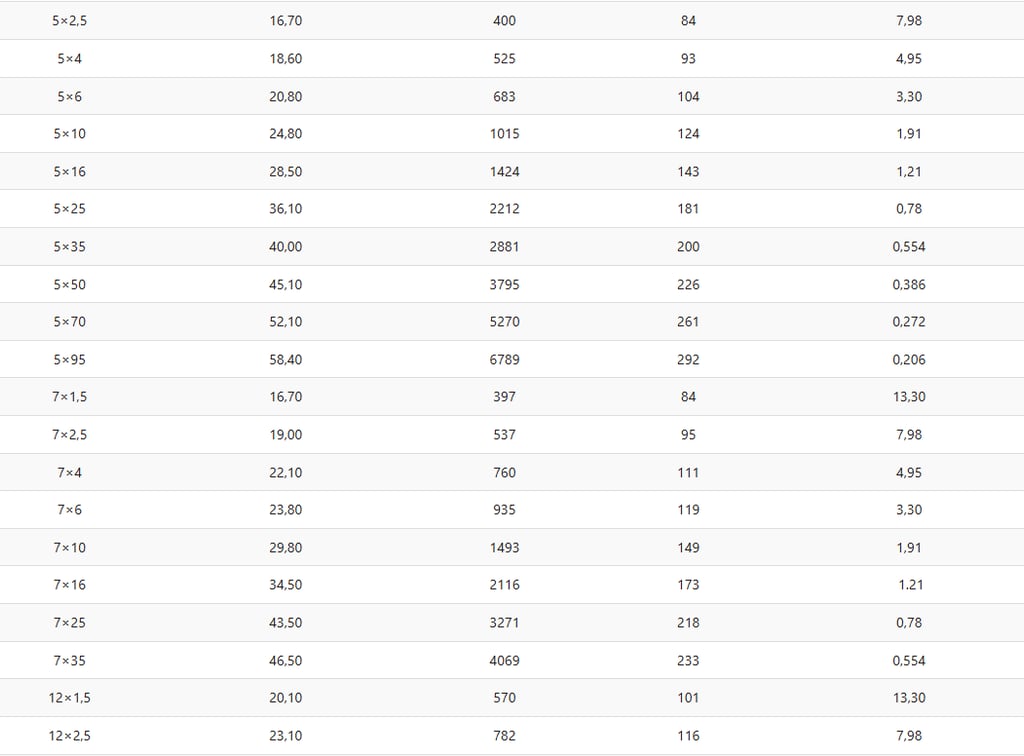
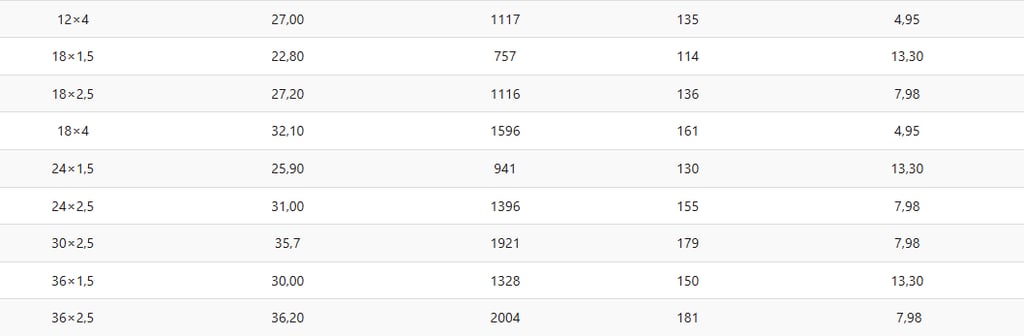
Current carrying capacity depends on cross-section, conductor type, insulation, and installation method. According to VDE 0298-4, NSHTÖU cables maintain consistent performance under defined loads. For example:
These tables help engineers select the correct conductor size and configuration to minimize voltage drop, ensure safety, and optimize performance.
What Standards and Certifications Apply to NSHTÖU Cables?
Compliance with internationally recognized standards guarantees safety, durability, and performance:
Construction & General Requirements:
DIN VDE 0250-814 (construction)
DIN VDE 0250-1 (general)
Usage guidelines: DIN VDE 0298-3
Electrical & non-electrical tests: DIN VDE 0472 series
(e.g., voltage withstand, insulation, bending, oil and chemical resistance)Fire & flame retardant: VDE 0482-332-1-2, IEC 60332-1
Oil and chemical resistance: HD/EN/IEC 60811-2-1
Why certification matters:
In industrial and mining environments, uncertified cables can lead to downtime, accidents, or non-compliance penalties. NSHTÖU cables’ adherence to DIN VDE standards ensures safe, long-term operation, and regulatory acceptance in South Africa and beyond.
Where Are NSHTÖU Cables Used?
NSHTÖU cables excel in high-stress environments. Their design makes them suitable for:
Which industries benefit from NSHTÖU cables?
Mining: Hoisting, winding operations, submersible pumps
Lifting plants: Cranes, elevators, and hoists
Material handling & transportation machinery: Conveyors, gantries, and automated systems
Wet or damp industrial conditions: Factories, pulp mills, and water treatment plants
How do NSHTÖU cables perform in reeling and festoon systems?
Can withstand continuous travel at speeds up to 240 m/min in festoon systems.
Horizontal reeling: stable at speeds up to 120 m/min.
Resistance to torsion and tensile stress minimizes downtime and prevents cable failure in repetitive operations.
How does NSHTÖU compare to monospiral reeling cables (Reelkab RV)?
NSHTÖU’s design emphasizes robustness and longevity, while monospiral cables are more cost-effective for light industrial tasks.
What Are the Advantages of Choosing NSHTÖU Cables?
Mechanical robustness: Withstands torsion, tensile stress, and repetitive bending.
Chemical & oil resistance: Suitable for harsh industrial environments.
Flame retardant: Reduces fire risk in factories and mines.
Wide operating temperature range: Functional from -40°C to +80°C.
Ease of installation: Flexible yet durable for festoon, reel, or horizontal use.
These advantages minimize downtime, reduce maintenance costs, and ensure compliance with DIN VDE and local South African safety standards.
How to Select the Right NSHTÖU Cable for Your Application?
Which cross-section and conductor count should I choose?
The choice depends on current load, mechanical stress, and installation type. For example:
Small mobile devices: 3×1.5 mm² to 3×10 mm²
Medium loads: 4×16 mm² to 4×50 mm²
Heavy-duty hoisting or mining: 5×70 mm² to 7×35 mm²
A detailed table (see technical specifications) guides precise selection for current carrying, bending radius, and mechanical load.
What installation tips ensure long service life?
Avoid sharp bends or over-tensioning.
Maintain recommended travel speeds in festoon and reel systems.
Ensure proper anchoring and support to prevent abrasion and torsion.
Use protective conduits or guides in harsh environments.
How to maintain and inspect NSHTÖU cables?
Visual inspection: Check sheath and braid for wear, cracks, or abrasion.
Electrical testing: Verify continuity and insulation resistance regularly.
Replacement guidelines: Replace cables showing excessive mechanical or electrical degradation to prevent operational hazards.
NSHTÖU Cable FAQ
Q: What is the difference between NSHTÖU and H07RN-F cables?
A: H07RN-F is a general-purpose rubber cable, suitable for flexible installations but not optimized for torsion and high-speed reeling like NSHTÖU.
Q: Can NSHTÖU cables be used outdoors or in wet conditions?
A: Yes, the 5GM3 outer sheath and HEPR insulation ensure oil, water, and UV resistance, making it suitable for wet industrial environments.
Q: What is the maximum tensile load NSHTÖU cables can handle?
A: Up to 20 N/mm², sufficient for most hoisting and reeling operations.
Q: Are NSHTÖU cables suitable for high-speed reeling applications?
A: Yes, NSHTÖU can operate up to 240 m/min in festoon systems and 120 m/min horizontally on reels.
Q: How does the cable respond to short-circuit conditions?
A: Conductors are rated for maximum short-circuit temperature of 250°C, preventing insulation breakdown.
Q: Can NSHTÖU cables be customized?
A: Yes, color, conductor type, and cross-section can be tailored to specific industrial requirements.
How NSHTÖU Cables Keep Industrial Operations Running
Mining hoist system in South Africa
At a platinum mine in Rustenburg, NSHTÖU 5×70 mm² cables were installed in vertical hoist systems. The cables endured continuous torsion, high tensile stress, and wet conditions. Over two years, inspections showed minimal wear, reducing downtime and maintenance costs significantly.
Material transport in a wet industrial plant
A chemical processing plant in Johannesburg used NSHTÖU 4×25 mm² cables in automated material handling systems exposed to moisture and oil. The cable’s chemical resistance and flexibility ensured uninterrupted operation for three consecutive years without replacement.
Reeling application in warehouse automation
In Cape Town’s logistics warehouse, NSHTÖU 3×16 mm² cables were used in high-speed horizontal reeling systems. The textile braid and robust sheathing prevented conductor deformation, enabling 240 m/min travel speeds safely.
Lessons learned: NSHTÖU cables deliver consistent performance under mechanical and environmental stress, proving their value in demanding industrial setups.
NSHTÖU Installation Recommendations
Ensure proper festoon alignment and avoid kinks.
Maintain minimum bending radius as per VDE standards.
Protect the cable from sharp edges, chemicals, and heat sources.
Use appropriate tools and accessories, such as cable rollers and supports, to prolong cable life.
Correct installation enhances mechanical endurance and electrical safety, reducing operational risk in industrial and mining applications.
Why NSHTÖU Cables Are a Smart Investment
Reduced downtime: Durability and torsion resistance minimize operational interruptions.
Compliance: Adherence to DIN VDE standards ensures safety and regulatory compliance.
Long-term cost efficiency: Lower maintenance and replacement frequency offset initial investment.
Investing in NSHTÖU cables translates to reliable industrial operations, particularly in South African mining and heavy industry, where downtime and equipment failure carry high costs.
CTA: For technical support or customized NSHTÖU cable solutions, contact us today. Our experts can guide you in selecting the right cable for your mechanical load, environment, and electrical requirements.
Email Address: Li.wang@feichuncables.com
© 2025. All rights reserved.
One-click to Quickly Contact
Products
Contact
Company
Location:
Building A Private Science and Technology Park, Hefei Economic and Technological Development Zone, Anhui Province, China
Heat Resistant Cable
WhatsApp: +86 17333223430
Social Media: