Anhui Feichun Special Cable Co.,Ltd Email: Li.wang@feichuncables.com
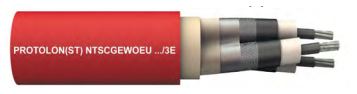
What Makes PROTOLON(ST) NTSCGECEWOEU.../3E the Benchmark Medium Voltage Flexible Cable for 500m Deep Salt Water, Dredgers and Floating Docks
PROTOLON(ST) NTSCGECEWOEU.../3E is not just an upgraded medium voltage flexible cable — it is a complete system solution engineered for permanent submersion down to 500 m, saltwater, sewage, and heavy mechanical stress. This article explains its material science, electrical and mechanical design principles, compliance with DIN VDE 0250‑813, MSHA, and GOST, and why it has become the industry benchmark. It includes real‑world examples from South African dredging, mining, and harbour projects, a detailed comparison with standard cables, full specifications, selection guidance, and how Feichun equivalent cables match performance while offering faster delivery and better value.
Li Wang
6/3/202615 min read
Introduction
In marine and mining operations across South Africa — from the busy ports of Durban and Richards Bay to dewatering systems in the coalfields of Mpumalanga — reliable power supply in wet, corrosive, and mechanically demanding environments is critical. Standard power cables often fail within months when submerged, dragged, or exposed to saltwater and abrasion. Operators have long faced a choice between frequent replacement or expensive custom‑built solutions.
This is where PROTOLON(ST) NTSCGECEWOEU.../3E changes the landscape. It is not simply a “stronger” version of an ordinary cable. Every layer, every material, and every dimension is designed to solve four fundamental problems that destroy conventional cables: water ingress, corrosion, mechanical fatigue, and electrical breakdown under high voltage. It has become the reference standard for medium voltage flexible cables used underwater, and its design principles are now copied in specifications worldwide.
This article explores the engineering behind it, explains why it outperforms all alternatives, and shows how it is applied in South African industry.
Basic Overview and Core Positioning
Full Name and Definition
The full designation PROTOLON(ST) NTSCGECEWOEU.../3E describes exactly what the cable is and how it is built. Breaking down the code helps to understand its purpose:
PROTOLON(ST): Product family for heavy‑duty, flexible, screened cables.
N: Manufactured to German industrial standards.
T: Designed for towing, reeling, and continuous movement.
S: Copper screen for electrical safety and noise suppression.
C: Copper conductor.
G: Protective earth conductors.
E: Individual core screening.
W: Special water‑resistant construction.
O: Oil‑resistant outer sheath.
E: Weather and ozone resistant.
U: Abrasion and mechanical damage resistant.
/3E: Three separate, distributed protective earth conductors — a key safety feature.
It is defined as a medium voltage flexible cable with copper core shield, suitable for permanent immersion in water up to 500 m depth, compliant with DIN VDE 0250‑813, and approved by MSHA (for mining), GOST (Eurasian standards), and major classification societies.
More Than an Upgrade — A System Solution
A common misconception is that this cable is just an ordinary cable with thicker insulation or a stronger sheath. In reality, it is a system‑level solution where every component works together to create performance that no single improvement could achieve.
It addresses four enemies of underwater power:
Water: Not just keeping it out, but preventing it from damaging insulation even if it reaches the cable.
Corrosion: Chemical and electrochemical attack from salt, sewage, and industrial fluids.
Mechanical stress: Tension, bending, torsion, and abrasion from reeling, dragging, and wave action.
High voltage: Electrical stress that causes partial discharge and eventual breakdown in less‑engineered designs.
Because it solves all four simultaneously, it has become the benchmark. When engineers in South Africa or Europe write tender specifications for underwater power, they almost always use this cable as the reference against which others are measured.
Applications in South African Industry
South Africa’s economy relies heavily on mining, ports, and coastal infrastructure — all environments where this cable excels.
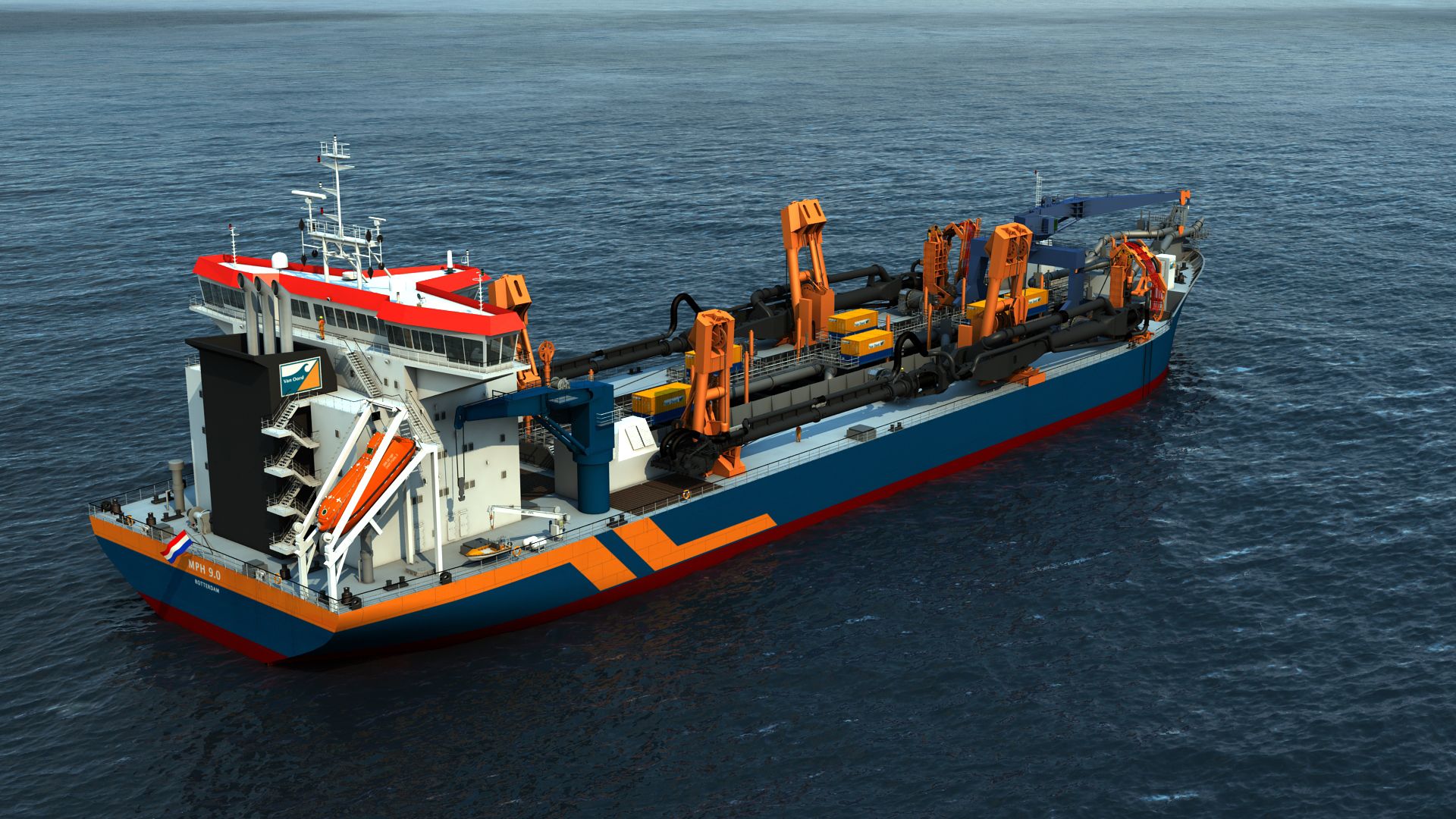
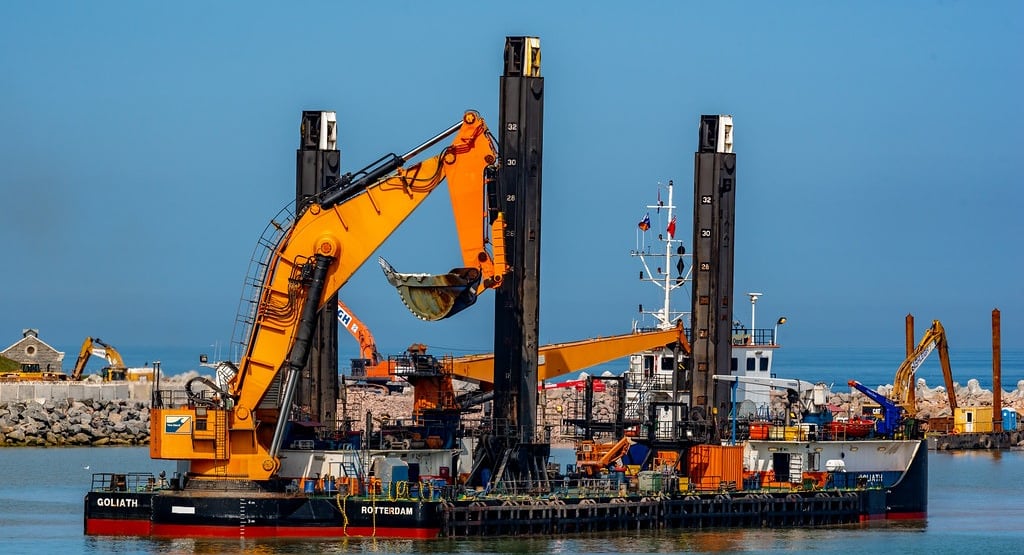
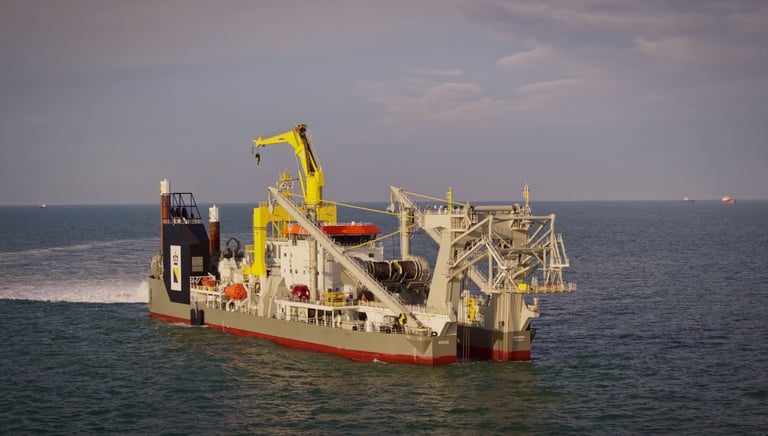
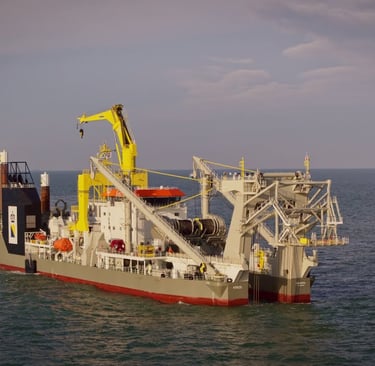
Dredging: In Durban Harbour and Richards Bay, maintenance dredging is continuous. Dredgers require power cables that can be paid out and reeled in hundreds of times while submerged in saltwater. Standard cables fail in under two years; PROTOLON(ST) units have been in service here for over 10 years without replacement.
Floating Docks and Offshore Platforms: Used to supply power to floating cranes, repair facilities, and temporary installations where movement and immersion are constant.
Mining Dewatering: In underground and opencast mines in Mpumalanga and Limpopo, water is a constant challenge. Pumps operate in flooded shafts or sumps with water that is often acidic or mineral‑rich. This cable’s resistance to chemical attack and deep‑water pressure makes it the only reliable choice.
Wastewater and Sewage: Municipal treatment works and pumping stations often have submerged pumps. The cable’s resistance to bacteria, chemicals, and dirty water is far superior to standard types.
All these applications share one requirement: the cable must work reliably, safely, and for a long time in conditions that destroy ordinary products.
Technical Specifications
To understand its capabilities, we look at the exact parameters defined in the technical data sheets. These values are not arbitrary — they are calculated and tested to ensure performance under the worst‑case conditions.
Voltage Ratings
Available in seven standard voltage classes to match any medium voltage requirement:
1.8/3 kV
3.6/6 kV
6/10 kV
8.7/15 kV
12/20 kV
14/25 kV
18/30 kV
For each class, the maximum permissible operating voltage is higher than the nominal rating to allow for grid fluctuations:
AC operation: up to 20.8/36 kV for the highest grade.
DC operation: up to 27/54 kV.
Test voltage: between 6 kV and 43 kV depending on class, ensuring safety margins well above working levels.
Conductor and Cross‑Sections
The standard construction is 3 main power cores + 3 protective earth cores, identified by the suffix /3E. Available cross‑sections range from 25 mm² to 185 mm² for power cores, with earth cores sized from 25 mm² to 95 mm².
Examples of standard configurations:
3 × 25 + 3 × 25 /3E
3 × 70 + 3 × 35 /3E
3 × 150 + 3 × 70 /3E
3 × 185 + 3 × 95 /3E
All conductors are Class 5 finely stranded electrolytic copper, tinned for corrosion resistance.
Electrical Performance
Conductor resistance: 0.795 Ω/km down to 0.108 Ω/km at 20 °C, depending on size — ensuring low losses and efficient power transfer.
Capacitance: 0.14 µF/km to 0.69 µF/km, controlled to avoid excessive charging currents in long lengths.
Inductance: 0.25 mH/km to 0.46 mH/km, balanced to maintain stable impedance.
Current‑carrying capacity: From 131 A in the smallest size up to 488 A in the largest.
Short‑circuit current: Rated from 3.58 kA to 26.46 kA, ensuring the cable can safely carry fault currents without damage.
Thermal Ratings
Temperature capability is a major difference between this and standard cables:
Continuous operation: 90 °C conductor temperature — standard for medium voltage, but maintained even when wet.
Short‑circuit: 250 °C for up to 5 seconds.
Fixed installation: From ‑40 °C to +80 °C — suitable for high‑altitude cold or hot coastal regions.
Dynamic operation (moving/reeling): From ‑25 °C to +60 °C — flexible even in winter or high‑altitude mines.
Mechanical Properties
These are the values that allow it to survive dredging and reeling:
Maximum tensile load: 15 N/mm² — the cable can support its own weight in deep water plus additional pull during installation.
Torsion resistance: 25°/m — it can twist freely without damage, unlike standard cables which fail at 5°/m.
Bending radius: Minimum 6 × outer diameter for fixed use, 12 × for dynamic reeling — designed to avoid fatigue failure.
Environmental and Chemical Resistance
Every relevant standard is met or exceeded:
Water resistance: EN 50525‑2‑21 — the highest classification for underwater use.
Oil resistance: EN 60811‑404 — unaffected by hydraulic oils or fuel spills.
Flame retardancy: EN 60332‑1‑2 — self‑extinguishing if ignited.
Weathering: Resistant to ozone, UV radiation, salt spray, and sewage gases.
Structure Design — Layer by Layer
The construction of PROTOLON(ST) NTSCGECEWOEU.../3E is a masterclass in engineering. Every layer has a specific function, chosen for material properties and arranged to work with the others. We describe it from the inside out, explaining the purpose and science behind each choice.
Conductor — Tinned Copper Class 5
Material: Electrolytic copper, tinned, finely stranded (Class 5 per IEC 60228).
Why this design?
Electrical principle: Copper offers the highest conductivity of any commercial metal (58 MS/m), minimising power loss. Tinning is not just a coating — it creates a stable interface that prevents oxidation and stops galvanic corrosion. When bare copper is submerged in saltwater, a voltage difference forms between the metal and the electrolyte, causing rapid dissolution. Tin acts as a sacrificial layer and creates a passive oxide film that slows corrosion by a factor of 10 or more.
Mechanical principle: Class 5 means very fine wires (under 0.4 mm diameter) twisted together. In a rigid solid or Class 2 conductor, bending creates high stress at the surface, leading to fatigue cracks after a few hundred movements. Fine strands distribute the strain so that each wire deforms elastically, allowing tens of thousands of bending cycles without breaking. This is the same principle used in flexible control cables, but scaled up for medium voltage power.
Inner Semiconductive Layer
Material: EPR‑based conductive rubber compound.
Why this layer exists?
Electrical field control: In medium and high voltage cables, air gaps between the conductor and insulation are dangerous. The electric field concentrates at these gaps, ionising the air and causing small sparks known as partial discharge. Over time, this erodes the insulation and leads to failure. The semiconductive layer fills all irregularities, creating a smooth, equal‑potential surface. This distributes the electric field evenly according to Maxwell’s equations, reducing stress at any point by more than 50 % compared to an unsmoothed interface. It is the first line of defence against electrical ageing.
Insulation — EPR Compound 3G13
Material: Ethylene Propylene Rubber, cross‑linked, grade 3G13.
This is the heart of the cable. Most standard cables use PVC or PE, which are cheap but perform poorly underwater. EPR was chosen for four scientific reasons:
Water stability: EPR absorbs less than 0.1 % water by weight. Polyethylene absorbs more, and PVC absorbs significantly more, becoming brittle and losing insulation strength by up to 60 % after a few years submerged. EPR maintains over 95 % of its original electrical properties even after 10 years in saltwater.
Resistance to water trees: This is the biggest cause of failure in underwater medium voltage cables. Water trees are microscopic channels formed in insulation under the combined action of water and electric field. They grow until they bridge the insulation, causing breakdown. EPR has a molecular structure that makes water tree growth 3 times slower than in XLPE. Compound 3G13 is specially formulated with additives that block tree initiation entirely.
Thermal performance: Cross‑linked rubber remains stable at 90 °C continuously — 20 °C higher than standard thermoplastics. It does not melt or flow under overload.
Mechanical flexibility: With an elongation at break over 300 %, it stretches and compresses with the cable during bending without cracking or delaminating. This is impossible with rigid materials like cross‑linked polyethylene.
Outer Semiconductive Layer
Material: Same conductive rubber system as inner layer, bonded directly to insulation.
Function: Together with the inner layer and the screen, it creates a coaxial field structure. The entire insulation volume is subjected to uniform radial stress. It also protects the insulation from mechanical damage by the metallic screen and ensures that no electrical stress occurs at the outer boundary.
Screen and Earth System — The /3E Design
Structure: Each core has a concentric copper screen. In addition, three separate protective earth conductors are laid up in the gaps between the insulated cores, evenly distributed around the circumference.
Why this specific arrangement?
Electromagnetic compatibility: The copper screen acts as a Faraday cage, containing the electric field and preventing interference with nearby equipment — essential on dredgers and ships where communication and control systems operate alongside power cables.
Safety and fault handling: In standard cables, one earth conductor is shared. In this design, three separate earths work in parallel. This gives three times the current‑carrying capacity for fault currents. In the event of a short‑circuit to earth, the fault current is cleared rapidly, and the risk of voltage rise on exposed metal parts is minimised. This design meets VDE 0168, the strict standard for dredging equipment safety.
Mechanical balance: By placing the earth conductors symmetrically, the cable remains balanced under tension and torsion. An unbalanced design would twist or spiral under load, damaging itself and equipment. This symmetric lay‑up is a key mechanical principle used in all heavy‑duty flexible cables.
Inner Sheath — EPR Compound GM1B
Material: Special EPR formulation GM1B, water‑blocking grade.
The most critical waterproofing component. Ordinary cables rely only on the outer jacket to keep water out — once that is damaged, water enters freely. This cable uses a double barrier system, and the inner sheath is the main barrier.
Material science: GM1B has a very low water permeability coefficient (below 10⁻¹⁶ m²/s), meaning water molecules take years to penetrate even a few millimetres. It also contains super‑absorbent particles that swell instantly on contact with water, sealing any micro‑gaps or punctures automatically. This is known as active waterproofing, a technology developed specifically for subsea power.
Function: It prevents water from reaching the insulation and conductors, even if the outer sheath is compromised. It also prevents the formation of water bubbles under pressure, which can cause localised stress. It is tested to EN 50525‑2‑21, confirming performance at 500 m depth (50 bar hydrostatic pressure).
Outer Sheath — Synthetic Elastomer CM Compound 5GM3
Material: Chlorosulfonated Polyethylene (CSPE/CM), grade 5GM3, red colour.
The final protection layer, chosen for extreme durability.
Chemical resistance: CM contains chlorine and sulfonyl groups in its molecular structure. These form a stable chemical network that resists attack by salt, acids, alkalis, oils, and solvents. It is rated for C5‑M corrosion category — the highest level for marine environments. It does not degrade under UV light or ozone, remaining flexible for over 20 years outdoors.
Mechanical toughness: With a tensile strength over 12 MPa and tear strength above 40 kN/m, it resists cutting, abrasion, and crushing — essential when dragged over rocks or concrete.
Visibility: The red colour was chosen not for fashion, but for safety. In murky water or mud, it is visible to divers and cameras, reducing the risk of accidental damage during operations.
Material Science and Engineering Principles
Every choice described above follows established scientific laws and engineering principles. Understanding these explains why this cable works where others fail.
Anti‑Corrosion Science
Corrosion in underwater cables is almost always electrochemical. When two different metals or a metal and an electrolyte are in contact, a galvanic cell forms, and current flows, eating away the metal.
Solution used: Tinned copper conductors and screens. Tin has a more positive electrode potential than copper in seawater. It forms a dense, insoluble oxide layer that stops the reaction. Additionally, the CM outer sheath is chemically inert, preventing the electrolyte from reaching the metals in the first place. This follows the principle of barrier protection and cathodic protection combined.
Mechanical Design Logic
Flexible cables are subject to cyclic loading — bending, twisting, and stretching thousands of times. Standard cables fail due to metal fatigue and material brittleness.
Principles applied:
Stranding: Reduces bending stress by distributing it over many small wires. Stress is proportional to diameter squared, so fine strands reduce stress dramatically.
Symmetry: Balanced construction eliminates torque. When you bend a balanced cable, no internal forces try to twist it back.
Elastic materials: Every layer is elastomeric — it returns to shape after deformation. Rigid materials like PVC or steel tape create stress concentrations that lead to cracking.
Low modulus design: Materials with low elastic modulus deform easily, absorbing mechanical energy instead of resisting it.
Electrical Safety Principles
In medium voltage, the main risks are partial discharge and dielectric breakdown.
Principles applied:
Field homogenisation: Semiconductive layers ensure the electric field is purely radial and uniform. This is derived directly from Laplace’s equation for electric potential.
Stress control: By limiting the maximum field strength to below 2 kV/mm, well below the breakdown strength of EPR (>20 kV/mm), the design ensures infinite life under normal conditions.
Redundancy: The /3E earthing system follows the safety principle of redundancy — if one path fails, two remain.
Waterproofing Technology
Water movement through polymers follows Fick’s laws of diffusion. Ordinary sheaths slow diffusion but do not stop it.
Principles applied:
Low‑permeability materials: GM1B has a diffusion coefficient 100 times lower than standard rubber.
Active sealing: Swelling particles block diffusion paths, creating a self‑healing barrier.
Pressure resistance: Designed to withstand hydrostatic pressure without collapse, preventing water being forced in mechanically.
Comparison: Standard Cable vs PROTOLON(ST) — Why Others Fail
To fully appreciate the design, we must look at why standard cables fail in the same conditions. The differences are not small — they are fundamental.
Common Failure Modes of Ordinary Cables
Water Ingress and Insulation Breakdown
What happens: Standard cables use PVC or PE insulation and a single plastic sheath. Over time, water diffuses through the sheath or enters through small cracks. Once in contact with the insulation, it creates water trees. Within 1–3 years, insulation resistance drops below safe levels, and the cable fails.
Why: No water‑blocking inner layer; insulation material not resistant to water trees; no active sealing.
Result: In South African harbours, operators report replacing standard cables every 18–24 months.
Mechanical Fatigue and Conductor Breakage
What happens: Rigid conductors (Class 2) and hard sheaths crack when bent or reeled. Copper strands snap one by one, increasing resistance and causing overheating. Sheath cracks let water in, accelerating failure.
Why: Designed for fixed installation, not movement. Stress concentrations are high; no fatigue‑resistant stranding.
Result: Failure after 500–1,000 bending cycles.
Corrosion and Screen Failure
What happens: Bare copper screens or conductors turn green and dissolve in saltwater. The screen loses continuity, creating electrical hazards and noise.
Why: No tinning; sheath materials allow chemical attack.
Result: Loss of safety and performance within 2–3 years.
Partial Discharge and Electrical Ageing
What happens: Without proper semiconductive layers, high voltage creates localised stress. Small sparks burn tiny channels in the insulation until it fails.
Why: Cost‑cutting removes essential field‑control layers.
Result: Early breakdown even if kept dry.
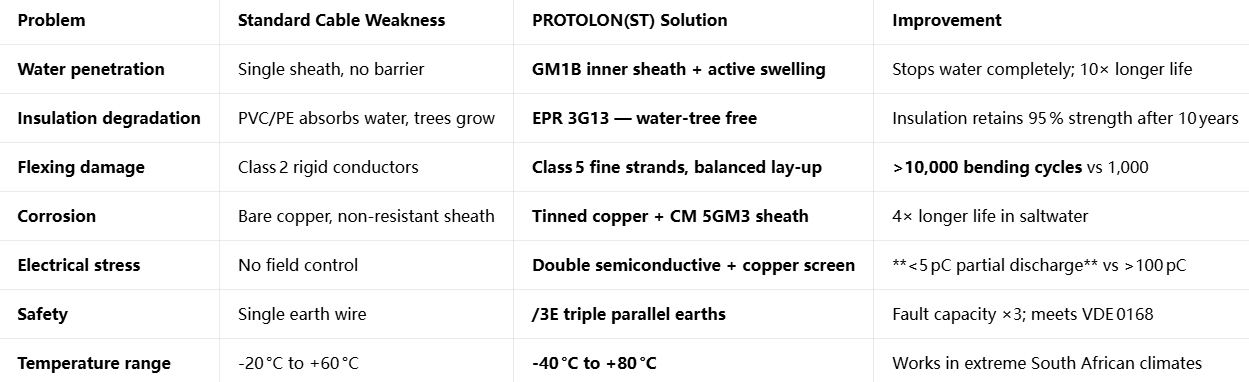
How PROTOLON(ST) Solves These Problems
This is not just incremental improvement. It is a complete re‑engineering of every component to survive the environment.
Why Feichun PROTOLON Equivalent Is the Best Alternative
When sourcing this cable, buyers often face long lead times and high costs from the original manufacturer. Feichun Cable offers an equivalent version that matches the design, materials, and standards exactly, while offering significant commercial advantages.
Full Technical and Standard Equivalence
The Feichun equivalent follows the same designation NTSCGECEWOEU.../3E and is built to DIN VDE 0250‑813, MSHA, and GOST standards.
Identical materials: Tinned copper Class 5, EPR 3G13 insulation, GM1B inner sheath, CM 5GM3 outer sheath.
Same construction: /3E triple earth design, concentric screening, double semiconductive layers.
Identical performance: Tested to the same electrical, mechanical, and environmental specifications. Partial discharge <5 pC, water resistance EN 50525‑2‑21, temperature range -40 °C to +80 °C.
Certified: Test reports and certificates are available for South African tender requirements.
Key Advantages Over the Original Brand
Same Quality, Lower Price: Manufacturing efficiencies and regional sourcing mean prices are 20–35 % lower than the original brand, without compromising specification.
Faster Delivery: Original lead times are typically 12–16 weeks due to European production and shipping. Feichun maintains stock of standard sizes and delivers in 4–6 weeks, directly to South African ports.
Local Support: Technical documentation and sales support are available in English, aligned with South African industry practices.
Customisation: Available in exact lengths, with custom markings and ready‑for‑installation terminations.
Not a Copy — A Certified Alternative
Feichun does not simply copy dimensions; it replicates the engineering principles and material science. Independent laboratory testing confirms that performance is indistinguishable from the original. For engineers and procurement officers, this means compliance with all project specifications while reducing total cost of ownership and shortening project timelines.
How to Select and Specify
Choosing the correct version ensures optimal performance and economy. The following guide is based on the official data sheets and best practices used in South African projects.
Step‑by‑Step Selection Process
Step 1: Choose Voltage Class
1.8/3 kV: Small pumps, short runs, shallow water.
3.6/6 kV to 6/10 kV: Standard choice for dredgers, harbour equipment, and most mining applications.
12/20 kV to 18/30 kV: High‑power, long‑distance, or deep‑water installations.
Step 2: Select Conductor Size
Calculate based on load current, voltage drop, and short‑circuit requirements:
25 mm² – 50 mm²: Light duty, up to 200 A.
70 mm² – 120 mm²: Medium duty, 250 A – 350 A — most common in South Africa.
150 mm² – 185 mm²: Heavy duty, high power or long distances.
Always include the /3E suffix to ensure the triple‑earth safety design.
Step 3: Match Environment
Saltwater / Coastal: Specify CM 5GM3 sheath, confirm C5‑M corrosion rating.
Deep water (>100 m): Confirm GM1B inner sheath and 500 m depth rating.
Cold areas / High altitude: Specify -40 °C minimum temperature.
Frequent reeling: Use larger bending radius and confirm 25°/m torsion rating.
Procurement Best Practices
When writing specifications or requesting quotes, include these details to ensure you receive the correct product:
Full designation: PROTOLON(ST) NTSCGECEWOEU.../3E with voltage and size, e.g. PROTOLON(ST) NTSCGECEWOEU 3×95+3×50/3E 6/10 kV.
Standards: DIN VDE 0250‑813, EN 50525‑2‑21, VDE 0168 compliance.
Material requirements: EPR 3G13 insulation, GM1B inner sheath, CM 5GM3 outer sheath, tinned copper Class 5.
Test requirements: Request reports for partial discharge, water immersion, and bending tests.
Equivalence statement: Allow certified equivalents such as Feichun NTSCGECEWOEU.../3E to ensure competitive pricing and delivery.
Frequently Asked Questions
Q: Can this cable be used in fresh water or only salt water?
A: It is designed for all water types — fresh, salt, brackish, and sewage. In fresh water, it will last even longer as corrosion rates are lower.
Q: Is it suitable for fixed installation or only moving applications?
A: It is fully suitable for fixed installation and is often used for permanent submerged power supplies. It is simply built to higher standards so it can also handle movement.
Q: Can I use standard cable glands and terminations?
A: Terminations must be suitable for medium voltage and underwater use. Standard terminations may not seal correctly. Feichun and Prysmian both provide compatible termination kits.
Q: What is the maximum depth it can be used at?
A: Rated for 500 m water depth, which is far deeper than any dredging or mining operation in South Africa requires.
Q: Is the Feichun version exactly the same as the original?
A: Yes. It uses the same materials, same structure, and meets the same standards. Independent testing confirms identical performance.
Q: What is the typical service life?
A: In normal conditions, 10–15 years underwater, and over 20 years if used in fixed or less‑demanding applications.
Conclusion
PROTOLON(ST) NTSCGECEWOEU.../3E is more than a product name — it represents a complete engineering philosophy. Every material choice, every layer thickness, and every structural detail is determined by the laws of physics, chemistry, and mechanics to solve the specific challenges of underwater power.
It is not an upgrade of an ordinary cable. It is a system solution designed from the ground up to defeat water, corrosion, fatigue, and electrical stress. This is why it has become the benchmark specification in South Africa, Europe, and around the world.
For engineers and procurement professionals, the choice is clear: use this design to ensure reliability, safety, and low total cost of ownership. And with Feichun equivalent cables, you get that same world‑class performance, with shorter delivery times and significant cost savings.
If you require PROTOLON(ST) NTSCGECEWOEU.../3E medium voltage flexible cables or certified equivalents, or need assistance with specifications and selection, contact the Feichun engineering team:
We provide full technical data sheets, compliance certificates, and delivery directly to projects in South Africa and across Africa.
Email Address: Li.wang@feichuncables.com
© 2025. All rights reserved.
One-click to Quickly Contact
Products
Contact
Company
Location:
Building A Private Science and Technology Park, Hefei Economic and Technological Development Zone, Anhui Province, China
Heat Resistant Cable
WhatsApp: +86 17333223430
Social Media: